occasional door-to-door false claims covered by state, but not federal, false advertising law

Vivint, Inc. v. Northstar Alarm Services, LLC, a Utah
limited liability company, 2019 WL 1098986, No. 16-cv-00106-JNP-EJF (D. Utah
Mar. 8, 2019)
The parties compete in the market for electronic home
automation and security systems. They market themselves in various ways, but a
majority of sales come from door-to-door or direct-to-home sales.. Vivint presented
evidence of 216 individual Vivint customers who experienced deceptive sales practices
by NorthStar representatives between 2012 and 2015.  It sued for deceptive trade practices in violation
of the Utah Truth in Advertising Act; violation of the Lanham Act; unfair
competition; and intentional interference with customer contracts.
Interpreting the Utah Truth in Advertising Act, which lists
a number of banned deceptive practices, the court found that “advertising” was
not a threshold requirement of each banned practice. Rather, if the listed item
didn’t include “advertising,” then it was banned even if it occurred in
door-to-door solicitation and not “advertising.” A previous federal district court
had disagreed because the UTAA’s purpose statement “effectively imposes an
overarching requirement that otherwise actionable conduct constitute
advertising.” In the absence of a state court ruling, the court here reexamined
the issue and determined that “the plain language of the statute does not limit
the covered conduct to advertising.” The purpose statement says:
The purpose of this chapter is to prevent deceptive,
misleading, and false advertising practices and forms in Utah. This chapter is
to be construed to accomplish that purpose and not to prohibit any particular
form of advertising so long as it is truthful and not otherwise misleading or
deceptive.
There’s also a definition of “advertisement” that excludes “any
oral, in person, representation made by a sales representative to a prospective
purchaser.” But in Utah, “a statement of purpose is generally ‘not a
substantive part of the statute’ ” and “cannot override the clear terms of the
law.” The substantive part of the law listed twenty-odd “deceptive trade
practices,” some of which included the words “advertisement” or “advertising” and
others didn’t. The definition of “advertising” applied only where the term was
used to define the deceptive trade practice at issue. “If the Utah Legislature
had intended that limitation to apply to the entire statute, it would have been
listed not in the definitions section, but in the section … titled ‘Exemptions.’”  Here, the alleged violations didn’t require “advertising,”
e.g., causing confusion “as to the source, sponsorship, approval, or
certification of goods or services”; representing “that goods or services have
sponsorship, approval, characteristics, ingredients, uses, benefits, or
qualities that they do not have”; and “disparag[ing] the goods, services, or
business of another by false or misleading representation of fact.”
However, the Lanham Act claim failed for want of sufficient “commercial
advertising or promotion.”  False
statements made by NorthStar’s door-to-door sales representatives to 216 Vivint
customers were not “disseminated sufficiently to the relevant purchasing
public” to constitute commercial advertising or promotion.  “[T]here must be some statistical analysis of
the number of alleged incidents in comparison to the relevant market, “and given
the millions of pitches, NorthStar argued that this was only 43 customers per
year, “less than 0.5%” of NorthStar’s total door-to-door sales in any given
year and a small percentage of Vivint’s customers (as the relevant market).
Vivint argued that this was just the falsity it had identified and that there
was other falsity that it hadn’t caught, but the court found that speculative.  If there was a script or other direction to
sales reps encouraging them to make the allegedly false statements, it seems to
me that Vivint’s argument ought to work, but this was a motion for summary
judgment and Vivint apparently hadn’t developed evidence about that.

from Blogger https://ift.tt/2W9Px6B
Posted in Uncategorized | Tagged , , | Leave a comment

Compounder’s claims of FDA approval/legality were literally false and material

Allergan USA, Inc. v. Prescribers Choice, Inc., No. 17-cv-01550-DOC-JDE,
2019 WL 650424 (C.D. Cal. Jan. 11, 2019)
Allergan “markets a portfolio of leading medical brands and
products.” Prescriber’s Choice and Sincerus have common ownership and work
together: “Sincerus produces drugs; Prescriber’s Choice markets Sincerus’s
drugs and makes them available to physicians.” Sincerus registered with the FDA
as an “outsourcing facility” under Section 503B of the FDCA in March 2016. “Through
the FDCA and its exemptions, Congress allows outsourcing facilities to produce
certain bulk drugs when the FDA determines there is a drug shortage or a
clinical need.” The presence of either obviates the need for an individual prescription
before the drug is produced. Sincerus formulated, compounded, distributed, and
sold drugs from 700 different drug formulations, and Prescriber’s Choice marketed
Sincerus’s to 3,000 customers in 30 states.

Compounding involves combining ingredients to create a bespoke drug, which can
occur when, for example, a patient who has an allergy to a certain dye and
needs a medication to be made without it. 
It’s not illegal, but there are supposed to be restrictions on it. The varied
drugs Sincerus and Prescriber’s Choice sold were intended to treat many conditions;
only one drug appears on FDA’s drug shortage list. At the relevant time, the FDA
hadn’t found a “clinical need” for outsourcing facilities to use any bulk drug
substances, which would have let them be used under the Section 503B statutory
exemption. Basically, and without trying to get the details right, Allergan
argued that Sincerus was going beyond what the law allowed for a Section 503B
facility, and falsely advertising legality.
Defendants promoted their business and drugs by representing
to their customers that they comply with the law, that it is legal for Sincerus
to compound in large quantities, and that the business meets federal regulatory
guidelines. Customers—“including those who asked for reassurance or had
questions about FDA compliance”—were told that “[t]o demonstrate compliance,
Prescriber’s Choice and Sincerus FL tasked one of the top international law
firms, Ropes & Gray, to analyze whether the business model comports with
FDA regulations,” and “[t]he resulting written memorandum concludes that if
your practice follows the model outlined, you are compliant.” Other claims were
that that the Sincerus drugs are “prepared in the FDA facility, Sincerus, so
you have the supreme reassurance that the quality of the medication is made
under CGMP manufacturing standards with federal oversight.” Another rep told a
customer that defendants “have had over 400 independent healthcare attorneys
from many states review our whole platform and they all recommend our
platform.” An internal e-mail said “I of course did explain to [the customer]
that everything comes from our 503B facility and is FDA approved.”
Defendants also claimed that “[t]he unique combination of
active and inactive ingredients has been selected to produce an outcome that is
clinically superior and materially different to that which is commercially
available.” The truth or falsity of this was a disputed fact.
“The FDA does not ‘accredit’ or ‘approve’ Section 503B
outsourcing facilities or pharmaceutical ingredients, although the FDA does register
and inspect such facilities,” including those of Sincerus, which hasn’t had an
FDA objection.
Sales reps made statements about compliance with the law “because
they knew that compliance with the law was an important issue to customers when
they make a decision.” FDA-approved ingredients are also important because “dermatologists
are seeking safe medication.” Prescriber’s Choice’s National Director told the
sales team that Sincerus’s status as a “503B FDA Facility” would provide “even
more assurance to patients due to the fact that they are generally familiar
with the FDA.”
Allergan commissioned a survey of 202 dermatologists which
revealed that 25 percent of physicians “worry about the legality and
tediousness of in-office physician dispensing”; 27 percent of the respondents
agreed with the statement “I worry about the legality of in-office dispensing”;
18% of the respondents said that “state regulation/restriction concerns” was a
challenge with recommending or prescribing Prescriber’s Choice’s products; and
24 percent of dermatologists who had been visited by a Prescriber’s Choice
sales representative indicated that they had received “Guidance with
governmental regulations” from Prescriber’s Choice.
Allergan argued that “mass manufacturing and marketing
unapproved new drugs” violated California’s Sherman Law, which incorporates the
FDCA’s requirements (thus rendering defendants’ conduct a violation of California’s
UCL under the “unlawful” prong and providing Allergan with a private cause of
action). Defendants use bulk drug substances to produce their drugs, but only
one of these drugs is on the FDA’s drug shortage list, and they also made drugs
nominated for inclusion—but not yet included—on the clinical need list. (They
also allegedly made drugs that weren’t even in this category.) FDA’s exercise
of its enforcement discretion was not enough, Allergan argued, to convert this
into legal conduct.
Sincerus argued that the FDA is encouraging 503B compounders
to use substances on the FDA’s nomination list until the FDA finishes its
clinical need list. The FDA issued an Interim Policy in January 2017, asking industry
participants to nominate bulk substances for consideration under Section 503B
and then creating three categories to determine which bulk drugs the FDA would
allow for compounding while it worked on the multi-year process of preparing
the clinical need list. Category 1 is nominations for the clinical need list;
Category 3 comprises nominated substances that require more information, and
defendants allegedly made substances from both categories. Defendants argued
that because Sincerus holds a California Outsourcing Facility license and the FDA
eventually placed all the relevant bulk drugs in Category 1, there could be no
violation of California law.
The court wouldn’t rely on FDA’s exercise of its discretion
to deem Sincerus’s actions legal, but nor would it ignore the Interim Policy, which
seemed to encourage use of Category 1. 
However, to the extent that Sincerus failed to comply with the Interim Policy,
it would violate federal and thus state law. The undisputed facts showed that
Sincerus began compounding and distributing drugs before they appeared on the
FDA’s Category 1 list, which violated the law. It wasn’t clear that they were
still making drugs in violation of Section 503B and the Interim Policy, creating
a dispute of fact for the jury to resolve.
Lanham Act/California FAL/fraudulent prong of the UCL: Allergan
argued that defendants made literally false statements about the lawfulness of
their business:
• Statements about legal compliance
because Defendants do not comply with Section 503B’s requirements.
• Statements about FDA “approval”
because the FDA does not approve any of Sincerus’s drugs nor approve or accredit
businesses or drug ingredients.
• Statements that Sincerus is an
FDA lab merely because Sincerus is a registered 503B outsourcing facility,
accomplished by “sending certain information to the FDA through an electronic
registration system”; and
• Statements that “hundreds of
lawyers” including the law firm Ropes & Gray LLP have opined that defendants’
business is lawful because defendants were not able to name any lawyers who
made this conclusion and the Ropes & Gray memorandum assumed compliance.
Allergan also argued that it was false to claim clinical/patient
outcome superiority for their drugs without any basis for so claiming.
Defendants argued that no one could have been fooled because
their customers were “a sophisticated group of licensed and board-certified
dermatologists, not one of whom would believe that Defendants are operated by
the FDA.”  They argued that “FDA
approval” wasn’t false because every active ingredient was for a FDA-approved drug
acquired from a FDA-registered source and each formula is submitted to the FDA
for biannual review. They argued that their practices were reviewed by “countless
medical practices (and their lawyers)” but that they did not “take a roll call”
of their customers’ lawyers. For superiority, they argued that compounding
clearly can improve patient outcome and that these weren’t falsifiable statements
[classic legal strategy: both puffery and true!]. Finally, they argued that Allergan’s
survey showed that most dermatologists didn’t care about these issues.
The court found that some of the challenged statements weren’t
literally false. E.g., Sincerus was a 503B facility and 503B drugs don’t need
an ANDA and can be compounded in large quantities. However, there’s a difference
between describing the 503B exception and “representing to customers compliance
with that exception or general FDA approval,” and Sincerus had been out of
compliance. Moreover, even compliance wasn’t “FDA approval.” “It is literally
false for a company to represent that a compounder is ‘FDA approved’ during
this period of regulatory evaluation, especially when the compounder is not even
complying with FDA’s interim guidance.” 
FDA inspection isn’t approval either.
Despite Sincerus’s violation of the law, sales consultants represented
that the medications “are FDA approved” and touted compliance, which just wasn’t
true at least before July 2018 and maybe after. Further, FDA approval of
ingredients didn’t change the analysis. 
If FDA approval of ingredients were enough, there’d be no need for the
FDA interim process determining whether such drugs should fall under the 503B
exemption as a clinical necessity.
However, there was a factual dispute on the literal falsity
of statements about drug superiority, “where the drugs may allow a patient
relief where she cannot tolerate a more traditional prescription.”
Because of the literal falsity, the court used a rebuttable
presumption of actual deception. Even without that, there was no factual issue
on materiality: it was clear that compliance with the law was important to
customers, who linked it to quality in numerous ways (as did sales reps).  Allergan’s survey didn’t show lack of
materiality—to the contrary, it showed that dermatologists were very attentive
to the perceived legality of Sincerus’s operations.
Sincerus counterclaimed about Allergan’s reps’ disparagement
of Sincerus: an allegedly official policy to “spread doubt” about Prescriber’s
Choice and Sincerus.  “[S]preading doubt
about the legality of a company that is not complying with the FDA Interim
Policy cannot give rise to a valid claim under the Lanham Act.” However, there
was enough evidence that Allergan sales representatives went beyond that,
working alongside competitors to “shut Prescriber’s Choice out of St. Louis.” Though
it was close, a reasonable jury could determine that Allergan violated the UCL
and Lanham Act.

from Blogger https://ift.tt/2uflZIY

Posted in Uncategorized | Tagged , | Leave a comment

supplement guide isn’t “advertising or promotion” under the Lanham Act, even w/undisclosed affiliation

Ariix, LLC v. NutriSearch Corp., 2019 WL 1040135, No.
17CV320-LAB (BGS) (S.D. Cal. Mar. 5, 2019)
Previous
iteration discussed here
. Arrix competes fiercely with Usana in the
nutritional supplement market. 
NutriSearch publishes the NutriSearch Comparative Guide to Nutritional
Supplements, a guide used by consumers and professionals that reviews various
companies’ products, including both Ariix’s and Usana’s. It’s now in its sixth
edition. In 2005, individual defendant/author MacWilliam was working directly
as a sales representative for Usana and writing the Guide, which he had
conceived as a way to promote Usana’s products. “At the time, the Guide could
have been considered commercial advertising.” But after several editions, it no
longer qualifies as such.
The fifth edition awarded the Gold Medal of Achievement
designation to companies that meet particular standards; Ariix made a vigorous
effort to qualify, but was denied while four other companies were given the
award. NutriSearch allegedly admitted Ariix had met the standard, but refused
to award the company the Gold Medal because it was reworking its criteria. The
new sixth edition has bronze, silver, gold, diamond, and platinum award tiers.
Usana was the only platinum medalist. Ariix didn’t allege that Usana didn’t
meet the criteria for this award, or that Ariix or any other manufacturer did.
As in its previous order, the court held that  “the Lanham Act does not apply to reviews of
consumer products. This is true even if they are alleged to be biased,
inaccurate, or tainted by conflicts of interest.” However, self-labeling as a
consumer product review isn’t all it takes to be protected. The ultimate
question is whether a publication is a consumer product review or commercial
advertising. This one is the former. Although “reviewers who have undisclosed
conflicts of interest may be liable under other laws, such as the FTC Act or various
states’ advertising or unfair competition laws,” Ariix could not bring a Lanham
Act claim against them.
The Guide as a whole wasn’t advertising. It includes two
major sections: a set of ratings of 1,500 different nutritional supplements
sold by different companies, and general information about supplementation. “The
only feature alleged to be commercial advertising are the Guide’s awards. But
even if the awards were commercial advertising, this would not suffice to bring
the entire book within the statute.”  Moreover,
the sheer number of companies whose supplements were reviewed made it
implausible that the purpose of the reviews was “merely” to urge consumers to
buy Usana’s products. And the book was sold commercially as a guide to
supplements, and “is regarded” as a standard guide on the subject, though the
court doesn’t say by whom.
“The [fifth edition] Guide itself included a preliminary
note, disclaiming any association between either MacWilliam or NutriSearch and
any manufacturer or product the Guide reviewed.” This wasn’t a commercial ad
because it was part of the Guide, even if it could be viewed by potential Guide
buyers online.  And the removal of the
statement from the sixth edition wasn’t an admission of falsity; it could be a
nod to the fact of this litigation. Moreover, its omission made the sixth
edition even less likely to be the basis of a valid claim.
After several companies won the Gold Medal award in 2008, Usana
allegedly demanded that it be positioned ahead of its competitors; NutriSearch allegedly
then created a new “Editor’s Choice” award and gave it to Usana. But Ariix didn’t
allege what the criteria for that award were, or that defendants ever claimed
objectivity; the name itself suggests subjectivity.  Then, for the sixth edition, NutriSearch
allegedly failed to notify Ariix when its new criteria were finalized, preventing
it from being listed as a medalist. But there were no factual allegations
indicating Ariix had a right to be told about new criteria or prompted to
submit an application, or that others were treated differently—and even if
there were such allegations, that wouldn’t make a misrepresentation; Ariix was
still just criticizing a product review. “[E]ven if Ariix thinks NutriSearch’s
criteria were illegitimate, as a reviewer NutriSearch is entitled to decide
what its criteria should be.”
Going further, the court’s broad latitude for product
reviews made it hesitant to find that awards of this type are ever fully
objective, even if they involve objective criteria.
Previously, the court held that the “cozy relationship”
between NutriSearch and Usana wasn’t enough to make the Guide commercial
advertising. There weren’t allegations plausibly suggesting that speaking fees
or Usana’s purchases and recommendation of the Guide were “some kind of
under-the-table payment for promoting Usana and its products.” The amended complaint’s
new allegations were still conclusory. The only “payments” NutriSearch
allegedly received were “Usana’s promotion of the Guide, its purchase of many
copies of the Guide, and its use of the Guide to promote its products.” But
this behavior was fully consistent with non-liability.  “A company whose products are favorably
reviewed has every incentive to capitalize on those reviews by doing what Usana
did, and the fact that it does so does not suggest it has entered into some
kind of secret agreement with the reviewer.”
The amended complaint alleged that in 2009, after
NutriSearch gave Usana the Editor’s Choice award, MacWilliam decided to cash in
on it, asking Usana to send him on a speaking tour. Usana agreed, and paid him
$90,000 that summer. But this occurred far too long before the fifth or sixth
editions to count as payment in connection with them, and wasn’t alleged to
reflect a previous understanding, only an “afterthought.”  “Furthermore, a recognized and knowledgeable
author who has just favorably reviewed a company is a natural choice as that
company’s promoter or spokesman.” The complaint alleged that Usana continued to
pay MacWilliam to promote its products and to speak to its reps, but didn’t
support the conclusion that these were payments for advertising in the Guide as
opposed to payments for speaking as agreed. 
“MacWilliam could be liable under the Lanham Act if, while speaking, he
made misrepresentations of fact about Usana or Ariix. But the only allegations
show expressions of opinion or value judgments, rather than facts.”
Assuming the truth of the allegations, MacWilliam could be
criticized for an undisclosed bias or conflict of interest, but that wasn’t
enough for a Lanham Act claim [where the result wasn’t a commercial
advertisement].  It wasn’t enough to
allege that defendants had a direct economic motive for their speech to make it
commercial speech.
The complaint was dismissed, this time without leave to
amend.

from Blogger https://ift.tt/2TaNptf

Posted in Uncategorized | Tagged , , , | Leave a comment

plaintiff suing for noncomparative false advertising fails to establish irreparable harm

True Organic Products, Inc. v. California Organic
Fertilizers, Inc., 2019 WL 1023888, No. 18-CV-1278 AWI EG (E.D. Cal. Mar. 4,
2019)
If trademark owners have cause to bemoan eBay’s application to Lanham Act claims,
false advertising plaintiffs have even more, as this case demonstrates.
Plaintiff True sells organic fertilizers, and is one of the largest and most
sought-after manufacturers of organic fertilizers on the West Coast. Defendant
COFI directly competes with True for sales of organic liquid fertilizer
containing at least 4% nitrogen.
COFI sells Phytamin Clear, whose label states that it
contains 4% nitrogen, which is composed of 3% nitrate nitrogen and 1%
ammoniacal nitrogen. Phytamin Clear’s label also reads: “Derived from mined
seabird guano.” The Material Safety Data Sheet repeats the guano claim. “Phytamin
Clear is appealing to growers because of its high nitrate nitrogen levels and
because the clear liquid can be easily applied through irrigation systems.”
True’s most directly competing products don’t have nitrate nitrogen,
to which plants more quickly than they do to the organic nitrogen in most
organic fertilizers. True “controls over 50% of the market” for organic liquid
fertilizers containing at least 4% nitrogen and there are only four other
companies competing with it.
Based on True’s experience with seabird guano products, it
thought the nitrate nitrogen content of Phytamin Clear wasn’t consistent with
seabird guano. It raised concerns with the California Department of Food and
Agriculture, but nothing happened.  True
thinks COFI’s source uses sodium nitrate to nitrogenate the guano; sodium
nitrate is approved for use in organic farming in the United States, but not in
Canada.  Many organic users in the U.S.
allegedly export to Canada and thus must comply with Canadian rules. True
allegedly obtained five samples of what it alleged was Phytamin Clear that came
from at least four different batches and compared them to other products and
materials, including the accepted reference sample for Chilean sodium nitrate
and fossilized seabird guano.  (COFI
argued that there were substantial questions about the authenticity and/or purity
about the samples because of chain of custody issues—for example, the lot
numbers on the containers allegedly didn’t indicate a direct sale to the farms
from which the samples were obtained and the containers weren’t labeled the way
COFI labels its containers.) The test results were reviewed by a professor of soil
biogeochemistry, who concluded that Phytamin Clear is not solely derived from
mined seabird guano or a fossilized seabird guano extract, but the ingredients
were consistent with a product made from Chilean sodium nitrate.
True alleged literal falsity.  The only issue the court resolved was irreparable
harm. True argued (1) sales diversion and (2) lessened goodwill for True
through the implication that the nutrient content of Phytamin Clear can be
achieved through the use of seabird guano, when True can’t offer similar
products because it’s impossible. “Further, the general goodwill associated
with organic fertilizer products is lessened by misleading advertising that
cause farmers to distrust organic fertilizers.”
“[B]ecause of the difficulty of valuing goodwill, a loss of
or damage to goodwill can constitute an irreparable harm for purposes of a
preliminary injunction.” Nonetheless, “concrete evidence” of harm to goodwill is
still required, and it wasn’t present here. There was no likely confusion
between the companies and no comparative references on COFI’s label.  The idea that COFI could damage True’s
goodwill, or the credibility of organic fertilizers generally, was “counterintuitive
and contrary to the concept of ‘goodwill,’” which refers to the reputation of
an individual business entity. “[A]ny negative ramifications to goodwill due to
a false label would fall on COFI alone.” [I’m not sure about this—although it
might not happen here, the idea that a bad actor can taint the reputation of an
entire industry is not ridiculous; that’s part of what gets us the famous
market for lemons.]  There was no
evidence of damage to True’s goodwill, and its market share suggested to the
contrary even though Phytamin Clear has been on the market since 2010.
As for threatened lost sales/prospective customers, they
could also support finding irreparable harm. But there wasn’t evidence that
this had actually happened.  The fact that
the parties competed directly was insufficient with four other companies on the
market. Anyway, “lost profits due to lost sales generally constitutes the type
of harm that is fully compensable through money damages and therefore does not
support injunctive relief.” Trademark cases were of no assistance to the claim
here.

from Blogger https://ift.tt/2XUvvPj

Posted in Uncategorized | Tagged , | Leave a comment

sales show format and timing are functional, court finds

VBS Distribution, Inc. v. Nutrivita Laboratories, Inc., No. SACV
16-01553-CJC(DFM), 2018 WL 5274172 (C.D. Cal. Sept. 10, 2018)
The parties compete in the market for nutritional
supplements and television programs. VBS sued for Lanham Act and California state
unfair competition law violations, as well as other claims including trade
secret misappropriation.  None worked.
VBS alleged two unlawful schemes, the first involving false
advertising of a dietary supplement. The supplement defendants made and sold “Arthro-7,”
a dietary supplement for joint relief, with 60% of the market (perhaps among
elderly people/people of Vietnamese descent). VBS sold a competing dietary
supplement called JN-7 Best, with 10% of the market.  Defendants allegedly falsely advertised that Arthro-7
is “100% natural herbal,” that over 8 million bottles have been sold, and that
Arthro-7 has been “clinically tested” and is “Doctor Recommended.”
“100% natural herbal” was allegedly false because the
product contains animal products. The challenged ad contains the following
phrase in Vietnamese: “100% tu duoc thao thien nhien.” VBS argued that this
phrase translates to “100% natural herbal,” whereas defendants argued that the
correct translation of “duoc thao” was “dietary supplement,” not “herbal.” There
was a disputed issue of fact on the translation, but defendants still got
summary judgment for lack of evidence of harm from this one ad. Instead, the only
relevant evidence was that VBS suffered no lost profits between 2013 and 2014,
when the advertisement ran in the newspaper, because its sales of JN-7 Best
actually increased in that time period.
“Over 8 Million Bottles Sold!”  Defendants provided evidence that they had
sold this many bottles from 1998-2017, so it wasn’t false.
The Arthro-7 package states that Arthro-7 is “clinically
tested” and “Doctor Recommended,” and that “Positive results utilizing Arthro-7
have been supported by a UCLA researcher.” [See
xkcd on “clinically tested.”
] The packaging also has a picture of a man in
a doctor’s coat, identified as “Dr. John E. Hahn, Board certified foot
surgeon.” Plaintiffs argued that this was misleading because Dr. Hahn is a
Doctor of Podiatric Medicine, and not a medical doctor.  But defendants submitted an article on the
results of a 12-week clinical study in China; four of ten authors were from the
Department of Pathology and Laboratory Medicine at UCLA’s medical school. This
wasn’t misleading just because the studies took place in China; nothing on the package
indicated otherwise. Nor was the use of a podiatrist whose license had expired as
a “doctor” false—“Plaintiffs provide no admissible evidence showing that ‘doctor’
necessarily means one who is currently licensed or one who has a medical degree.”
The second general scheme involved the parties’ respective
television shows. VBS Television is “primarily aimed at the Vietnamese
community and is broadcast primarily in the Vietnamese language.” It produces a
show named “DAU GIA TREN TRUYEN HINH” (“Fight Price on Television”), a live
auction program which primarily auctions diamonds. In 2012, Defendant Tram Ho
became a host of the show.  In 2016, VBS
discovered that Ho was appearing on a rival television show called “Diamond at
a Surprise Low Price.” The two shows allegedly have the same hostess, some of
the same vendors, the same technician, the same time slot of 5:00 p.m. to 7:00
p.m., “the least to most expensive format,” “the same auctioning of
approximately 30 items each show,” and the same product price range from $300
to $3,000.
Plaintiffs alleged trade dress infringement based on a trade
dress comprised of:
a) the unique style and format of
the show, b) its time slot and date selection, each week on alternate weekdays,
from 5 to 7 p.m., on Tuesdays and Thursdays, c) the price range for its auctioned
items, ranging from about $300 to $3000, d) its “least to most expensive”
format in which the least expensive items are sold first, ascending to the most
expensive items at the end of the show, e) the length of the show, 2 hours, f)
its focus on live TV auctions of jewelry, particularly diamonds, g) its
carefully selected vendors, who appear on the show with the show’s host, h)
unique and proprietary camera angle and special lighting techniques developed
by Plaintiffs using an Apple ipad tablet, i) the number and selection of items
sold, usually about 30 items.
VBS failed to show that the claimed trade dress had
nonfunctional features or a nonfunctional arrangement of those features. VBS’s
own CEO and Chairman explained in his deposition that the lighting techniques
and camera angles function to make the diamonds on the television show
“sparkle” and appear brighter and that the lighting techniques are common in
jewelry stores, “which demonstrates that the techniques are intrinsic to the
sale of jewelry.” He testified that the show times and dates were chosen as
times that would maximize viewership and auction purchases; that the show sells
thirty products per episode because it is the optimal amount to sell during a
two-hour long show; and that the products are priced between $300 to $3000
because the range is what the average target consumer can afford. Finally, he
testified that the products are shown in the order of lowest to highest price to
maximize sales, because more viewers tune in towards the end of the show. That’s
all functional.
(Some other claims failed because Ho didn’t
quit or breach her contract because of any outside interference—she left because
the CEO/Chairman “grabbed [her] boobs, put his hands on [her] butt and then put
his hands into [her] groin area.”)

from Blogger https://ift.tt/2T8esFV

Posted in Uncategorized | Tagged , , | Leave a comment

False advertising & TM fail as workarounds to 230 for software blocking

PC Drivers Headquarters, LP v. Malwarebytes Inc., 2019 WL
1061739, No. 18-cv-05409-EJD (N.D. Cal. Mar. 6, 2019)
PC Drivers alleged that Malwarebytes’ malware detection software
wrongfully categorized PC Drivers’ “technical support” software as malware or a
“Potentially Unwanted Program” (PUP), generating claims under the Lanham Act
and for business disparagement, tortious interference with contractual
relations, negligence and gross negligence, unfair competition, promissory
estoppel, and declaratory relief. The court (after transfer from Texas where Malwarebytes
already did well
) granted Malwarebyte’s motion to dismiss based on §
230(c)(2)(B) of the CDA, but granted leave to amend.
Malwarebytes offers a free version of its software and then
upsells premium versions, promoting them by allegedly identifying and
quarantining alleged PUP and malware and their official websites. In 2016, Malwarebytes
categorized PC Drivers’ DRIVER SUPPORT and ACTIVE OPTIMIZATION software products
with a negative PUP rating and as a security risk to Malwarebytes’ customers. PC
Drivers customers who received Malwarebytes’ warnings were allegedly deceived
into removing PC Drivers’ software. Despite PC Drivers’ allegedly providing
Malwarebytes with evidence of its compliance with industry standards and other
anti-malware vendor certifications, Malwarebytes refused to change the rating.  A Malwarebytes staff member also posted “Removal
instructions for Driver Support” on Malwarebytes’ message board forum, including
allegedly false and misleading comments about PC Drivers’ products. Similar
comments came from a post on another site by a person who allegedly (on
information and belief) receives monetary or in-kind benefits from Malwarebytes
for each sales lead or software download generated from his post.
All this allegedly resulted in trademark “misappropriation,”
infringement, and dilution, and “diminution in the value of PC Drivers as a
going concern.”
Malwarebytes sought and received CDA immunity from some of the
non-trademark claims. The CDA states that “No provider or user of an interactive
computer service shall be held liable on account of … (B) any action taken to
enable or make available to information content providers or others the
technical means to restrict access to [material that the provider or user
considers to be obscene, lewd, lascivious, filthy, excessively violent,
harassing, or otherwise objectionable, whether or not such material is
constitutionally protected].” This could be evaluated on a motion to dismiss,
taking all PC Drivers’ factual assertions as true.
PC Drivers argued that section 230(c)(2) immunity didn’t
cover “stealing” click advertising services paid for by PC Drivers and making
false and disparaging statements about PC Drivers’ Products. The “theft” was
described as:
When a Malwarebytes free version
software user opens a search engine in his own web browser and searches for
DRIVER SUPPORT or ACTIVE OPTIMIZATION, PC Drivers’ ads or website links bearing
the Marks will prominently appear in the search engine results. However,
instead of going directly to PC Drivers’ official website when clicking these
links, it redirects consumers to the Malwarebytes website for the purpose of
executing a Malwarebytes sale. The result is that Malwarebytes obtains the
benefits of a potential paying customer based on the acquisition costs paid by
PC Drivers.
But the CDA immunizes “any action” as long as it was “taken
to enable or make available to information content providers or others the
technical means to restrict access to material.” The alleged redirection was “clearly”
such an action. When a Malwarebytes user navigates to driversupport.com or a PC
Drivers advertisement, Malwarebytes identifies the domain as associated with a
PUP and then directs the user to a Malwarebytes page notifying them that the
site was blocked “due to PUP.” Id. It also informers the user: “Learn about
PUP. If you don’t want to block this website, you can exclude it from website
protection by accessing Exclusions.” “The statute does not contain qualifiers,
conditions, or exceptions for ‘actions’ that have the secondary effect of
depriving PC Drivers of the benefits of the page-click advertising it purchased
from a third party.”
As for the allegedly false and disparaging statements, they
were found in Malwarebytes’ online explanation for the basis of its classification
of Driver Support as a PUP: “Malwarebytes has determined that Driver Support is
a ‘system optimizer.’ These so-called ‘system optimizers’ use intentional false
positives to convince users that their systems have problems. Then they try to
sell you their software, claiming it would remove these problems.”  This stated basis wasn’t necessarily an
“action taken to enable or make available” the technical means to restrict
access to objectionable material. It was premature to rule on §230 immunity for
that statement.  By contrast, screenshots
and instructions for removing Driver Support were “actions” taken to “make
available … the technical means to restrict access to” objectionable
material.
PC Drivers argued that Malwarebytes did more than necessary
to make available technical means to restric access to material by blocking
access to PC Drivers’ website even to its paying customers and by making it
hard to allow users to readily un-PUP individual sites, constituting tortious
interference with contractual relations. The court disagreed.  These were all functions that flowed from
Malwarebytes’ making available the technical means to restrict access, regardless
of details of operation. Even if PC Drivers subscribers are forced to choose
between quarantining all or none of the listed PUPs and are unable to override
Malwarebytes’ block, that was ok; if that was unwanted behavior, the subscriber
could get rid of Malwarebytes.
PC Drivers then argued that the statutory immunity didn’t
apply because Driver Support is not “objectionable” and Malwarebytes “has not
actually determined that PC Drivers is objectionable.” Unsurprisingly, the
court declined to reject Malwarebytes’ characterization, since §230 grants
providers and users discretion to determine objectionability.  Although a concurrence in Zango expressed concern about secret, anticompetitive
blocking such as browsers that filtered out criticism of the browser company, secrecy
(and competition) wasn’t alleged here.
False advertising/disparagement: The claim that Driver Support
was a “system optimizer” that “uses intentional false positives to convince
users that their systems have problems” was nonactionable opinion.  There was no explanation of why “system
optimizer” was a verifiable characteristic or was false. And classification of
the products as PUPs was protected by CDA §230 as well as by being
nonactionable opinion.
Trademark dilution: not famous, not actionable.
Infringement: It is not trademark infringement to confuse
the public “into believing PC Drivers’ website and [P]roducts are malicious, and
that Malwarebytes’ premium product is the solution to resolve any future
‘malicious’ programs.” And the complaint pled nominative fair use: the
associated screenshots showed that Malwarebytes uses “download.driversupport.com.”
and “www.driversupport.com” to inform the user of the program that is being
blocked. “PC Drivers does not explain how its products or services may be
readily identifiable without use of the domain names.” There was no excessive
use of the mark pled. Nor did the use suggest sponsorship or endorsement by the
trademark holder: very much to the contrary.
Other non-TM workarounds also failed, such as negligence (no
duty), common law unfair competition (no independent tort), promissory estoppel
(insufficiently specific promise).

from Blogger https://ift.tt/2Ff8UFT

Posted in Uncategorized | Tagged , , , | Leave a comment

“local” is falsifiable but relative, meaning damages for false advertising must be limited

Bimbo Bakeries USA, Inc. v. Sycamore, 2019 WL 1058234, No. 13-cv-00749
(D. Utah Mar. 5, 2019)
Previously, Bimbo
won a false advertising claim
in front of a jury against U.S. Bakery for trade
secret misappropriation and for falsely advertising its bread as “local.” Bimbo
Bakeries’ false advertising damages were limited to Utah and southern Idaho.  At trial, Bimbo’s expert testified about
consumer surveys performed on U.S. Bakery’s fresh/local tagline, and another
expert offered damages testimony; U.S. Bakery offered conflicting expert
testimony.  After the verdict judgment
was entered against U.S. Bakery for $8,027,720 in false advertising damages and
$1,578,942 in trade secret damages, plus exemplary damages of $789,471 for the
trade secret claim.
U.S. Bakery argued that the verdict should be set aside
because (1) the word “local” in U.S. Bakery’s tagline is not a specific
geographic place, and therefore not false or misleading; (2) Bimbo Bakeries’
expert testimony couldn’t support the verdict; and (3) Bimbo Bakeries failed to
present evidence that “localness” was material. These arguments had been made before
and didn’t work now either.  “Local” has
a relative meaning, but it’s still a factual meaning in its context, and Bimbo
showed misleadingness through extrinsic evidence.  U.S. Bakery cited Forschner Group, Inc. v.
Arrow Trading Co., a Second Circuit case, to argue that “local” is not a
specific geographic location that can be verified objectively as either true or
false. Even if it had been binding, it wasn’t relevant: the court there held
that “Swiss Army knife” doesn’t falsely suggest Swiss origin, but “a term does
not need to designate a specific geographic origin to be actionable.”  “Local” is geographically descriptive, and
Bimbo presented evidence that U.S Bakery used the term deceptively, “to suggest
that its bread products were particularly fresh and of high quality because
they were baked within the geographic vicinity of where they were sold.”
At trial, Bimbo’s expert presented admissible results of
consumer surveys performed demonstrating 28% consumer confusion. The jury
properly found materiality through direct testimony as well as survey evidence.
However, remittitur was appropriate on the false advertising
claim. Remittitur is appropriate if the jury award is “so excessive as to shock
the judicial conscience and to raise an irresistible inference that passion,
prejudice, corruption or other improper cause invaded the trial.” The expert’s
damage calculation was based on U.S. Bakery’s profits from all eight states in
which the misleading tagline was used, but only Utah consumers were
surveyed.  (What makes Utah consumers
different in their likely response to the use of “local”?  In the abstract, I don’t see why this isn’t
legitimately extrapolable to the other areas using only common sense. The
expert admitted that consumers in different states might have different
perceptions of what constitutes being “local”; “for example, a consumer in
Vancouver, Washington, may consider Portland, Oregon, to be ‘local.’” This
would be meaningful to the case here if the products were baked in places that
may have been “local” to some consumers within the slogan’s footprint.)  Bimbo’s evidence was sufficient, but only
with respect to consumer confusion in Utah and damages from false advertising
in Utah. Since the jury chose to adopt Bimbo’s expert’s method of calculation,
and since he calculated $83,398 in profits from U.S. Bakery’s use of the
disputed tagline in Utah, no new trial was necessary and the damages were
remitted to that amount.

from Blogger https://ift.tt/2Oc9cQN

Posted in Uncategorized | Tagged , , | Leave a comment

It wasn’t malpractice to argue unauthorized use of name was false association, not false advertising

Majorsky v. Lieber, No. 798 WDA 2017, 2019 WL 1092543 (Pa.
Super. Ct. Mar. 8, 2019)
Majorsky and two business partners, Douglas and Natale,
purchased the D.J. Hess Advertising Company. “D.J. Hess is a partnership that
sells promotional products, items such as keyrings and pens inscribed with a
company’s name. Two years after acquiring the business, Douglas and Natale
voted to change the compensation scheme for partners.” As a result, Majorsky
left and formed other competing businesses, including, Peg’s Custom Products and
sued Douglas and Natale for violations of the Pennsylvania Uniform Partnership
Act, as well as damage to his business interests and reputation in the
promotional products industry. Douglas and Natale counterclaimed, alleging that Majorsky’s new business competed
with D.J. Hess in violation of his fiduciary duty to the partnership.
A consent verdict dictated that Douglas and Natale pay Majorsky
$10,000 in damages. That
action was discontinued, after which Majorsky retained Lieber’s legal services and
filed a second suit premised on the dissolution of the partnership. A key cause
of action was that Douglas and Natale allegedly continued to use Majorsky’s
name on the company’s website during the previous litigation, in violation of
the Lanham Act. 
The Lanham Act case was dismissed on summary judgment, and
appeals were unsuccessful. The Majorskys then sued their attorneys for
malpractice for failing to adequately argue a false advertising theory under
the Lanham Act. The trial court dismissed the complaint.
On appeal, Majorsky argued that his attorneys should have
argued “false advertising involving literal falsity” instead of a trademark
infringement claim, and that failure to do so was malpractice. To win a
malpractice case, a plaintiff must show by a preponderance of the evidence that
they would have recovered a judgment in the underlying action—that is, that they
had a viable claim. Thus, the court turned to the literal falsity theory.
Whereas a false association claim requires secondary
meaning, false advertising does not.  However,
the underlying claim here was “essentially a false association claim in
disguise.” Majorsky didn’t allege untrue claims about the products D.J. Hess
sold, only that he remained erroneously associated with the company due to the
retention of his name on the company’s website. Thus, the false advertising
claim was “groundless” and Lieber “wisely” limited the action.  [I don’t disagree with this result, not least
because I think materiality is a barrier to a false advertising claim because
of the lack of secondary meaning, but I must note that the Lanham Act covers material
false statements about goods, services, and “commercial activities,” not just statements
about products.]  The malpractice claim
failed and the trial court’s decision was affirmed.

from Blogger https://ift.tt/2Fco66u

Posted in Uncategorized | Tagged , , | Leave a comment

copying without infringement, falsity without materiality in adhesive case

J-B Weld Co., LLC v. Gorilla Glue Co., 2018 WL 6356768, No. 17-CV-03946-LMM
(N.D. Ga. Oct. 17, 2018)
Among other things, this case is a reminder that when you sue a competitor for false advertising you can often expect counterclaims–here the only thing that (partially and provisionally) survives summary judgment.
J-B Weld sells a two-part epoxy adhesive: when epoxy resin
and paste hardener are mixed together, a reaction produces a permanent adhesive
bond. Both J-B Weld Original and its newer KwikWeld are sold in major retail
stores and online sites.  The current
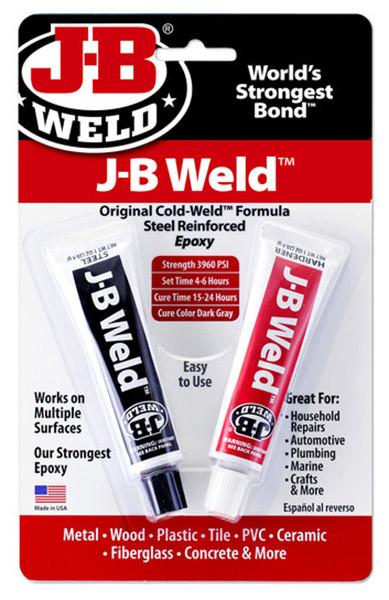
Original trade dress dates from 2012, and J-B Weld defines it as: (1) two
squeezable tubes in a clear blister package with the two tubes arranged in a
“V-shape”; (2) red coloring on one tube and black coloring on the other tube;
(3) a clear plastic blister package holding the tubes curved downward; (4) a
drop-down technical information box, located between the two tubes, that has
four lines of information separated by white lines; (5) a colored banner across
the bottom end of the card; (6) a colored banner bar that includes “Weld”
within the banner; (7) the phrase “Steel Reinforced Epoxy” and “World’s
Strongest Bond” on the card; (8) a list of uses near the bottom right corner of
the card; and (9) a card that is five inches.

J-B Weld’s packaging has described J-B Weld Original as a
“Steel Reinforced Epoxy” and the resin tube was labeled with the word “STEEL”
since 2009.  That was also when Gorilla
Glue allegedly became aware that J-B Weld intended the word “steel” on its
packaging to indicate the presence of an iron-containing additive. Gorilla Glue
neither contacted J-B Weld about nor challenged its use of the word “steel” on
its packaging until this case. J-B Weld has also featured “World’s Strongest
Bond” on the packaging for all its adhesive products since 2011, including its
two-part epoxy adhesive sold in a plunger syringe launched in 2012; Gorilla
Glue learned of the use of the phrase when the packaging debuted. Gorilla Glue likewise
didn’t object until this case.
In 2012, Gorilla Glue introduced a new Gorilla Epoxy
formula, which improved performance and provided a clear, rather than
yellowish, formula. It then began working on a two-part clear syringe product
with methacrylate chemistry (MMA) that it referred to as “Plastic Plus” or
“Heavy Duty Epoxy” during development and consumer testing. It ultimately
became the two-tube adhesive product known as “GorillaWeld.” During the design
process, Gorilla Glue’s Brand Manager instructed its graphic designer to
develop three blister card designs, including one that was “Close to JB Weld
brand” and that “should follow closely to going head to head with JB Weld and
play with such elements as black and red color palate and bringing in some
visual reference to steel reinforcement.” The graphic designer stated: “The
objective of this project was to go straight up against the top competitor (JB
Weld) and create packaging that mimics the competitor’s architecture. I was
able to pull subtle elements into our package, but still keep our package
looking tough and geared towards the Gorilla brand.”

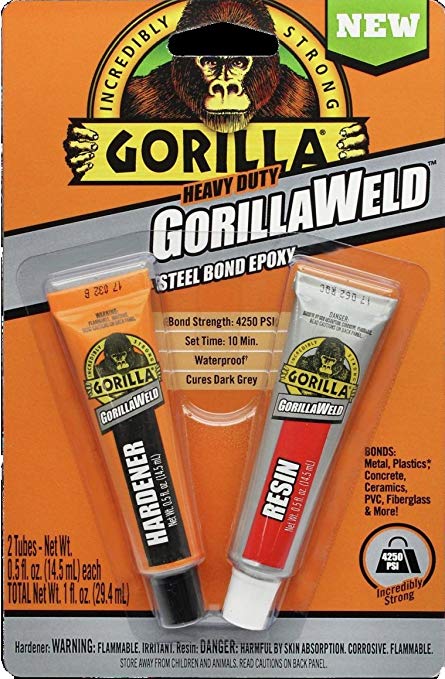
The ultimate trade dress had: (1) a 5-inch-wide orange
blister package card; (2) an image of a gorilla at the top next to the phrase
“Gorilla Incredibly Strong”; (3) two squeezable tubes in a clear blister
package in a V-shape; (4) a gray tube with red coloring on the bottom and a
gorilla image next to the phrase “Gorilla Incredibly Strong” towards the top;
(5) an orange tube with black coloring on the bottom and a gorilla image next
to the phrase “Gorilla Incredibly Strong” towards the top; (6) a clear plastic
blister package holding the tubes curved downward; (7) a drop-down technical
information box located between the V-shaped tubes, that has four lines of
information separated by white lines; (8) a gray banner across the bottom end
of the card; (9) a gray banner across the top of the card that includes the
name “GorillaWeld”; (10) the phrase “Steel Bond Epoxy” on the card; and (11) a
list of materials to which GorillaWeld bonds on the card’s bottom right side.
[Note: the descriptions here are really not that helpful,
though clearly carefully crafted to make J-B Weld’s case—the overwhelming fact
is that the dominant colors create a completely different visual impression.
Yes, they look like the same product, the way that different manufacturers’
light bulbs look like the same product, but they do not in any way look like
they have the same source.]
Although whether GorillaWeld is an “epoxy” was disputed, the
back of GorillaWeld’s packaging, the Safety Data Sheet (SDS), and Gorilla
Glue’s website all state that GorillaWeld uses MMA chemistry.
J-B Weld sued for trademark infringement and false
advertising of GorillaWeld as an epoxy adhesive containing steel. Gorilla Glue counterclaimed
against (1) “World’s Strongest Bond”; and (2) “Steel Reinforced Epoxy.”
Trade dress first: the overall impression wasn’t
similar.  Much explanation of why
omitted, focusing on colors and their arrangement.  J-B Weld urged the court to find similarity
“despite the brand names, logos, and color schemes.” But “it is precisely the
prominent display of distinctive brand names and logos coupled with the use of
radically different color schemes that negates any possibility of consumer
confusion in this case—thus precluding a finding of similarity.” This wasn’t a
swap of one name and logo for another, but a “radically different color scheme”
and a prominent use of a distinctive logo “to cure the effect of any visual
similarity.”
J-B Weld offered as actual confusion evidence three
employees’ testimony.  One indicated that
a Loctite sales rep asked if J-B Weld made Gorilla Glue’s “twin tube product
for [Gorilla Glue]”; another had an encounter with a Loctite rep who asked if
J-B Weld was “private labeling for GorillaWeld” after seeing the packaging; and
another indicated a buyer from O’Reilly’s Auto Parts asked if J-B Weld had
“anything to do with” Gorilla Glue’s product. These were admissible hearsay, going
to state of mind and not the truth of the matter asserted.  But “[i]nquiries indicating that ‘consumers
perceive a difference between the designations and are skeptical of the
existence of a connection between users’ may not establish the existence of actual
confusion.” Those inquiries indicate that the speakers actually know there’s a
difference. They were inquiring into whether there was a possible
collaboration, but they weren’t confused about source nor did they believe that
there was a collaboration (if they did, they wouldn’t have needed to ask).  And there was no other evidence of confusion.
Intent: the Eleventh Circuit has held that: “If it can be
shown that a defendant adopted a plaintiff’s mark with the intention of
deriving benefit from the plaintiff’s business reputation, this fact alone may
be enough to justify the inference that there is confusing similarity.” But the
court here noted that “there is a difference between ‘intentional copying’ and
adopting a design ‘with the intent of deriving benefit from’ another person’s
design.”  Intent to copy aspects of a
trade dress doesn’t show intent to derive benefit from J-B Weld’s reputation
through confusion.  [Not unrelatedly,
Gorilla Glue didn’t adopt J-B Weld’s mark,
even if it copied aspects of that alleged mark.]  And bad intent is neither necessary nor
sufficient for infringement. The instructions to Gorilla Glue’s graphic designer
didn’t reveal an infringing/confusing intent. As she herself stated, “I was
able to pull subtle elements [of J-B Weld’s Dress] into our package, but still
keep our package looking tough and geared towards the Gorilla brand.” “The
Eleventh Circuit has noted that public policy favors permitting companies to
imitate the products of competitors—so long as there is no intent to deceive
consumers as to the maker or origin of the product.”  Gorilla Glue intended to compete, for sure,
but its use of its own well-known color scheme and distinct logo “clearly
indicates that Gorilla Glue did not intend to confuse consumers as to
GorillaWeld’s origin.”  In addition,
certain design features may have had non-trademark functions, such as the
V-shape showing consumers that the components need to be mixed together and preventing
leakage. “Where, as here, ‘there may have been many other motivations for
Defendant’s actions,’ intentional copying does not necessarily indicate a
desire to capitalize on another’s goodwill.”
The remaining factors changed nothing. Gorilla Glue was
entitled to summary judgment on the infringement claim.
False advertising based on Gorilla Glue’s use of the phrase
“steel bond epoxy”: The court started with “epoxy.” Literal falsity requires an
unambiguous message and is a “demanding” standard.  J-B Weld argued that Gorilla Glue’s use of “epoxy”
is literally false because “epoxy refers to a polymer containing one or more
epoxy groups.” Even if the court accepted that definition, the claim failed for
lack of materiality. “[T]he presence of a false statement alone is not
sufficient to prove materiality.”  J-B
Weld’s consumer survey didn’t show materiality; it failed to show that consumers
even understood “epoxy” as chemically defined. J-B Weld’s expert didn’t
question survey respondents about whether an “epoxy resin has a specific type
of chemistry to it”: as he said, “Do you really think [consumers] care at the
end of the day if it takes two things, you put it together, and it stays there?
They’re happy.” J-B Weld’s speculation that Gorilla Glue’s prior attempts to
launch an MMA product under the name “Plastic Plus” and alleged repositioning
of the product as an epoxy indicated that “epoxy” was material were
insufficient.
“Steel bond”: J-B Weld argued misleadingness: a false
suggestion that GorillaWeld contains steel. Again, assuming that its survey
showed misleadingness, it still didn’t show materiality. The survey simply showed
respondents both J-B Weld Original and GorillaWeld, and then asked which of the
two products contained steel. (Amazon also originally categorized GorillaWeld
as a “metal-filled epoxy” on its website, but a retailer’s misclassification wasn’t
evidence of consumer deception.)  Nor
would the court presume deception from Gorilla Glue’s deliberate conduct
because the Eleventh Circuit hasn’t adopted that rule and in any case Gorilla
Glue’s acts weren’t of an “egregious nature.” 
J-B Weld pointed to some 2009 evidence from Gorilla Glue
employees noting that steel or a similar filler would provide “some advantage
from a marketing standpoint.” But that old evidence wasn’t a direct indication
of what actual consumers would do today. 
[Quite notable how differently courts treat evidence of advertisers’
beliefs about consumers in advertising cases versus trademark cases. There’s no
question that a substantial number of courts would treat similar evidence about
the appeal of, e.g., a particular trade dress as indicating both an intent to
deceive and likely success in doing so. I think those courts are wrong, but it’s
also a bit bizarre to presume that active competitors in a market have no idea
what might appeal to consumers.] Summary judgment for Gorilla Glue.
Counterclaims: J-B Weld argued that claims based on “steel
reinforced” should be dismissed based on laches. In Georgia, the borrowed period
for assessing laches is four years. Gorilla Glue argued that its awareness of
the phrase did not ripen into a provable claim until the present litigation. The
court agreed. In 2009, its reverse engineering attempts led to a report from an
adhesive manufacturer in 2009 stating that the “one puzzle in this adhesive is
presence of iron powder in the formula. It does not appear to add anything to
the properties … one clue to iron powder … can be found in the name ‘steel’
that labels the resin.” But that didn’t mean that Gorilla Glue knew or should
have known that it had a provable claim for false advertising simply based on a
comment from a third-party that the presence of iron in JB Weld Original was
“puzzling.” Even if it did delay, Gorilla Glue raised a material issue on
excusability, because the parties weren’t directly competing on two-tube epoxy
products until GorillaWeld was launched. 
The Eleventh Circuit has held that delay is reasonable where a plaintiff
waits to sue until coming into direct competition.
And there was a genuine dispute of material fact on literal
falsity.  Gorilla Glue had evidence that
the “presence of ‘steel’ in JB Weld glues has no significant overall
reinforcing effect,” while J-B Weld’s expert said that the addition of steel
“strengthens the adhesive, supports the adhesive, allows those steel-containing
products to provide enhanced performance and improved mechanical behavior.”  [Is that the question?  I thought it was whether there was “steel” in
there in the first place.] Anyway, could be literally false or misleading, although
the court had “reservations” about ultimate materiality and would allow
additional briefing on the matter. J-B Weld’s motion for summary judgment
denied.
Claims based on “World’s Strongest Bond” were not only
barred by laches, but also failed as a matter of law. Gorilla Glue learned of
J-B Weld’s use of the phrase in 2011, discussed challenging it in 2013, and did
nothing. Unlike with “steel reinforced,” J-B Weld was using the phrase on all its
products, including those in direct competition with Gorilla Glue.  Gorilla Glue argued that it didn’t sue because
a comparison between its Gorilla Epoxy product and J-B Weld’s competing
ClearWeld showed comparable bond strengths. “Yet if the two products had
comparable bond strengths, … it stands to reason that J-B Weld’s product could
not literally create the ‘World’s Strongest Bond,’ because another product
could create that very same bond.”
J-B Weld also showed prejudice because it “extensively used
the J-B Weld Packaging Statements and built its brand around them,” spending
millions on advertising and marketing its products between 2012-2017—all of
which prominently feature the phrase “World’s Strongest Bond.” Gorilla Glue
argued that there was no prejudice because J-B Weld knew from the beginning
that it was a wrongdoer and had no testing supporting its claims. But J-B Weld
argued that the phrase was puffery; it could hardly be said that J-B Weld would
have spent the same amount of money and effort “notwithstanding any threat of
litigation from Gorilla Glue.” [Really? 
They might have changed that one phrase; the advertising/marketing is
for the products as a whole, not a single phrase.]
Gorilla Glue argued that laches didn’t apply because it
sought only injunctive relief, but that’s only the rule where the public interest
in preventing consumer deception outweighs the effect of a plaintiff’s delay in
bringing suit. Without strong evidence of likely or actual confusion, laches
applied.
Anyway, “World’s Strongest Bond” was nonactionable puffery—exaggerated
and general. Gorilla Glue argued that the strength of an adhesive bond is
measurable and thus falsifiable. But it was too general, not a “detailed
factual claim.”

from Blogger https://ift.tt/2O6vAuu

Posted in Uncategorized | Tagged , , | Leave a comment

Omission of side effects in lash “cosmetic” ads was plausibly false & misleading

Lewis v. Rodan & Fields, LLC, 2019 WL 978768, No.
18-cv-02248-PJH (N.D. Cal. Feb. 28, 2019)
Nine plaintiffs brought a putative class action alleging
that defendant Rodan failed to disclose that its Enhancement Lash Boost eye
serum, advertised as a cosmetic designed to make eye lashes longer and more
beautiful, “had harmful side effects linked to an ingredient in” the product, a
synthetic prostaglandin analog. One plaintiff’s eyes changed color, another
“developed a grey spot in her vision and had central serious retinopathy,” another’s
eye lashes fell out and not all of them have grown back, and another “developed
a rash on her eyelid[,] [ ] her eyelid became discolored and darkened, … and
lashes no longer grow where [a] bump” developed. “Many of these side effects
match those associated with all prostaglandin analogs.”
Indeed, for these reasons, the FDA previously warned another
manufacturer of “cosmetic” lash-enhancement products that used the ingredient
that the products violated the FDCA because they were unapproved new and
misbranded drugs and failed to reveal important side effects. Rodan, too,
didn’t disclose the serious side effects associated with the ingredient.  The warning states, as relevant here, “For
external use only. Avoid getting in the eye; in the event of direct contact
rinse with cold water. If you develop irritation or swelling discontinue
product usage.” Rodan’s website and marketing materials did no better and, in
some instances, affirmatively distinguished “drugs” that cause those side
effects from Lash Boost’s side effects, e.g.: “The only serious side effects we
have heard about are those associated with drug products, not cosmetics.” Rodan
claimed the product was “a cosmetic.”
Plaintiffs alleged that, had Rodan included an adequate and
“full[ ] disclos[ure about the] adverse side effects of Lash Boost, plaintiffs
would have decided not to purchase Lash Boost.” And plaintiffs alleged that “they
did not receive what they paid for when purchasing Lash Boost,” because they
paid for a product with, at most, side effects limited to irritation but
instead received a product that had serious and sometimes permanent side
effects.  They asserted claims under
various states’ common laws and false advertising laws, as well as a RICO claim
that was dismissed because it was a RICO claim.
The false advertising claims were all based on an omission
theory. For omission, Rule 9(b) “requires that the complaint adequately allege
why the omitted fact is true, as well as being material to consumer
decision-making.”  The complaint did
so.  Plaintiffs plausibly alleged that
the product could cause serious side effects, and that this is material in that
reasonable consumers would have been likely to act differently because of this
fact.  Given the materiality of the
omission and the other allegations, it was plausible that, had Rodan reasonably
and adequately disclosed the serious side effects, the plaintiffs would have
been aware of the disclosure and acted differently. And plaintiffs adequately
alleged injury: they didn’t receive the benefit of the bargain, a
minimal-side-effect product.  Finally, as
to the states that require some kind of intent, plaintiffs adequately alleged “that
defendants were aware of or had [ ] reason to know of” the allegedly omitted
information.

from Blogger https://ift.tt/2NIEq1i

Posted in Uncategorized | Tagged , , | Leave a comment