ASTM v. PublicResource.org: Trademark

American Society for Testing and Materials v.
Public.Resource.Org, Inc., No. 17-7035 (D.C. Cir. Jul. 17, 2018)
Trademark: This was where the district court went very, very
wrong—I consider the copyright issues difficult though I have a preferred
outcome; the trademark issues should not have been.
ASTM has registrations for ASTM word marks and stylized ASTM
logos, which they place on the cover pages of their technical standards. The
first page of a standard introduces the name of the work by depicting the “ASTM
International” logo and placing it next to the text.  Each subsequent page of the work includes a
header that again displays the ASTM logo and places it next to text indicating
a short title.

PRO copied these, which ASTM alleged constituted trademark infringement.  The district court found that PRO’s
disclaimers didn’t work because they “do not mention [PRO’s] creation of the
reproductions, [the SDOs’] lack of association or authorization, or that they
are even reproductions or transcriptions.”  Thus, consumers would be confused about
whether these were authentic copies of ASTM’s works, even though PRO “did not
undertake the same quality control procedures,” which, in turn, would harm
ASTM’s brand identity and goodwill.
Although Dastar was
itself about the creation of an unauthorized derivative work, the court of
appeals said that Dastar might well
preclude a claim based on reproduction of identical copies of the standards,
but that allegations of creation of unfaithful copies “through scanning and
re-typing, with resultant errors and differences,” didn’t fall within Dastar. 
The reason was that consumers who downloaded copies from PRO’s website
might attribute the digital files, and their errors, to ASTM, risking confusion
about “the tangible product sold in the marketplace.” Thus, the court of
appeals reasoned, “post-Dastar cases
where courts have found trademark claims foreclosed involved instances of
virtually identical copies,” which is descriptively untrue as well as failing
to account for the facts of Dastar.  [The court’s flawed distinction does highlight
the difficulty Dastar poses when the copying is of material that (allegedly) has secondary meaning—it’s notable that what’s missing in the identical copy situation,
in the court’s reasoning, is not the confusion,
which could well be unabated; it’s just the harm
to ASTM’s goodwill from the confusion. 
And in an alternate scenario where the defendant was selling copies, there could well be substitutionary harm, as
there could well have been in Dastar itself,
since some consumers will not be like my son and will buy only one series about
WWII campaigns in Europe.  If we let
plaintiffs plead around Dastar by
alleging confusion over the source of the copies, then Dastar becomes a dead letter.  The better solution would be to say that when the alleged confusion stems from the content itself, error-filled or otherwise, Dastar is triggered.]
The question then was the relevant likelihood of confusion
test, which is usually the multifactor test. However, nominative fair use accommodates
situations where it would be “virtually impossible to refer to a particular
product for purposes of comparison, criticism, point of reference or any other
such purpose without using the mark.” The district court declined to consider
nominative fair use because it had already found that consumer confusion was
likely; this was error.
There is a robust split about how to evaluate nominative
fair use—as a substitute for the usual confusion test, an affirmative defense,
or [ugh] as add-on factors—but the panel didn’t make a decision today for the
DC Circuit. “Where, as here, there is a claim of nominative fair use, the
likelihood of confusion analysis remains incomplete without at least some
discussion of these factors.”  Given that
PRO can reproduce some of the standards under copyright fair use, “it is hard
to see how PRO could fulfill that goal without identifying the standard by its
name—the very name also used in the incorporating law.”  And as for whether only so much was used as
reasonably necessary, “it may well be that PRO overstepped when it reproduced
both ASTM’s logo and its word marks but, as it told the district court, it is
not wedded to using the logo.”  So this
might point to a narrower remedy. 
And as to whether the user suggested sponsorship or
endorsement, PRO’s disclaimers “may well fail to adequately eliminate the possibility
a consumer would assume sponsorship or endorsement by ASTM, but that hardly
means that no disclaimer could cure that risk.” 
[Of course, case after case in the 9th Circuit (and some
elsewhere) has held that disclaimers aren’t required; the question under
nominative fair use is whether the defendant has done anything else affirmatively, other than use the mark, to suggest sponsorship.  I also have some words I could say about the
DC Circuit’s attitude towards disclaimers generally, but I shall resist.]  PRO had already modified the disclaimers to
disclose that it’s the one doing the scanning, that errors are its own, and
that it wasn’t affiliated with any organizations. “[E]ven if the district court
ultimately concludes that the record supports an infringement finding, it
should consider whether its previous grant of an injunction barring all
unauthorized use is still warranted or whether it ‘may order defendants to
modify their use of the mark so that all three factors are satisfied’ and a narrower
remedy would suffice.”

from Blogger https://ift.tt/2uJiZUU

Posted in Uncategorized | Tagged , | Leave a comment

ASTM v. PublicResource.org: Copyright

American Society for Testing and Materials v.
Public.Resource.Org, Inc., No. 17-7035 (D.C. Cir. Jul. 17, 2018)
The panel, citing “serious constitutional concerns,” vacated
the district court’s finding of trademark and copyright infringement based on
PRO’s copying of privately drafted standards that have been incorporated into
law in various jurisdictions.  Finding
errors in the district court’s dual fair use analyses, the court left for
another day “the far thornier question of whether standards retain their
copyright after they are incorporated by reference into law.”  The court also left it to the district court
to re-apply copyright fair use after further factfinding, and to determine how
to apply nominative fair use.
Incorporation into law varies across jurisdictions, as do
the legal consequences thereof, across thousands of technical standards (over
1200 ASTM standards in the CFR alone). 
Some incorporated standards define legal obligations, while others are “mere
references” that “have no direct legal effect on any private party’s conduct,”
and there are others in the middle, e.g. that trigger agency obligations or
establish eligibility for federal programs.  The court of appeals disagreed with the
district court’s blanket treatment of standards for fair use purposes, thus
allowing it to avoid the larger constitutional question for some or perhaps all
of the infringement claims.
Treating this case as one involving fair use rather than
copyrightability also “limits the economic consequences that might result from
the [plaintiff] SDOs losing copyright—which they repeatedly emphasize would
jeopardize the continued development of high-quality standards—by allowing
copying only where it serves a public end rather than permitting competitors to
merely sell duplicates at a lower cost.” 
And it avoids difficult questions about what happens, for example, when
a newer version of a standard becomes incorporated—would older versions regain
any lost copyright?  If necessary, these
issues might have to be reached on a fuller record.
Fair use: The district court found that the purpose of PRO’s
copying was “for the direct purpose of undermining [the SDOs’] ability to raise
revenue.” The record didn’t support that conclusion: “by all accounts, PRO
distributed these standards for the purpose of educating the public about the
specifics of governing law.” Further, the district court failed to consider
each standard on its own facts.  This
might not require individual factual development as to each standard, but
rather might allow for groupings that are fair use-relevant.
As for the commerciality of the use, the district court
found that PRO’s use had commercial elements because it distributed identical
standards in the same consumer market. 
This was too broad a definition of commerciality.  [Happy sigh.] 
Although PRO’s copies might serve as substitutes, “little, if anything,
in the record indicates that PRO stands to profit from its reproduction.” Even
if distributing the standards is part of PRO’s fundraising appeal, “that hardly
rises to the level of making this a ‘commercial’ use.” [Happier sigh.]
As a general matter, freely distributing standards
incorporated by reference into law furthers the purposes of fair use. Transformativeness
is important, and format change isn’t transformation for these purposes, but a
purpose to facilitate public access could be transformative without altering
the original work. (Citing A.V. ex rel. Vanderhye v. iParadigms, LLC, 562 F.3d
630 (4th Cir. 2009), and Swatch Group Management Services Ltd. v. Bloomberg
L.P., 756 F.3d 73 (2d Cir. 2014)).
Exact copying can be important to understand, say, one’s
legal obligations, and where this is so, “this factor would weigh heavily in
favor of permitting a nonprofit seeking to inform the public about the law to reproduce
in full the relevant portions of that particular standard.”  For example, federal law’s incorporation of
ASTM specifications to “dictate” whether a retailer of diesel fuel needs to
provide additional fuel labels likely favors PRO’s copying, while using ASTM
standards as a reference procedure for determining whether gasoline without ethanol
has an “[e]vaporated initial boiling point” of “75- 95[°F],” likely doesn’t.  Copying the version that is incorporated in
federal law is also likely to be favored over copying a later edition that is not so incorporated (though the court doesn’t
here discuss copying prior versions so
that the public can see what’s changed over time—something of particular interest
as this administration dumps ever more once-public information down the memory
hole).
“[W]here knowing the content of an incorporated standard
might help inform one’s understanding of the law but is not essential to
complying with any legal duty, the nature of PRO’s use might be less
transformative and its wholesale copying, in turn, less justified” because
paraphrase or summary might be adequate to serve the purpose.  [Would paraphrase avoid an infringement claim
based on structure, sequence, and organization? The court seems to assume the
answer is yes, and I think it should, but I’m not confident it would. 
Query also how much room there is to rephrase a reference procedure for
determining an initial boiling point; that sounds a little merger-y to me.]  Purpose has to be assessed use by use, even
though that may be difficult.
Factor two: “All of the works at issue here fall at the
factual end of the fact-fiction spectrum, which counsels in favor of finding
fair use.”  But the district court found
that because technical standards “are vital to the advancement of scientific
progress in the U.S.,” they are “exactly the type of expressive work that
warrants full protection under . . . the Copyright Act.” If these were “ordinary
technical standards used for no public purpose,” the court of appeals might
have agreed. [Though it shouldn’t have! Patent and copyright are different, and
“science” now means something very different than it did in “Science and Useful
Arts.”]  But these standards have all, in
some capacity, been incorporated by reference into law, and, “the express text of
the law falls plainly outside the realm of copyright protection.” Standards
incorporated by reference into law are thus, “at best, at the outer edge of ‘copyright’s
protective purposes,’” though just how far at the edge depends on the degree of
incorporation, as above.
Factor three: Must be considered standard by standard, in
light of PRO’s purpose.  “If PRO limits
its copying to only what is required to fairly describe the standard’s legal
import, this factor would weigh strongly in favor of finding fair use here,
especially given that precision is ten-tenths of the law.”  So where specific provisions are incorporated
into law, maybe you can only copy those provisions [and I presume any
provisions required to understand those provisions—the court of appeals doesn’t
mention cross-references, but given its discussion, definitional and other
foundational provisions would have to be fair game as well].  Where the law refers generally to a standard’s
specifications, by contrast, a greater amount of copying would be allowed. “And
where the incorporation merely makes reference to an external standard, but
that standard does not govern any conduct, perhaps the copier’s purpose could
be achieved with only a paraphrase or a summary.”
Factor four: first, the district court erred in presuming market
harm based on PRO’s [nonexistent] commercial purpose. The record didn’t show
how serious any adverse impact on the SDOs’ market might be.  On remand, the district court should consider
that (1) the SDOs already make copies of their standards freely available
online (in “controlled reading rooms”), presumably “without entirely
cannibalizing sales of their standards.” 
How much additional harm could PRO’s copying cause?  (2) The market harm question has to be
addressed with reference to the legal alternatives—that is, if PRO were only to
reproduce the portions of a longer standard that were actually incorporated
into law, “would there still be a vibrant market for the standards in their
entirety?” [There are a couple of ways to read this, but I think one significant
point is this: suppose that partial copying had the same effect on the market
as full copying.  Given that such partial
copying is fair use, then the marginal market impact of PRO’s infringing use would
be zero.  Of course, partial copying
might not have the same effect on the market.] 
(3) What’s up with derivative works? 
Because SDOs routinely update their standards, “in many cases, the
edition PRO posts to the internet—and, indeed, the one incorporated into the law—is
long outdated.” Does PRO’s copying of old standards harm the market for
updated, unincorporated editions?  If the
SDOs are to be believed, the primary purpose of technical standards is “to have
them used by private industry and other non- governmental users to address
technical issues or problems,” indicating that “market demand for the most
up-to-date standards would be resilient.” 
Does the SDOs’ ability to market derivatives provide an adequate
incentive to continue producing standards even with PRO’s copying?  Even after Veeck v. Southern Building Code
Congress International, Inc., 293 F.3d 791 (5th Cir. 2002), the successor SDO
remains profitable both through sales of codes and of “program services,
including consulting, certification, and training.”
Ultimately, genuine issues of material fact precluded
summary judgment on copyright fair use.
Judge Katsas concurred to emphasize that law cannot be
copyrighted and that the majority opinion was pretty clear that “[W]here a
particular standard is incorporated as a binding legal obligation, and where
the defendant has done nothing more than disseminate it, the Court leaves little
doubt that the dissemination amounts to fair use.” 

from Blogger https://ift.tt/2LjEfLq

Posted in Uncategorized | Tagged , | Leave a comment

Unclean (but collagen rich) hands in a false advertising case

Certified Nutraceuticals, Inc. v. Avicenna Nutraceutical,
LLC, 2018 WL 3361142, No. 16-cv-02810-BEN-BGS (C.D. Cal. Jul. 10, 2018)
A rare unclean hands victory in a false advertising case.  Certified alleged that Avicenna, its
competitor in the market for collagen products used as ingredients in other
products, falsely advertised its products as “patented” or processed using
“patented formulas and production methods” while Avicenna never held any
relevant patents.
To prevail on a defense of unclean hands, a defendant must
demonstrate by clear and convincing evidence: (1) “that the plaintiff’s conduct
is inequitable;” and (2) “that the conduct relates to the subject matter of
[the plaintiff’s] claims.” Even in such cases, unclean hands isn’t
automatically a defense; the plaintiff’s wrongdoing must be balanced against
the defendant’s, considering the substance of the plaintiff’s rights.
In the Ninth Circuit, “only a showing of wrongfulness,
willfulness, bad faith, or gross negligence, proved by clear and convincing
evidence, will establish sufficient culpability for invocation of the doctrine
of unclean hands.”  Here, Avicenna
established that Certified falsely claimed patent protection for its competing
product, over a year before the PTO granted any Certified patent.  Certified argued that its product was covered
by a different patent, but Certified wasn’t an owner, assignee, or licensee of that
patent at that time or since, perhaps because of a permanent injunction against
a Certified principal enjoining him from transferring, enforcing, or otherwise
affecting the title to that patent. 
Certified’s only other evidence that the statements weren’t false or
misleading was a false statement that the principal was the assignee of a
patent that was a continuation of the enjoined patent.  Thus, the court found that Certified
knowingly made statements about the patented nature of its product—either
because it knew the later patent hadn’t been issued, or because it knew it had
no right to manufacture, distribute, offer for sale, or sell any goods under
the continuation patent.  Avicenni showed
Certified’s wrongfulness, willfulness, and bad faith in engaging in inequitable
conduct with clear and convincing evidence. [I’m not sure courts would find
that claiming patent protection when the patent was pending always meets this
standard, though it would usually have to be knowing.]
Did this inequitable conduct relate to Avicenna’s false
advertising claim? Unclean hands should only be applied “where some
unconscionable act of one coming for relief has immediate and necessary
relation to the equity that he seeks in respect of the matter in litigation,” which
means that the plaintiff dirtied its hands “in acquiring the right” presently
asserted or “the manner of dirtying renders inequitable the assertion of such
rights against the defendants.” Even though the statements were now years old,
there was still an immediate and necessary relationship to the equitable
remedies sought, because they were about the patented status of the directly
competing products.
Summary judgment on Lanham Act claims granted; coordinate
state-law claims dismissed for want of supplemental jurisdiction.

from Blogger https://ift.tt/2NJHv13

Posted in Uncategorized | Tagged | Leave a comment

TM/False advertising issue of the day

Seen on the street in NYC; the candies have no marijuana content–they’re sold as “adult” candies, furthering the impression. My daughter also asked “Could the owners of Scooby Doo sue?” and then, because I have taught her well, corrected that to “Could the owners of Scooby Doo win?”

from Blogger https://ift.tt/2Lfyuex

Posted in Uncategorized | Tagged , | Leave a comment

False designation damages require proximate cause, dooming $250 million jury award

ZeniMax Media Inc. v. Oculus VR LLC, No. 14-cv-01849 (N.D.
Tex. Jun. 27, 2018)
After trial of this case, the jury returned a verdict,
finding in relevant part that defendants were liable for false designation of
origin, basically about the origins of Oculus’s technology with a lagniappe of
use of ZeniMax’s trademarks in a Kickstarter promotion. The jury awarded actual
damages of $250 million in total for the false designation of origin. The court
granted judgment as a matter of law because the record lacked legally
sufficient evidence of injury causation in that or any amount. [Pointing to
another part of Dastar’s practical
wisdom: it’s rare that false designation of origin of ideas makes a difference.
The court was sensitized to the Dastar
problem in that its analysis focuses on unauthorized use of ZeniMax’s marks,
but the trial theory, and thus the jury’s award, seems to have focused on
claiming credit for the technology. The mismatch between the allowable scope of
§1125 and the theory is likely part of what accounts for the lack of evidence
of damages.]
Under Lexmark,
damages must be proximately caused by the act of the false designation: “[A]
plaintiff suing under § 1125(a) ordinarily must show economic or reputational
injury flowing directly from the deception wrought by the defendant’s
[actions]. . . .”
Plaintiffs’ damages expert testified only as to damages
resulting from stolen trade secrets, not to reputational injury, or any defendant
gains from false designation. For reputational damages, ZeniMax cited the
testimony of Todd Hollenshead, former President of plaintiff id Software, that
he was “concerned” about “the use of preleased software in any public
demonstration that id Software was not controlling.” Without specifically
noting that the existence of a risk isn’t evidence that the risk to reputation
materialized, the court concluded that this wasn’t evidence of damage to
reputation based on false designation. ZeniMax also pointed to three other
items that supposedly showed reputational injury: (1) false representations
Oculus made in the press about“collaborat[ion]” when “there was no actual
affiliation between ZeniMax and Oculus”; (2) Oculus leading Mark Zuckerberg to
believe that Oculus, not ZeniMax, “was miles ahead of everyone else” as to
virtual reality technology; and (3) Zuckerberg’s testimony that ZeniMax “came
out of the woodwork” when the Facebook purchase was announced. These were “even
further from being evidence of reputational injury” than Hollenshead’s
testimony.
ZeniMax pointed to excerpts from the damages expert’s
testimony where he calculated a reasonable royalty for ZeniMax’s technology. But
none of this testimony referenced false designation, let alone how the damages
calculation he computed for trade secret violations also related to false
designation and any resulting injury to ZeniMax. Defendant Carmack also wrote an
email saying that “Oculus wouldn’t exist as a funded company if it weren’t for
[Plaintiffs’] involvement.” That didn’t provide evidence that defendants “were
massively and unjustly enriched” in relation to the false designation.
ZeniMax argued that defendants were unjustly enriched by
their act of false designation when Facebook bought Oculus for approximately $2
billion. [Unjust enrichment of this type isn’t damages—it’s a disgorgement
theory.]  Standing alone, the purchase
price was legally insufficient evidence to prove damages from false
designation. Facebook didn’t buy Oculus until 2014, almost two years after Oculus
used promotional items containing ZeniMax’s marks without authorization in a Kickstarter
video and investor materials. There was no causal evidence linking the two.
Even if there had been evidence of damages, plaintiffs
failed to show proximate cause between those damages and the unauthorized use
of their marks. Plaintiffs argued that the jury is vested with “broad latitude
to infer proximate cause.” However, there was no evidence that Facebook believed the parties were
somehow associated and that this led to the purchase. [Materiality as a proximate
cause requirement….] Also, “[t]he time and intervening facts between these
events alone makes the approximately $2 billion purchase price too remote to
have been the proximate result of Defendants’ acts of false designation.” During
those two years, millions of dollars were invested into Oculus by multiple
investors, and others invested substantial time and effort, taking the Oculus
Rift from a prototype device into a functioning device with market potential. That was the product that attracted
Facebook to acquire Oculus. “There was simply no evidence presented that the
purchase price Facebook paid for Oculus proves any of the harms against which
Section 1225 protects.”
The only other evidence arguably proving proximate cause of
harm flowing from the false designation was the money Oculus raised from
investors in direct connection with the use of the promotional materials
containing ZeniMax’s marks. However, there was no evidence about how much money
was actually generated from these specific efforts using ZeniMax’s marks
without permission. Also, the display of ZeniMax’s marks and the endorsement by
Carmack, who was employed by ZeniMax at that time, was “merely a minor portion
of the entire video.” By contrast, the video spent a substantial amount of time
discussing the invention and technological improvements of the Oculus Rift
without making any reference to ZeniMax or displaying of any of ZeniMax’s
marks. The video also contained references to and endorsements from other
companies and people in the industry unconnected to ZeniMax, such as USC’s MxR
Lab, Epic Games, Unity, and Valve. The unauthorized use of ZeniMax’s marks was
“diluted” by these endorsements of others as well as the support of ZeniMax’s
competitors.
Here’s the Dastar
hook: “The invention and technology of the Oculus Rift was a major issue in
dispute in this matter” but those issues “play no role in a proximate cause
analysis as to the false designation claims because the Lanham Act is intended
to protect from harm related to the improper use of a mark and not intended to
protect inventor’s rights.” The invention issues “add nothing to further a
finding of proximate cause of a harm related to the money raised by this
Kickstarter video.”

from Blogger https://ift.tt/2lLO2vf

Posted in Uncategorized | Tagged , , , | Leave a comment

the perils of default judgments against speech: showing up late can prove onerous

Lokosky v. Gass, No. 1 CA-SA 18-0101, 2018 WL 3150499 (Az.
Ct. App. Jun. 28, 2018)
Respondents (not Gass, who’s the judge, named for procedural
reasons) sued Lokosky for false advertising and related claims seeking to compel Lokosky to “remove from the
internet all material pertaining to Respondents and their business,” and
obtained a default judgment. Next, they compelled the transfer of ownership of Lokosky’s
website to themselves. Lokosky then applied for a restraining order seeking to
have ownership of her website returned to her and moved to vacate or set aside
the judgment. The superior court granted the TRO and ordered Lokosky to “remove
any and all material and/or references pertaining to each Plaintiff” on her
website and “refrain from publishing or republishing on the Internet any and
all materials and/or references pertaining to each Plaintiff.” Well, that’s
incredibly overbroad. Then:
In March 2017, the superior court
held the first day of an evidentiary hearing on Lokosky’s motion to vacate
judgment. During the month in between hearing days the superior court placed
both parties under an order forbidding the parties from engaging in speech regarding
each other, counsel, and the instant lawsuit. … In April 2017, the superior court held the second day
of the evidentiary hearing and vacated the default judgment against Lokosky. 
Lokosky filed a motion to dissolve the TRO because there was
no longer a default judgment to justify the restraint on her speech. In a
sequence of events that would have fit well in Jarndyce v. Jarndyce, the superior court declined to act, waiting
on the result of respondents’ pending appeal of the vacation of the default
judgment. So Lokosky filed a separate notice of appeal about the superior
court’s decision not to decide the motion to set aside the TRO; the court of
appeals determined that it lacked jurisdiction. Lokosky then requested that the
court of appeals dissolve the TRO by way of a filing in respondents’ appeal. The court of appeals denied the motion because the request was
more appropriately raised as a special action. Lokosky then filed a special
action petition, and finally her claim was heard on the merits. [Eugene Volokh
could use this as a cautionary tale about granting speech restraints in default
judgments. They can be very hard to reverse, as it turns out!]
The TRO was a prior restraint on speech and violated the
First Amendment. Before any TRO against future speech can issue, the court has
to determine that the future speech is unprotected by the First Amendment. “Although
the superior court indicated its intent to prevent the parties from engaging in
speech which might later increase their own liability in this litigation, the
record is devoid of any support for the notion that Lokosky’s speech is not
protected.” Respondents argued that they competed with Lokosky and that
her speech was commercial (allowing prior restraint). Even assuming that, her
speech hadn’t been determined to be misleading and thus couldn’t be restrained,
even temporarily.

from Blogger https://ift.tt/2tYayoq

Posted in Uncategorized | Tagged , | Leave a comment

search results labeled as results aren’t confusing

Carter v. Oath Holdings, Inc., No. 17-cv-07086-BLF (N.D.
Cal. Jun. 21, 2018)
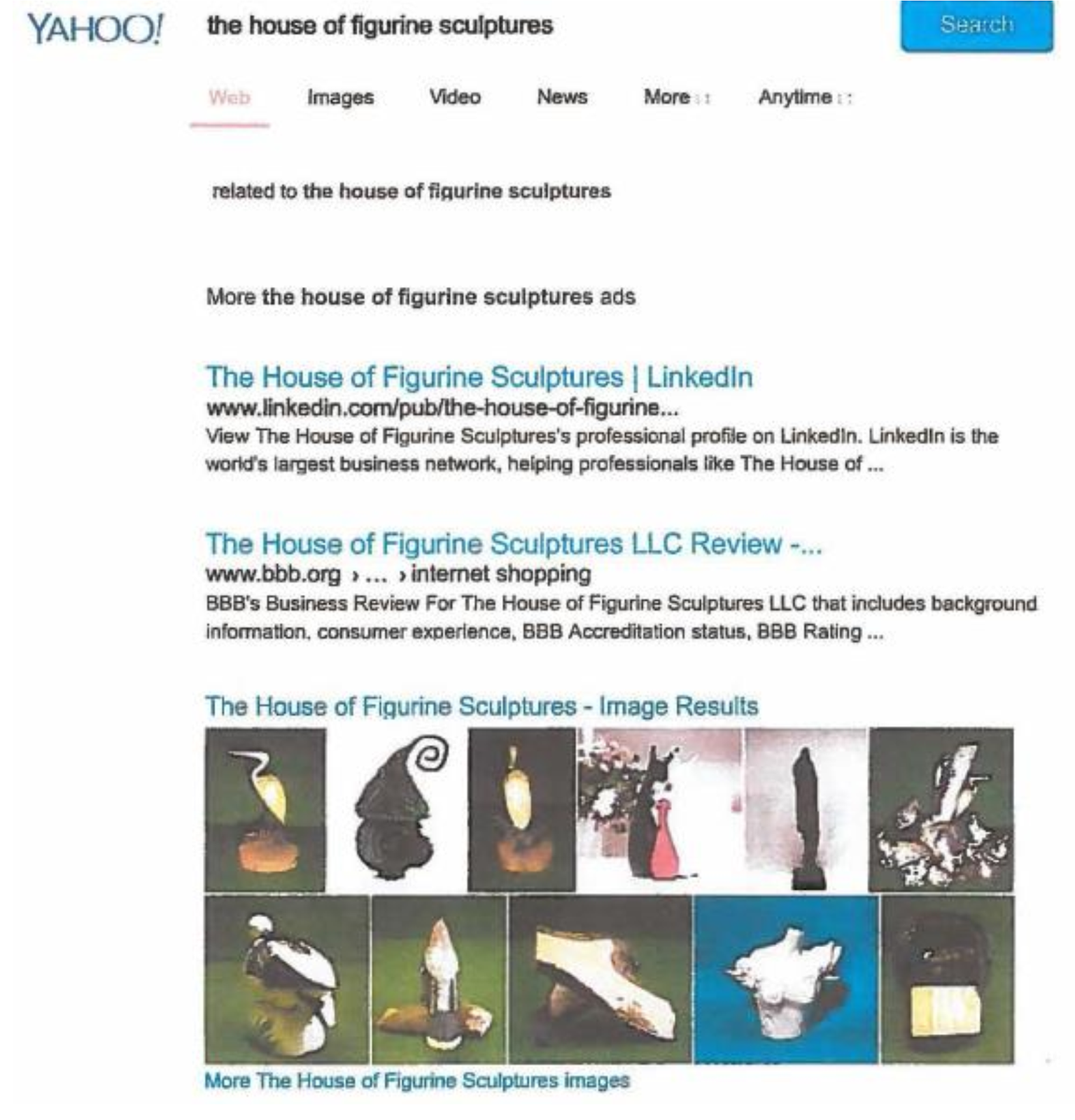
Carter allegedly owns a trademark registration for “The
House of Figurine Sculptures.com.” Defendant is Yahoo!, which runs a search
engine.  The complaint alleged that
Yahoo! uses “two active counterfeit marks identical to Plaintiff[’s] genuine
mark” titled “The House of Figurine Sculptures – Image Result” and “More The
House of Figurine Sculptures Images”:
Carter alleged that he has no connection to “those goods and
services sold” and that Yahoo!’s “counterfeit marks misrepresent [the]
designation of origin” of the goods and services. The court dismissed the
trademark infringement, false designation of origin, and counterfeiting claims.
First, the complaint failed to sufficiently plead “use” of the mark. “Courts
have held that an online provider does not ‘use’ a mark under the meaning of
the Lanham Act when its search engine returns a search result based on an input
of a consumer. As such, merely returning search results to purportedly display
a trademark does not show that Defendant is liable under the Lanham Act.”
Second, the complaint failed to sufficiently allege a
likelihood of confusion. Mere allegations that Yahoo!’s “counterfeit marks
misrepresent [the] designation of origin” and that their “counterfeit marks
[are] deceptive, confusing, and is likely to cause mistake on the part of [the]
consuming public” were conclusory and insufficient. [Note that if more plausible
facts were alleged leading up to this (e.g., that defendant was selling
identical goods/services in direct competition with plaintiff, using the same
mark), the very same allegations would not be treated as conclusory but as
plausible inferences from the other alleged facts.]

from Blogger https://ift.tt/2lQ2rXq

Posted in Uncategorized | Tagged | Leave a comment

Dr. Pepper gets an upset tummy: Court approves conjoint analysis/price premium model in ginger ale class action

Fitzhenry-Russell v. Dr. Pepper Snapple Group, Inc., 2018 WL
3126385, No. 17-cv-00564 (N.D. Cal. Jun. 26, 2018) (magistrate judge)
Canada Dry Ginger Ale allegedly deceived consumers with the
phrase “Made From Real Ginger” when, in fact, Canada Dry does not contain the
type of, or amount of, ginger consumers would expect (ginger root). Instead,
Canada Dry contains a ginger derivative, ginger oleoresin. Plaintiffs alleged
that Dr. Pepper was wrongfully able to charge a 4% price premium on Canada Dry
as a result. The court certified a class and rejected challenges to plaintiffs’
expert declarations in support of class certification on the usual California
claims.
Plaintiffs’ survey expert, Dr. Dennis, looked at consumer
understanding of “Made from Real Ginger” and materiality/price premiums. Respondents
were asked “what is your understanding of the statement ‘Made From Real Ginger’
on the Canada Dry Ginger Ale?” and provided options:
[1.] Ginger oil, which is extracted
from the ginger root using steam
[2.] Ginger root, which is part of
the ginger plant, not an extract
[3.] Ginger oleoresin, which is
extracted from the ginger root using a solvent
[4.] None of these
78.5% of California Canada Dry consumers answered that the
product was made from ginger root, while 4.8% of consumers picked ginger
oleoresin and 8.6% picked ginger oil. (The truth is oleoresin.)
Before answering the materiality question, respondents were
presented with the definitions of “ginger root” and “ginger oleoresin.” Ginger
oleoresin was defined almost as above, but with the additional information that
a solvent, such as ethanol, could be used to extract the ginger. In the survey,
92.4% of respondents preferred to purchase a version made with ginger root over
one made with oleoresin.
For the price premium survey, Dennis used a choice-based
conjoint survey, which asked respondents to express preferences by choosing
from a set of product profiles (i.e., choosing a product from a group of
products). The price premium survey was restricted to respondents who recently
purchased ginger ale, and presented respondents with mixes of six
attributes.  The results were fed into
Bayesian models that allegedly allowed Dennis to calculate a price premium from
“Made with Real Ginger” for the marginal consumer; he found a 4% price premium.
Plaintiffs’ expert Weir opined on whether it would be
possible to determine damages on a class-wide basis using common evidence, and provided
a framework for/estimate of damages to the California class. Weir multiplied
the total California sales of Canada Dry in the class period by 4% to calculate
damages, resulting in a figure of $10,778,477.
Dr. Pepper didn’t challenge the experts’ qualifications or
the reliability of their methods. 
Instead, it focused on the argument that Dennis didn’t properly apply
the methodologies behind his consumer understanding survey and price premium
analysis.
As to the consumer perception survey, “survey evidence
should be admitted as long as it is conducted according to accepted principles
and is relevant.” “[T]echnical inadequacies in a survey, including the format
of the questions or the manner in which it was taken, bear on the weight of the
evidence, not its admissibility.”  Dr.
Pepper pointed to its rebuttal expert’s “vastly different results” in his
replication survey of consumers. That expert recreated Dennis’s consumer
understanding survey, but changed the descriptors of ginger oil, ginger
oleoresin, and ginger root. But even where “simple language” was used to
describe ginger oil, ginger oleoresin, and ginger root, 40.59% of respondents
still believed “Made From Real Ginger” meant that Canada Dry was made using
“ginger root” as its ginger ingredient. “This is still a legally significant
percentage of people who would be misled.” 
The rebuttal expert also did a replication survey using “technical”
descriptors of ginger oil, ginger oleoresin, and ginger root, but this
different language proved the point that Dennis’s survey needed to go to a
fact-finder, who could determine if plaintiffs’ survey was unduly biased. “This
is because the replication survey using technical language seems to be designed
to confuse respondents, and encourage them to answer that they ‘don’t know’ or
are ‘unsure’ of what the ginger ingredient behind the ‘Made From Real Ginger’
claim is. After all, which layperson has ever heard of the ginger root powder
they purchase in stores being referred to as ‘triturated ginger’ [defined in
the survey as ‘a coarse powder obtained from the ginger root using a bleaching
process’]?”  [I agree that the “not an
extract” language in the original survey has some biasing potential; I also
wonder about the “not sure/don’t know” option—but at the same time “triturated
ginger” isn’t how I would think about ginger root powder either.]
The court found Dr. Pepper’s criticisms of the price premium
survey and simulator to be more substantive. 
Dr. Pepper argued that despite Dennis’s representation in his
declaration that his survey only contained six features or attributes— brand,
type, flavor, nutrition facts, description on front of the package, and
price—he instead used 11 factors, because the description on the front of the
Canada Dry packaging wasn’t one attribute but six: (1) “100% Natural Flavors,”
(2) “The Original Ginger Soda,” (3) “Barrel-Aged,” (4) “Made with/from Real
Ginger,” (5) “Caffeine Free,” and (6) “Since 1904/1873.” The more attributes in
a conjoint survey, “the higher risk that it simply becomes too complex for
respondents.” Also, it may be that the reason a person considered the descriptors
on the product packaging was because he or she thought the “100% Natural
Flavors” claim was important, rather than the “Made From Real Ginger” claim.  
Dennis’s reply declaration didn’t assuage the court’s
concerns: He argued that grouping the different product descriptions under one
attribute “likely led to a dilution of the respondents’ attention (in contrast
to showing only one product description for each product option), and therefore
reducing possible risk from focalism bias.” If he hadn’t included the four
product descriptions on the Canada Dry can on the price premium survey, the
survey would have been criticized on that basis. The court understood that, but
wasn’t convinced. Still, even if the survey overestimated the value consumers
placed on “Made From Real Ginger,” it wasn’t excludable excludable. Dr. Pepper could
attack it at trial.
Dr. Pepper argued that one of its other ginger ale products,
Schweppes, didn’t have the ginger claim, and it sold in stores at either the
same price or for less. Plaintiffs responded that legal authorities agree that using
a side-by-side comparison is “bunk.” The court agreed that as a matter of
common sense, such comparisons don’t account for any of the range of other
possible reasons for these products to be priced so similarly. Even the possibility
that another survey might have used side-by-side comparisons didn’t make this
survey excludable.
Most substantively, Dennis considered willingness to pay in
the conjoint survey, not a price premium; thus, Dr. Pepper argued, it couldn’t
calculate restitution, which is the difference between what consumers paid and
the true market price, which also takes into account supply-side factors.
However, the study used past market prices, which reflect supply factors. The
study can get insight into price premium by looking at the marginal consumer: the
one who is indifferent between buying and not buying the infringing product. That
consumer’s WTP is “equivalent to the price premium associated with the
infringing level of the attribute; this marginal consumer can be identified by
offering respondents a ‘no buy’ option.” 
The model asks “At what price in that actual market in which [defendant]
sold the offending products could [defendant] have sold the equivalent number
of products without the false claim(s)?” The marginal consumer’s WTP discloses
that price, tethered to the real market because the conjoint survey used actual
market-clearing prices as the basis for the prices in its survey and actual
competitor products.  Thus, the price
premium study satisfied Daubert.
After that, the class certification discussion was lengthy,
but largely foreordained.
Dr. Pepper argued that “Made From Real Ginger” couldn’t be
material to consumer decisions because there was no common understanding of the
term, as courts have ruled for “All Natural” and “100% Natural.” The court
found the challenged phrase to be far less vague; almost 80% of people thought
“Made From Real Ginger” meant that Canada Dry was made using ginger root. Plus,
Dr. Pepper’s internal documents showed that Dr. Pepper thought the “Made From
Real Ginger” claim was material. E.g., Dr. Pepper sought to capitalize on the
alleged health halo ginger products have to consumers by encouraging people to
believe that “Canada Dry Ginger Ale is a [carbonated soda drink] that fits into
your healthy lifestyle because it is made from real ginger.” When respondents were
asked their reasons for drinking Canada Dry five years later, the top five
reasons were: (1) “I trust and respect the Canada Dry Brand (28%)”, (2)
“Drinking Canada Dry makes me feel better by soothing my stomach (26%)”, (3)
“Canada Dry is easy to find in stores (26%)”, (4) “Canada Dry tastes good with
food (25%)”, and (5) “Canada Dry is made with real ginger (25%),” even though
previously lots of people hadn’t believed that ginger ale had real ginger.
Thus, “through its marketing, it orchestrated a change in consumer perceptions.”
Another document claimed that the “Made From Real Ginger” program “is working: –
New news – Strong POD and message relevant to target consumer – Consumer
awareness and brand equity increased – Purchase frequency and volume growth
escalated to +8.5%.” “Clearly, if a quarter of Canada Dry consumers were
listing the ginger claim as a top five reason why they bought the product, the
claim is material. Dr. Pepper cannot walk back evidence contained in its own
documents.”
The most interesting argument Dr. Pepper presented against
the price premium survey under predominance is that “it does not match
[plaintiffs’] theory of liability. The survey purports to calculate a price
premium associated with misleading consumers to believe the drink contains
powdered or chopped ginger, but it does not do so—it calculates the premium
associated with all possible meanings of the claim.” Canada Dry does contain
traces of real ginger, in the form of ginger oleoresin. But the complaint still
properly alleged that these traces weren’t “real ginger” as a reasonable
consumer would understand it and that the flavorings contained none of the
health benefits of real ginger. 
Plaintiff’s rebuttal expert reported that the concentration in parts per
million of 6-gingerol and 6-shaogal, which are ginger-derived compounds, in
Canada Dry was far below what a person would be able to detect when drinking
the ginger ale. Even if it is literally true that Canada Dry has ginger in it,
the ginger is not what a reasonable consumer would expect.
The worth of the “Made From Real Ginger” claim would only
matter in the future if a jury does find that the claim is misleading. Thus,
plaintiffs’ damages model fit the theory of the case.

from Blogger https://ift.tt/2lFzRb5

Posted in Uncategorized | Tagged , , , | Leave a comment

Direct competition + literally false advertising don’t equal standing without more

Brave Law Firm, LLC v. Truck Accident Lawyers Gp., Inc., No.
17-1156-EFM-GEB, 2018 WL 3122172 (D. Kan. Jun. 26, 2018)
Brave sued its personal injury law firm rivals (TALG) under
the Lanham Act and Kansas state law based on allegations of false and deceptive
advertising. The court ruled that Brave hadn’t sufficiently alleged
injury—furthering my suspicion that Lexmark
reasoning has made it easier to proceed against disparagement and harder to
proceed against false claims a defendant makes about itself, even though the
latter was the core of what the Lanham Act false advertising provisions tried
to cover.
Brave and TALG offer competing legal services in the same
geographic area. An example of the allegedly false advertising is an ad depicting
a woman holding a check with the words “$2.4 MILLION” displayed in bold text,
with a disclaimer stating, in part: “Amounts are gross recovery before fees and
expenses.” Brave alleged that this ad was false because the actual “gross
recovery” before fees and expenses was $387,018, or 16% of what was advertised.
The court found that Article III wasn’t satisfied. The
allegations of injury were conclusory, alleging mostly that the false
advertising was intentional. The court declined to apply a presumption of
injury to standing even if the advertising was literally false.  Brave failed to allege that it lost potential
clients to TALG, that it lost revenue from the false ads, or that TALG
strengthened its market position through the ads. The motion to dismiss on
standing was granted with leave to amend.
Because of the leave to amend, the court addressed zone of
interests/proximate causation under Lexmark
as well. As with standing, Brave failed to sufficiently allege injury to a
commercial interest in reputation or sales (zone of interests). Brave argued
that it was seeking injunctive relief, so it didn’t have to show injury. But
that’s not right. However, if Brave successfully amended to assert an injury to
a commercial interest in reputation or sales, the proximate cause test would
most likely be met, given that Brave’s scenario would fit into the “classic
Lanham Act false-advertising claim.”
Finally, Brave’s pleadings didn’t satisfy FRCP 9(b) in
identifying the when, where, and how: though it provided a screenshot of an alleged
ad, it didn’t allege when or how the ad was disseminated, or when/how (in terms
of medium) other ads were or who ran those or what those other ads specifically
said.

from Blogger https://ift.tt/2tLBg3B

Posted in Uncategorized | Tagged , | Leave a comment

false patent marking doesn’t presumptively cause injury even in 2-player market

John Bean Technologies Corp. v. Morris & Assoc., Inc.,
No. 15-CV-02211, 2018 WL 3039734 (W.D. Ark. Jun. 19, 2018)
JBT’s predecessor asserted Patent Act false marking claims,
Lanham Act false advertising claims, and various North Carolina and Arkansas State
law claims against Morris, its sole competitor in selling auger chillers to
poultry processors in the United States. An auger chiller takes chicken
carcasses in the middle stages of the butchering process and cools them to
prevent contamination.  Cold water runs
from the far end to the receiving end and the auger slowly rotates on a shaft,
driving the chickens against this current to the far end of the tank, where
they enter the next stage of the processing line. These are expensive and
durable machines; sales are therefore rare and lucrative.  
Morris uses vertical openings in the auger blades of its
chiller to increase the flow of water (a desirable feature) and advertised its
chiller as patented (the ’529 patent). JBT’s chiller also had openings for
water in the blades, though its didn’t run to the edge of the blade as Morris’s
did.
Morris’s website advertised that its auger chiller was
patented. It also included caricatures of the parties’ chillers (JBT’s
recognizable from the openings in the auger blades) and a statement that “In
other systems, water circulates only around the shaft and through a narrow gap
between the auger flights and the tank wall.” JBT alleged that the openings on
the caricature were disproportionately small compared to their size on an
actual JBT chiller, and that the image plus the statement about water flow in
“other systems” were literally false comparative ads.
The false marking claims failed because JBT couldn’t show
competitive injury, as is now required:
If an article that is within the
public domain is falsely marked, potential competitors may be dissuaded from
entering the same market. False marks may also deter scientific research when
an inventor sees a mark and decides to forego continued research to avoid possible
infringement. False marking can also cause unnecessary investment in design
around or costs incurred to analyze the validity or enforceability of a patent
whose number has been marked upon a product with which a competitor would like
to compete.
JBT argued that competitive injury necessarily occurred from
false marking in a two-player market because Morris’s auger chillers gained
value from being marked as patented, causing the value of JBT’s chillers to
decrease. In addition, JBT argued that its reputation and goodwill with a
customer were injured when the customer declined to purchase a JBT auger
chiller with openings because Morris’s auger chillers were marked as patented,
but subsequently asked JBT to retrofit the auger chiller with openings.
The two-player market supported a rebuttable presumption of
economic injury in false advertising cases where a two-player market
necessarily makes ads comparative. But such a presumption was inappropriate for
false marking, given that the Patent Act now affirmatively requires a plaintiff
to demonstrate competitive injury as part of a false marking claim.
The evidence about the one customer who wanted a retrofit
was just hearsay and speculation. (Even if it had been admissible, it tended to
show that Morris’s past patent litigation practices led to the request, not
false patent marking.)  Anyway, JBT made
that sale, and additional sales to that customer, meaning that there wasn’t
evidence of lost reputation or goodwill. 
(It seems like retrofitting was likely to be more costly than initially
manufacturing the auger with the openings, but I guess JBT didn’t say
that?)  There was no other evidence of
deterred market entry, deterred research, design-around investments, or costs
incurred to analyze the validity or enforceability of the marked patent.
Likewise, there was insufficient evidence of harm on the
false advertising claims. Again, even assuming the customer experience above
were admissible, there was no evidence the customer was affected by Morris’s
advertising.  The “two-player market”
principle created a rebuttable presumption of economic injury, but such
presumptions serve only “to control the result where there is an entire lack of
competent evidence.” When sufficient proof has been offered to rebut a
presumption, “it falls out of the case.” Even assuming that JBT was entitled to
the presumption of injury, Morris rebutted it: “Multiple deponents familiar
with selling auger chillers testified that whether equipment is advertised as
patented is all but meaningless to customers seeking to purchase.”  There was also evidence that customers do not
make equipment purchases based on websites. There was also evidence that Morris
didn’t hurt JBT’s reputation or goodwill, and that any relevant decline
happened because JBT’s predecessor was sold to JBT, whose sales remained strong
nonetheless. All this rebutted any presumption of injury and of irreparable
harm.
Morris won summary judgment on these claims; the coordinate state
claims also failed.

from Blogger https://ift.tt/2KqpWEt

Posted in Uncategorized | Tagged , | Leave a comment