
It stinks to high heaven: knockoff fragrances infringing, diluting, falsely advertised, but not counterfeit

Coty Inc. v. Excell Brands, LLC, No. 15-CV-7029, 2017 WL
4155402 (S.D.N.Y. Sept. 18, 2017)
Coty and a number of other producers and distributors of well-known
fragrances sued Excell, which produced cheap “versions” of Coty’s fragrances,
with similar names and “nearly identical packaging.” “Compounding matters,
Excell prominently included on its packaging Coty’s own marks, albeit under
words to the effect of “Our Version Of” in comparatively smaller text.”  Guess what Judge Furman found as to
infringement and dilution after a bench trial? There was also false advertising, but not counterfeiting. Coty was entitled to
injunctive relief and to recover Excell’s profits, but not to enhanced damages,
and the case wasn’t “exceptional” for the purpose of attorney’s fees and
prejudgment interest.
back

front

To give some idea of the scope of Coty’s branding efforts, “between
2002 and 2015, Coty spent over $658 million advertising and promoting its
Calvin Klein fragrances, over $114 million advertising and promoting its Vera
Wang fragrances, over $14 million advertising and promoting its Lady Gaga
fragrances, and over $13 million advertising and promoting its Joop! fragrances.”  Its net sales over that period for Calvin
Klein fragrances were over $2.2 billion, for its Vera Wang products over $296
million, for its Lady Gaga products over $28 million, and for its Joop! line
over $188 million. Some are successful enough to have subbrands, or “flankers” –Dark
Obsession, Eternity Aqua, CK One Shock, and CK Free Blue.
Excell sought to copy expensive fragrances in a way that
would be “understood by its customer base of ‘lower income, sometimes ethnic
customers.’ ” Excell then chose a product name to evoke the name of the
original fragrance. “Excell did not make any meaningful effort to replicate the
scent of Coty’s products. Instead, using only their own noses and reviews of
the original fragrances, Excell employees made broad recommendations to the
company’s supplier in India, which then manufactured the alternative fragrances
and packaging,” though Excell often supplied the original fragrance (or a
picture of the fragrance) it sought to emulate along with instructions on how
to emulate it. Excell also frequently made changes to the products so that the
packaging would more closely resemble Coty’s original branded fragrances.
Excell nonetheless lacked any meaningful quality assurance program. 
On the front of each fragrance box at issue, Excell included
a legend stating that the fragrance was “Our Version Of” the relevant Coty
product. On the back was “Not Associated With The Makers Of,” followed by
reference to the relevant Coty product.  But Coty’s marks were depicted more
prominently than the other text. “On the top of each box, in comparatively
smaller lettering, Excell included its own brand name: Diamond Collection
Luxurious Fragrances.”
Excell didn’t advertise or market directly to consumers, but
sold primarily to traditional retailers and discount chains, such as Kmart,
Dollar General, and Ross Stores, and its products were also available on Amazon
and eBay.  
In 2015, several of Excell’s principals and employees were
indicted on money laundering and other offenses. Given the pending proceedings,
three such individuals invoked their privilege against self-incrimination in
these proceedings. Excell shut down its business operations and ceased selling
its fragrances in December 2016, unrelated to the present lawsuit.
The court rejected Excell’s laches defense.  Laches is no defense against injunctive
relief when the defendant intended the infringement, which the court found to
be the case here. Also, Coty didn’t delay unreasonably; it sued in 2015, “well
within the applicable six-year statute of limitations” given that Excell was
founded in 2010. Further, Excell’s sales were relatively insignificant during
its first few years of operation and Excell’s marketing efforts to its
retailers were less focused on the Coty knockoffs during that time.  Moreover, even if Excell could show
unreasonable delay, it didn’t show evidence of prejudice. By Excell’s own
admission, the filing of the lawsuit had no effect on its operations: it
continued to sell its knockoffs long after Coty filed suit, and was “winding
down” due to the pending criminal charges. “[A]ny conceivable prejudice was
mooted when Excell decided, for reasons unrelated to this case, to cease its
operations and stop using its brands.”
Unfortunately, the court decided that HOMME was suggestive
for cologne.  It reasoned that, even if
the general consumer knows that “homme” means “man,” it still “requires
imagination, thought and perception to reach [the] conclusion” that HOMME is
not just a cologne, but a cologne targeting men. Of course, that’s not the
traditional framing of the conceptual distinctiveness inquiry, though courts
increasingly have (wrongly) changed their approach to this question; the PTO
would ask whether, knowing the mark and the goods, imagination is required to
connect the two.  Cologne for men?  Not so much. 
This didn’t matter much here, given the secondary meaning of the marks.
The court also found that the packages and bottles were
product packaging, and thus capable of inherent distinctiveness as trade
dress.  Excell argued that the bottles
were product design, an argument the court found no support for; I’d be more
sympathetic, since part of the point of these bottles is to have beautiful
things on one’s dresser, unlike soda or alcohol bottles.  Again, though, Coty also showed secondary
meaning.
Similarity: “Excell’s products copy, with only slight
differences, the names, typefaces, packaging, design, coloring, and bottle
shapes of Coty’s fragrances,” and also include two exact replicas of Coty’s
house mark (e.g., Calvin Klein) and product mark (e.g., ETERNITY AQUA) as part
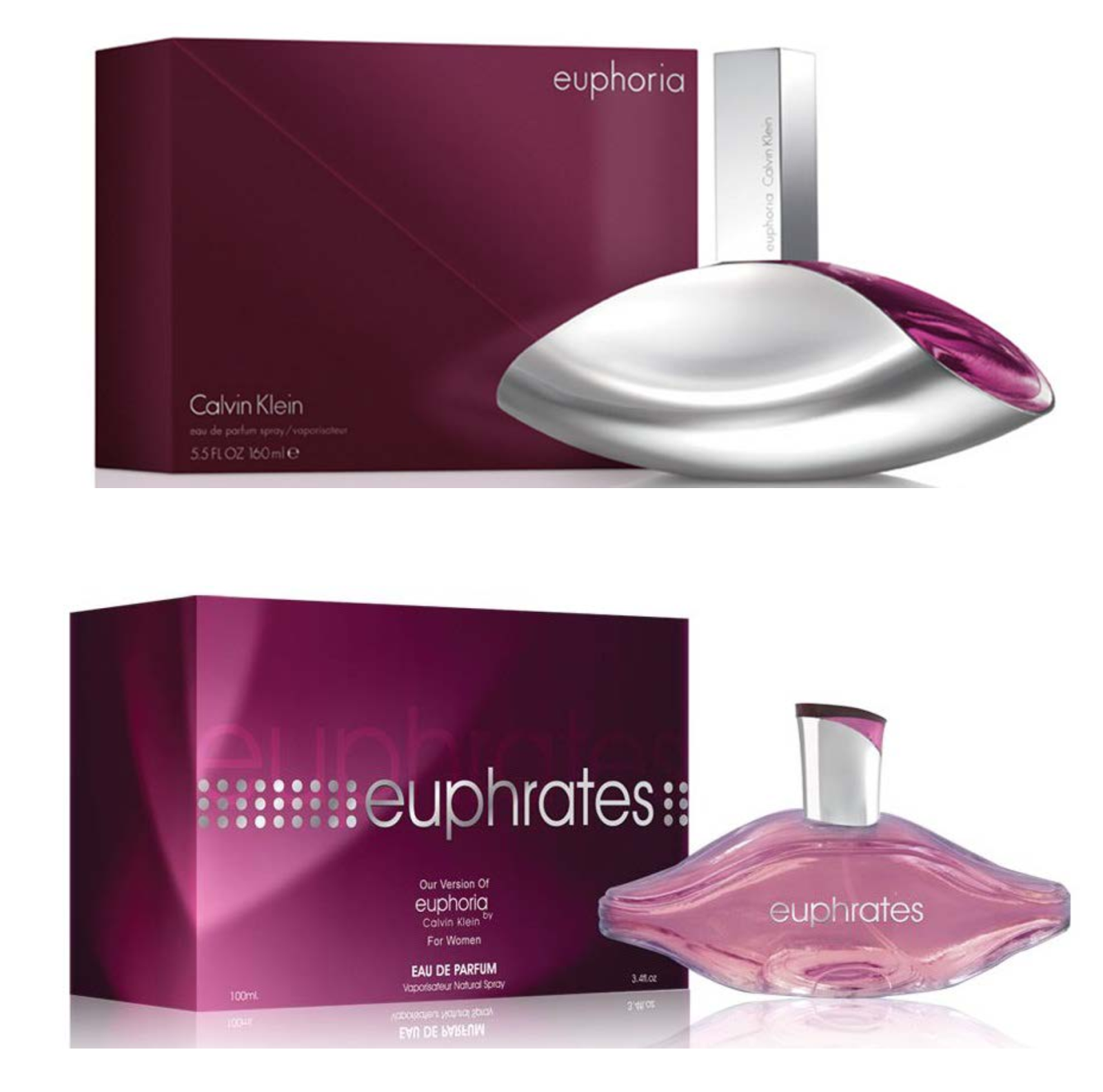
of the “Our Version Of” and “Not Associated With” legends.  As the court noted, the City Girl and Love
Story fragrances were “[a]t the less infringing end” of the similarity
spectrum; the names evoked similar associations and the packages had notable
differences.  By contrast, Excell’s OK
ROCK and SERENITY fragrances were “remarkably similar” to Coty’s CK SHOCK and
ETERNITY, in both name and trade dress. But even the “less infringing”
fragrances had significant similarities in color, shape, and layout.  As a whole, each allegedly infringing product
was quite similar to its counterpart.
 

similar, but not shockingly so (though still infringing)

way too similar

see more below

Excell argued that its “Our Version Of” and “Not Associated
With” disclaimers made clear that the company’s products weren’t associated
with Coty. But Coty’s marks were “significantly more prominent and accentuated
on Excell’s fragrances than both the supposedly disclamatory language … and
Excell’s own marks. In similar circumstances, courts have held that disclaimers
are not only ineffective, but actually cut against the allegedly infringing
party.”  Based partly on the survey
evidence, the court found the same here.
Competitive proximity: price differences/retail channels had
“little or no bearing on post-sale confusion as to the source of the goods,”
and might even enhance the likelihood that a consumer would buy the accused
product, to obtain the same prestige for less money.  Plus, the fragrance market is “somewhat fluid”
and some retailers have sold both parties’ fragrances, including K-mart, CVS,
Amazon, and eBay. Some Coty fragrances have been “diverted” and sold at CVS and
Dollar General, both of which sell Excell products.  The price difference was  “also largely immaterial” to initial interest
confusion; “most purchasers of fragrances in a retail setting are likely to
view the packaging before checking the price label.”  Finally, the price difference wasn’t huge.
Actual confusion: because “evidence of intentional copying
gives rise to a presumption of actual confusion,” the burden was on Excell to
demonstrate a lack of confusion, which it failed to do.  Excell’s own survey found that 19.5% of
respondents in an Internet survey identified Calvin Klein as the source of
Excell’s POSSESSION fragrance, and 15.1% identified Calvin Klein as the source
of Excell’s SERENITY fragrance.  And this
survey was limited to people who had recently shopped at a discount store, flea
market, rummage sale, or bazaar, even though Excell’s products were marketed
more broadly. And the survey didn’t measure initial interest or post-sale
confusion.  The survey was also flawed
because it allowed respondents to see all faces of the packaging at once.  And there were coding errors: people coded as
not confused said things like, “What a bargain for a Calvin Klein product”;
“It’s made by Calvin Klein, I like it”; and “Just the fact that it was made by
Calvin Klein is worth the $4.99.” 
Recoded, 25% of the respondents actually identified Calvin Klein as the
source of Excell’s POSSESSION and 20% identified Calvin Klein as the source of
Excell’s SERENITY.
Anyway, Coty’s survey was more reliable.  Coty used an Eveready format, which is the
gold standard for cases involving strong marks. 
Coty used a mall intercept survey of “people 18 years old and older who
ha[d] purchased a fragrance product for themselves, or for someone else, in the
past six months” and showed them versions of the Excell packages. Neither the
participants nor the interviewers were exposed as part of the survey to the
genuine Calvin Klein OBSESSION or ETERNITY fragrances; the expert concluded
that an average of 54% of the respondents misidentified the source of Excell’s
products as Calvin Klein.
Excell argued that the survey erred by not excluding
higher-end consumers to ensure that respondents were actual or potential
purchasers of Excell’s products, and the court noted some justice to the
argument.  The relevant market was the
junior user’s customers.  But there was
overlap, and it isn’t uncommon for higher-end fragrance companies, including
Coty, to create less expensive versions of their products — those “flankers” —
for sale at lower price points or in lower-end retail markets. Thus, the survey
still had probative value.  Nor was the
survey flawed for failing to provide respondents with relevant sales channel
and price information about the products, which is in fact irrelevant to initial-interest
and post-sale confusion.  It’s also true
that the survey only tested two fragrances, and the survey itself indicated that
the levels of consumer confusion would likely vary among the fragrances, with a
22% difference in confusion levels between the two Excell products tested.  But the results were still relevant to the
other fragrances, given their shared “common and prominent features.”
There was no evidence of actual confusion. But that wasn’t
important: (1) the employees’ invocation of the Fifth Amendment limited Coty’s
ability to obtain evidence, meaning that it would be unfair to hold the absence
of evidence against Coty; (2) Coty and Excell are manufacturers and
distributors of fragrances, not retailers, “and thus less likely to hear
directly from a duped consumer”; (3) consumers are less likely to complain
about a relatively inexpensive product; and (4) the survey was good alternative
evidence.
Intent: The record was “replete” with evidence of bad faith.
Excell’s business model “involved little more than ‘capitalizing on plaintiff’s
reputation and goodwill.’” Excell then “meticulously mimicked the external
trappings of those fragrances and used Coty’s protected marks on its packaging
in a way that, even with the disclamatory language, could only have been
calculated to capitalize on Coty’s goodwill.” Excell kept going “in the face of
a slew of complaints from third-party brand owners,” and chose its business
model shortly after a company that used to employ various Excell employees
entered a Consent Judgment with Calvin Klein and other fragrance producers
about infringing alternatives to CK fragrances. Excell argued that Consent
Judgement indicated approval of the use of the “Our Version” phrase, but (among
other things) the consent judgment didn’t allow anyone to indiscriminately sell
“Our Version Of” fragrances, but merely reserved the parties’ rights with
respect to fragrances containing the “Our Version Of” legend that weren’t
“unlawful under the Lanham Act” and that weren’t “Counterfeit” or “Knock-Off”
products.
Excell noted that there is a difference between intending to
compete by imitating successful features and intending to deceive purchasers as
to source. This is true, “but Excell’s intent falls squarely in the latter
category. The company’s intent to deceive can be inferred from the remarkable
similarities between the fragrances’ trade dresses, the prominent use of Coty’s
legends on Excell’s products, and the uncanny resemblance between the fragrance
names chosen by Excell and Coty’s products.” Anyway, an intent to copy “creates
a presumption of an intent to deceive, unless there is evidence to the
contrary.” [Ugh—does that mean that house brands imitating national brands are
presumptively intentionally deceptive?]
Quality, the Second Circuit outlier factor: Favored Coty,
because Excell’s products are cheap and use synthetic oils, rather than the
natural oils used in Coty’s fragrances. 
They don’t smell the same as Coty’s perfumes and colognes. Unlike Coty’s
fragrances, many of Excell’s Diamond Collection products were found to contain
DEHP, a potential carcinogen.
Consumer sophistication: As now-Justice Sotomayor wrote, “even
sophisticated buyers are not always careful buyers, and their very awareness of
status brand names and designs may make them more vulnerable to confusion.” Great
similarity, as here, reduces the ability of sophistication to resist
confusion.  And “it could be argued” that
Excell’s target demographic, “lower income, sometimes ethnic customers” was likely
to be less sophisticated about the differences between and among fragrances and
more easily confused upon seeing Excell’s cheaper knockoffs. This factor was a
draw.
Excell argued that it was making nominative fair use of
Coty’s marks.  But the Second Circuit
just held that nominative fair use isn’t a defense; it instead provides
additional factors to consider alongside the Polaroid factors.  “[T]he
manner in which Excell displays Coty’s source identifiers belies its argument
that it is merely using the marks to inform consumers that it is not the
manufacturer of the original fragrance.” The fair use argument “would be on
firmer ground if it sold its fragrances in generic bottles and cartons, picked
fragrance names that were unrelated to any of Coty’s, included its disclaimers
without prominently displaying Coty’s typesetting or marks, and marketed its
own brand on the packaging in a noticeable manner.”  But it didn’t do any of that.
Having found likely infringement, the court turned to trademark
dilution, federal for the registered Calvin Klein, Vera Wang, and Lady Gaga
marks, and New York law for the remaining marks.  The court found dilution by blurring.  Excell didn’t contest the fame of the Calvin
Klein, Vera Wang, and Lady Gaga marks. The the similarity between the marks as
well as the distinctiveness and degree of recognition of the plaintiff’s mark
favored Coty, as did Coty’s otherwise substantially exclusive use and Excell’s
intent to create an association.  The
court apparently misread the sixth statutory factor, “actual association,” as
something like “truthful association,” finding that it favored Coty because
Excell had no “actual association” with Coty, but this really can’t have
mattered.  The court found state law
blurring for the same reasons.

Tarnishment: Yep. “Excell uses inferior oils, employs cheaper packaging
components, lacks any quality assurance program, and produces fragrances with
potentially harmful ingredients.” The ongoing criminal case also arguably
risked tarnishment, but there was “no reason to believe that the average
consumer would know about the criminal charges, let alone link them to Coty.”
False advertising: yes. 
“Our version of” was misleading. 
Coty didn’t have to show literal falsity, because the words implied that
the products were “similar, if not equivalent.” 
[If the surveys show that people aren’t reacting to the disclaimers by
understanding the difference, are they even reading the disclaimers, and can
there be material deception without reading?]  The duality of contrast and equivalence was
inherent in the use of the word “version.” 
“But Excell indisputably does not produce fragrances of a similar
quality to those of Coty; nor does it produce anything that could reasonably be
called a ‘version’ of Coty’s products.” 
[This is consistent with caselaw indicating that, even if there are
possible ambiguities, when the defendant isn’t telling the truth under any of
the different possibilities, literal falsity may be found.]  In context, along with the infringing
marks/packaging, the court found an intent to connote a false equivalence
(citing necessary implication cases).
Coty’s survey also found that 20% of respondents believed
the legend communicated the message that Excell’s fragrances were substantially
equivalent to Coty’s fragrances on formula and longevity of scent. Excell
criticized the survey for asking “closed-ended questions of whether the two
fragrances were ‘the same or different,’ rather than giving respondents the
option to indicate that the products were ‘similar.’ ” But participants were
asked a series of open-ended questions, including, “does the wording on these
two products communicate or imply anything to you” about whether certain
qualities of the products “are the same or different?” Participants then
responded using their own language and explained what the wording communicated
to them. Plus, surveys crafted to test comparative advertising claims sometimes
call for “a more defined option set,” even if closed-ended questions aren’t as
good.  Excell’s survey also was
closed-ended, but added a third option, “similar.” This didn’t add clarity;
anyway, given the significant differences between the companies’ fragrances, the
Excell survey’s finding that “[a]pproximately two-thirds of consumers view[ed]
the Excell and Calvin Klein products to be ‘similar’ ” only strengthened the court’s
falsity conclusion.
Materiality: consumers “undoubtedly care about the quality
and longevity of their perfume or cologne.” Because it was a false comparative
ad, no further proof of likely injury was necessary.
Injunctive relief: with no mention of eBay, the court reasoned that likely confusion establishes
irreparable harm. Money alone couldn’t compensate for the company’s
unquantifiable “losses of reputation and goodwill and resulting loss of
customers.” The balance of hardships favored Coty, because Excell wasn’t
selling any products and was a newcomer to the market anyway.  Coty’s request wasn’t moot, because Excell hadn’t
dissolved as of the time of trial.  “Because
Excell could simply resume operations directly or indirectly — and because its
directors, officers, and employees have demonstrated such tendencies in the
past— Excell has not shown that it is ‘absolutely clear that [its] wrongful
conduct will not recur.’”  Coty’s request
for injunctive relief was granted with respect to Excell and its “officers,
agents, servants, employees … [and] other persons who are in active concert
or participation” with them.
The court also awarded an accounting of profits.  This equitable remedy requires courts to
consider “(1) the degree of certainty that the defendant benefited from the
unlawful conduct; (2) availability and adequacy of other remedies; (3) the role
of a particular defendant in effectuating the infringement; (4) plaintiff’s
laches; and (5) plaintiff’s unclean hands.” All of these factors favored Coty. Excell’s
business model depended on creating customer confusion, making it certain that
it benefited from the infringement. Excell’s sales of the accused fragrances
from July 2010 through April 2016 totaled a bit over $6.5 million, and it
didn’t submit reliable evidence of its costs, only spreadsheets with totals
that witnesses couldn’t adequately explain. 
Thus, Coty was awarded all Excell’s revenue for the relevant time
periods.
Coty argued that it should get treble damages because its
marks were counterfeited. A counterfeit mark must be “substantially indistinguishable”
or “spurious,” which requires more than a mere similarity between the marks or
a “colorable imitation.”  Excell’s
infringing products weren’t countefeits. 
None used the exact same name, nor the same/“substantially
indistinguishable” combination of colors, designs, and shapes. Though Excell
did use Coty’s own marks as part of its disclaimers, the existence of those
disclaimers and Excell’s (admittedly less prominent) use of the Diamond
Collection mark on its bottles “creates enough of a contextual difference that
[Excell’s fragrances] cannot be considered counterfeits of [Coty’s].”  The court was unwilling to conclude that
Excell was trying to trick buyers into thinking they were actually buying Coty
fragrances.  [Note how much implicit
weight this gives to the IIC/post-sale confusion theories.]
The court refused to find the case “exceptional” for
fees/prejudgment interest purposes. “Exceptional cases” involve fraud, bad
faith, or willfulness, but bad faith isn’t an automatic entitlement to
attorneys’ fees or prejudgment interest. 
Excell’s litigation conduct, “while certainly not commendable, falls
short of the ‘the sort of misconduct that supports an attorney fees award.’”  Plus, Coty didn’t show that it suffered
“ascertainable damage”: “the fact is that, despite several years of competition
with Excell’s infringing products, Coty failed to produce demonstrable evidence
of actual confusion.”  Plus, the outcome
of the case “was by no means a foregone conclusion,” especially as to
fragrances at the less infringing end of the “similarity spectrum.”  Coty did get its costs, though.
from Blogger http://ift.tt/2wFSjZc

Posted in Uncategorized | Tagged , , , , , , , | Leave a comment

It stinks to high heaven: knockoff fragrances infringing, diluting, falsely advertised, but not counterfeit

Coty Inc. v. Excell Brands, LLC, No. 15-CV-7029, 2017 WL
4155402 (S.D.N.Y. Sept. 18, 2017)
Coty and a number of other producers and distributors of well-known
fragrances sued Excell, which produced cheap “versions” of Coty’s fragrances,
with similar names and “nearly identical packaging.” “Compounding matters,
Excell prominently included on its packaging Coty’s own marks, albeit under
words to the effect of “Our Version Of” in comparatively smaller text.”  Guess what Judge Furman found as to
infringement and dilution after a bench trial? There was also false advertising, but not counterfeiting. Coty was entitled to
injunctive relief and to recover Excell’s profits, but not to enhanced damages,
and the case wasn’t “exceptional” for the purpose of attorney’s fees and
prejudgment interest.
back

front

To give some idea of the scope of Coty’s branding efforts, “between
2002 and 2015, Coty spent over $658 million advertising and promoting its
Calvin Klein fragrances, over $114 million advertising and promoting its Vera
Wang fragrances, over $14 million advertising and promoting its Lady Gaga
fragrances, and over $13 million advertising and promoting its Joop! fragrances.”  Its net sales over that period for Calvin
Klein fragrances were over $2.2 billion, for its Vera Wang products over $296
million, for its Lady Gaga products over $28 million, and for its Joop! line
over $188 million. Some are successful enough to have subbrands, or “flankers” –Dark
Obsession, Eternity Aqua, CK One Shock, and CK Free Blue.
Excell sought to copy expensive fragrances in a way that
would be “understood by its customer base of ‘lower income, sometimes ethnic
customers.’ ” Excell then chose a product name to evoke the name of the
original fragrance. “Excell did not make any meaningful effort to replicate the
scent of Coty’s products. Instead, using only their own noses and reviews of
the original fragrances, Excell employees made broad recommendations to the
company’s supplier in India, which then manufactured the alternative fragrances
and packaging,” though Excell often supplied the original fragrance (or a
picture of the fragrance) it sought to emulate along with instructions on how
to emulate it. Excell also frequently made changes to the products so that the
packaging would more closely resemble Coty’s original branded fragrances.
Excell nonetheless lacked any meaningful quality assurance program. 
On the front of each fragrance box at issue, Excell included
a legend stating that the fragrance was “Our Version Of” the relevant Coty
product. On the back was “Not Associated With The Makers Of,” followed by
reference to the relevant Coty product.  But Coty’s marks were depicted more
prominently than the other text. “On the top of each box, in comparatively
smaller lettering, Excell included its own brand name: Diamond Collection
Luxurious Fragrances.”
Excell didn’t advertise or market directly to consumers, but
sold primarily to traditional retailers and discount chains, such as Kmart,
Dollar General, and Ross Stores, and its products were also available on Amazon
and eBay.  
In 2015, several of Excell’s principals and employees were
indicted on money laundering and other offenses. Given the pending proceedings,
three such individuals invoked their privilege against self-incrimination in
these proceedings. Excell shut down its business operations and ceased selling
its fragrances in December 2016, unrelated to the present lawsuit.
The court rejected Excell’s laches defense.  Laches is no defense against injunctive
relief when the defendant intended the infringement, which the court found to
be the case here. Also, Coty didn’t delay unreasonably; it sued in 2015, “well
within the applicable six-year statute of limitations” given that Excell was
founded in 2010. Further, Excell’s sales were relatively insignificant during
its first few years of operation and Excell’s marketing efforts to its
retailers were less focused on the Coty knockoffs during that time.  Moreover, even if Excell could show
unreasonable delay, it didn’t show evidence of prejudice. By Excell’s own
admission, the filing of the lawsuit had no effect on its operations: it
continued to sell its knockoffs long after Coty filed suit, and was “winding
down” due to the pending criminal charges. “[A]ny conceivable prejudice was
mooted when Excell decided, for reasons unrelated to this case, to cease its
operations and stop using its brands.”
Unfortunately, the court decided that HOMME was suggestive
for cologne.  It reasoned that, even if
the general consumer knows that “homme” means “man,” it still “requires
imagination, thought and perception to reach [the] conclusion” that HOMME is
not just a cologne, but a cologne targeting men. Of course, that’s not the
traditional framing of the conceptual distinctiveness inquiry, though courts
increasingly have (wrongly) changed their approach to this question; the PTO
would ask whether, knowing the mark and the goods, imagination is required to
connect the two.  Cologne for men?  Not so much. 
This didn’t matter much here, given the secondary meaning of the marks.
The court also found that the packages and bottles were
product packaging, and thus capable of inherent distinctiveness as trade
dress.  Excell argued that the bottles
were product design, an argument the court found no support for; I’d be more
sympathetic, since part of the point of these bottles is to have beautiful
things on one’s dresser, unlike soda or alcohol bottles.  Again, though, Coty also showed secondary
meaning.
Similarity: “Excell’s products copy, with only slight
differences, the names, typefaces, packaging, design, coloring, and bottle
shapes of Coty’s fragrances,” and also include two exact replicas of Coty’s
house mark (e.g., Calvin Klein) and product mark (e.g., ETERNITY AQUA) as part
of the “Our Version Of” and “Not Associated With” legends.  As the court noted, the City Girl and Love
Story fragrances were “[a]t the less infringing end” of the similarity
spectrum; the names evoked similar associations and the packages had notable
differences.  By contrast, Excell’s OK
ROCK and SERENITY fragrances were “remarkably similar” to Coty’s CK SHOCK and
ETERNITY, in both name and trade dress. But even the “less infringing”
fragrances had significant similarities in color, shape, and layout.  As a whole, each allegedly infringing product
was quite similar to its counterpart.
 

similar, but not shockingly so (though still infringing)

way too similar

see more below

Excell argued that its “Our Version Of” and “Not Associated
With” disclaimers made clear that the company’s products weren’t associated
with Coty. But Coty’s marks were “significantly more prominent and accentuated
on Excell’s fragrances than both the supposedly disclamatory language … and
Excell’s own marks. In similar circumstances, courts have held that disclaimers
are not only ineffective, but actually cut against the allegedly infringing
party.”  Based partly on the survey
evidence, the court found the same here.
Competitive proximity: price differences/retail channels had
“little or no bearing on post-sale confusion as to the source of the goods,”
and might even enhance the likelihood that a consumer would buy the accused
product, to obtain the same prestige for less money.  Plus, the fragrance market is “somewhat fluid”
and some retailers have sold both parties’ fragrances, including K-mart, CVS,
Amazon, and eBay. Some Coty fragrances have been “diverted” and sold at CVS and
Dollar General, both of which sell Excell products.  The price difference was  “also largely immaterial” to initial interest
confusion; “most purchasers of fragrances in a retail setting are likely to
view the packaging before checking the price label.”  Finally, the price difference wasn’t huge.
Actual confusion: because “evidence of intentional copying
gives rise to a presumption of actual confusion,” the burden was on Excell to
demonstrate a lack of confusion, which it failed to do.  Excell’s own survey found that 19.5% of
respondents in an Internet survey identified Calvin Klein as the source of
Excell’s POSSESSION fragrance, and 15.1% identified Calvin Klein as the source
of Excell’s SERENITY fragrance.  And this
survey was limited to people who had recently shopped at a discount store, flea
market, rummage sale, or bazaar, even though Excell’s products were marketed
more broadly. And the survey didn’t measure initial interest or post-sale
confusion.  The survey was also flawed
because it allowed respondents to see all faces of the packaging at once.  And there were coding errors: people coded as
not confused said things like, “What a bargain for a Calvin Klein product”;
“It’s made by Calvin Klein, I like it”; and “Just the fact that it was made by
Calvin Klein is worth the $4.99.” 
Recoded, 25% of the respondents actually identified Calvin Klein as the
source of Excell’s POSSESSION and 20% identified Calvin Klein as the source of
Excell’s SERENITY.
Anyway, Coty’s survey was more reliable.  Coty used an Eveready format, which is the
gold standard for cases involving strong marks. 
Coty used a mall intercept survey of “people 18 years old and older who
ha[d] purchased a fragrance product for themselves, or for someone else, in the
past six months” and showed them versions of the Excell packages. Neither the
participants nor the interviewers were exposed as part of the survey to the
genuine Calvin Klein OBSESSION or ETERNITY fragrances; the expert concluded
that an average of 54% of the respondents misidentified the source of Excell’s
products as Calvin Klein.
Excell argued that the survey erred by not excluding
higher-end consumers to ensure that respondents were actual or potential
purchasers of Excell’s products, and the court noted some justice to the
argument.  The relevant market was the
junior user’s customers.  But there was
overlap, and it isn’t uncommon for higher-end fragrance companies, including
Coty, to create less expensive versions of their products — those “flankers” —
for sale at lower price points or in lower-end retail markets. Thus, the survey
still had probative value.  Nor was the
survey flawed for failing to provide respondents with relevant sales channel
and price information about the products, which is in fact irrelevant to initial-interest
and post-sale confusion.  It’s also true
that the survey only tested two fragrances, and the survey itself indicated that
the levels of consumer confusion would likely vary among the fragrances, with a
22% difference in confusion levels between the two Excell products tested.  But the results were still relevant to the
other fragrances, given their shared “common and prominent features.”
There was no evidence of actual confusion. But that wasn’t
important: (1) the employees’ invocation of the Fifth Amendment limited Coty’s
ability to obtain evidence, meaning that it would be unfair to hold the absence
of evidence against Coty; (2) Coty and Excell are manufacturers and
distributors of fragrances, not retailers, “and thus less likely to hear
directly from a duped consumer”; (3) consumers are less likely to complain
about a relatively inexpensive product; and (4) the survey was good alternative
evidence.
Intent: The record was “replete” with evidence of bad faith.
Excell’s business model “involved little more than ‘capitalizing on plaintiff’s
reputation and goodwill.’” Excell then “meticulously mimicked the external
trappings of those fragrances and used Coty’s protected marks on its packaging
in a way that, even with the disclamatory language, could only have been
calculated to capitalize on Coty’s goodwill.” Excell kept going “in the face of
a slew of complaints from third-party brand owners,” and chose its business
model shortly after a company that used to employ various Excell employees
entered a Consent Judgment with Calvin Klein and other fragrance producers
about infringing alternatives to CK fragrances. Excell argued that Consent
Judgement indicated approval of the use of the “Our Version” phrase, but (among
other things) the consent judgment didn’t allow anyone to indiscriminately sell
“Our Version Of” fragrances, but merely reserved the parties’ rights with
respect to fragrances containing the “Our Version Of” legend that weren’t
“unlawful under the Lanham Act” and that weren’t “Counterfeit” or “Knock-Off”
products.
Excell noted that there is a difference between intending to
compete by imitating successful features and intending to deceive purchasers as
to source. This is true, “but Excell’s intent falls squarely in the latter
category. The company’s intent to deceive can be inferred from the remarkable
similarities between the fragrances’ trade dresses, the prominent use of Coty’s
legends on Excell’s products, and the uncanny resemblance between the fragrance
names chosen by Excell and Coty’s products.” Anyway, an intent to copy “creates
a presumption of an intent to deceive, unless there is evidence to the
contrary.” [Ugh—does that mean that house brands imitating national brands are
presumptively intentionally deceptive?]
Quality, the Second Circuit outlier factor: Favored Coty,
because Excell’s products are cheap and use synthetic oils, rather than the
natural oils used in Coty’s fragrances. 
They don’t smell the same as Coty’s perfumes and colognes. Unlike Coty’s
fragrances, many of Excell’s Diamond Collection products were found to contain
DEHP, a potential carcinogen.
Consumer sophistication: As now-Justice Sotomayor wrote, “even
sophisticated buyers are not always careful buyers, and their very awareness of
status brand names and designs may make them more vulnerable to confusion.” Great
similarity, as here, reduces the ability of sophistication to resist
confusion.  And “it could be argued” that
Excell’s target demographic, “lower income, sometimes ethnic customers” was likely
to be less sophisticated about the differences between and among fragrances and
more easily confused upon seeing Excell’s cheaper knockoffs. This factor was a
draw.
Excell argued that it was making nominative fair use of
Coty’s marks.  But the Second Circuit
just held that nominative fair use isn’t a defense; it instead provides
additional factors to consider alongside the Polaroid factors.  “[T]he
manner in which Excell displays Coty’s source identifiers belies its argument
that it is merely using the marks to inform consumers that it is not the
manufacturer of the original fragrance.” The fair use argument “would be on
firmer ground if it sold its fragrances in generic bottles and cartons, picked
fragrance names that were unrelated to any of Coty’s, included its disclaimers
without prominently displaying Coty’s typesetting or marks, and marketed its
own brand on the packaging in a noticeable manner.”  But it didn’t do any of that.
Having found likely infringement, the court turned to trademark
dilution, federal for the registered Calvin Klein, Vera Wang, and Lady Gaga
marks, and New York law for the remaining marks.  The court found dilution by blurring.  Excell didn’t contest the fame of the Calvin
Klein, Vera Wang, and Lady Gaga marks. The the similarity between the marks as
well as the distinctiveness and degree of recognition of the plaintiff’s mark
favored Coty, as did Coty’s otherwise substantially exclusive use and Excell’s
intent to create an association.  The
court apparently misread the sixth statutory factor, “actual association,” as
something like “truthful association,” finding that it favored Coty because
Excell had no “actual association” with Coty, but this really can’t have
mattered.  The court found state law
blurring for the same reasons.

Tarnishment: Yep. “Excell uses inferior oils, employs cheaper packaging
components, lacks any quality assurance program, and produces fragrances with
potentially harmful ingredients.” The ongoing criminal case also arguably
risked tarnishment, but there was “no reason to believe that the average
consumer would know about the criminal charges, let alone link them to Coty.”
False advertising: yes. 
“Our version of” was misleading. 
Coty didn’t have to show literal falsity, because the words implied that
the products were “similar, if not equivalent.” 
[If the surveys show that people aren’t reacting to the disclaimers by
understanding the difference, are they even reading the disclaimers, and can
there be material deception without reading?]  The duality of contrast and equivalence was
inherent in the use of the word “version.” 
“But Excell indisputably does not produce fragrances of a similar
quality to those of Coty; nor does it produce anything that could reasonably be
called a ‘version’ of Coty’s products.” 
[This is consistent with caselaw indicating that, even if there are
possible ambiguities, when the defendant isn’t telling the truth under any of
the different possibilities, literal falsity may be found.]  In context, along with the infringing
marks/packaging, the court found an intent to connote a false equivalence
(citing necessary implication cases).
Coty’s survey also found that 20% of respondents believed
the legend communicated the message that Excell’s fragrances were substantially
equivalent to Coty’s fragrances on formula and longevity of scent. Excell
criticized the survey for asking “closed-ended questions of whether the two
fragrances were ‘the same or different,’ rather than giving respondents the
option to indicate that the products were ‘similar.’ ” But participants were
asked a series of open-ended questions, including, “does the wording on these
two products communicate or imply anything to you” about whether certain
qualities of the products “are the same or different?” Participants then
responded using their own language and explained what the wording communicated
to them. Plus, surveys crafted to test comparative advertising claims sometimes
call for “a more defined option set,” even if closed-ended questions aren’t as
good.  Excell’s survey also was
closed-ended, but added a third option, “similar.” This didn’t add clarity;
anyway, given the significant differences between the companies’ fragrances, the
Excell survey’s finding that “[a]pproximately two-thirds of consumers view[ed]
the Excell and Calvin Klein products to be ‘similar’ ” only strengthened the court’s
falsity conclusion.
Materiality: consumers “undoubtedly care about the quality
and longevity of their perfume or cologne.” Because it was a false comparative
ad, no further proof of likely injury was necessary.
Injunctive relief: with no mention of eBay, the court reasoned that likely confusion establishes
irreparable harm. Money alone couldn’t compensate for the company’s
unquantifiable “losses of reputation and goodwill and resulting loss of
customers.” The balance of hardships favored Coty, because Excell wasn’t
selling any products and was a newcomer to the market anyway.  Coty’s request wasn’t moot, because Excell hadn’t
dissolved as of the time of trial.  “Because
Excell could simply resume operations directly or indirectly — and because its
directors, officers, and employees have demonstrated such tendencies in the
past— Excell has not shown that it is ‘absolutely clear that [its] wrongful
conduct will not recur.’”  Coty’s request
for injunctive relief was granted with respect to Excell and its “officers,
agents, servants, employees … [and] other persons who are in active concert
or participation” with them.
The court also awarded an accounting of profits.  This equitable remedy requires courts to
consider “(1) the degree of certainty that the defendant benefited from the
unlawful conduct; (2) availability and adequacy of other remedies; (3) the role
of a particular defendant in effectuating the infringement; (4) plaintiff’s
laches; and (5) plaintiff’s unclean hands.” All of these factors favored Coty. Excell’s
business model depended on creating customer confusion, making it certain that
it benefited from the infringement. Excell’s sales of the accused fragrances
from July 2010 through April 2016 totaled a bit over $6.5 million, and it
didn’t submit reliable evidence of its costs, only spreadsheets with totals
that witnesses couldn’t adequately explain. 
Thus, Coty was awarded all Excell’s revenue for the relevant time
periods.
Coty argued that it should get treble damages because its
marks were counterfeited. A counterfeit mark must be “substantially indistinguishable”
or “spurious,” which requires more than a mere similarity between the marks or
a “colorable imitation.”  Excell’s
infringing products weren’t countefeits. 
None used the exact same name, nor the same/“substantially
indistinguishable” combination of colors, designs, and shapes. Though Excell
did use Coty’s own marks as part of its disclaimers, the existence of those
disclaimers and Excell’s (admittedly less prominent) use of the Diamond
Collection mark on its bottles “creates enough of a contextual difference that
[Excell’s fragrances] cannot be considered counterfeits of [Coty’s].”  The court was unwilling to conclude that
Excell was trying to trick buyers into thinking they were actually buying Coty
fragrances.  [Note how much implicit
weight this gives to the IIC/post-sale confusion theories.]
The court refused to find the case “exceptional” for
fees/prejudgment interest purposes. “Exceptional cases” involve fraud, bad
faith, or willfulness, but bad faith isn’t an automatic entitlement to
attorneys’ fees or prejudgment interest. 
Excell’s litigation conduct, “while certainly not commendable, falls
short of the ‘the sort of misconduct that supports an attorney fees award.’”  Plus, Coty didn’t show that it suffered
“ascertainable damage”: “the fact is that, despite several years of competition
with Excell’s infringing products, Coty failed to produce demonstrable evidence
of actual confusion.”  Plus, the outcome
of the case “was by no means a foregone conclusion,” especially as to
fragrances at the less infringing end of the “similarity spectrum.”  Coty did get its costs, though.

from Blogger http://ift.tt/2wFSjZc

Posted in Uncategorized | Tagged , , , , , , , | Leave a comment

False advertising case stomped by ambiguity of “original”

Not Dead Yet Manufacturing Inc. v. Pride Solutions, LLC, 2017
WL 4150720, No. 13 C 3418 (N.D. Ill. Sept. 19, 2017)
Patent case with a side order of false advertising.  NDY owns patents concerning ‘quick connect
and disconnect’ apparatuses for the assembly of devices known as ‘stalk
stompers.‘ A stalk stomper “attaches to the front of a combine or tractor and
flattens cornstalks after they have been cut, thereby protecting the tires of
the combine or tractor from damage caused by the sharp remains of the stalks.”
The ‘quick connect and disconnect apparatus’ enabled faster, easier, tool-free
attachment and removal of stalk stompers.
NDY challenged Pride’s advertising for its products as ‘The
Original Quick Disconnect Stalk Stomper‘ even though Pride knew that NDY and
another manufacturer had sold quick-disconnect stalk stompers before the the
Pride QD1 was commercially available. Pride also began a campaign for its QD2 stating
‘This design change replaces a major change we introduced three years ago with
the earliest quick disconnect.’  NDY sued
under the Lanham Act, the Illinois Uniform Deceptive Trade Practices Act, and
the Illinois Consumer Fraud and Deceptive Business Practices Act.
Pride argued that all of their stalk stomper products,
regardless of the products’ individual features, were marketed as ‘THE
ORIGINAL’ because Pride was the first company to introduce stalk stompers,
decades ago, and was the first to refer to their stalk stomper products using
the term ‘quick disconnect,’ whereas NDY used ‘quick release.’ Thus, the ‘The
Original’ was not literally false, and the QD2 ad just said that the QD1 was Pride’s earliest quick-disconnect
product. [This last seems like an implausible reading of that claim.]
The court concluded that ‘The Original Quick Disconnect
Stalk Stomper’ was ambiguous. On its face, the ad didn’t indicate that whether
the phrase means that the QD1 was the first product to contain a quick
connect-disconnect feature, whether it was the first product to be marketed as
a ‘quick disconnect‘ device, or whether the product was just one in a line of
stalk stompers branded as ‘The Original.’ NDY failed to provide evidence of
consumer confusion, so the Lanham Act claim failed.

Interestingly, the court noted that the ICFA and IUDTPA didn’t
have a falsity/misleadingness divide: likely deception or capacity to deceive
was sufficient, without evidence of consumer perception.  However, the claims still failed because NDY
didn’t show it was likely to suffer or actually suffered any harm from the
alleged falsity. There was no evidence that the ads would confuse consumers
about whether the QD1 was the first stalk stomper product to incorporate a
quick connect-disconnect feature, “let alone evidence demonstrating that any
such confusion would have an adverse effect on Plaintiff’s sales or otherwise
cause harm.”  NDY argued that it didn’t
need to prove actual damages because it sought only equitable relief, including
redress for unjust enrichment. But there was no evidence that Pride was
unjustly enriched by its claim.  

from Blogger http://ift.tt/2xW7XQ7

Posted in Uncategorized | Tagged | Leave a comment

9th Circuit is sour on sugar-sweetened beverage disclosure

American Beverage Association v. City and County of San
Francisco, No. 16-16072 (9th Cir. Sept. 19, 2017)
Plaintiffs challenged a SF ordinance requiring warnings
about the health effects of certain sugar-sweetened beverages (SSBs) on certain
fixed advertising (e.g., billboards) in the city. The court of appeals reversed
the district court’s refusal to preliminarily enjoin the ordinance, on the
grounds that the required disclosure was controversial/misleading and unduly
burdensome.
The ordinance required ads to contain this warning: “WARNING:
Drinking beverages with added sugar(s) contributes to obesity, diabetes, and
tooth decay. This is a message from the City and County of San Francisco.”  Covered ads excluded, inter alia, ads in
periodicals, television, electronic media, SSB containers or packaging, menus,
shelf tags, vehicles, or logos that occupied an area less than thirty-six
square inches.  SSBs were defined to
include soda and other non-alcoholic beverages that contain one or more added
sweeteners and more than twenty-five calories per twelve fluid ounces of
beverage, but not milk, milk alternatives primarily consisting of plant-based
ingredients, 100% natural fruit juice, natural vegetable juice, infant formula,
medical food, supplements, and certain other products.  The warning had to occupy 20 percent of a
covered ad and be set off with a rectangular border. San Francisco’s purposes
included the desire to “inform the public of the presence of added sugars and
thus promote informed consumer choice that may result in reduced caloric intake
and improved diet and health, thereby reducing illnesses to which
[sugar-sweetened beverages] contribute and associated economic burdens.”
Zauderer applies
to mandatory disclosures, whether or not they are designed to remedy deception.
 A “purely factual and uncontroversial
disclosure that is not unduly burdensome will withstand First Amendment
scrutiny so long as it is reasonably related to a substantial government
interest.” The government has the burden of showing that a disclosure is purely
factual and uncontroversial, not unduly burdensome, and reasonably related to a
substantial government interest.  “[U]ncontroversial”
here “refers to the factual accuracy of the compelled disclosure, not to its
subjective impact on the audience,” and a “literally true but nonetheless
misleading and, in that sense, untrue” disclosure is not purely factual under Zauderer.
The majority concluded that “the factual accuracy of the
warning is, at a minimum, controversial.” he unqualified statement that
“[d]rinking beverages with added sugar(s) contributes to obesity, diabetes, and
tooth decay” “conveys the message that sugar-sweetened beverages contribute to
these health conditions regardless of the quantity consumed or other lifestyle
choices.” This message contradicted FDA statements that added sugars are
“generally recognized as safe,” and “can be a part of a healthy dietary pattern
when not consumed in excess amounts.” SF’s experts concluded that “there is a
clear scientific consensus” that sugar-sweetened beverages contribute to
obesity and diabetes through “excessive caloric intake” and “by adding extra
calories to the diet,” but didn’t directly challenge the conclusion of the plaintiffs’
expert that “when consumed as part of a diet that balances caloric intake with
energy output, consuming beverages with added sugar does not contribute to
obesity or diabetes.” Because SF’s warning wasn’t about overconsumption, and it
said “contributes” instead of “may contribute,” “the accuracy of the warning is
in reasonable dispute.”
Furhtermore, the warning was “misleading and, in that sense,
untrue.” By focusing on a single product and not on others with an equal or
greater amount of added sugars and calories, “the warning conveys the message
that sugar-sweetened beverages are less healthy than other sources of added
sugars and calories and are more likely to contribute to obesity, diabetes, and
tooth decay than other foods.”  Borrowing
an example from plaintiffs, the court reasoned that “If car dealers were
required to post a warning only on Toyota vehicles that said: ‘WARNING: Toyotas
contribute to roll-over crashes,’ the common-sense conclusion would be that
Toyotas are more likely to cause rollovers than other vehicles.”
[Note: not all courts will apply this interpretive standard,
which relies on the ordinary rules of implicature, to false advertising cases.
They should.  Second note: under false
advertising precedents, misleadingness is a matter of extrinsic evidence, not
simple reading.  If the government’s
burden is to show that the disclosure is nonmisleading, should it have to
provide expert or survey evidence of this? 
If the government does provide such evidence of nonmisleadingness, can
it rebut the court’s conclusions about the meaning of the disclosure?  I have my own conclusions about this, but
more overarchingly I believe that judicial reasoning about how consumers react
to information should be consistent across cases, adjusting appropriately for
who has the burden of proof.]
The current state of research on this issue indicated that
this message was deceptive. According to the FDA, “added sugars, including
sugar-sweetened beverages, are no more likely to cause weight gain in adults
than any other source of energy.” The American Dental Association likewise
cautioned against the “growing popularity of singling-out sugar-sweetened
beverages” because “ the evidence is not yet sufficient to single out any one
food or beverage product as a key driver of dental caries.” SF argued that an
underinclusive warning is okay because it was entitled “to attack problems
piecemeal.” But the problem was that the warning was potentially misleading,
not because it “does not get at all facets of the problem it is designed to
ameliorate.”
SF argued that people were more likely to over-consume
sugar-sweetened beverages than other foods. “But even if it were undisputed
that consumption of sugar-sweetened beverages gives rise to unique behavioral
risks, the warning does not communicate that information”—it didn’t mention
behavioral risks, “and thus clearly implies that there is something inherent
about sugar-sweetened beverages that contributes to these health risks in a way
that other sugar-sweetened products do not, regardless of consumer behavior.”  [This is an example of how “inherent” is
usually an unhelpful concept when people are involved.]   The
district court erred in finding that it would be unreasonable to interpret the
warning to mean that sugar-sweetened beverages are uniquely or inherently unhealthy.
Separately, the warning imposed an undue burden because it
required a black box, bold warning covering 20 percent of the ads, making it
impractical to advertise on covered media.  The court of appeals agreed that “the black
box warning overwhelms other visual elements in the advertisement,” thus
imposing an undue burden.  Although the
district court reasoned that a commercial speaker could use the remaining 80
percent of its advertising space to engage in counter-speech, that wasn’t
enough—the speaker was being forced “to tailor its speech to an opponent’s
agenda,” and to respond to a one-sided and misleading message when it would
“prefer to be silent” (which sounds like it’s going back to point one).  “[C]ountering San Francisco’s misleading
message would leave them little room to communicate their intended message.
This would defeat the purpose of the advertisement, turning it into a vehicle
for a debate about the health effects of sugar-sweetened beverages.”
 

sample ad submitted by plaintiffs
Plaintiffs submitted unrefuted declarations from major
companies manufacturing sugar-sweetened beverages stating that they’d remove
advertising from covered media if San Francisco’s ordinance went into effect. Effectively
ruling out advertising in a particular medium was evidence of undue burden
(consider the effect of this holding on FTC/FDA disclosure rules and Twitter
ads).   The district court erred in rejecting this
evidence because the declarations were “self-serving,” which alone isn’t enough
reason to disregard an affidavit.  The
district court also reasoned that tobacco and pharmaceutical companies
continued to advertise despite being compelled to provide similar warnings. But
SSBs don’t have “the same physiologically addictive qualities as tobacco, nor
are they prescribed by doctors to treat health conditions like pharmaceutical
products. There is no evidence in the record that advertisers have continued
advertising products analogous to sugar-sweetened beverages in the face of
compelled disclosures of the sort required here.”  
[While I understand why the payoff from addiction might be
enough to get tobacco companies to continue to advertise despite the warnings, I
don’t get the second distinction.  If
anything, the availability of an alternate means to get to the
consumer—advertising to doctors who prescribe drugs—makes it even clearer that
the benefits of advertising directly to consumers induce pharmacos to continue
to advertise despite onerous disclosure requirements, thus not chilling their
speech.  Is the distinction one of care
exercised by consumers in choosing?  The
profit margin on drugs/payoff per ad dollar, on which no factual findings have
been made?  That’s all I can come up with
at the moment.]
Though SF had a substantial government interest in the
health of its citizens, it failed to meet its burden for these reasons, though
the court commented in a footnote that SF might not even be able to establish
that providing misleading information through an unduly burdensome disclosure was
reasonably related to its substantial interest in the health of its citizens.
Indeed, San Francisco “has no legitimate reason to force retailers to affix
false information on their products.”

Judge Nelson
concurred in the judgment because of the warning’s size.  “[T]he City has not carried its burden in
demonstrating that the twenty percent requirement at issue here would not deter
certain entities from advertising in their medium of choice.” She wouldn’t have
ruled on the “tenuous” ground that the disclosure was misleading.

from Blogger http://ift.tt/2wC5XMT

Posted in Uncategorized | Tagged , , | Leave a comment

“Herbal” doesn’t include animal products

VBS Distribution, Inc. v. Nutrivita Laboratories, Inc., — Fed.Appx.
—-, 2017 WL 4118381, No. 17-55198 (9th Cir. Sept. 15, 2017)
VBS makes a commercial television live auction show named
“DAU GIA TREN TRUYEN HINH” (“Fight Price on Television”). It primarily auctions
jewelry, particularly diamonds. VBS claimed a unique trade dress made of: a)
the unique style and format of the show, b) its time slot and date selection,
each week on alternate weekdays, from 5 to 7 p.m., on Tuesdays and Thursdays,
c) the price range for its auctioned items, ranging from about $300 to $3000,
d) its ‘least to most expensive’ format in which the least expensive items are
sold first, ascending to the most expensive items at the end of the show, e)
the length of the show, 2 hours, f) its focus on live TV auctions of jewelry,
particularly diamonds, g) its carefully selected vendors, who appear on the
show with the show’s host, h) unique and proprietary camera angle and special
lighting techniques developed by Plaintiffs using an Apple ipad tablet, [and]
i) the number and selection of items sold, usually about 30 items.”
VBS sued over a co-host’s activities advertising on KVLA, VBS’ competitor, for a show entitled “Diamond at a Surprise Low Price,” using
the same hostess, some of the same vendors, the same style as provided by the
same technician, the same time slot of 5:00 pm–7:00 pm, but on Mondays,
Wednesdays and Friday instead of Tuesdays and Thursdays, the least to most
expensive format, the same auctioning of approximately 30 items each show, the
content is virtually identical, and the price range of products is virtually
identical ($300–$3,000). KVLA also advertises a supplement, Arthro–7, on its
show.
The court of appeals reversed and remanded the denial of a
preliminary injunction in this trademark infringement, trade secret, and false
advertising case.  TM: Although the overall
configuration of VBS’s live auction television show was functional, it could
still claim protectable trade dress in its “overall look and feel of VBS’s live
auction show, regardless whether individual elements that constitute part of
the claimed trade dress are functional.” (Looking at the initial decision, it appears to me that the real problem is the failure to describe the trade dress with reasonable specificity–I don’t think anyone could have a TM on the idea of a two-hour timeslot with products presented in order of increasing price; it’s possible that other elements in the show might, maybe, be protectable in the presence of secondary meaning, but saying that there are unique camera angles doesn’t give enough information about what those angles are to see, not just whether all the claimed aspects are functional, but also if there’s a real trade dress at issue, and not just a set of unprotectable ideas.  I think this one might be ripe for re-dismissal with more explanation on remand, though the “same hostess” thing is very interesting–query whether the public policy favoring free job mobility should affect the scope of any rights VBS might have.)
Trade secret: VBS’s customer list contains identifying
information that wasn’t readily accessible to the public or to other
businesses, including purchase histories, methods of payment, and amounts of payment.
Because VBS had the names of people who had already expressed an interest in
purchasing jewelry from an auction television show, the customer list had
independent economic value o VBS’s competitors. Thus, the district court shouldn’t
have rejected trade secret misappropriation claim on the ground that VBS failed
to show that a reasonably diligent competitor couldn’t readily get the
information in the customer list.
False advertising: The district court erred in failing to
find literal falsity for two statements.  Nutrivita advertised that Arthro-7 was “100%
herbal,” but its own ingredient list includes animal products, and animals aren’t
made of herbs.  (The reasoning below was that both sides just asserted: Ps that herbal isn’t animal products, and Ds that the industry accepts animal products as herbal.  At some point, we have to figure out what words mean, and the court of appeals seems right on this point: without anything but the dictionary, you can identify literal falsity.)  Nutrivita’s CEO also
admitted that there was no basis for its claim “8 Million Bottles Sold,” making
it literally false, though “Doctor Recommended” was not literally false and VBS
didn’t put in evidence of misleadingness.  (On the 8 million bottles, the reasoning below was that falsity was plausible but there wasn’t evidence of likely success on the merits, which appears to have been too opaque for the court of appeals and is for me as well.)
Remanded for further consideration of the remaining PI
elements.

from Blogger http://ift.tt/2fyC7hI

Posted in Uncategorized | Tagged , , | Leave a comment

Adding clickbait title isn’t false advertising or fraud on author

Dankovich v. Keller, 2017 WL 4081852, No. 16-13395 (E.D.
Mich. Sept. 15, 2017)
Interesting dispute: the pro se litigant didn’t like the
editing of his essay, including the clickbaity headline added by the editors,
and sued for various fraud/false advertising claims. The magistrate judge
recommended denial of leave to amend/dismissal of various claims, and the
district judge agreed.
Dankovich wrote an essay about his experience as a young
prisoner in solitary confinement.  He
sent a draft to defendant Eli Hager, an editor at defendant The Marshall
Project, a non-profit news organization that focuses on the criminal justice
system. He called the essay The Riving, which dealt with “how quickly solitary
confinement can institutionalize and mess with the mind of an adolescent.” Hager
requested a few alterations and stated “[j]ust like last time, my higher-up
editor will have the final say, so I don’t want to make any promises. But I
definitely CAN promise that if you keep working on these pieces and future
submissions, you will definitely be published here.” He responded, and then
Hager sent him “the latest” version and said that it had moved to the top of
the queue for publication. The Marshall Project, in collaboration with
defendant VICE, published the essay under the title I’m Losing My Mind after
Refusing to Plead Insanity for Murdering My Mom. Dankovich also alleged other
changes to the text of his essay, including that he pleaded no contest to the
murder of his mother when he pleaded guilty, and that “around”—not “on” — his
eleventh birthday he was taken to the hospital for physical abuse by his
mother.  (The plea information was
apparently later corrected.)  Dankovich
objected to the published version but Hager told him that VICE Media wrote the
headlines and wouldn’t be changing this one.
Dankovich sued for copyright infringement (not addressed
here) and Lanham Act violations, and tried to amend the complaint to add fraud
claims.  The court agreed that Dankovich
couldn’t adequately plead fraud based on Hager’s statements to Dankovich about
the essay: none of Hager’s statements contained a representation that the essay
was returned to Dankovich in final version, and thus Dankovich couldn’t allege
reliance on a false statement.  The
statement, “My editor just informed me that she liked your piece (‘The Riving’)
so much that she’s moving it to the top of our production queue,” wasn’t a
statement that the piece would be published as submitted, nor was the statement
that “[a]ll of the different parts are still yours, but they’ve shifted around
a lot of lines to make things pack more of a punch” false in context, which
included Hager’s statements that he wanted Dankovich to see the edits “since
it’s your piece” but that “this kind of editing happens with all of our pieces.”
The statement “[a]ll of the different parts are still yours” was thus, in
context, not a representation about the published version would be “all his.”  Dankovich’s subjective interpretation was
wrong, but that didn’t make out a fraud claim.

Lanham Act claim: Initially, Dankovich only pled
§43(a)(1)(A) claims, but wanted to argue false advertising: “Defendants
continue to advertise a completely false statement which Plaintiff has never
written or uttered with Plaintiff’s name online, advertisement which furthers
The Marshall Project’s business and political goals.”  The initial complaint argued that the
headline was falsely attributed to him. 
Considered as false advertising, this fell short: there were no facts
alleging that any false statements were made in “commercial advertising or promotion.”
Even assuming implied falsehood, he didn’t allege facts showing that a
“substantial portion” of the 100,000 people who read the essay were deceived by
the title, other parts of the essay, or defendants’ attribution of the essay to
him, or facts showing materiality to a purchasing decision.  Also, Dastar
prevented any “origin”-based claim—an interesting entry into the trend of using
Dastar to resolve issues that also
might be Rogers v. Grimaldi type
cases of affirmative (alleged) misrepresentations of authorship.

from Blogger http://ift.tt/2wuI6i2

Posted in Uncategorized | Tagged , | Leave a comment

Reading list: consequences of 1A protections for off-label promotion

Patricia J. Zettler, The Indirect Consequences of Expanded Off-Label Promotion, Ohio State Law Journal, Forthcoming 

The U.S. Food and Drug Administration’s (FDA) policies have been a battleground for litigation about First Amendment protections for commercial speech. In the last five years, the FDA’s position that “off-label” promotion of approved prescription drugs—when a manufacturer promotes a drug for a use for which the FDA has not approved it—leads to violations of the Federal Food, Drug, and Cosmetic Act has been subject to successful legal challenges. Although the merits of these off-label promotion decisions are well traversed in the literature, this Article explores the potential indirect consequences of recently-recognized protections for off-label promotion. This Article demonstrates that—as suggested in the dissenting opinion in United States v. Caronia, a high-profile 2012 case regarding off-label promotion—protections for off-label promotion might affect the FDA’s decision-making in areas other than drug promotion, and analyzes precisely what those effects could be in light of the FDA’s current statutory authority.

from Blogger http://ift.tt/2x8qfNw

Posted in Uncategorized | Tagged , , , , | Leave a comment

Reading list: the consumer in TM law

Kimberlee G. Weatherall, The Consumer as the Empirical Measure of Trade Mark Law, The Modern Law Review, Vol. 80, No. 1, pp. 57-87, 2017


Although consumer responses to signs and symbols lie at the heart of trade mark law, courts blow hot and cold on the relevance of empirical evidence – such as surveys and experiments – to establish how consumers respond to alleged infringing marks. This ambivalence is related to deeper rifts between trade mark doctrine and the science around consumer decision‐making. This article engages with an approach in ‘Law and Science’ literature: looking at how cognitive psychology and related disciplines conceptualise consumer decision‐making, and how counterintuitive lawyers’ approaches appear from this perspective. It demonstrates how, especially when proving confusion, decision‐makers in trade mark demand the impossible of empiricists and are simultaneously blind to the weaknesses of other sources of proof. A principled divergence, without seeking to collapse the gaps between legal and scientific approaches, but taking certain small steps, could reduce current problems of proof and contribute to better‐informed, more empirically grounded decisions.

from Blogger http://ift.tt/2w2CyH9

Posted in Uncategorized | Tagged , | Leave a comment

Right of publicity question of the day

Restaurant: Thelonious Monkfish

from Blogger http://ift.tt/2ffUTgO

Posted in Uncategorized | Tagged | Leave a comment

SPIRE-inspired TM suit fails to enjoin noncompetitor

Spire, Inc. v. Cellular South, Inc., 2017 WL 3995759, No.
17-00266 (S.D. Ala. Sept. 11, 2017)
Spire, a provider of natural gas fueling services, sought a
declaratory judgment against Cellular South, d/b/a C SPIRE, a wireless
telecommunications provider that also provides television and internet services,
for noninfringement/nondilution, and Cellular South sought a TRO/PI in
return. 
Cellular South began doing business as C SPIRE in late 2011.  In late 2012, the entity now known as Spire
chose the Spire mark and began using it for its natural gas stations, displayed
in a combination of gray, blue and white. 
In 2013, LXE and Cellular South entered into a coexistence agreement;
LXE used “Spire” for antennas for infrastructure, not sold to ordinary
consumers.  In 2014, now-Spire’s
rebranding as Spire spread, and Spire was registered for fueling stations and
used on a national website.  In a 2015
trademark search, now-Spire identified C SPIRE as one of the results in 596
pages of results; now-Spire considered it irrelevant because it wasn’t in the
same business.  There were over 150 active
registrations for Spire, including 15 in Alabama.  In 2016, Spire began rebranding most of its
operations under the Spire brand name, including for promoting, offering and
rendering natural gas marketing/fueling in Alabama, Mississippi, Missouri, and South
Carolina.  Cellular South then sent a
C&D and opposed Spire’s pending trademark registration.  Spire’s rebranding continued; as of August
2017, employees were wearing Spire hats and ID badges but had yet to get new
uniforms, and vehicles were being updated.
Cellular south cited 2016 and 2017 market surveys for
Mississippi indicating C SPIRE has a “high brand preference” and the general
health of the brand is “very strong,” with 88% brand awareness in that state.  The court found that the mark was at least
“well known” in Mississippi, but evidence didn’t support strength claims for
other states.  Spire submitted
significant evidence of competing uses in many states, rendering the term “heavily
diluted nationwide.” “Cellular South has not established a substantial
likelihood of showing that its mark is arbitrary and thus entitled to the
highest protection.” [Yes, this conflates conceptual with marketplace strength,
but it doesn’t seem to make a difference.]
Mark similarity: 
Cellular South’s witness testified that Cellular South’s logo will be
confused with Spire’s logo because “the average consumer driving down the road
at 55 miles per hour seeing a billboard will likely think Cellular South
altered its logo and changed its color to orange.” The court found that the
marks differed somewhat: Spire’s mark is orange, with block lettering in a
specific font, and has a symbol after the lettering (two staggered
semi-circles, representing a handshake). Cellular South’s mark is blue, with
rounded lettering in a different font, and has a symbol before the lettering (a
“c” with beams of varying lengths surrounding it). They were pronounced
differently: one versus two syllables, and one using “c” while the other didn’t.
Cellular South also made prior representations to the USPTO (in the Honeywell
agreement) that its use of the letter “c” in its logo sufficiently
distinguished it from another “spire” mark. 
The context was distinguishable (businesses involved in infrastructure,
not common consumers) but that argument was still relevant.  Overall, the colors differed, the fonts
differed slightly, the spacing differed slightly, and the art differed, making
the overall impression distinguishable. Similarity weighed slightly in Cellular
South’s favor.

Product/service similarity:  Cellular South argued that local and long
distance transmission of telecommunications was similar to Spire’s  “local and long distance transmission of gas”:
Cellular South has 7,000 miles of fiber cable underground and Spire supplies
natural gas through underground pipelines.  Also, “someone may move into a new home or
office and need to set up phone, internet, television and gas. In that case, he
or she could call C Spire for the first three and Spire for the last.”  Cellular South planned to expand into lighting
controls, thermostats, CO2 detectors, etc. for the household, and argued that
Cellular South was a utility like Spire.
The court disagreed. 
“Spire’s natural gas energy services are distinct and unrelated to Cellular
South’s telecommunication goods and services.” They don’t compete, and, as
Cellular South told the USPTO, its buyers sign up for phone or computer
services not “by mistake” nor “without full knowledge as to the source of those
services.”  
There was also no evidence of actual confusion.  Jacob Jacoby did a survey and concluded that
“it is highly unlikely that any consumers seeking telecommunications services
would call a natural gas company for such services, or think that one is linked
with the other – noting only 2.7% of consumers may think the businesses could
be associated.” The lack of relation between the parties’ services made
confusion less likely.  Most interesting
citation: General Motors Corp. v. Cadillac Marine & Boat Co., 226 F. Supp.
716 (W.D. Mich. 1964) (rejecting plaintiff’s theory that “public confusion
automatically follows the use of the trademark ‘Cadillac’ upon any other
product, no matter how unrelated it may be to Cadillac automobiles” and holding
“[w]hile Cadillac cars and defendant’s Cadillac boats are means for
transportation….they do not possess the same descriptive properties….This
differential makes them void of inherent confusing characteristics.”….).
Indeed, the court, continued, “[c]ase law also suggests that
direct or actual competition with the same or similar goods/services is
required for an infringement claim to survive.” 
V. interesting!  The court pointed
to dilution as the appropriate cause of action for unrelated
goods/services.  In terms of Cellular South’s
claim to its “zone of natural expansion” in services, “the senior user of a
mark cannot monopolize markets that neither his trade nor his reputation has
reached.”  Being utilities delivered
undergraound wasn’t sufficient similarity to weigh in Cellular South’s favor.
Similarity of customers and sales outlets between the
entities: Cellular South argued that it used all types of advertising you can
think of and sold to the general public, leading to inevitable overlap.  Spire responded that it didn’t use retail
stores (consumers have to call Spire or use its website to sign up) and that
the public couldn’t select from a long list of competing natural gas providers
as it can for telecom providers.  “Cellular
South’s advertising and sales argument is based on a faulty premise — that
Cellular South and Spire are using the same available channels of advertising
to compete against one another…. Further, apart from stating its customers are
homeowners and businesses, Cellular South has not shown how a cell phone or
internet customer is similar to a natural gas customer.”  [Well, they probably often are the same
person, but they could be thinking about different things for different
purchases.]
Similarity of advertising methods: the court found this
factor neutral, given Spire’s arguments that the content of its ads were very different, despite the similar
media.  “[W]hile both companies may use
the same or similar advertising methods and styles, because the companies are
not competitors in the telecom industry, they are necessarily communicating
distinct and different advertising messages to different audiences.”
Intent: Cellular South didn’t show that Spire had a
conscious intent to capitalize on its reputation/goodwill, was intentionally
blind, or otherwise manifested improper intent in adopting its mark.
Actual confusion: Cellular South’s confusion arguments were
linked to its future plans to “own the home” – it recently applied to register
its marks for home automation and security services (alarm services – alarm
systems, CO2 detectors, thermostats, garage door openers, lights, AC, door
locks, lighting controls, etc). But Spire has no plans to go into the telecom
and internet business.  And Cellular
South couldn’t show actual confusion; there were no instances of both companies
advertising in Alabama and Mississippi. 
Its survey found that, after viewing the company’s logos, “just shy of
37%” of consumers were confused, thinking Spire was affiliated with Cellular
South.  Spire criticized showing only the
bare logos to participants, which the surveyor justified by arguing that Spire
wasn’t yet in the marketplace and that isolated logos are common (e.g., on a
headset or jumbotron). The surveyor also testified that there might be
confusion and inconvenience with customer call centers, and that a Spire
catastrophe could affect the image of Cellular South.  Jacoby responded that Cellular South’s expert
used the wrong universe (testing Spire’s customer base, not Cellular South’s),
wrong stimuli (logos without context), and wrong protocols (no control group!).
The court found no evidence of actual confusion, just conjecture
and speculation by Cellular South. “At most, the evidence, per Dr. Jacoby,
indicates that 15.3% of consumers thought a telecommunications business and a
natural gas business could be associated. Association, however, is not de facto
confusion.” On balance, there was no likely success on the merits.
Alabama and Mississippi Trademark dilution: 15 U.S.C. §
1125(c)(6) states that “[t]he ownership by a person of a valid registration …
on the principal register under this chapter shall be a complete bar to” a
state law dilution claim.  But Cellular
South is challenging the Spire registration. 
While that was pending, the court wouldn’t dismiss the state-law
dilution claims as preempted.
Both states protect marks that are “famous and
distinctive.”  Fame meaans “widely
recognized by the general consuming public of this state or a significant[ ] geographic
area in this state as a designation of source of the goods or services or the
business[ ] of the mark’s owner.”  For
Alabama, there was no evidence that the C SPIRE was “famous” in Alabama before
Spire’s first use of the “spire” mark in December 2013. For Mississippi, the
evidence of fame was from 2016, years after Spire’s first use of a version of
the “spire” mark in December 2013. However, since Spire used other versions of
the mark in 2016, there was “some” evidence of C SPIRE’s fame at that time.  “[E]ven assuming arguendo that the C SPIRE
mark was famous in Mississippi as of March 2016, Cellular South still has to
submit evidence showing that the public associates (or will likely associate)
the same mark with both Cellular South and Spire, and that such association
infringes on Cellular’ South’s rights ‘by preventing the mark to serve as a
unique identifier of the senior user alone.’” While it was a close case, the
court found that Cellular South hadn’t shown a substantial likelihood of
success on the merits.  (Could it be
a close case overall if the Spire registration might be valid?)
Irreparable harm: eBay
applied to trademark cases. Cellular South argued that the threat of lost
control over its reputation was irreparable harm.  But “Cellular South and Spire do not
produce/sell (or associate with) the same goods/services such that one would
logically (or necessarily) ‘be at the mercy’ of the nature and quality of the
goods/services of the other.”  Cellular
South’s evidence was speculative: e.g., “risk of a gas leak,” theoretical
“negative customer experiences,” “negative social posts” incorrectly linked to,
or associated with, Cellular South. But Cellular South also emphasized the
hundreds of millions of dollars and thousands of hours it has invested to to
create trust in its brand. Here’s a good quote for defendants in non-competing
goods cases: “The Court finds it incongruous for Cellular South to argue how
famous and well known its name is and how vested it is with its customers and
communities as a trusted brand, yet to simultaneously ask the Court to conclude
that Spire’s use of a mark – in a different industry, with a different
business, selling/providing different goods/services – is on the verge of
causing the imminent loss or destruction of all of those dollars and work hours
unless an immediate injunction issues.” 
Plus, Cellular South’s delay in seeking injunctive relief
argued against irreparable injury; it knew of Spire’s rebranding plans at the
latest in March 2016, when it sent a C&D. 
Then Spire sued for declaratory relief in June 2017.  Cellular South only moved for injunctive
relief in August 2017.  The potential for
a slow rollout of Spire’s rebranding didn’t justify disregarding the March 2016
letter, which “indicates that Cellular South thought the harm or injury was
actual or imminent at that time, not prospective, potential or possible, yet
failed to seek injunctive relief.” And in February 2017, Spire notified
Cellular South that it was already rebranding and that the process would finish
by the end of 2017.  Whether Cellular
South’s delay was a few months or 18 months, it undercut any urgency.
The balance of harms weighed in favor of Spire, given that
it had already started operating under that mark and it had invested substantially
in rebranding since 2016. Nor, of course, did the public interest favor an
injunction.

from Blogger http://ift.tt/2wbWDPt

Posted in Uncategorized | Tagged , | Leave a comment