
FTC loses motion to dismiss because court doesn’t deal well with statistics

FTC v. Quincy Bioscience Holding Co., 2017 WL 4382312, No. 17
Civ. 124 (S.D.N.Y. Sept. 28, 2017)
Lawyers and especially generalist-by-necessity judges need
to understand some statistical basics. When they don’t, they let bad science
shape consumers’ decisions and even law. 
The FTC and NY’s AG sought to hold Quincy liable for false
advertising.  Quincy sells a dietary
supplement known as Prevagen, whose active ingredient, apoaequorin, is a
dietary protein originally derived from the jellyfish Aequorea victoria. Defendants
claim that “Prevagen improves memory,” that it “has been clinically shown to
improve memory,” that “A landmark double-blind and placebo controlled trial
demonstrated Prevagen improved short-term memory, learning, and delayed recall
over 90 days,” that Prevagen “Helps with memory problems associated with
aging,” that “Prevagen is clinically shown to help with mild memory problems
associated with aging,” and that Prevagen can support “healthier brain
function, a sharper mind and clearer thinking.”
The primary support for these claims is the Madison Memory
Study, a randomized, double-blind, placebo-controlled study involving 218
adults between the ages of 40 and 91. Participants were assigned “AD8” scores
of 0 through 8, with an AD8 score of 2 used to differentiate between those who
are cognitively normal or very mildly impaired (with scores of 0-2) and those
with higher levels of impairment (with scores of 3-8). At intervals during the
90-day trial, participants were assessed on a variety of cognitive skills. “No
statistically significant results were observed for the study population as a
whole on any of the cognitive tasks.” 
However, test cell participants in the AD8 0-1 subgroup showed
statistically significant improvements over those who received the placebo in
three of the nine tasks (measuring memory, psychomotor function, and visual
learning), and showed a “trend toward significance” in two more tasks
(measuring verbal learning and executive function). Test cell participants in
the AD8 0-2 subgroup showed statistically significant improvements over those
who received the placebo in three of the nine tasks (measuring executive
function, attention, and visual learning), and showed a “trend toward
significance” in one more task (measuring memory). Thus, the study concluded,
“Prevagen demonstrated the ability to improve aspects of cognitive function in
older participants with either normal cognitive aging or very mild impairment,
as determined by AD8 screening.”
The FTC allegegd that “the researchers conducted more than
30 post hoc analyses of the results looking at data broken down by several
variations of smaller subgroups for each of the nine computerized cognitive
tasks,” and that post hoc subgroup analysis “greatly increases the probability
that the statistically significant improvements shown are by chance alone.” As
a result, “the few positive findings on isolated tasks for small subgroups of
the study population do not provide reliable evidence of a treatment
effect.”  Further, plaintiffs alleged
that Quincy’s theory was that apoaequorin enters the human brain to supplement
endogenous proteins that are lost during the natural process of aging, but
there are no studies showing that orally-administered apoaequorin can cross the
human blood-brain barrier. Instead, Quincy’s studies allegedly show that
orally-administered apoaequorin is rapidly digested in the stomach and broken
down into amino acids and small peptides like any other dietary protein.
In a footnote, the court said that these studies were “contradicted
by canine studies whose relevance plaintiffs challenge,” and also that the
FTC’s argument “loses force when applied to the results of the subgroup study
which make it clear that something
caused a statistically significant difference between those subjects who took
Prevagen and those given a placebo” (emphasis added).
And here, in the footnote, we have the core of the problem:
that “something” causing the statistically significant difference is, at a
minimum, plausibly random error.  When you analyze 20 different subgroups, and
one of them shows a statistically significant difference at the .05 confidence
level, that is exactly what you would expect
when the hypothesis that there is no effect is true: 19 out of 20 times, experimental
results from the sample match underlying truth, and 1 out of 20 times they
don’t.  That’s literally (numerically)
what .05 confidence means.  And it’s also
part of why post hoc subgrouping is so risky and potentially misleading: once
you slice and dice, you have decreased your sample size and increased the
chances of getting a false positive.  If
the only evidence you had were from the subgroup, then yes, the results support
the hypothesis of efficacy, but you can’t ignore that you also have the evidence from the other subgroups.  Moreover, a related reason why post hoc
subgrouping is dangerous is that it’s post hoc because you had no preexisting
reason to suspect a difference in reaction to the test substance.  Occam’s Razor works well here: the simplest
and most plausible explanation is that the subgrouped results, which aren’t
even for the same cognitive tasks across groups (thus making a posited
mechanism other than random error even harder to come up with), are positive as
a result of random error. This is why lawyers desperately need statistics
classes.
Xkcd has this on lock, as usual with math stuff:

Despite this, the court found that the FTC didn’t plausibly
allege that the representations at issue were false or unsubstantiated, given
that “the Madison Memory Study followed normal well-accepted procedures,
conducted a ‘gold standard’ double blind, placebo controlled human clinical
study using objective outcome measures of human cognitive function using 218
subjects.”  The parties agreed that it
failed to show a statistically significant improvement in the experimental
group over the placebo group as a whole. The court said “[t]hat confined
plaintiffs’ attack to the studies of subgroups,” but that’s an odd way to frame
it: the best evidence we have is that the claims that Quincy actually made, phrased
generally in the advertising, and not directed at people with low AD8, are
untrue.  The best evidence we have that
the claims Quincy made are substantiated comes from the subgrouping, but at a
minimum the claims would then not be properly qualified, and the better evidence is from the study as a whole.  Anyway, ignoring that, the court ruled that,
as to the subgroups, “the complaint fails to do more than point to possible
sources of error but cannot allege that any actual errors occurred.”  
The court thought that the FTC’s post hoc argument was
merely theoretical.  “They say that
findings based on post hoc exploratory analyses have an increased risk of false
positives, and increased probability of results altered by chance alone, but
neither explain the nature of such risks nor show that they affected the
subgroups performance in any way or registered any false positives.”  When I was in practice, we had a case where
we ended up having a math professor testify. He concededly had absolutely no
expertise in trademark law, or surveys, or drug errors, but he was really
helpful in explaining statistics, and why a supposedly positive result from a
“confusion analysis” didn’t mean that confusion was likely.  (Bayes’ theorem, so useful.)  Given the substantiation standard and the
other evidence from the study as a whole and the evidence about the blood/brain
barrier, it is at least plausible that the positive results were false positives.
Perhaps that could be refuted by replicating the study and seeing whether the
same subgroups and tasks show up as significant, as a start.  The court thought there was no “reason to
suspect that these risks are so large in the abstract that they prevent any use
of the subgroup concept, which is widely used in the interpretation of data in
the dietary supplement field.”  Even if
that’s true, (a) what is the court doing deciding this on a motion to dismiss?
And (b) post hoc subgrouping is a very different animal.  There’s a very good book about this, Richard
Harris’ Rigor Mortis, which I highly recommend to the interested. Still, “[a]ll
that is shown by the complaint is that there are possibilities that the study’s
results do not support its conclusion,” which isn’t enough for plausibility.

The court dismissed the coordinate state law claims to be
renewed (I hope) in state court, if not on appeal.

from Blogger http://ift.tt/2xVTPpH
Posted in Uncategorized | Tagged , | Leave a comment

Pleading facts indicating that ad claims are likely impossible suffices for plausibility

Fan Fi International, Inc. v. Interlink Prods. Int’l, Inc., 2017 WL 4293144, No.16-cv-00661 (D. Nev.
Sept. 27, 2017)

After being sued in New Jersey, Fan Fi and ETL sued Interlink in Nevada for false advertising under the Lanham Act and deceptive trade practices and unfair competition under Nevada law, alleging that some of Interlink’s showerheads violated federal regulations because they permitted a flow of greater than 2.5 gallons per minute at 80 pounds per square inch when the flow restrictor was removed and that the flow restrictors could be removed with less than eight pounds of force.

False advertising claims can’t be based on unsettled regulatory provisions. The court found that the force test regulation was ambiguous.  The Department of Energy itself—the promulgating agency—expressly stated in the Federal Register that the meaning was so unclear that DOE had yet to establish a test method to determine whether a shower head satisfies the test. Though the 8-pound requirement is clear, the method by which resistance to removal was to be tested was unclear (e.g., what angle should the force be applied from).

Fan Fi previously alleged that Interlink advertised a 100,000-hour lifespan, exceeding typical industry claims of 25,000-to-50,000 hours, and argued falsity because this claim would take 11 ½ years to substantiate and unidentified consumers had complained that the LEDs failed in as little as two weeks. The court previously dismissed, with leave to amend, reasoning that a claim of product life could be based on a reasonable estimate, and that isolated instances of product failure did not show falsity. To plead falsity required something objective, “e.g., a mechanical comparison of Defendant’s LED system with an LED system of known lifespan” or the like.  Fan Fi now alleged that another entity tested one of the showerheads, finding a lifetime of 199 hours.  The allegations continued that the LED system comprised a motor that generates power to the LED light from the movement of water through the showerhead, and that this motor lasts for several hundred or several thousand hours, meaning that 100,000 hours wouldn’t be possible for the system.  Interlink argued that there was no indication of expert testing or testing of more than one unit, but that didn’t matter at the pleading stage, where plausibility could be achieved by alleging testing and an explanation of mechanical characteristics that made the ad claims likely impossible.

from Blogger http://ift.tt/2fK3Qza

Posted in Uncategorized | Tagged | Leave a comment

“information and belief” isn’t enough to allege competitive injury in false advertising case

Brickstructures, Inc. v. Coaster Dynamix, Inc., 2017 WL
4310671, No. 16 CV 10969 (N.D. Ill. Sept. 28, 2017)
Brickstructures, a LEGO-structure-creating business, sued
Coaster for breach of contract, breach of fiduciary duty, and false advertising
under the Lanham Act. Given that the complaint’s allegations of diversity
jurisdiction were insufficient, the court looked at the Lanham Act claims.  Brickstructures’ founder conceived of the
idea of a brick-based roller coaster many years ago. He began by adapting a
piece from a model roller coaster kit sold by Coaster, which used glue and not
LEGOs, then reached out to Coaster to propose a possible partnership. The
parties agreed to collaborate and their joint venture began a small production
run of a brick-based roller coaster. After a thousand kits were made and sold,
Brickstructures alleged, Coaster remitted far less than Brickstructures was
due, and then stopped communicating.  Coaster
then launched a successful Kickstarter campaign for a nearly identical toy.
The allegedly false claims were that Coaster’s solo kit, the
Cyclone, was the first commercially available kit combining the leading block system
with the Coaster Dynamix track system, that it was the first brick-based roller
coaster of its kind and the first commercially available brick compatible
roller coaster construction toy, and that it was created by the Coaster Dynamix
team.

It didn’t matter that the parties weren’t direct
competitors, because of Lexmark.  However, what must be pleaded (and proven) is
that plaintiff suffered an injury to its sales or business reputation, and the
allegations of injury, all stated on information and belief, were too
conclusory and superficial to sustain this complaint under Twiqbal. “[W]here something is alleged which should be within a
plaintiff’s personal knowledge, an information and belief allegation thrusts
the complaint into the realm of speculation.” Reputational injury wasn’t outside
Brickstructures’ knowledge.  And without
an adequate allegation of injury, there was an Article III problem.  (Brickstructures definitely alleged a
contract-based injury, but it needed a Lanham Act-based one.) 

from Blogger http://ift.tt/2wtOIcq

Posted in Uncategorized | Tagged , , | Leave a comment

Are Crocs’ uniqueness claims a crock?

Crocs, Inc. v. Effervescent, Inc., No. 06-cv-00605, 2017 WL
4286148 (D. Colo. Sept. 25, 2017)
Crocs makes molded clogs, and Dawgs is a competitor. Allegedly,
“[e]ach and every functional feature disclosed in the [’858] patent
application, except the heel strap, already existed in the Battiston Molded
Clog,” while pivoting heel straps also existed and were sold attached to molded
clogs, and these features were also disclosed in an Italian patent granted in
2002.  Nonetheless, in 2006, the PTO also
issued a design patent, which “contains diagrams of the base shoe that are
substantially similar to the diagrams that were created by Ettore Battiston in
2000 and assigned from Battiston to [Foam Creations, Inc.], with a strap added
that serves a functional purpose and such as had previously existed for many
years on a wide variety of footwear, including clogs.”  Thus the patent allegedly lacked both novelty
and appropriate inventorship. Crocs allegedly failed to get patents similar to
the ’858 and ‘789 patents outside the United States because of the “well-known
existence of prior sales, the widely-recognized existence of invalidating prior
art, and the established identity of the true and proper inventorship and
origin of the shoe.”
After the ‘789 patent issued, Crocs filed a complaint with
the ITC against various respondents, alleging infringement. While ITC initially
found no infringement of the ‘789 patent and that the ’858 patent was invalid
as obvious in view of prior art, the Federal Circuit reversed on the latter
issue and remanded. Crocs allegedly acted in the ITC proceedings “knowing that
these patents were invalid and unenforceable,” and also filed a 2006 lawsuit
alleging patent infringement.  Dawgs was
added to the case in 2012, and argued that the litigation was objectively
baseless in light of the unenforceability of the patents and because, by the
time Crocs filed its amended complaint adding Dawgs, it “knew or should have
known” that the Battiston patent “rendered the claims of at least the ’858 patent”
invalid.
In 2012, another Crocs opponent filed an application for
inter partes reexamination of the ’858 patent, and, allegedly in retaliation,
Crocs sued CVS, which sold Dawgs products. Dawgs filed an application for inter
partes reexamination with the PTO of the ‘789 patent. In 2016, the PTO rejected
the sole claim of the ‘789 patent as unpatentable and closed the reexamination
prosecution related to that patent.
Dawgs argued that Crocs’ acts violated antitrust law and
that Crocs engaged in false advertising. The individual named defendants
allegedly “directed, participated in, sanctioned, ratified, or acquiesced” in
the decision to sue Dawgs and to continue the 2006 lawsuit through the present.
The court found that the court had personal jurisdiction
over the individual defendants, though they reside outside Colorado.  The fact that Crocs was headquartered in
Colorado and conducts business in the forum wasn’t relevant to the minimum
contacts analysis, since “each defendant’s contacts with the forum State must
be assessed individually.” However, “the act of authorizing and directing a
lawsuit [may] be enough to establish jurisdiction over officers of a
corporation.” As the Tenth Circuit has noted, “[i]t is scarcely unfair to make
those who have initiated a lawsuit in a particular state undergo suit in that
state to determine whether the lawsuit was tortious.”
The antitrust claims failed. 
 Defendants were immune from suit
for seeking and enforcing Crocs’ patents. The other antitrust claims failed
because it’s basically impossible to plead successful antitrust claims.  So too with intentional interference with
business advantage. 
False advertising claims, however, survived.  These were based on claims that Crocs misled
the public and consumers by claiming that Crocs were made of” an exclusive and
proprietary closed-cell resin that they call ‘Croslite.’”  “Croslite” is in fact ethyl vinyl acetate,
used by footwear companies around the world, including Dawgs. Crocs’
promotional materials refer to “our patented CrosliteTM material” and “our
proprietary CrosliteTM material,” and claim that Croslite is a “revolutionary
technology.” These claims allegedly misled consumers into believing that Crocs
uses a different material from competitors and that Crocs owns the rights to
such material, so that consumers mistakenly believe that Dawgs are “made of
inferior material.”

Defendants argued that Dawgs didn’t allege that each
individual defendant made a false statement of fact.  “The statute itself does not insulate
individuals from liability who authorize the use of false statements in
commerce, and defendants cite no authority barring Lanham Act liability where a
defendant approves promotional statements that he or she knows are false.”  Also, Dawgs properly alleged standing as a competitor
under Lexmark. Its alleged injuries
“flow[ ] directly from the deception” caused by Crocs’ advertising. 

from Blogger http://ift.tt/2xavcB2

Posted in Uncategorized | Tagged , , , | Leave a comment

Reasonable consumers needn’t expect individual products to differ from overall brand recommended by experts

Eidelman v. Sun Prods. Corp., No. 16-cv-3914, 2017 WL
4277187 (S.D.N.Y. Sept. 25, 2017)
Eidelman allegedly bought Sun Product’s “237-fl oz. bottle
of ALL PLUS + FREE CLEAR … liquid detergent” based on its label that it was “from
the #1 Detergent Brand Recommended by Dermatologists for Sensitive Skin.”  But he discovered that this particular
product wasn’t recommended, and sued under New York law.  He alleged that the words “from the” were presented
in an “excessively small” font size, as compared to the remainder of the text,
and the words “recommended by dermatologists” were in bold, misleading consumers to
believe that the product itself was the “#1” detergent recommended by
dermatologists for sensitive skin, when it wasn’t.  Eidelman also alleged that a reasonable
consumer would presume that if the product was “from the #1” recommended brand
for sensitive skin, this should include the detergent contained in the labeled
bottle.

from the website

on the product

Sun allegedly makes a standard bottle for an alternate
detergent which has a label that states that it is “#1 recommended by
Dermatologist, Allergists [and] Pediatricians for Sensitive Skin,” without the “from
the” qualifier. Given the similarities between the bottles, at the time of
product choice and purchase, consumers would allegedly be misled into believing
that both detergents are the most highly recommended by dermatologists for
those with sensitive skin types. Eidelman also alleged that the product he
bought contained a “number of known skin irritants,” but that the ingredients
for the Detergent are not listed on the bottle, nor easily accessible online.
 

Another product, slightly different label
The court found that Eidelman stated a claim under NY GBL §§
349 and 350.  Defendants argued that the
claim was limited to the “brand,” and that a “reasonable consumer acting
reasonably under the circumstances understands what it means for doctors to
recommend a ‘brand’ as opposed to a particular product.” Even assuming the
entire text of the label was fully visible and easily read, the court refused
to conclude as a matter of law that no reasonable consumer could be misled—the claims
weren’t “patently implausible” or unrealistic.
Eidelman also alleged negligent misrepresentation, which
requires “(1) the defendant had a duty, as a result of a special relationship,
to give correct information; (2) the defendant made a false representation that
he or she should have known was incorrect; (3) the information supplied in the
representation was known by the defendant to be desired by the plaintiff for a
serious purpose; (4) the plaintiff intended to rely and act upon it; and (5)
the plaintiff reasonably relied on it to his or her detriment.” Defendants
challenged whether a special relationship existed.  “[L]iability in the commercial context is
‘imposed only on those persons who possess unique or specialized expertise, or
who are in a special position of confidence and trust with the injured party
such that reliance on the negligent misrepresentation is justified.’ ” Eidelman
argued that Sun’s claim on its website to have “clinical proof” of the products’
benefit and mild effects on skin satisfied his burden. And the label claims
that it’s from the “#1” brand recommended by dermatologists for sensitive skin.  These claims weren’t as extensive, in volume
and substance, as they were in other cases where a seller’s claims to special
expertise were enough to create a special relationship.  Eidelman didn’t overcome the presumption that
advertisements are generally insufficient to establish such a relationship.
An unjust enrichment claim did survive, even though defendants
argued that Costco couldn’t be held liable because there was no allegation that
it actually participated in misleading activities.  Costco as retailer allegedly received a price
premium from selling the falsely labeled product, which was enough at this
stage.

from Blogger http://ift.tt/2ybQtiK

Posted in Uncategorized | Tagged , | Leave a comment

Errant earrings: (c) but not trade dress success likely, still no irreparable harm

Ear Charms, Inc. v. Bling Jewelry, Inc., 2017 WL 2957796,
No. CV 16-02091 (C.D. Cal. Apr. 11, 2017)
Sandra Callisto designed a “stylish alternative to pierced
earrings” for Ear Charms, specifically “wave” earrings, which allegedly bore “a
unique and distinctive trade dress in the overall design of the product” consisting
of “four curls, bent in gentle turns that roll around the perimeter of the ear,
each widening to greater degrees until flattening out— like a wave rolling onto
land.”  Ear Charms registered copyrights
in the wave earrings.  Bling allegedly
sold copies smaller in size, scale, and weight than those of Ear Charms, which Ear
Charms alleged showed that defendants created molds and stamping dies from its
products. Defendants had also been making wholesale purchases of Ear Charm
products.
 

registered and allegedly infringing designs

Defendants didn’t challenge the validity of the copyrights,
and the court found access plus virtual identicality, leading to likely success
on the merits of the copyright claim. 
(As to the designs for which applications were merely pending, there
seems to me to be a Kalpakian problem
for some—how do you expect a starfish ear wrap to look?  As a dedicated Etsy browser, I think some,
though not all, of these are pretty much the basic idea of an X ear wrap.  Also, applying for one registration for a
silver-plated version of a charm and one for a gold-plated version seems to
miss the point of the copyright system.)
 

registration pending designs and alleged copies

Trade dress infringement: Ear Charms alleged inherent
distinctiveness of its “wave” trade dress, but Walmart says no go.  In
showing secondary meaning, Ear Charms relied on its founder’s declaration,
which averred that Ear Charms had been sold since 1982 and “state[d] in very
general terms that in thirty-five years the public has come to recognize
earrings bearing the Product Trade Dress and associate those products with high
quality and conformity to Plaintiff’s specifications and that the Product Trade
Dress has established strong secondary meaning and extensive goodwill.” Such a
conclusory declaration was insufficient to show likely success.  Ear Charms argued that intentional copying
shifted the burden to the defendant to show lack of secondary meaning, but the
Ninth Circuit disagrees, given that “[c]ompetitors may intentionally copy
product features for a variety of reasons. They may, for example, choose to
copy wholly functional features that they perceive as lacking any secondary
meaning because of those features’ intrinsic economic benefits.”
Unfair competition/misleading advertising under the
UCL:  Ear Charms suggested that the
relevant wrong here was conversion, but such a claim would be preempted by the
Copyright Act given that defendants lawfully bought Ear Charms products.
Likewise, the misleading advertising claim fell with the trade dress claim.

Irreparable harm: there’s no presumption of such harm in
copyright cases after eBay. The conclusory
claim that defendants’ solicitation of Ear Charms customers “ha[s], and unless
enjoined will, detrimentally effect [sic] Plaintiff’s overall ability to
control the use of [its intellectual property], thereby causing injury to
Plaintiff,” and the claim that Ear Charms “suffered lost profits and lost
customer goodwill” were insufficient.  Ear
Charms argued that defendants’ poor quality products would harm Ear Charms’
reputation, but lost goodwill/reputation claims “must be supported by
sufficient evidence demonstrating that such loss is likely,” and Ear Charms
lacked evidence. 

from Blogger http://ift.tt/2yrCrWt

Posted in Uncategorized | Tagged , , , | Leave a comment

Response to Tim Wu’s piece on First Amendment obsolescence

Not Waving but Drowning: Saving the Audience from the Floods. A response to Tim Wu’s essay “Is the First Amendment Obsolete?”

from Blogger http://ift.tt/2hybHwu

Posted in Uncategorized | Tagged , | Leave a comment

Harvard JOLT seeks submissions

The Harvard Journal of Law and Technology is one of the
leading journals covering the ever-developing interaction between law and
technology. JOLT Digest is the Journal’s online-only companion, providing
timely updates and new perspectives on recent developments in technology law,
touching on topics such as privacy, security, AI, IP, and free speech.
Currently offering exclusively student writing opportunities, JOLT Digest is
launching a new program for professors, practitioners, and non-lawyers to
contribute: Digest Commentary. JOLT Digest is seeking inaugural Commentary
authors.

Commentary will host primarily three types of writings:
opinions, primers, and responses to JOLT publications. They should be
approximately 2,000 words in length. Comments will be accepted on a rolling
basis, and JOLT Digest anticipates a 2-week window between submitting a
complete draft and publication. For more information on Digest Commentary,
please review our Commentator’s Guide. Please send any questions or submit an
idea or a completed draft for consideration to Filippo A. Raso, JOLT Digest’s
Executive Editor, at joltdigest@mail.law.harvard.edu.

from Blogger http://ift.tt/2wUbsSe

Posted in Uncategorized | Tagged , , , | Leave a comment

Brief on TM issues in ASTM v. Public Resource

Mark McKenna and I, with other trademark professors, have written a brief in the ASTM case.  Thanks to Sam Bagenstos for last-minute filing assistance.

from Blogger http://ift.tt/2hy8HjI

Posted in Uncategorized | Tagged , | Leave a comment

It stinks to high heaven: knockoff fragrances infringing, diluting, falsely advertised, but not counterfeit

Coty Inc. v. Excell Brands, LLC, No. 15-CV-7029, 2017 WL
4155402 (S.D.N.Y. Sept. 18, 2017)
Coty and a number of other producers and distributors of well-known
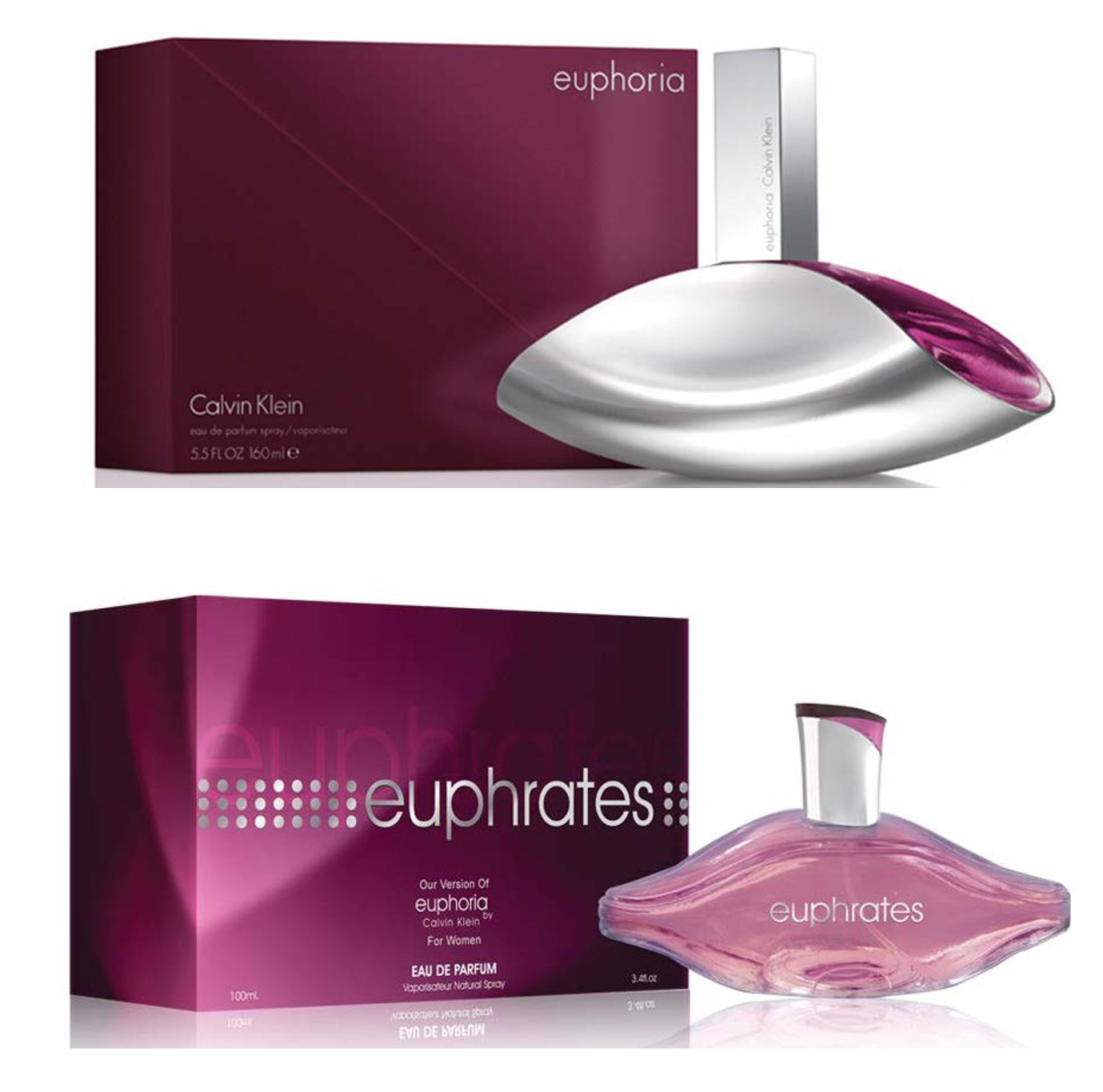
fragrances sued Excell, which produced cheap “versions” of Coty’s fragrances,
with similar names and “nearly identical packaging.” “Compounding matters,
Excell prominently included on its packaging Coty’s own marks, albeit under
words to the effect of “Our Version Of” in comparatively smaller text.”  Guess what Judge Furman found as to
infringement and dilution after a bench trial? There was also false advertising, but not counterfeiting. Coty was entitled to
injunctive relief and to recover Excell’s profits, but not to enhanced damages,
and the case wasn’t “exceptional” for the purpose of attorney’s fees and
prejudgment interest.
back

front

To give some idea of the scope of Coty’s branding efforts, “between
2002 and 2015, Coty spent over $658 million advertising and promoting its
Calvin Klein fragrances, over $114 million advertising and promoting its Vera
Wang fragrances, over $14 million advertising and promoting its Lady Gaga
fragrances, and over $13 million advertising and promoting its Joop! fragrances.”  Its net sales over that period for Calvin
Klein fragrances were over $2.2 billion, for its Vera Wang products over $296
million, for its Lady Gaga products over $28 million, and for its Joop! line
over $188 million. Some are successful enough to have subbrands, or “flankers” –Dark
Obsession, Eternity Aqua, CK One Shock, and CK Free Blue.
Excell sought to copy expensive fragrances in a way that
would be “understood by its customer base of ‘lower income, sometimes ethnic
customers.’ ” Excell then chose a product name to evoke the name of the
original fragrance. “Excell did not make any meaningful effort to replicate the
scent of Coty’s products. Instead, using only their own noses and reviews of
the original fragrances, Excell employees made broad recommendations to the
company’s supplier in India, which then manufactured the alternative fragrances
and packaging,” though Excell often supplied the original fragrance (or a
picture of the fragrance) it sought to emulate along with instructions on how
to emulate it. Excell also frequently made changes to the products so that the
packaging would more closely resemble Coty’s original branded fragrances.
Excell nonetheless lacked any meaningful quality assurance program. 
On the front of each fragrance box at issue, Excell included
a legend stating that the fragrance was “Our Version Of” the relevant Coty
product. On the back was “Not Associated With The Makers Of,” followed by
reference to the relevant Coty product.  But Coty’s marks were depicted more
prominently than the other text. “On the top of each box, in comparatively
smaller lettering, Excell included its own brand name: Diamond Collection
Luxurious Fragrances.”
Excell didn’t advertise or market directly to consumers, but
sold primarily to traditional retailers and discount chains, such as Kmart,
Dollar General, and Ross Stores, and its products were also available on Amazon
and eBay.  
In 2015, several of Excell’s principals and employees were
indicted on money laundering and other offenses. Given the pending proceedings,
three such individuals invoked their privilege against self-incrimination in
these proceedings. Excell shut down its business operations and ceased selling
its fragrances in December 2016, unrelated to the present lawsuit.
The court rejected Excell’s laches defense.  Laches is no defense against injunctive
relief when the defendant intended the infringement, which the court found to
be the case here. Also, Coty didn’t delay unreasonably; it sued in 2015, “well
within the applicable six-year statute of limitations” given that Excell was
founded in 2010. Further, Excell’s sales were relatively insignificant during
its first few years of operation and Excell’s marketing efforts to its
retailers were less focused on the Coty knockoffs during that time.  Moreover, even if Excell could show
unreasonable delay, it didn’t show evidence of prejudice. By Excell’s own
admission, the filing of the lawsuit had no effect on its operations: it
continued to sell its knockoffs long after Coty filed suit, and was “winding
down” due to the pending criminal charges. “[A]ny conceivable prejudice was
mooted when Excell decided, for reasons unrelated to this case, to cease its
operations and stop using its brands.”
Unfortunately, the court decided that HOMME was suggestive
for cologne.  It reasoned that, even if
the general consumer knows that “homme” means “man,” it still “requires
imagination, thought and perception to reach [the] conclusion” that HOMME is
not just a cologne, but a cologne targeting men. Of course, that’s not the
traditional framing of the conceptual distinctiveness inquiry, though courts
increasingly have (wrongly) changed their approach to this question; the PTO
would ask whether, knowing the mark and the goods, imagination is required to
connect the two.  Cologne for men?  Not so much. 
This didn’t matter much here, given the secondary meaning of the marks.
The court also found that the packages and bottles were
product packaging, and thus capable of inherent distinctiveness as trade
dress.  Excell argued that the bottles
were product design, an argument the court found no support for; I’d be more
sympathetic, since part of the point of these bottles is to have beautiful
things on one’s dresser, unlike soda or alcohol bottles.  Again, though, Coty also showed secondary
meaning.
Similarity: “Excell’s products copy, with only slight
differences, the names, typefaces, packaging, design, coloring, and bottle
shapes of Coty’s fragrances,” and also include two exact replicas of Coty’s
house mark (e.g., Calvin Klein) and product mark (e.g., ETERNITY AQUA) as part
of the “Our Version Of” and “Not Associated With” legends.  As the court noted, the City Girl and Love
Story fragrances were “[a]t the less infringing end” of the similarity
spectrum; the names evoked similar associations and the packages had notable
differences.  By contrast, Excell’s OK
ROCK and SERENITY fragrances were “remarkably similar” to Coty’s CK SHOCK and
ETERNITY, in both name and trade dress. But even the “less infringing”
fragrances had significant similarities in color, shape, and layout.  As a whole, each allegedly infringing product
was quite similar to its counterpart.
 

similar, but not shockingly so (though still infringing)

way too similar

see more below

Excell argued that its “Our Version Of” and “Not Associated
With” disclaimers made clear that the company’s products weren’t associated
with Coty. But Coty’s marks were “significantly more prominent and accentuated
on Excell’s fragrances than both the supposedly disclamatory language … and
Excell’s own marks. In similar circumstances, courts have held that disclaimers
are not only ineffective, but actually cut against the allegedly infringing
party.”  Based partly on the survey
evidence, the court found the same here.
Competitive proximity: price differences/retail channels had
“little or no bearing on post-sale confusion as to the source of the goods,”
and might even enhance the likelihood that a consumer would buy the accused
product, to obtain the same prestige for less money.  Plus, the fragrance market is “somewhat fluid”
and some retailers have sold both parties’ fragrances, including K-mart, CVS,
Amazon, and eBay. Some Coty fragrances have been “diverted” and sold at CVS and
Dollar General, both of which sell Excell products.  The price difference was  “also largely immaterial” to initial interest
confusion; “most purchasers of fragrances in a retail setting are likely to
view the packaging before checking the price label.”  Finally, the price difference wasn’t huge.
Actual confusion: because “evidence of intentional copying
gives rise to a presumption of actual confusion,” the burden was on Excell to
demonstrate a lack of confusion, which it failed to do.  Excell’s own survey found that 19.5% of
respondents in an Internet survey identified Calvin Klein as the source of
Excell’s POSSESSION fragrance, and 15.1% identified Calvin Klein as the source
of Excell’s SERENITY fragrance.  And this
survey was limited to people who had recently shopped at a discount store, flea
market, rummage sale, or bazaar, even though Excell’s products were marketed
more broadly. And the survey didn’t measure initial interest or post-sale
confusion.  The survey was also flawed
because it allowed respondents to see all faces of the packaging at once.  And there were coding errors: people coded as
not confused said things like, “What a bargain for a Calvin Klein product”;
“It’s made by Calvin Klein, I like it”; and “Just the fact that it was made by
Calvin Klein is worth the $4.99.” 
Recoded, 25% of the respondents actually identified Calvin Klein as the
source of Excell’s POSSESSION and 20% identified Calvin Klein as the source of
Excell’s SERENITY.
Anyway, Coty’s survey was more reliable.  Coty used an Eveready format, which is the
gold standard for cases involving strong marks. 
Coty used a mall intercept survey of “people 18 years old and older who
ha[d] purchased a fragrance product for themselves, or for someone else, in the
past six months” and showed them versions of the Excell packages. Neither the
participants nor the interviewers were exposed as part of the survey to the
genuine Calvin Klein OBSESSION or ETERNITY fragrances; the expert concluded
that an average of 54% of the respondents misidentified the source of Excell’s
products as Calvin Klein.
Excell argued that the survey erred by not excluding
higher-end consumers to ensure that respondents were actual or potential
purchasers of Excell’s products, and the court noted some justice to the
argument.  The relevant market was the
junior user’s customers.  But there was
overlap, and it isn’t uncommon for higher-end fragrance companies, including
Coty, to create less expensive versions of their products — those “flankers” —
for sale at lower price points or in lower-end retail markets. Thus, the survey
still had probative value.  Nor was the
survey flawed for failing to provide respondents with relevant sales channel
and price information about the products, which is in fact irrelevant to initial-interest
and post-sale confusion.  It’s also true
that the survey only tested two fragrances, and the survey itself indicated that
the levels of consumer confusion would likely vary among the fragrances, with a
22% difference in confusion levels between the two Excell products tested.  But the results were still relevant to the
other fragrances, given their shared “common and prominent features.”
There was no evidence of actual confusion. But that wasn’t
important: (1) the employees’ invocation of the Fifth Amendment limited Coty’s
ability to obtain evidence, meaning that it would be unfair to hold the absence
of evidence against Coty; (2) Coty and Excell are manufacturers and
distributors of fragrances, not retailers, “and thus less likely to hear
directly from a duped consumer”; (3) consumers are less likely to complain
about a relatively inexpensive product; and (4) the survey was good alternative
evidence.
Intent: The record was “replete” with evidence of bad faith.
Excell’s business model “involved little more than ‘capitalizing on plaintiff’s
reputation and goodwill.’” Excell then “meticulously mimicked the external
trappings of those fragrances and used Coty’s protected marks on its packaging
in a way that, even with the disclamatory language, could only have been
calculated to capitalize on Coty’s goodwill.” Excell kept going “in the face of
a slew of complaints from third-party brand owners,” and chose its business
model shortly after a company that used to employ various Excell employees
entered a Consent Judgment with Calvin Klein and other fragrance producers
about infringing alternatives to CK fragrances. Excell argued that Consent
Judgement indicated approval of the use of the “Our Version” phrase, but (among
other things) the consent judgment didn’t allow anyone to indiscriminately sell
“Our Version Of” fragrances, but merely reserved the parties’ rights with
respect to fragrances containing the “Our Version Of” legend that weren’t
“unlawful under the Lanham Act” and that weren’t “Counterfeit” or “Knock-Off”
products.
Excell noted that there is a difference between intending to
compete by imitating successful features and intending to deceive purchasers as
to source. This is true, “but Excell’s intent falls squarely in the latter
category. The company’s intent to deceive can be inferred from the remarkable
similarities between the fragrances’ trade dresses, the prominent use of Coty’s
legends on Excell’s products, and the uncanny resemblance between the fragrance
names chosen by Excell and Coty’s products.” Anyway, an intent to copy “creates
a presumption of an intent to deceive, unless there is evidence to the
contrary.” [Ugh—does that mean that house brands imitating national brands are
presumptively intentionally deceptive?]
Quality, the Second Circuit outlier factor: Favored Coty,
because Excell’s products are cheap and use synthetic oils, rather than the
natural oils used in Coty’s fragrances. 
They don’t smell the same as Coty’s perfumes and colognes. Unlike Coty’s
fragrances, many of Excell’s Diamond Collection products were found to contain
DEHP, a potential carcinogen.
Consumer sophistication: As now-Justice Sotomayor wrote, “even
sophisticated buyers are not always careful buyers, and their very awareness of
status brand names and designs may make them more vulnerable to confusion.” Great
similarity, as here, reduces the ability of sophistication to resist
confusion.  And “it could be argued” that
Excell’s target demographic, “lower income, sometimes ethnic customers” was likely
to be less sophisticated about the differences between and among fragrances and
more easily confused upon seeing Excell’s cheaper knockoffs. This factor was a
draw.
Excell argued that it was making nominative fair use of
Coty’s marks.  But the Second Circuit
just held that nominative fair use isn’t a defense; it instead provides
additional factors to consider alongside the Polaroid factors.  “[T]he
manner in which Excell displays Coty’s source identifiers belies its argument
that it is merely using the marks to inform consumers that it is not the
manufacturer of the original fragrance.” The fair use argument “would be on
firmer ground if it sold its fragrances in generic bottles and cartons, picked
fragrance names that were unrelated to any of Coty’s, included its disclaimers
without prominently displaying Coty’s typesetting or marks, and marketed its
own brand on the packaging in a noticeable manner.”  But it didn’t do any of that.
Having found likely infringement, the court turned to trademark
dilution, federal for the registered Calvin Klein, Vera Wang, and Lady Gaga
marks, and New York law for the remaining marks.  The court found dilution by blurring.  Excell didn’t contest the fame of the Calvin
Klein, Vera Wang, and Lady Gaga marks. The the similarity between the marks as
well as the distinctiveness and degree of recognition of the plaintiff’s mark
favored Coty, as did Coty’s otherwise substantially exclusive use and Excell’s
intent to create an association.  The
court apparently misread the sixth statutory factor, “actual association,” as
something like “truthful association,” finding that it favored Coty because
Excell had no “actual association” with Coty, but this really can’t have
mattered.  The court found state law
blurring for the same reasons.

Tarnishment: Yep. “Excell uses inferior oils, employs cheaper packaging
components, lacks any quality assurance program, and produces fragrances with
potentially harmful ingredients.” The ongoing criminal case also arguably
risked tarnishment, but there was “no reason to believe that the average
consumer would know about the criminal charges, let alone link them to Coty.”
False advertising: yes. 
“Our version of” was misleading. 
Coty didn’t have to show literal falsity, because the words implied that
the products were “similar, if not equivalent.” 
[If the surveys show that people aren’t reacting to the disclaimers by
understanding the difference, are they even reading the disclaimers, and can
there be material deception without reading?]  The duality of contrast and equivalence was
inherent in the use of the word “version.” 
“But Excell indisputably does not produce fragrances of a similar
quality to those of Coty; nor does it produce anything that could reasonably be
called a ‘version’ of Coty’s products.” 
[This is consistent with caselaw indicating that, even if there are
possible ambiguities, when the defendant isn’t telling the truth under any of
the different possibilities, literal falsity may be found.]  In context, along with the infringing
marks/packaging, the court found an intent to connote a false equivalence
(citing necessary implication cases).
Coty’s survey also found that 20% of respondents believed
the legend communicated the message that Excell’s fragrances were substantially
equivalent to Coty’s fragrances on formula and longevity of scent. Excell
criticized the survey for asking “closed-ended questions of whether the two
fragrances were ‘the same or different,’ rather than giving respondents the
option to indicate that the products were ‘similar.’ ” But participants were
asked a series of open-ended questions, including, “does the wording on these
two products communicate or imply anything to you” about whether certain
qualities of the products “are the same or different?” Participants then
responded using their own language and explained what the wording communicated
to them. Plus, surveys crafted to test comparative advertising claims sometimes
call for “a more defined option set,” even if closed-ended questions aren’t as
good.  Excell’s survey also was
closed-ended, but added a third option, “similar.” This didn’t add clarity;
anyway, given the significant differences between the companies’ fragrances, the
Excell survey’s finding that “[a]pproximately two-thirds of consumers view[ed]
the Excell and Calvin Klein products to be ‘similar’ ” only strengthened the court’s
falsity conclusion.
Materiality: consumers “undoubtedly care about the quality
and longevity of their perfume or cologne.” Because it was a false comparative
ad, no further proof of likely injury was necessary.
Injunctive relief: with no mention of eBay, the court reasoned that likely confusion establishes
irreparable harm. Money alone couldn’t compensate for the company’s
unquantifiable “losses of reputation and goodwill and resulting loss of
customers.” The balance of hardships favored Coty, because Excell wasn’t
selling any products and was a newcomer to the market anyway.  Coty’s request wasn’t moot, because Excell hadn’t
dissolved as of the time of trial.  “Because
Excell could simply resume operations directly or indirectly — and because its
directors, officers, and employees have demonstrated such tendencies in the
past— Excell has not shown that it is ‘absolutely clear that [its] wrongful
conduct will not recur.’”  Coty’s request
for injunctive relief was granted with respect to Excell and its “officers,
agents, servants, employees … [and] other persons who are in active concert
or participation” with them.
The court also awarded an accounting of profits.  This equitable remedy requires courts to
consider “(1) the degree of certainty that the defendant benefited from the
unlawful conduct; (2) availability and adequacy of other remedies; (3) the role
of a particular defendant in effectuating the infringement; (4) plaintiff’s
laches; and (5) plaintiff’s unclean hands.” All of these factors favored Coty. Excell’s
business model depended on creating customer confusion, making it certain that
it benefited from the infringement. Excell’s sales of the accused fragrances
from July 2010 through April 2016 totaled a bit over $6.5 million, and it
didn’t submit reliable evidence of its costs, only spreadsheets with totals
that witnesses couldn’t adequately explain. 
Thus, Coty was awarded all Excell’s revenue for the relevant time
periods.
Coty argued that it should get treble damages because its
marks were counterfeited. A counterfeit mark must be “substantially indistinguishable”
or “spurious,” which requires more than a mere similarity between the marks or
a “colorable imitation.”  Excell’s
infringing products weren’t countefeits. 
None used the exact same name, nor the same/“substantially
indistinguishable” combination of colors, designs, and shapes. Though Excell
did use Coty’s own marks as part of its disclaimers, the existence of those
disclaimers and Excell’s (admittedly less prominent) use of the Diamond
Collection mark on its bottles “creates enough of a contextual difference that
[Excell’s fragrances] cannot be considered counterfeits of [Coty’s].”  The court was unwilling to conclude that
Excell was trying to trick buyers into thinking they were actually buying Coty
fragrances.  [Note how much implicit
weight this gives to the IIC/post-sale confusion theories.]
The court refused to find the case “exceptional” for
fees/prejudgment interest purposes. “Exceptional cases” involve fraud, bad
faith, or willfulness, but bad faith isn’t an automatic entitlement to
attorneys’ fees or prejudgment interest. 
Excell’s litigation conduct, “while certainly not commendable, falls
short of the ‘the sort of misconduct that supports an attorney fees award.’”  Plus, Coty didn’t show that it suffered
“ascertainable damage”: “the fact is that, despite several years of competition
with Excell’s infringing products, Coty failed to produce demonstrable evidence
of actual confusion.”  Plus, the outcome
of the case “was by no means a foregone conclusion,” especially as to
fragrances at the less infringing end of the “similarity spectrum.”  Coty did get its costs, though.

from Blogger http://ift.tt/2wFSjZc

Posted in Uncategorized | Tagged , , , , , , , | Leave a comment