Gov’t brief in Lee v. Tam

Available here.  They make the same “bumper sticker” argument that I think makes sense.

from Blogger http://tushnet.blogspot.com/2016/11/govt-brief-in-lee-v-tam.html

Posted in Uncategorized | Tagged , | Leave a comment

Yelp avoids liability for allegedly biased filter yet again

Albert v. Yelp, Inc., 2016 WL 3910830, No. G051607, 44 Media
L. Rep. 2357 (Cal. Ct. App. July 15, 2016)
Albert, who operates a small law office, sued Yelp for
various claims, and Yelp brought an anti-SLAPP motion.  Although she might have been able to amend
her claim to add potentially meritorious causes of action, that can’t be done
to avoid an anti-SLAPP dismissal.
After a temporary employee of Albert’s became upset because
he believed Albert had missed a deadline concerning a case involving a friend
of his, he allegedly enlisted a group of his friends (and possibly others) in a
campaign of defamation against Albert. “The campaign allegedly included having
nonclients pose as clients to write derogatory reviews about Albert’s services.” 
Albert had no choice about having a review page on Yelp,
though Yelp also sells ad packages to reviewed businesses.  A Yelp VP declared under oath that “the
software does not favor advertisers or punish non-advertisers.” Yelp also claimed
that it used a filter to try to weed out reviews from interested parties,
whether false positive reviews from employees, or false negative reviews from
competitors.  These reviews are still
accessible, but don’t count in the aggregate star rating.  Albert alleged that her decision not to
advertise on Yelp resulted in the removal of at least one positive, five-star
review from the counted reviews, and the display of multiple negative reviews.
Albert alleged that the format of a review page would feature
information about the business in the upper left, under a Yelp review
banner.  “The space to the immediate
right is a space for photos. If no photos are posted by either the business
itself or reviewers, there is merely a rectangular box with a faint outline of
city buildings suggesting a sort of skyline.” Albert alleged that her page
would look like this without any photos:

Photos that are posted “generally look as if they were
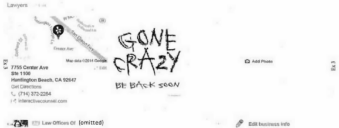
posted by the business itself for promotional purposes.” But Albert alleged that,
as part of the campaign against her, a picture was appended showing a “Gone
Crazy Be Back Soon” post-it, with no indication that it came from a third
party:

Albert was allegedly unable to delete the post-it note
picture. Her complaint against Yelp alleged (1) defamation; (2) intentional
interference with economic advantage and (3) intentional infliction of
emotional distress. The trial court granted Yelp’s anti-SLAPP motion.
There was no question that Yelp had been sued for its
exercise of free speech rights; but was this speech about a matter of public
interest? “[C]omment on issues of public interest are integral to Albert’s
claims,” given Albert’s self-presentation, and associated press publicity, as a
crusader fighting foreclosures on behalf of small homeowners.  “The tenor of many of the third-party posts
giving her bad reviews was that she was not living up to her image as such a
champion.”  The dividing line between purely
private speech and comment on issues of public interest was whether the speech
merely concerns “a particular interaction between the parties” or touches on
“matters of public concern that can affect many people.”  The appellate court concluded that the posts
about Albert “implicate broader matters than just whether she missed a deadline
in one case,” given her heavy involvement in the foreclosure fallout from the
Great Recession.
The statutory exemption of commercial speech from anti-SLAPP
protection applied only to a defendant’s statements trying to sell its own
products or services, not to a third party’s comments about some other person’s
products or services.  Thus, the court of
appeals proceeded to assess whether, if the facts were as Albert claimed, Yelp
could be held liable.
Defamation: §230 applied, easily.  Roommates
supported Yelp, because there was no evidence that it solicited defamatory or
misleading reviews. Indeed, “[i]t is easy to overlook that the Roommates court,
while saying the website could be liable for its own eliciting of illegal
preferences, also said that a free-form ‘Additional Comments’ section of the
website was protected under section 230.” Even if Yelp’s algorithm downgraded
non-paying businesses, there was no liability because Yelp didn’t create any of
the bad reviews.  It’s not enough for an
ISP to make it “too easy” for vindictive third parties to sully reputations, or
for it to “psychologically” encourage defamatory reviews.  Affirmatively asking third parties to post
defamatory content might be actionable, but there was no evidence that Yelp did
that.
Intentional infliction of emotional distress: “Since Albert
provided no evidence that Yelp itself authored any of the defamatory postings
or that Yelp intentionally hid positive reviews, nothing it did would approach
extreme conduct.”
Intentional interference with prospective economic advantage:
This requires a separate wrongful act by the defendant designed to disrupt an
economic relationship. Yelp’s §230 immunity for the posts precluded liability.

Other possible causes of action: “It might be true, in a
vacuum, that what Yelp says about itself, and specifically its review filter,
could constitute commercial speech and thus be exempt from the anti-SLAPP
statute.” But the anti-SLAPP statute can’t be circumvented via belated amendments
to the complaint.

from Blogger http://tushnet.blogspot.com/2016/11/yelp-avoids-liability-for-allegedly.html

Posted in Uncategorized | Tagged , , | Leave a comment

Consumer protection fellowship opportunity

The ABA encourages 1Ls and 2Ls to apply for the Janet D. Steiger Fellowship Project. Students selected will serve eight or ten weeks during the summer of 2017 in the consumer protection or consumer affairs offices of participating state and territorial governments. 

The application period is November 10, 2016 through January 31, 2017.  Applications and full details are available online at: http://AmBar.org/Steiger. Submission of all required materials must be sent via email to: ABASteigerFellowship@americanbar.org

Each selected student will receive $6,000 stipend for the summer (administered through the offices of the state/territory attorneys general and subject to certain federal taxes). In the event that a Steiger Fellow is not living at home during their fellowship, there is a possiblity that a limited optional travel/housing stipend allowance may be available.

Please refer any questions or concerns to: ABASteigerFellowship@americanbar.org

The ABA’s Antitrust and Consumer Protection section is a valuable resource for students interested in consumer protection, and I recommend checking it out more generally.

from Blogger http://tushnet.blogspot.com/2016/11/consumer-protection-fellowship.html

Posted in Uncategorized | Tagged | Leave a comment

Airbnb had a bad day too: court rejects 230, First Amendment challenges to SF rental ordinance

Airbnb, Inc. v. City and County of San Francisco,
16-cv-03615 (N.D. Cal. Nov. 8, 2016)
Airbnb and HomeAway sought to enjoin SF’s ordinance making
it a misdemeanor to provide booking services for unregistered rental
units.  The court denied a preliminary
injunction.
Airbnb and HomeAway make money by charging hosts and guests
a service fee based on the cost of the rental. 
Their posting process is automated and requires the host to fill in some
required fields, but the sites don’t verify, review or edit the information
provided by the host, and do not contribute content of their own to the
listing.
In 2015, San Francisco banned its effective ban on “tourist
or transient” rentals, but required that a host register a residence with San
Francisco before making it available as a short-term rental.  Registration has various prerequisites.  Plaintiffs agreed that a residential unit
must be lawfully registered before being rented on a short-term basis, but compliance
with the registration requirement has been spotty:
As of November 2015, for example,
San Francisco had received only 1,082 short-term rental registration
applications while Airbnb listed 5,378 unique short-term rental hosts in San
Francisco, which points to a registration rate of just 20% even without
including HomeAway and other similar services. 
By March 2016, the ratio was 1,647 registered out of 7,046 listed — a
registration rate of approximately 25%. 
Enforcement of the registration requirement was “hampered by
the City’s lack of information” because short-term rentals “operate in private
residences without any commercial signage posted” and because hosting platforms
“do not disclose addresses or booking information about their hosts.”  An August 2016 ordinance made it a
misdemeanor to collect a fee for providing booking services for the rental of
an unregistered unit.  A“Booking Service”
is defined in relevant part as “any reservation and/or payment service provided
by a person or entity that facilitates a short-term rental transaction between
an Owner . . . and a prospective tourist or transient user . . . for which the
person or entity collects or receives . . . a fee in connection with the
reservation and/or payment services.” A “Hosting Platform” is a “person or entity
that participates in the short-term rental business by providing, and
collecting or receiving a fee for, Booking Services,”  but doesn’t need to be “an online platform”
and encompasses non-Internet based services as well.  The Ordinance permits a Hosting Platform to
“provide, and collect a fee for, Booking Services in connection with short-term
rentals” only when the units rented are lawfully registered on the Short Term
Residential Rental Registry at the time of rental.  “Lawfully registered” means that a host has obtained
a registration number from the San Francisco’s administrative office, the OSTR.  A violation is a misdemeanor punishable by a
fine of up to $1,000 and imprisonment for up to six months.
Plaintiffs argued that the Ordinance was preempted by § 230
of the CDA.  Plaintiffs argued that the
threat of a criminal penalty for providing and receiving a fee for Booking
Services for an unregistered unit required them to actively monitor and police
listings by third parties to verify registration.  This was, they argued, tantamount to treating
them as a publisher because it involved the traditional publication functions of
“reviewing, editing, and deciding whether to publish or to withdraw from
publication third-party content.” 
But, the court concluded, the Ordinance didn’t treat them as
publishers or speakers of the rental listings. 
It didn’t regulate what the listings could or couldn’t say. It created
no monitoring or blocking obligation.  Plaintiffs
were perfectly free to publish any listing they get from a host and to collect fees
for doing so, whether the unit was lawfully registered or not. The only thing
that could create liability was plaintiffs’ own conduct: providing and
collecting a fee for booking services in connection with an unregistered unit.  This didn’t depend on who was the publisher or
who was the speaker.  Section 230(c) does
not create “a general immunity from liability deriving from third-party
content.”
 “[T]he challenged
Ordinance regulates plaintiffs’ own conduct as Booking Service providers and
cares not a whit about what is or is not featured on their websites.” Plaintiffs
argued that the ordinance would still have the practical effect of requiring
them to monitor listings and remove posts for unregistered rentals.  But the ordinance didn’t compel that
result.  Plaintiffs could post a notice
to users that they could provide Booking Services in San Francisco only for
units that are lawfully registered and verified as such. Or they could charge
fees for publishing listings, rather than for facilitating transactions, which
would be perfectly lawful.  [Interesting result, not entirely surprising.  If Airbnb provided its ISP services via a negative option billing plan and a state banned negative option billing, I would think 230 would not preclude that regulation either.]
Likewise, there was no First Amendment barrier to the
ordinance.  The First Amendment doesn’t
prevent restrictions directed at commerce or conduct from imposing incidental
burdens on speech.  The conduct at issue
doesn’t have a significant expressive element, nor did the ordinance have the
inevitable effect of “‘singling out those engaged in expressive
activity.’”   The law wasn’t limited to internet platforms
and there was no indication that there was any speech-suppressive
motivation.  The Ordinance was supposed
to help enforce compliance with the registration requirement: it was directed at
specific business transactions and practices, and “not to any message the
businesses express.”
Sorrell didn’t
require a different outcome, nor did Simon & Schuster, Inc. v. Members of
N.Y. State Crime Victims Bd., 502 U.S. 105 (1991).  Sorrell
on its face “disfavor[ed] marketing, that is, speech with a particular
content,” and “[m]ore than that, . . . disfavor[ed] specific speakers, namely pharmaceutical
manufacturers.”  Simon & Schuster also featured a “content-based statute”
because it singled out income derived from “expression[s] of [an] accused or
convicted person’s thoughts, feelings, opinions or emotions” about the crime.  That wasn’t similar to the ordinance, nor was
the ordinance in Reed v. Town of Gilbert.
 None of those laws were “restrictions
directed at commerce or conduct,” as the ordinance was here, with only an incidental
impact on speech. 
Even if the Ordinance was reviewed as a restriction on
commercial speech, it survived scrutiny. 
The speech affected was commercial speech.   A “threshold requirement” for protection for
such speech is that it must be related to lawful activity.  If it is related to unlawful activity, the
commercial speech at issue isn’t protected by the First Amendment and no
further analysis would be required.  And
such was the case here: the speech at issue proposed an illegal transaction,
because it is illegal in San Francisco to rent a unit that is not lawfully
registered. 
However, the court did accept SF’s concession that the
ordinance didn’t impose criminal liability without proof of scienter.  There was no reason to think that SF intended
to dispense with the standard mens rea requirement for criminal liability.  As for potential vagueness, SF bound itself
to the interpretations that “lawfully registered” meant having a registration
certificate (not necessarily complying with all the underlying requirements ranging
from insurance to tax reports) and that “at the time it is rented” meant when
the booking transaction occurred. 

Finally, plaintiffs pointed out that SF’s enforcement agency
OSTR wasn’t able to provide prompt and effective registration
verification.  SF wouldn’t enforce the
ordinance while this issue was being litigated. 

from Blogger http://tushnet.blogspot.com/2016/11/airbnb-had-bad-day-too-court-rejects.html

Posted in Uncategorized | Tagged , , , | Leave a comment

Evidence of good faith not relevant for liability, but relevant for damages in false advertising cases

A.L.S. Enterprises, Inc. v. Robinson Outdoor Products, LLC,
No. 14-CV-500, 2016 WL 4260062 (W.D. Mich. May 9, 2016)
ALS sued Robinson for false advertising over odor control
claims for its hunting apparel; the court in this and a related order resolves some
false advertising-related evidentiary issues. 
First, ALS moved to preclude Robinson from offering evidence or argument
that its ad claims are supported by testing, in general, as opposed to specific
tests; and to preclude Robinson from presenting evidence that it acted in good
faith reliance on test results.
challenged 40/200 claims

When an establishment claim is at issue, “the defendant must
identify the cited tests.” Where a superiority claim does not purport to rest
on test results, the plaintiff can prove falsity only by adducing evidence that
affirmatively shows that the claim is false. 
Robinson’s ads claimed that its product adsorbed
“up to 40% more [odor] than carbon” ad claim; that it had “[m]ore odor
adsorbing capacity than any competitor”; provided retailers with charts showing
adsorption rates; and claims “blocks odor 8x better than zeolite and 3x better
than carbon alloy.” The court agreed that these were establishment claims, yet,
during discovery, Robinson’s witnesses failed to identify specific tests
supporting these claims.  Instead, they
cited general product development and testing processes or extrapolations from
unspecified noncomparative tests.  The
court granted ALS’s motion in limine to preclude references to such tests,
other than one identified test known as the Aspen Report
ALS also argued that Robinson should be precluded from
presenting testimony that it relied in good faith on the Aspen Report or any of
the other unspecified testing that Robinson claimed supported its advertising statements.
 ALS responded that its good faith was
relevant to damages if it’s held liable. “With regard to liability for false
advertising under the Lanham Act, the law appears settled that a defendant’s
state of mind is not relevant to the issue of liability.” Not so with damages;
the law is unsettled because the 1999 amendment to § 35(a) of the Lanham Act
made it unclear whether willfulness is required for an award of profits.  The most recent Sixth Circuit precedent says
willfulness isn’t required, but is an element that can be considered in
weighing the equities, and bears on relevant factors, such as whether the
defendant had the intent to confuse or deceive and whether sales had been
diverted. Thus, evidence pertaining to Robinson’s good faith was relevant to
damages.  Moreover, such evidence, even
if self-serving, had more than minimal probative value and didn’t present
enough of a danger of unfair prejudice or confusion to outweigh that value.  “In fact, it is entirely possible that
testimony from Robinson’s witnesses that ‘dodg[es] substantive questions about
its testing with vague assertions and conclusory statements about its intent,’
as ALS describes it, may be the most powerful evidence the jury may hear
supporting a damage award for ALS.” [Yikes.]
A.L.S. Enterprises, Inc. v. Robinson Outdoor Products, LLC, No.
14-CV-500, 2016 WL 4257453 (W.D. Mich. May 9, 2016)
Robinson moved to exclude evidence and argument (1) about a
prior lawsuit against Robinson under the Lanham Act, Wildlife Research Center,
Inc. v. Robinson Outdoors, Inc., No. 02-CV-2773 (D. Minn) and (2) relating to
Robinson’s offer to remove from its apparel hangtags containing the allegedly
false or misleading “40/200” claims.  
In Wildlife Research Ctr. v. Robinson Outdoors, Inc., 409 F.
Supp. 2d 1131 (D. Minn. 2005), a jury awarded the plaintiff close to $5 million
for Robinson’s false advertising, consisting of damages and Robinson’s profits.
 Robinson argued that the jury would
wrongly treat reference to the case as propensity evidence, and that it wasn’t
relevant to the issue of willfulness because the litigation occurred nearly ten
years ago and involved a different product and different executive decision
maker.
ALS responded that Robinson’s present corporate personnel testified
in the trial, and ALS intended to show that Robinson learned from the
litigation that it had to be “very careful” in its advertising claims, but
instead acted in a completely different manner in promoting the products at
issue here. Because this was evidence of past wrongdoing, Rule 403(b) concerns applied.  Although rebutting Robinson’s claim of
good-faith reliance on testing in connection with damages “would seem to be a
permissible use,” it still had minimal probative value to show Robinson’s
knowledge of the need for care, while the potential for jury confusion and
unfair prejudice at the mention of prior false advertising litigation “is both
apparent and substantial, and certainly outweighs any probative value of the
evidence.” ALS could ask Robinson’s witness whether Robinson knew it had to be
“very careful” in its advertising; if the witness denied this fact, ALS could
refer to the prior litigation for the limited purpose of impeachment.
Robinson also asked the court to exclude evidence and
testimony concerning Robinson’s removal of hangtags containing the “40/200”
claims at issue from its apparel, because this offer occurred in the context of
settlement discussions early on in the case. Robinson cited Rule 408 (settlement
negotiations and discussions) and Rule 407 (subsequent remedial measures), and
argued that the evidence was irrelevant.
ALS responded by noting “Robinson’s shifting story during
discovery about hangtag removal—first that it was unable to specify when removal
took place, and then stating that it first began to remove hangtags in late
June of 2014,” then testimony that hangtags were still being sent to retailers
in September 2014, then a June 2015 email instructing Robinson’s warehouse to
remove or cover all tags, and then photos from a store in April 2016 of a
Robinson product bearing the hangtag and accompanying sticker.  ALS argued that this evidence was relevant to
the propriety of injunctive relief, ALS’s entitlement to treble damages or
attorney fees based on an exceptional case finding, and the credibility of
Robinson’s witnesses.
Evidence of Robinson’s lagging hangtag removal was relevant
to ALS’s allegation that Robinson continued to run false ads even after it had
test results showing that its products were no better at adsorbing odors than
comparable carbon products. This evidence didn’t concern “conduct or statements
made during compromise negotiations about the claim.” Fed. R. Evid. 408(a)(2). All
of the conduct occurred outside of compromise negotiations. Nor was Rule 407 on
subsequent remedial measures implicated, because ALS wasn’t presenting the
evidence to show that Robinson removed the hangtags, but rather, to show that
it failed to remove them even once it knew the truth. This was relevant to good
faith, among other things.

from Blogger http://ift.tt/2eAd3U4

Posted in Uncategorized | Tagged , , | Leave a comment

Failure to disclose effect of compensation on opinion isn’t actionable under Lanham Act (but maybe in NY)

Casper Sleep, Inc. v. Hales, No. 16-cv-03223, 2016 WL
6561386, — F.Supp.3d —- (S.D.N.Y. Oct. 20, 2016)
Casper is a mattress e-retailer. (Discussion
of a similar lawsuit it filed here
.) Defendant Derek Hales is a specialist
reviewer who runs http://www.sleepopolis.com, where he writes reviews of and blogs
about mattresses, as well as a YouTube channel featuring video reviews and a
Twitter account where he interacts with people and promotes Sleepopolis.  Hales uses affiliate marketing and offers
coupon codes for some mattress companies to generate revenue.  Hales isn’t in an affiliate marketing
relationship with Casper.
Hales disclosed his affiliate
marketing relationship in at least three places on the Sleepopolis website: in
a text-box sidebar labeled “Referrals & Honest Reviews,” available in any
given mattress review; and in both the “Commitment to Integrity & Honesty”
and “Affiliate Links” subsections of his “Disclosures” page, accessible through
a hyperlink in the “Referrals & Honest Reviews” sidebar.
Casper alleged that these disclosures were false or
misleading “insofar as they make it seem like Hales’s reviews are unbiased,
when, in fact, his mattress endorsements are underwritten by the mattress
companies featured positively in his reviews.” In fact, Casper alleged that
Hales’s affiliate marketing relationships, or the absence thereof, influenced
his reviews to be positive for companies with whom he had a relationship and
negative for Casper. In head-to-head comparison reviews, Hales “inevitably
concludes that the non-Casper mattress is superior.”
The court found most of Casper’s allegations to be
non-actionable under the Lanham Act.
As for the mattress reviews, Casper alleged that these weren’t
really reviews but veiled ads. E.g., “I’m impressed. I’m sleeping as well as I
ever have. The Leesa mattress just feels incredible. So much so that a
life-long stomach sleeper is able to sleep comfortably on his back and side.”  In comparing Casper mattresses to those sold
by his affiliates, Hales said things such as: “After sleep testing each
mattress, I have come to the conclusion that Purple is the outright better
choice. The hyper-elastic polymer top layer in addition to the multiple layers
of polyurethane foam simply make a more supportive, cooler, and higher
performance mattress than the Casper.”  These are, on their face, statements of
opinion to which the Lanham Act doesn’t apply:
Hales’s opinions and comparisons
are not objectively verifiable, because if there is one true thing in this world,
it is that different people experience mattresses differently, and have
different preferences among mattresses. One man’s comfortable mattress is
another’s “princess and the pea” sleep experience. In my own house, to take an
example, one family member detests memory foam, while another will sleep on
nothing else. It is simply not possible to “objectify” a sleeper’s reaction to
a mattress in a way that transforms what is essentially opinion into an
objectively verifiable fact.
There was no exception to the “statements of opinion are not
actionable” rule for “statements of opinion that are influenced by factors such
as a financial relationship,” even for reviews structured as comparisons or
reviews containing facts.  (E.g., an
opinion that one mattress is “technically superior” is not changed to fact by
adding in the verifiable claim that the mattress had a “hyper-elastic polymer
top layer in addition to the multiple layers of polyurethane foam.”  Those claims are fact, but the resulting
claim that the mattress “feels more supportive and cool to me” is an opinion.) 
Moreover, the financial relationship between Hales and his
affiliates was disclosed.  There were
direct links to the websites of all the praised mattresses, but no direct links
to Casper.  The court understood Casper
to argue that Hales should be clearer about the influence money has on the
comfort of his sleep, but “as long as the consumer is told about the affiliation
and the financial reward that comes to Hales when a reader makes a purchase
after clicking Hales’s affiliate link, s/he is free to factor that into his/her
evaluation of the value of Hales’s reviews.” 
Parenthetically, the court noted that money might not even be
influencing Hales’s conclusions.
Separately, Casper alleged that Hales’s disclosures of his
affiliate marketing relationships were actionable because they failed to give
adequate notice about Hales’s financial interests. E.g., “If you use one of my
links and purchase a mattress or other product you should know that the respective
companies pay me a small referral fee. These referral bonuses help me continue
to create great content and pay for other expenses associated with the site.
Most of the products reviewed were given to me by the manufacturer. Visit my
full disclosures page for more information.”  The court found these disclosures to be “plain[]”
and present in several places on his site, “fully inform[ing]” consumers about
the payment.  “[E]ven if Hales’s
disclosures are somehow inadequate, a failure to disclose, by itself, is not
actionable under the Lanham Act.”  An
actionable omission only exists if it renders separate affirmative statements
of fact false or misleading.  The
allegedly inadequate disclosures were not separate statements of fact. 
Casper also alleged that the disclosures contained false statements
about the impact of Hales’s marketing relationships on his mattress reviews. The
court found these statements potentially false: “No review or content is
written, directed, or otherwise influenced by any manufacturer or sleep
company”; “No review or content is paid for by any manufacturer or sleep
company”; “No member of Sleepopolis is employed by any mattress or sleep
company”; and “Sleepopolis does not have any paid advertisements. Any links,
images, or promo codes you find on-site are there because they provide great
value for my readers.”  
By contrast, “All reviews you find on Sleepopolis are
genuine, honest, and based on my personal views of the product,” “All content
on Sleepopolis is 100% my own opinions and thoughts,” and “All companies pay
Sleepopolis nearly the same amount per referral and no company receives
preferential treatment because of these referrals” didn’t contain actionable
factual claims.  The first two statements
weren’t necessarily false or misleading, even assuming the content is
influenced by Hales’s commercial relationships. “The fact that Hales receives a
kickback does not make his thoughts any less his own.”  The final statement wasn’t literally false
because it didn’t say that Casper was one of the affiliates, and there was no
allegation that Sleepopolis linked to Casper’s website.  Anyway, Casper failed to plead plausibly that
this statement caused it injury: even if consumers believed that there was an
affiliate relationship, Casper didn’t explain how that damaged Casper’s
reputation or took away its business. Instead, Casper was complaining about the
bad reviews, but those reviews weren’t actionable.
NY General Business Law § 349: For the reasons given in Casper
Sleep, Inc. v. Mitcham, linked above, Casper’s claims based on affirmative acts
and omissions survived. “Casper also alleges injury and plausibly links Hales’s
deceptive or misleading acts to this injury: when Casper had an affiliate
marketing relationship with Hales, Hales gave Casper positive reviews, and when
Casper terminated the relationship, Hales gave Casper poor reviews.”

from Blogger http://ift.tt/2frJ3Mj

Posted in Uncategorized | Tagged , , | Leave a comment

Georgetown Law Launches New Institute for Technology Law and Policy

From our website:

Building on its growing expertise in the field, Georgetown Law today announced the launch of the Georgetown Institute for Technology Law and Policy. The Institute will be led by Alexandra Reeve Givens, who most recently served as chief counsel for IP and Antitrust on the Senate Judiciary Committee, working for senior Democrat Senator Patrick Leahy (D-Vt)(L’64).
“As technology transforms the law, the economy, government, and every aspect of daily life, Georgetown Law is uniquely positioned to advance the conversation on technology law and public policy,” said Georgetown Law Dean William M. Treanor. “Leveraging our presence in Washington, D.C., and the deep expertise of our full-time and adjunct faculty, the Institute will provide an important forum for the thought leaders and lawmakers shaping technology policy today.”
The Institute will convene conferences and workshops on new and emerging technology issues and create opportunities for law students to gain deep exposure in the field. The Institute will soon begin a Technology Law & Policy Scholars program for students to gain immersive experience in technology policy. The Institute will also launch the Georgetown Technology Review this fall.
“Now is an essential time for nuanced, thoughtful conversation about how policymakers should respond to the opportunities and challenges created by new technologies,” said Givens. “I am thrilled to help lead this effort at Georgetown Law.”
The Institute is the latest of a number of recent Georgetown Law initiatives focused on the impact of technology. Georgetown’s Center on Privacy and Technology, launched in 2014, recently released a groundbreaking report on the use of facial recognition by law enforcement nationwide. The Communications and Technology clinic, part of Georgetown’s long-standing Institute for Public Representation, recently filed a complaint with the Federal Communications Commission relating to police use of a “stingray” device to intercept cell phone calls. Georgetown Law is also home to a stellar Center on National Security and the Law, sponsoring events related to technology and cybersecurity.
The new Institute for Technology Law and Policy will bolster Georgetown Law’s curricular offerings, which include more than 50 courses such as Coding for Lawyers, classes on cybersecurity and intellectual property, and a privacy law and technology practicum that pairs Georgetown Law students with engineering students from the Massachusetts Institute of Technology. Georgetown’s Iron Tech Lawyer Competition trains students to use technology as a tool to help users navigate the justice system or apply for legal aid. 
“Training lawyers who are proficient in technology law and policy has become a top priority of Georgetown Law,” Treanor said.
“Our students come to D.C. to get a front-row seat witnessing the highest levels of policymaking,” Givens said. “I look forward to sharing that experience with students in the fast-evolving world of technology policy.” 
In her role with the Senate Judiciary Committee, Givens advised Senator Leahy and developed legislative strategy on matters including patent reform, federal trade secrets legislation, net neutrality, First Amendment issues surrounding online speech, access to medicines, and oversight of mergers and antitrust policy. She previously served as a litigator at Cravath, Swaine & Moore in New York City. 
The Institute can be found online at: http://ift.tt/2f8udtG.
For more information, please contact mediarelations@law.georgetown.edu.

from Blogger http://ift.tt/2eGKUvA

Posted in Uncategorized | Tagged | Leave a comment

Florida man held liable for false green coffee claims

FTC v. NPB Advertising, Inc., No. 14-cv-1155, 2016 WL
6493923 (M.D. Fla. Nov. 2, 2016)
The FTC sued Nicholas Congleton and others under Section 5
of the FTC Act for engaging in false or deceptive advertising. Congleton
received an email from a dietary-supplement manufacturer touting the efficacy
of “green-coffee extract” as a weight-loss aid. 
The e-mail linked to a three-minute clip from the television show “Dr.
Oz,” describing a study that allegedly “showed women and men who took green-coffee
extract lost an astounding amount of fat and weight, 17 pounds in 22 weeks by
doing absolutely nothing extra….” After watching the clip and searching the
Internet, Congleton, with co-defendants, founded a green-coffee extract
business.
The FTC showed that defendants made false efficacy claims, unsubstantiated
claims, and false establishment claims that were materially misleading.  Moreover, defendants prominently showed
testimonials on their website without disclosing the material fact that the
people shown were compensated for their testimonials. 
Defendants also published dailyconsumeralert.org, which had
a masthead for Women’s Health Journal, a navigation banner with several health-
or fitness-related categories, and the text “AS SEEN ON” next to the logos of
CBS, ABC, MSNBC, and CNN (“creating a false impression that these networks
reported favorably on Pure Green Coffee”). 
The court found that a viewer would see these as characteristic of a
bona fide news outlet. “The presence of the word ‘Advertorial’ in small font at
the top of the page fails to alter the overall impression.”  An article purportedly written by a Women’s
Health Journal columnist claimed to report on an objective test of the product’s
efficacy.  (Sample text: “[W]e here at
Consumer Lifestyles were a little skeptical of this Green Coffee Bean Extract.
Even after pouring through mountains of research. While I had an educated
opinion, I still had no personal proof that the Green Coffee Bean was worth the
time….”)  The court found that a
reasonable consumer would be materially misled by the website, even though
Congleton admitted that he and a co-defendant admitted that they just copied
the article from another website. 
Congleton was individually liable for the corporate
defendants’ false advertising.  The
standard first required the FTC to show that the corporations operated as a
“common enterprise,” which can happin if the structure, organization, and
pattern of a business venture reveal a “maze” of integrated corporate entities.  Here, the corporations operated under common
control, commingled funds, shared advertising, and retained the same employees,
so the standard was satisfied.
The FTC also had to show that Congleton knew of the
enterprise’s deceptive act and participated directly in, or had authority to
control, the act. Knowledge can include reckless indifference to the falsity of
the misrepresentation, even in the absence of intent to defraud.  That was present here: Congleton admited that
he knew the efficacy claims lacked a scientific basis. (E.g., “I don’t know
that there is a basis for [the claim of losing twenty pounds in four weeks.]”)  At a minimum, Congleton showed reckless
indifference to the truth or falsity of the claims. Although he based the
efficacy claims on the Dr. Oz. segment and the study reported therein, he said,
“I’m not a medical doctor. I don’t know exactly that I understood everything
that’s being said in here,” deferred blindly to Dr. Oz’s “expertise,” and
admittedly copyied unverified claims from competitors’ ads or websites.  This was not good faith. Congleton
participated directly in the deceptive advertising practices by running the ad
program, and he also controlled the business.
Congleton claimed First Amendment protection, but there is
no protection for false commercial statements of fact; here the claims were
specific, objective, and falsifiable.  “Because
Congleton knowingly misrepresented Pure Green Coffee’s efficacy, the First
Amendment offers Congleton no protection from civil liability.”  [Actually, even lack of knowledge doesn’t
defeat liability for misleading commercial speech.]  The FTC didn’t need to show that consumers
were actually misled, only that his representations were likely to mislead a reasonable
consumer.  An old DC Circuit case (Bork,
J.) says that the FTC should introduce “empirical evidence of consumer
perception” for an implied claim, but the claims here were both express and
facially false, and even for an implied claim, no survey data is required.
Congleton challenged the constitutionality of the FTC’s
presumption of materiality for express claims. Nope.
The court granted a permanent injunction against Congleton:
Because Congleton conducted a
deceptive advertising campaign for years, because Congleton knew of the
advertisements’ falsity, because Congleton failed to immediately discontinue
the deceptive advertising after learning of the FTC’s demand, because another
violation could seriously harm a consumer, because Congleton appears proficient
in internet-advertising techniques, and because the barriers to entry in the
dietary-supplement industry are low, the FTC proves a cognizable danger of a
prospective violation. A permanent injunction that bars Congleton from
conducting the same variety of deceptive advertising he undertook at Pure Green
Coffee is warranted.

Congleton was required to disgorge a bit over $29,000,000,
calculated by subtracting from the defendants’ $30 million in gross receipts customer
refunds and disgorgements by other defendants. Congleton argued that profit,
rather than net revenue, was the proper measure of disgorgement, but net revenue
appropriately measures a defendant’s unjust gain under section 13(b).  Congleton’s brother also had to disgorge
title to a property held in his name, but bought with money from a Pure Green
Coffee bank account; the brother was an appropriate relief defendant who had no
legitimate claim to defendants’ “ill-gotten” proceeds. 

from Blogger http://ift.tt/2fmdP9R

Posted in Uncategorized | Tagged , , | Leave a comment

230 provides protection against liability, not immediately appealable immunity from suit

General Steel Domestic Sales, L.L.C. v. Chumley, No. 15-1293
(10th Cir. Nov. 1, 2016)
Defendants (Armstrong Steel) appealed from the district
court’s denial of CDA §230 immunity for a number of General Steel’s false
advertising claims.  Armstrong ran an
online ad campaign that included twenty posts summarizing, quoting, and
referencing lawsuits involving General Steel. While the district court found
that Armstrong Steel was entitled to immunity for three posts because those
posts simply contained links to content created by third parties, it found that
Armstrong created and developed the content of the remaining seventeen posts
and the internet search ads leading to Armstrong’s pages; the district court
found that the defendants developed the content by selectively quoting and
summarizing court documents in a deceptive way, and that CDA immunity didn’t
apply to the Lanham Act.
The court of appeals refused to allow Armstrong Steel to
appeal the §230 ruling before final judgment. 
The denial of §230 immunity would be appealable as a collateral order if
(as relevant here) it would be unreviewable on appeal from a final judgment,
which would only be true if §230 provides immunity from suit, not just immunity
from liability.  This requires “an explicit
statutory or constitutional guarantee that trial will not occur,” but the CDA doesn’t
have language clearly indicating such a guarantee.  Section 230(e)(3) states: “No cause of action
may be brought and no liability may be imposed under any State or local law
that is inconsistent with this section.” But “reading the text in its entirety
reveals that 47 U.S.C. § 230(e)(3) is merely a preemption provision.”

Armstrong Steel argued that construing §230 as a bar against
suit would further congressional intent, but the statute simply doesn’t say
that. Furthermore, immunity from suit is a benefit typically reserved for
governmental officials, in the absence of a close connection to government or a
historical basis for providing immunity to that type of private entity, neither
of which were present here.

from Blogger http://ift.tt/2ezIUoU

Posted in Uncategorized | Tagged , , | Leave a comment

Reading List: The Ethics of Visual Legal Rhetoric

Michael D. Murray, The Ethics of Visual Legal Rhetoric, 13 Legal Comm. & Rhetoric: JALWD 107 (2016).  Highly recommended!

Abstract:

This Article discusses the application of visual rhetorical techniques in legal writing and the ethical questions that are raised regarding the use of these techniques. It is likely that visual rhetoric will be used in brief writing and general legal communications at an increasing rate because the research and scholarship of a wide range of disciplines — law and popular culture, cognitive studies and brain science, data visualization studies, and modern argument theory in rhetoric — indicate the communicative power of visual techniques. This fact coincides with the development of technology in the production of legal documents, and technology in the reading and reception of legal documents, that allow judges and attorneys to access full-color graphics, embedded video, and multimedia content, and follow hyperlinks in the normal course of reading legal briefs and memoranda.

The recognition in the literature that visual rhetoric is rapid, efficient, constructive, and persuasive reveals the potential of visual rhetorical devices to serve as topics and tropes in legal discourse to construct meaning and to inform and persuade legal audiences. The visual rhetorical topics and tropes inspire inventive thinking about the law that constructs meaning, for the author and the audience. For many members of the legal writing discourse community — judges, practitioners, government agencies, and academics — the modes of persuasion of visual rhetoric can construct meaning and improve the persuasiveness of legal discourse generally in content, arrangement, and style.

Attorneys should fulfill their professional responsibility to use the best practices to represent the interests of their clients in law practice. However, the cautions of scholars as to the dangerous power of visuals to deceive or to overpower more deliberative forms of rational thought and analysis are not lightly to be dismissed. The speed and power of visuals is seductive. Visual topics and tropes are subject to abuse, and must be used ethically and with careful regard to their propriety as a tool to create meaning and inspire imagination, and not used as a tool of deception or obfuscation within the rhetorical situation at hand. I conclude that visual rhetorical devices are a proper form of legal rhetoric if they are used to construct knowledge and understanding of the meaning and message of the communication and do not mislead or prejudice the audience’s reception or understanding of the communication.

from Blogger http://ift.tt/2fdPV00

Posted in Uncategorized | Tagged | Leave a comment