ascertainability defeats class but EULA doesn’t

Perrine v. Sega of America, Inc., No. 13-cv-01962, 2015 WL 2227846 (N.D. Cal. May 12, 2015)
 
Gearbox developed and Sega produced the game “Aliens: Colonial Marines,” “held out as the canon sequel to James Cameron’s 1986 film ‘Aliens.’”  The named plaintiffs purchased prerelease copies.  The complaint alleged a bait-and-switch in which defendants developed a “non-retail but technically superior version” of the game that featured, among other things, “advanced artificial intelligence programming, certain gameplay sequences drawn from the Aliens movie,” and “a highly advanced graphics engine (the ‘Demo Engine’),” and presented this version and described it to the public as “actual gameplay.” The retail version ultimately sold, however, allegedly “utilized different programming altogether and a different—and much less advanced—graphics engine (the ‘Retail Engine’).” Plaintiffs alleged the usual California claims.
 
The court adopted an ascertainability requirement for class certification and held that plaintiffs failed it. Defining the class as pre-release purchasers of the game would pose individualized questions of reliance.  A presumption of reliance “does not arise when class members ‘were exposed to quite disparate information from various representatives of the defendant.’” Limiting the class to people who saw an ad wouldn’t work because the court didn’t want to rely on affidavits from putative class members that they saw an ad.  (I wonder if there’s anything to be said about distrust of consumers versus moves towards voter ID.)  Here, the non-retail version was allegedly advertised in a series of demonstrations and an ongoing ad campaign. Many trailers and ads were released, and several pre-release videos contained footage from only the final retail version.
 
The named plaintiff moving for certification could not “answer … with any degree of certainty” a question regarding which videos he saw before he preordered his copy of the game. Given the problems of subjective memory at issue, self-identification through affidavits was impermissible. As Judge Alsup noted, “[s]wearing ‘I smoked 146,000 Marlboro cigarettes’ is categorically different from swearing ‘I have been to Paris, France,’ or ‘I am Jewish,’ or even ‘I was within ten miles of the toxic explosion on the day it happened,” and the “memory problem is compounded by incentives individuals would have to associate with a successful class or dissociate from an unsuccessful one.” (Interestingly enough, that importance-based claim is completely inconsistent with what memory researchers say about memory.)
 
Certification was denied.  Separately, in an attempt to get nationwide application of California law, plaintiffs invoked Gearbox’s EULA, which had a California choice of law provision incorporated by reference from Sega’s EULA. Gearbox’s EULA, though, also has a mandatory arbitration provision and class action waiver.  The court found that this case fell outside the scope of those provisions. As used in the EULA, “dispute” is defined to mean “any dispute, claim, demand, action, proceeding, or other controversy between you and Gearbox concerning the Licensed Works….” “Licensed Works” referred to “the online features of Gearbox games and products.” 
 
Gearbox’s argument that “Licensed Works” included “Gearbox games and products” failed because the EULA stated that “Gearbox may limit or prohibit access to the Licensed Works in its discretion.” As the court noted, “[t]his makes sense only if ‘Licensed Works’ means the online features, which Gearbox could presumably control access to via log-in credentials, IP addresses, and the like. It makes no sense at all if it refers to Gearbox games and products already purchased and in the living rooms of consumers. Gearbox definitely does not have the right to go into consumers’ homes and remove their copies.” So Gearbox couldn’t win dismissal or judgment on the pleadings.
Posted in california, class actions, consumer protection, contracts, http://schemas.google.com/blogger/2008/kind#post | Leave a comment

New Jersey court rejects ascertainabilty requirement for class actions

Daniels v. Hollister Co., — A.3d —-, 2014 WL 8808428, No.
A–3629–13T3 (N.J. Super. Ct. App. Div. May 13, 2015)
 
Of interest
because it’s a state court within the Third Circuit rejecting that circuit’s
view of “ascertainability” in class actions. 
In fact, the court holds, ascertainability “must play no role in considering the certification
of a low-value consumer class action” (emphasis added).  This is a class action about gift cards.
 
In New Jersey, in the context of consumer transactions,
“class actions should be liberally allowed … under circumstances that would
make individual actions uneconomical to pursue.” This policy furthers the
creation of an “even playing field” for small claims.  In this case, “over $3,000,000 worth of $25
gift cards were voided,” and “numerosity, commonality, typicality, and adequacy
of representation” were concededly present.
 
Hollister argued that certifying the class violated due
process because it wouldn’t be able to test class members; absent class members
couldn’t opt out; and the preclusive effect of any judgment would be unknowable
and unenforceable.  But pre-certification
ascertainability wasn’t a condition for certification, as long as the contours
of the class were clearly defined. Ascertainability wasn’t a requirement of the
New Jersey cases, and “federal experimentation with the ascertainability
doctrine seems far from over and, indeed, this doctrinal wave may have broken
before ever cresting.”  Even the Third
Circuit seems unsettled on the issue. 
The concerns expressed by Judge Ambro’s dissent in Carrera (adopting the requirement) and Judge Rendell’s concurrence
in Byrd (limiting the requirement)
were more in tune with New Jersey class action policy.  The whole point of the class action mechanism
is to aggregate claims to make them easier to bring—or bringable at all. “[W]hen
the concept of ascertainability is applied inflexibly it becomes a device that
serves to burden or eliminate nascent class actions without providing any
societal benefit.”  The equitable roots
of the class action mechanism shouldn’t be overlooked.
 
Ascertainability was “particularly misguided when applied to
a case where any difficulties encountered in identifying class members are a
consequence of a defendant’s own acts or omissions.”  After all, if Hollister had obtained the
identities of consumers when giving out $25 gift cards, it wouldn’t have an
ascertainability problem.  Ultimately,
ascertainability didn’t help the fair and efficient administration of
justice.  “[T]he Third Circuit’s
experiences suggest the doctrine is practically unworkable in application and
is being exploited by defendants in unsuitable cases to evade liability.”
 
Even if ascertainability were relevant, it wouldn’t pose an
obstacle to class certification, but would only be a matter for claims
administration. Any future identification problems could be overcome with some
ingenuity.  Members in possession of
cancelled gift cards should probably not need to do anything other than present
the card.  Members who discarded a gift
card “because they were told that the cards expired or had been voided” “may
need to show more, perhaps through submission of an affidavit; it has not been
shown, however, how such a process unfairly hampers the defense.”
 
Though there were legitimate concerns about the preclusive
effect of a judgment when class membership is uncertain, those concerns were
outweighed by the benefits provided by class status, at least in low value
consumer class actions.

from Blogger http://ift.tt/1H5tS0p

Posted in Uncategorized | Tagged , | Leave a comment

New Jersey court rejects ascertainabilty requirement for class actions

Daniels v. Hollister Co., — A.3d —-, 2014 WL 8808428, No. A–3629–13T3 (N.J. Super. Ct. App. Div. May 13, 2015)
 
Of interest because it’s a state court within the Third Circuit rejecting that circuit’s view of “ascertainability” in class actions.  In fact, the court holds, ascertainability “must play no role in considering the certification of a low-value consumer class action” (emphasis added).  This is a class action about gift cards.
 
In New Jersey, in the context of consumer transactions, “class actions should be liberally allowed … under circumstances that would make individual actions uneconomical to pursue.” This policy furthers the creation of an “even playing field” for small claims.  In this case, “over $3,000,000 worth of $25 gift cards were voided,” and “numerosity, commonality, typicality, and adequacy of representation” were concededly present.
 
Hollister argued that certifying the class violated due process because it wouldn’t be able to test class members; absent class members couldn’t opt out; and the preclusive effect of any judgment would be unknowable and unenforceable.  But pre-certification ascertainability wasn’t a condition for certification, as long as the contours of the class were clearly defined. Ascertainability wasn’t a requirement of the New Jersey cases, and “federal experimentation with the ascertainability doctrine seems far from over and, indeed, this doctrinal wave may have broken before ever cresting.”  Even the Third Circuit seems unsettled on the issue.  The concerns expressed by Judge Ambro’s dissent in Carrera (adopting the requirement) and Judge Rendell’s concurrence in Byrd (limiting the requirement) were more in tune with New Jersey class action policy.  The whole point of the class action mechanism is to aggregate claims to make them easier to bring—or bringable at all. “[W]hen the concept of ascertainability is applied inflexibly it becomes a device that serves to burden or eliminate nascent class actions without providing any societal benefit.”  The equitable roots of the class action mechanism shouldn’t be overlooked.
 
Ascertainability was “particularly misguided when applied to a case where any difficulties encountered in identifying class members are a consequence of a defendant’s own acts or omissions.”  After all, if Hollister had obtained the identities of consumers when giving out $25 gift cards, it wouldn’t have an ascertainability problem.  Ultimately, ascertainability didn’t help the fair and efficient administration of justice.  “[T]he Third Circuit’s experiences suggest the doctrine is practically unworkable in application and is being exploited by defendants in unsuitable cases to evade liability.”
 
Even if ascertainability were relevant, it wouldn’t pose an obstacle to class certification, but would only be a matter for claims administration. Any future identification problems could be overcome with some ingenuity.  Members in possession of cancelled gift cards should probably not need to do anything other than present the card.  Members who discarded a gift card “because they were told that the cards expired or had been voided” “may need to show more, perhaps through submission of an affidavit; it has not been shown, however, how such a process unfairly hampers the defense.”
 
Though there were legitimate concerns about the preclusive effect of a judgment when class membership is uncertain, those concerns were outweighed by the benefits provided by class status, at least in low value consumer class actions.
Posted in consumer protection, http://schemas.google.com/blogger/2008/kind#post | Leave a comment

Prior proceedings: no confusion where defendant existed for 100 years

Sovereign Military Hospitaller Order of Saint John v.
Florida Priory of the Knights Hospitallers of the Sovereign Order of Saint
John, 2014 WL 8804752, No. 09–81008–CIV (S.D. Fla. Aug. 19, 2014)
 
Westlaw just coughed this one up and I found it interesting
because of prior proceedings (okay, fine, pun intended).  The district court
initially found that the plaintiff had committed fraud on the PTO
, and the
Eleventh Circuit reversed the cancellation of plaintiffs’ word marks (later amending
its opinion
to deal with the admission
of historical testimony by a group leader who didn’t have personal knowledge
and wasn’t admitted as an expert
, for those of you interested in
evidentiary issues).
 
On remand, the district court analyzed plaintiff’s likely
confusion claim against defendant and found it wanting.  Plaintiff had a design mark and four word
marks (Knights of Malta; Sovereign Military Hospitaller Order of St. John of Jerusalem
of Rhodes and of Malta; Hospitallers of John St. of Jerusalem; and Order of St.
John of Jerusalem).  It challenged
defendant’s design mark and word mark, Florida Priory of the Knights Hospitallers
of the Sovereign Order of Saint John of Jerusalem and Knights of Malta, the
Ecumenical Order. (Pictures are in my earlier post.)
 
Plaintiff’s design mark was an eight-pointed cross (commonly
known as a Maltese cross) on an unadorned shield, while defendant’s was a cross
on a shield, superimposed over a larger Maltese cross with an outline. A crown
is centered above the Maltese cross and shield. 
The court pointed out that the Maltese cross design “has existed in one
form or another for more than a thousand years.”  It was the insignia of Amalfi, Italy, “long
before the original Knights of Malta adopted the symbol,” and is still in use
there.  It “frequently appears in
portraiture, ceremony, and trade.” Defendant’s parent began using its mark in
the US as early as 1911, and defendant/those in privity with it used the mark continuously
in Canada and the United States, including New Jersey, Pennsylvania, Delaware,
Florida, Texas, North Carolina, South Carolina, the Rockies, Texas, and
Louisiana. By contrast, plaintiff’s US use in commerce began in 1926.  As a result, the marks weren’t arbitrary or
suggestive, given their widespread use, and they were weak.  (Note that the Abercrombie spectrum doesn’t work well for images, as the court
implicitly holds by just saying “not strong” rather than “descriptive.”) 
 
However, plaintiff’s design mark was incontestable and thus “immune”
to a mere descriptiveness challenge, so the “type of mark” weighed in plaintiff’s
favor for the design mark. (This doesn’t make sense, but the Eleventh Circuit
lets incontestability make a weak mark stronger, so it’s not the district court’s
fault.)
 
Components of the word marks were also in widespread use.  “At least 20 charitable organizations can be
found on the Internet that use the terms ‘Saint John,’ ‘Knights,’ ‘Hospitallers,’
and ‘Knights of Malta’ in the names…. In addition to other Orders of St. John
operating in the United States, at least three United States groups and a Cuban
association share the nonexclusive license to use Plaintiff’s name.”  This made the word marks weak, except that the
second and third marks were incontestable and so “type of mark” weighed in
plaintiff’s favor.
 
Similarity of marks: the design marks were visually
dissimilar and easily distinguishable. 
The word marks were unmistakably similar.  “The addition of the ‘Florida Priory’ and ‘Ecumenical
Order’ language is insufficient to render the word marks dissimilar.”
 
Similarity of services: the parties both engaged in
charitable activities, favoring plaintiff. 
Similarity of trade channels and customers: Plaintiff claimed that
“[b]oth parties seek the participation of persons who are inclined to perform
charitable works or donate funds towards charitable works without regard to
religion.”  The court found both
similarities and differences in fundraising; plaintiff sought donations almost
exclusively from its members, but not entirely, and defendant did the same. “Application
of this factor … slightly favors Defendant’s organization, as Plaintiff directs
some of its fundraising efforts to governmental and Catholic sources in a
manner that Defendant does not, and Defendant’s parent has appeared on
television, whereas Plaintiff has not.” Similarity of advertising media and
communication: again there were similarities and differences, but plaintiff
presented no evidence that the parties’ advertising reached the same
individuals, thus favoring defendant.
 
Intent: Defendant preexisted plaintiff in the US, and thus
didn’t have a bad intent.  Its parent
even added “Ecumenical Order” to its unregistered word mark “to avoid any
accusation that it was purposefully attempting to trade on Plaintiff’s name.”
 
Actual confusion: Here was the killer.  When plaintiff first attempted to register
its marks, the examiner found defendant’s parent.  At that point, plaintiff argued that defendant’s
mark, “Sovereign Order of Saint John of Jerusalem” wasn’t confusingly similar
to “Sovereign Order of Malta.” The plaintiff also distinguished itself as a “charitable
organization” as opposed to defendant’s parent’s “membership organization.” The
plaintiff’s previous position on lack of confusion “lends support to a finding
of absence of actual confusion.” Likewise, the oath about exclusive use
executed by plaintiff’s counsel as part of its registration, while not
constituting fraud on the PTO, showed that there was no confusion.  That oath said that, to the best of counsel’s
knowledge, no one else had the right to use a confusingly similar mark. “Either
Plaintiff was aware that Defendant’s parent existed but did not believe that
the marks were confusingly similar, or Plaintiff was unaware that Defendant’s
parent existed. Either scenario leads to a finding of absence of actual
confusion.”
 
Plaintiff’s evidence of lack of confusion was
insufficient.  Plaintiffs submitted a
letter from King Michael of Romania (!) in which the King wrote that he has
“always considered the Sovereign Military order of Malta as the only
institution which is subject to international law in this field, and the only
repository of the noble and ancient traditions begun in the 11th Century.” “King
Michael is not located in the United States, nor is he a consumer,” and the
letter didn’t indicate confusion anyway.  Defendant also solicited a donation from an
individual who then contacted the Order of Malta’s American Association, but
she was the cousin of Plaintiff’s American Association licensee’s president. There
was no testimony that she was a donor or that she was confused about which
entity was which. Her email showed that she immediately recognized the
difference between “this group and your Order of Malta….” She even recalled
seeing their separate and distinct presence in her worldwide travels.
 
The court concluded that confusion was unlikely: the most
important factors, the type of mark and the absence of actual confusion (given
100 years in which to find some!), weighed in defendant’s favor.
 
Furthermore, the prior use defense overrode the
incontestability of plaintiff’s incontestable marks. Under 15 U.S.C. §
1115(b)(5) and (6), “the record is clear that Defendant’s Order, or its
predecessors in privity with it, have used the name ‘Knights of Malta’ and a
Maltese cross in commerce since 1908 and thereafter incorporated in New Jersey
in 1911.”  Plaintiff argued that there
was no privity because there was no evidence that the earlier entities used the
marks in connection with charitable or fundraising services, as opposed to
corporate or club membership names. But the parties stipulated from the outset
that both organizations are charities, and there was no evidence supporting
plaintiff’s claim.  Given the nearly 100
years of activity before plaintiff’s registration, defendant could continue to
use its marks in parts of the US where it had been active.  (The court is less than clear about whether
this means defendant’s potential expansion is blocked, but I’d say given the
lack of confusion defendant wins even in areas where it previously didn’t
exist.)

from Blogger http://ift.tt/1cXLp3e

Posted in Uncategorized | Tagged | Leave a comment

No need to name competitor if context does

Champion Laboratories, Inc. v. Central Illinois
Manufacturing Co., 2015 WL 2208198,  No.
14 CV 9754 (N.D. Ill. May 8, 2015)
 
The parties are the leading manufacturers and suppliers of
fuel dispensing filters in the United States. “Fuel dispensing filters are
incorporated in fuel dispensing equipment, such as gas pumps, and they are
designed to remove particulate contaminants from petroleum and other fuels
before being dispensed into a vehicle.” Champion (which makes PetroClear)
alleged false advertising by Central Illinois (Cim-Tek and Bio-Tek).  The key difference between the parties’
filters is composition: Champion’s are made from cellulose, while Central
Illinois primarily makes filters from microglass.
 

With respect to the first challenged claim, “Return to Full
Flow,” Central Illinois ran an ad touting three comparative advantages of
Cim–Tek ethanol filters against “competitor’s filters.” It stated: “Cim–Tek
ethanol filters reduce the flow of fuel if phase separation [contamination] is
detected and will not return to full flow as with competitor’s filters.”  Central Illinois argued that there were no
representations about Champion’s filters in the ad, but instead the ad referred
to “other filters that do not return to full flow.”  But an ad need not name a competitor to be
false. Champion avoided dismissal because it pled that the parties were the
leading suppliers; that they sold more than half the filters in the US; and
that they sold to the same customers. 
Though the market may be less concentrated than a two-party market, “many
customers deciding on which filter to purchase are choosing between the two
options: Cim–Tek or PetroClear.”  Thus,
when Central Illinois used the word “competitor” and touted the benefits of
microglass elsewhere in the ad, customers might infer a reference to
PetroClear, especially since the ad used the singular and not the plural to
refer to “competitor,” thus suggesting a comparison with the leading product
and not with one of the 25 other competitors with smaller market shares.
 

Similarly, other claims were potentially false because they
touted test results that Champion plausibly alleged weren’t industry accepted
and didn’t correctly validate the performance or strength of a filter.  Also, Central Illinois issued a white paper
claiming that customers “Save 20% to 50% by using Bio–Tek Dispenser Filters.”
The white paper included a table that compared the total costs of buying and
replacing two filters with model numbers: (1) “Cellulose (Paper) 70015
(400–10)” and (2) “Bio–Tek 400BMG–10 (Microglass), 70104,” favoring the
latter.  Both model numbers referred to
filters made by Central Illinois.  Champion
could proceed on a misleadingness theory. 
“The table states only the model number and not the brand name of the
cellulose filter, and a reasonable customer may not understand Defendant to be
comparing two of its own products,” especially given that Champion pled that
the defining difference between the parties’ products was their
composition.  Further, the white paper
had a blown up notation on the side stating that “competitors” use cellulose
filters.  The court analyzed similar
comparisons to “cellulose filters” in other ads similarly, despite Central
Illinois’ argument that it was comparing its microglass filters to its own
cellulose filters.

from Blogger http://ift.tt/1AYVEcP

Posted in Uncategorized | Tagged | Leave a comment

Prior proceedings: no confusion where defendant existed for 100 years

Sovereign Military Hospitaller Order of Saint John v. Florida Priory of the Knights Hospitallers of the Sovereign Order of Saint John, 2014 WL 8804752, No. 09–81008–CIV (S.D. Fla. Aug. 19, 2014)
 
Westlaw just coughed this one up and I found it interesting because of prior proceedings (okay, fine, pun intended).  The district courtinitially found that the plaintiff had committed fraud on the PTO, and the Eleventh Circuit reversed the cancellation of plaintiffs’ word marks (later amending its opinion to deal with the admission of historical testimony by a group leader who didn’t have personal knowledge and wasn’t admitted as an expert, for those of you interested in evidentiary issues).
 
On remand, the district court analyzed plaintiff’s likely confusion claim against defendant and found it wanting.  Plaintiff had a design mark and four word marks (Knights of Malta; Sovereign Military Hospitaller Order of St. John of Jerusalem of Rhodes and of Malta; Hospitallers of John St. of Jerusalem; and Order of St. John of Jerusalem).  It challenged defendant’s design mark and word mark, Florida Priory of the Knights Hospitallers of the Sovereign Order of Saint John of Jerusalem and Knights of Malta, the Ecumenical Order. (Pictures are in my earlier post.)
 
Plaintiff’s design mark was an eight-pointed cross (commonly known as a Maltese cross) on an unadorned shield, while defendant’s was a cross on a shield, superimposed over a larger Maltese cross with an outline. A crown is centered above the Maltese cross and shield.  The court pointed out that the Maltese cross design “has existed in one form or another for more than a thousand years.”  It was the insignia of Amalfi, Italy, “long before the original Knights of Malta adopted the symbol,” and is still in use there.  It “frequently appears in portraiture, ceremony, and trade.” Defendant’s parent began using its mark in the US as early as 1911, and defendant/those in privity with it used the mark continuously in Canada and the United States, including New Jersey, Pennsylvania, Delaware, Florida, Texas, North Carolina, South Carolina, the Rockies, Texas, and Louisiana. By contrast, plaintiff’s US use in commerce began in 1926.  As a result, the marks weren’t arbitrary or suggestive, given their widespread use, and they were weak.  (Note that the Abercrombie spectrum doesn’t work well for images, as the court implicitly holds by just saying “not strong” rather than “descriptive.”) 
 
However, plaintiff’s design mark was incontestable and thus “immune” to a mere descriptiveness challenge, so the “type of mark” weighed in plaintiff’s favor for the design mark. (This doesn’t make sense, but the Eleventh Circuit lets incontestability make a weak mark stronger, so it’s not the district court’s fault.)
 
Components of the word marks were also in widespread use.  “At least 20 charitable organizations can be found on the Internet that use the terms ‘Saint John,’ ‘Knights,’ ‘Hospitallers,’ and ‘Knights of Malta’ in the names…. In addition to other Orders of St. John operating in the United States, at least three United States groups and a Cuban association share the nonexclusive license to use Plaintiff’s name.”  This made the word marks weak, except that the second and third marks were incontestable and so “type of mark” weighed in plaintiff’s favor.
 
Similarity of marks: the design marks were visually dissimilar and easily distinguishable.  The word marks were unmistakably similar.  “The addition of the ‘Florida Priory’ and ‘Ecumenical Order’ language is insufficient to render the word marks dissimilar.”
 
Similarity of services: the parties both engaged in charitable activities, favoring plaintiff.  Similarity of trade channels and customers: Plaintiff claimed that “[b]oth parties seek the participation of persons who are inclined to perform charitable works or donate funds towards charitable works without regard to religion.”  The court found both similarities and differences in fundraising; plaintiff sought donations almost exclusively from its members, but not entirely, and defendant did the same. “Application of this factor … slightly favors Defendant’s organization, as Plaintiff directs some of its fundraising efforts to governmental and Catholic sources in a manner that Defendant does not, and Defendant’s parent has appeared on television, whereas Plaintiff has not.” Similarity of advertising media and communication: again there were similarities and differences, but plaintiff presented no evidence that the parties’ advertising reached the same individuals, thus favoring defendant.
 
Intent: Defendant preexisted plaintiff in the US, and thus didn’t have a bad intent.  Its parent even added “Ecumenical Order” to its unregistered word mark “to avoid any accusation that it was purposefully attempting to trade on Plaintiff’s name.”
 
Actual confusion: Here was the killer.  When plaintiff first attempted to register its marks, the examiner found defendant’s parent.  At that point, plaintiff argued that defendant’s mark, “Sovereign Order of Saint John of Jerusalem” wasn’t confusingly similar to “Sovereign Order of Malta.” The plaintiff also distinguished itself as a “charitable organization” as opposed to defendant’s parent’s “membership organization.” The plaintiff’s previous position on lack of confusion “lends support to a finding of absence of actual confusion.” Likewise, the oath about exclusive use executed by plaintiff’s counsel as part of its registration, while not constituting fraud on the PTO, showed that there was no confusion.  That oath said that, to the best of counsel’s knowledge, no one else had the right to use a confusingly similar mark. “Either Plaintiff was aware that Defendant’s parent existed but did not believe that the marks were confusingly similar, or Plaintiff was unaware that Defendant’s parent existed. Either scenario leads to a finding of absence of actual confusion.”
 
Plaintiff’s evidence of lack of confusion was insufficient.  Plaintiffs submitted a letter from King Michael of Romania (!) in which the King wrote that he has “always considered the Sovereign Military order of Malta as the only institution which is subject to international law in this field, and the only repository of the noble and ancient traditions begun in the 11th Century.” “King Michael is not located in the United States, nor is he a consumer,” and the letter didn’t indicate confusion anyway.  Defendant also solicited a donation from an individual who then contacted the Order of Malta’s American Association, but she was the cousin of Plaintiff’s American Association licensee’s president. There was no testimony that she was a donor or that she was confused about which entity was which. Her email showed that she immediately recognized the difference between “this group and your Order of Malta….” She even recalled seeing their separate and distinct presence in her worldwide travels.
 
The court concluded that confusion was unlikely: the most important factors, the type of mark and the absence of actual confusion (given 100 years in which to find some!), weighed in defendant’s favor.
 
Furthermore, the prior use defense overrode the incontestability of plaintiff’s incontestable marks. Under 15 U.S.C. § 1115(b)(5) and (6), “the record is clear that Defendant’s Order, or its predecessors in privity with it, have used the name ‘Knights of Malta’ and a Maltese cross in commerce since 1908 and thereafter incorporated in New Jersey in 1911.”  Plaintiff argued that there was no privity because there was no evidence that the earlier entities used the marks in connection with charitable or fundraising services, as opposed to corporate or club membership names. But the parties stipulated from the outset that both organizations are charities, and there was no evidence supporting plaintiff’s claim.  Given the nearly 100 years of activity before plaintiff’s registration, defendant could continue to use its marks in parts of the US where it had been active.  (The court is less than clear about whether this means defendant’s potential expansion is blocked, but I’d say given the lack of confusion defendant wins even in areas where it previously didn’t exist.)
Posted in trademark | Leave a comment

No need to name competitor if context does

Champion Laboratories, Inc. v. Central Illinois Manufacturing Co., 2015 WL 2208198,  No. 14 CV 9754 (N.D. Ill. May 8, 2015)
 
The parties are the leading manufacturers and suppliers of fuel dispensing filters in the United States. “Fuel dispensing filters are incorporated in fuel dispensing equipment, such as gas pumps, and they are designed to remove particulate contaminants from petroleum and other fuels before being dispensed into a vehicle.” Champion (which makes PetroClear) alleged false advertising by Central Illinois (Cim-Tek and Bio-Tek).  The key difference between the parties’ filters is composition: Champion’s are made from cellulose, while Central Illinois primarily makes filters from microglass.
 

With respect to the first challenged claim, “Return to Full Flow,” Central Illinois ran an ad touting three comparative advantages of Cim–Tek ethanol filters against “competitor’s filters.” It stated: “Cim–Tek ethanol filters reduce the flow of fuel if phase separation [contamination] is detected and will not return to full flow as with competitor’s filters.”  Central Illinois argued that there were no representations about Champion’s filters in the ad, but instead the ad referred to “other filters that do not return to full flow.”  But an ad need not name a competitor to be false. Champion avoided dismissal because it pled that the parties were the leading suppliers; that they sold more than half the filters in the US; and that they sold to the same customers.  Though the market may be less concentrated than a two-party market, “many customers deciding on which filter to purchase are choosing between the two options: Cim–Tek or PetroClear.”  Thus, when Central Illinois used the word “competitor” and touted the benefits of microglass elsewhere in the ad, customers might infer a reference to PetroClear, especially since the ad used the singular and not the plural to refer to “competitor,” thus suggesting a comparison with the leading product and not with one of the 25 other competitors with smaller market shares.
 

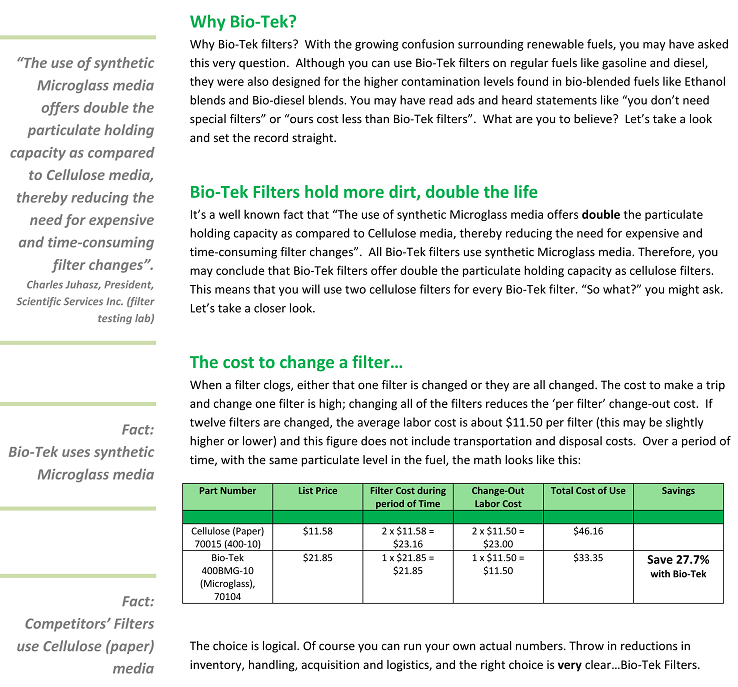
Similarly, other claims were potentially false because they touted test results that Champion plausibly alleged weren’t industry accepted and didn’t correctly validate the performance or strength of a filter.  Also, Central Illinois issued a white paper claiming that customers “Save 20% to 50% by using Bio–Tek Dispenser Filters.” The white paper included a table that compared the total costs of buying and replacing two filters with model numbers: (1) “Cellulose (Paper) 70015 (400–10)” and (2) “Bio–Tek 400BMG–10 (Microglass), 70104,” favoring the latter.  Both model numbers referred to filters made by Central Illinois.  Champion could proceed on a misleadingness theory.  “The table states only the model number and not the brand name of the cellulose filter, and a reasonable customer may not understand Defendant to be comparing two of its own products,” especially given that Champion pled that the defining difference between the parties’ products was their composition.  Further, the white paper had a blown up notation on the side stating that “competitors” use cellulose filters.  The court analyzed similar comparisons to “cellulose filters” in other ads similarly, despite Central Illinois’ argument that it was comparing its microglass filters to its own cellulose filters.
Posted in http://schemas.google.com/blogger/2008/kind#post | Leave a comment

SDNY allows consumer “organic” claims to proceed

Segedie v. Hain Celestial Group, Inc., 2015 WL 2168374, No.
14–cv–5029 (S.D.N.Y. May 7, 2015)
 
Plaintiffs bought Earth’s Best food, body care, and home
care products, and alleged that they were misleadingly labeled as “organic,”
“natural,” or “all natural.”  They
identified 62 food and 12 body care products that contained one or more of 47
ingredients that applicable law allegedly bars in organic products.  They made similar claims about products
labeled “natural” or “all natural” that allegedly contained one or more of 72
artificial or synthetic ingredients.  They
brought claims under NY and California common law, NY GBL §349 claims, and the
usual California statutory claims.
 
Hain argued that the federal OFPA preempted the “organic”
claims.  The OFPA directed the USDA to
establish national standards governing products marketed as “organic,” which
resulted in the National Organic Program (NOP). The NOP regulations govern the
use of “organic” in labeling and marketing agricultural and processed products.
The OFPA and NOP require that any product sold as “organic” has to have been
certified as such by an accredited certifying agent.  The NOP’s program manager and accredited
certifying agents can investigate certified operations suspected of
noncompliance and can suspend or revoke a certification, with associated civil
penalties of up to $10,000 per violation and the possibility of a 5–year
prohibition from re-certification. Adverse actions are appealable.  The law doesn’t provide a private cause of
action or any remedies for consumers harmed by violations.
 
The court disagreed with the Eighth Circuit, In re Aurora
Dairy Corp. Organic Milk Mktg. & Sales Practices Litig., 621 F.3d 781 (8th
Cir. 2010), and found that the OFPA didn’t preempt the plaintiffs’ claims here.  There was clearly no express or field
preemption; the only question was conflict preemption.  Compliance with the OFPA and state law was
physically possible, so the question was whether there was a conflict with
Congress’s purpose.
 
The relevant congressional objections were stated in the law:
“(1) to establish national standards governing the marketing of certain
agricultural products as organically produced products; (2) to assure consumers
that organically produced products meet a consistent standard; and (3) to
facilitate interstate commerce in fresh and processed food that is organically
produced.”  Aurora held that the OFPA does not preempt claims that do not
“interfere with” the certification decision but still depend on facts crucial
to the certification decision—“e.g., claims based sale of the milk as free from
antibiotics and hormones or as produced by humanely treated cows.” But Aurora did find preemption for “claims
directly challenging the certification decision—i.e., claims challenging the
sale of the milk as ‘organic.’” Aurora
reasoned that allowing the latter kind of claim could lead to inconsistencies
and fragmentation of the national standards, and that the OFPA specifically
allows products to be sold as “organic” if they’re produced in accordance with
the OFPA and NOP, without consumer remedies.
 
The court here found Aurora
unpersuasive.  “Obstacle preemption
precludes only those state laws that pose an ‘actual conflict’ with an
overriding federal purpose and objective.” The conflict has to be a sharp one,
especially in an area of traditional state concern.  Allowing the claims here wouldn’t cause such
a sharp conflict.  Allowing “organic”
claims furthers the congressional purpose “to assure consumers that organically
produced products meet a consistent standard.”  
 
Though Congress also sought to establish national standards,
this case didn’t present a big obstacle because the theory of liability didn’t
diverge from the national organic standards. Though different courts might
interpret the same standards differently, Congress “(1) delegated certification
decisions to certifying agents—of which there are ‘[n]early 100’—whose
interpretations of organic standards surely must diverge to some extent, and
(2) expressly assigned U.S. district courts an interpretive role, albeit
through the lens of arbitrary-and-capricious review.” The risk of divergence
was therefore contemplated in some degree. 
Any court adjudicating the kinds of claims brought here “would be
interpreting the same standards, with appropriate deference to published USDA
regulations and interpretations.” There’s no reason to expect so much
divergence as to prevent national standards.
 
Aurora was also at
odds with the Supreme Court’s decision in Wyeth,
which found failure-to-warn claims not preempted even though the label of the
drug at issue had been FDA-approved. 
Similarly, a certification agency’s approval of “organic” status is not
necessarily the final word if state law finds the “organic” label false or
misleading (as long as it is using the definition of “organic” used by the
feds).  “[S]tate law causes of action are
not preempted where they merely provide a damages remedy for claims premised on
a violation of federal law that does not itself provide a private right of
action.” There was no reason to think that Congress “intended to eliminate all
remedies for aggrieved purchasers of organic products.”  The express preemption provisions of the OFPA,
governing alternative state certification programs, showed that Congress knew
how to preempt state law when it wanted to.
 
On the merits, plaintiffs pled legally sufficient facts that
the products at issue weren’t “organic.” 
Foods labeled “organic” can have up to 5% by weight of non-organic
ingredients listed on the National List of Allowed and Prohibited Substances. “If
a non-organic ingredient is not on the National List, it cannot appear in an
organic product in any quantity (unless it qualifies for some other exception).”  The National List allows “Nutrient vitamins
and minerals, in accordance with 21 C.F.R. 104.20, [sic ] Nutritional Quality
Guidelines For Foods.”  Hain argued that
this was an open-ended exception that encompassed the challenged ingredients,
but it wasn’t.  The cross-reference
allowed foods to be fortified with 21 specific substances under “certain
limited conditions—e.g., to restore nutrients lost during processing,” plus “as
permitted or required by applicable regulations established elsewhere in this
chapter.” The FDA has explained that this last allowance “extends only to
substances permitted or required to be added to foods pursuant to regulations
pertaining to a common or usual name, a standard of identity, or nutritional
quality guideline.”  Thus, it doesn’t
permit “indiscriminate fortification of foods with, for example, AHA, DHA,
taurine, or inositol simply because the FDA has deemed them ‘Generally
Recognized as Safe.’” The FDA also excluded infant formula from this exception
because it has another specific regulation for infant formula.  This agency interpretation was not plainly
erroneous or inconsistent with the regulation.
 
Hain tried to rely on a contrary interpretation that the NOP
expressed in a since-disavowed April 2007 opinion letter, but the court wouldn’t
let it.  That interpretation wasn’t
entitled to deference, since the NOP didn’t promulgate the regulation at issue,
and anyway it was disavowed/inconsistent over time and therefore entitled to
less deference.  “Congress could not have
been clearer in mandating that the NOP may permit additional nutrients to be
added to organic foods only by amending the National List through
notice-and-comment rulemaking (except in certain emergency situations not
applicable here).” 
 
Finally, even if Hain’s interpretation were correct, it
couldn’t win a motion to dismiss by asserting that the challenged ingredients were
nutrient vitamins or minerals, without providing judicially noticeable evidence
for this.
 
Hain attacked the “natural” claims as implausible and
lacking an objective definition of “natural.”  The court disagreed: the complaint alleged
that plaintiffs understood “natural” to mean that the products were free from
synthetic ingredients, and that wasn’t unreasonable as a matter of law.  Although foods labeled “organic” may lawfully
contain some synthetic ingredients, “[t]here is no rigid hierarchy that makes ‘natural’
a more permissive label than ‘organic’ in all respects as a matter of law.” A
jury might so find, but not a court on a motion to dismiss.  So too with the presence of the ingredients on
the ingredient list (citing the Ninth Circuit’s Williams v. Gerber case). 
 
Plaintiffs’ definition of natural was sufficient in that
they alleged that the term “communicates the absence of synthetic ingredients”;
they didn’t have to define it for all purposes. The FDA and USDA policies on “natural”
were potentially relevant, as was Hain’s own definition in SEC filings, but the
ultimate question was one of reasonableness. “The alleged presence of synthetic
ingredients merely brings the claim of deception into the realm of plausibility,”
and the rest was for a jury.
 
Unsurprisingly, the court also rejected Hain’s primary
jurisdiction argument. Courts can resolve questions of whether labels violate
OFPA regulations and whether violations reasonably misled consumers.  Plus, the USDA can’t retroactively amend the
regulations to make Hain have complied with them.
 
The court did express doubt over plaintiffs’ standing to sue
over products they didn’t purchase, because their own allegations suggest that
the concerns for different products weren’t nearly identical, given the
different products and ingredients.

from Blogger http://ift.tt/1FkNe6I

Posted in Uncategorized | Tagged , , , | Leave a comment

SDNY allows consumer "organic" claims to proceed

Segedie v. Hain Celestial Group, Inc., 2015 WL 2168374, No. 14–cv–5029 (S.D.N.Y. May 7, 2015)
 
Plaintiffs bought Earth’s Best food, body care, and home care products, and alleged that they were misleadingly labeled as “organic,” “natural,” or “all natural.”  They identified 62 food and 12 body care products that contained one or more of 47 ingredients that applicable law allegedly bars in organic products.  They made similar claims about products labeled “natural” or “all natural” that allegedly contained one or more of 72 artificial or synthetic ingredients.  They brought claims under NY and California common law, NY GBL §349 claims, and the usual California statutory claims.
 
Hain argued that the federal OFPA preempted the “organic” claims.  The OFPA directed the USDA to establish national standards governing products marketed as “organic,” which resulted in the National Organic Program (NOP). The NOP regulations govern the use of “organic” in labeling and marketing agricultural and processed products. The OFPA and NOP require that any product sold as “organic” has to have been certified as such by an accredited certifying agent.  The NOP’s program manager and accredited certifying agents can investigate certified operations suspected of noncompliance and can suspend or revoke a certification, with associated civil penalties of up to $10,000 per violation and the possibility of a 5–year prohibition from re-certification. Adverse actions are appealable.  The law doesn’t provide a private cause of action or any remedies for consumers harmed by violations.
 
The court disagreed with the Eighth Circuit, In re Aurora Dairy Corp. Organic Milk Mktg. & Sales Practices Litig., 621 F.3d 781 (8th Cir. 2010), and found that the OFPA didn’t preempt the plaintiffs’ claims here.  There was clearly no express or field preemption; the only question was conflict preemption.  Compliance with the OFPA and state law was physically possible, so the question was whether there was a conflict with Congress’s purpose.
 
The relevant congressional objections were stated in the law: “(1) to establish national standards governing the marketing of certain agricultural products as organically produced products; (2) to assure consumers that organically produced products meet a consistent standard; and (3) to facilitate interstate commerce in fresh and processed food that is organically produced.”  Aurora held that the OFPA does not preempt claims that do not “interfere with” the certification decision but still depend on facts crucial to the certification decision—“e.g., claims based sale of the milk as free from antibiotics and hormones or as produced by humanely treated cows.” But Aurora did find preemption for “claims directly challenging the certification decision—i.e., claims challenging the sale of the milk as ‘organic.’” Aurorareasoned that allowing the latter kind of claim could lead to inconsistencies and fragmentation of the national standards, and that the OFPA specifically allows products to be sold as “organic” if they’re produced in accordance with the OFPA and NOP, without consumer remedies.
 
The court here found Auroraunpersuasive.  “Obstacle preemption precludes only those state laws that pose an ‘actual conflict’ with an overriding federal purpose and objective.” The conflict has to be a sharp one, especially in an area of traditional state concern.  Allowing the claims here wouldn’t cause such a sharp conflict.  Allowing “organic” claims furthers the congressional purpose “to assure consumers that organically produced products meet a consistent standard.”  
 
Though Congress also sought to establish national standards, this case didn’t present a big obstacle because the theory of liability didn’t diverge from the national organic standards. Though different courts might interpret the same standards differently, Congress “(1) delegated certification decisions to certifying agents—of which there are ‘[n]early 100’—whose interpretations of organic standards surely must diverge to some extent, and (2) expressly assigned U.S. district courts an interpretive role, albeit through the lens of arbitrary-and-capricious review.” The risk of divergence was therefore contemplated in some degree.  Any court adjudicating the kinds of claims brought here “would be interpreting the same standards, with appropriate deference to published USDA regulations and interpretations.” There’s no reason to expect so much divergence as to prevent national standards.
 
Aurora was also at odds with the Supreme Court’s decision in Wyeth, which found failure-to-warn claims not preempted even though the label of the drug at issue had been FDA-approved.  Similarly, a certification agency’s approval of “organic” status is not necessarily the final word if state law finds the “organic” label false or misleading (as long as it is using the definition of “organic” used by the feds).  “[S]tate law causes of action are not preempted where they merely provide a damages remedy for claims premised on a violation of federal law that does not itself provide a private right of action.” There was no reason to think that Congress “intended to eliminate all remedies for aggrieved purchasers of organic products.”  The express preemption provisions of the OFPA, governing alternative state certification programs, showed that Congress knew how to preempt state law when it wanted to.
 
On the merits, plaintiffs pled legally sufficient facts that the products at issue weren’t “organic.”  Foods labeled “organic” can have up to 5% by weight of non-organic ingredients listed on the National List of Allowed and Prohibited Substances. “If a non-organic ingredient is not on the National List, it cannot appear in an organic product in any quantity (unless it qualifies for some other exception).”  The National List allows “Nutrient vitamins and minerals, in accordance with 21 C.F.R. 104.20, [sic ] Nutritional Quality Guidelines For Foods.”  Hain argued that this was an open-ended exception that encompassed the challenged ingredients, but it wasn’t.  The cross-reference allowed foods to be fortified with 21 specific substances under “certain limited conditions—e.g., to restore nutrients lost during processing,” plus “as permitted or required by applicable regulations established elsewhere in this chapter.” The FDA has explained that this last allowance “extends only to substances permitted or required to be added to foods pursuant to regulations pertaining to a common or usual name, a standard of identity, or nutritional quality guideline.”  Thus, it doesn’t permit “indiscriminate fortification of foods with, for example, AHA, DHA, taurine, or inositol simply because the FDA has deemed them ‘Generally Recognized as Safe.’” The FDA also excluded infant formula from this exception because it has another specific regulation for infant formula.  This agency interpretation was not plainly erroneous or inconsistent with the regulation.
 
Hain tried to rely on a contrary interpretation that the NOP expressed in a since-disavowed April 2007 opinion letter, but the court wouldn’t let it.  That interpretation wasn’t entitled to deference, since the NOP didn’t promulgate the regulation at issue, and anyway it was disavowed/inconsistent over time and therefore entitled to less deference.  “Congress could not have been clearer in mandating that the NOP may permit additional nutrients to be added to organic foods only by amending the National List through notice-and-comment rulemaking (except in certain emergency situations not applicable here).” 
 
Finally, even if Hain’s interpretation were correct, it couldn’t win a motion to dismiss by asserting that the challenged ingredients were nutrient vitamins or minerals, without providing judicially noticeable evidence for this.
 
Hain attacked the “natural” claims as implausible and lacking an objective definition of “natural.”  The court disagreed: the complaint alleged that plaintiffs understood “natural” to mean that the products were free from synthetic ingredients, and that wasn’t unreasonable as a matter of law.  Although foods labeled “organic” may lawfully contain some synthetic ingredients, “[t]here is no rigid hierarchy that makes ‘natural’ a more permissive label than ‘organic’ in all respects as a matter of law.” A jury might so find, but not a court on a motion to dismiss.  So too with the presence of the ingredients on the ingredient list (citing the Ninth Circuit’s Williams v. Gerber case). 
 
Plaintiffs’ definition of natural was sufficient in that they alleged that the term “communicates the absence of synthetic ingredients”; they didn’t have to define it for all purposes. The FDA and USDA policies on “natural” were potentially relevant, as was Hain’s own definition in SEC filings, but the ultimate question was one of reasonableness. “The alleged presence of synthetic ingredients merely brings the claim of deception into the realm of plausibility,” and the rest was for a jury.
 
Unsurprisingly, the court also rejected Hain’s primary jurisdiction argument. Courts can resolve questions of whether labels violate OFPA regulations and whether violations reasonably misled consumers.  Plus, the USDA can’t retroactively amend the regulations to make Hain have complied with them.
 
The court did express doubt over plaintiffs’ standing to sue over products they didn’t purchase, because their own allegations suggest that the concerns for different products weren’t nearly identical, given the different products and ingredients.
Posted in california, consumer protection, http://schemas.google.com/blogger/2008/kind#post, preemption | Leave a comment

Hypo of the day, Denny’s edition

This might require a bit of background.  Tumblr is a social media platform very popular with a demographic of young users; Yahoo! bought Tumblr and is trying to figure out how to make it profitable through advertising.  As a result, Tumblr is trying out new ad formats in users’ let’s-call-them-newsfeeds.  One of these formats, for reasons best known to Yahoo!, was a blank picture frame that appeared mysteriously, without any other labeling.  Because this is Tumblr, a meme generator without equal, users soon started posting their own picture frames with content inside.  Denny’s, again for reasons that are unclear but probably have to do with the accident of the social media person assigned to Tumblr, is probably the most successful advertiser-user of Tumblr.  The Denny’s Tumblr regularly posts weird, amusing, much-reblogged  and -liked posts referring to Denny’s–like Jon Stewart, but less disparaging.  So Denny’s went and inserted a 2000s-style ad into the Yahoo! picture frame.  Denny’s didn’t pay for this, of course.  Would Yahoo! have a valid 43(a) false endorsement claim based on the theory that it looks like Denny’s did pay?

from Blogger http://ift.tt/1cTpni1

Posted in Uncategorized | Tagged , | Leave a comment