No need to name competitor if context does

Champion Laboratories, Inc. v. Central Illinois Manufacturing Co., 2015 WL 2208198,  No. 14 CV 9754 (N.D. Ill. May 8, 2015)
 
The parties are the leading manufacturers and suppliers of fuel dispensing filters in the United States. “Fuel dispensing filters are incorporated in fuel dispensing equipment, such as gas pumps, and they are designed to remove particulate contaminants from petroleum and other fuels before being dispensed into a vehicle.” Champion (which makes PetroClear) alleged false advertising by Central Illinois (Cim-Tek and Bio-Tek).  The key difference between the parties’ filters is composition: Champion’s are made from cellulose, while Central Illinois primarily makes filters from microglass.
 

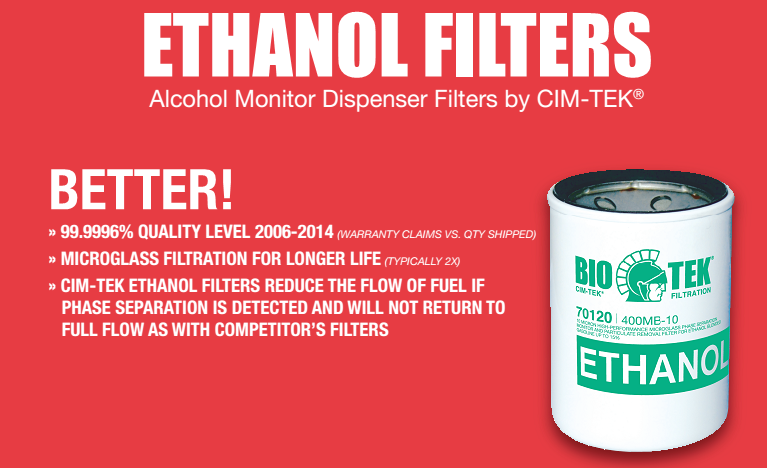
With respect to the first challenged claim, “Return to Full Flow,” Central Illinois ran an ad touting three comparative advantages of Cim–Tek ethanol filters against “competitor’s filters.” It stated: “Cim–Tek ethanol filters reduce the flow of fuel if phase separation [contamination] is detected and will not return to full flow as with competitor’s filters.”  Central Illinois argued that there were no representations about Champion’s filters in the ad, but instead the ad referred to “other filters that do not return to full flow.”  But an ad need not name a competitor to be false. Champion avoided dismissal because it pled that the parties were the leading suppliers; that they sold more than half the filters in the US; and that they sold to the same customers.  Though the market may be less concentrated than a two-party market, “many customers deciding on which filter to purchase are choosing between the two options: Cim–Tek or PetroClear.”  Thus, when Central Illinois used the word “competitor” and touted the benefits of microglass elsewhere in the ad, customers might infer a reference to PetroClear, especially since the ad used the singular and not the plural to refer to “competitor,” thus suggesting a comparison with the leading product and not with one of the 25 other competitors with smaller market shares.
 

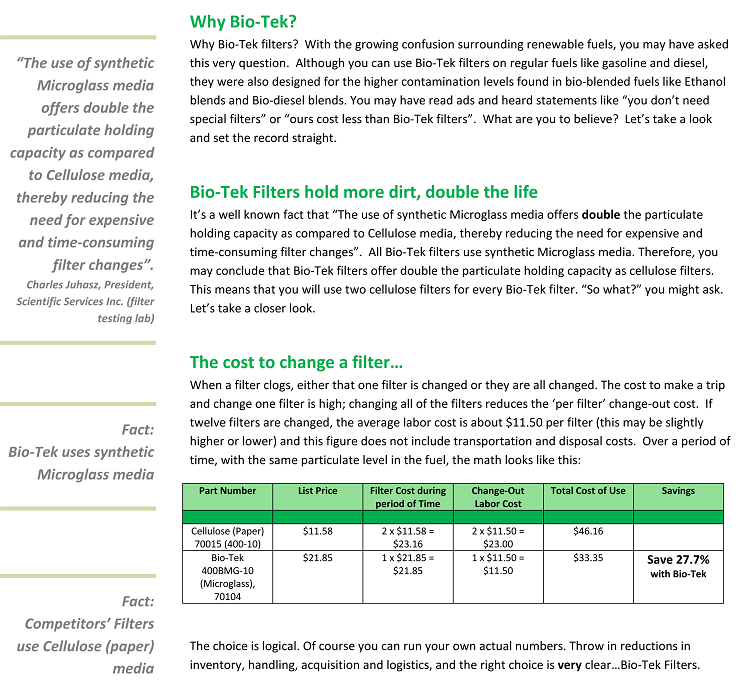
Similarly, other claims were potentially false because they touted test results that Champion plausibly alleged weren’t industry accepted and didn’t correctly validate the performance or strength of a filter.  Also, Central Illinois issued a white paper claiming that customers “Save 20% to 50% by using Bio–Tek Dispenser Filters.” The white paper included a table that compared the total costs of buying and replacing two filters with model numbers: (1) “Cellulose (Paper) 70015 (400–10)” and (2) “Bio–Tek 400BMG–10 (Microglass), 70104,” favoring the latter.  Both model numbers referred to filters made by Central Illinois.  Champion could proceed on a misleadingness theory.  “The table states only the model number and not the brand name of the cellulose filter, and a reasonable customer may not understand Defendant to be comparing two of its own products,” especially given that Champion pled that the defining difference between the parties’ products was their composition.  Further, the white paper had a blown up notation on the side stating that “competitors” use cellulose filters.  The court analyzed similar comparisons to “cellulose filters” in other ads similarly, despite Central Illinois’ argument that it was comparing its microglass filters to its own cellulose filters.
Posted in http://schemas.google.com/blogger/2008/kind#post | Leave a comment

SDNY allows consumer “organic” claims to proceed

Segedie v. Hain Celestial Group, Inc., 2015 WL 2168374, No.
14–cv–5029 (S.D.N.Y. May 7, 2015)
 
Plaintiffs bought Earth’s Best food, body care, and home
care products, and alleged that they were misleadingly labeled as “organic,”
“natural,” or “all natural.”  They
identified 62 food and 12 body care products that contained one or more of 47
ingredients that applicable law allegedly bars in organic products.  They made similar claims about products
labeled “natural” or “all natural” that allegedly contained one or more of 72
artificial or synthetic ingredients.  They
brought claims under NY and California common law, NY GBL §349 claims, and the
usual California statutory claims.
 
Hain argued that the federal OFPA preempted the “organic”
claims.  The OFPA directed the USDA to
establish national standards governing products marketed as “organic,” which
resulted in the National Organic Program (NOP). The NOP regulations govern the
use of “organic” in labeling and marketing agricultural and processed products.
The OFPA and NOP require that any product sold as “organic” has to have been
certified as such by an accredited certifying agent.  The NOP’s program manager and accredited
certifying agents can investigate certified operations suspected of
noncompliance and can suspend or revoke a certification, with associated civil
penalties of up to $10,000 per violation and the possibility of a 5–year
prohibition from re-certification. Adverse actions are appealable.  The law doesn’t provide a private cause of
action or any remedies for consumers harmed by violations.
 
The court disagreed with the Eighth Circuit, In re Aurora
Dairy Corp. Organic Milk Mktg. & Sales Practices Litig., 621 F.3d 781 (8th
Cir. 2010), and found that the OFPA didn’t preempt the plaintiffs’ claims here.  There was clearly no express or field
preemption; the only question was conflict preemption.  Compliance with the OFPA and state law was
physically possible, so the question was whether there was a conflict with
Congress’s purpose.
 
The relevant congressional objections were stated in the law:
“(1) to establish national standards governing the marketing of certain
agricultural products as organically produced products; (2) to assure consumers
that organically produced products meet a consistent standard; and (3) to
facilitate interstate commerce in fresh and processed food that is organically
produced.”  Aurora held that the OFPA does not preempt claims that do not
“interfere with” the certification decision but still depend on facts crucial
to the certification decision—“e.g., claims based sale of the milk as free from
antibiotics and hormones or as produced by humanely treated cows.” But Aurora did find preemption for “claims
directly challenging the certification decision—i.e., claims challenging the
sale of the milk as ‘organic.’” Aurora
reasoned that allowing the latter kind of claim could lead to inconsistencies
and fragmentation of the national standards, and that the OFPA specifically
allows products to be sold as “organic” if they’re produced in accordance with
the OFPA and NOP, without consumer remedies.
 
The court here found Aurora
unpersuasive.  “Obstacle preemption
precludes only those state laws that pose an ‘actual conflict’ with an
overriding federal purpose and objective.” The conflict has to be a sharp one,
especially in an area of traditional state concern.  Allowing the claims here wouldn’t cause such
a sharp conflict.  Allowing “organic”
claims furthers the congressional purpose “to assure consumers that organically
produced products meet a consistent standard.”  
 
Though Congress also sought to establish national standards,
this case didn’t present a big obstacle because the theory of liability didn’t
diverge from the national organic standards. Though different courts might
interpret the same standards differently, Congress “(1) delegated certification
decisions to certifying agents—of which there are ‘[n]early 100’—whose
interpretations of organic standards surely must diverge to some extent, and
(2) expressly assigned U.S. district courts an interpretive role, albeit
through the lens of arbitrary-and-capricious review.” The risk of divergence
was therefore contemplated in some degree. 
Any court adjudicating the kinds of claims brought here “would be
interpreting the same standards, with appropriate deference to published USDA
regulations and interpretations.” There’s no reason to expect so much
divergence as to prevent national standards.
 
Aurora was also at
odds with the Supreme Court’s decision in Wyeth,
which found failure-to-warn claims not preempted even though the label of the
drug at issue had been FDA-approved. 
Similarly, a certification agency’s approval of “organic” status is not
necessarily the final word if state law finds the “organic” label false or
misleading (as long as it is using the definition of “organic” used by the
feds).  “[S]tate law causes of action are
not preempted where they merely provide a damages remedy for claims premised on
a violation of federal law that does not itself provide a private right of
action.” There was no reason to think that Congress “intended to eliminate all
remedies for aggrieved purchasers of organic products.”  The express preemption provisions of the OFPA,
governing alternative state certification programs, showed that Congress knew
how to preempt state law when it wanted to.
 
On the merits, plaintiffs pled legally sufficient facts that
the products at issue weren’t “organic.” 
Foods labeled “organic” can have up to 5% by weight of non-organic
ingredients listed on the National List of Allowed and Prohibited Substances. “If
a non-organic ingredient is not on the National List, it cannot appear in an
organic product in any quantity (unless it qualifies for some other exception).”  The National List allows “Nutrient vitamins
and minerals, in accordance with 21 C.F.R. 104.20, [sic ] Nutritional Quality
Guidelines For Foods.”  Hain argued that
this was an open-ended exception that encompassed the challenged ingredients,
but it wasn’t.  The cross-reference
allowed foods to be fortified with 21 specific substances under “certain
limited conditions—e.g., to restore nutrients lost during processing,” plus “as
permitted or required by applicable regulations established elsewhere in this
chapter.” The FDA has explained that this last allowance “extends only to
substances permitted or required to be added to foods pursuant to regulations
pertaining to a common or usual name, a standard of identity, or nutritional
quality guideline.”  Thus, it doesn’t
permit “indiscriminate fortification of foods with, for example, AHA, DHA,
taurine, or inositol simply because the FDA has deemed them ‘Generally
Recognized as Safe.’” The FDA also excluded infant formula from this exception
because it has another specific regulation for infant formula.  This agency interpretation was not plainly
erroneous or inconsistent with the regulation.
 
Hain tried to rely on a contrary interpretation that the NOP
expressed in a since-disavowed April 2007 opinion letter, but the court wouldn’t
let it.  That interpretation wasn’t
entitled to deference, since the NOP didn’t promulgate the regulation at issue,
and anyway it was disavowed/inconsistent over time and therefore entitled to
less deference.  “Congress could not have
been clearer in mandating that the NOP may permit additional nutrients to be
added to organic foods only by amending the National List through
notice-and-comment rulemaking (except in certain emergency situations not
applicable here).” 
 
Finally, even if Hain’s interpretation were correct, it
couldn’t win a motion to dismiss by asserting that the challenged ingredients were
nutrient vitamins or minerals, without providing judicially noticeable evidence
for this.
 
Hain attacked the “natural” claims as implausible and
lacking an objective definition of “natural.”  The court disagreed: the complaint alleged
that plaintiffs understood “natural” to mean that the products were free from
synthetic ingredients, and that wasn’t unreasonable as a matter of law.  Although foods labeled “organic” may lawfully
contain some synthetic ingredients, “[t]here is no rigid hierarchy that makes ‘natural’
a more permissive label than ‘organic’ in all respects as a matter of law.” A
jury might so find, but not a court on a motion to dismiss.  So too with the presence of the ingredients on
the ingredient list (citing the Ninth Circuit’s Williams v. Gerber case). 
 
Plaintiffs’ definition of natural was sufficient in that
they alleged that the term “communicates the absence of synthetic ingredients”;
they didn’t have to define it for all purposes. The FDA and USDA policies on “natural”
were potentially relevant, as was Hain’s own definition in SEC filings, but the
ultimate question was one of reasonableness. “The alleged presence of synthetic
ingredients merely brings the claim of deception into the realm of plausibility,”
and the rest was for a jury.
 
Unsurprisingly, the court also rejected Hain’s primary
jurisdiction argument. Courts can resolve questions of whether labels violate
OFPA regulations and whether violations reasonably misled consumers.  Plus, the USDA can’t retroactively amend the
regulations to make Hain have complied with them.
 
The court did express doubt over plaintiffs’ standing to sue
over products they didn’t purchase, because their own allegations suggest that
the concerns for different products weren’t nearly identical, given the
different products and ingredients.

from Blogger http://ift.tt/1FkNe6I

Posted in Uncategorized | Tagged , , , | Leave a comment

SDNY allows consumer "organic" claims to proceed

Segedie v. Hain Celestial Group, Inc., 2015 WL 2168374, No. 14–cv–5029 (S.D.N.Y. May 7, 2015)
 
Plaintiffs bought Earth’s Best food, body care, and home care products, and alleged that they were misleadingly labeled as “organic,” “natural,” or “all natural.”  They identified 62 food and 12 body care products that contained one or more of 47 ingredients that applicable law allegedly bars in organic products.  They made similar claims about products labeled “natural” or “all natural” that allegedly contained one or more of 72 artificial or synthetic ingredients.  They brought claims under NY and California common law, NY GBL §349 claims, and the usual California statutory claims.
 
Hain argued that the federal OFPA preempted the “organic” claims.  The OFPA directed the USDA to establish national standards governing products marketed as “organic,” which resulted in the National Organic Program (NOP). The NOP regulations govern the use of “organic” in labeling and marketing agricultural and processed products. The OFPA and NOP require that any product sold as “organic” has to have been certified as such by an accredited certifying agent.  The NOP’s program manager and accredited certifying agents can investigate certified operations suspected of noncompliance and can suspend or revoke a certification, with associated civil penalties of up to $10,000 per violation and the possibility of a 5–year prohibition from re-certification. Adverse actions are appealable.  The law doesn’t provide a private cause of action or any remedies for consumers harmed by violations.
 
The court disagreed with the Eighth Circuit, In re Aurora Dairy Corp. Organic Milk Mktg. & Sales Practices Litig., 621 F.3d 781 (8th Cir. 2010), and found that the OFPA didn’t preempt the plaintiffs’ claims here.  There was clearly no express or field preemption; the only question was conflict preemption.  Compliance with the OFPA and state law was physically possible, so the question was whether there was a conflict with Congress’s purpose.
 
The relevant congressional objections were stated in the law: “(1) to establish national standards governing the marketing of certain agricultural products as organically produced products; (2) to assure consumers that organically produced products meet a consistent standard; and (3) to facilitate interstate commerce in fresh and processed food that is organically produced.”  Aurora held that the OFPA does not preempt claims that do not “interfere with” the certification decision but still depend on facts crucial to the certification decision—“e.g., claims based sale of the milk as free from antibiotics and hormones or as produced by humanely treated cows.” But Aurora did find preemption for “claims directly challenging the certification decision—i.e., claims challenging the sale of the milk as ‘organic.’” Aurorareasoned that allowing the latter kind of claim could lead to inconsistencies and fragmentation of the national standards, and that the OFPA specifically allows products to be sold as “organic” if they’re produced in accordance with the OFPA and NOP, without consumer remedies.
 
The court here found Auroraunpersuasive.  “Obstacle preemption precludes only those state laws that pose an ‘actual conflict’ with an overriding federal purpose and objective.” The conflict has to be a sharp one, especially in an area of traditional state concern.  Allowing the claims here wouldn’t cause such a sharp conflict.  Allowing “organic” claims furthers the congressional purpose “to assure consumers that organically produced products meet a consistent standard.”  
 
Though Congress also sought to establish national standards, this case didn’t present a big obstacle because the theory of liability didn’t diverge from the national organic standards. Though different courts might interpret the same standards differently, Congress “(1) delegated certification decisions to certifying agents—of which there are ‘[n]early 100’—whose interpretations of organic standards surely must diverge to some extent, and (2) expressly assigned U.S. district courts an interpretive role, albeit through the lens of arbitrary-and-capricious review.” The risk of divergence was therefore contemplated in some degree.  Any court adjudicating the kinds of claims brought here “would be interpreting the same standards, with appropriate deference to published USDA regulations and interpretations.” There’s no reason to expect so much divergence as to prevent national standards.
 
Aurora was also at odds with the Supreme Court’s decision in Wyeth, which found failure-to-warn claims not preempted even though the label of the drug at issue had been FDA-approved.  Similarly, a certification agency’s approval of “organic” status is not necessarily the final word if state law finds the “organic” label false or misleading (as long as it is using the definition of “organic” used by the feds).  “[S]tate law causes of action are not preempted where they merely provide a damages remedy for claims premised on a violation of federal law that does not itself provide a private right of action.” There was no reason to think that Congress “intended to eliminate all remedies for aggrieved purchasers of organic products.”  The express preemption provisions of the OFPA, governing alternative state certification programs, showed that Congress knew how to preempt state law when it wanted to.
 
On the merits, plaintiffs pled legally sufficient facts that the products at issue weren’t “organic.”  Foods labeled “organic” can have up to 5% by weight of non-organic ingredients listed on the National List of Allowed and Prohibited Substances. “If a non-organic ingredient is not on the National List, it cannot appear in an organic product in any quantity (unless it qualifies for some other exception).”  The National List allows “Nutrient vitamins and minerals, in accordance with 21 C.F.R. 104.20, [sic ] Nutritional Quality Guidelines For Foods.”  Hain argued that this was an open-ended exception that encompassed the challenged ingredients, but it wasn’t.  The cross-reference allowed foods to be fortified with 21 specific substances under “certain limited conditions—e.g., to restore nutrients lost during processing,” plus “as permitted or required by applicable regulations established elsewhere in this chapter.” The FDA has explained that this last allowance “extends only to substances permitted or required to be added to foods pursuant to regulations pertaining to a common or usual name, a standard of identity, or nutritional quality guideline.”  Thus, it doesn’t permit “indiscriminate fortification of foods with, for example, AHA, DHA, taurine, or inositol simply because the FDA has deemed them ‘Generally Recognized as Safe.’” The FDA also excluded infant formula from this exception because it has another specific regulation for infant formula.  This agency interpretation was not plainly erroneous or inconsistent with the regulation.
 
Hain tried to rely on a contrary interpretation that the NOP expressed in a since-disavowed April 2007 opinion letter, but the court wouldn’t let it.  That interpretation wasn’t entitled to deference, since the NOP didn’t promulgate the regulation at issue, and anyway it was disavowed/inconsistent over time and therefore entitled to less deference.  “Congress could not have been clearer in mandating that the NOP may permit additional nutrients to be added to organic foods only by amending the National List through notice-and-comment rulemaking (except in certain emergency situations not applicable here).” 
 
Finally, even if Hain’s interpretation were correct, it couldn’t win a motion to dismiss by asserting that the challenged ingredients were nutrient vitamins or minerals, without providing judicially noticeable evidence for this.
 
Hain attacked the “natural” claims as implausible and lacking an objective definition of “natural.”  The court disagreed: the complaint alleged that plaintiffs understood “natural” to mean that the products were free from synthetic ingredients, and that wasn’t unreasonable as a matter of law.  Although foods labeled “organic” may lawfully contain some synthetic ingredients, “[t]here is no rigid hierarchy that makes ‘natural’ a more permissive label than ‘organic’ in all respects as a matter of law.” A jury might so find, but not a court on a motion to dismiss.  So too with the presence of the ingredients on the ingredient list (citing the Ninth Circuit’s Williams v. Gerber case). 
 
Plaintiffs’ definition of natural was sufficient in that they alleged that the term “communicates the absence of synthetic ingredients”; they didn’t have to define it for all purposes. The FDA and USDA policies on “natural” were potentially relevant, as was Hain’s own definition in SEC filings, but the ultimate question was one of reasonableness. “The alleged presence of synthetic ingredients merely brings the claim of deception into the realm of plausibility,” and the rest was for a jury.
 
Unsurprisingly, the court also rejected Hain’s primary jurisdiction argument. Courts can resolve questions of whether labels violate OFPA regulations and whether violations reasonably misled consumers.  Plus, the USDA can’t retroactively amend the regulations to make Hain have complied with them.
 
The court did express doubt over plaintiffs’ standing to sue over products they didn’t purchase, because their own allegations suggest that the concerns for different products weren’t nearly identical, given the different products and ingredients.
Posted in california, consumer protection, http://schemas.google.com/blogger/2008/kind#post, preemption | Leave a comment

Hypo of the day, Denny’s edition

This might require a bit of background.  Tumblr is a social media platform very popular with a demographic of young users; Yahoo! bought Tumblr and is trying to figure out how to make it profitable through advertising.  As a result, Tumblr is trying out new ad formats in users’ let’s-call-them-newsfeeds.  One of these formats, for reasons best known to Yahoo!, was a blank picture frame that appeared mysteriously, without any other labeling.  Because this is Tumblr, a meme generator without equal, users soon started posting their own picture frames with content inside.  Denny’s, again for reasons that are unclear but probably have to do with the accident of the social media person assigned to Tumblr, is probably the most successful advertiser-user of Tumblr.  The Denny’s Tumblr regularly posts weird, amusing, much-reblogged  and -liked posts referring to Denny’s–like Jon Stewart, but less disparaging.  So Denny’s went and inserted a 2000s-style ad into the Yahoo! picture frame.  Denny’s didn’t pay for this, of course.  Would Yahoo! have a valid 43(a) false endorsement claim based on the theory that it looks like Denny’s did pay?

from Blogger http://ift.tt/1cTpni1

Posted in Uncategorized | Tagged , | Leave a comment

Hypo of the day, Denny’s edition

This might require a bit of background.  Tumblr is a social media platform very popular with a demographic of young users; Yahoo! bought Tumblr and is trying to figure out how to make it profitable through advertising.  As a result, Tumblr is trying out new ad formats in users’ let’s-call-them-newsfeeds.  One of these formats, for reasons best known to Yahoo!, was a blank picture frame that appeared mysteriously, without any other labeling.  Because this is Tumblr, a meme generator without equal, users soon started posting their own picture frames with content inside.  Denny’s, again for reasons that are unclear but probably have to do with the accident of the social media person assigned to Tumblr, is probably the most successful advertiser-user of Tumblr.  The Denny’s Tumblr regularly posts weird, amusing, much-reblogged  and -liked posts referring to Denny’s–like Jon Stewart, but less disparaging.  So Denny’s went and inserted a 2000s-style ad into the Yahoo! picture frame.  Denny’s didn’t pay for this, of course.  Would Yahoo! have a valid 43(a) false endorsement claim based on the theory that it looks like Denny’s did pay?

Posted in trademark | Leave a comment

Reading list: entertainment franchises and Drassinower

Law and Creativity in the
Age of the Entertainment Franchise
, ed. Kathy Bowrey & Michael
Handler: A collection of essays on the general theme, some much more specific
than others. The editors suggest that the things that the
“entertainment
industry
”
values don
’t
map very well onto the law, but that industry members nonetheless
deploy/interact with the law to get what they want.  I like their working definition of franchises:
franchises involve connected cultural content that some entity tries to exploit
and keep profitable over time.
 
David Lindsay contributes a pretty bad
defense of copyright in
“Franchises, imaginary worlds,
authorship and fandom,
” arguing that a hierarchy of ownership
is important to sustain the attractiveness of a cultural artifact, because
fandoms are like religions and religions need hierarchy
—yes,
multiple interpretations are inevitable, but polysemous meaning needs a claim
of authoritativeness against which to define itself.  (I was not aware of that, and nor I think
were the directors of many a Hamlet I have seen.  Polysemous meaning may well need other
interpretations against which to define itself, but I see no requisite
connection to hierarchy.)  In a world
where different kinds of content compete for limited attention, he argues, it
’s
important to have a combination of
“material that is familiar to an
audience
—both
in terms of its content and its
‘authorial’
reputation
—with
the potential for the generation of new meanings.
” 
These universes must be owned to ensure their
“authenticity
and integrity,
”
without which fans and audiences won
’t form an “ongoing
attachment.
”  (Citation needed.)  Within those controlled boundaries, then,
there
’s
room for experimentation/playing out the rules of the world.  But fans need to be kept in line:
“Just
as the ambiguous line between orthodoxy and heresy played a policing role in
the Middle Ages, uncertainty surrounding copyright
infringement is essential in constructing the terms of the relationship between
franchise owners and online communities.
” 
(Or not: see, e.g., transformativeworks.org.  I really wish people wouldn
’t
treat copyright uncertainty as so much more uncertain than other legal
regimes.  What does it take to avoid
driving a car negligently?) 
 
The fact that franchise owners “naturally
have a strong interest in being a source (although not
necessarily the sole source) of canonical meaning, and in
being perceived by a fan community as the responsible (and potentially responsive)
guardians (or co-guardians) of canonical meaning
” really says nothing about what the
law should give them.  These claims for
the necessity of some permanent meaning in order to preserve a community around
a work have been made many times before; I
’ve never been persuaded.
Lindsay even discusses affirmational v. transformative fandom, then proceeds
to ignore transformative fandom by saying that fan communities
“are
based upon defining themselves against
‘outsiders,’” and
therefore that fan communities do not protect the diversity of responses to
texts but rather foster exclusion and identity politics, based on claims about
their
“depth
of knowledge (and loyalty to) canonical meaning
” and “the enclosure of meaning.”  He might feel excluded from my fandoms, but I
am sure that none of them are recognizable in this description.
 
Of course fan/producer relations aren’t as
simple as
“the
contrast between franchise owners as over-zealous control freaks, and fans as
the virtuous creators of socially valuable meaning,
” but
that
’s
not where fan studies is (or really has been for a while, if it ever was–he misses the whole aspect of fan studies that is about recuperating fandom from the pathologization to which it was subject and to which Lindsay seems to be indifferent).  A key issue is
exploitation, and Lindsay just valorizes it instead of
critiquing it or attempting to understand the many ways in which it might play
out.  It
’s not helpful to insist that “[i]n
a commercial culture, content is a commodity
” and that economic law demands that
producers maximize profits
—not only is it empirically false
(there
’s
plenty of irrational behavior in the content sector, not to mention
noncommercial production), it
’s normatively bankrupt. 
 
What really galls me is the
evidence-free insistence that control is necessary to
preserve something called
“authenticity,” as
if authenticity weren
’t contingent and negotiable.  Lindsay even seems to acknowledge this,
retreating to the assertion that struggles over
authenticity are necessary to a franchise
—which gets us back to the religion
point.  It may well be true that such
struggles are a part of a healthy belief system, but that doesn
’t
mean that there needs to be any state-sponsored religion.  When you have to analogize copyright law to
the Inquisition, you might be on the wrong side of the
argument.  (Really! 
“[J]ust as when the uniform Christian
world view began to fray in the face of the proliferation of meanings spurred
by the Reformation the Church developed institutions such as the Inquisition to
police heretics, so, in the face of the proliferation of meanings through
online fan communities, the threat of copyright infringement
can be used by franchise owners to police meaning.
”)  I suppose it’s not surprising that the chapter
lacks any concrete examples of how he thinks this works.  Lindsay refuses to define the extent of legal
“control” he
thinks is necessary
—shall corporate owners wield the power
of excommunication? What does it even mean to require a
“threat” to
hang over fan activities?  Must that
threat ever be carried out?  Enforcement
is absent in this account
—though it definitely wasn’t in
his analogous Inquisition.
 
More gems: Hierarchy is important: “the
creative process, and the relationship between authors and audiences, is
necessarily asymmetrical
…. [E]veryone may be a creator, but
that does not mean that everyone is equally creative.
”  (Straw men, anyone?)  GRRM doesn’t like fan fiction, which means …
something.  But Lindsay doesn
’t
want to enter into
“the increasingly tendentious debates
over the pros and cons of fan fiction.
” 
Still, if we feel sympathy for an author who feels sad over the
“bowdlerization” of
her creation by a corporate licensee, why wouldn
’t we feel the same sympathy “when
it is digitally empowered fans that may be responsible for the bowdlerizing?
”  (I’d love to find this corner of fandom
that bowdlerizes. 
Of course, Congress has
legalized what CleanFlicks, which really did bowdlerize, sought to do, so again
I must wonder about relevance.) 
 
Really, Lindsay just wants to be clear
that neither side, corporate or fandom, has
“self-evidently better claims to higher
normative ground.
” 
In this environment, it
’s claims by individual authors like
GRRM for respect that might be the most desirable, because they can disrupt
both fandom and corporate constructions. 
Why this ability to intervene in debates over meaning requires the
threat of copyright infringement liability is an exercise left for the reader.
 
Johnson Okpaluba contributes a chapter
on digital sampling, arguing that licensing was prevalent in the US music
industry even before litigation established a rule of
“get a
license or don
’t
sample.
”
It
’s
true that it
’s
hard/impossible now to make commercial sample-heavy albums like Paul
’s
Boutique and It Takes a Nation of Millions to Hold Us Back, but those weren
’t
ever the most common uses of sampling, Okpaluba argues, and those albums
shouldn
’t
be seen as an artistic peak, since that
’s just a subjective aesthetic
judgment.  (Valuing the possibility of
variety isn
’t
part of this analysis.)  Producers
shifted to new sampling techniques and/or live instrumentation, so legal
constraints on sampling were productive of creativity.  Joseph Fishman recently made the same
argument in Creating Around Copyright.
I find it unpersuasive, since this thesis doesn’t
explain why the law is needed on top of artistic motives to experiment and
strike out in new directions, and the resulting legal suppression is not
neutral. 
 
David Rolph’s
chapter on defamation law and celebrities has an interesting case study of how
filing a defamation case harmed the public image of a celebrity, turning him
from nice guy into perceived bully. 
Celebrity
’s fluidity, Rolph suggests, may be
inconsistent with defamation law
’s understanding of the stolidity of
reputation.
 
Other chapters cover the
Disneyfication of theater; Australian film and TV practices relating to reality
show (and other) concepts; the codification of flamenco music; arts festivals;
and carnivals as franchise opportunities for locations with communities with a
strong connection to the Caribbean.  I
didn
’t
know that you can buy a carnival-in-a-box package to promote tourism to your
city!
 
Abraham Drassinower, What’s
Wrong with Copying?
: Really thought-provoking book that proceeds
from the thesis that copyright ought to be a true author
’s
right: a right to participate in a conversation, which entails a like right of
others, thus creating its own inherent limits (specifically the idea/expression
distinction and transformative fair use). 
Also, because copyright rights involve communication, non-uses
—including
database uses and private copying
—are not infringements of the
legitimate copyright rights.  I was about
half persuaded.  He convincingly argues
that the
“balance”
metaphor of copyright (balancing author and audience interests) doesn
’t
justify copyright because it doesn
’t tell us what is to be balanced.  It makes copyright’s
lack of coverage for ideas and facts, as well as fair use, into empirical
questions when they shouldn
’t be; balancing certainly can’t
tell you as a matter of first principle that copyright should protect
expression and only expression, or why copyright and patent are different. A
mousetrap may well involve creativity
– just not the kind of creativity
copyright protects.
 
He makes a good point about defending
the public interest versus the public domain; instrumentalist accounts of
copyright focus on the former, when we should defend the latter. In Drassinower
’s
view, only understanding copyright as dealing with communicative acts can
explain copyright: copyright is not a property right, but a right
“inhering
in persons as speaking beings.
” 
Because others need free access to ideas and transformative fair use, an
author
’s
claim can
’t
extend to those
—though Drassinower doesn’t
fully convince me that he
’s defended these needs (why is freedom
to copy ideas always necessary to the next author?). 
 
One quibble comes from his use of
Borges
’
“Pierre
Menard, Author of the Quixote
” to
defend the principle that independent creation can
’t be
infringement, since Menard is definitely an author
—but
Menard was also definitely not an independent creator in the sense of not
needing Cervantes as a but-for cause of his creation.  I also thought his distinction between
copyright and trademark was unpersuasive, since he defines trademark as the
right to completely control the meaning of a mark as applied to a good or
service, and a trademark is not and should not be that!  We
’re allowed to talk about a Mickey
Mouse operation, or a Cadillac health plan. 
 
As Drassinower recognizes, entailed in
his view is that the derivative works right is illegitimate, which would be a
big change
—though
he does allow for room for infringement via substantial similarity, at least in
some cases.  He also, in what I think is
a concession that
’s inconsistent with his theory but he
thinks necessary for practical purposes, allows for the existence of a
translation right.  Of course translation
also requires creative endeavor by the translator, but he argues that
“[u]nlike
fan fiction, which uses the work of another in one
’s
own, translation is not a speaking in one
’s own words but a rendering of another’s
words in another language. Unauthorized translation is therefore infringing.
” I’m not
sure I can go with him
—why isn’t then a movie version a translation
of a book into a different medium and therefore infringing, justifying at least
part of the derivative works right?  He
recognizes translation as authorial but also infringing; that opens the
possibility of other categories of authorial acts that are also infringing, and
now we
’re
back to fighting over the scope of the derivative works right.
 
Drassinower is trenchant in his
criticism of US parochialism, which dismisses rights-based accounts of
copyright law out of hand. 
Low-protectionists worry that an author-centered account of copyright
would give authors too much control, but not all authorial demands would be
plausible in his account
—respecting an author’s
autonomy doesn
’t
require us to diminish the autonomy of others. 
Only republishing her words without also transforming them to be one
’s own
expression, whether through commentary or otherwise, ought to count as
compelled speech (treating her like a puppet, working at the behest of others
without her consent) that she can suppress.

from Blogger http://ift.tt/1ItMI6T

Posted in Uncategorized | Tagged , | Leave a comment

“Handmade” is too vague to be actionable for bourbon

Salters v. Beam Suntory, Inc., 2015 WL 2124939, No. 14cv659
(N.D. Fla. May 1, 2015)
 
Plaintiffs alleged that Maker’s Mark bourbon was falsely
advertised as “handmade.” In a pithy opinion, the court found that they
couldn’t state a claim for falsity.  As support
for the allegations of falsity, plaintiffs alleged that “Maker’s Mark is not
made by hand but is instead manufactured with large machines in a highly
mechanized process.”
 
Handmade means “made by hand,” although that is of course
circular:
 
But the term obviously cannot be
used literally to describe bourbon. One can knit a sweater by hand, but one
cannot make bourbon by hand. Or at least, one cannot make bourbon by hand at
the volume required for a nationally marketed brand like Maker’s Mark. No reasonable
consumer could believe otherwise.
 
RT: Last I checked, knitting usually required tools, albeit simple tools.  (There is a method known as finger knitting,
also arm knitting, but it can’t, as far as I know, produce a sweater.)  It’s amazing how technology can be invisible
to us in particular ways.  Like making a
sweater, making bourbon requires tools—the question is whether they are hand
tools.
 
Plaintiffs didn’t argue that “handmade,” in the context of
bourbon, meant “literally made by hand.” They offered other possible meanings,
including “made from scratch or in small units.” But the defendants say they
made Maker’s Mark that way, and the plaintiffs didn’t allege otherwise, or
challenge the representation on the label that each batch consists of no more
than 19 barrels. Plaintiffs argued that “handmade” implies close attention by a
human being, not a high-volume, untended process. But the defendants again said
their human beings paid close attention and that they made their bourbon in
small, carefully tended batches. Plaintiffs alleged no contrary facts, nor
could they plausibly allege that they were unaware that Maker’s Mark is mass
marketed nationwide.
 
Then plaintiffs tried the argument that “handmade” means
made with only some kinds of machines, not others, and that defendants used
machines that were too big or too modern. 
“[I]t is hard to take from the word ‘handmade’ a representation about
the age, or even the size, of equipment used in the process.”  (This debate about authenticity occurs in
many “craft” spaces—I’ve seen woodworking
debates
over what counts as a “legitimate” hand tool.)
 
Then plaintiffs contended that “handmade” “connotes greater
value and trades on the current fashion that also brought us craft beer.”
Construed as such, “a general, undefined statement that connotes greater value,
detached from any factual representation” was mere puffery.

from Blogger http://ift.tt/1ItMHjr

Posted in Uncategorized | Tagged , | Leave a comment

Reading list: entertainment franchises and Drassinower

Law and Creativity in the Age of the Entertainment Franchise, ed. Kathy Bowrey & Michael Handler: A collection of essays on the general theme, some much more specific than others. The editors suggest that the things that the “entertainment industry”values don’t map very well onto the law, but that industry members nonetheless deploy/interact with the law to get what they want.  I like their working definition of franchises: franchises involve connected cultural content that some entity tries to exploit and keep profitable over time.
 
David Lindsay contributes a pretty bad defense of copyright in “Franchises, imaginary worlds, authorship and fandom,” arguing that a hierarchy of ownership is important to sustain the attractiveness of a cultural artifact, because fandoms are like religions and religions need hierarchy—yes, multiple interpretations are inevitable, but polysemous meaning needs a claim of authoritativeness against which to define itself.  (I was not aware of that, and nor I think were the directors of many a Hamlet I have seen.  Polysemous meaning may well need other interpretations against which to define itself, but I see no requisite connection to hierarchy.)  In a world where different kinds of content compete for limited attention, he argues, it’s important to have a combination of “material that is familiar to an audience—both in terms of its content and its ‘authorial’reputation—with the potential for the generation of new meanings.”  These universes must be owned to ensure their “authenticity and integrity,”without which fans and audiences won’t form an “ongoing attachment.”  (Citation needed.)  Within those controlled boundaries, then, there’s room for experimentation/playing out the rules of the world.  But fans need to be kept in line: “Just as the ambiguous line between orthodoxy and heresy played a policing role in the Middle Ages, uncertainty surrounding copyright infringement is essential in constructing the terms of the relationship between franchise owners and online communities.”  (Or not: see, e.g., transformativeworks.org.  I really wish people wouldn’t treat copyright uncertainty as so much more uncertain than other legal regimes.  What does it take to avoid driving a car negligently?) 
 
The fact that franchise owners “naturally have a strong interest in being a source (although not necessarily the sole source) of canonical meaning, and in being perceived by a fan community as the responsible (and potentially responsive) guardians (or co-guardians) of canonical meaning” really says nothing about what the law should give them.  These claims for the necessity of some permanent meaning in order to preserve a community around a work have been made many times before; I’ve never been persuaded. Lindsay even discusses affirmational v. transformative fandom, then proceeds to ignore transformative fandom by saying that fan communities “are based upon defining themselves against ‘outsiders,’” and therefore that fan communities do not protect the diversity of responses to texts but rather foster exclusion and identity politics, based on claims about their “depth of knowledge (and loyalty to) canonical meaning” and “the enclosure of meaning.”  He might feel excluded from my fandoms, but I am sure that none of them are recognizable in this description.
 
Of course fan/producer relations aren’t as simple as “the contrast between franchise owners as over-zealous control freaks, and fans as the virtuous creators of socially valuable meaning,” but that’s not where fan studies is (or really has been for a while, if it ever was–he misses the whole aspect of fan studies that is about recuperating fandom from the pathologization to which it was subject and to which Lindsay seems to be indifferent).  A key issue is exploitation, and Lindsay just valorizes it instead of critiquing it or attempting to understand the many ways in which it might play out.  It’s not helpful to insist that “[i]n a commercial culture, content is a commodity” and that economic law demands that producers maximize profits—not only is it empirically false (there’s plenty of irrational behavior in the content sector, not to mention noncommercial production), it’s normatively bankrupt. 
 
What really galls me is the evidence-free insistence that control is necessary to preserve something called “authenticity,” as if authenticity weren’t contingent and negotiable.  Lindsay even seems to acknowledge this, retreating to the assertion that struggles over authenticity are necessary to a franchise—which gets us back to the religion point.  It may well be true that such struggles are a part of a healthy belief system, but that doesn’t mean that there needs to be any state-sponsored religion.  When you have to analogize copyright law to the Inquisition, you might be on the wrong side of the argument.  (Really!  “[J]ust as when the uniform Christian world view began to fray in the face of the proliferation of meanings spurred by the Reformation the Church developed institutions such as the Inquisition to police heretics, so, in the face of the proliferation of meanings through online fan communities, the threat of copyright infringement can be used by franchise owners to police meaning.”)  I suppose it’s not surprising that the chapter lacks any concrete examples of how he thinks this works.  Lindsay refuses to define the extent of legal “control” he thinks is necessary—shall corporate owners wield the power of excommunication? What does it even mean to require a “threat” to hang over fan activities?  Must that threat ever be carried out?  Enforcement is absent in this account—though it definitely wasn’t in his analogous Inquisition.
 
More gems: Hierarchy is important: “the creative process, and the relationship between authors and audiences, is necessarily asymmetrical …. [E]veryone may be a creator, but that does not mean that everyone is equally creative.”  (Straw men, anyone?)  GRRM doesn’t like fan fiction, which means …something.  But Lindsay doesn’t want to enter into “the increasingly tendentious debates over the pros and cons of fan fiction.”  Still, if we feel sympathy for an author who feels sad over the “bowdlerization” of her creation by a corporate licensee, why wouldn’t we feel the same sympathy “when it is digitally empowered fans that may be responsible for the bowdlerizing?”  (I’d love to find this corner of fandom that bowdlerizes.  Of course, Congress has legalized what CleanFlicks, which really did bowdlerize, sought to do, so again I must wonder about relevance.) 
 
Really, Lindsay just wants to be clear that neither side, corporate or fandom, has “self-evidently better claims to higher normative ground.”  In this environment, it’s claims by individual authors like GRRM for respect that might be the most desirable, because they can disrupt both fandom and corporate constructions.  Why this ability to intervene in debates over meaning requires the threat of copyright infringement liability is an exercise left for the reader.
 
Johnson Okpaluba contributes a chapter on digital sampling, arguing that licensing was prevalent in the US music industry even before litigation established a rule of “get a license or don’t sample.”It’s true that it’s hard/impossible now to make commercial sample-heavy albums like Paul’s Boutique and It Takes a Nation of Millions to Hold Us Back, but those weren’t ever the most common uses of sampling, Okpaluba argues, and those albums shouldn’t be seen as an artistic peak, since that’s just a subjective aesthetic judgment.  (Valuing the possibility of variety isn’t part of this analysis.)  Producers shifted to new sampling techniques and/or live instrumentation, so legal constraints on sampling were productive of creativity.  Joseph Fishman recently made the same argument in Creating Around Copyright. I find it unpersuasive, since this thesis doesn’t explain why the law is needed on top of artistic motives to experiment and strike out in new directions, and the resulting legal suppression is not neutral. 
 
David Rolph’s chapter on defamation law and celebrities has an interesting case study of how filing a defamation case harmed the public image of a celebrity, turning him from nice guy into perceived bully.  Celebrity’s fluidity, Rolph suggests, may be inconsistent with defamation law’s understanding of the stolidity of reputation.
 
Other chapters cover the Disneyfication of theater; Australian film and TV practices relating to reality show (and other) concepts; the codification of flamenco music; arts festivals; and carnivals as franchise opportunities for locations with communities with a strong connection to the Caribbean.  I didn’t know that you can buy a carnival-in-a-box package to promote tourism to your city!
 
Abraham Drassinower, What’s Wrong with Copying?: Really thought-provoking book that proceeds from the thesis that copyright ought to be a true author’s right: a right to participate in a conversation, which entails a like right of others, thus creating its own inherent limits (specifically the idea/expression distinction and transformative fair use).  Also, because copyright rights involve communication, non-uses—including database uses and private copying—are not infringements of the legitimate copyright rights.  I was about half persuaded.  He convincingly argues that the “balance”metaphor of copyright (balancing author and audience interests) doesn’t justify copyright because it doesn’t tell us what is to be balanced.  It makes copyright’s lack of coverage for ideas and facts, as well as fair use, into empirical questions when they shouldn’t be; balancing certainly can’t tell you as a matter of first principle that copyright should protect expression and only expression, or why copyright and patent are different. A mousetrap may well involve creativity – just not the kind of creativity copyright protects.
 
He makes a good point about defending the public interest versus the public domain; instrumentalist accounts of copyright focus on the former, when we should defend the latter. In Drassinower’s view, only understanding copyright as dealing with communicative acts can explain copyright: copyright is not a property right, but a right “inhering in persons as speaking beings.”  Because others need free access to ideas and transformative fair use, an author’s claim can’t extend to those—though Drassinower doesn’t fully convince me that he’s defended these needs (why is freedom to copy ideas always necessary to the next author?). 
 
One quibble comes from his use of Borges’“Pierre Menard, Author of the Quixote” to defend the principle that independent creation can’t be infringement, since Menard is definitely an author—but Menard was also definitely not an independent creator in the sense of not needing Cervantes as a but-for cause of his creation.  I also thought his distinction between copyright and trademark was unpersuasive, since he defines trademark as the right to completely control the meaning of a mark as applied to a good or service, and a trademark is not and should not be that!  We’re allowed to talk about a Mickey Mouse operation, or a Cadillac health plan. 
 
As Drassinower recognizes, entailed in his view is that the derivative works right is illegitimate, which would be a big change—though he does allow for room for infringement via substantial similarity, at least in some cases.  He also, in what I think is a concession that’s inconsistent with his theory but he thinks necessary for practical purposes, allows for the existence of a translation right.  Of course translation also requires creative endeavor by the translator, but he argues that “[u]nlike fan fiction, which uses the work of another in one’s own, translation is not a speaking in one’s own words but a rendering of another’s words in another language. Unauthorized translation is therefore infringing.” I’m not sure I can go with him—why isn’t then a movie version a translation of a book into a different medium and therefore infringing, justifying at least part of the derivative works right?  He recognizes translation as authorial but also infringing; that opens the possibility of other categories of authorial acts that are also infringing, and now we’re back to fighting over the scope of the derivative works right.
 
Drassinower is trenchant in his criticism of US parochialism, which dismisses rights-based accounts of copyright law out of hand.  Low-protectionists worry that an author-centered account of copyright would give authors too much control, but not all authorial demands would be plausible in his account—respecting an author’s autonomy doesn’t require us to diminish the autonomy of others.  Only republishing her words without also transforming them to be one’s own expression, whether through commentary or otherwise, ought to count as compelled speech (treating her like a puppet, working at the behest of others without her consent) that she can suppress.
Posted in http://schemas.google.com/blogger/2008/kind#post, reading list | Leave a comment

"Handmade" is too vague to be actionable for bourbon

Salters v. Beam Suntory, Inc., 2015 WL 2124939, No. 14cv659 (N.D. Fla. May 1, 2015)
 
Plaintiffs alleged that Maker’s Mark bourbon was falsely advertised as “handmade.” In a pithy opinion, the court found that they couldn’t state a claim for falsity.  As support for the allegations of falsity, plaintiffs alleged that “Maker’s Mark is not made by hand but is instead manufactured with large machines in a highly mechanized process.”
 
Handmade means “made by hand,” although that is of course circular:
 
But the term obviously cannot be used literally to describe bourbon. One can knit a sweater by hand, but one cannot make bourbon by hand. Or at least, one cannot make bourbon by hand at the volume required for a nationally marketed brand like Maker’s Mark. No reasonable consumer could believe otherwise.
 
RT: Last I checked, knitting usually required tools, albeit simple tools.  (There is a method known as finger knitting, also arm knitting, but it can’t, as far as I know, produce a sweater.)  It’s amazing how technology can be invisible to us in particular ways.  Like making a sweater, making bourbon requires tools—the question is whether they are hand tools.
 
Plaintiffs didn’t argue that “handmade,” in the context of bourbon, meant “literally made by hand.” They offered other possible meanings, including “made from scratch or in small units.” But the defendants say they made Maker’s Mark that way, and the plaintiffs didn’t allege otherwise, or challenge the representation on the label that each batch consists of no more than 19 barrels. Plaintiffs argued that “handmade” implies close attention by a human being, not a high-volume, untended process. But the defendants again said their human beings paid close attention and that they made their bourbon in small, carefully tended batches. Plaintiffs alleged no contrary facts, nor could they plausibly allege that they were unaware that Maker’s Mark is mass marketed nationwide.
 
Then plaintiffs tried the argument that “handmade” means made with only some kinds of machines, not others, and that defendants used machines that were too big or too modern.  “[I]t is hard to take from the word ‘handmade’ a representation about the age, or even the size, of equipment used in the process.”  (This debate about authenticity occurs in many “craft” spaces—I’ve seen woodworking debates over what counts as a “legitimate” hand tool.)
 
Then plaintiffs contended that “handmade” “connotes greater value and trades on the current fashion that also brought us craft beer.” Construed as such, “a general, undefined statement that connotes greater value, detached from any factual representation” was mere puffery.
Posted in consumer protection, http://schemas.google.com/blogger/2008/kind#post | Leave a comment

NPR on The Slants, with appearance by me

Link to the show is here.

from Blogger http://ift.tt/1H8LSMC

Posted in Uncategorized | Tagged , , | Leave a comment