From Franklin Mint Corp. v. Nat’l Wildlife Art Exch., 575 F.2d 62 (3d Cir. 1978), the works in suit, Cardinals on Apple Blossom and The Cardinal:

from Blogger http://tushnet.blogspot.com/2024/10/my-latest-copyright-acquisition.html
From Franklin Mint Corp. v. Nat’l Wildlife Art Exch., 575 F.2d 62 (3d Cir. 1978), the works in suit, Cardinals on Apple Blossom and The Cardinal:
from Blogger http://tushnet.blogspot.com/2024/10/my-latest-copyright-acquisition.html
Calchi v. Topco Assoc., LLC, 2024 WL 4346420, No. 22-cv-747
(N.D. Ill. Sept. 30, 2024)
Is there any circuit style more distinctive than the Seventh
Circuit style? (Cf.)
This is one of a number of lawsuits against purportedly non-drowsy
cold meds that are allegedly in fact drowsiness-promoting because of an active
ingredient called Dextromethorphan Hydrobromide, which studies allegedly
confirm causes drowsiness. The court was snarky about the multiple lawsuits and
their resemblances. Calchi herself sued a different manufacturer in the SDNY. “She
might have a big fool-me-once, fool-me-twice problem (and an adequacy of class
representation problem, too).”
TopCo argued FDA preemption. The FDA expressly considered
the claim that “DXM caused drowsiness and determined that insufficient data
existed to support such a finding.” So it doesn’t require a drowsiness warning.
Thus, TopCo argued, Calchi’s claim would create separate requirements that are
“not identical” to the federal requirements and are thus preempted.
Calchi responded that, regardless, TopCo cannot add false or
misleading information to the label. Controlling Seventh Circuit precedent
agreed with her (possibly to the court’s dismay). True, a state law that
prohibits using the label “non-drowsy” for DXM seems “different from” the
federal regulation, which doesn’t ban calling DXM “non-drowsy.” But Bell v.
Publix Super Markets, Inc., 982 F.3d 468 (7th Cir. 2020), reasoned that, when
the FDA standard of identity required only that the label call the item “Grated
Parmesan Cheese,” and was silent about whether the products could be labeled as
“100%” cheese, a deception claim wasn’t precluded. States may not “tack on
further required disclosures” but they may prohibit advertisers “from
voluntarily adding deceptive language to the federally permitted labels.” This
was so because doing so doesn’t create any new requirement, given that the FDCA
already provides that false or misleading labels constitute misbranding. This FDCA
provision seems to distinguish consumer protection claims from attempts to add requirements
orthogonal to the federal scheme. The court imagined a hypothetical where the federal
government said things to park visitors like “don’t feed the bears” and “stay
on the paths” and the state then wanted to add a “don’t swim in the rivers”
rule. But here, the federal rule is similar to “don’t engage in dangerous
behavior,” and the plaintiff is trying to establish that something is “dangerous.”
If she’s right, then there’s no “difference” between the law and its
application, just a level of specificity. The preemption question is whether
states—whether through statutory torts or otherwise—can specify whether something
is false or misleading if the FDA hasn’t opined on the issue.
Indeed, the court concluded, states can’t add to the list of
required disclosures, but “if the federal government has not addressed a
statement about D, then states can ban a statement about D if the states
believe that D is false.” If the state law is directed to banning false and
misleading statements, it “doesn’t add anything new, because federal law
already prohibits false and misleading statements.” Thus, unless a monograph
“protects a particular statement,” the preemption provision of the FDCA “does
not expressly preempt state-law prohibitions on deceptive statements that
sellers add voluntarily to their labels or advertising.”
Following the course of my thoughts exactly, the court
suggested that “this issue boils down to an all-too-common, all-too-important
question: who decides? … If the FDA looked at a statement, and took no position
on whether it is false or misleading, can the states ban it?” But Bell
made the question academic. (Thanks! I agree, it’s a super important question!
Not much reasoning in the cases! FWIW, I incline towards the Bell
position, because the FDA has way too much on its plate to go after whatever new
language marketers think of next. But the ability of state legislatures
to declare something to be false or misleading as a matter of law worries me.
Does the First Amendment require advertisers to have an opportunity to disprove
falsity/misleadingness of their commercial speech (outside the IP context?).)
Calchi alleged that TopCo shouldn’t have voluntarily placed
a misleading “Non-Drowsy” label on its medicine. That’s not preempted.
A reasonable consumer could plausibly be materially deceived
by “non-drowsy,” since there were plenty of obvious reasons to want to avoid
drowsiness.
Calchi alleges that she bought a product, and would not have
purchased the product without the misrepresentation. That’s enough to allege an
injury. She also alleges that she paid more for the product than she otherwise
would have paid. Based on this complaint, that theory is a bit shakier, but it
is enough to get to the next stage of the case. She also alleged a pocketbook
injury—she paid more than she otherwise would have—and that was enough at this stage,
though the court expressed some skepticism about proof.
from Blogger http://tushnet.blogspot.com/2024/10/claims-that-non-drowsy-is-false-arent.html
Li v. Amazon.com Servs., 2024 WL 4336432, No.
2:23-cv-01975-JHC (W.D. Wash. Sept. 27, 2024)
Plaintiffs alleged that Amazon promoted, sold, and delivered
dietary supplements that lacked mandatory FDA disclaimers in violation of
California law. Plaintiffs allegedly saw the representations on the “product
labels and otherwise” on Amazon’s site and believed “that the [p]roducts
harbored therapeutic value, and/or they and the marketing claims were reviewed
and approved by the FDA.” Plaintiffs allegedly relied on “Amazon’s stature,
representations, and reputation,” its marketing of the dietary supplements, and
the “[p]roduct labels and its omissions from the same” when choosing to buy the
dietary supplements. They also “purchased more of, and/or paid more for, the
[p]roducts” than they would have “had [they] known the truth about the
[p]roducts.” As a result, Plaintiffs “lost money” because of Amazon’s conduct
and were “exposed to risk of serious bodily injury.”
Amazon allegedly “systematically…promote[s] and sell[s]”
dietary supplements that “lack[ ]…mandatory disclaimers from [p]roduct
labels.” Many dietary supplements in Amazon’s marketplace allegedly claim to
“treat, cure, or prevent various diseases and viruses including…diabetes,
high blood pressure, Alzheimer, arthritis, depression, prostate cancer, and
others,” when these products have not been “scientifically established as safe
or efficacious under the established protocol for drugs, nor are they subject
to FDA review and approval.” E.g., this listing for Doctor’s Best Vitamin D3:

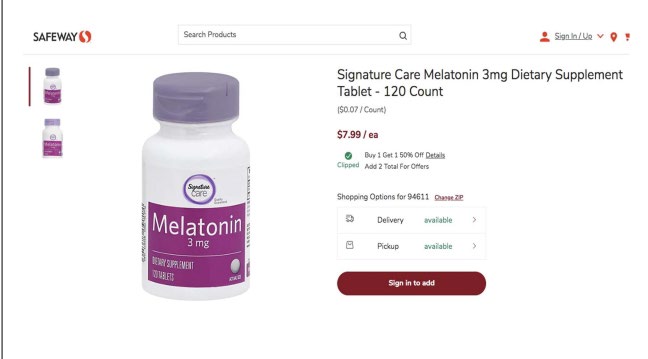
Other companies like Safeway and Target allegedly lawfully
label their supplements by not making such claims:

Most of Amazon’s sales come from Amazon’s “Fulfilled by
Amazon” (FBA) program, in which Amazon provides services including stocking,
maintaining, and storing products at Amazon fulfillment centers; sorting and
shipping; and 24/7 customer support for consumers of the products. Amazon
controls product listings, communications with consumers about the product, and
processing of payments and fees for sale of the product, including Amazon’s
service fee. Amazon also purportedly operates an “Industry-Leading Safety and
Compliance Program,” which allows Amazon to “ban or delist products” in the
marketplace that are “unlawful and/or dangerous.”
Plaintiffs brought both product liability/warranty claims
and the usual
consumer protection claims under California law.
First, plaintiffs adequately alleged standing, despite
Amazon’s argument that the reliance allegations were implausible because the
product details and labels showed that all of the products had at least one
clear DSHEA disclaimer.
Spending money one would otherwise not have spent is a
quintessential injury in fact.
Federal law, which is adopted by California’s Sherman Law,
mandates that, if a dietary supplement includes a statement that “describes the
role of a nutrient or dietary ingredient intended to affect the structure or
function in humans, characterizes the documented mechanism by which a nutrient
or dietary ingredient acts to maintain such structure or function, or describes
general well-being from consumption of a nutrient or dietary ingredient,” it
must also include a DSHEA disclaimer. The disclaimer must be “prominently
displayed and in boldface type” and include the text: “ ‘This statement has not
been evaluated by the Food and Drug Administration. This product is not
intended to diagnose, treat, cure, or prevent any disease.’ ” The disclaimer
must also “be placed adjacent to the statement with no intervening material or
linked to the statement with a symbol (e.g., an asterisk) at the end of each
such statement that refers to the same symbol placed adjacent to the
disclaimer[.]”Also, “[o]n product labels…the disclaimer shall appear on each
panel or page where there such is a statement. The disclaimer shall be set off
in a box where it is not adjacent to the statement in question.” Plaintiffs argued
that “to be legally compliant, the disclaimer must: (1) appear ‘on each panel
or page’ of a supplement label or package that bears a health-related claim;
and (2) be ‘prominent.’ ”
Amazon argued that the product labels and product details
pages, including the product images on those details pages, include the DSHEA
disclaimer in a box titled, “Important information” in “bold orange font.” It further
contended that “the product detail[s] pages for multiple [p]roducts include
images showing an actual product label with the prominent DSHEA disclaimer.” The
structure function claim on the front label of those products was followed by
an asterisk that directs a consumer to a DSHEA disclaimer on the back label.
Plaintiffs rejoined that “[b]urying a disclaimer multiple
scrolls down on Amazon’s product page, and/or amongst a multitude of voluntary
claims and images (which dominate through placement, size, color, contrast),
cannot as a matter of law redress illegality, nor can it redress the deception
and fraud.”
The court agreed with plaintiffs: “None of the materials
introduced by Amazon refute Plaintiffs’ contention that the products omit
disclaimers on the primary panels that carry the structure function claim. For
example, no image submitted shows a product that includes the required disclaimer
on the same panels that carry the structure function claims.” E.g, the Amazon
display page for Safrel Vitamin B-12:

Thus, plaintiffs plausibly alleged that they were misled
when purchasing the dietary supplements on Amazon.
Amazon argued that plaintiffs failed to “plausibly allege”
that a reasonable consumer would believe that the dietary supplements had
“therapeutic value” or had received FDA approval, given the DSHEA disclaimer under
the “Important information” section and that the “[p]roduct photographs” and
“Amazon.com display page images” for some of the dietary supplements show that
the health claims on the front label were “accompanied by asterisks or other
symbols that directed the consumer to a DSHEA disclaimer.” Amazon argued that
it is “implausible” and “unreasonable” for a consumer to ignore the asterisk.
But Amazon allegedly omitted disclaimers from display panels
that carry health-related claims and, as a result, plaintiffs allegedly did not
read “disclaimers in conjunction with reading the effusive health claims, which
led to their belief in the products’ therapeutic value and safety.” This wasn’t
suitable for resolution on a motion to dismiss. Amazon also provided the court
with images of the “product detail pages” of the dietary supplements plaintiffs
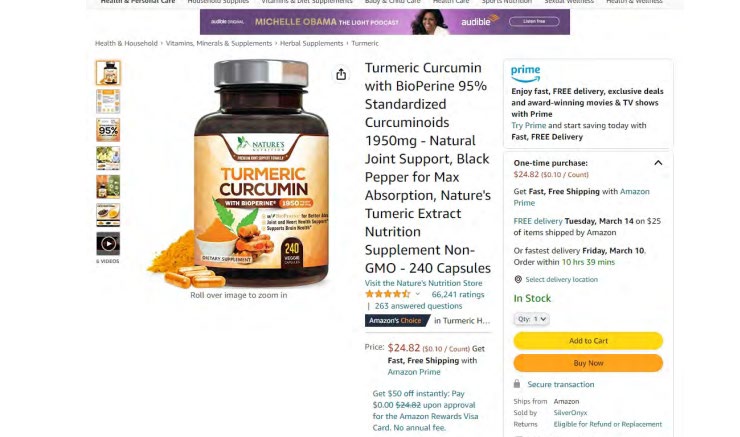
purchased. The product details page for Nature’s Nutrition Turmeric Curcumin stated
in bold, black font that the product provides “Natural Joint Support” and
“Support[s] Joint and Heart Health[,]”but there is no asterisk next to either
of these assertions nor is there an adjacent DSHEA disclaimer:

This was consistent with plaintiffs’ allegations that the
“proximity and prominence” of the DSHEA disclaimers provides consumers with the
opportunity to “see and read them in order to be alerted that the products are
not therapeutic and thereby avoid deception.”
Amazon argued that plaintiffs’ claims sought to impose
vicarious liability on it, which is unavailable for unfair competition claims,
as to which “[a] defendant’s liability must be based on [their] personal
‘participation in the unlawful practices’ and ‘unbridled control’ over the
practices that are found to violate [California Business and Professions Code]
sections 17200 or 17500.” Under the CLRA, “absent allegations of participation
or control[,]” the defendant cannot be held liable for the acts of third
parties.
Plaintiffs responded that Amazon was “integral[ly]
involv[ed] in the unlawful and deceptive marketing, promotion, sales, delivery
into interstate commerce, and delivery to Plaintiffs of illegal products.” The
court agreed with plaintiffs, citing Amazon’s promotional efforts as well as
FBA and Amazon’s control of consumer support and whether returned items could
be resold. Plaintiffs sufficiently alleged Amazon’s “unbridled control” over
the “unlawful practices.”
Amazon then argued that California’s Sherman Law protected
it by exempting “persons engaged in business as wholesale or retail
distributors of foods, drugs, devices, or cosmetics, except to the extent that
they are engaged in the packaging or labeling of the commodities or they
prescribe or specify the manner in which the commodities are packaged or
labeled.” (This exemption must “not be construed to repeal, invalidate, or
supersede any other section of this part.”) But the “unbridled control”
allegations also sufficiently pled around this. “Amazon’s alleged actions in
labeling and promoting the dietary supplements exceed the role of a wholesale
or retail distributor. The Amazon product pages for the dietary supplements
state structure function claims about the products.”
However, the economic loss rule barred the product liability
claims. There was no special relationship between Amazon and the plaintiffs.
Implied warranty of merchantability claims did survive.
from Blogger http://tushnet.blogspot.com/2024/10/amazon-potentially-on-hook-for.html
Haver v. General Mills, Inc., 2024 WL 4492052, No.:
3:24-cv-01269-CAB-MMP (S.D. Cal. Oct. 11, 2024)
Interesting remand to state court. Haver sued under the UCL
and FAL, alleging that GM deceptively marketed “Fruit Snacks” to contain “Real
Fruit Juice,” when the snacks in question were allegedly sweetened entirely
with added sugars. GM removed under CAFA, but the court held that it lacked
jurisdiction over Haver’s claims, which were all equitable, and therefore
remanded, ruling that CAFA didn’t trump the rule regarding remand when the claims
were only cognizable in state court. “[N]o antiremoval presumption attends
cases invoking CAFA, which Congress enacted to facilitate adjudication of
certain class actions in federal court.” Nonetheless, under 28 U.S.C. §
1447(c), remand is available if the court lacks subject matter jurisdiction.
Although removal was proper, the court continued on to
Article III standing, which requires traceable injury and redressability. A
plaintiff’s intention to purchase a product in the future is necessary for
Article III standing when seeking injunctive relief. “As a general rule, if the
district court is confronted with an Article III standing problem in a removed
case—whether the claims at issue are state or federal—the proper course is to
remand for adjudication in state court.”
The relevant part of the complaint said: “Plaintiff and
Class Members are likely to continue to be damaged by General Mills’ deceptive
trade practices, because General Mills continues to disseminate misleading
information.” But Haver didn’t plead any concrete intention to buy the snacks
in the future, meaning she didn’t have Article III standing for injunctive
relief.
And Haver’s remaining claims sounded in equity: restitution
and disgorgement. Equitable jurisdiction asks whether the “principles governing
equitable relief” allow a district court to “exercise its remedial powers.” In
that sense, equitable jurisdiction is a “threshold jurisdictional question.” Sonner
v. Premier Nutrition Corp., 971 F.3d 834 (9th Cir. 2020). (I did wonder
whether defendants’ victory in Sonner could be taken back by plaintiffs,
and here we are.)
“Federal courts sitting in diversity can only award
equitable relief under state law if there is no adequate legal remedy.” But Haver
didn’t plead that she lacked an adequate remedy at law. “[N]othing in the
complaint suggests that a damages award for the alleged false advertising type
claims would fail to make class members whole.” Thus, the court lacked
equitable jurisdiction; the court couldn’t provide the only relief Haver
sought.
Numerous abstention doctrines guide courts on remand
decision, as well as “longstanding Supreme Court precedent which informs that
when a federal court lacks equitable jurisdiction, a case may be remanded.”
Cates v. Allen, 149 U.S. 451 (1893); Twist v. Prairie Oil & Gas Co., 274
U.S. 684 (1927). These precedents are binding.
GM argued that they weren’t, because those cases predated
the merger of law and equity, and CAFA superseded any discretionary remand
decision. “But none of these advancements have altered a federal court’s
authority to remand cases ‘where the relief being sought is equitable or
otherwise discretionary.’” “Although the Court shares Defendant’s concern for ‘end-runs’
around federal statutes, the principles of federalism and proper judicial
administration point to remand where this Court cannot offer Plaintiff any
relief under purely state causes of action.” This wasn’t a case where remand
would have resulted in piecemeal adjudication—it would be an inevitable loss on
the whole claim. (Speaking of end-runs around statutes ….)
from Blogger http://tushnet.blogspot.com/2024/10/cafa-cant-prevent-remand-to-state-court.html
KHN Solutions LLC v. Shenzhen City Xuewu Feiping Trading Co.,
No. C 20-07414 WHA, 2024 WL 4351861 (N.D. Cal. Sept. 30, 2024)
I don’t usually blog default judgments, but this one was interesting.
It granted interim relief against Amazon.com, impounding funds and products of
defendants. KHN makes blood-alcohol concentration breathalyzers; defendants
make competing breathalyzers “popularized by fake reviews and false quality
assurances on Amazon.” After difficulties serving the Chinese defendants, the
magistrate allowed email service and recommended a default judgment.
The district court asked Amazon to comment, since the
recommended injunction would burden it. Amazon proposed revisions, including expanding
the injunction to cover products newly identified by three Amazon Standard
Identification Numbers, and that Amazon transfer defendants’ allegedly
ill-gotten gains only after Amazon covered its fees from all those sales.
The recommended injunction didn’t specify the particular
breathalyzers for Amazon to discontinue. Amazon and plaintiffs proposed adding
identifiers for three specific models of Rofeer-branded breathalyzers, not just
one model. The complaint never stated a specific model name, product number, or
web address of the complained-of product(s). The complaint’s allegations about
fake reviews and poor breathalyzer test results — even when accepted as true — were
untethered from specific models. Amazon did suggest that of the many
“Rofeer®-branded breathalyzers” it investigated only “certain” products
identified “by Plaintiff,” the “B07ZH6PVD4” and “B08CZBL7YS” products, but neither
identifier made it into the proposed text of the injunction, and then they
proposed to expand it to a third.
“But how can the Court permanently enjoin the sales of three
specific products, when there is only an allegation or evidence supporting at
most one product being falsely advertised? Plaintiff was required to plead
false advertising with specificity, then prove it.” It only did so with
evidence as to B07ZH6PVD4.
This is a false advertising case, not a counterfeiting case.
Usually, a false advertising injunction stops false statements about products. The
recommended injunction would do more:
It would permanently stop
defendants from selling their product (including from unspecified sites besides
Amazon’s, where no false statements have been shown). It would even order the
shipping of offending breathalyzers to plaintiff. And it would permanently
disable the defendants’ purported seller accounts, even though the record does
not show that defendants’ sole use of these accounts is for selling falsely
advertised items.
That would not be justified as a permanent injunction,
though interim relief was appropriate.
As for damages, “the proposed injunction permits double,
triple, or even sixteen-fold recovery,” by letting the plaintiff recoup “up to
the amount of the Court’s damages award” from Amazon, then from financial
institutions and payment processors “not limited to” the fifteen listed in the
injunction to get “the amount of the Court’s damages award.” “Plaintiff has not
established that defendants even have accounts with all third parties.” There
were no provisions to avoid double recovery, and even single recovery would be
unsupported.
The recommended damages award “exceeds what the law allows,
because it impounds all sales revenue, not just plaintiff’s actual damages or
defendants’ profits.” The Lanham Act allows compensation, not punitive damages,
as measured either by actual damages or defendant’s profits. The plaintiff
bears the burden of proving the “defendant’s gross profits from the infringing
activity with reasonable certainty.”
But selling always has costs.
Awarding defendants’ total revenues
ignores that reality. Similarly, total sales surpass what plaintiff possibly
would have earned but-for the purported misconduct. Selling products almost
always involves competing against more than one rival for the sale. Here, there
were multiple rivals: Plaintiff compares defendants’ product not only to its
own but to third-party “Lifeloc’s FC10 police-grade industry standard
breathalyzer.” If plaintiff made fewer sales because of defendants, Lifeloc
likely made fewer sales, too. Thus, awarding all of defendants’ revenues (or
profits) to plaintiff also ignores this reality. Plaintiff makes no substantive
or equitable argument to justify such outsized relief.
District courts have awarded damages in trademark infringement
cases in the amount of defendant’s sales where no offsetting costs were proven.
But trademark infringement involves more direct harm than defendants “who
simply made false statements about their own products.” The recommended award
here surpassed “what equity allowed, which is the Lanham Act’s limit.” And
there were other problems with the proposed award, including that Amazon
omitted dollar amounts from its spreadsheet showing sales “ostensibly for
confidentiality reasons.” Because of the lack of detail, there was no way to
attribute sales to specific models.
Thus, the court ordered Amazon to cease to deal with the
defendants/anyone operating for their benefit; impound any products in Amazon’s
control that are at issue in this case, specifically including three ASINs; and
impound all revenues in the Amazon accounts of persons or entities that have
accrued from selling those products. “Upon the Court’s further order, the
impounded funds might be released to defendants or possibly to plaintiff — or
to someone else, perhaps even to disappointed purchasers. Same goes for the
products. But defendants must show up to make their case.”
The court reasoned that impounding would create a fund to
allow damages, once properly determined. Impounding was also intended to “get
the immediate attention of defendants and to break the cycle of selling into
our country but refusing to appear and to defend, meaning to get the attention
of defendants and persuade them to appear and to defend on the merits.” If
defendants failed to appear, the court would entertain a renewed motion for
default judgment.
from Blogger http://tushnet.blogspot.com/2024/10/even-after-default-court-may-constrain.html
Crocs, Inc. v. Effervescent, Inc., No. 2022-2160 (Fed. Cir. Oct.
3, 2024)
Crocs sued competitors for patent infringement; defendant
Dawgs counterclaimed for false advertising about the characteristics of the
primary material Crocs uses to make its footwear products, a material it
promoted as the “patented,” “proprietary,” and “exclusive” “Croslite.” Dawgs
alleged that none of this was true, but that Crocs misled current and potential
customers to believe that “Crocs’ molded footwear is made of a material that is
different than any other footwear.” The district
court, relying on the Federal Circuit’s Baden
decision interpreting Dastar, tossed out the claims, reasoning that
these terms were Dastar-barred claims of inventorship rather than claims
about the nature of Crocs’ products. The court of appeals reversed.
Baden found that claims to have “innovative” technology
were Dastar-barred. Baden had argued that Molten’s advertisements were
false “precisely because Molten was not the source of the innovation,” i.e.,
not the author. But “authorship, like licensing status, is not a nature,
characteristic, or quality, as those terms are used in Section 43(a)(1)(B) of
the Lanham Act.” By contrast, “here, the false claim that a product is patented
does not stand alone. Dawgs presents allegations and evidence that the falsity
of Crocs’ promotional statements is rooted in the nature, characteristics, or
qualities of Crocs’ products.”
Specifically, “[a] claim that a product is constructed of ‘patented’
material is not solely an expression of innovation and, hence, authorship.” In Baden,
there weren’t ads “linking such claims to a product’s tangible nature,
characteristics, or qualities.” But here, Dawgs alleged promotional statements
by Crocs that a patent covers Croslite, paired with statements that “Croslite
has numerous tangible benefits.” Thus, the claim “patented” “was used by Crocs
to ascribe characteristics that go to the nature and qualities of Croslite.” This
plausibly alleged that consumers would be misled about the “nature,
characteristics, or qualities” of Crocs’ product.
from Blogger http://tushnet.blogspot.com/2024/10/false-patentedproprietaryexclusive.html
Am. Soc. for Testing & Materials v. UpCodes, Inc., No.
24-1895 (E.D. Pa. Oct. 2, 2024)
ASTM, which produces technical standards, sued UpCodes for providing free online access to
unauthorized copies of ten ASTM standards, all of which have been incorporated
by reference into state and local legal codes. ASTM sought a preliminary injunction
based on its copyright and trademark claims, which the court denied.
Over seventy percent of ASTM’s revenue comes from the sale
of its standards. Along with individual sales, ASTM sells a publication
entitled ASTM Standards in Building Codes that contains over 13,000 ASTM
standards including the ten at issue here.
“Although local, state, and federal jurisdictions reference
ASTM standards in their laws, it is accepted that ASTM does not lobby the
government—or other entities—to reference their standards.” Nonetheless, ASTM’s
official form and style manual indicates that certain ASTM standards are
“developed for reference in model building codes.” Plus, “when ASTM standards
are adopted into law, ASTM can market its own compliance-focused training
materials.”
UpCodes is a for-profit start-up, which only publishes
standards that, in its view, have been adopted into law by specific
jurisdictions. Users of the UpCodes website can filter their searches by
jurisdiction or by the original publisher of the adopted standard. Any user
with an UpCodes account can freely view and copy a supported jurisdiction’s
laws , and they can also purchase a subscription to access UpCodes’ premium
features, including bookmarking, annotating, and automation tools. Posting
these standards therefore “may provide UpCodes with tangential benefits like
drawing users to its website, increasing active account numbers, and enabling
the collection of user information.”
Each unauthorized copy that UpCodes posted at issue here includes
what ASTM describes as “expressly non-mandatory” material, such as explanatory
notes, supplementary materials, appendices, and Annexes. UpCodes identifies
ASTM as the original publisher. Since promulgating the ten standards at issue,
ASTM has published updated versions of nine of them.
When a standard is incorporated by reference,
the incorporated standard may be
enforced against regulated entities without being included in the text of the
law itself. When this happens, a regulated entity will not find the text of the
standard that details their legal obligations in the official public code. They
must look elsewhere to access the content of the standard. Often, that access
comes with a price. The private standard-developing organizations that create
these referenced standards typically copyright their work and charge fees for
users to access them.
When federal agencies incorporate by reference
privately authored materials, federal law requires copies of incorporated
standards to be, at a minimum, available for public inspection at the Office of
the Federal Register’s reading room in Washington D.C., and in the promulgating
agency’s public library. ASTM also operates an online read-only reading room
(with no print or download options) for ASTM standards that have been
incorporated into federal law.
But no such law regulates state or local government
incorporation by reference. The standards at issue in this case were not
available online for free before UpCodes posted them. Although incorporation by
reference can save money and work, it can create “serious notice and
accountability problems.” “[P]lacing legally binding standards behind paywalls
undermines the ‘principle that [government] should provide regulated parties
fair warning of the conduct [a regulation] prohibits or requires.’” This may
also hinder mechanisms of democratic accountability.
Incorporation by reference can also occur indirectly: A
government incorporates by reference a third-party publication. That
publication incorporates by reference a separate privately authored standard. Whether
incorporation by reference is direct or indirect, neither involve having “the
content of the technical standard reprinted in the text of the law itself.
Thus, people are typically unable to view the content of these standards unless
they pay a fee.”
The Philadelphia Building Code states that the 2018
International Building Code “is incorporated as if fully set forth herein,
subject to [] local amendments.” As the IBC’s Chapter on Referenced Standards
explains, “[t]he International Building Code contains numerous references to
standards promulgated by other organizations that are used to provide
requirements for materials and methods of construction . . . . These standards,
in essence, are part of this code to the extent of the reference to the
standard.” The ten ASTM standards at issue are so incorporated. If individuals
violate the Philadelphia Building Code, they can face fines of up to three
hundred dollars a day per violation.
Reading the fair use factors in light of copyright’s
purposes, UpCodes’ copying was likely to be fair use.
Factor one “considers the reasons for, and nature of, the
copier’s use of an original work.” The court deemed UpCodes’ use of the
standards “largely noncommercial,” since it didn’t derive any direct monetary
profit from publishing them. And the transformative nature of the use outweighed
its status as a for-profit company. “UpCodes achieves the distinct objective of
making the law freely accessible and educating the public on the contents of
binding laws. Unlike ASTM, UpCodes seeks neither to publish industry best
practices nor to ‘positively impact[] public health and safety’ by developing
high-quality technical standards.” This use had a different character and
further purpose from ASTM’s use.
The court declined to see both purposes as “providing information
to professionals.” UpCodes focused on standards that have been enacted into
law, while ASTM sought to publish standards that improve safety and
performance. One objective indication of that different purpose (following
Warhol) that weighed in UpCodes’ favor was that ASTM has updated 9 of the
10 standards, but UpCodes doesn’t publish the updated versions because they’re
not the law, showing that the reasons for copying were different than ASTM’s
reasons for publishing. (Although this isn’t a big data case, it follows the pattern, which Warhol may have accelerated, of courts being more confident in identifying different purpose in identical copies than different “character” when the latter requires assessing the meaning of physical changes to the copied work.)
In addition, the use was “justified because it furthers the
goal[s] of copyright,” including “enriching public knowledge.” And it was
“justified because copying is reasonably necessary to achieve [UpCodes’] new
purpose.” As UpCodes explained, “[i]f [it] attempted to express that law using
other words . . . it would not be publishing the law of Philadelphia.” The DC
Circuit’s decision in Public Resource was persuasive, even though
UpCodes is not a nonprofit, given the mostly noncommercial nature of the use. Although
the explanatory notes, supplementary materials, and appendices weren’t binding,
the court agreed with the DC Circuit that, “because law is interpreted
contextually, even explanatory and background material will aid in
understanding and interpreting legal duties” and, like legislative history,
such materials “may prove [] important for resolving ambiguities in the
portions of standards that set forth the directly binding legal obligations.”
Factor two: Technical standards generally “fall at the
factual end of the fact-fiction spectrum, which counsels in favor of finding
fair use.” And because “the express text of the law falls plainly outside the
realm of copyright protection,” “standards incorporated by reference into law
are, at best, at the outer edge of ‘copyright’s protective purposes.’” The
nature of the work, that is, is that it has been incorporated into law, weighing
“heavily” in favor of fair use.
Factor three: It’s ok to copy the whole thing when that’s
reasonable in relation to the purpose and character of the use. “[T]his amount
of copying was plainly reasonable in relation to UpCodes’ objective.” Like the
DC Circuit, the court agreed that this factor “strongly” supported fair use
because the copying was limited “to only what is required to fairly describe
the standard’s legal import.”
Factor four: Following Google v. Oracle’s directive
that “a potential loss of revenue is not the whole story,” the court analyzed
both the source of any market harm and the countervailing public benefits of
the copying. Courts must consider “whether enforcing a copyright will allow the
copyright holder to gain profits that would ‘interfere with, not further,
copyright’s basic creativity objectives’” and balance the monetary effects
against the public benefits, a consideration that was “especially weighty” when
it came to standards that have been given the force of law.
Using this analysis, the fourth factor didn’t weigh clearly
in either side’s favor. It was “plain” that free availability from UpCodes
would have a market effect on purchases of the standards from ASTM. Nonetheless, copyright “should not grant
anyone more economic power than is necessary to achieve the incentive to
create,” and “ASTM may have other incentives to continue developing technical
standards even if some of its standards lose their copyright protection after
being enacted into law”: “its mission of promoting product quality and public
safety, its professional interest in being recognized as a global leader in
standard development, and other monetary benefits that it may derive after its
standards are incorporated into law, like profits derived from marketing its
own compliance-focused training materials.”
And of course the countervailing public benefits were
substantial—there was no requirement that referenced standards enacted by state
and local jurisdictions be publicly available, but significant practical value
to the public of unfettered access to such incorporated standards. “For
example, journalists have explained that this access is essential to inform
their news coverage; union members have explained that this access helps them
advocate and negotiate for safe working conditions; and the NAACP has explained
that this access helps citizens assert their legal rights and advocate for
legal reforms.”
Weighing the factors, the use was fair. After all, copyright
law is not designed for the primary purpose of providing “a special private
benefit” to authors like ASTM. The court didn’t see why incorporation by
reference was any different from direct incorporation into law for fair use
purposes, since the legal consequences were “virtually indistinguishable.” (Is
it even “virtually” indistinguishable? Maybe for the commentary.)
Trademark: This was nominative fair use. In nominative fair
use cases, “the alleged infringer uses the trademark holder’s mark to describe
the trademark holder’s product, even if the alleged infringer’s ultimate goal
is to describe his own product.” Like car mechanics identifying VWs as among
the types of cars they repair, UpCodes used ASTM’s mark in a nominative manner.
And “the only practical way” for UpCodes to refer to them was to use the term,
because the entities that incorporated the standards into law did so.
In the Third Circuit, courts use a modified LOC case in
nominative use cases. Under that test, two usually key factors—similarity between
the owner’s mark and the allegedly infringing mark, and strength of the owner’s
mark—are ignored (because in a NFU situation they wouldn’t actually bear on likely
confusion/the use is justified even, or especially, because it’s identical to a
strong mark). Although district courts have discretion, four other factors are likely
to be relevant: (1) the price of the goods and other factors indicative of the
care and attention expected of consumers when making a purchase; (2) the length
of time the defendant has used the mark without evidence of actual confusion;
(3) the intent of the defendant in adopting the mark; and (4) the evidence of
actual confusion. Only if those factors favor a likely confusion finding does
the burden shift to the defendant to show that it’s satisfied the NFU test.
ASTM didn’t make it to the burden-shifting stage.
Here, length of defendant’s use was short and thus not very
probative one way or another. But the relevant consumers were sophisticated: ASTM’s
standards are “targeted at technical people” including “engineers, architects,
builders, and suppliers and manufacturers of construction materials.”
UpCodes’ intent was not to “confuse or deceive consumers as
to the product’s source . . . .” Instead, “ASTM” was the only practical way to
refer to the standards; its intent was accuracy.
And there was no evidence of actual confusion.
Thus, there was no likely success on the merits.
(It’s not even obvious that there’s more to do for summary judgment,
certainly on the copyright claims.)
from Blogger http://tushnet.blogspot.com/2024/10/for-profit-company-can-republish-astm.html
Advance Dx, Inc. v. YourBio
Health, Inc., — F.Supp.3d —-, 2024 WL 4393314, No. 24-10595-WGY (D.
Mass. Oct. 3, 2024)
Advance sued YourBio, which competes in the market for
at-home medical device testing patients’ level of anti-Mullerian hormone, for
false advertising, tortious interference, defamation/disparagement, unjust
enrichment, and unfair trade practices under Massachusetts statutory law.
Advance makes a card used to collect a blood sample
obtained from a patient’s lanced fingertip, while YourBio manufactures a device
that is used to collect a blood sample by attaching to the back of a patient’s
arm and piercing capillaries close to the skin’s surface with microneedles. In
2022, BioMed studied the parties’ products and conventional venipuncture. “After
processing the data, BioMed imposed an internal control, calculated based on
the Study’s data, to normalize Advance’s results to the venipuncture instead of
using the recommended internal control provided in Advance’s guidelines.” It
then published the study, concluding that YourBio’s testing device was more
accurate, superior, and has stronger consumer preference than Advance’s.
YourBio used PR Newswire to tout its superiority and also repeatedly promoted
the study “to consumers, industry professionals, and third parties at trade
shows and in YourBio’s marketing materials.” However, after it learned about
the use of the simulated control, the testing lab “stated that any discordance
noted in the Study may be due to BioMed’s failure to follow Advance’s
instructions for the Card, and not due to any fault of the Card.”
YourBio argued that the study was a non-actionable
scientific conclusion and statement of opinion and therefore could not be
falsified. The court disagreed. Even under the rule of ONY, Inc. v. Cornerstone
Therapeutics, Inc., 720 F.3d 490 (2d Cir. 2013), “we must take into account the
statement’s context, including the medium in which the statement was published
and the audience to which it was presented.” The medium here was republication
by YourBio specifically to promote its devices. “Unlike a typical scientific
journal, the medium in this case is not meant to communicate insights into
matters of scientific debate, despite the fact that the Study may have been
first published by BioMed for exclusively scientific reasons.” The audience was
also not “purely scientific,” but rather targeted at customers/potential
customers.
The court also found that Advance was not a public figure,
so defamation required only negligence, although it did plead that YourBio was
aware of the falsity. And damage could be presumed without evidence of economic
loss because the statements were of the kind that would harm Advance’s
business.
The same basic logic allowed the Lanham Act false
advertising claims to proceed. (Advance didn’t say a lot about “interstate
commerce,” but alleging that the false statements were published online
sufficed.) Unfair trade practices under Chapter 93A MGL are treated the same way
as Lanham Act false advertising claims, so they also survived.
Tortious interference and commercial/product disparagement
claims likewise survived. Under Massachusetts law, “[p]roduct disparagement is
similar to defamation but lacks a reputational harm element and makes greater
demands as to the ‘falsity of the statement[s], fault of the defendant and
proof of damage.’ ” That didn’t make a
difference here.
Unjust enrichment claims failed, however, because Advance
didn’t plead it had the right to some benefit/money that YourBio received.
from Blogger http://tushnet.blogspot.com/2024/10/republishing-scientific-study-to.html
Bowen v. Energizer Holdings, Inc., — F.4th —-, 2024 WL
4352496, No. 23-55116 (9th Cir. Oct. 1, 2024)
Bowen sued Energizer for false advertising, alleging that
its Banana Boat sunscreen was adulterated with dangerous
levels of benzene, a carcinogen that scientists have determined can cause
cancer.
Energizer moved to dismiss under
Rule 12(b)(1), arguing that there was no Article III standing because Bowen’s
allegations that small amounts of benzene in sunscreen are unsafe were false. The
district court held that “[i]n light of the [FDA] guideline permitting 2 [parts
per million] of benzene in sunscreen, [Bowen] does not allege facts that tend
to show a non-speculative increased health risk or actual economic harm”
arising from her purchase of Banana Boat products. This was a premature
resolution of the merits issue. “Although a district court faced with a factual
challenge to its exercise of jurisdiction may resolve disputed facts as to
purely jurisdictional questions, it may not do so when those jurisdictional
questions are intertwined with the merits of a claim. When the jurisdictional
and merits issues are inseparable, the court must treat a factual attack on
jurisdiction as a motion for summary judgment and construe disputed issues of
fact in favor of the nonmoving party. Applying that standard here, Bowen has
adequately established an injury in fact for purposes of Article III.”
Remanded.
Bowen had one bottle of the
sunscreen tested at a lab, revealing that it contained 0.29 parts per million
(“ppm”) of benzene. A non-party pharmacy also allegedly tested various Banana
Boat products and found that they too contained benzene, including a bottle
with more than 0.1 ppm of benzene.
Bowen alleged that “[b]enzene
is a carcinogen that can cause cancer in humans,” and that “the application of
sunscreen specifically increases the absorption rate of benzene through the
skin.” A Yale researcher, clinician, and professor of dermatology allegedly
opined that “[t]here is not a safe level of benzene that can exist in sunscreen
products,” given the large surface area of the human body and the amount of
sunscreen needed to properly cover it. This contamination allegedly has led to
public concern and voluntary recalls of Banana Boat products.
Looking to documents produced
or relied on by the FDA, the district court determined that they “impl[y] that
manufacturers like Defendants may continue to release products that are
adequately tested and contain less than 2 ppm of benzene.” It further held that
Bowen’s “alleged economic harm”—i.e., that she paid more than she would have
had she known that Banana Boat contained benzene—“is premised on the
speculative notion that the presence of 0.29 ppm of benzene, or any potential
presence of benzene, makes the sunscreen unsafe.”
Bowen’s allegations relating
to standing weren’t “separable from the merits of the case,” but rather
“intertwined with an element of the merits of the plaintiff’s claim,” such that
the district court was required to “leave the resolution of material factual
disputes to the trier of fact.”
When plaintiffs in a false advertising
case “ ‘contend that [they] paid more for [a product] than they otherwise would
have paid, or bought it when they otherwise would not have done so’ [because of
a false claim or misleading omission] they have suffered an Article III injury
in fact.” Whether the statements they relied on were materially false was also
a merits issue. These allegations weren’t separable from the merits.
The district court thus “mistakenly
required Bowen to show that Banana Boat was noncompliant with FDA guidelines in
order to establish injury under an economic-harm theory.” Her alleged
overpayment was the harm, not the safety/risk profile. In addition, to find
0.29 ppm benzene “safe” was to improperly weigh disputed evidence. The court of
appeals pointed out that, even without considering Bowen’s countervailing
evidence, the FDA hardly blessed the presence of benzene at any level in the
relevant documents. Its guidance was that benzene “should not be employed in
the manufacture of … drug products because of their unacceptable toxicity or
their deleterious environmental effect. However, if their use is unavoidable in
order to produce a drug product with a significant therapeutic advance, then
their levels should be restricted” to 2 ppm, “unless otherwise justified.” That
“caveat-laden” guidance was hardly a safety endorsement. “Faced with two
sunscreens in the skincare aisle of a pharmacy—one with benzene, the other with
no benzene—it is perfectly reasonable that the consumer would avoid the product
containing benzene, as Bowen alleges that she would have absent Defendants’
alleged false advertising.”
from Blogger http://tushnet.blogspot.com/2024/10/9th-circuit-refuses-to-kick-out-claim.html
Silvertop v. Kangaroo (3d Cir. 2019) held that a banana costume was both copyrightable and infringed:

In holding that the costume was protectable, the Third Circuit reasoned:
Although a banana costume is
likely to be yellow, it could be any
shade of yellow—or
green or brown for that matter. Although a banana costume is likely to be curved, it need not be—let alone in any
particular manner. And although a banana costume is likely to have ends that
resemble a natural banana’s, those tips need not look like Rasta’s black tips (in color, shape, or size).
Commenting on this reasoning, Jamie Boyle and Jennifer Jenkins said:
So, while the court admits that a
banana costume is likely to be yellow and curved, it says it could
also be brown and straight. On Halloween, when your child goes out in her
brown, straight, banana costume and her friends ask “why are you dressed up as
a stick!?” she will be able to respond with a simple, terse explanation.
“Star Athletica,” she will say.
(It’s not really Star Athletica that is the direct culprit, but the court’s cramped understanding of scenes a faire/basic designs; Star Athletica just means that all the limiting work is done by idea/expression and similar doctrines, and the court misapplied Star Athletica‘s holding that the designer’s intent is irrelevant to separability to the separate issue of whether the designer did something creative/original.)
Anyway, the court has a possibly better argument: “copyrighting Rasta’s banana costume would not effectively monopolize the underlying idea because there are many other ways to make a costume resemble a banana. Indeed, Rasta provided over 20 non-infringing examples.”
So I decided to take a look at the record.

First, there aren’t “over 20”–there are 21 pictures, 2 of which are of a costume from Arrested Development. (I only used one of those two pictures.) Of the 20 costumes–treating minor variations as different costumes–3 are “sexy” bananas, a different 6 cover the face, 1 is a guy in a yellow suit with a hood, and 1 is an odd Wolverine. Maybe that’s still enough to justify protection for Rasta’s version, but the fact that no one noticed Wolverine in there suggests to me that principles of equity were doing more work than copyright principles.
On the other hand, the court isn’t really suggesting that noninfringing costumes need to be straight and brown or green. Yay?
from Blogger http://tushnet.blogspot.com/2024/09/revisiting-silvertop-banana-costume-case.html

