false patent marking and implicit claims of Nobel connection in a supplement case

ThermoLife Int’l, L.L.C. v. NeoGenis Labs, Inc., 2019 WL
4193968, No. 18-cv-2980-HRH (D. Ariz. Sept. 4, 2019) 
ThermoLife allegedly holds a number of patents related to
dietary supplement/food ingredients, including those related to “the use of
amino acids in combination with nitrates to increase performance.” It allegedly
“licenses the use of its patented technology…to many of the largest dietary
supplement companies” and “supplies the raw materials necessary to practice its
patented inventions.”
NeoGenis “sells nitric oxide test strips and dietary
supplements[,]” and was allegedly “a dominant force in the beet supplementation
market.” NeoGenis products allegedly competed with products that use TL’s raw
materials and products produced with its patented nitrate technology. TL
doesn’t currently market oxide testing strips, though it’s trying to get into
that market.
NG allegedly falsely advertised “that it has developed a
‘patent pending’ method to determine ‘if you are N-O [nitric-oxide] deficient’
and/or ‘if you’re getting enough dietary nitrate through the foods that you
eat’: HumanN’s nitric oxide Indicator Strips.” But the patent, while applied
for in 2013, was allegedly rejected in its entirety. In addition, NG allegedly
falsely advertised that its strips “can determine whether an individual is
nitric oxide deficient[.]” A one time saliva test allegedly can’t do that.  NG also allegedly engaged in false patent
marking because the listed six (later three) patents weren’t practiced in the
marked products (the patents allegedly required a nitrite salt not present in
the products, and anyway they failed to include a sufficient quantity of
nitrites of any sort to practice the listed patents). Similarly, NG allegedly falsely
claimed that its “licensed patents protect ‘patented Nitric Oxide technology’”
and that its research was “Nobel-Prize winning.”  Finally, NG allegedly falsely claimed that
its products were foods or dietary supplements.
After dismissal for want of standing, TL filed an amended
complaint.
False marking: “Title 35 section 292(a) prohibits, in part,
‘mark[ing] upon…in connection with any unpatented article, the word ‘patent’
or any word or number importing that the same is patented, for the purpose of
deceiving the public.’ … Section 292(b) provides a private right of action to
enforce § 292(a) to any ‘person who has suffered a competitive injury as a
result of a violation of this section.’ ”
A “competitive injury” is “ ‘[a] wrongful economic loss
caused by a commercial rival, such as the loss of sales due to unfair
competition,’ ” but someone who’s attempted to enter the market (in intent and
action) can have standing.  
TL alleged that, since at least October 2018, it had been
working with someone on testing/monitoring nitric oxide over “several face-to-face
meeting[s] and numerous phone conferences” and that “when the deal is reached,
[it] will be in…direct competition with HumanN’s Nitric Oxide Test Strip[s].”
This was too late, since TL sued in September 2018 and standing is measured at
the time suit is filed and not later. [Is this correct where the issue is
statutory “standing,” a la Lexmark, rather than Article III standing?]
As for the beet supplements, TL alleged that NG was still
showing pictures of these products on the internet that list six patents on the
products’ labels even though defendant removed three of the patents from the
actual product labels, and also that that these products do not practice the
three patents which are still listed on the products’ actual labels. As for the
internet claims, NG argued that the claim wasn’t plausible because, when a
product carries both proper and false patent markings, a plaintiff must show
specifically that the falsely marked patents caused it harm, and that it
definitely practiced one patent, the ‘999. However, it was still plausible
injury “because a consumer might be more likely to purchase a product that
lists several patents as opposed to a product that lists only one patent.”
As for the other patents: TL argued that some relevant
patents required a ‘nitrite salt’ to practice the patented inventions, and
alleged that the accused products didn’t contain a nitrite salt.  NG offered a Certificate of Analysis showing
that the product being tested, “NEO Dry Blend BC Flavor w/ Vit C[,]” contained
sodium nitrite, which it said was a nitrite salt. But even if the court took
judicial notice of the certificate, it wasn’t clear that product was used in
the accused products. Also, TL alleged that, regardless, it did lab tests on
two of the products in two separate months and found insufficient nitrites to
practice the patent. NG made a bunch of arguments about the proper chemicals
and their measurement that weren’t appropriate for a motion to dismiss.  (But as for a product as to which TL didn’t
allege tests, just alleged that the product didn’t practice the patents, that
was too conclusory to be plausible yet.)
NG next argued that the complaint flunked Rule 9(b) because
it wasn’t plausible that NG, a sophisticated business, would license patent
rights from the University of Texas, presumably paying some royalties therefor,
without even bothering to practice the patents. The court disagreed.
Lanham Act false advertising: There was the same problem
with the N-O Indicator Strips. TL was not a competitor; a potential competitor
didn’t have Lexmark standing.
Specific claims: it was plausible that claims that NG’s
products use “patented Nitric Oxide technology” constituted false advertising,
see above. NG argued that it never claimed it had won the Nobel Prize, just
referred to the prize awarded to 1998 for discoveries concerning nitric oxide as a
signaling molecule in the cardiovascular system, more than ten years before NG’s
predecessor company was founded. You can see why this might be an implicit
falsity claim—defendant allegedly used this website text:
[o]ur research on Nitric Oxide
first began with the discovery of its unique impact on cardiovascular health.
Its immense importance as a biological signaling molecule resulted in the
awarding of the Nobel Prize in 1998. Realizing that the discovery of Nitric
Oxide had immense potential, it didn’t take long for our interest in N-O to
become our passion.
TL also alleged that NG asserted a connection to “Nobel
Prize-winning research” and advertised that “the discovery of Nitric Oxide, the
first gas to be identified as such, won the Nobel Prize in 1998. This discovery
is what HumanN is built on.” This was sufficient to allege a false implication
of connection to Nobel Prize winning research.
TL alleged that NG falsely advertised that it was “the only
company that can practice ‘patented N-O platform technology.’ ” But the only alleged
example didn’t say that; it said “ ‘there is not any product out there, despite
dozens if not hundreds of…nitric oxide products on the market, food or
supplement, that do[es] what our technology does.’ ” That’s not the same thing
(and seems like puffery), so the claim was dismissed.
TL’s claim that defendant falsely advertised its products
as foods or dietary supplements failed insofar as it was just alleging
misbranding in violation of the FDCA, which doesn’t provide a private cause of action.
It would be possible to plead a plausible claim that defendant was falsely
advertising that its products were foods or dietary supplements, as those terms
are defined by the FDA, but the allegations here were too conclusory.
State law claims fared exactly the same.

from Blogger https://ift.tt/2HWXiYN
Posted in Uncategorized | Tagged , | Leave a comment

ex-employees with new company trigger false advertising dispute (and submarine patent invalidity argument)

AlterG, Inc. v. Boost Treadmills LLC, 2019 WL 4221599, No.
18-cv-07568-EMC (N.D. Cal. Sept. 5, 2019)
The wildest allegation here involves former AlterG employees
(who founded defendant Boost), one of whom allegedly got a journalist to write
an article disclosing a machine, which article was published more than a year
before AlterG filed for a relevant patent, thus creating an invalidity problem,
all allegedly in breach of his duty to AlterG/so defendants could claim invalidity
if AlterG came after them. Submarine invalidity instead of submarine patents? I won’t otherwise discuss the patent infringement/breach
of contract/trade secret parts of the case, but they exist.
AlterG is a medical device company that is the “leading
provider of impact reduction treadmills,” also known as “Anti-Gravity
Treadmills,” that are used for orthopedic rehabilitation and training. It
allegedly devoted substantial resources to develop “a lower cost, bare bones
AlterG machine” but ultimately decided not to “immediately commercialize” or
sell any products from this project.  You
won’t be surprised that two of the former employees worked on this project.
AlterG alleged that defendants falsely claimed superiority
to AlterG products “at a fraction of the cost,” and otherwise denigrated
AlterG, for example claiming that AlterG was going out of business and was in
poor financial health and thus consumers wouldn’t be able to get AlterG
treadmills any more.
For deception/harm, it was sufficient to allege that, by
falsely representing the capabilities of the Boost One treadmill relative to
AlterG products, defendants succeeded in selling “over 20 [Boost] units to date
to customers considering an AlterG unit.” The “where” was on defendant’s
website and on another website that was allegedly an “affiliate and sales
partner” of Boost, from which it could be reasonably inferred that Boost is
responsible for the statements about Boost products on the website.  However, the “who” was still problematic. AlterG
alleged that “Defendants, either individually or collectively” made the
statements, but that wasn’t enough.  However,
recognizing that there’s no need to plead the identity of the people acting for
the corporation if the statements on the websites were made by “Boost” in the
sense that agency law requires, the court granted AlterG leave to amend the
claim “by specifying that only Boost was responsible for the false advertising.”
Trade libel was sufficiently pled because it detailed an
instance: “[I]n or around May 2018, sales representatives of the Boost One
treadmill falsely told the University of Tennessee that Woodway would stop
selling treadmill [sic] to AlterG.” It was enough to allege that AlterG lost
two sales to that client “at least in part” due to the misrepresentation; trade
libel doesn’t require the misrepresentation to be the sole cause of the harm.
California UCL “unlawful” claims survived because of the survival
of the predicate trade secret misappropriation and breach of fiduciary claims.

from Blogger https://ift.tt/2PX6zqn

Posted in Uncategorized | Tagged , , | Leave a comment

even more corn syrup

MillerCoors, LLC v. Anheuser-Busch Cos., No. 19-cv-218-wmc
(W.D. Wisc. Sept. 4, 2019)
My
discussion of the prior opinion
, in which the court preliminarily enjoined
AB from suggesting that corn syrup is in Miller Lite and Coors Light, “including
emphasizing that corn syrup is not in its Bud Light beer in light of a massive
advertising campaign intended to suggest” that ML and CL contain corn syrup. At
that time, the court didn’t rule on whether the injunction should cover BL’s
packaging, which does not explicitly make comparative statements and instead says
“No Corn Syrup.” Here, the court extended its injunction to cover packaging,
but AB could sell products using the packaging it had on hand as of June 6,
2019, or until March 2, 2020, whichever occurs first.
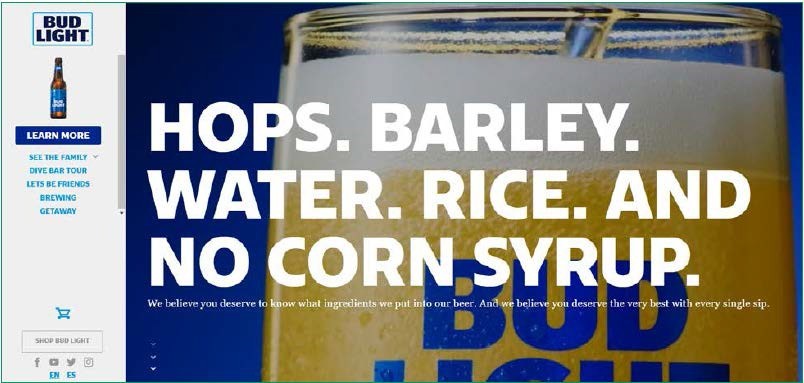
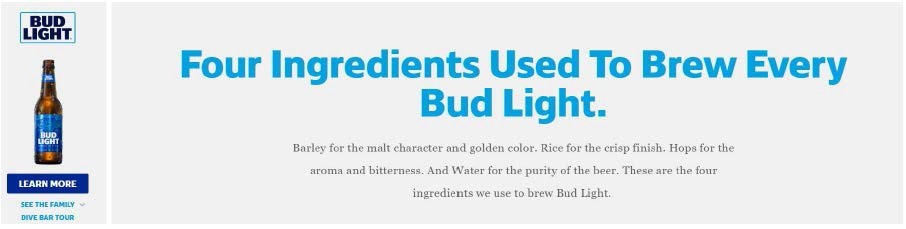
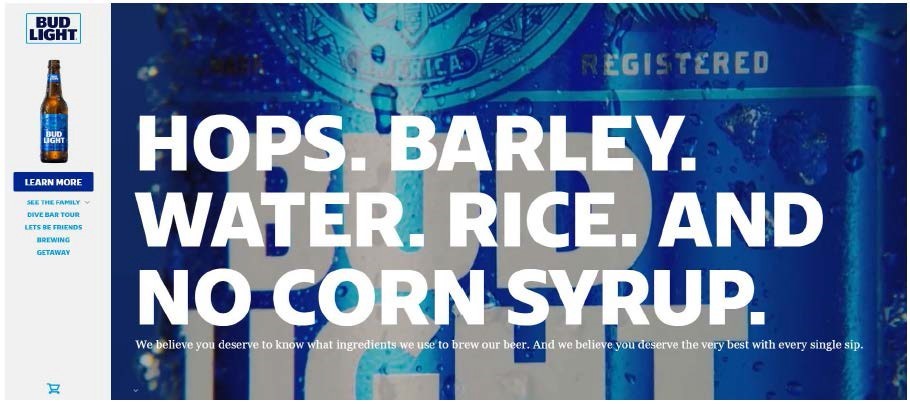
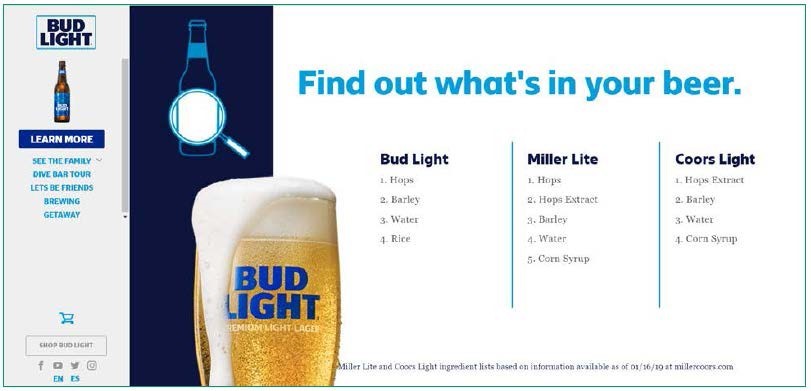
For some additional context, perhaps, the court explains that the Bud Light website used to say “We believe you deserve to
know what ingredients we put into our beer.” Given the existing injunction, it
was changed to: “We believe you deserve to know what ingredients we use to brew
our beer.”
 

old website

more old website

Add caption

new website
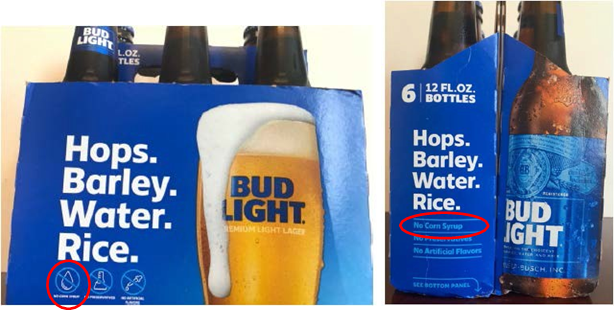
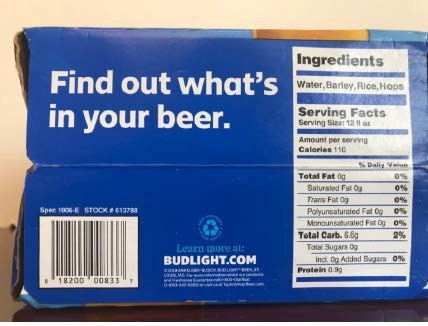
Current packaging says “no corn syrup” on the front and side
panels, and has “see bottom panel” language on the side panels. The bottom
panel states “find out what’s in your beer” (emphasis added) and “learn
more at: budlight.com.”  Despite some
quibbling by AB, it was pretty clear that Bud Light is displayed at retail
locations alongside packages of Miller Lite and Coors Light. The three beers
comprise 100% of the national premium light beer market. 

There was also testimony that packaging “is an effective way
to drive purchasing decisions because it communicates claims about the product
to consumers at the point-of-purchase.” MillerCoors also submitted a Neilsen
report indicating that between 32-60% of consumers (varying by age) haven’t yet
decided which brand of beer to purchase when they enter a store. AB submitted a
2018 consumer research report on beer and craft beer, finding that packaginging
isn’t an important factor in deciding what beer to purchase for 91% of beer
purchasers and for 94% of non-craft beer drinkers including drinkers of light
beer.
AB also commissioned a survey showing consumers either the Bud
Light packaging or a control that had the “no corn syrup” language and icon
removed. After reviewing the front image for 10 seconds and the side image for
10 seconds, participants were asked a series of open ended questions,
including: “In your own words, what as the main message, if any, on the package
you just saw?” Zero respondents in either group mentioned Miller Lite or Coors
Light; the majority identified Bud Light’s ingredients as the main message. If
respondents correctly identified Bud Light or Budweiser as the brand, they were
then asked, “Did the package say or suggest OR did the package not say or
suggest something about any other brand or brands of beer?” 28% of the test
group and 23% of the control group answered that the packaging did say or
suggest something about other brands, but only one respondent in the test group
identified Miller Lite or Coors Light in the followup to that question.  When asked what the packaging says or
suggests about other brands, 3% of the test respondents who reported receiving
any message about other brands of beer mentioned having or using corn syrup.
AB also submitted evidence that its printed but as yet
unused packaging for BL containing the “no corn syrup” icon and language had a
value of $27 million, which amounts to 69 million packages. AB also has 1.3
million finished cases that have been packaged into secondary containers but
that have not yet left A-B’s breweries or warehouses with a value of $5
million.  AB represented that its quality
control policy requires secondary packaging be used within 270 days. MillerCoors
suggested that stickers could be used instead of destroying the packaging; AB
said this would cost $1.10 per package—three times the cost of the packaging
itself, or $76 million.  “This strikes
the court as an absurdly high estimation,” but the decision didn’t turn on
that.
The court applied the pre-eBay presumption that false
advertising injuries are presumed to be irreparable, “even if the plaintiff
fails to demonstrate a business loss.”
AB argued that its packaging was noncomparative and nonactionable.  Neither of these things are necessarily true
(citing a case about highly concentrated markets). “Viewed in context of the
full advertising campaign, a reasonable jury could find that the implicit
message of the packaging is that other beers contain corn syrup. Moreover, in
light of the limited number of beers in the light beer market, with Bud Light,
Miller Lite and Coors Light accounting for almost 100% of sales, that same jury
could also find a substantial segment of consumers would infer that Bud Light’s
principal competitors contain corn syrup, especially after a hundred million
dollar television and print campaign misleadingly suggesting the same thing.”  It was reasonable to consider the overall
campaign because of the unity of message.
As for defendant’s survey, the court thought that a reasonable
jury might accept some of MillerCoors’ criticisms, though it was skeptical of
the argument that the survey also should’ve shown them the bottom of the package
“at least absent some evidence that a substantial segment of beer purchasers
examine the bottom of packaging in deciding which beer to purchase (or at least
that retailers regularly stack product to display the bottom of packaging).” But
the more intuitive objection, that the survey should’ve been conducted in a
retail setting next to Miller Lite and Coors Light packaging, might well
convince a jury, and “the limited time (ten seconds per image) respondents had
to examine an image of the packaging cuts against the weight of the survey
findings.” There were also issues with how the open-ended questions were coded.
There was at least “some likelihood of success in proving to a reasonable jury
that the Bud Light packaging’s continued use of the now-well-known tag lines ‘no
corn syrup’ and ‘find out what is in your beer’ when on display next to Miller
Lite and Coors Lite packaging is likely to be misleading, at least viewed in
the context of defendant’s full advertising campaign.”
Although previously the court didn’t want to rely on intent,
it pointed out that AB spent “tens of millions of dollars on special packaging
closely attuned to its larger advertising effort,” which implicitly made AB’s
argument that packaging wasn’t material to consumer decisions somewhat less
credible.  Moreover, AB’s argument that
consumers wouldn’t tolerate stickering on packages contradicted its
immateriality argument. And AB’s evidence about lack of reliance on “label /
packaging design” focused on the relevance of cosmetic issues such as choice of
font, color or layout of the packaging, not on “substantive concerns about
nutritional value.” MillerCoors’ contrary evidence was sufficient for a reasonable
factfinder to find materiality (and implicitly, it was likely to prevail on
this issue).
The court balanced the equities by giving AB the opportunity
to use up all its existing packaging as of June 6, 2019, or to use the packaging
until March 2, 2020 (270 days from June 6, 2019), whichever occurs first. The
court was open to modifying the injunction if MillerCoors could either show
that a sticker was feasible or that it was practical to get replacement packaging
without interrupting AB’s ability to offer Bud Light for sale.

from Blogger https://ift.tt/2ZW4bQm

Posted in Uncategorized | Tagged | Leave a comment

Even more cocaine

Genus Lifesciences Inc. v. Lannett Company, Inc., 2019 WL
4168958, No. 18-cv-07603-WHO (N.D. Cal. Sept. 3, 2019)
Pleading survey evidence of misleadingness can be pretty helpful, but it can’t help you past theories that target the wrong defendant.
Discussion
of previous opinion
. Genus alleged that its competitors in the market for
cocaine hydrochloride nasal spray, defendants Lannett and Cody (Lannett’s
wholly owned subsidiary), falsely advertised their unapproved product. Genus
also sued First Databank, a pharmaceutical pricing list company. The court
previously found that some of Genus’s claims against Lannett and Cody were
plausibly stated but that none of its claims against First Databank were; Genus
filed an amended complaint and a motion for reconsideration, neither of which
changed the basic situation.
Additional allegations in the amended complaint: Genus conducted
a survey of Lannett’s customers, which showed that 73.4% of them falsely
believe that C-Topical is FDA approved and that 70.4% falsely believe that
Lannett only sells FDA approved products. It also alleged new survey data
related to whether C-Topical’s unapproved status is material.  Genus added new false advertising allegations
based on Lannett ads describing C-Topical as a “pre-1998” drug and Lannett’s
product catalog identification of C-Topical as generic, as well as other
allegations that don’t turn out to matter.
The previous order held, among many other things, that Genus
could plead false advertising based on the false implication that C-Topical is
FDA-approved using survey data that 91% of pharmacists believe that all
products pharmacists dispense are FDA approved, but statements in SEC filings
and investor calls that C-Topical is “grandfathered” or sold under a
“preliminary new drug application” couldn’t support a Lanham Act claim without
specific allegations that they were made for the purpose of influencing
customers of cocaine hydrochloride solutions to buy C-Topical, or were
disseminated sufficiently to the relevant purchasing public (pharmacists,
hospitals, and doctors) to constitute “advertising” or “promotion” within the
pharmaceutical industry.  Finally, the
appearance and content of C-Topical’s labeling and packaging didn’t support a
Lanham Act claim because they weren’t literally false and Genus failed to allege
that they actually conveyed the implied message that C-Topical was FDA approved
to a significant number of consumers.
  
Genus now argued that its claim wasn’t based on the
statements in SEC filings or investor calls alone, but rather in combination
with the advertisements describing C-Topical as a “pre-1938” product, which would
render the statements contained in the SEC filings and investor calls
actionable. But “Lanham Act claims must be evaluated on a
statement-by-statement basis.”  Factfinders
must analyze the message conveyed in context, but courts “may not assume
context” and shouldn’t necessarily assume that consumers would be exposed to
every ad in a campaign. “There is no indication that consumers would have
observed the SEC filings and statements in the investor calls along with the
pre-1938 ads.” Thus, the SEC filings/investor calls remained outside the scope
of the Lanham Act.
As for the “pre-1938” statement itself, Lannett disclosed that “Cocaine HCL
is a pre-1938 drug that has not been approved by the FDA” and ENT Journal ads
stated that Cocaine HCL “has not been proven safe and effective by the FDA.”  The court agreed that the complaint
sufficiently alleged meaning: Genus alleged “that the only reason Lannett would
advertise C-Topical as ‘pre-1938,’ or that they had submitted an NDA, would be
to convince consumers that C-Topical is an unapproved ‘grandfathered’ drug
product or otherwise authorized by FDA.”
(Separately, Genus argued that “C-Topical is a pre-1938
drug” and “Cocaine HCL has not been proven safe and effective by FDA” were
literally false because the approval of its competing Goprelto product shows
that Cocaine HCL has been proven safe and effective by the FDA. Those
claims survived.)
Genus argued that Lannett’s immateriality argument based on
its disclaimers failed, because a “pre-1938” drug, or one that has a submitted
NDA, is FDA-authorized even though it is not FDA approved, so Lannett’s ads
still falsely suggested FDA authorization. And on materiality, Genus alleged
that the FDA approval status of a prescription drug is material to customers “since
approved drugs provide customers assurance concerning the quality of the
product not afforded to unapproved prescription drugs.” Genus also pointed to
its survey evidence allegedly showing that the majority of Lannett’s customers
would not buy C-Topical if they knew it was unapproved. However, that didn’t
show that consumers care whether the FDA authorizes a manufacturer to
sell an unapproved drug (though presumably they would be less likely to buy it anyway if they understood that it was unapproved). Just because consumers care about FDA
approval doesn’t mean they care about FDA authorization. Anyway, the claim
based on the pre-1938 ads was dismissed with leave to amend for failure to
allege materiality.
On C-Topical’s labeling and packaging: Genus previously
alleged that there were misleading similarities between it and the labeling and
packaging of an FDA approved drug. Genus now pled that it conducted a survey of
Lannett’s customers and alleged that 73.4% of them falsely believed that
C-Topical was FDA approved after reviewing its packaging. Lannett argued that
this allegation was still insufficient because Genus didn’t allege that specific
information on the label or package was false. 
Using Mead Johnson, Lannett argued that Genus was at best
alleging misunderstanding, and that a survey can’t be used to ascribe a
“misleading” meaning to an otherwise accurate statement. Further, it argued that
it was required by federal law to include the various statements on the
packaging and label.
The court found that it was sufficient to allege that the
overall combination of C-Topical’s packaging misled consumers to believe that
it is an FDA approved product. Mead Johnson was inapposite. “Genus is
not using survey data to parse a particular phrase and establish that it is
misleading.” And the alleged federal requirements weren’t controlling.  Lannett’s “supposed dilemma could be remedied
by including a statement that C-Topical is not FDA-approved without running
afoul of FDA labelling requirements.”
This time, Genus successfully pled that general statements
on Lannett’s website that it complied with FDA regulatory requirements were
misleading because they conveyed the implied message that C-Topical was
grandfathered or sold with FDA approval and deceived a significant portion of
recipients. Genus pled that survey evidence showed that after reviewing
Lannett’s homepage for its http://www.lannett.com website, 70.4% of Lannett’s
customers falsely believed that Lannett sells only drugs that are FDA approved.
 (Verbatims to “What makes you say
Lannett sells only drugs that are FDA approved?” included “Website mentions
generic medications, giving impression that they are selling already FDA
approved pharmaceuticals” and “based on the first page, it is a generic drug
manufacturer. Generic drugs still require FDA approval.”)
Statements in Lannett’s catalog characterizing C-Topical as “generic,”
however, made until 2016, couldn’t have harmed Genus because Genus didn’t enter
the market until after the catalogs were distributed. Thus, without pleading
more of an explanation of harm, the catalogs didn’t plausibly proximately cause
“an injury to a commercial interest in sales or business reputation[.]” Genus
argued that was able to find Lannett’s 2016 catalog as late as April 2019 and
that Lannett hadn’t produced more recent marketing materials.  But that didn’t successfully plead that the
catalogs were currently used in advertising or promotion.
The court also got rid of Sherman Act claims based on
alleged false advertising. For reasons that, whatever their formal
justification, clearly depend on the treble damages available in antitrust
claims, antitrust law generally refuses to consider false advertising to constitute
an antitrust violation. Thus, in antitrust cases, false advertising is presumed
to have a de minimis effect on competitition. To implicate antitrust law, false
advertising must be explicitly false, clearly material, clearly
reliance-inducing, directed at buyers who don’t know the subject matter, long-lasting,
and not subject to neutralization (perhaps by counteradvertising) or other
measures by competitors.  Thus, Genus had
to explain why it couldn’t have engaged in its own advertising promoting its
product as the only FDA approved cocaine hydrochloride product and telling
customers that C-Topical is unapproved or that its route of administration is
misleading.  Genus argued that coutneradvertising
wouldn’t work because the false and misleading statements were being presented
to the market through third-party price lists that appeared to provide
objective and unbiased information. The court disagreed. The main previous case
invoking the third party principle involved a third party, a swimming coach,
who disparaged the quality of the plaintiff’s swim gear.  But here there was no disparagement of Genus’s
product, only allegedly false description of C-Topical.  So it would be easier to rebut.  Nor did it successfully plead that expending
time and money on neutralizing the false advertising would be a
disproportionate burden. And its own pleadings on materiality suggested that an
ad campaign on this theme would be effective, given that roughly 60% of Lannett
customers thought that approval would influence a purchasing decision.
Genus’s amendments to its complaint also didn’t save its
claims against First Databank because there was still no sufficient allegation
that First Databank was engaging in commercial speech when it listed C-Topical.  There was still no facts supporting a finding
that First Databank had any monetary interest in whether customers of cocaine
hydrochloride choose to buy C-Topical rather than Goprelto.
Genus alleged that First Databank falsely advertised that
its database is “reliable” and “accurate.” But that was puffery, and anyway
there was no causal link plausibly alleged between those general statements and
Genus’s alleged injuries sufficient to confer standing on Genus.
Nor did the court reconsider its conclusions on Genus’s contributory
false advertising claim. Genus argued that, under VHT, Inc. v. Zillow Group,
Inc., 918 F.3d 723 (9th Cir. 2019), all that was required for contributory
liability was “material contribution” to the legal violation. Under that
standard, First Databank allegedly controlled the means of dissemination and
was a main channel for Lannett’s false claims. But the court rejected the
copyright treatment. “To do so would open up a vast and currently non-existent
scope of liability for all publishers of non-commercial information.”  [It’s all right for copyright owners, though!] 

from Blogger https://ift.tt/2N0s1s6

Posted in Uncategorized | Tagged , , | Leave a comment

Does Rogers v. Grimaldi apply to false advertising claims?

Dickinson v. Ryan Seacrest Enterprises, Inc., No. CV
18-2544-GW(JPRx), 2019 WL 3035090 (C.D. Cal. Mar. 26, 2019)
This dispute over alleged supermodel Janice Dickinson’s
appearance in a reality show is going up to the 9th Circuit.  Here, the district court kicked out Lanham
Act claims for false endorsement, false advertising, and trademark dilution and
declined to exercise supplemental jurisdiction over the related state law
claims.
Dickinson has been a producer, judge, contestant, and/or
guest star in America’s Next Top Model, The Janice Dickinson Agency, I’m a
Celebrity … Get Me Out of Here!, Celebrity Rehab with Dr. Drew, and Celebrity
Big Brother. She allegedly attends charity runway shows and photoshoots without
a fee for the dual purpose of serving charity and “maintaining and building
goodwill in her mark and brand,” and doesn’t voluntarily appear on reality
television shows pro bono.
Rosette is a designer and the founder of Art Hearts Fashion,
a charitable organization that produces runway shows during fashion events. Dickinson appeared as
a runway model pro bono during Los Angeles Fashion Week for Rosette each year
between 2010 and 2016, and Rosette allegedly knew that she wouldn’t do this if she
knew that Rosette was planning to exploit her “celebrity” without her consent
to facilitate a reality television show. In 2016, that’s allegedly what
happened: Dickinson’s appearance at the fashion show became part of an episode
of the Shahs of Sunset series that allegedly made it look like she “intentionally
stole or bullied her way into wearing a romper that had supposedly been
previously selected for Golnesa Gharachedaghi, a lead character.”  The episode was allegedly scripted so that Gharacedaghi
would falsely act as though she was experiencing “trauma and consternation,”
and Gharachedaghi would “intentionally, maliciously and falsely disparage” Dickinson
on camera.  Adding to the intrigue,
defendants apparently say they have a signed release, but Dickinson alleged
that she didn’t sign any release (and thus that defendants faked the release to
reassure others in the corporate hierarchy/insurers; she alleged that the
purported signature doesn’t match her own), or that if she did, it was as a
result of deception leaving her unaware that she was signing anything at all or
that she was signing a release. Alleged fraud in the factum!
Defendants allegedly falsely advertised that the series was
an “unscripted” “docuseries” rather than a largely scripted or fictional
series, and traded off Dickinson’s fame to promote the series.  The use of “True Entertainment” as the name
of a credited production entity associated with the series was also allegedly
false, and “[f]eaturing this credit on the screen at the end of the programming
is intended to make viewers believe that the Series tells ‘true stories.’” [OK,
I’m not a huge fan of Twiqbal, but how do we feel about the plausibility
of this allegation?]  
The promotional material allegedly falsely portrayed her as
a “fashion runway ‘thief’ ” who stole Gharachedaghi’s outfit, causing negative
public reaction, including in YouTube comments. [Is there anything a woman can
do that won’t cause negative YouTube comments?] Two of the marketing
clips for the relevant episode on Bravo TV’s website allegedly used Dickinson’s
mark [her name] to make false statements about the content of the episode to
encourage consumers to “commercially engage with” the episode.
One clip includes the statement: “Did Janice Dickinson Just
Steal GG’s Look?! Evidently she took the outfit GG was supposed to wear on the
runway, and GG is pissed …. ”  [The
alleged falsity of this statement is based on the allegation that Dickinson
didn’t “steal” the look; First Amendment doctrine (outside of TM) generally
protects advertising about the content of noncommercial speech to the same
extent as the content of the underlying noncommercial speech, and thus you
can’t usually turn your defamation claim into a false advertising claim by
challenging the advertising of the noncommercial speech.] Another clip says:
“Did we mention Janice Dickinson makes an appearance?” Dickinson alleged that,
given her fame, fans would believe that she would only “appear” on the series
voluntarily, and that as such, she endorsed the show. [Showing the importance
of Rogers v. Grimaldi as a speech-protective test!]  Similar “interstitial” ads ran during the
episode itself to “tease viewers about upcoming content,” which allegedly
“explicitly” falsely “impl[ied] that if consumers continue to tune in they will
be shown documentary footage of a controversy between Plaintiff and
Gharachedaghi.” In one clip, a cast member says “It’s about to go down,” but the
episode never shows any confrontation  and none occurred.
False endorsement: From an earlier ruling: Rogers v.
Grimaldi
applies. The use of Dickinson’s persona was artistically
relevant.  And the use wasn’t explicitly
misleading.  Dickinson unsurprisingly
cited Gordon v. Drape to say that there was a factual issue about that,
but even Gordon talks about TV programs as being different from greeting cards.
 The Ninth Circuit has already found that
the following allegations don’t suffice as evidence of explicit falsity:  “mere use of the plaintiff’s likeness,” “a
consumer data survey showing confusion,” and written materials accompanying the
work that didn’t explicitly mislead.  The
complaint didn’t allege any “explicit indication, overt claim, or explicit
misstatement” relating to endorsement. 
The beginning credits list cast members, producers, and companies behind
the episode, and Dickinson’s not on that list. And nothing else “suggest[s]”
that Dickinson, the nemesis in one scene of one episode, endorsed or backed the
episode.  “Though the Episode’s allegedly
false narrative portraying Plaintiff as ‘stealing’ the romper may be unethical
or violate some other law, that narrative does not sustain the Rogers explicitly
misleading prong as to Plaintiff’s Lanham Act claims.”  Nor were there any statements outside the
episode that Dickinson was behind the episode. And many of the statements
Dickinson cited were outside of defendants’ control.
False advertising: Under Lexmark, Dickinson needed to
“allege an injury to a commercial interest in reputation or sales.” In the
light most favorable to her, she did so, alleging harm to her reputation,
thereby diminishing the “desirability of Dickinson’s appearance on other media
projects, and her $75,000 appearance fee value.” Did the economic or
reputational injury flow directly from the deception wrought by the
advertising? The court found this a “closer call.” Dickinson alleged that the
episode’s “false narrative” deceived consumers into believing that she was unprofessional,
and thus diminished the value of her celebrity brand.  But that was about the content of the episode,
rather than about the alleged falsity of the “unscripted” advertising claim.
Thus, she didn’t properly allege that the advertising was the proximate cause
of her injury.
Also, false advertising is only actionable under the Lanham
Act when it’s in “commercial advertising or promotion.”  But there are special rules for commercial
speech where ads promote expressive works. Under governing law, “[f]or private
actions, such as tort suits, advertisements that are ‘adjunct’ to a protected
work are entitled to the same immunity from as the underlying work.” All the
ads that Dickinson cited were clips from the episode itself, a few with short
descriptions. They were noncommercial speech for Lanham Act purposes.  Thus, the court applied Rogers to the
false advertising claim.  [Note that this
step is entirely unnecessary if you agree with the idea that the episode promos
aren’t “commercial speech”; the inquiry is over for §43(a)(1)(B) purposes at
this point. That’s unlike §43(a)(1)(A), which courts have held applicable to
noncommercial speech, which was the reason they needed to invent Rogers
in the first place. The court thus expressed some uncertainty about how to
apply Rogers to false advertising about the content of an
expressive work, but that’s a self-created difficulty.]
In a footnote, the court declined to find that Gordon
counseled in favor of finding a factual issue here.  This isn’t a “minimally expressive” work like
a greeting card. [Sigh.]  Gordon
contrasted use “in the creation of a song, photograph, video game, or
television show” with “just past[ing]” a mark into greeting cards, which could
be explicitly misleading. Here, the use of Dickinson’s likeness, image, and
name in the episode, and concomitant promotional materials obviously had
artistic relevance above zero.
Explicit misleadingness: Dickinson alleged that the
“docuseries” advertising misled as to content because the show was scripted,
but that wasn’t enough under Rogers because Rogers requires the
use of the mark to be explicitly misleading. “Plaintiff’s mark has no bearing
on whether or not Bravo advertises their show as a scripted series or reality
television.” [Which is why proximate cause might be the better move here if you
insist on going further than “not commercial speech.”]
Second, Dickinson argued that the ads explicitly misled
about the content of the episode by making her look bad/promising a fight. Not
so.  The ads were all clips of the
episode itself: “A clip of a television episode could not possibly mislead as to
the content of the episode, as it is itself a portion of the content.” And the
additional descriptive statement: “Did Janice Dickinson Just Steal GG’s Look?!
Evidently she took the outfit GG was supposed to wear on the runway and GG is
pissed ….” wasn’t explicitly misleading; it wasn’t even unequivocal. The
short descriptions of the clips “both accurately preview the controversy
portrayed on the Episode, whether the controversy itself was contrived by
Defendants or not.”  “Did we mention
Janice Dickinson makes an appearance?” is also not misleading, since she does.
Dilution: Not commercial speech, no claim.

from Blogger https://ift.tt/2ZMHiiq

Posted in Uncategorized | Tagged , , | Leave a comment

fine print won’t necessarily fix misleading comparison

Asurion, LLC v. SquareTrade, Inc., 2019 WL 4142154, No. 18-cv-01306
(M.D. Tenn. Aug. 30, 2019)
The parties compete to provide extended warranties for
mobile phones. Typically, wireless carriers bundle Asurion’s insurance with an
extended warranty and technical support and sell the combined “Carrier
Protection Plan.” SquareTrade sells a “Protection Plan” that provides
protection against defects and accidental damages for a variety of consumer
products, including cell phones, but doesn’t cover theft or loss as Asurion’s
plan does. In addition, the SquareTrade plan doesn’t include technical support,
as does the carrier bundle.
Asurion challenged a mail ad:

And an online ad:

The fine print in both advertisements states: “… Price
comparisons based on smart phone protection for the following providers: [a
bunch of bundles]. Prices and terms are as of 08/01/2018 and may change.
SquareTrade plans do not cover loss or theft. …”
Asurion alleged that the side-by-side comparison in the
advertisements falsely and misleadingly implies that SquareTrade offers
coverage equivalent to the bundles for a lower price and that using the name of
its affiliate, Allstate, in the online advertisement misleadingly implies
SquareTrade offers insurance (i.e. theft and loss protection). It alleged false
advertising under the Lanham Act and the Tennessee Consumer Protection Act (TCPA).
The court denied SquareTrade’s motion to dismiss.
Context matters; a disclaimer or clarifying language may
defeat a claim of deception “if it renders an otherwise false statement true,
so that consumers are not misled. To be effective, a disclaimer must actually
be read by the consumer. Consequently, a disclaimer that is unlikely to be read
because of its print size or location will not remedy a misleading claim.” 
Asurion alleged misleadingness. At this stage, it needed to
plead facts that support a “plausible inference that the challenged
advertisements in fact misled a significant number of reasonable customers.”
The core of the complaint was the allegedly implied false equivalency between
the SquareTrade plan and the bundles. For example, the mailer allegedly falsely
suggested” that SquareTrade “offers insurance coverage by co-branding the
advertisement with Allstate (an insurance company) and stating ‘Stop overpaying
for phone insurance through your wireless carrier’ and ‘By switching to
SquareTrade your family could save hundreds vs. carrier insurance.’ ” [It
sounds a bit different to say “save on insurance by not paying for insurance.”]
Asurion argues that the logical conclusion implied by the statements and by the
comparison charts is that “a consumer could replace one of the Carrier
Protection Plans with SquareTrade’s plan without any change in coverage.”
SquareTrade argued that the fine print disclaimer avoided
misleadingness and that any reasonable consumer “would know that each plan
offered by a different company at a different price likely has some differences
in the services offered.” The court disagreed for purposes of a motion to
dismiss. “Here, the side-by-side comparison suggests that the plans are, if not
identical, at least comparable. The fine print disclaimer does not conclusively
remedy the potentially misleading nature of the advertisement as a whole. Other
than the notice that the SquareTrade plan does not cover loss or theft, the
fine print does nothing to dispel any misleading comparisons between
SquareTrade and the Carrier Protections Plans with which it is compared.”  Although people know that dog food isn’t made
from people food, “SquareTrade’s Protection Plan is not so obviously different
from the Carrier Protection plans that consumers would instinctively know they
were not the same product.”  Plus, even
the disclaimer didn’t explain that the other plans listed did cover
theft or loss, so it didn’t dispel the perception that the plans listed had
comparable coverage, the way the ingredient list on dog food explains what’s in
it.
For similar reasons, the TCPA claim survived, after the
court found that competitors had standing to bring such claims, given the
statutory language that a claim may be brought by any person, including
corporations, who “suffers an ascertainable loss” proximately caused by unfair
or deceptive actions declared unlawful by the TCPA.

from Blogger https://ift.tt/2LiVY4x

Posted in Uncategorized | Tagged , | Leave a comment

benefit of the bargain damages can be measured by cost of repair in car class action

Nguyen v. Nissan North America, Inc., 932 F.3d 811 (9th Cir.
2019)
Nguyen bought a new 2012 Nissan 370Z with an allegedly
potentially catastrophic design defect hidden in the vehicle’s hydraulic clutch
system. “After the clutch purportedly malfunctioned—and Plaintiff spent more
than $700 replacing it—he filed a putative class action” asserting consumer
protection and warranty claims. The court noted evidence supporting the idea of
a general defect of which Nissan was aware since 2007 or so, such as a project
engineer’s internal email: “This issue is great enough that it warrants a
serious look by R&D as to how we can improve the feel, and function of the
clutch system. … Customers are universally dissatisfied with the feel and
performance of the system even when it is performing as designed. … Combine that
with the frequent claims of clutch pedal sticking to floor and you’ve taken a
dissatisfaction item and made it into a breakdown item.” Nguyen’s son
experienced a scary instance of this when the clutch stopped working on the
highway, though fortunately he was able to move to the shoulder without physical
injury.
The district court denied class certification based on what
it saw as inadequacies in Nguyen’s damages model based on the cost of repairing
the clutch to fix the problem.  The
district court reasoned that the benefit of the bargain would only equal the
cost of replacing the defective clutch if consumers would’ve deemed the
defective part valueless, which was implausible because even Nguyen drove the
vehicle for nearly 27,000 miles before replacing the part.
The court of appeals reversed, finding that a
benefit-of-the-bargain model as measured by the average cost of replacing the
allegedly defective clutch system was appropriate to satisfy Rule 23(b)(3)’s
predominance requirement. The Supreme Court has emphasized that “at the
class-certification stage (as at trial), any model supporting a ‘plaintiff’s
damages case must be consistent with its liability case.’ ”
Damages under the CLRA, the Song-Beverly Act (California’s
warranty law), and the Magnuson-Moss Act could all be measured using a benefit
of the bargain theory.  And that was
consistent with Nguyen’s liability theory. “Plaintiff’s legal theory is not
based on the performance of the allegedly defective clutch system, but instead
the system itself, which he claims is defective. Had Plaintiff alleged that
performance problems constituted the defect and caused his and the class
members’ injuries, then the benefit of the bargain would not be the appropriate
measure of damages because, as the district court noted, class members might
have received varying levels of value based on if and when they experienced a
sticky clutch problem.”  But under Nguyen’s
theory, the defect exists whether or not the symptoms have manifested.  Further, he alleged, “a reasonable person
would have considered [the fact of the alleged defect] to be important in
deciding whether to purchase or lease Class Vehicles,” and thus that Plaintiff
and class members “would not have purchased or leased Class Vehicles equipped
with transmissions, or would have paid less for them.” Thus, “under both causes
of action, the sale of the vehicle with the known defect is the
liability-triggering event, not when the [defect] manifests.” It’s at that
point that a consumer paid more than she would’ve paid had she known the truth.
“[T]he focus is on the difference between what was paid and what a reasonable
consumer would have paid at the time of purchase without the fraudulent or
omitted information.”  Thus, it was
incorrect to say that repair costs wouldn’t measure the harm unless consumers
would’ve deemed the defective part valueless. 
Cases from other circuits have also found similar questions “amenable
to classwide resolution,” explaining that “a manufacturer’s misrepresentation
may allow it to command a price premium and to overcharge customers
systematically. Even if an individual class member subjectively valued the
vehicle equally with or without the accurate [information], she could have
suffered a loss in negotiating leverage if a vehicle with perfect safety ratings
is worth more on the open market.” 
Technically, I can see why the cost-to-fix might not completely match up
with the price drop in the overall negotiated price—though that’s how it works
in buying a house, buying a car might be different—but the court noted that
cost-to-fix “is a proxy for [his] overpayment of the vehicle at the point of
sale.”  In reality, probably many people would’ve
gone with a different car instead of one with a clutch so potentially nonfunctional it needed to be replaced, but since we can’t rewind that transaction the
cost-to-fix seems like a decent proxy for what they would’ve demanded to take this car
instead.
Anyway, Nguyen was seeking to vindicate “the right to take a
product free from defect. The defect did not cause the plaintiffs’ injury; the
defect was the injury.”  Damages for
actual faulty performance would indeed require an individualized analysis that
might defeat predominance. The faulty design, however, didn’t pose that problem
for class treatment. Reversed and remanded.

from Blogger https://ift.tt/2LfBicL

Posted in Uncategorized | Tagged , , , | Leave a comment

When is a sale worth $100,000? court is generous to real estate brokerage ad

At World Properties, LLC v. Baird & Warner Real Estate,
Inc., 2019 WL 4034636, No. 18-cv-01973 (N.D. Ill. Aug. 27, 2019)
B&W and plaintiff @properties are real estate brokerage
companies serving Chicago and the surrounding area. B&W advertised its
accomplishments in 2017, allegedly falsely touting $8.8 billion in sales and
32,000 transactions in violation of the Lanham Act and the Illinois Uniform
Deceptive Trade Practices Act. @properties alleged that, in fact, in 2017,
B&W’s total volume for properties listed and sold was approximately $5.7
billion and its total number of sales was 17,168, while @properties’s total
volume for properties listed and sold was approximately $8.5 billion and its
total number of transactions was 17,153. B&W allegedly inflated its sales
and transactions figures by including not just its real estate brokerage sales
and transactions, but also mortgage originations and refinances performed by
its affiliate, Key Mortgage Services, and title searches, title insurance
services, and other title-related services performed by its affiliate, BWT, as
well as two other companies, Starck Title and Landtrust National Title. Those
figures also allegedly included property rentals and leases for which B&W
acted as the agent.
B&W allegedly inflated its sales and transactions
figures by double- or triple-counting certain transactions, for example: “if
B&W acted as the real estate broker for the purchase of a property for
$100,000, the purchasers of the property obtained a mortgage from Key Mortgage
in the amount of $80,000, and the purchasers of the property used BWT as their
title company, B&W would have: (a) considered those three distinct
transactions for purposes of the 32,000 transactions figure; and (b) added the
$100,000 for the property purchase, the $80,000 for the mortgage origination,
and $100,000 for the title insurance or other services into the ‘$8.8 billion
in sales’ figure, such that $380,000 would have been added to the ‘sales’
figure for what was a $100,000 transaction.” That does sound hinky.
The ad first appeared in an email from Chicago Agent
Magazine, a publication catering to Chicagoland’s top real estate agents,
brokers, developers, and mortgage professionals claiming “Our 2017 Stats Are
Pretty Interesting” and “IT’S OFFICIAL. WE CRUSHED 2017.” The ad didn’t explain
its methods or sources, or mention other related companies. The email linked to
a blog post on B&W’s website repeating the claims and adding that, “[i]t’s
almost hard to believe everything that happened, and not just with our
residential sales company, but with our mortgage and title companies, too.” It
stated that the “$8.8 billion in sales and more than 32,000 transactions
[B&W] did last year is evidence that [B&W’s] clients and [B&W’s]
agents across Chicagoland are onto something.” Four paragraphs in, the blog
post notes that “[t]he other businesses in our family had impressive results
too,” expressly identifying BWT and Key Mortgage. There were similar ads
elsewhere.
Were the sales and transactions numbers literally false? Literal
falsity depends on how the statement would be understood by a “linguistically
competent person,” and a statement that is ambiguous cannot be literally false.
“Sales” and “transactions” were at least ambiguous about whether they included
property rentals, leases, and mortgage and title services, which seemed like “transactions,”
and revenue derived from these actions pretty clearly would count as “gross
receipts” (a key definition of “sales”). [That doesn’t seem to deal with counting
the amount of title insurance in sale amounts—insuring a property for $100,000
doesn’t mean you’ve made $100,000 in sales/receipts.]
@properties alleged that “sales” and “transactions” are
understood in the real estate brokerage industry to refer “to the exchange of
ownership interest and title of a parcel of real property from one person or
entity to another person or entity.” But that would make this an implicit
falsity claim, which @properties disavowed. “It is not the domain of a literal
falsity claim to evaluate the specialized understandings of consumers in a
particular market; rather, a literal falsity claim asks only how an
advertisement would be understood by a ‘linguistically competent person.’”
[This disturbs me as a blanket statement—the linguistically
competent person has to be competent in something.  And English is probably too broad a category;
otherwise it wouldn’t be possible to literally falsely advertise to watchmakers that one had tourbillons for sale.  Be
truthful: most of you had to look that one up! 
It also conflicts with some older cases (albeit not in the 7th Circuit) allowing for literal
falsity when a term (a) has a specific meaning to the trade and (b) is directed
at the trade; I think falsity in those cases should be provable by expert testimony.]  The court here wanted
survey or other evidence to establish that potential real estate brokerage
clients have a specific understanding of the words “sales” and “transactions.”
Thus, a literal falsity claim based on the fact that
B&W’s $8.8 billion in sales and 32,000 transactions numbers are not limited
to real estate brokerage sales couldn’t proceed, and the court concluded that the
alleged double- and triple-counting didn’t change things, since the actual
property sale, mortgage origination, and purchase of title insurance are each
discrete sales and transactions. [But as pled, the title insurance sale was a
sale of $100,000 in title insurance, not a receipt of $100,000!  How can it be truthful to count receipts of a
couple of hundred dollars as $100,000 in an aggregate sales amount?  The real problem is that each individual
definition of “sales” might be truthful but the effect of adding the dollar numbers
given for those sales together is not truthful because no single definition of
sales can produce the total advertised number.]
However, @properties did successfully plead literal falsity
in alleging that it was false to include sales and transactions consummated by
Key Mortgage, BWT, Starck, and Landtrust. B&W argued that including those
companies’ sales wasn’t literally false because they are B&W affiliates.  That would be a closer question if only Key Mortgage
and BWT had been included; “[e]specially with respect to BWT, which includes
“Baird & Warner” in its own name, a linguistically competent person may
well understand B&W’s sales and transactions figures to include BWT’s sales
and transactions.” And the blog post expressly named them as businesses in the
family (although in a way that seemed to me to suggest that their successes
were separate from the beginning claim). “Ultimately, the issue may turn on the
exact nature of the corporate relationship between the affiliates,” and the
complaint didn’t allege that all of these were in fact affiliates. “[I]f, in
fact, B&W included sales and transactions from wholly unaffiliated entities
in its $8.8 billion in sales and 32,000 transactions figures, it would have
made a literally false statement.”  [I
was just
reading
about why one might want to transact with a particular company in a
group, given the use of corporate structure to limit liability risks.]
Materiality: The complaint cited an article stating that a
“real estate broker’s sales volume and position in the real estate market are
material to a consumer’s decision regarding which real estate brokerage firm to
choose.” Kirk Wakefield, et al., What Do Consumers Expect From Real Estate
Agents?, Keller Ctr. Research Report (Nov. 2008). B&W argued that this was
about a consumer’s selection of an individual agent rather than a brokerage
firm. But the article also recognizes how the reputation of the brokerage
company can boost an agent because it “can lead to greater attractiveness or
demand for the brand.” And it was reasonable to infer “that one sign of a
well-established agency is its number of sales and transactions, and thus a
potential client would be more likely to select a real estate brokerage company
that has a high volume of sales and transactions.” Materiality is generally an
issue of fact, though the court noted that, to survive summary judgment, “@properties
would be well-advised to adduce better evidence than a single article.”
Injury: The complaint successfully pled that there was a
trend following the publication of the ads in which B&W’s real estate sales
volume or number of real estate transactions in both the City of Chicago and
Chicagoland markets did one of the following: (i) increased at a higher rate
than @properties’s sales volume or number of transactions as compared to the
same month of 2017, (ii) increased while @properties’s sales volume or number
of transactions decreased, or (iii) decreased at a smaller margin than
@properties’s sales volume or number of transactions decreased. This was sufficient
at the pleading stage, though @properties would need more “evidence that
directly links the trends shown in the charts and any claimed reputational
damage with B&W’s deceptive advertising” to prevail.

from Blogger https://ift.tt/2L18tBF

Posted in Uncategorized | Tagged , | Leave a comment

district court ignores Empire, decides that Rogers doesn’t cover nonfiction

IOW, LLC v. Breus, No. CV18-1649-PHX-DGC, 2019 WL 4010737
(D. Ariz. Aug. 26, 2019)
Every time I think I’ve seen it all …. Here, the court decides that Rogers doesn’t apply
if the challenged book title isn’t itself “expressive,” which means something other
than “conveys meaning.”  I feel like Old
Luke.

Breus “is a clinical psychologist … who studies how his
patients’ chronobiologies [natural circadian rhythms] effect their treatment.”
He’s written three books and more than eighty blog posts discussing
chronobiology and circadian rhythms. 
Breus met Randy Miller, the sole member of plaintiff IOW and the
majority shareholder of plaintiff WEC. Miller told Breus about his business,
WHEN, and shared his ideas for an online counseling platform named “If or When”
or “If not Now When,” “where coaches would help customers achieve their goals
based on the concept of: ‘If I don’t do it now, when will I do it?’” They
entered into a Confidentiality Agreement regarding their discussions, but Breus
provided no services to plaintiffs and was never identified as an associate by
their promotional materials.
This dispute is about Breus’s third book, The Power of When
(initially titled The Overnight Solution), which “posits that an individual can
be healthier and more productive by adjusting when she accomplishes certain
tasks.” In 2015, Breus acquired thepowerofwhen.com to promote the book; it went
live in August 2016. Id. at 5. He also registered thepowerofwhenquiz.com to
publish his Bio-Time Quiz, which went live in July 2016. Plaintiffs claimed
that Breus, in developing the concept for his third book, used and incorporated
information that he discussed with Miller and that was subject to the
Confidentiality Agreement and trade secret protections.
Breach of contract: 
WEC argued that Breus “utilize[d] the confidential materials received
from [WEC], which included the confidential proposed trademarks and branding of
WHEN selected by Mr. Miller.” Miller requested his attorney perform a trademark
search on Power of When, and stated that he and his attorney “considered that
phrase to be highly confidential” until it was publicly disclosed in an August
2016 trademark application. But this didn’t show that Breus violated the
agreement, nor did the evidence show that The Power of When or its marketing
materials mimicked the WHEN programs, ideas, and brand models.
As for the origin of the book title, defendants cited
evidence that Breus’s publisher, LB, “conceived the title in a meeting where
Dr. Breus was not present and later suggested the title to him via email.” The
emails in the record didn’t controvert LB’s employee’s sworn testimony that she
and LB conceived the title without input from Breus; indeed, the emails stated
specifically that Breus had different title suggestions. The employee testified
that she disliked the book’s working title; another person came up with The
Science of When, but the publisher found the word “science” too
technical-sounding so she suggested “power.” There was no contrary evidence;
credibility issues couldn’t preclude summary judgment without evidence
undercutting the truthfulness of the email exchange or the participants’ testimony
about it.
WEC argued that even if Breus did not suggest The Power of
When as a book title, he had a duty under the Agreement not to use it, but
didn’t establish the existence of such a duty. Nor was there a breach of the
implied covenant of good faith and fair dealing on this record; plaintiffs
weren’t claiming misuse of confidential information, but “misappropriation of
use of ‘WHEN,’ ‘Power of WHEN,’ and other uses of ‘WHEN’ throughout the book.”
[Ugh.]
Trade secrets: a similar fate. Plaintiff’s principal Miller
testified that the trade secret disclosed in Dr. Breus’s book is “WHEN” and
“Power of WHEN”; that he did not own the trademark Power of WHEN until August
2016 when he filed a public trademark application [pro tip: the application
isn’t “ownership”]; that the information disclosed in Dr. Breus’s book was “not
confidential information”; and that it was no secret that he used “when” in
connection with his business. Nor did anything identified as confidential by
the plaintiffs show up in the book.
And yet the trademark claims survive, the court becoming
entangled in various doctrinal thickets.
Claims based on WEC’s Power of When trademark: Defendants
pointed out that Breus told Miller the title of his book in December 2015, and
the title was conceived, domain names acquired, websites published, promotions
began, and more than 15,000 copies of the book were shipped to retailers, all
before WEC filed its ITU application on August 28, 2016. 
Plaintiffs’ argument was to cite cases that “the title of a
single book cannot serve as a source identifier” and that “the publication of a
single book cannot create, as a matter of law, an association between the
book’s title (the alleged mark) and the source of the book.” The court thought
the Ninth Circuit might be more flexible, and that the presence of “several
promotional activities and the shipping of 15,000 books to retailers” might
also matter.  However, the court thought
that plaintiffs might be able to establish priority.  But priority isn’t the best way to describe
the issue: even after the registration issued (2017), plaintiff shouldn’t be
able to prevent uses that began before the filing date of the ITU. Prior users
shouldn’t need to have “trademark rights” that would enable them to suppress
others’ uses in order to have rights to continue use. 
The court reasoned that the trademark application constitutes
“prima facie evidence of the validity of the registered mark” [also not true as
stated; only as of 2017, when the registration issued, did the claims of the
registration—not the application—constitute prima facie evidence of validity]
and so a fact-specific inquiry was required. 
“[A]n issue of fact exists regarding whether Defendants’ pre-August 2016
activities rebut Plaintiffs’ presumption of ownership… “A reasonable jury could
weigh the factors and determine that Defendants’ pre-registration activities –
most of which appear to have occurred out of the public eye – were not
sufficiently public to identify the mark in an appropriate segment of the
public mind as Defendants’ mark.”  [This
is also an instance of Bill McGeveran’s observation that multiple overlapping
doctrines allowing defenses can actually impair defendants’ chances—a §33(b)
prior user defense might have worked here, subject to the court deciding that
defendants would need to have had a valid mark as opposed to a use; descriptive fair use might also
have worked. But the real problem is that defendants, in apparent good faith,
began using the phrase before plaintiffs filed their ITU. But don’t worry; it gets worse.]
Now, on to Rogers. 
The court characterized the test as follows: “Under Rogers, a
defendant must first ‘make a threshold legal showing that its allegedly
infringing use is part of an expressive work protected by the First Amendment.’
Gordon v. Drape Creative, Inc., 909 F.3d 257, 264 (9th Cir. 2018).”
Defendants, completely correctly, argued that using a phrase
as the title of a book satisfies that threshold showing because it’s the title
of a book, which is an expressive work. Appallingly, the court disagreed
because the book is a nonfiction book. Although the word “artistic” appears
many times in Rogers cases, the First Amendment concerns about using
trademark to suppress speech are no different for nonfiction. In addition, and
in contradiction to Empire, the governing law of the circuit (cited
several times in this opinion and yet somehow completely ignored on this
point), the court required that defendants show that the phrase had “cultural
significance or meaning beyond its source-identifying function” in order to
invoke Rogers. [And by the way, even if you did require that, the descriptive
meaning of the phrase is clearly meaning “beyond its source-identifying
function”—when the title was chosen, there was no source-identifying
function because even the ITU was not yet filed.]
Thus: “The Court must determine therefore whether
Plaintiffs’ mark, Power of When, has assumed cultural significance such that
Defendants’ use of the mark in Dr. Breus’s book title is expressive, rather
than simply commercial use or advertising for his non-fiction work.”  Defendants, again completely correctly,
pointed out that the book was a creative work with a lot of expression.  “But this evidence addresses the book’s
contents, not whether the book’s title is expressive or artistic.” But of
course that’s not even close to the test: the test is whether the putative
infringer is using the claimed mark as part of a work; a title is part of a
book just as it is part of a movie for First Amendment purposes.  The court cites Rogers’ statement that
purchasers have the right not to be misled about the source of books without
noting, as Rogers does, that titles [like other components of expressive
works that aren’t the publisher’s imprint] don’t usually indicate source, which
is why we have a special test.
And defendants didn’t show that the Power of When mark has
“transcend[ed] [its] identifying purpose,” “enter[ed] public discourse and
become an integral part of our vocabulary,” “assume[d] [ ] cultural
significance,” been imbued “with a meaning beyond its source-identifying
function,” or “evinces an intent to convey a particularized message” that “would
[likely] be understood by those who viewed it.” [Cue endless screaming.]  Thus, “no evidence shows that Dr. Breus’s
allegedly infringing use of The Power of When as a title is an expressive,
creative, or artistic choice, rather than ordinary commercial speech that
describes the content of his non-fiction self-help book.”  [Endless screaming continues; the court said
it right there: the phrase describes the content of his book!  That is a particularized message!]
Thus, the use of The Power of When implicated ordinary
trademark concerns, not the First Amendment. 
Rogers didn’t apply.
Defendants sought to cancel WEC’s fourteen registered marks
covering “personal growth and motivation consulting services,” all filed as
ITUs with subsequent statements of use. However, the claimed use dates seemed
creaky (most were in 2016; a few in early 2017), while “members of a beta test
that presumably used services related to the marks did not complete surveys
until 2017 and 2018. WEC produced a WHEN member status page showing no activity
earlier than June 30, 2017, and produced communications with members of the
beta test group in 2017.”  The court
noted the authority holdign that uses that are sufficient to establish priority
are not necessarily good enough to merit registration, which requires actual
use and not analogous use. However, the Ninth Circuit still applies a totality
of circumstances test to determine “whether a service has actually been
‘rendered in commerce.’”
WEC argued that it had “genuine, commercial, pre-sales
activities before it launched its business, including presenting its service
offerings to 10-15 prospective customers in Powerpoint presentations and in
online and in-person meetings; creating branded apparel and websites; creating
and distributing sales materials; creating and using training manuals and
customer tools, including health journals; creating and marketing various
service levels; raising investor capital; getting evaluations of trainings,
performing beta tests and compiling surveys; and issuing press releases.” Query
whether any of that would have had any chance of satisfying the PTO had it
known that was what WEC called “use.” 
The PTO requires the services to be actually rendered in commerce, and
none of that sounds like rendering services. 
Also query whether it makes any sense to think that this company was
using fourteen marks—is it really plausible that there were fourteen
symbols serving to designate the source of these services?
But anyway, there was evidence that on December 14, 2016,
WEC conducted an online interactive team meeting with a prospective client
using a document that bore the Power of When mark; that WHEN Advisors were
trained in Fall 2016; and that WEC used the marks in actual sales after its
launch. “WEC’s training schedule from September 2016 repeatedly includes the
WHEN mark, and the 2016 Training Manual includes Find Your When. WEC’s other
cited evidence, which appears to include internal documents and promotional
materials, contains references to the other registered marks, including
WHENness, WHEN Advisor, WHEN Way of Life, WHEN is Now, MyWHEN, and FYW.”
Because the Ninth Circuit test “specifically instructs the
Court to consider pre-sales activities in determining whether a trademark owner
uses its marks in connection with services rendered in commerce,” there were
issues of fact about whether WEC’s activities “distinguished the marked
services and were a commercially reasonable attempt to market their services.”

from Blogger https://ift.tt/2NBdqTC

Posted in Uncategorized | Tagged , | Leave a comment

failure to disclose vaping’s extra risks over smoking could be deceptive; no arbitration for Juul

Colgate v. Juul Labs, Inc., 2019 WL 3997459, No.
18-cv-02499-WHO (N.D. Cal. Aug. 23, 2019)
Juul makes e-cigarettes and nicotine cartridges/pods.
“Plaintiffs seek to represent a nationwide class and numerous subclasses in
claims for false advertising, fraud, unjust enrichment, several forms of
product liability, several types of negligence, violation of Magnuson-Moss
Warranty Act, breach of express and implied warranty, and violation of the
unfair and unlawful prongs of various state consumer protection statutes.” A
lot goes on here; the court partially grants and partially denies Juul’s motion
to dismiss and denies its motion to compel arbitration because plaintiffs did
not have inquiry or actual notice of the arbitration provision.
Previously, the court had found that some but not all of the
plaintiffs’ claims were preempted by the FDCA as amended by the Tobacco Control
Act: claims based on the allegation that Juul’s labelling fails to warn
consumers that its nicotine formulation is more addictive than other methods of
nicotine ingestion were expressly preempted. Claims based on the mislabeling of
the percentage of nicotine per pod were not preempted because the plaintiffs
had sufficiently alleged that Colgate relied on Juul’s representation that the
pods contained 5% nicotine when they allegedly contained 6.2% nicotine. Also, a
clause in the TCA expressly excepts advertisements from preemption, so claims
based on ads’ failure to warn consumers about the potency and addictiveness of
Juul’s formulation or the amount of nicotine could be repleaded.  Many of the previous consumer protection
claims didn’t satisfy Rule 9(b), but claims based on identified state consumer
protection statutes, unjust enrichment, design defect, manufacturing defect,
breach of implied warranty of merchantability, and negligent misrepresentation
were sufficiently pled. This new complaint added allegations in an attempt to
satisfy Rule 9(b).
At the base of the claim: Juul’s formulation is allegedly
more addictive and dangerous than a normal cigarette because it delivers more
nicotine up to four times faster, and causes less throat irritation, which in
cigarettes slows consumption and inhibits use. 
Juul’s formulation allegedly “delivers doses of nicotine that are
materially higher than combustible cigarettes,” producing “higher nicotine
absorption than expected for the advertised formulation,” or about 30% more
nicotine per puff than a traditional cigarette. Juul allegedly touted data to
claim that it delivered approximately 25% less nicotine to the blood than a
cigarette, creating the false impression that it is less addictive. Advertising
claims that a “JUULpod is designed to contain approximately 0.7mL with 5%
nicotine by weight at time of manufacture which is approximately equivalent to
1 pack of cigarettes or 200 puffs” was therefore false and misleading because
(as Juul allegedly knew) what is important is the amount of nicotine that
enters the bloodstream, which is as much as twice as much as that delivered via
a pack of cigarettes. Worse, each cigarette in a pack must be separately lit,
but Juul can be inhaled continuously and used indoors without detection,
eliminating the need for smoke breaks.
The court ruled that plaintiffs satisfied Rule 9(b) with
respect to named plaintiffs who remembered which ads they’d seen, but not as to
named plaintiffs who didn’t.  Without
identifying specific ads, they didn’t properly plead the “where” required by
9(b).  Attaching representative ads to
the complaint wasn’t enough, as it would be for the FTC as plaintiff.
Juul next argued that plaintiffs didn’t plausibly allege
misleadingness, in part because the risks of nicotine have been well known for
decades. The court found that plaintiffs sufficiently stated both an omission
claim and an affirmative misrepresentation with regards to Juul’s advertising
that one pod has as much nicotine as a pack of cigarettes. “Although the
dangers of nicotine are known to the community, it would go too far to say that
JUUL need not to warn consumers that using JUUL’s product will cause their
bodies to absorb twice as much nicotine as they would from a pack of cigarettes.
It is also irrelevant that certain plaintiffs were smokers before using JUUL.
Being a smoker of combustible cigarettes would not impart knowledge that JUUL’s
liquid nicotine formulation might be twice as potent.”
Thus, claims related to Juul’s pharmacokinetics survived,
though the aesthetics of its marketing (“bright” colors, “clean lines,”
“minimal text,” “eye-catching graphics,” FDA-regulated flavors, attractive
adult models, and other common advertising practices) wouldn’t themselves
constitute misrepresentations, and “claims based on themes and vague terms in
JUUL’s advertising are, as JUUL argues, nothing more than non-actionable
puffery.” Nor did plaintiffs state a claim based on Juul’s statement that a
user may cancel the autoship service at any time (which allegedly
misrepresented their ability to cancel given the likelihood of addiction)
because none of the plaintiffs alleged that they used the service.
Some products liability/warranty claims also survived, as
did UCL unlawfulness and unfairness claims (the latter based on alleged
targeting of minors).
The analysis in Sperry is both analogous and persuasive.
Plaintiffs have stated an “unfair” claim under state consumer protection law
because they have sufficiently alleged that JUUL’s targeting of minors meets
the requirements of Sperry. The allegations also state an unfair claim under
the tethering test because the public policy at issue is tethered to state laws
prohibiting the sale of e-cigarettes to minors.
The court found that the complaint didn’t successfully plead
that Juul was vicariously liable for the acts of third party @JUULnation on
Instagram. @JUULnation “posted tips on how to conceal JUUL devices in school
supplies; ridiculed efforts to combat use in schools; promoted videos of JUUL
influencers; sold JUULpods directly through its Instagram account; and promoted
other sites selling JUUL products to its 650,000 mostly teenage followers.” The
complaint alleged that, because @JUULnation used JUUL’s hashtags in its posts,
“JUUL, which monitors its hashtags, was aware of @JUULnation’s conduct and
could have stopped and condemned @JUULnation’s youth-targeted activity. Id.,
CAC at Instead, JUUL repeatedly promoted @JUULNation’s hashtag (“#JUULnation”)
through its own social media accounts, giving an externally observable
indication that it consented to @JUULnation’s activities and reaped the
benefits of free marketing and increased sales.”  That wasn’t enough when the third party
wasn’t an agent and didn’t purport to be one.
Juul also argued that the minor plaintiffs’ claims should be
dismissed because of the intervening unlawful acts of third parties who sold
Juul products to them. The court pointed out that some of the claims didn’t
stem from Juul’s allegedly minor-targeted ads (theories of product liability,
implied warranty, and failure to warn). Anyway, at this stage, the acts of the
third parties here were plausibly alleged to be foreseeable and therefore did
not constitute an intervening cause were Juul allegedly specifically targeted
minors and had reason to know that its conduct would encourage illegal use and
trade of its products.
As for arbitration for plaintiffs who signed up using Juul’s
website, the signup page had a hyperlink to the terms and conditions, but it
was too inconspicuous to say that plaintiffs had gotten proper inquiry notice.
The link wasn’t in a “different color, underlined, italicized, or in any way
visually distinct from the surrounding text…. Users cannot be reasonably expected
to click on every word of the sentence in case one of them is actually a
link.”  Prior cases have found more
conspicuous links to be insufficient. A later version of the signup page
changed the color of the links, but that wasn’t enough without more (underlining,
highlighting, all caps, or in a separate box), especially given the greater
prominence of the “forgot password?” link on the same page:
A reasonable user scanning the page
would first see the “Forgot Password?” hyperlink and would observe that it is a
different color, underlined, and of a particular font size. That user would not
then see the “Terms and Conditions” and “Privacy Policy” hyperlinks and
conclude that they were clickable. They are not underlined, they are the same
size as the sentence they are in, and the color is different from the initial
hyperlink they would see.

from Blogger https://ift.tt/2NzDNJD

Posted in Uncategorized | Tagged , , , | Leave a comment