7th Cir: descriptive component of distinctive slogan can be descriptive fair use

SportFuel, Inc. v. PepsiCo., Inc., No. 18‐3010 (7th Cir.
Aug. 2, 2019)
SportFuel, which among other things sells dietary
supplements, sued Gatorade after Gatorade rebranded itself with the slogan, “Gatorade
The Sports Fuel Company.” The court of appeals affirmed a finding of
descriptive fair use. SportFuel has an incontestable registration for “SportFuel”
for “food nutrition consultation, nutrition counseling, and providing
information about dietary supplements and nutrition” and a registration for “goods
and services related to dietary supplements and sports drinks enhanced with
vitamins.”
“In addition to its traditional sports drinks, Gatorade now
customizes its sports drink line by selling formulas that are tailored to the
nutritional needs of individual professional athletes,” and sells other sports
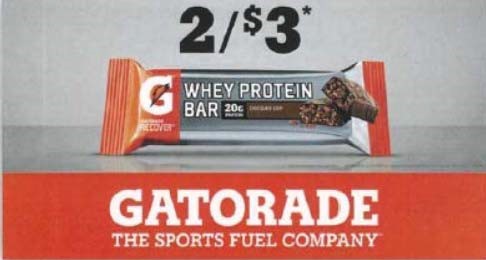
nutrition products. “It began to publicly describe its products as sports fuels
in 2013” and registered “Gatorade The Sports Fuel Company” in 2016, with “The
Sports Fuel Company” disclaimed after the PTO said that was merely descriptive.
(1) Was the use other than as a mark?  SportFuel argued that Gatorade used the
slogan as an “attention getting symbol,” it placed a trademark symbol after the
slogan, and it sought to register the slogan. 
“[M]ultiple factors” are relevant to whether there was use as a
mark.  “Gatorade is Thirst Aid” was found
to be a slogan in an earlier case where Gatorade featured the term “Thirst Aid”
even more prominently on its product packaging than the Gatorade mark, and where
the term rhymed with Gatorade and was used as an “attention‐getting symbol.” The
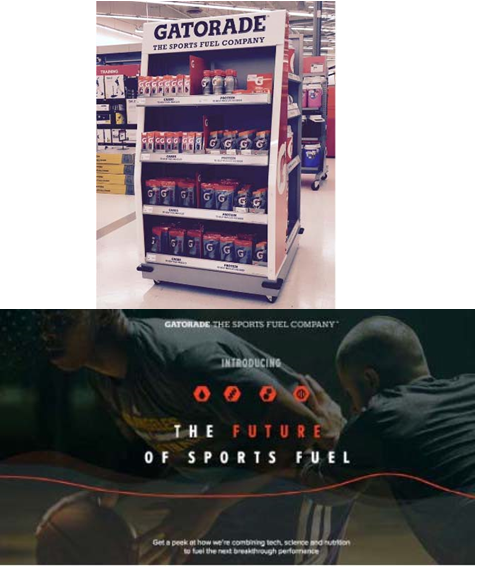
visuals here didn’t support the claim of use as a source indicator.  Gatorade’s word mark and G Bolt logo were
more prominent, and “Gatorade rarely uses the term ‘Sports Fuel’ directly on
product packaging, except for where the company labeled a ‘Sports Fuel Drink’ with
the term. Instead, it primarily features the slogan on in‐store displays and
other advertisements—appearing almost as a subtitle to the house mark.” Also, “Sports
Fuel” “lacks the catchy, rhyming play‐on‐words at issue in Quaker Oats. Nothing
about Gatorade’s use in this context suggests that consumers would view ‘Sports
Fuel’ as a source indicator.”  [I have to admit, I don’t get why the difference should matter to the descriptive fair use analysis.  Gatorade wasn’t trying to replace its Gatorade mark with “Thirst Aid”; instead it was trying to create a catchy overall slogan that paired the two.  I think this may boil down to how source-y and distinct from the unadorned Gatorade mark the two slogans seemed to the court, but why? The distinctive weakness of Seventh Circuit opinions is that they list facts that seem like they might matter, but don’t tell you how to identify a principle that will help decide cases with different facts.]
Nor did use of the TM symbol or the registration change the
result. The slogan included Gatorade’s trademark-protected Gatorade mark, and Gatorade
specifically disclaimed “The Sports Fuel Company”; the PTO specifically told
Gatorade that “Sports Fuel” was descriptive. Gatorade’s chief marketing officer
stated in his deposition that he viewed the whole phrase as the mark.  [So, use of a descriptive term within an
overall nondescriptive mark can be nontrademark use.]
(2) Was the use descriptive, rather than suggestive?  Yes. “Descriptive phrases refer to a
characteristic of the product. But they need not be common phrases.” Both
market use and the imagination test supported this conclusion.  “First, producers of nutritional products for
athletes regularly invoke the ‘Sports Fuel’ terminology to describe the
products they sell.”  Second, no mental
leap was required to deduce that the company is really selling athletic
nutrition products. SportFuel argued that Gatorade’s consumers were mostly not
high‐performance athletes, but that didn’t mean the products weren’t designed
for athletes. “Just as the pervasive use of yoga pants and other activewear as
casual clothing does not change the athletic characteristics of those products,
the fact that Gatorade sells more sports drinks to average joes who limit their
rigorous exercise to lawn mowing does not change the athletic characteristics
of Gatorade’s products.”
(3) Was the use fair and in good faith?  The key here is subjective purpose, which is
an interesting thing for the Seventh Circuit in particular to focus on. SportFuel’s
evidence of subjective bad faith was: (1) Gatorade’s knowledge of the mark
because of a previous working relationship a SportFuel principal; (2) continued
use of the term after SportFuel sued; (3) Gatorade didn’t account in detail for
how it came up with the slogan; (4) Gatorade’s purported bad blood with the SportFuel
principal, “suggesting that Gatorade adopted the new slogan to settle an old
score.”
Knowledge of the plaintiff’s mark, without other evidence of
subjective bad faith, is insufficient, as is continued use of a term after suit
is filed, since intentional use of a term one has every right to use is not bad
faith.  Nor was SportFuel entitled to an
adverse inference based on the argument that Gatorade produced no documentation
related to high-level approval of the slogan, which must have occurred—speculation
isn’t enough on summary judgment.  Maybe
SportFuel could have pursued this argument further in discovery, but it didn’t,
and it was too late.  Likewise, there
wasn’t evidence that the falling out with SportFuel’s principal related to the
adoption of the slogan. Her relationship with Gatorade ended more than a decade
before the alleged infringement began. “And the idea that a new slogan for a
nation‐wide rebranding campaign and stale antipathy towards [her] are connected
is facially incredible when otherwise unsupported by the record.”
In addition, SportFuel argued that Gatorade acted in bad
faith by not taking the risk of reverse confusion into account.  But “intent is largely irrelevant in reverse
confusion cases because ‘the defendant by definition is not palming off or
otherwise attempting to create confusion as to the source of his product.’” Anyway,
Gatorade provided evidence of its intent: “it adopted the slogan to reflect its
various types of sports fuel products.”  Not
thinking of SportFuel’s interests isn’t bad faith.
Nor was it bad faith to incorporate a descriptive term into
a slogan that, as a whole, functioned as a mark (at least when the whole
included Gatorade’s core mark). Gatorade produced evidence of fairness and good
faith: its stated purpose was to describe its business/products better, and its
evidence showed that “the company and its employees view themselves as
producers of sports fuels.” [Such a weird formulation, no pun intended: how can
the company have a mental state distinct from that of its employees?]

from Blogger https://ift.tt/2YSmEkj
Posted in Uncategorized | Tagged | Leave a comment

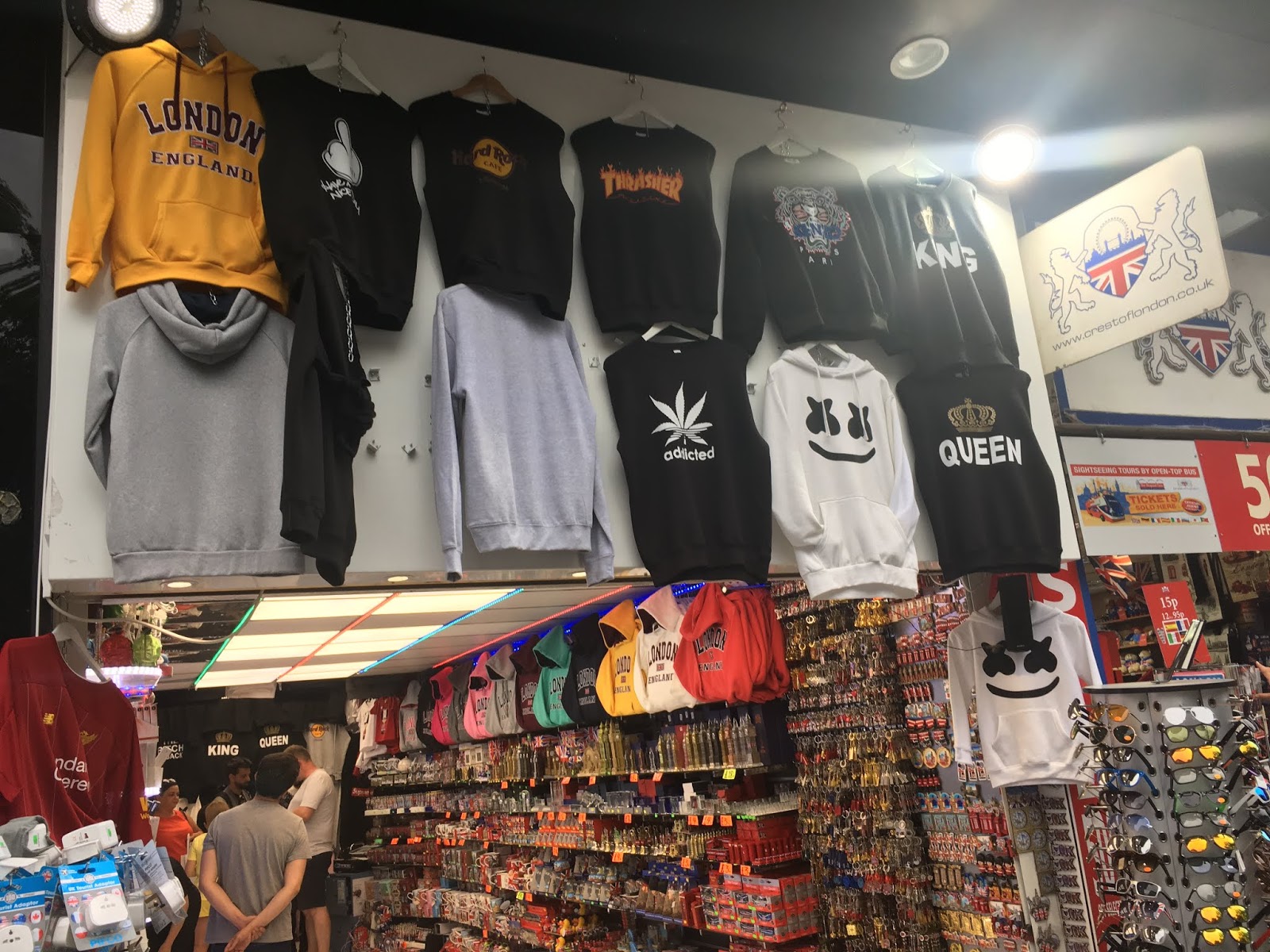
London sights for TM aficionados

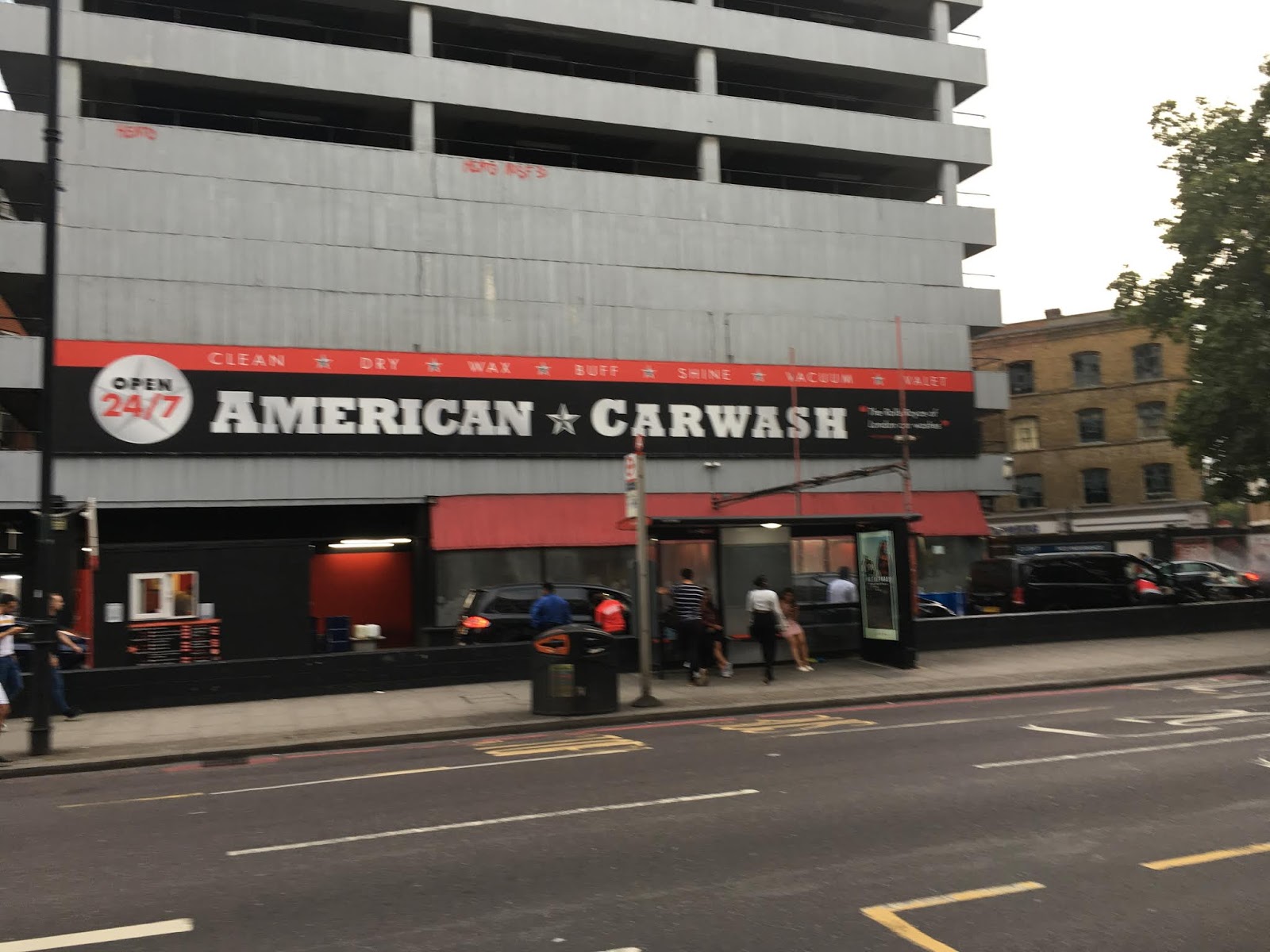
Pictures taken while traveling. The geographic attractiveness of the “American” carwash is enhanced by the slogan “The Cadillac of London car washes.”

Adidas/marijuana leaf in center.

from Blogger https://ift.tt/2YEtYQH

Posted in Uncategorized | Tagged | Leave a comment

false advertising trolling, consumer protection, or both

I wrote about a couple
of cases filed by a supplement maker, Outlaw
, against retailers that sold
allegedly unlawful “male enhancement” supplements that the FDA has issued
warnings on—sometimes the “supplements” illegally contain pharmaceuticals like sildenafil
(active ingredient in Viagra).  Vice made
a short
film about the cases
, highly sympathetic to the small business defendants.  My reaction is decidedly more mixed.  On the one hand, Outlaw’s tactics suggest a
kind of false advertising trolling—threatening a lot of small businesses and
trying to get payouts from them.  On the
other, Outlaw points out that the manufacturers of these supplements are shady
and hard to find, meaning that it’s not particularly easy to go after them
(and, not for nothing, that the retailers are themselves being rather careless
about what they stock—carrying Tiger Male Enhancement pills is really not the
same thing as carrying Diet Coke).  The
film points out that these products are often made with identical packaging but
filled with different substances by different people, so sometimes you get sildenafil
and sometimes you get random non-drug substances.  This certainly does make it difficult to show
that the stuff sold at any given bodega had pharmaceuticals in it, but at the
same time it makes the falsity of the advertising, and the danger to consumers,
even more clear.  Ultimately, it’s far
easier to conclude that Outlaw’s enforcement model is a bad one than that these
small businesses should be left alone to sell whatever they can get consumers to
buy.

from Blogger https://ift.tt/2ZuBZVj

Posted in Uncategorized | Tagged , , , , | Leave a comment

C&D to competitor’s clients can be “commercial advertising & promotion”

Matonis v. Care Holdings Gp., L.L.C., No. 19-cv-20247-UU, 2019
WL 3386378 (S.D. Fla. Jul. 25, 2019)
The defendant Care Companies engage in healthcare management
consulting, “advising healthcare providers on, inter alia, patient intake
strategies and revenue management.” 
Plaintiff Matonis is a healthcare management consultant who provided
consulting services to the Care Companies pursuant to a consulting agreement
with a confidentiality provision and a non-solicitation provision with respect
to the Care Companies’ employees, consultants, and agents. In 2016, while still
employed with the Care companies, Matonis founded her own consulting company
(Caliber) to help health care providers track their revenue. Defendants
allegedly explicitly authorized her work with Caliber (apparently after the
fact of founding). The Care Companies then offered Matonis a W-2 employment
contract, which she declined because the proposal contained a two-year
non-competition restriction and would have required her to shut down
Caliber.  The Care Companies transitioned
her clients to other Care employees and officially terminated the relationship.
During the winding down period and after, Matonis expanded
the healthcare consulting services provided by Caliber into patient intake and
revenue management, leading to direct competition with her former employer.
Defendants allegedly informed a number of Matnois’s Care clients that she was
still affiliated with the Care Companies but was unable to work because she was
suffering from ongoing health issues and had requested time off. She allegedly
found this out after clients reached out to her to check on her health. After
one such call, the client contacted Care employees, expressing his
dissatisfaction with their dishonesty. Quirk, an employee, assured the client
that at Matonis would continue to work with the Care Companies indefinitely and
was still available to be his point person, despite the fact that Matonis had
been terminated almost a month prior.
After numerous clients terminated their relationships with
the Care Companies, in-house counsel allegedly sent cease and desist letters to
Matonis’s Care clients and to Matonis directly. The letters asserted that
Matonis was still subject to “broad confidentiality and non-solicitation
provisions” in her Consulting Agreement and threatened legal action if Matonis
continued to solicit Care clients and/or if those clients sought Matonis’
services. In addition, the Care Companies allegedly created an “out of office”
auto-response message on Mantonis’ former email account at Care, allegedly
creating the false impression that she remained affiliated with the Care
Companies and tainting her reputation as a professional who promptly returns
her client’s messages.
Finally, Matonis alleged that defendant CareOptimize’s
website falsely advertises that it serves over twenty thousand healthcare
providers nationwide, when in fact it serves closer to five thousand healthcare
providers at any given time. The website allegedly misrepresents its client
base, listing two clients even after both companies terminated their
relationship with CareOptimize.
Matonis sued for false advertising/unfair competition under
state and federal law, defamation, tortious interference, and declaratory
judgment that she wasn’t barred from working with the Care Companies’ current,
former, or prospective clients.
False advertising: defendants argued that its C&D
letters weren’t commercial speech or advertising for purposes of the Lanham Act
and the allegedly false statements on Defendants’ website didn’t directly
disparage Matonis; neither argument succeeded.
Under the Gordon & Breach test (which, as a
reminder, has a prong requiring “commercial competition” that doesn’t survive Lexmark,
though that doesn’t matter here), these particular C&Ds were commercial
speech.  “Commercial speech encompasses
not merely direct invitations to trade, but also communications designed to
advance business interests ….” Matonis alleged that defendants utilized the
cease and desist letters as a tool to disparage her as someone who ignores
contractual obligations. Defendants allegedly stood to profit from them because
Matonis’ consulting company was now in direct competition with them and the
clients to whom the letters were sent were former Care clients who were
interested in Matonis’ services.  This
sufficed to avoid dismissal.
As for the website statements, disparagement isn’t required
for false advertising.  If the argument
was that Matonis failed to allege injury, it was enough to allege that the
parties were direct competitors and that defendants falsely represent the
number of clients they represent and the scope of the representation at this
tage.
Defamation per se: allegations that defendants falsely
represented that (1) Matonis was suffering from an ongoing health problem that
affected her ability to work on their accounts; (2) she is in violation of a
non-solicitation agreement by working with the Care Companies’ former clients;
and (3) continued work with her would expose them to legal liability sufficed
to allege defamation per se, which in Florida covers falsehods that are injurious
to the target’s trade and professional reputation.

from Blogger https://ift.tt/2yqAGuS

Posted in Uncategorized | Tagged , , | Leave a comment

California SCt rejects record-keeping ascertainability requirement

Noel v. Thrifty Payless, Inc., — P.3d —-, 2019 WL
3403895, S246490 (Cal. Jul. 29, 2019)
Noel brought a putative class action on behalf of retail
purchasers of an inflatable outdoor pool sold in packaging that allegedly
misled buyers about the pool’s size, asserting the usual California claims
(UCL, FAL, CLRA). The district court found that the proposed class wasn’t
ascertainable, and the court of appeals agreed. Here, the California Supreme
Court rejects an ascertainability requirement that would require good written records,
either from the seller or the purchasers, of purchases.  The proposed class definition here was sufficiently
ascertainable, in that it defined the class “in terms of objective
characteristics and common transactional facts” that make “the ultimate
identification of class members possible when that identification becomes
necessary.”  This standard was satisfied here,
where the class definition would allow class members to self-identify.
The facts: the package image indicates that the pool can
handily accommodate several adults when inflated and filled:

A pool holding five people with plenty of room between them

Here’s the actual pool, as inflated and filled:
 

a pool that holds three children
Rite Aid sold over 20 thousand of these pools in California
during the class period (nearly 2500 were returned), making nearly $950,000 in
revenue.
The court surveyed its own decisions, those of the
California courts, and federal courts on ascertainability to derive its
standard.  In general, the concerns for
proper definition and identification of class members are well addressed by the
usual certification standards, which consider both the costs and benefits of
the class action device, while ascertainability pulls a few considerations out into
a vacuum.  So, for example, the court of
appeals here worried that “[i]f the identities of absent class members cannot
be ascertained, … it is unfair to bind them by the judicial proceeding.” But
certification of a class requires the provision of the best practicable notice;
due process doesn’t invariably require individual notice to absent class members.
A heightened ascertainability requirement demanding the ability to provide
individual notice would be “pyrrhic,” since it conflicts with the point of
class actions for aggregating low-value claims. Nor is a heightened
ascertainability requirement “necessary to protect the due process interests of
class action defendants by protecting them from bogus claims and
disproportionate liability.… There is no suggestion that, if the plaintiff
class ultimately prevails, Rite Aid will face any onslaught of spurious claims,
much less a bevy that could not be weeded out through a competent claims
administration process. Also, because it is known how many pools were sold and
not returned, and how much in revenue Rite Aid earned from these sales, the
overall body of claims has a functional ceiling that further marginalizes any
prospect of exaggerated liability.”
Using objective facts (rather than class members’ subjective
states of mind) to define the class thus makes it ascertainable.  This puts members of the class on sufficient notice,
and supplies “a concrete basis for determining who will and will not be bound
by (or benefit from) any judgment,” making res judicata determinations possible.   The
court also pointed out that “premising ascertainability on the existence of
official records capable of being used to identify class members might, in some
situations, incentivize potential class action defendants to destroy or refuse
to maintain useful records that could provide a basis for class treatment.”
The appropriate form of notice to satisfy due process could
be worked out as part of the broader certification process/assessment of
manageability. “[G]iven the modest amount at stake (the pool having retailed
for $59.99), the odds that any class member will bring a duplicative individual
action in the future are effectively zero. Thus the true choice in this case is
not between a single class action challenging the packaging of the Ready Set
Pool and multiple individual actions pressing similar claims; it is between a
class action and no lawsuits being brought at all. Under the circumstances, due
process may not demand personal notice to individual class members, and to
build a contrary assumption into the ascertainability requirement would be a
mistake.”
Thus, the trial court abused its discretion when it
determined that the class proposed by plaintiff wasn’t ascertainable. The
proposed definition, “All persons who purchased the Ready Set Pool at a Rite
Aid store located in California within the four years preceding the date of the
filing of this action,” was neither vague nor subjective.

from Blogger https://ift.tt/2MqtsPz

Posted in Uncategorized | Tagged , , | Leave a comment

Amicus brief in Smith v. Drake fair use case

With the able assistance of UCI’s IP clinic, led by Jack Lerner, I worked on an amicus brief in this case arguing that fair use should continue to be a flexible standard that accommodates various types of transformativeness. The brief is here.

from Blogger https://ift.tt/2YeGh1A

Posted in Uncategorized | Tagged , | Leave a comment

Ornamental use of pun is aesthetically functional (defendant-side functionality in the wild!)

LTTB LLC v. Redbubble, Inc., No.  18-cv-00509-RS (N.D. Cal. Jul. 12, 2019)
Defendant-side functionality! This is a concept I’ve been
arguing exists for years (see, e.g., the result in Louboutin v. YSL), and now
it is no longer immanent in the caselaw but fully arrived!
Here, it serves another way to protect noncommercial speech
despite the Honey Badger case:
while a source-identifying
trademark may embody a pun, no one can claim exclusive rights to use the pun
merely by printing it on t-shirts, other ‘[w]earable garments and clothing,”
“[p]aper for wrapping and packaging,” or “tote bags,” or similar products and
calling it a “trademark.” Even if a trademark embodying a pun is otherwise
enforceable where there is a likelihood of source confusion, the trademark
holder cannot prevent others from using the pun in contexts that do not imply
source.
Plaintiff’s applications to register “LETTUCE TURNIP THE BEET”
were initially rejected as decorative/ornamental when they showed the phrase
“emblazoned” on products, but allowed after it submitted specimens using on
product labels and hang tabs—the application was rejected when plaintiff first
suggested the phrase merely would be emblazoned across those products. The
registrations became incontestable.  Although
the court didn’t apply file wrapper estoppel, it did use the PTO’s reasoning to
bolster its conclusion that plaintiff’s enforceable marks didn’t entitle it to preclude
others from making the joke on t-shirts or elsewhere.
Anyway, defendant lets artists upload designs to be printed
on products such as apparel, phone cases, stickers, bags, wall art and so on.  Products featuring the phrase “Lettuce Turnip
the Beet” or similar phrases allegedly have been offered for sale on the Redbubble
site.  Its no-secondary-liability
argument might otherwise have created a triable issue of fact, the aesthetic
functionality of the phrase when used as a phrase demanded summary judgment for
Redbubble.
Redbubble’s defense was either about the rule that “decorative
or ornamental” features are not subject to trademark protection or about the
exclusion for “aesthetic functionality.” “Case law has not always clearly
distinguished between the two concepts, which undoubtedly are related and
overlap.” However characterized, it succeeded. 
Despite Au-tomotive Gold, aesthetic functionality still exists in
the 9th Circuit, and here no reasonable trier of fact “could
conclude that consumers seek to purchase products based on LTTB’s
reputation—whether ‘genuine’ LTTB products or those produced by any
competitors. Rather, as LTTB’s evidence and argument make clear, consumers are
interested in purchasing products displaying the pun.”  [So this isn’t completely limited to defendant-side
functionality. To the extent that LTTB’s claimed rights are based on exclusive
use of the pun as the decoration for clothes, de facto secondary meaning can’t
protect that. Although the
term isn’t generic, declaring it aesthetically functional produces the same
result for what could in other circumstances (if used on clothes tags) be an
arbitrary designation.]
 

Screenshot from plaintiff’s Etsy store, showing P’s own variable, ornamental uses
LTTB argued that this argument “would permit a t-shirt bearing
a copy or near copy of the Nike swoosh logo or some other registered design
mark,” so the fact of ornamentation can’t produce functionality. But there’s a
key difference: “Nike, Volkswagen, and Audi all developed their trademark
rights by selling goods under those brand names, and have at least arguably
gained brand loyalty for those products, as opposed to mere consumer interest
in the specific names, independent of the reputation the companies developed when
selling the products.”  International
Order of Job’s Daughters v. Lindeburg & Co., 633 F.2d 912 (9th Cir. 1980),
also supported Redbubble.  And
Redbubble’s case was stronger because LTTB wasn’t a group with which consumers
could express allegiance by buying products displaying the pun. “The products
are simply the vehicle for distributing the claimed ‘trademark,’ rather than
the other way around, where a trademark is used to identify the source of the
goods.”  Using an already-established
mark to sell t-shirts would have been a different case.
None of this was to say that LTTB’s registered marks were
“per se” invalid (though it sure sounds like a holding of limited secondary
meaning).  [Side note: secondary meaning
isn’t necessary for an arbitrary mark, though one might reasonably argue that
should change if secondary meaning failed to develop over a long time despite
the theoretical arbitrariness of the term. 
But what ornamentality/decorativeness really does is provide a way to
manage the presumptive source-indicating function of arbitrary/fanciful
symbols: in fact there are lots of ways to use many such signals that don’t
almost automatically signal trademark function. 
Ornamentality is our way of managing that reality for supposedly “inherently
distinctive” words or designs.]  Rather,
the decorativeness of the use prevented LTTB from showing a likelihood of
confusion as to source, “where the mere use of the pun on the face of various
products cannot be source-identifying.” 
“LTTB may not … recover for alleged trademark infringement based on any
competitors’ use of the very kind of designs that the PTO found not to be
eligible for trademark protection.”  As
in Job’s Daughters, a use could be confusing if it led consumers to assume
source/sponsorship, but there was no sufficient evidence “that any purchaser of
allegedly infringing items inferred from use of the pun that the product was
produced, sponsored, or endorsed by any particular person or entity, such as
LTTB.”
Incontestability didn’t matter because this wasn’t a finding
of invalidity of the marks, but a limit on the scope of LTTB’s rights, and
because incontestability doesn’t bar a functionality challenge.

from Blogger https://ift.tt/2Yqrhli

Posted in Uncategorized | Tagged | Leave a comment

Duck, duck, noninfringement: TM and (c) claims over distinct duck designs fail

Great American Duck Races Inc. v. Kangaroo Mf’g Inc., No.
CV-17-00212-PHX-ROS (D. Ariz. Jul. 19, 2019)
Despite some bad reasoning equating intent to compete with
(relevant) intent to confuse, the court rejects bad copyright and trademark
claims based on the copying of the idea of an inflatable duck wearing
sunglasses.  GAME’s duck was designed
“from scratch,” but was similar to Sesame Street’s Rubber Ducky, except with
sunglasses. GAME has a trademark registration for an image of the duck for
various goods, and a copyright registration for the inflatable itself.  Defendant Ligeri and his companies “would identify
successful products on Amazon and then make slightly different versions of
those products without apparent concern about possible intellectual property
violations.”  Nonetheless, defendants did
use a designer, and the design wasn’t a slavish copy.  Setting aside size variations and the
functional ring (D) v. flat flotation surface (P), Kangaroo’s version had a
closed orange bill, not an open red bill, and its wings and tail were drawn on
instead of inflatable. Like GAME’s duck, Kangaroo’s duck has a small crest on
its head and is wearing sunglasses, but Kangaroo’s duck’s sunglasses weren’t
completely black or inflatable, and they didn’t have a double bridge like
GAME’s.
 

Derby Duck box

Derby Duck

Registered design mark

Kangaroo duck box

Kangaroo duck

Copyright: there was copying, but not unlawful
appropriation. Under Satava v. Lowry, copyright can’t “prevent others from depicting yellow ducks, with a bill,
wings, a tail, and a crest on the head. All of those attributes are found on
ducks in nature.” In addition, the general design and color of an inflatable
rubber duck was a “stock or standard feature[].” The sunglasses were the key
protectable element of the Derby Duck, but didn’t extend to the idea of a duck wearing
sunglasses, only to the particular expression. As a result, the court had to
figure out “whether the two expressions of the sunglasses-on-a-duck idea are so
similar that ‘the ordinary observer, unless he set out to detect the
disparities, would be disposed to overlook them.’” They would not; instead,
there were “a few striking differences,” including differences in the bridge,
the color, and the sculptural features (inflatable versus painted on).  GAME could thus not pass the extrinsic test
for similarity in protected expression; even if it could, the ducks lacked
substantial similarity in total concept and feel and thus GAME couldn’t satisfy
the intrinsic test.
Trademark: sloppier analysis, which is perhaps
understandable given the conclusion of no liability, but the court doesn’t
delineate what is actually protectable about Kangaroo’s marks and thus proceeds
as if its registration might give it trade dress protection for the overall
shape of the ducks, without requiring it to show either nonfunctionality or
secondary meaning of the trade dress (as opposed to the registered specific
image). This is a classic example of abusing a registration beyond its scope,
because the US has a bad concept of the appropriate scope of a
registration.  A registration for a
specific two-dimensional image of a product shouldn’t be equated to trade dress
rights in the product itself.  The cases
tend to reject liability when fully litigated—there’s the Mardi
Gras bead dog case
and the Rock +
Roll Hall of Fame
case, for example—but this case went through summary
judgment, and that’s a waste of resources and a deterrent to legitimate
competition.
Anyhow, the issue was “whether a reasonable consumer seeing
Kangaroo’s marks would mistakenly conclude GAME had some association with that
product,” and the court cites but neither explicitly endorses nor rejects
GAME’s argument that Kangaroo’s “marks” were pictures of Kangaroo’s own duck
and the duck itself.  Too bad.
Conceptual strength: the court does get that there’s
a problem here.  It focuses on the
registered image of the duck, deeming it “descriptive” or “generic.” “The
trademarks are just stylized versions of the underlying products. A consumer
does not need to exercise any imagination to associate the mark with GAME’s
products.” There was “relatively little” conceptual strength, and the evidence
of secondary meaning was limited to use of the marks in advertising and
substantial sales, resulting in “limited” commercial strength.  Overall favored Kangaroo.
Relatedness of goods: neutral, because much depends on what
the Amazon listings for the products said, as in Network Automation, but
GAME didn’t preserve or submit the listings. The boxes clearly identified each
company, but “there is insufficient evidence to determine whether the manner in
which the products were presented or advertised would have caused consumers to
assume there was an association between GAME and Kangaroo.”
Similarity of marks: GAME argued that the relevant
comparison was between the pictures on Kangaroo’s box to GAME’s marks, but
there were distinct differences in the ducks wearing glasses.  “Some” similarity, slightly favoring GAME.  [If the court had been more rigorous about
the scope of the image registration, it seems likely to have found less
similarity.]
Actual confusion: no evidence, favoring Kangaroo.
Marketing channels: not very important when both parties use
the internet, or more specifically Amazon.
Degree of care: low, favoring GAME.
Intent: Sigh.  There
was “no question that Kangaroo made some visible changes to its duck in an
apparent attempt to avoid copyright infringement. In the end, however, Kangaroo
knowingly used marks similar to GAME’s in an attempt to capitalize on what was
already popular. This factor supports GAME.” 
So here the court, conflicting with its analysis of strength of the
mark, presumes that GAME’s rights extend to the product design—but doesn’t ask
whether there’s nonfunctionality or secondary meaning—by equating making a
competing product, and showing that product on the box, with “use” of a
“mark.”  I see nothing on the box that
looks like GAME’s registered mark.
Likelihood of expansion: irrelevant.
Though counting factors favored GAME, that’s not how this
game is played.  Evaluating the factors
as
a whole, and in light of all the other evidence, GAME didn’t
show likely confusion as opposed to possible confusion.
GAME also argued unfair competition under Arizona law,
apparently finding Kangaroo’s copying “unfair.” 
As Mark Lemley says, lots of businesses firmly believe that the phrase
“unfair competition” is redundant.  But
Arizona looks for consumer deception as the core of unfair competition. “Though
there was evidence of Kangaroo’s clear intent to capitalize on the popularity
of the Derby Duck, the Court would need evidence of how the public was being
cheated or deceived to conclude Kangaroo’s competitive behavior was improper.”
It was possible that the original Amazon listing of Kangaroo’s float was “designed
… to capitalize on GAME’s own success,” which might entitle GAME to relief, if,
for example, the listing “made representations that the two floats were
manufactured by the same company or if the Amazon listing contained pictures of
the Derby Duck but Kangaroo then delivered its own duck.”

from Blogger https://ift.tt/2JXbGRc

Posted in Uncategorized | Tagged , , | Leave a comment

Lysol can’t quickly clean up this mess of anti-Clorox ads

Clorox Co. v. Reckitt Benckiser Gp. PLC, 2019 WL 3068322, No.
19-cv-01452-EMC (N.D. Cal. Jul. 12, 2019)
Clorox sued Reckitt for false advertising of its Lysol cleaning products under the Lanham Act and California’s UCL/FAL. The court found
tiny parts of the complaint insufficiently pled but kept most of the claims
intact.
First, the court determined that Rule 9(b) applied to the
false advertising claim, as to the California claims, because intentional
misrepresentation was alleged.
Next, Reckitt argued that all Clorox’s misleadingness claims
failed because the complaint didn’t allege specific facts proving significant
consumer deception.  But proof is for
summary judgment/trial, not the pleadings. “[A]t the pleading stage the
plaintiff need only allege specific misleading statements and explain why they
are misleading in accordance with Rule 9(b).”
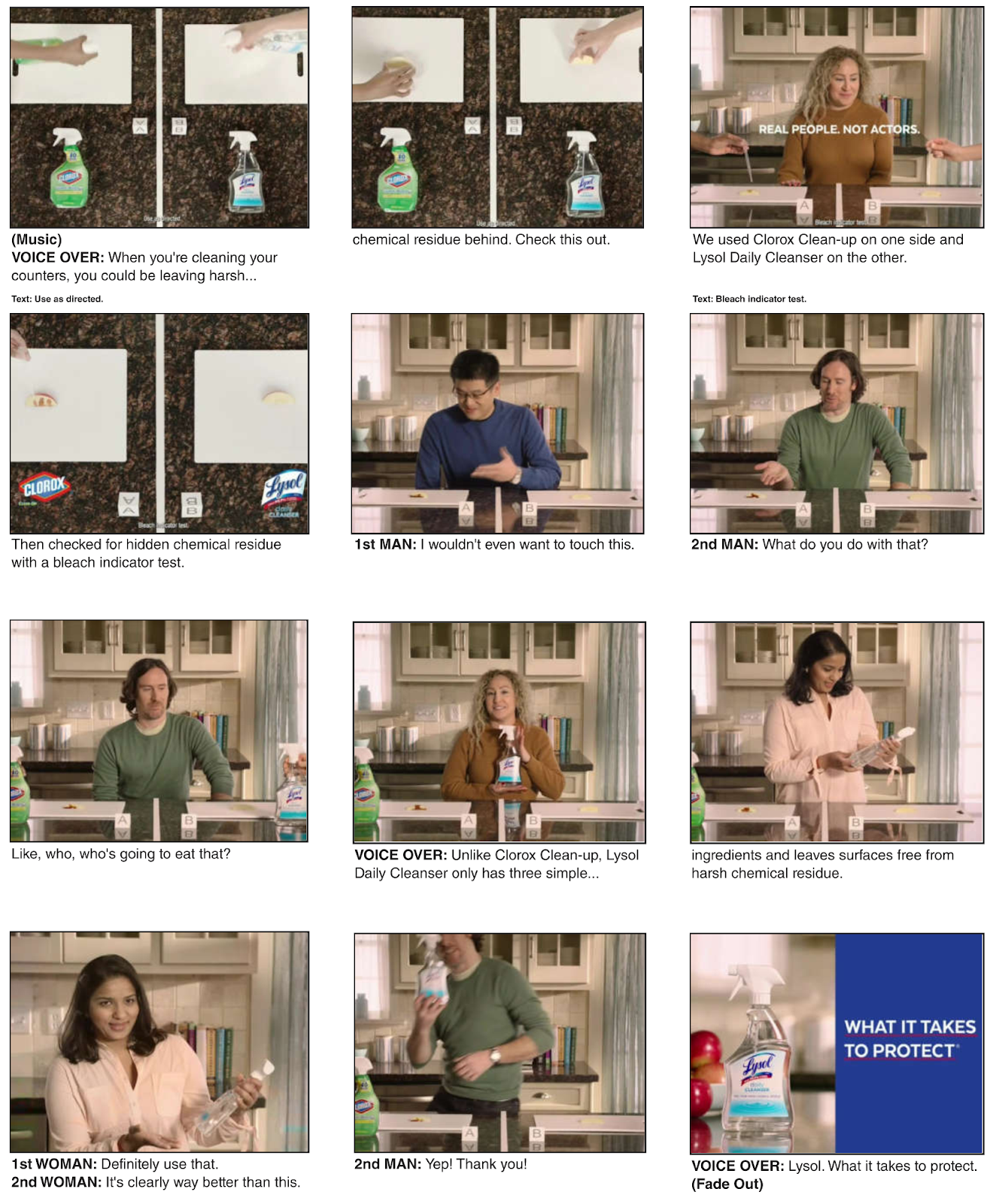
On to specifics: Ads: (1)“Bleach Indicator Test” depicting a
side-by-side test of Clorox Clean Up and Lysol Daily Cleanser.. One cutting
board is first cleaned with Clorox Clean Up and another cleaned with Lysol
Daily Cleanser, then an apple slice is placed on each cutting board; the former
turns brown and the latter doesn’t. Four individuals labeled as “real people”
negatively react to the browned apple, e.g., “I wouldn’t even want to touch
this.” Voice-over: “unlike Clorox Clean Up, Lysol Daily Cleanser has only three
simple ingredients and leaves surfaces free from harsh chemical residue.” A
similar ad used a “bleach indicator test” instead.

This was sufficiently alleged to be false for three reasons:
(1) It plausibly necessarily implied that Clorox Clean Up was unsuitable or
unsafe for use in kitchens, even though the EPA has in fact deemed the product
safe for kitchen use. “[A]n advertisement can be literally false where it
necessarily implies to customers that a product is unsafe to consume.” Given
the images of food turned brown and people recoiling in disgust, it was reasonable
to infer falsity by necessary implication. 
(2) It plausibly falsely indicated that the result of the
test depicted—that Lysol Daily Cleanser apparently leaves no residue that would
affect an apple slice—was inaccurate. According to Clorox, Lysol Daily Cleanser
contains hypochlorous acid, “a form of bleach,” so a “properly chosen and
calibrated ‘bleach indicator test’ would detect the residue left by Reckitt’s
product,” but Reckitt’s chosen test was deliberately designed not to do so. A “tests
prove” claim is false where the tests “are not sufficiently reliable to permit
one to conclude with reasonable certainty that they established the claim
made.” Clorox plausibly alleged that Reckitt’s test is not sufficiently
reliable to permit one to conclude with reasonable certainty that Lysol Daily
Cleanser leaves no bleach residue.  (Note
the elision of the key question here: what exactly does the ad claim that “tests
prove”?  The ad doesn’t explicitly say
there’s bleach on one slice and not on the other.)
(3) It was literally false because it necessarily implied
that Lysol Daily Cleanser and Clorox Clean Up are comparable products but that
the Clorox product leaves a harsh residue. But they have different formulations
and purposes. “Although usable in kitchens, Clorox Clean Up is a heavier duty
product than Lysol Daily Cleanser” with stronger ingredients not for everyday
use, so attempts to “position Lysol Daily Cleanser as a ‘simpler’ or ‘less
harsh’ substitute for CCU misrepresents the facts and deceives customers.”  [Gotta admit, less harsh sounds true but also
necessarily misleadingly comparative, given the background expectation that a
thing will be compared with a thing in its class, e.g., what are the harshest daily
cleaners? Clorox alleged that it did market an actually competing product,
which makes the misinterpretation even more likely.] LDC couldn’t be substituted
for CCU because the former was much more diluted and lacked a surfactant/detergent
for intensive cleaning. [This seems eminently correct as to indications but possibly
not descriptively true—I might want to know how many consumers are unaware of
the difference.] Apples-to-oranges comparisons can be literally false by
necessary implication “where non-comparable products are portrayed as otherwise
equivalent (except for the superior or inferior aspect being illustrated in the
advertisement).” Thus, “plaintiffs can establish literal falsity under the
Lanham Act by alleging that two products portrayed as comparable in an
advertisement are not actually comparable – that the advertisement omits
differences which would have been material to recipients.”  Clorox sufficiently alleged lack of comparability,
especially given the availability of a closer Clorox comparator.
Reckitt argued that Clorox Clean Up was in fact comparable
to Lysol Daily Cleanser because the EPA has approved the Clorox Clean Up as
“Gentle & Powerful Enough for Daily Use,” but there was no authority
holding that the EPA’s categorization of products makes those products
comparable for Lanham Act purposes. Anyway, this was a factual dispute.
(2) “Spray Away” ads showing an image of Clorox Clean Up and
its list of ingredients being sprayed and wiped away with Lysol Daily Cleanser.
The ad then flashes banners stating: “Lysol Daily Cleanser[;] Only 3
ingredients,” “Kills 99.9% of germs (when used as directed),” and “No harsh
chemical residue.” A Facebook ad juxtaposes the safety warnings of Clorox Clean
Up and Lysol Daily Cleanser and concludes with the same statement.  Also sufficiently alleged falsity.
First, this was another plausibly apples-to-oranges
comparison of LDC with CCU. Second, the Facebook ad juxtaposing the safety
warnings was plausibly likely to mislead consumers because it suggests that the
Lysol product is “simpler” and has “fewer safety risks” and “impugns the safety
of CCU by suggesting that consumers should shy away from products that require
cautionary disclosures.” Clorox also alleged that the active ingredient in the
Lysol product, hypochlorous acid, was no gentler than the bleach in Clorox
Clean Up.
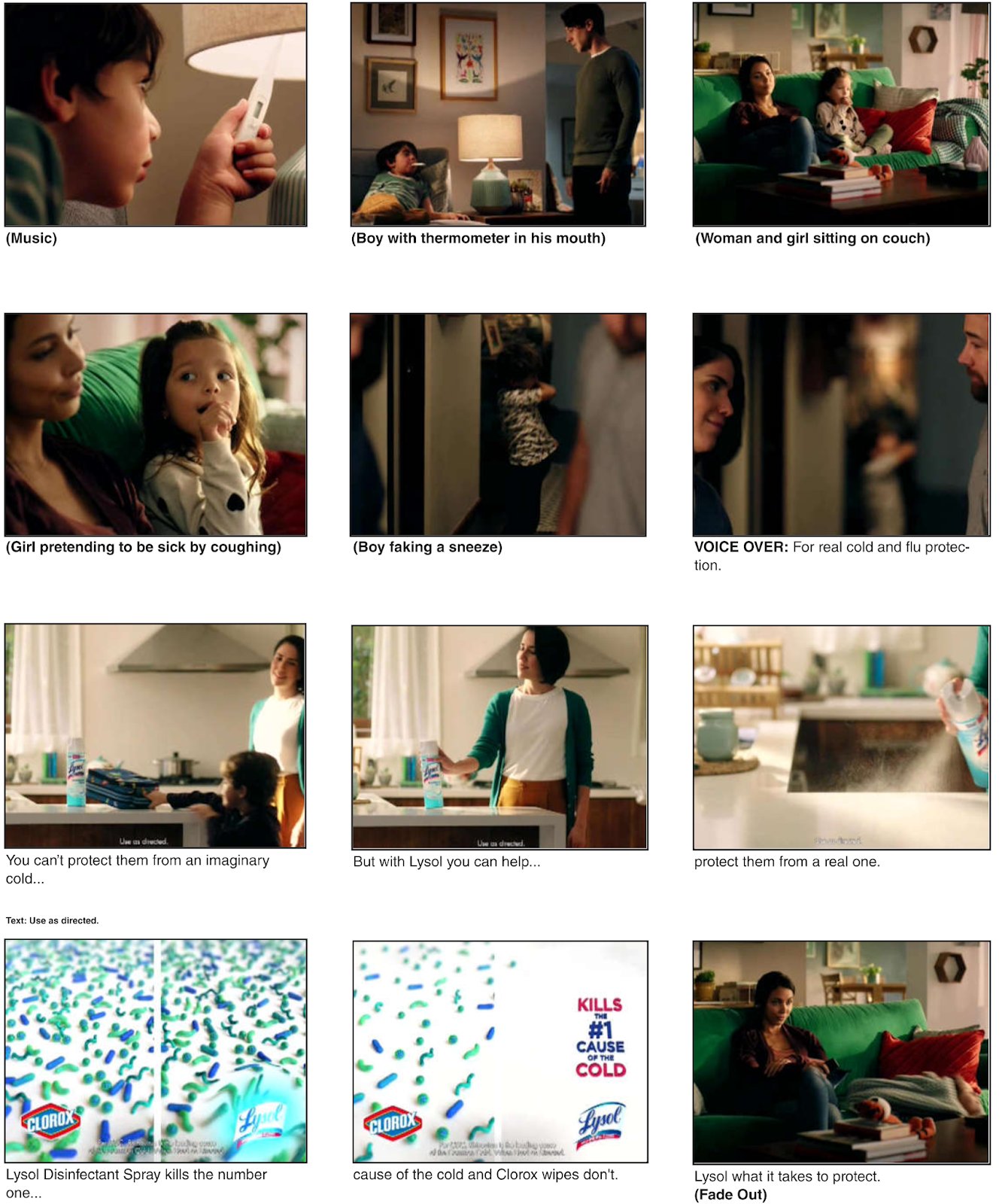
 (3) “Fake It,” “Game
Over,” and “Spray Away” ads: the first said that Lysol could “help protect”
children from colds then showed a split screen with the Clorox and Lysol
symbols on either side, and “germs” on both sides of the screen; the germs on
the Lysol side of the screen disappear while those on the Clorox side remain.
An announcer states, “Lysol Disinfectant Spray kills the number one cause of
the cold and Clorox Wipes don’t.” Reckitt eventually added in “minuscule type”
that the comparison was between Clorox Disinfecting Wipes and Lysol
Disinfecting Spray. Two other ads had the same factual claims, presented differently
(in one, a container of Clorox Disinfecting Wipes is sprayed off the screen by
Lysol Spray).
Plausibly alleged to be literally false by necessary
implication. Clorox again alleged an apples-to-oranges comparison of Clorox’s
“pre-moistened, anti-microbial wipes that consumers use to clean and disinfect
surfaces throughout the home” to a Lysol product in a different category with different
usage instructions. Wipes are allegedly formulated to target different germs
than disinfecting sprays. “The key difference is between wipes and sprays, not
Clorox and Lysol.” Again, Clorox alleged that more comparable products were
available—both parties’ sprays (neither of which are approved for rhinovirus)
or their wipes (both of which are).
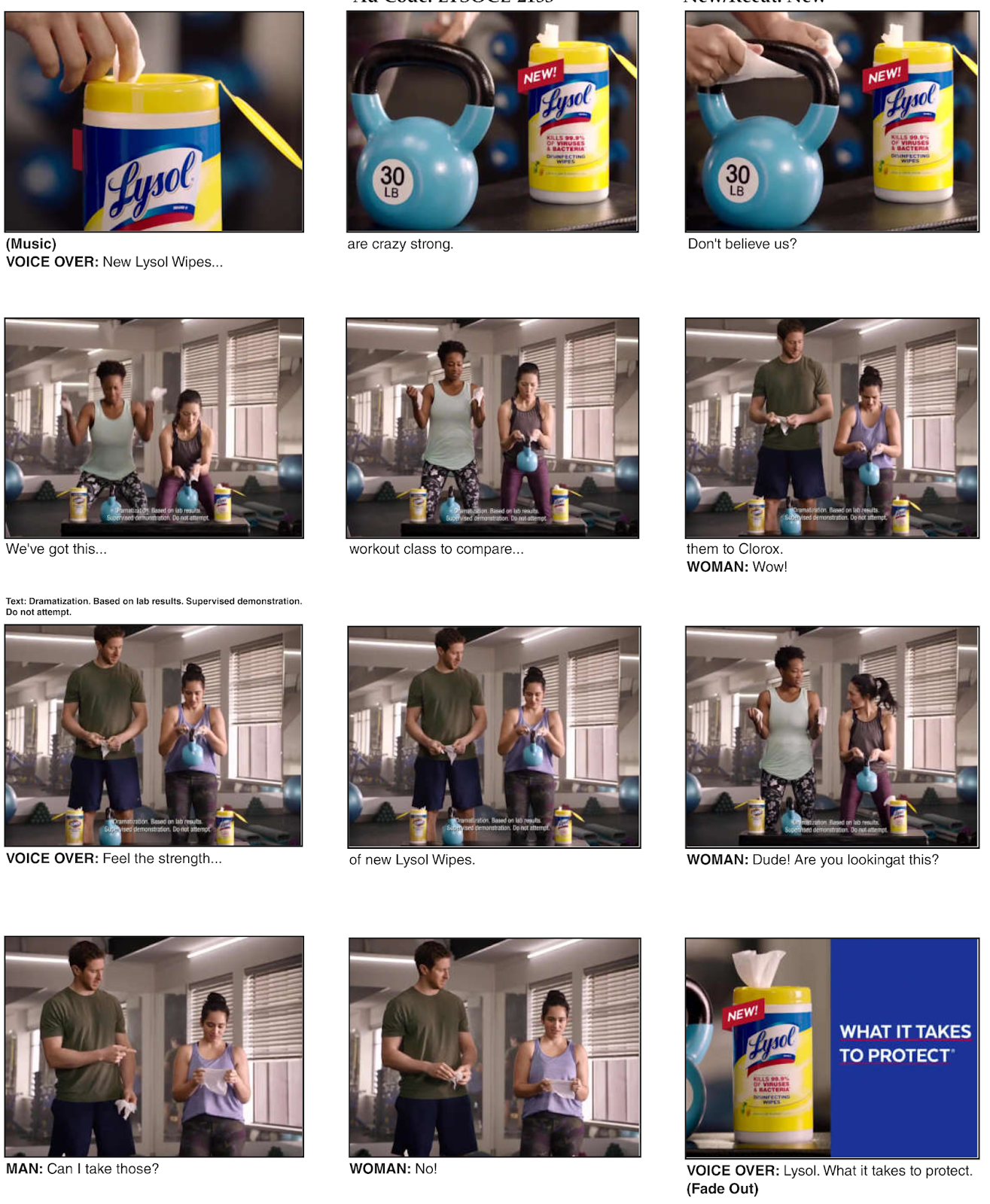
(4) “Strength Test” ads: Employed to pick up kettlebell
weights, the Clorox wipe rips immediately while the Lysol wipes holds the
weight for several seconds. A disclaimer states, “Dramatization. Based on lab
results. Supervised demonstration. Do not attempt.” A Facebook ad said, “Lysol
wipes are stronger than competition” and depicted a Lysol wipe intact next to a
torn “competitive” wipe that “appears below a version of the famous Clorox
chevron, in which the Clorox brand name has been replaced with the words ‘vs
leading competitor.’ ”

Clorox’s claim that the ad falsely insinuates that Lysol
wipes are “of higher quality, are more durable, and are more resistant to
tearing during use than Clorox wipes” failed because Clorox didn’t allege that Lysol
wipes are not of higher quality, more durable, and more resistant to
tearing than Clorox. [Technically, it should be enough to allege that they are
of equal quality—one might even hedge and allege that Clorox wipes are
of at least equal quality to Lysol’s.] It wasn’t enough to allege that
the Clorox wipes are unlikely to rip under typical use conditions.
However, the court was more receptive to the allegation that
the “strength test” conducted in the advertisement was unreliable and therefore
literally false. Clorox alleged that the test “is not capable of replication,
because neither product is actually long enough to serve as a ‘handle’ when
holding a kettlebell weight,” and thus it wasn’t “sufficiently reliable to permit
one to conclude with reasonable certainty that [it] established the claim made.”
This was more than the insufficient allegation “there was simply no way a valid
test would show” results supporting an advertising claim.
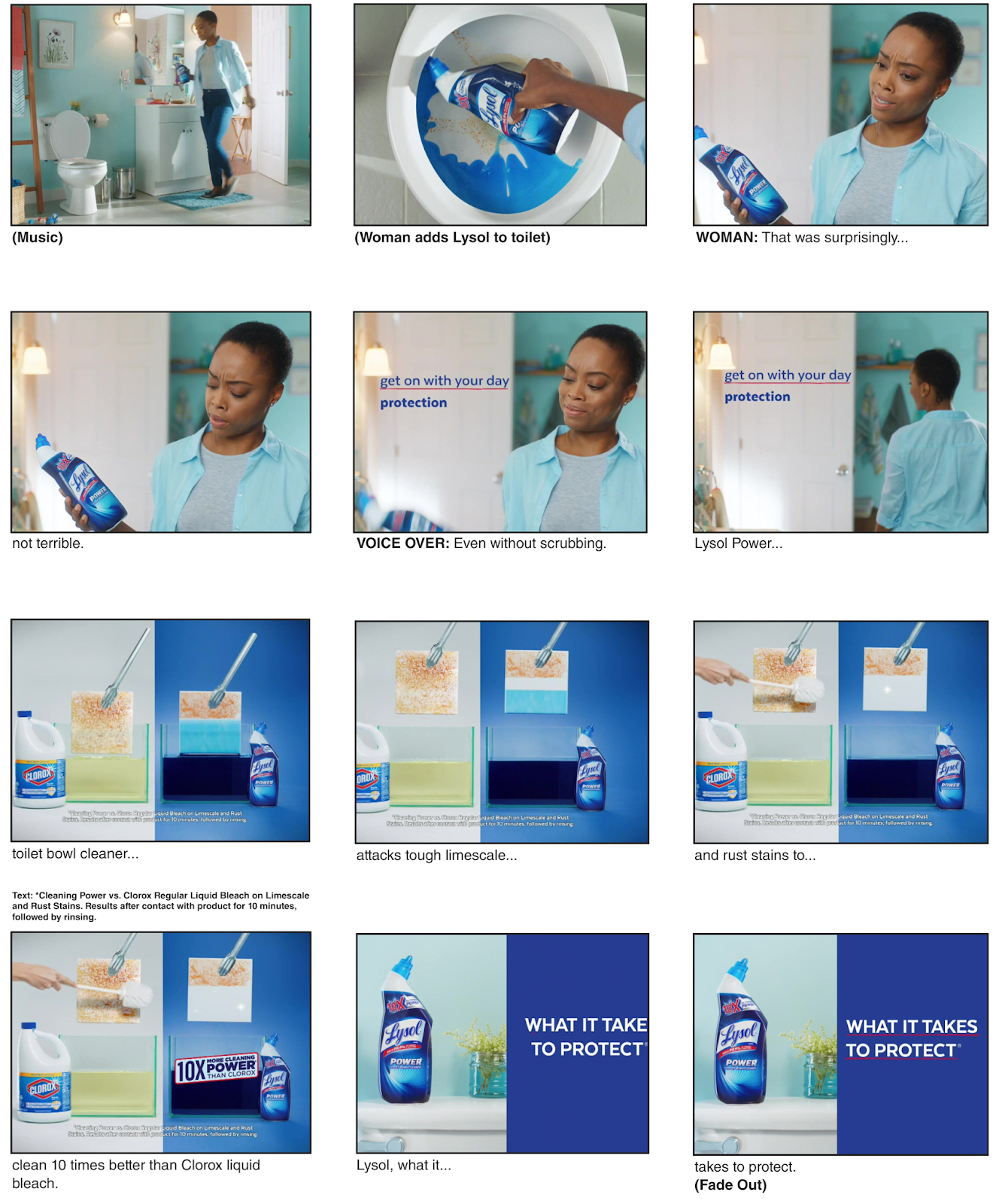
(5) “No Scrubbing” ads: for example, a woman squirts Lysol
Power Toilet Bowl Cleaner into a toilet and flushes; the toilet bowl instantly
becomes clean without the use of a brush. The ad then depicts the unfavorable
results of a side-by-side efficacy test comparing Lysol Power Toilet Bowl
Cleaner and Clorox Regular Liquid Bleach. A small disclaimer states, “Cleaning
Power vs. Clorox Regular Liquid Bleach on limescale and rust stains. Results
after contact with product for 10 minutes, followed by rinsing.” A small banner
states, “10X more cleaning power than Clorox.” 
In another similar ad, a tiny disclaimer states that the results involve
Lysol Power Toilet Bowl Cleaner and Clorox Toilet Bowl Cleaner Clinging Bleach
Gel, but that’s is a distinct product from the “Clorox Toilet Bowl Cleaner with
Bleach” product referenced in the voice-over. 
The “10X More Cleaning Power than Bleach” claim also appears in stores.

Clorox pled falsity: (1) Again, apples-to-oranges: Clorox
alleged that the formulation and purpose of the two products differ.  [I just love what you learn about the world
in false advertising cases.]  Acid-based
cleaners, such as Lysol Power Toilet Bowl Cleaner, are more effective against
mineral-based deposits (like rust and limescale), whereas Clorox’s bleach-based
Clorox Toilet Bowl Cleaner is more effective at removing organic stains (like
mildew and mold). Again, the parties allegedly marketed more directly competing
products. Again, Reckitt’s argument that the EPA approved both for use on
mineral-based deposits wasn’t sufficient.
Reckitt argued that it added a “disclaimer expressly
stat[ing] that the purported advantage relates only to rust and limescale and
not to organic matter.” Clorox alleged that the disclaimers were “nearly
illegible” and “minuscule” and thus plausibly useless.
Second, Clorox plausibly alleged misleadingness: “[t]hrough
its depiction of a woman using a single squirt of the product to render her
toilet immaculate,…[the ad indicates that] the Lysol product works instantly
to removal all deposits from toilets.” First, “the product requires at least 10
minutes to remove some toilet bowl stains,” and second, it’s not [as] good at
organic deposits, so it “cannot render toilets immaculate in seconds, as
depicted in Reckitt’s advertising.”

Third, Clorox plausibly alleged that the claim “10X more
cleaning power than Clorox” was literally false because Lysol products
generally do not have a performance advantage over Clorox. Compared apples to
apples, the Lysol product allegedly didn’t have an advantage in removing
limescale and rust because they contain the same active ingredient, glycolic
acid. So too with the claim “10X More Cleaning Power than Bleach,” because a
reasonable consumer would likely believe that the comparison is in fact with
its leading competitor, Clorox.

(6) Noncomparative ads: claims included: kills “99.9% of
germs”; “kills over 100 illnesses causing germs” and a disclaimer that “Lysol
Disinfecting Spray kills germs on hard surfaces when used as directed.”  One ad was ambiguous as to whether the ad was
claiming that both touted products could
kill over 100 illness-causing germs, or whether they can do
so together.  But it was plausible that
it misleadingly implied that either product alone would be enough. Another ad
claimed that Lysol Daily Cleanser kills “99.9% of germs” and the visual showed
an actor spraying and immediately wiping the surface, whereas the EPA-approved
use instructions on the label requires ten minutes of contact with a treated
surface to achieve its disinfectant effect. That was plausibly misleading,
though it wasn’t a comparison to Clorox.
Materiality: the court quoted precedent that materiality “is
‘typically’ proven through consumer surveys,” even though that is empirically
false (this is a problem for the courts of appeal; the court here notes but
does not give a reason for the shift in judicial treatment of materiality over
time, from presuming materiality for literal falsity—often a matter of common
sense—to a seemingly rigid insistence on separate evidence no matter what).
Restoring some flexibility, a plaintiff can also establish materiality by
showing that “the defendants misrepresented an inherent quality or
characteristic of the product.” Clorox plausibly alleged that Reckitt’s
advertisements attack Clorox products’ efficacy, safety, and durability. These
were inherent qualities and characteristics of cleaning products, and would
likely influence the purchasing decision of a consumer.
Injury: Clorox alleged direct diversion of sales and damage
to its goodwill.  Reckitt argued that
wasn’t enough, but for a competitor who’d been directly attacked it definitely
was. In Vincent v. Utah Plastic Surgery Soc., 621 F. App’x 546 (10th Cir.
2015), the Tenth Circuit required the plaintiff to make some showing of “how
much Plaintiff’s profits have decreased since Defendants began their advertising
campaign,” to “quantif[y] or estimate the decreased in goodwill,” or to
“quantify the number of potential customers who allegedly have been lost
because of Defendant’s statements,” but the court wasn’t going to do that in
the Ninth Circuit.
UCL/FAL: Reckitt argued that Clorox needed to allege its own
reliance on Reckitt’s ads to state UCL/FAL claims.  That’s true for the FAL and UCL “unlawful,”
but not for UCL “unfair.”  Also, whether
the ads would deceive reasonable consumers was a fact question, as it usually
is.

from Blogger https://ift.tt/2GkHZZg

Posted in Uncategorized | Tagged | Leave a comment

Monster Energy can’t show falsity, can show tortious interference (but not irreparable injury)

The court denied a preliminary injunction on Monster’s claim
that Vital falsely advertised its “Super Creatine” as “creatine,” because there
wasn’t sufficient evidence that the two were distinct (in meaning or more
significantly in function), and on tortious interference for lack of a showing
of irreparable harm.
Monster argued that using “creatine” on the labels of
Vital’s energy drink BANG (as part of a promise of “Creatine, Caffeine, CoQ10,
& BCAAs”) was literally false, because BANG does not contain creatine, and
that “Super Creatine” was impliedly false because BANG actually contains an
entirely different molecule, creatyl-L-leucine.
Monster’s expert tested four cans and found no creatine, or
only trace amounts, in the products. 
Vital’s principal also made public statements that the products didn’t
contain “regular creatine.” The expert’s declaration stated that “Super
Creatine,” Vital’s term for creatyl-L-leucine, was a “chemically synthesized
compound” which is created from the linking of two distinct amino acids,
creatine and leucine, with properties “distinct from [those of] the constituent
amino acids.”
The court found Monster’s definition of “creatine” to be
“overly narrow,” since its own cited evidence established that “[m]any forms of
creatine exist in the marketplace,” including formulations combining creatine
with other amino acids. Monster also argued that creatyl-L-leucine does not
provide any of the benefits of creatine, but its evidence did not establish that
fact; it supported “only the more general conclusion that the chemical and
physical properties of a new substance formed from the combination of two amino
acids differs from their constituent parts.” Monster’s cited scientific journal
articles didn’t discuss creatyl-L-leucine, “but both state that at least some
of common creatine compounds provide similar or superior effects to those
provided by creatine alone.”  The burden
of proof was on Monster, and it did not meet that burden.
Monster also argued that BANG doesn’t contain enough Super
Creatine to provide the benefits that VPX promises consumers. But testing only
four cans of a single flavor of BANG purchased from the same retail store in
Southern California wasn’t enough to conclude that the results were
representative of BANG products generally. “The Court will not order a
nationwide recall on the basis of such a limited sample size.”
Intentional interference with
contractual relations: Monster showed that it had valid contracts for specific
amounts of in-store shelf and/or cooler space with retailers across the
country, and also showed that Vital disrupted those agreements, leading to BANG
products being stocked in Monster’s contracted-for retail shelving space in
retail locations across the country. 
This wasn’t a matter of “wayward cans,” given the scope and duration of
the problem and documented statements from Vital’s leadership. One former Vital
account manager declared that district and regional managers directed him to
use “guerilla tactics” and “be aggressive” in order to obtain shelf and cooler
space for BANG at retail stores. “They made specific demands about the location
in which BANG should be placed … and instructed [him] to document the space he
acquired with photographs,” though he knew that competitors had contracts with
retailers about placement. There was also evidence that placement contracts
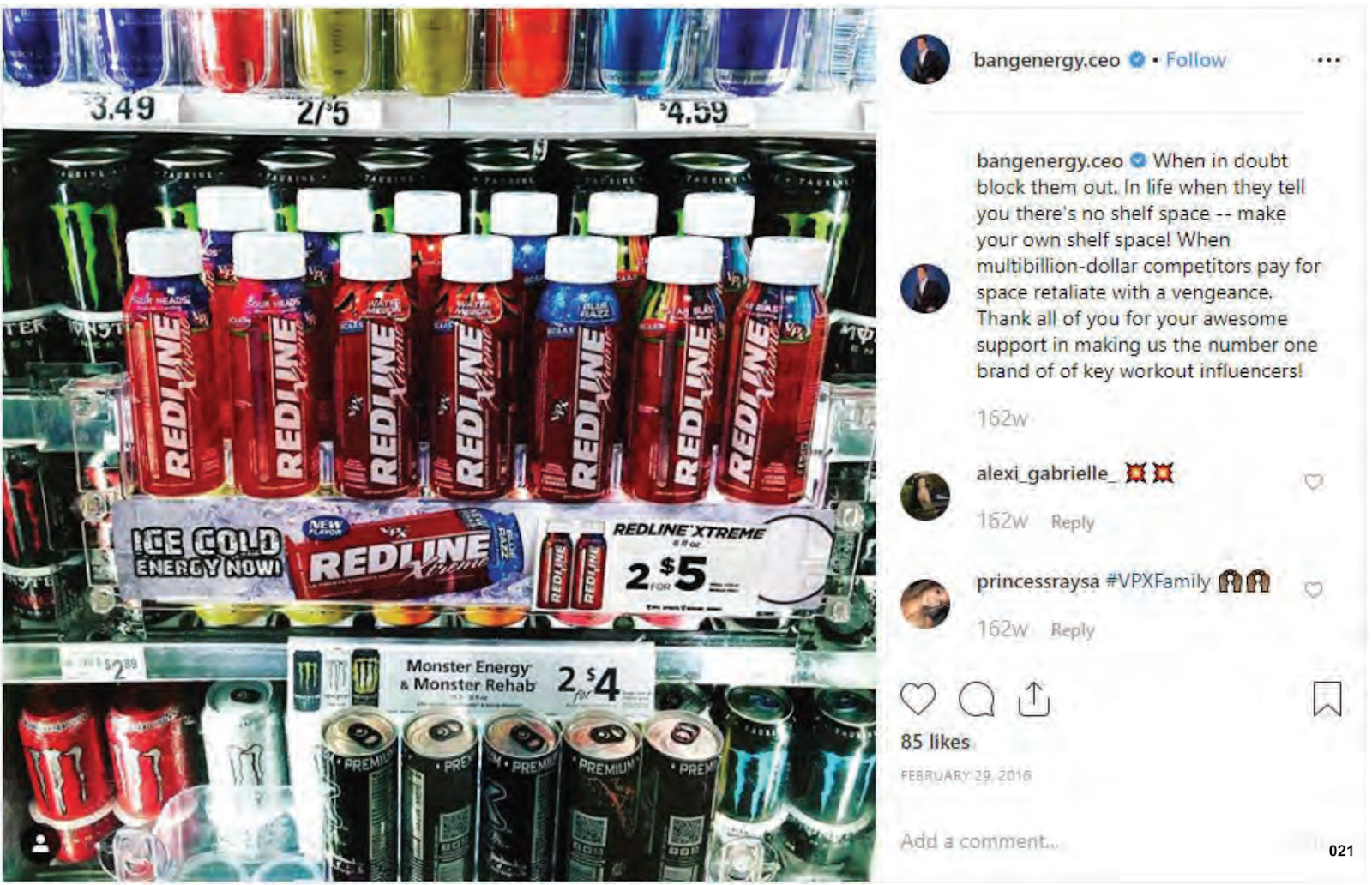
were industry custom, and that Vital’s principal made Instagram posts showing
intent, such as one that shows an image of a VPX products placed in front of
Monster products accompanied by the text “When in doubt block them out. In life
when they tell you there’s no shelf space – make your own shelf space! When
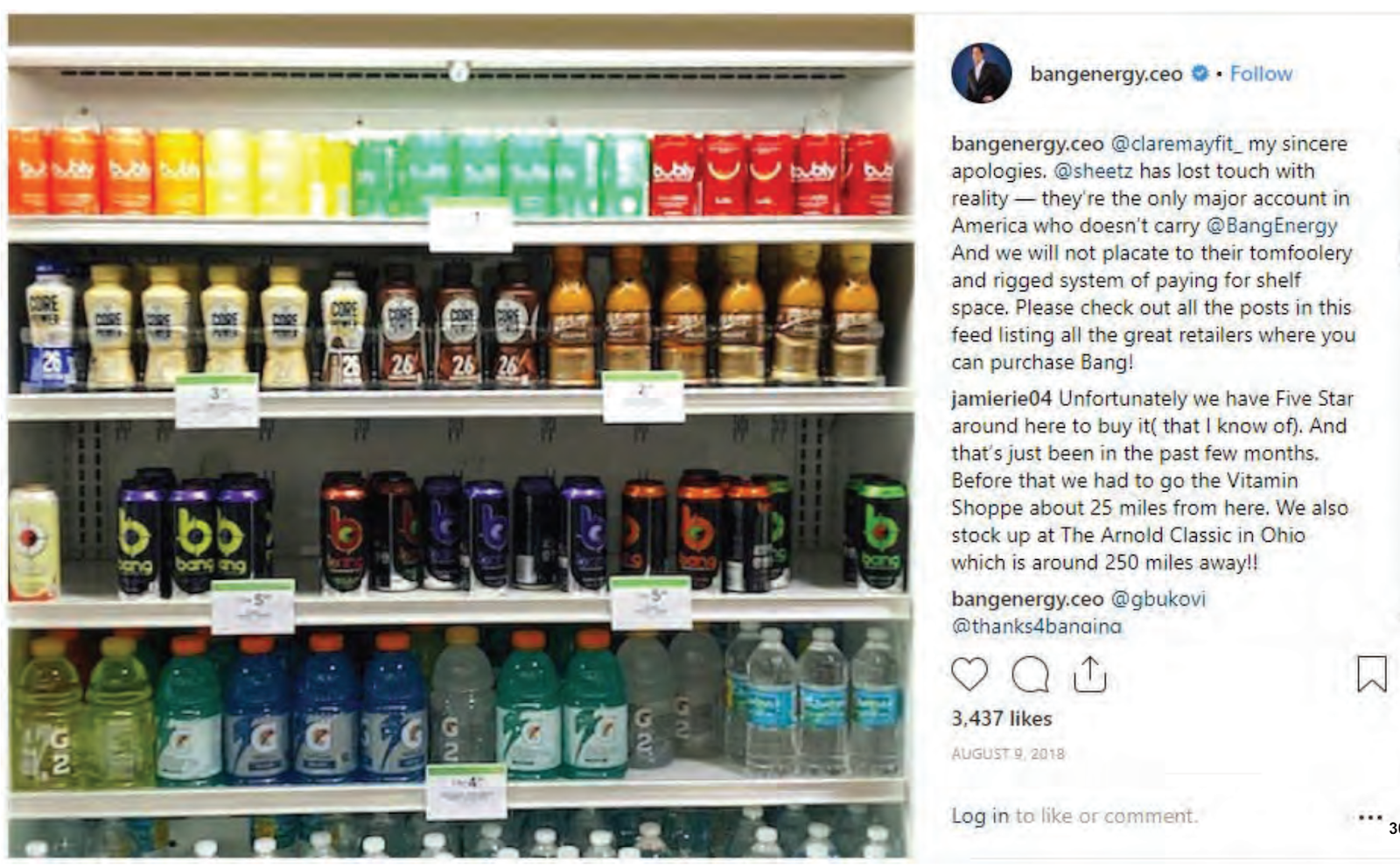
multibillion-dollar competitors pay for space retaliate with a vengeance,” and
another which states that VPX will “not placate to [a retailer’s] tomfoolery
and rigged system of paying for shelf space.”

Defendants argued
that Monster failed to show that Vital or its agents had knowledge of the
existence of the specific shelving-space contracts between Monster and its
retailers with which they interfered. The evidence was to the contrary,
including public statements made by the principal which object to the industry
practice of paying for shelf space and state his intention to “make [his] own shelf
space” and “retaliate” against competitors who pay for space. [Ah, clients and
their social media.] “In light of the extent of this practice, Plaintiff need
not demonstrate specific knowledge of each contract in question in order to
demonstrate a likelihood of success on the merits.”  Likewise, the evidence showed that the
“wayward” cans in Monster’s shelving space were likely the result of defendants’
intentional conduct.
But there was very
little evidence of damages. While it may be the case that BANG’s sales growth
has been “fueled by VPX’s theft of Monster’s shelf and cooler space,” Monster
didn’t have good evidence backing this up. 
There was no evidence connecting contractual interference with “the loss
of customer goodwill, the loss of market share, or the loss of profits,” making
harm speculative at this stage. So too with irreparable harm.

from Blogger https://ift.tt/2YZxB09

Posted in Uncategorized | Tagged , , | Leave a comment