Weight Watchers competitor wins dismissal of TM claims over “millennials are calling [it] Weight Watchers 2.0” ad

Weight Watchers Int’l, Inc. v. Noom, Inc., 2019 WL 3890139,
No. 18-cv-9637 (PKC) (S.D.N.Y. Aug. 19, 2019)
Noom markets “weight-loss services based on nutrition and
lifestyle advice dispensed through a mobile app.” It ran some ads that
mentioned Weight Watchers. “Broadly characterized, these advertisements
described Noom as offering effective, modern weight-loss services that compared
favorably to those of Weight Watchers.” 
WW sued for false advertising and trademark infringement.  Almost astoundingly for a court in the Second
Circuit, the court dismissed the trademark infringement claims
as nominative fair use. It also dismissed some of WW’s false advertising
theories but found that claims based on Noom’s statement that its service is
“backed by 8 years of research and proven to be effective by several medical
journals” were sufficiently pled.
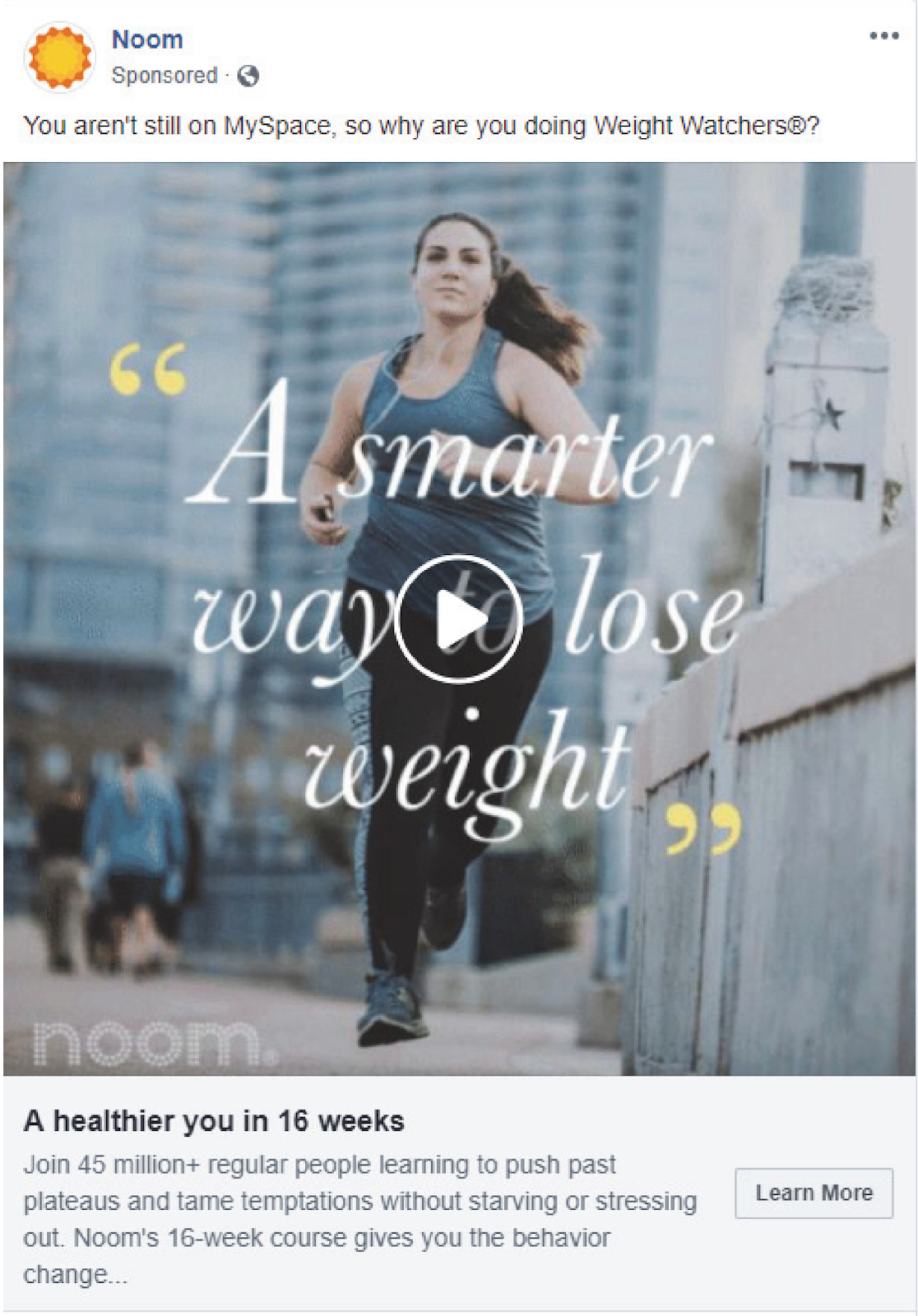
One Noom Facebook ad stated: “You aren’t still on MySpace,
so why are you doing Weight Watchers®?” and used the phrase, “A healthier you
in 16 weeks.” Another: “I’ve tried Weight Watchers and nothing has worked!”
Other Noom ads featured phrases like, “Lose weight for good,” and, “Most weight
loss programs are based on unsustainable dieting” and “crash dieting.” Some
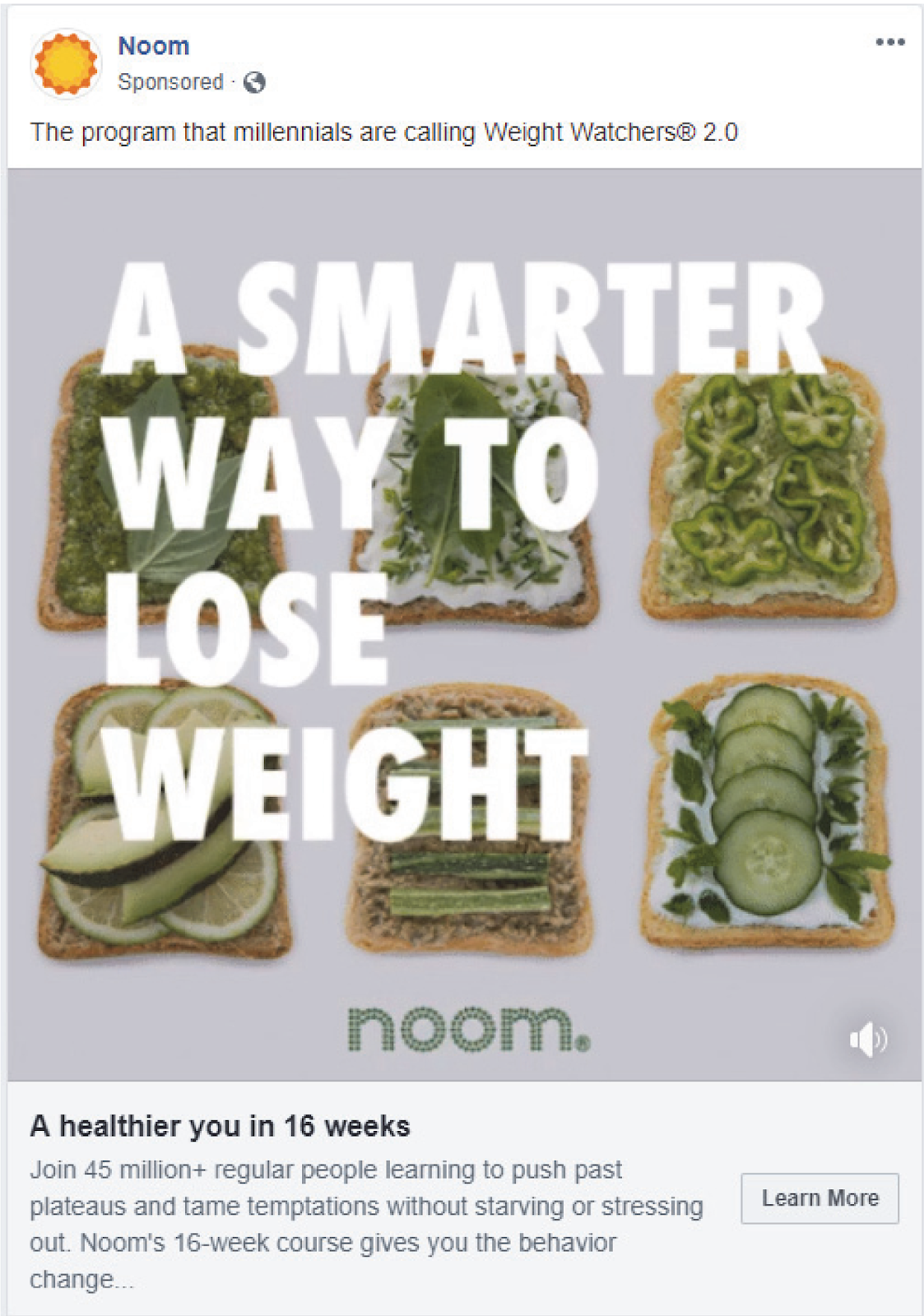
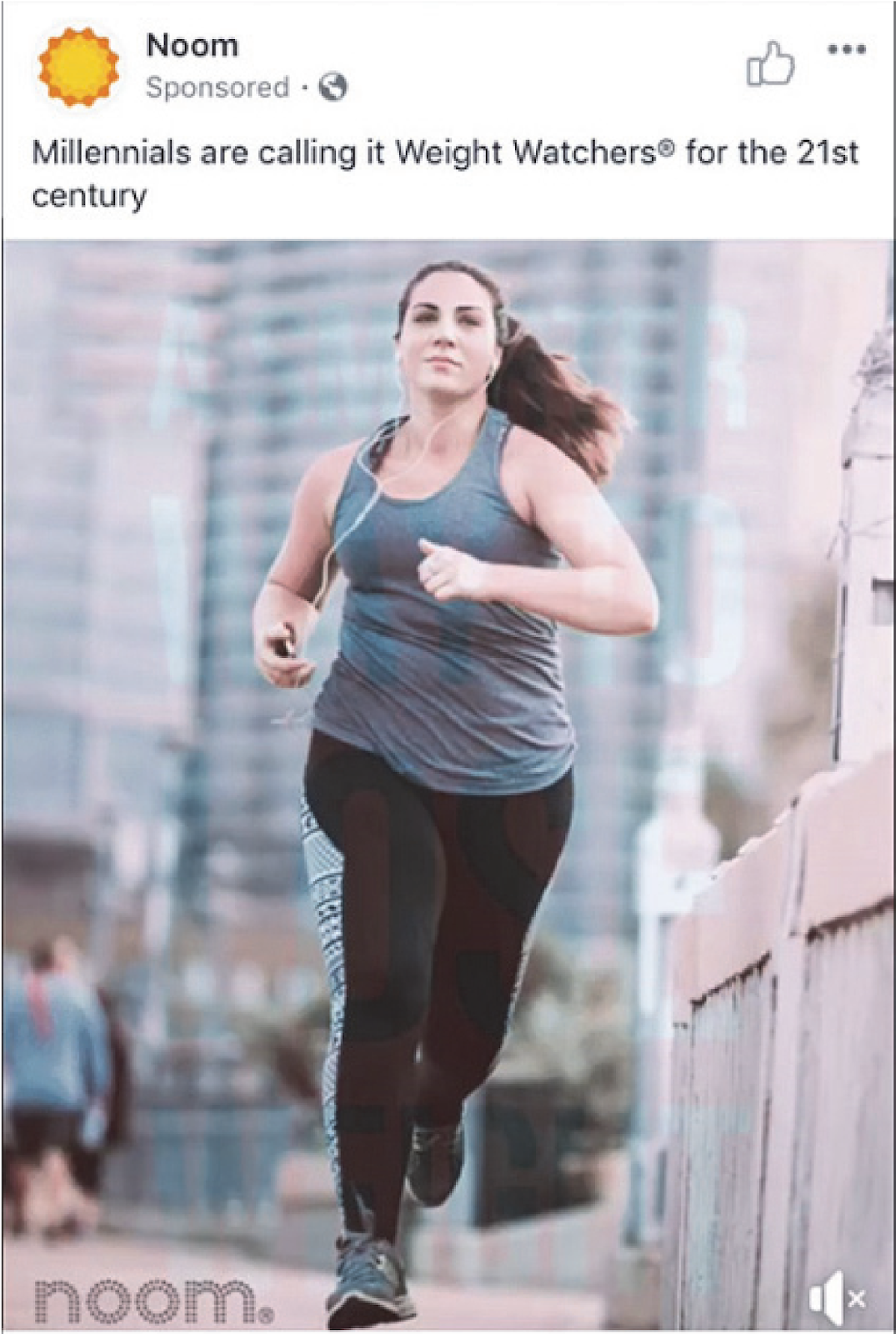
Facebook ads included the text, “The program that millennials are calling
Weight Watchers® 2.0” and “Millennials are calling it Weight Watchers® for the
21st century.”
False advertising: 
The “… so why are you doing Weight Watchers®?” ads allegedly implied
the false message that “consumers would lose more weight in 16 weeks using Noom
that they would using Weight Watchers, or, alternatively, that Weight Watchers
customers would lose no weight in 16 weeks.” The ads included the text, “A
healthier you in 16 weeks,” followed by, “Join 45 million+ regular people
learning to push past plateaus and tame temptation without starving or
stressing out. Noom’s 16-week course gives you the behavior change tools to
forgive, practice, and (finally) stick to a plan.” Additional phrases varied,
but included “A smarter way to lose weight,” “noom. Weight loss for
millennials” and “Lose Nothing But the Weight.”
The court found WW’s reading of the ads “strained.”  The challenged statements were puffery. They
mentioned WW only in the context of comparing it to MySpace’s obsolescence. The
ads didn’t imply that a Noom customer would lose more weight in 16 weeks than a
WW customer would. The analogy between WW and MySpace was simply a vague claim
of superiority.
“The Review of Sally W.” 
A Noom Facebook ad quoted “Sally W.,” stating “I have lost more weight
with Noom in 5 weeks than I lost in 10 months on Weight Watchers.” It
apparently used a stock photo and didn’t state an original source for the
review.  [The FTC would not be happy with
this ad.]  WW argued that the ad falsely
implied that Sally W.’s experience was typical. The court found this allegation
implausible. The court thought that a reasonable consumer would perceive this
as a review from a single customer with no special expertise in weight loss or
other relevant areas.  “The Court takes
judicial notice that customer reviews of businesses, products and services have
become common on many websites and mobile apps, including Google, Facebook and
Yelp. Reviewers frequently express their views in strong, personal terms.” 
The court reached this conclusion despite WW’s deployment of
the FTC’s Endorsement Guide, which itself was based on consumer research
indicating that a substantial percentage of consumers did receive
typicality messages from similar ads. 
[The court didn’t cite the FTC’s factual basis for its conclusions, just
the relevant what-to-do guidance.] While it’s true that “courts have held that
a ‘plaintiff may and should rely on FTC guidelines as a basis for asserting
false advertising under the Lanham Act,’ ” it’s also true that “there is no
private right of action under the FTC Act, and its disclosure obligations do
not apply to Lanham Act claims.”  Even
according “some weight” to the FTC’s guidance, it didn’t render the claim here
plausible because the FTC was concerned with disclosures and disclaimers, not
with the underlying ad statements themselves. 
[This reasoning is just wrong.  (1) The FTC disfavors “not typical”
disclosures for ads of this type because its research showed that ads of this
type are still misleading to many consumers, even with the disclosures,
and (2) even if the FTC Guide was “about” disclosures, the point of the FTC
guidance here is that, without sufficient disclosure to actually convey
atypicality to consumers, these kinds of ads are misleading.  The FTC is substantively concerned with
consumer deception under §5, not with disclosure in the abstract.  Given the evidence developed by the FTC—not
for nothing, much of it in the weight loss context—it is at least plausible
that the ad conveyed a typicality message. 
Even taking judicial notice of the prevalence of reviews shouldn’t
change that, especially since reviews are not the same thing as reviews
endorsed and disseminated by the advertiser, who consumers may indeed consider
to have (1) special expertise and (2) some constraints imposed by advertising
law against deceiving them, thus making the advertiser’s selection of a review
more trustworthy than a random review.]
“Lose Weight for Good” and “Permanent weight loss in the
palm of your hands.” The relevant ads included the line “Noom’s 16-week course
gives you the behavior change tools to forgive, practice, and (finally) stick
to a plan.” And some touted “life-changing results.” WW argued that these ads
conveyed a false message “that consumers will not regain the weight they lose by
using Defendant’s Program for only 16 weeks, even after they stop using it.” But
it wasn’t plausible that a reasonable consumer encountering the ads as a whole “would
conclude that Noom guarantees permanent, lifelong weight-loss simply by
subscribing to Noom.” This was just puffery.
The December 2018 Ads: These ads included the statements
that “Most weight loss programs are based on unsustainable dieting,” “Most
weight loss programs are based on crash dieting,” and a purported consumer
stating, “I’ve tried Weight Watchers and nothing has worked.” This allegedly
conveyed the false messages that WW used crash-dieting techniques and that the
customers of WW would regain any weight that they lost. Noom argued that there
was a 12-second gap between the “crash dieting” statements and a reference to
WW. The court agreed that the challenged statements were puffery: “I’ve tried
Weight Watchers and nothing has worked!” was too vague and broad to be
falsifiable, and its “hyperbolic” character was reinforced by the next
exaggerated statement: “Noom has literally been life-changing!”

Earlier references to “crash” or “unsustainable” dieting and results that
“DON’T last” didn’t change matters. They were references to “unnamed
weight-loss programs” but didn’t impute particular methods to WW, especially
given the accompanying images of a woman eating pasta and a multi-layer
chocolate cake being sliced and served, which served to make the claims more
exaggerated.
“I yoyo dieted for years ….” This ad continued: “I counted
the points. I followed the rules and it didn’t help me long term. I was just so
tired of losing the weight and gaining it all back. But I found something new.
It’s called Noom. It’s not a diet. It’s a totally different personalized
program that uses psychology and small goals to change your habits so that you
can lose the weight and keep it off for good.” WW argued that this ad impliedly
conveyed a false message that the WW program is based on diet alone. The court
disagreed; there was no express reference to WW, and even assuming that
points/rules identified WW, the ad still didn’t plausibly convey that WW
programs were “based on diet alone”; the relevant statements were about Noom
not being a diet, not WW.
The “Coach Heather” E-Mail. This email from Noom had the
subject line, “Why Weight Watchers failed you.” The email stated, “Weight
Watchers doesn’t have an app which means it’s not only more expensive, it costs
more time making room for it in your life.” The complaint alleged that this
statement was literally false (since 2009!). However, the ad didn’t
sufficiently allege that this email was commercial advertising or promotion, or
even identify to whom it was sent.
Finally, WW’s allegations about Noom’s claims about research
did survive. Noom’s website allegedly stated that its weight-loss program is
“backed by 8 years of research and proven to be effective by several medical
journals.” A Noom ad also stated: “Your course is backed by 8 years of research
and proven to be effective by several medical journals.” WW alleged
falsity/misleadingness because the Noom program has not been subject to
“randomized, controlled studies, and at least three of the studies relied upon
by [Noom] are preliminary or pilot studies involving only small groups of people,”
rendering the “proven effective” statement false and misleading.
For a “tests prove” claim, a plaintiff can show falsity by
showing the tests aren’t “sufficiently reliable to permit one to conclude with
reasonable certainty that they established the claim made.” By contrast, “[c]onclusions
drawn from non-fraudulent data about subjects of legitimate scientific
disagreement ‘are not grounds for a claim of false advertising under the Lanham
Act.’” Noom’s arguments that it should be protected by the latter principle
were more appropriate for summary judgment. 
[And those arguments expose the very shaky foundations of ONY,
the case cited by the court—deciding which science is more likely than not to
be a correct account of the world is a basic judicial function in the modern
age.  Among other things, ONY’s
scope is/should be limited by the fact that the case involved (1) full
disclosure of the underlying data and its limits (2) to doctors who understood
the import of that disclosure and thus could draw their own conclusions about
whether the results were real.  Previous
courts interpreting ONY have understood those limits and I hope that if
this case continues the court here does as well.] “The Court is unable to
resolve at the pleading stage whether the research submitted by Noom proves the
effectiveness of its weight-loss programs, whether that research is reliable,
or whether the journals publishing the research are considered credible.”
Trademark infringement: The challenged ads were one with the
text, “The program that millennials are calling Weight Watchers® 2.0” and a
second stating, “Millennials are calling it Weight Watchers® for the 21st
century.” Both ads were identified as “Sponsored” by Noom.  Noom argued nominative fair use.  In the Second Circuit, that’s evaluated by
using the multifactor LOC test plus the Third Circuit NFU test as additional
factors.  [Sigh.]
Strength and competitive proximity favored WW, but the other
usual factors weren’t alleged/were neutral, and the parties’ marks were dissimilar.
The alleged bad faith was only the prominence of the use of the WW mark, but
those ads also were identified as being from Noom and used the stylized “noom.”
logo.  As for the NFU factors, “Weight
Watchers” was necessary to identify Weight Watchers, weighing in favor of
nominative fair use.  [The court
implicitly treats the Second Circuit’s use of the Third Circuit factor one, “whether
the use of the plaintiff’s mark is necessary to describe both the plaintiff’s
product or service and the defendant’s product or service, that is, whether the
product or service is not readily identifiable without use of the mark,” as
more like the Ninth Circuit version focusing only on whether the use identifies
the plaintiff. Perhaps it would be even more likely to be NFU if Noom needed to
use Weight Watchers to explain what Noom was, but it is enough that Noom
needs to use the mark to identify Weight Watchers.  If NFU is going to be shoved into the
multifactor, balancing LOC test, then it makes some sense that, like the other
factors, this factor is a matter of degree.]
Next, “whether the defendant uses only so much of the
plaintiff’s mark as is necessary to identify the product or service.” “Courts
should consider whether the alleged infringer ‘stepped over the line into a
likelihood of confusion’ by using a mark ‘too prominently or too often, in
terms of size, emphasis or repetition.’” In these ads, the WW mark appeared
once, in a sentence that runs above an image, with no additional marks or
design elements owned by WW, and it included the “®” symbol, which the court
apparently thought of as good faith-y (although its effect on whether consumers
would think the ad came from WW is a bit ambiguous to me). “That the use of the
mark is limited to one mention of the company name weighs in favor of
nominative fair use.”
Finally, the court considered “whether the defendant did
anything that would, in conjunction with the mark, suggest sponsorship or endorsement
by the plaintiff holder, that is, whether the defendant’s conduct or language
reflects the true or accurate relationship between plaintiff’s and defendant’s
products or services,” giving weight not only to source confusion, but also to “confusion
regarding affiliation, sponsorship, or endorsement by the mark holder.” Here,
the ad text didn’t plausibly “suggest sponsorship or endorsement” of Noom by Weight
Watchers. It attributed an opinion to a consumer demographic, suggesting that
they “compared Noom to Weight Watchers” and perceived Noom to be “more
contemporary.” That didn’t suggest endorsement or sponsorship, but rather that “Noom
is a different and modern alternative to Weight Watchers.” Instead, this was “a
comparative claim” … Weight Watchers is invoked once in the text, with a
negative connotation that its services are outdated.  [Compare to the “if you like X, you’ll love Y”
cases—though those cases split in result, and favor X when there are other
indicators of similarity to X such as product trade dress; the court makes the point
here that there aren’t any such indicators in these ads and instead a clear use
of the Noom mark.]
TM claims dismissed. State law claims survived to the extent
they matched up with the analysis above. Also, the NY §349 claim based on infringement was dismissed
because it didn’t “plausibly allege a specific and substantial injury to the
consuming public, beyond the purported infringement of the Weight Watchers
mark.”

from Blogger https://ift.tt/2MAqatQ

Posted in Uncategorized | Tagged , | Leave a comment

Supplement ingredient supplier lacks Article III standing against supplement seller

ThermoLife International LLC v. American Fitness Wholesalers
LLC, 2019 WL 3840988, No. CV-18-04189-PHX-JAT (D. Ariz. Aug. 15, 2019)
Courts really, really like to call the Lexmark issue
“standing.” Here, though, the court goes further by finding the noncompetitor
plaintiff—who makes ingredients that are added to third party supplements—not
to have Article III standing against the defendant supplement seller for its
Lanham Act false advertising claim.
ThermoLife holds supplement-related patents and licenses
them for use in supplements as well as selling ingredients.  Allegedly, “[w]ith few exceptions, anytime an
amino acid is combined with nitrate(s) and sold and marketed to consumers[,]
the product relies on [Plaintiff’s] patented technology.” Its patented creatine
nitrate is an ingredient in the (alleged) world’s top-selling pre-workout
product: Cellucor’s C4.  
Defendant sells supplements to consumers online. It advertises
“C4” and other, non-ThermoLife-licensed creatine nitrate products, including
APS Nutrition’s product, which is advertised as “a vastly superior patented
creatine [nitrate].” ThermoLife alleged that defendant was falsely advertising
as supplements ingredients that have been deemed to be “drugs” by the FDA,
without disclosure. Defendant also allegedly falsely labeled products on its
website as “patented.”
The court found that ThermoLife failed to plead injury in
fact.  It alleged that it had a unique
interest in the dietary supplement market and its business was tied to the
general popularity of sports nutrition supplements. Thus, it was allegedly
harmed “when consumers are misled into purchasing any falsely advertised
product that competes with any product that contains ingredients that are
sourced from [Plaintiff] and/or products that are licensed by [Plaintiff].”
The court cited Ninth Circuit precedent stating that direct
competition is a strong indicator of injury in fact in a false advertising
case.  A plaintiff can also “allege that
it can provide witness testimony or survey material to show that false
advertising would influence consumer choice and, therefore, ‘establish an
injury by creating a chain of inferences’ that online advertising harmed a
plaintiff’s businesses.”
The allegations here weren’t sufficient. The parties were at
different points in the supply chain. The “attenuated link between one product
sold by Defendant that contains creatine nitrate sourced from
Plaintiff—Cellucor’s C4— and another product sold by Defendant that is not
sourced from Plaintiff—APS Nutrition’s creatine nitrate product—does not put
Plaintiff and Defendant in direct competition.”  Nor were there specific factual allegations of
lost sales data, of specific licenses or ingredients for which sales decreased
as a result of the advertising, or of testimony or surveys “that could
demonstrate Defendant’s alleged false advertising influenced customer choices.”  [One would think that harm to plaintiff, not
influence on consumer choices, would be the key thing here.]  The fact that defendant sells C4 (and calls
it “top-selling”) as well as a competing product undercut any inference of
diversion. Thus, ThermoLife failed to allege a “sufficiently concrete and
particularized injury.”  [Is it just me,
or is the court confusing traceability to the defendant’s conduct with the
concreteness of the injury?]
In the alternative, the court found the complaint
insufficiently pled under 12(b)(6) for basically the same reasons.  Under Lexmark, ThermoLife needed to
allege a commercial or competitive injury; this is generally presumed when the
parties compete, but couldn’t be presumed here. 
And a plaintiff can’t plead a claim for damages just by pleading harm to
the overall market in which it competes. Moreover, to allege a plausible
commercial injury, a “plaintiff must allege some factual support for its
allegations.” It wasn’t enough to plead “damage to its business, reputation and
good will and … lost sales and profits that [Plaintiff] would otherwise have
made.” ThermoLife didn’t allege “any facts to show that the use of its licensed
technology or sales of patented creatine nitrate decreased, when the decrease
occurred, where sales were diverted to, or how it correlated with Defendant’s
false advertising.” [Call me when a court says any of these things in response
to the same words being used to plead trademark infringement.] Nor did ThermoLife
allege that companies who use its patented ingredients and licensed technology
suffered a loss of sales.
The same defects doomed the false patent marking claim.
Arizona common law unfair competition: that too.
The court declined to award defendant its attorneys’ fees.
“[T]he Court could conceive of a situation in which Plaintiff subjectively
believed—even if erroneously so—that its Lanham Act claim was not wholly
frivolous. … Plaintiff’s arguments do not rise to the high-level of frivolity
required to award fees against it.” 
[That sounds a bit pre-Octane Fitness, but the court
properly cited Octane Fitness so it’s probably ok.]

from Blogger https://ift.tt/2ZcLTy2

Posted in Uncategorized | Tagged , | Leave a comment

Reading list: Julie Cohen on internet exceptionalism’s failures

Julie E. Cohen, Internet
Utopianism and the Practical Inevitability of Law
, 18 Duke L. & Tech.
Rev. 85 (2019)
From the Introduction:

Writing at the dawn of the digital era, John Perry Barlow
proclaimed cyberspace to be a new domain of pure freedom. Addressing the
nations of the world, he cautioned that their laws, which were “based on
matter,” simply did not speak to conduct in the new virtual realm. As both
Barlow and the cyberlaw scholars who took up his call recognized, that was not
so much a statement of fact as it was an exercise in deliberate utopianism. But
it has proved prescient in a way that they certainly did not intend. The “laws”
that increasingly have no meaning in online environments include not only the
mandates of market regulators but also the guarantees that supposedly protect
the fundamental rights of internet users, including the expressive and
associational freedoms whose supremacy Barlow asserted. More generally, in the
networked information era, protections for fundamental human rights—both on-
and offline—have begun to fail comprehensively.
 Cyberlaw scholarship in the Barlowian mold isn’t to blame
for the worldwide erosion of protections for fundamental rights, but it also
hasn’t helped as much as it might have. In this essay, adapted from a
forthcoming book on the evolution of legal institutions in the information era,
I identify and briefly examine three intersecting flavors of internet
utopianism in cyberlegal thought that are worth reexamining: utopianism about
platforms for distributed cultural and political production (and concomitant
failure to reckon with the transformative force of informational capitalism);
utopianism about anonymity as a force for institutional disruption (and
concomitant failure to acknowledge the essential role of institutions in
cabining the human capacity for malice and mayhem); and utopianism about the
relationship between information and communication networks and human freedom
(and concomitant failure to contend with the powerful and inherently
informational mechanisms by which existing protections for human rights are
increasingly outflanked and coopted). It has become increasingly apparent that
functioning legal institutions have indispensable roles to play in protecting
and advancing human freedom. It has also become increasingly apparent, however,
that the legal institutions we need are different than the ones we have.

from Blogger https://ift.tt/30t4D9G

Posted in Uncategorized | Tagged | Leave a comment

Rogers question: could this art be explicitly misleading?

One reason that Gordon v. Drape Creative is so concerning is that it reads “explicit” to be something other than explicit–maybe a version of falsity by necessary implication, but one that wants to pose transformativeness as the thing that avoids explicit falsity. So what do we do with art objects like this one?  Is the traditional porcelain decoration sufficient for there to be something more than the McDonald’s M present?  The V&A certainly thinks so … but who should decide?

Li Lihong, McDonald’s #1, 2007 (V&A Museum) porcelain, transfer-printed in underglaze blue: the explanation says that it “comments on the recent floods of global brands into China by rendering the famous ‘golden arches’ of the fast food chain in traditional blue-and-white. While contemporary in theme, Li’s piece also reminds us that Chinese porcelain has been a global product for centuries.”

from Blogger https://ift.tt/306nfwa

Posted in Uncategorized | Tagged , | Leave a comment

fake online review by competitor wasn’t advertising/promotion, 10th Circuit says

Wilson v. AdvisorLaw LLC, — Fed.Appx. —-, 2019 WL
3819604, No. 18-1441 (10th Cir. Aug. 15, 2019)
Wilson, a lawyer, had a relationship with AdvisorLaw that
ended badly in November 2016. Later that day, a “Patrick Erickson,” allegedly
from New York, posted a negative review of Wilson on the website
ripoffreport.com accusing Wilson of serious and deliberate professional
malfeasance. When Wilson discovered the review, he sued the defendants. The district
court dismissed the Lanham Act claim and then dismissed the state law claims for
civil conspiracy, defamation, and deceptive trade practices under the Colorado
Consumer Protection Act without prejudice.
The court of appeals affirmed the finding that Wilson failed
to show “commercial advertising or promotion” because of a failure to meet
prong four [reminder, post-Lexmark, now prong three!]: the
advertising/promotion “must be disseminated sufficiently to the relevant purchasing
public to constitute ‘advertising’ or ‘promotion’ within that industry.” Though
Ripoff Report receives up to 250,000 visitors a day, that wasn’t enough to show
that a sufficient number of relevant clients received the message.
The court of appeals held that there wasn’t evidence that
the review here “was disseminated to the relevant purchasing public—prospective
clients in need of the type of specialized legal services that plaintiffs
provide or others in that industry who might have influence over prospective
clients.” It wasn’t enough to argue that it was disseminated to the public at
large or to cite general evidence that customers look for online reviews. “While
we don’t condone the posting of a false review on the Ripoff Report website, we
agree with the Second Circuit that ‘[a]lthough the Lanham Act encompasses more
than the traditional advertising campaign, the language of the Act cannot be
stretched so broadly as to encompass all commercial speech.’”
Comment: While I understand why the court ruled this way,
there’s a significant conceptual move that goes unannounced here, and I’m
inclined to think it’s a mistaken one. 
The early commercial advertising/promotion cases were about isolated
statements by individual salespeople to specific individuals that by their nature were unlikely to travel beyond the few
individual recipients.  By contrast, a
national mailing would be easily understood as commercial advertising even
though there was no evidence that a single person read the mailing on its way
from the door to the trash.  Likewise, no
evidence of how many people saw a TV commercial is ever required to find that
it’s advertising/promotion, even though they may all have ignored it.  That is, the structural features of
the communication—the intent and attempt to penetrate the market in an
organized and widespread fashion—usually suffice to put it within (or outside
of) the Lanham Act, and the way the standard test is worded is consistent with that understanding.  By requiring
evidence of reception for online postings—and only online postings, even on
review sites designed to reach consumers interested in a target’s commercial
offerings—the court is raising the standard for what constitutes commercial
advertising or promotion, but only with respect to online communications.  There are other cases finding fake reviews by
competitors, and websites set up purporting to be independent and designed to
be found in a search for the plaintiff’s name, to be actionable under the
Lanham Act; I think that’s probably the better result.

from Blogger https://ift.tt/2Z7R4iz

Posted in Uncategorized | Tagged , , | Leave a comment

Reading list: once upon a time in student debt

Now that’s how to get people reading:

Intergenerational Equity, Student Loan Debt, and Taxing Rich Dead People
Victoria J. Haneman
Creighton University – School of Law

Once upon a time, there was a generation of indentured servants called Millennials. They were beautiful and mysterious and clever and feckless, in the way that all young people can sometimes be. The Millennials had dreams of future careers in which they were near-mystical, all-powerful protectors of the planet, brunching on avocado toast, driving in electric cars, and eradicating golf courses from the earth. Droves of Millennials applied to universities, believing that a diploma was a barrier for entry to advance the careers of which they dreamt. Most were confronted with a conundrum: borrow to subsidize the dream career, with decades of (potentially unaffordable) payments when they were finally employed. The Generation Who Stole the World, commonly referred to as the Baby Boomers, had decided that unlimited access to debt was the most economically sound approach by which to offer equal opportunity in higher education — and the delectable irony of this tale is that the availability of debt caused (or at the very least, accompanied) the skyrocketing of costs. A vicious cycle resulted in an entire generation of educated Millennials having mortgaged their futures, and visibly sagging under the weight of the chains of their debt.

This hyperbolic tale leans into stereotypes for dramatic effect, but is also strikingly accurate in its rendering of higher education financing in the United States. The Boomer gerontocracy inherited the benefits of New Deal policies, with substantial public investment into infrastructure and education, but then gradually shifted the financing of higher education away from grants and towards student loan debt. Millennials have taken on 300% more student loan debt than their parents, with those borrowers between the ages of 25 and 34 each having an average of $42,000 in student loan debt. Student loan debt has more than doubled since 2009 and can no longer be ignored: according to projections in this Article, assuming the same steady rate of growth from 2004 to 2019, outstanding student loan debt will exceed $13.5 trillion within the next twenty years, far outpacing the projected growth of the Gross Domestic Product (GDP) of the United States.

There is a glaring gap in academic literature with regard to the choice to primarily lean upon student loan indebtedness to finance higher education, the unsustainability of such an approach, and the intergenerational equity of shifting debt from this generation to the next. Those crafting public policy have implicitly shirked away from notions of intergenerational sustainability in its management of higher education financing — with the (perhaps unintentional) result that higher education financing is operating on Ponzi principles. Forward-looking higher-education policy must be rooted in notions of intergenerational equity: a society is intergenerationally just when each generation does its best to contribute its fair share towards succeeding generations, avoiding serious harm to future generations, with a consciousness of the needs that may exist in the future. This Article fills a gap by considering the way in which debt is used (and potentially abused) as a common pool resource and that the management of a common pool resource arguably carries with it intergenerational equity obligations. The first in a two part series, this Article proposes a way forward with a creative solution — the repurposing of the gratuitous tax system such that the revenues are earmarked and dedicated to the retooling of higher education finance in the United States.

from Blogger https://ift.tt/2OWZG89

Posted in Uncategorized | Tagged | Leave a comment

a made-up credential implying a doctorate is inherently misleading

Wilson v. Ohio State Chiropractic Board, 2019 WL 3801546,
No. 18AP-739, 2019 -Ohio- 3243 (Ct. App. Aug. 13, 2019)
The Board disciplined Wilson for deceptive advertising, and
the court of appeals upheld the discipline. 
Two bits of interest: (1) Wilson advertised that he was a “D.NMSc.” The
court of appeals found this inherently misleading, which is the constitutional
standard used to figure out when no disclaimer requirement need be attempted
for commercial speech. The crucial difference between this formulation and the
Lanham Act concept of falsity and misleadingness is that courts regularly use
their common sense and expert testimony to decide what’s inherently misleading,
rather than requiring the government to produce consumer perception evidence.
Quoting other state court cases, the court here reasoned that a term is
inherently misleading if it is “ ‘likely to deceive the public based upon the
general public’s use of the term.’ … In general, a statement will only be
inherently misleading if the statement, standing alone, will almost unavoidably
lead to fraud, undue influence, intimidation or other duplicity.”
That was the case here. Wilson acknowledged that D.NMSc was
supposed to connote that he is a Doctor of NeuroMetabolic Science.
That is simply not true. There is
no such credential. Appellant admitted that the D.NMSc is not an academic
degree; rather, it is a credential. However, the credential exists only because
appellant and his colleagues created it. Moreover, the credential was bestowed
upon appellant by the IANMP— an organization he and his colleagues formed—and
one that is unlicensed by any Florida or Ohio entity governing academic
accreditation of doctoral programs.
He and his colleagues created the D.NMSc credential to distinguish
their “functional medicine and functional neurology” services from traditional
chiropractic services. He testified that “I do functional medicine and
functional neurology, and there’s no certification out there specifically that
defines it.” Thus, it was clear that the general public was likely to be
deceived by the use of the designation: “A member of the public upon hearing or
reading that appellant holds a doctorate would assume that appellant has
completed a standardized course of study to obtain the degree when in fact
appellant created both the credential and the organization that bestowed the
credential.” This was inherently misleading and a prohibition created no First
Amendment problems.
(2) Wilson argued that it was wrong to hold that his use of
the designation D.C. did not clearly identify him as a chiropractor in
violation of Ohio law, which requires that “[a]ll advertisements and
solicitations shall clearly reveal that the advertisement and/or solicitation
is being made on behalf of a chiropractic physician.” The Board “determined in
2007 that the D.C. designation was insufficient to identify a chiropractic
physician in advertisements and accordingly amended its administrative rules to
require chiropractors to identify themselves using [chiropractic, chiropractor,
doctor of chiropractic, or chiropractic physician].” A representative submitted
testimony that the Board amended the rule due to consumer complaints that
advertisements using only the D.C. designation did not sufficiently signal that
the advertisement was for a chiropractor. 
This didn’t constitute unconstitutional compelled speech because Zauderer
allows disclosure requirements mandating “purely factual and uncontroversial
information” where it avoids consumer deception.  Wilson argued that the Board needed to
provide “empirical evidence” of deception to take advantage of this rule.  But Zauderer itself said that when the
possibility of deception is “self-evident,” the state need not “‘conduct a
survey of the * * * public before it [may] determine that the [advertisement]
had a tendency to mislead.’” Here, the Board’s position “that it is deceptive
to advertise for healthcare services without revealing the type of healthcare
professional providing such services” 
was reasonable enough to mandate disclosure, and that mandate was not
unduly burdensome.

from Blogger https://ift.tt/2z12aaC

Posted in Uncategorized | Tagged , , | Leave a comment

Kellogg’s un-FDAMA-approved health claim was “unlawful” under UCL

Hadley v. Kellogg Sales Co., 2019 WL 3804661, No.
16-CV-04955-LHK (N.D. Cal. Aug. 13, 2019)
An important reminder that California’s UCL makes “unlawful”
conduct a violation even without separate consumer deception (although consumer
belief may be important for damages causation). 
Hadley won partial summary judgment on UCL claims against certain Kellogg
advertising that its cereal products supported heart health.  First, the court had previously ruled that preemption
hadn’t been shown to apply to the labeling statements “Heart Healthy” or “+
Heart Health +” and declined to revisit the matter now.  (Among other things, Kellogg filed an answer
to the operative amended complaint 149 days late without seeking leave to do so.
Discovery had closed and the plaintiff had made a number of strategic decisions
about what claims to pursue, and “Kellogg effectively asks the Court to reward
Kellogg for not citing this regulation in three years of litigation in six
versions of Kellogg’s preemption defense. In this Court’s []view, rewarding
Kellogg for effectively sandbagging Plaintiff would be clearly erroneous and a
manifest injustice.” FWIW, the court didn’t like the “unwieldy” number of
products/claims challenged by the plaintiff either.)
Kellogg did succeed in avoiding punitive damages under the
CLRA, which allows them upon “clear and convincing evidence that the defendant
has been guilty of oppression, fraud, or malice.” Hadley’s theory was that
“Kellogg knew long before consumers of the dangers of added sugar consumption,
knew consumers were ignorant of those dangers, and intentionally obscured those
dangers, misleading consumers through both affirmative misrepresentations and
deceptive omissions, encouraging Class Members to consume its products, putting
their health at risk in pursuit of profit.” But the FDA has taken the position
that “inadequate evidence exists to support the direct contribution of added
sugars to obesity or heart disease.” Hadley’s own expert admitted that he couldn’t
find one study that finds that cereal consumption increases the risk of
coronary heart disease, diabetes, or obesity. There wasn’t a triable issue of
whether Kellogg met the high standard for punitive damages here.
Hadley sought summary judgment on the argument that two
statements: (1) “+ Heart Health + / Kellogg’s Raisin Bran / With crispy bran
flakes made from whole grain wheat, all three varieties of Kellogg’s Raisin
Bran are good sources of fiber” and (2) “Heart Healthy / Whole grains can help
support a healthy lifestyle” were unlawful under the UCL. The UCL borrows other
statutes and regulations for unlawfulness. Federal regulations (which have been
adopted as California law) govern health claims on food, defining a health
claim as “any claim made on the label or in the labeling of a food…that
expressly or by implication,…characterizes the relationship of any substance
to a disease or health-related condition.” The regulations specify that “[n]o
expressed or implied health claim may be made on the label or in the labeling
for a food,” unless “[t]he claim is specifically provided for …”; the linking
of “[d]ietary fiber and cardiovascular disease” is specifically listed as an
unauthorized claim.
Statement 1 (+ Heart Health +/good source of fiber): Kellogg
argued that this was two separate claims, each “expressly authorized by the FDA
regulations” and that they weren’t required to be separated by any given distance.  Hadley responded that there is a separation
requirement because the regulations bar making a direct link between
cardiovascular health and fiber. The regs expressly prohibit health claims
associating dietary fiber with heart disease and don’t contain an exception for
“when the reference to dietary fiber, considered alone, is an otherwise
authorized nutrient content claim.”  The
court agreed.
Statement 2: “Heart Healthy / Whole grains can help support
a healthy lifestyle.”  This statement
links whole grains and cardiovascular disease and was not specifically
authorized by any regulation, in violation of the statutory/regulatory scheme.
Kellogg conceded that “the FDA has not promulgated a formal regulation
authorizing food manufacturers to associate consumption of whole grains with
cardiovascular disease” but argued that Statement 2 should be considered
authorized because it was similar to two claims that the FDA approved via the
streamlined process outlined in the Food & Drug Administration
Modernization Act of 1997 (FDAMA).
The court disagreed. The FDAMA “provides an alternative
avenue for obtaining approval of health claims that are not specifically
authorized by FDA regulations,” where (i) “a scientific body” must have
published an “authoritative statement” “about the relationship between a
nutrient and a disease or health-related condition;” (ii) a manufacturer, “at
least 120 days” before using a health claim, submits to the FDA “the exact
words used in the claim,” as well as support for its validity; (iii) “the claim
and the food must be in compliance” with other requirements; and (iv) the claim
must be “stated in a manner so that the claim is an accurate representation of
the authoritative statement,” and “so that the claim enables the public to
comprehend the information provided in the claim and to understand the relative
significance of such information in the context of a total daily diet.”
Under FDAMA, General Mills in 1999 submitted the statement:
“[d]iets rich in whole grain foods and other plant foods and low in total fat,
saturated fat, and cholesterol, may help reduce the risk of heart disease and
certain cancers.” Kraft in 2003 submitted: “[d]iets rich in whole grain foods
and other plant foods, and low in saturated fat and cholesterol, may help
reduce the risk of heart disease.” By explicit statutory language, FDAMA
requires submission of the “exact words” to be used; Statement 2 didn’t contain
these exact words.  (And this case is
why: preauthorization would be almost meaningless if the manufacturer could
just get in the general target area and claim that it got close enough to be
deemed authorized.)  It was not enough to
argue that, when “read alongside the FDA-compliant disclaimer language,” the
“message is substantively identical to an approved FDAMA claim.” (An asterisk
referred to fine print: “[w]hile many factors affect heart disease, diets low
in saturated fats and cholesterol may reduce the risk of heart disease.”)  Even assuming that it was ok to look to the
fine print, that still wasn’t the exact words. Indeed, the asterisked statement
“may reduce the risk of heart disease” was different from “may help
reduce the risk of heart disease”; the former was simply not an approved
statement, implicating the requirement that the manufacturer must submit “a
balanced representation of the scientific literature relating to the
relationship between a nutrient and a disease or health-related condition to
which the claim refers.” Relatedly, Kellogg failed to cite any authority that it
could rely on a FDAMA claim submitted by different manufacturers regarding
different products and different product claims.
Kellogg argued that, regardless, there was no evidence that
its statements were “likely to deceive reasonable consumers or that Kellogg
acted with deceptive intent.” That’s not the law. The Ninth Circuit has
explicitly held that the “FDA regulations include no requirement that the
public be likely to experience deception,” and thus, the “reasonable consumer
test” is not an element of a violation of FDA regulations. (Of course, reliance
will also be an issue in assessing damages, so the reasonable consumer is not
gone from the case.)
The court also denied Kellogg’s motion to strike the
testimony of Bruce Silverman about consumer behavior and the challenged claims because
he didn’t conduct a consumer survey. But his opinion could be based on his “many
years of marketing experience and his review of Kellogg’s own internal consumer
research and other documents.” In California state law cases, “surveys and
expert testimony regarding consumer expectations are not required.”  Kellogg’s competing expert did do a survey,
and that would also come in because the surveys were relevant to assessing
materiality. Surveys are “typically ‘adequate evidence’ of whether consumers
were deceived or injured by an advertisement.”

from Blogger https://ift.tt/2OTr2fd

Posted in Uncategorized | Tagged , , | Leave a comment

Bobby Brown’s failed ROP claim shows some of the cracks in the current ROP tests

Brown v. Showtime Networks, Inc., No. 18 Civ. 11078 (CM)
(JLC), 2019 BL 290214 (S.D.N.Y. Aug. 02, 2019)
Bobby Brown and the Estate of Bobbi Kristina Brown sued Showtime
and the BBC (which got out of the case on jurisdictional grounds) and some
other defendants, claiming they used allegedly unauthorized footage of the
Browns in a documentary film on the life of Whitney Houston, Whitney: Can I
Be Me
. They alleged violations of 43(a) of the Lanham Act, as well as state
law claims of right of publicity violations and tortious interference with
contractual relations; the court dismissed the Lanham Act claim on grounds that
applied to the ROP claims and declined to exercise supplemental jurisdiction
over the tortious interference claim.
Brown is a famous singer and also well-known for being Houston’s
ex-husband; they had a daughter, Bobbi, who died in 2015 in Georgia. Brown pled
that information about him, Houston, and Bobbi Kristina is “very valuable and
of interest to the public.” Defendants Tracey Baker-Simmons and Wanda Shelley were
the executive producers of the reality television program Being Bobby Brown,
which starred Brown and aired on Bravo for one season in 2005. An agreement
with Brown’s company Brownhouse authorized the filming and included a confidentiality
clause.
Brown declined a request to be interviewed for the Showtime/BBC
documentary.  “The film, which lasts one
hour and forty-four minutes, contains approximately thirty minutes of footage
depicting Brown and his late daughter Bobbi Kristina, all of which was derived
from Being Bobby Brown.”
Brown and the Estate alleged that Showtime and BBC wrongfully
used their names, likenesses and personas without their consent in the film;
the credits of the film; and the marketing and promotion of the film. The film
allegedly contained unauthorized footage of musical performances of Brown and
Bobbi Kristina. The film’s end credits listed “B2 Brownhouse Entertainment in
Association with Simmons Shelley Entertainment LLC,” which Brown argued falsely
suggested that he consented and authorized the use of his image and voice in
the film.  Brown submitted as exhibits
reviews of the film that mentioned him, arguing that this demonstrated confusion
as to the origin, sponsorship, and approval of the film.
Brown’s ROP claim was under California statutory and common
law. But “Whitney: Can I Be Me is an expressive work and a report on a
matter of public interest, such that it is immune from suit under both the
First Amendment and California law.” The documentary was not commercial speech;
“[u]nder the First Amendment, a right of publicity cause of action may not be
maintained against ‘expressive works, whether factual or fictional.’” [But see Comedy
III
, sigh. Later, the court says that “[c]elebrities have successfully
pursued right of publicity claims for the usage of their images, likenesses,
and catchphrases, but only in the limited context of commercial advertisements
and product sales,” without noting the contradiction between saying that the
right of publicity is limited to commercial speech and saying that it extends
to “products” that incorporate celebrity likenesses.] 
This wasn’t a hard case. The First Amendment “safeguards the
storytellers and artists who take the raw materials of life—including the
stories of real individuals, ordinary or extraordinary—and transform them into
art, be it articles, books, movies, or plays.”  Likewise, “[t]he appropriation of a celebrity’s likeness
may be important to uninhibited debate on public issues, particularly debates
about culture and values.” The court noted that one of Brown’s own cited
reviews commented on “the film’s important role in ‘preserving a necessary
account of the truth behind the tabloids.’” Another review stated that the film
“delivers…[a] tragic lesson in the toxic mix of fame, talent and children; it
should be required viewing for all those who seek to follow this diva’s path to
fame and fortune.”
Brown argued that he never signed a release form authorizing
the use of his likeness. “However, no such agreement is necessary where, as
here, the film and its portrayal of Brown are protected under the First
Amendment.” Any industry custom of paying for such releases was not relevant to
the legal standard.  The court (not at
all uniquely!) uses the idea of “appropriation” to hide a legal conclusion in
what sounds like a factual claim: “Here, Brown’s name, likeness, and persona
were not appropriated to sell products, were not used in commercial
advertisements, and did not appropriate the economic value of Brown’s performance
or persona.”  Well… not exactly: they did
use his image in advertising the film, but that’s ok because the film itself
was constitutionally protected. “The fact that expressive works, including
films, plays, books, and television shows [but not greeting cards, lithographs,
or T-shirts], generate income for their creators does not diminish their
constitutional protection.”
The Estate’s claim was brought under Georgia law.  I find it rather puzzling that a federal
court would use the underlying state’s idea of what the First Amendment
requires to determine the constitutional scope of that state’s ROP.  Nonetheless, the court proceeded to do a
slightly different First Amendment analysis, following the Supreme Court of
Georgia’s holding that “where an incident is a matter of public interest, or
the subject matter of a public investigation, a publication in connection
therewith can be a violation of no one’s legal right of privacy.”  The Georgia ROP claim had to be dismissed
because the use here was newsworthy under Georgia law. Likewise, advertising a
protected use is also protected under Georgia law.
The Lanham Act claim failed under Rogers. The use
plainly had artistic relevance.  Brown tried to use Gordon v. Drape Creative, Inc., 909 F.3d 257 (9th Cir. 2018),
to argue otherwise. Not only was Gordon not binding, that case found
artistic relevance present even when the defendant “recreated plaintiff’s
trademarked catchphrases on the front covers of greeting cards, without any
other text” and went off instead on part 2 of Rogers.  (In an unfortunate and likely-to-be-repeated
shorthand, the court described this case as holding that the use of the “mark”
alone was “sufficient” to find explicit misleadingness, but didn’t note that
even Gordon said there was a triable fact issue.)  Anyway, the use here was artistically
relevant.
Was there explicit misleadingness?  Sadly, we’ve now arrived at the same kinds of
gyrations courts sometimes perform with explicit/implicit falsity in §43(a)(1)(B)
cases: “Although this determination is based on the same considerations as the
likelihood of confusion factors for trademark infringement, only a ‘particularly
compelling’ finding of likelihood of confusion can overcome the First Amendment
interests.”  A couple of comments: First,
this formulation comes from Twin Peaks, a case about expressive work-v-expressive
work contests, which the Second Circuit doesn’t actually apply Rogers to;
instead it tightens the usual LOC test to account for First Amendment concerns.  Twin Peaks shouldn’t have been relevant here, because Brown is a performer in exactly the same position as Ginger Rogers and should have gotten pure Rogers treatment. Second, and relatedly, this formulation makes
a mockery of the “explicit” requirement in Rogers.  
Despite all this, courts can still get rid of trademark
claims “where simply looking at the work itself, and the context in which it
appears, demonstrates how implausible it is that a viewer will be confused into
believing that the plaintiff endorsed the defendant’s work.”  Brown argued that the film’s credits were
explicitly misleading. This wasn’t plausible, let alone “particularly
compelling.”  The end credits listed “B2
Brownhouse Entertainment in Association with Simmons Shelley Entertainment LLC”
as one of dozens of archival sources for the film. The credit was visible on
screen for about eight seconds. “It is not plausible that a significant number
of people watching the film would pay much attention to the end credits of the
film, let alone the long list of archival sources presented near the very end
of the end credits. … It is even more implausible that viewers of the film
interpreted ‘B2 Brownhouse Entertainment in Association with Simmons Shelley
Entertainment’ as understanding that Bobby Brown endorsed, produced,
sanctioned, or approved of the film.”
Brown alleged that defendants’ “marketing strategy” capitalized
on his fame by providing advance copies of the films to members of the press,
giving the press the opportunity to view the film and write reviews before the
release date, allegedly in the hopes that the reviews would mention Brown and
thus would draw more attention to the film. But that wasn’t sufficient to plead
explicit misleadingness. “Put otherwise, Defendants specifically identify the
persons responsible for the film, and Bobby Brown is not among them.” None of
the reviews Brown identified even stated the mistaken belief that Brown
endorsed the film. As Rogers held, “[t]he slight risk that…use of a
celebrity’s name might implicitly suggest endorsement or sponsorship to some
people is outweighed by the danger of restricting artistic expression.”
With all that out of the way, the court turned to tortious
interference. The non-B2 defendants allegedly tortiously interfered with Brown’s
confidentiality agreement with B2 after he declined the interview, negotiating to
use footage from Being Bobby Brown in the film.  Though choice of law wasn’t clear, the elements
of a tortious interference with contract claim under New York and California
law were, for all practical purposes, identical: “(1) the existence of a valid
contract between the plaintiff and a third party; (2) the defendant’ knowledge
of the contract; (3) the defendant’s intentional procurement of the third-party’s
breach of the contract without justification; (4) actual breach of the
contract; and (5) damages resulting therefrom.”
(3) was ambiguous. Brown specifically alleged that he
notified defendants of the existence of the agreement in 2017, after the film
already began airing, which would mean the alleged breach necessarily occurred
before Brown notified them of the agreement.  The court was troubled by whether defendants
could have intended to procure a breach of a contract they did not know existed,
but at this stage it declined to grant the motion to dismiss, which would have
to be without prejudice anyway. Discovery was a better place to hash this out.
However, without the Lanham Act claim there was no longer a
basis for federal jurisdiction (complete diversity was lacking).  The court declined to exercise its
supplemental jurisdiction.  

from Blogger https://ift.tt/2yZJkAD

Posted in Uncategorized | Tagged , , | Leave a comment

click tracking makes online false advertising harm reparable, preliminary injunction inappropriate

Carson Optical, Inc. v. Alista Corp., 2019 WL 3729460, No. 19-cv-1725
(SJF)(AKT) (E.D.N.Y. Aug. 8, 2019)
Carson sells three products on Amazon that have a magnifying
mirror: a folding compact lighted mirror, a round lighted mirror with suction
cup base, and a square lighted mirror with stand. According to defendant RQ’s
principal Zheng, before February 2019, Carson didn’t advertise a cosmetic
makeup mirror. RQ sells beauty products online, including the ten magnifying
mirrors. Both parties buy magnifying products “from factories overseas—mostly
in China—and brand them as their own for sale at wholesale (Carson) or
direct-to-consumers (RQ).”
Carson alleged that the RQ defendants falsely advertised
their products with “grossly overstated” magnifying powers. Though the
complaint didn’t explain how Carson was harmed by RQ’s statements on its own
website, RQ conceded that it predominantly “sell[s] mirrors and … advertises
on Amazon.” According to Zheng, “RQ received the magnification listed on its
mirror products directly from its glass suppliers[,] … simply uses the
magnification given to it by its manufacturers and/or displayed in catalogs
produced by the glass supplier for its manufacturer[,] … [and] had no input
on the magnification listed.” Defendant Alista sells the same mirrors as the RQ
defendants and allegedly used the same false advertising claims.
Carson argued that it was harmed because, when the
advertisements “are positioned on the product pages of Carson’s magnifying
mirror products on http://www.Amazon.com[,] … consumers are presented with the false
[sic] choice of buying Carson’s product or buying the … falsely advertised
product[,]”and (ii) they “falsely cause Carson’s products to appear technically
inferior and over-priced, when compared to Fancii’s products.”
Carson’s attempt to get a preliminary injunction on its
Lanham Act claims failed for want of irreparable harm. Under Salinger v.
Colting
, “the court must not adopt a ‘categorical’ or ‘general’ rule or
presume that the plaintiff will suffer irreparable harm (unless such a
‘departure from the long tradition of equity practice’ was intended by
Congress).” Salinger was a copyright case, but the Second Circuit found
that eBay applies unless the relevant statute instructs otherwise; the
Lanham Act does not, and indeed specifies that injunctions should be based on
the principles of equity, and “eBay strongly indicates that the
traditional principles of equity it employed are the presumptive standard for
injunctions in any context.”
Still, though “general historical practices in comparative
advertising cases do not necessarily entitle plaintiff to injunctive relief
based upon a presumption of injury, they may be ‘helpful and instructive’ in
discerning and applying the eBay standard for granting injunctive relief ‘when
the circumstances of a case bear substantial parallels to litigation the courts
have confronted before’” (citing Kennedy’s eBay concurrence). Although
often “[i]t is virtually impossible to prove that so much of one’s sales will
be lost or that one’s goodwill will be damaged as a direct result of a
competitor’s advertisement[,]” that’s not true here. Even assuming that there’s
way to track “the precise number of customers” within the Amazon marketplace
who ultimately elected to buy defendants’ product over plaintiff’s product
“after being confronted with the false … advertising on Carson’s product
pages[,]” when a consumer clicks on one of defendants’ challenged ads appearing
on the page listing Carson’s product, Amazon apparently does track at least the
number of clicks. That maximum number means that “plaintiff’s losses are
measurable and can be sufficiently remedied by an award of monetary damages.”
Carson’s “conclusory” assertions of irreparable harm to its
goodwill and the value of its products in the minds of the consumer, without
more, were insufficient. And its claim was further weakened “by the lack of any
apparent causal connection between the advertisements and its own sales
position,” since Carson only hired its optics expert because, three years ago,
it discovered that RQ’s magnifying glasses were being sold with overstated
magnifying power claims and it wanted to know whether the mirrors were doing
the same. Although the expert opined in January 2019, Carson waited more than
two months to sue, and sought injunctive relief a week later, suggesting a lack
of irreparable harm.

from Blogger https://ift.tt/2Z29Ow2

Posted in Uncategorized | Tagged , , | Leave a comment