False advertising about sperm sales is legal in Georgia, court rules

Zelt v. Xytex Corp., — Fed.Appx. —-, 2019 WL 423052
(11th Cir. Feb. 4, 2019)
Reproductive rights advocates often make the point that legal
interventions to prioritize fetal life over all other considerations have
collateral consequences far beyond abortion. 
As the court here decides, those consequences include immunizing a sperm
bank from the consequences of its fraud.
The Zelts sued Xytex, a for-profit sperm bank, for
misrepresenting the characteristics of the sperm donor whose sperm they used to
fertilize their eggs, resulting in two children.
On its website, Xytex promised it
would carefully screen men applying to donate sperm using interviews and a
physical exam to ensure their suitability to become a donor. Its website also stated
that Xytex would conduct physical exams every six months to confirm donors’
“continued good health,” update online donor profiles, and convey new
information learned about donors to clients who used sperm purchased from Xytex
so that clients could “make the most informed decision possible when selecting
a donor.”
Xytex advertised, and told the Zelts, that Donor #9623 had
bachelor’s and master’s degrees and was working on a Ph.D., had an IQ of 160,
had a “nearly perfect” medical and mental health history, had no criminal
background, was one of Xytex’s most sought-after donors, and that his sperm
were rarely available. In fact, before the Zelts’ purchases, Donor # 9263 had:
been diagnosed with psychotic
schizophrenia, narcissistic personality disorder, a drug-induced psychotic
disorder, and significant grandiose delusions; been hospitalized repeatedly for
mental health reasons; received Social Security Disability Insurance due to a
finding that he was disabled; and been arrested for burglary, trespassing, driving
under the influence, and disorderly conduct. He has no master’s degree, was
never enrolled in a Ph.D. program, and had dropped out of school, only earning
a college degree years after the Zelts purchased his sperm and used it to
inseminate Rene Zelt. He also has a felony conviction, having pled guilty to
residential burglary.
He lied on his written questionnaire about his educational
achievements and mental health background. He told a Xytex employee that he
thought his IQ was about 130, but a Xytex employee suggested to him that he had
an IQ of 160 and encouraged Aggeles to lie about his education. As alleged,
Xytex could easily have disconfirmed his lies with a quick Google search. His
physical exam was minimal and Xytex did nothing to verify anything it said
about him. “It never requested Aggeles’s medical records or asked him to sign a
release so it could obtain his medical records, never asked about his mental
health history or spoke to any of his mental health providers, never asked
about his criminal history, never requested any proof of his identification, and
never attempted to confirm his educational history.”
The Zelts alleged that the donor’s illnesses were genetic
and heriditary and that they suffered physical and emotional pain and suffering
as a result of learning the truth about their sperm donor. They spent money to
evaluate their children for mental illnesses and expect to do so in the future.
The district court granted Xytex’s motion to dismiss on the
basis that the claims boil down to a wrongful birth claim, which Georgia law
does not recognize. The court of appeals affirmed on related grounds. The
essence of the fraud is that Xytex made misrepresentations about Donor #9623
that Xytex knew would induce the Zelts to purchase his sperm. “Had they known
the truth about Donor #9623’s background, the Zelts would have acquired sperm
from a different donor, one who had characteristics they found desirable.”  However, they suffered no legally cognizable
injury, because Georgia does not allow courts to assess the difference in the
value of a child’s life with one sperm donor and the value of a child’s life
with a different donor.  [Which … doesn’t
seem to be the damages being pled, even if you kick out the emotional damages
as a consequence.]
Georgia doesn’t recognize wrongful birth claims, though it
does recognize a limited claim for wrongful conception where a botched
procedure fails to prevent pregnancy; the damages recoverable are for the resulting
medical procedures and their consequences (lost wages, loss of consortium) but
not for costs of child-rearing because parents aren’t injured by having a
child.  The Georgia Supreme Court was
unwilling to declare that “life, even life with severe impairments, may ever
amount to a legal injury.” Where a plaintiff wanted the pregnancy, but not an
impaired child, “Georgia courts will not compare the value of an impaired
child’s life to the child’s nonexistence.”
Here, the comparison was not to the nonexistence of the
child but to the child’s existence with another donor.  This wasn’t a wrongful birth action.  However, even though “[a]ssigning a numeric
value to a person’s existence with impairments … is not the same as assigning a
numeric value to the impairments only,” the task was close enough to prevent
any recovery here.  Though the court was “sympathetic”
to the Zelts’ “pain and fear over what they and their children stand to suffer,”
they suffered no legally compensable injury because their children may be
different from what they wanted. They couldn’t get damages for costs from the pregnancies,
because they wanted the pregnancies and those costs wouldn’t differ with a
different donor.
“Monetizing the detrimental value of these characteristics
is a task ‘more properly suited to legislative action[,] as the legislature
offers a forum wherein all of the issues, policy considerations and long range
consequences involved … can be thoroughly and openly debated and ultimately
decided.’” [Though one could argue that the legislature already did that, by
enacting a false advertising law that does not exclude for-profit reproductive
health care businesses like Xytex.] 
Thus, all the claims alleging objectionable inheritance from the donor
had to be dismissed, including the false advertising claims and claims under
the Georgia Fair Business Practices Act for injunctive relief, for want of
cognizable injury. 
It seems to me that the sperm were worthless to them; at the
very least they should get an award for the value of the sperm as warranted and
the actual value of the sperm, which would not require putting any number on
the value of the resulting children. But the court of appeals disagreed—their unjust
enrichment/disgorgement claims were barred because calling Xytex’s enrichment
“unjust” “necessarily implies that the Zelts’ children somehow are worth less
than they would have been worth had they been conceived using a different
donor’s sperm.”  But: if I fed my kids
cereal that falsely promised to improve their immunities and intellects, I
would value the resulting kids no less, but I still would have been defrauded
of the extra amount I paid for the cereal. 
You can put a value on the inputs without having to put a value on the
outputs.
Xytex’s conduct was “[r]eckless, reprehensible, and
repugnant,” but perfectly legal.  

from Blogger http://bit.ly/2RGCmYi
Posted in Uncategorized | Tagged , , | Leave a comment

Swinging for the fences: court finds fraud on PTO from false first use date

Anello Fence, LLC v. VCA Sons, Inc., 2019 WL 351899, No.
13-3074 (JMV) (JBC) (D.N.J. Jan. 28, 2019)
“This trademark case arises out of a family dispute over the
use of the last name ‘Anello’ in competing outdoor fencing businesses in
northern New Jersey.” And you could probably get a decent Hollywood movie out
of it, or maybe even an HBO series. Steven Anello owns Anello Fence, and
Steven’s cousins Vincenzo Jr., Salvatore, Christopher, and Anthony own VCA
Sons, Inc. Anello Fence sued the defendants for trademark infringement,
contributory trademark infringement, misrepresentation, false designation of
origin, false advertising, unfair competition, unjust enrichment, and tortious
interference. VCA counterclaimed for cancellation of trademark registration,
false advertising, cybersquatting, and unfair competition; here the court
grants summary judgment to VCA on Anello Fence’s claims.
In 1963, Emilio Sr. and Joseph Anello started a fencing
company, Anello Brothers, Inc. Their younger brother, Vincenzo Sr., joined the
business in 1971. Steven is Emilio Sr.’s son. 
VCA’s owners are Vincenzo Sr.’s sons and Steven’s cousins. The parties
compete directly and are located within a mile of one another. The
litigation/arbitration history between them is extensive.
In 2003, after Joseph retired, the relationship between
Emilio Sr. and Vincenzo Sr. began to deteriorate when they couldn’t agree on
the business roles of their respective sons and decided that only one son each
could work at Anello Brothers. Three of Vincenzo Sr.’s sons departed and
started VCA Sons.  Emilio Sr. sued
Vincenzo Sr., VCA, and Salvatore for, in essence, stealing business from Anello
Brothers. The result was an order requiring that Anello Brothers be sold to a
third party or liquidated and dissolved by the end of 2005.  In 2005, Steven moved to Florida and sold his
own recently started New Jersey fencing company to VCA; his sale included a
restrictive covenant prohibiting him from returning to the northern New Jersey
fencing industry for a certain period.
In late 2006, Emilio Sr. unilaterally closed Anello
Brothers. Steven returned to New Jersey and formed Anello Fence in March 2007.
In April 2007, Steven paid VCA $30,000 to void his restrictive covenant. In
2010, Anello Fence applied for ANELLO on the Principal Register, claiming first
use in 1963. After registration was refused as primarily merely a surname, and
after only three and a half years in business, Anello Fence amended its
application to allege that the mark had “become distinctive of the
goods/services through applicant’s substantially exclusive and continuous use
in commerce for at least the five years immediately before the date of this
statement.” The service mark registration issued in 2011. In 2013, Anello Fence
repeated the process for ANELLO FENCE (after five years of operation) and
secured a registration for ANELLO FENCE in stylized lettering, with a triangle
partially forming the letter “A” on the Principal Register.
In the meantime, in early 2011, Anello Brothers — which had
been “essentially defunct” since 2006 held a shareholders’ meeting at which Emilio
Jr. joined with Vincenzo Sr. to oust Emilio Sr. from his position as president
of the company. The remaining shareholders then decided to re-open Anello
Brothers over Emilio Sr.’s objection. Steven quickly sued the principals of
Anello Brothers to prevent them from using the Anello name, and secured a TRO.
The lawsuit was then consolidated with two other actions between the parties, who
agreed to binding arbitration.
All of the resulting arbitration decisions listed the same
named parties: Steven, Vincenzo Sr., Catherine (Vincenzo Sr.’s wife), and
Emilio Sr., but not VCA nor any of its principals. The arbitrator found that Emilio
Sr. and Vincenzo Sr. were each entitled to 50% of the value, if any, of Anello
Brothers, but declined to address the trademark question, which was being
litigated in the instant case. The arbitrator noted that Anello Brothers closed
in 2006; that Steven’s father, then the corporate president, had no objection
to Steven’s use of the name; and that there was nonetheless no evidence of any
assignment. Also, Vincenzo Sr. owned 50% and had contributed to the goodwill of
the company, so the arbitrator declined to preclude Vincenzo Sr. from using the
names Anello Brothers or Anello Brothers Fence Company (but requiring him to
compensate Steven for post-2006 investments in the Anello goodwill as part of
ending the TRO; after Vincenzo Sr. declined to pay the compensation, the
arbitrator indicated that Vincenzo Sr. couldn’t use the name except as a family
name and not a trade name), while noting that “the federal court may have
jurisdiction and authority to consider and address this issue incident to the
trademark litigation.”
The court, unsurprisingly, found that there was no
collateral estoppel/issue preclusion from the arbitration rulings. The current
parties weren’t present or in privity with those who were and the issues
weren’t raised, actually litigated, and necessary to the prior judgment.
The court correctly noted that, because the litigation began
within five years of registration for both marks, neither registration could
become incontestable; any valid legal or equitable ground could be used to
challenge their validity.  It then found
that the registrations weren’t valid because they were procured through fraud.  [Ok, the court said “trademarks,” but it
meant registrations.] Fraud requires clear and convincing evidence of a
knowingly false, material representation with the intent to deceive the PTO. The
“intent to deceive can be inferred from indirect or circumstantial evidence,
indicating that the registrant actually knew or believed that someone else had
a right to the mark.”
The court found the requisite fraudulent intent.  For the first mark, Steven claimed acquired
distinctiveness based on use for at least five years, and that hadn’t happened.
His claimed basis for the representation to the PTO was an assignment from
Anello Brothers, but there was no assignment and Steven knew that.  “Formal assignments of trade names are not
required, because the law presumes that when a business is conveyed, its trade
name and goodwill are also conveyed.” But courts “must be cautious in scenarios
that do not involve clear written documents of assignment” and must
“[r]equir[e] strong evidence to establish an assignment … to prevent parties
from using self-serving testimony to gain ownership of trademarks.” The Anello
Brothers business was never conveyed to Steven (in fact it was defunct and then
revived in order to oust Emilio Sr. and reopen the business).  Nor would a naked assignment of the name
without the goodwill have sufficed; thus, even if there had been a genuine
issue of material fact as to assignment, “the trademark would nevertheless be
invalid because it is undisputed that the actual Anello Brothers business was
not transferred along with the mark.” 
Steven claimed that Emilio Sr. assigned the rights to him, but (1) there
wasn’t evidence of this; at most there was evidence that he didn’t object to
use of the name, which isn’t an assignment, and (2) Emilio Sr. wasn’t a
majority owner of Anello Brothers and therefore couldn’t consent.  By the time of his deposition, Steven
admitted that he did not receive “any type of permission to use the name
Anello” in his fence company from Anello Brothers and instead argued that the
mark had been abandoned.
As for the ANELLO FENCE mark, that was applied for when
Anello Fence had in fact been in business for over five years, but the
statements to the PTO also claimed that the use was “substantially exclusive,”
and Steven knew his cousins were competing with him in the northern New Jersey
fencing industry during both of the relevant time periods and using the Anello
name. This “substantially exclusive” assertion might potentially amount to
fraud in both applications, but the claim of first use in 1963 was sufficient to
cancel both registrations.  [I see the
court’s point, but I do think the PTO tends to disregard claimed first use
dates, whereas it does not disregard claims of five years of substantially
exclusive use; I don’t think it would necessarily have been material to the PTO
whether the date was 2007 or 1963 given that what’s at issue is a word mark,
though for trade dress it might well have mattered.  A stronger basis for the finding of fraud for
the second registration is the lack of substantial exclusivity plus the
specific circumstances of the claimed first use here, which interact with each
other.]
Anyway, the claimed first use in 1963 was “a knowingly false
statement sufficient to cancel both marks’ registrations.”
VCA then argued that it had priority in the name
Anello.  Without a registration, the rule
is first in time, first in right.  Prior
use can also justify cancelling a registration (a backstop to the fraud finding). VCA opened in 2003 and allegedly used the name Anello in ads
since then; this was the use that Anello Fence argued was trademark
infringement.  Anello Fence didn’t open
until 2007. Anello Fence’s only argument was that the arbitration order barred
VCA from using the name Anello, but the court disagreed.  Steven also knew that VCA had been around
since 2003 and even sold his own business to VCA, then paid it to release its
restrictive covenant. “The Court finds it incredible for Steven to now claim
that he was not aware of Defendant’s prior use of Anello.” Even without that,
VCA had superior rights in the Anello name.
Without valid marks, the remaining causes of action failed;
although unfair competition and tortious interference can address harms beyond trademark infringement, in this case, the
claims weren’t based on anything other than the facts underlying the infringement
claim.

from Blogger http://bit.ly/2Uu9Yu3

Posted in Uncategorized | Tagged | Leave a comment

claim to bring original formula of another’s brand back wasn’t nominative fair use

GlaxoSmithKline LLC v. Laclede, Inc., 2019 WL 293329, No. 18-CV-4945
(JMF) (S.D.N.Y. Jan. 23, 2019)
Judge Furman gets another TM case; in his close adherence to
precedent he demonstrates some of the current weak points in TM doctrine, here
the Second Circuit’s incoherent treatment of nominative fair use and its
handwaving around irreparable harm.
GSK bought the rights to Biotene, a line of OTC medicines
for treating dry mouth, from Laclede. 
Laclede later launched Salivea, a competing line.  GSK sought an injunction on trademark and
breach of contract grounds.  The court
denied the motion to the extent that it was based on the contract claims and
granted a limited injunction on trademark grounds.
The noncompete agreement GSK signed with Laclede provided
that Laclede agreed not to compete in the dry-mouth enzyme-based-treatement
market for three years, and its sole shareholders also agreed not to so compete.
GSK subsequently reformulated Biotene, removing certain enzymes.  Over three years after the closing date of
the agreement, Laclede introduced Salivea, sending “approximately 100,000
mailers … to [healthcare professionals] and others based on contacts
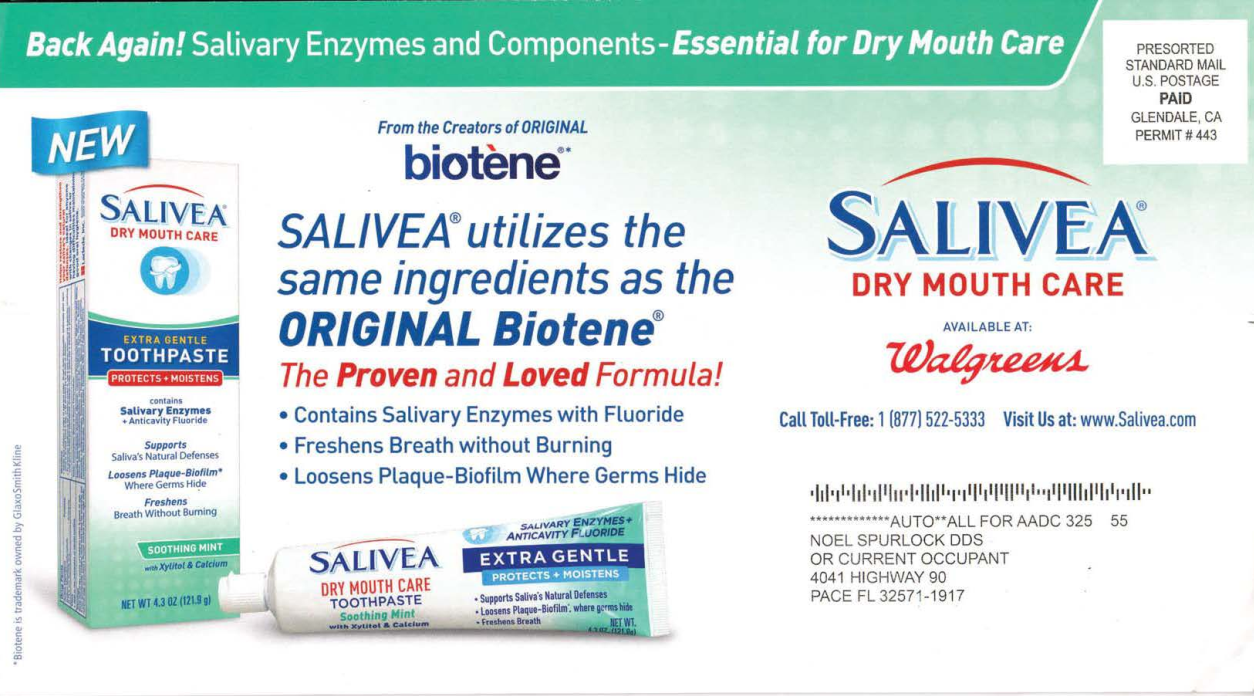
generated at conventions and rebate recipients.” In the first, a green banner announces:
“Back Again! Salivary Enzymes and Components – Essential for Dry Mouth Care.”
Just below that banner, the advertisement reads — in smaller typeface — “From
the Creators of ORIGINAL biotene,” with “biotene” appearing in a stylized font
and featuring a water droplet in the center of the “o.” Just below that, the
largest text on the flyer declares: “SALIVEA utilizes the same ingredients as
the ORIGINAL Biotene. The Proven and Loved Formula!” In mouseprint on the side
is: “Biotene is trademark [sic] owned by GlaxoSmithKline.”

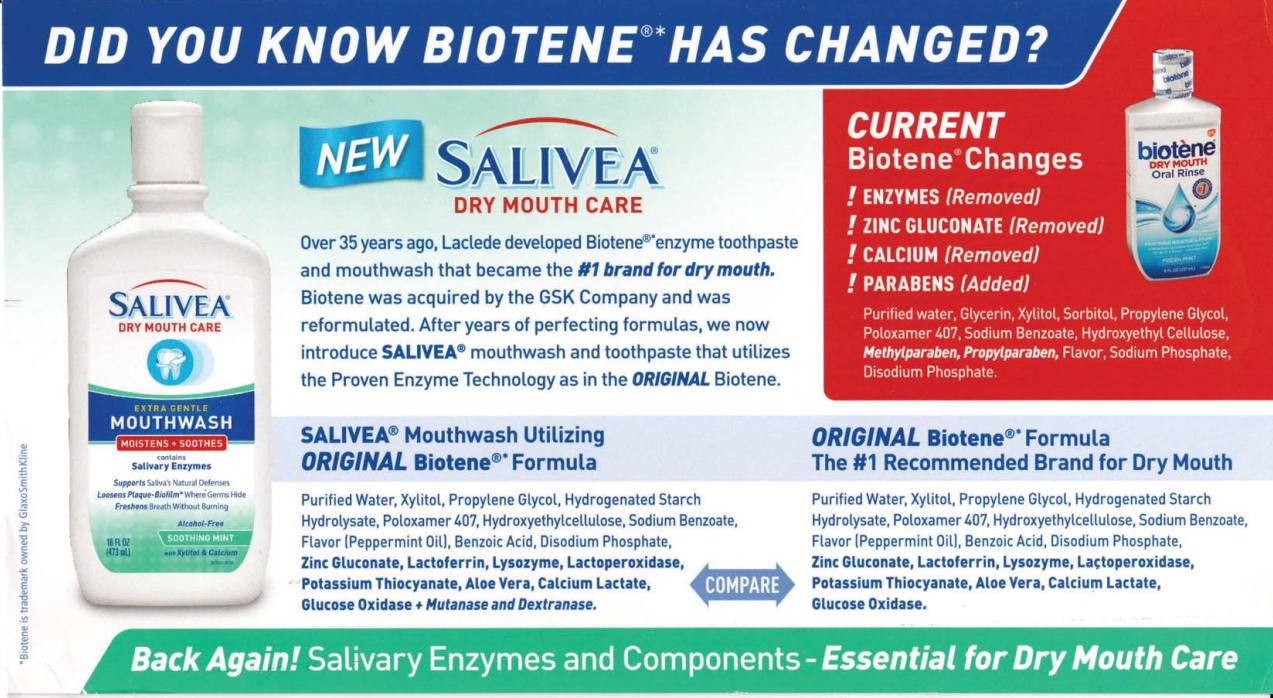
In the second flyer, a header in all capital letters reads:
“DID YOU KNOW BIOTENE HAS CHANGED?” It continues: “Over 35 years ago, Laclede
developed Biotene enzyme toothpaste and mouthwash that became the #1 brand for
dry mouth. Biotene was acquired by the GSK Company and was reformulated. After
years of perfecting formulas, we now introduce SALIVEA mouthwash and toothpaste
that utilizes the Proven Enzyme Technology as in the ORIGINAL Biotene.” Highlighted
in red, the flyer lists “CURRENT Biotene Changes,” including “ENYZMES
(Removed),” and “PARABENS (Added),” alongside a picture of a Biotene oral rinse
bottle. [One would think that this negative information would dispel likely
confusion about source.]  A footer states:
“Back Again! Salivary Enzymes and Components – Essential for Dry Mouth Care.” Above
the footer, the flyer compares “SALIVEA Mouthwash Utilizing ORIGINAL Biotene
Formula” with the “ORIGINAL Biotene Formula / The #1 Recommended Brand for Dry
Mouth.” It has the same disclaimer.

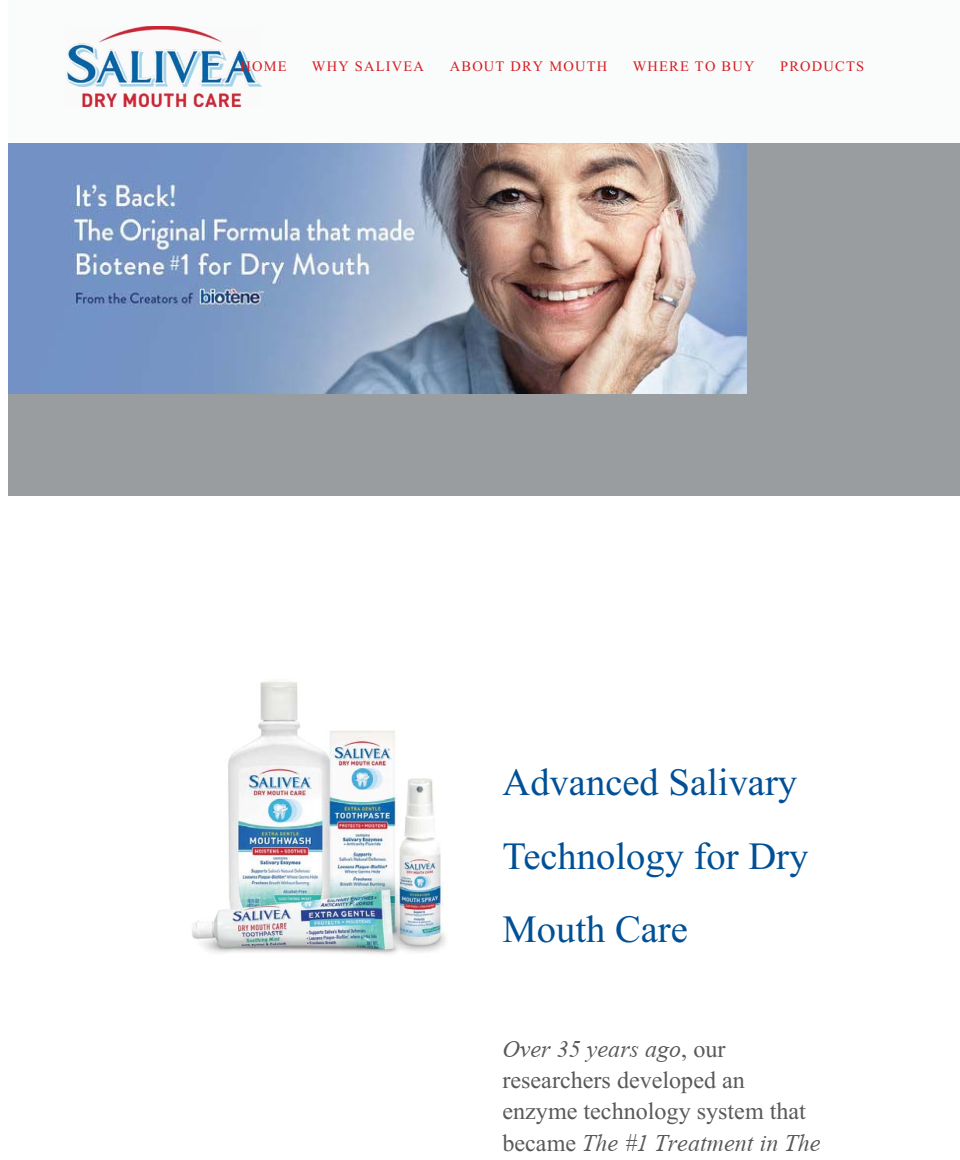
On Salivea’s website, it declared: “It’s Back! The Original
Formula that made Biotene #1 for Dry Mouth.” Below that: “From the Creators of
biotene,” with “biotene” once against appearing in stylized script and
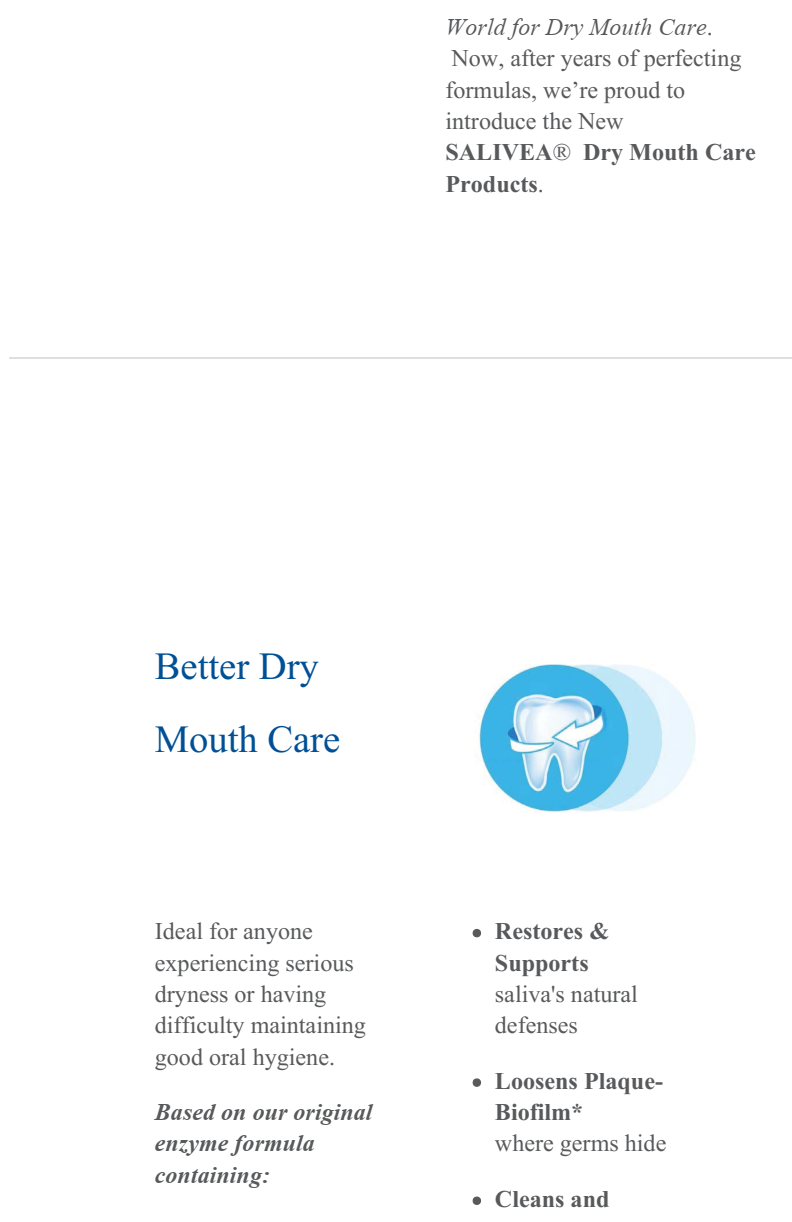
featuring the water droplet. It continues with similar claims: “Over 35 years
ago, our researchers developed an enzyme technology system that became The #1
Treatment in The World for Dry Mouth Care. Now, after years of perfecting
formulas, we’re proud to introduce the New SALIVEA Dry Mouth Care Products.”
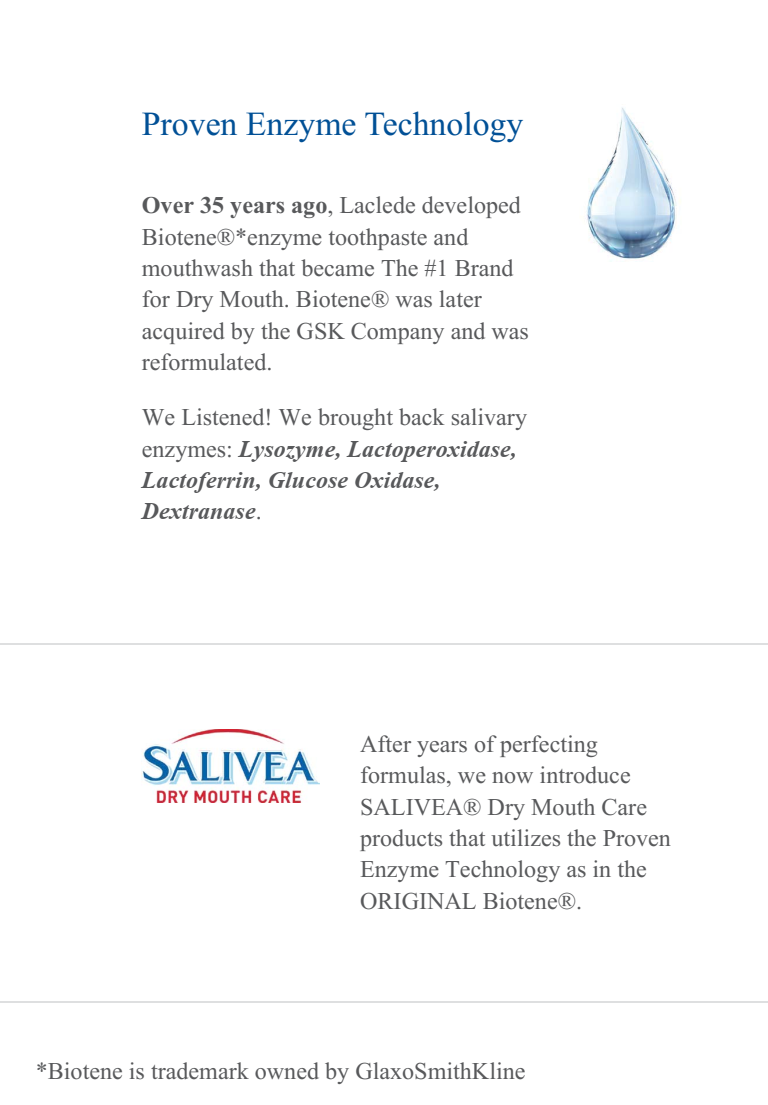
Another page reads: “Proven Enzyme Technology / Over 35 years ago, Laclede
developed Biotene enzyme toothpaste and mouthwash that became The #1 Brand for
Dry Mouth. Biotene was later acquired by the GSK Company and was reformulated.
/ We Listened! We brought back salivary enzymes ….” The same disclaimer
appeared.

In Mohawk Maintenance Co. v. Kessler, 419 N.E.2d 324 (N.Y.
1981), the New York Court of Appeals identified an “ ‘implied covenant’ to
refrain from soliciting former customers following the sale of the ‘good will’
of a business.” This implied covenant isn’t time-limited.  It bars targeted solicitation of former
customers but not advertising to the general public.  “[A]lthough the issue is a close one, the
Court concludes that Defendants’ actions are nearer to the permissible
public-advertising end of the spectrum than to the impermissible
specific-targeting-of-former-customers end of the spectrum.” GSK didn’t
identify any specific former customers that were solicited after the express
noncompete clause lapsed; instead, the complaint alleged that ads were mailed “to
health care professionals, including dentists, throughout the United States.” NY
holds that a seller may “advertise to the public” so long as the advertisement
is “general in nature … and not specifically aimed at the seller’s former
customers.” Targeting a “class” of customers isn’t enough.
The court also rejected GSK’s argument that the second part
of the express covenant—the part binding Laclede’s owners—didn’t expire after
three years.  Though the first part of
the covenant expressly had a three-year term, and the second part didn’t, that
wasn’t dispositive. First, “New York courts adhere to a strict approach to
enforcement of restrictive covenants.” Thus, a non-compete provision that is
“vague and unspecific” will be deemed unenforceable.  And the language here—that the owners “also
agree” to the noncompete—indicates that the prior provision governing Laclede
was what was supposed to apply to the owners. 
And it wouldn’t make sense for Laclede and its owners to be governed by
different non-compete durations. Anyway, “the Court has some doubts that a
time-unlimited non-compete would be enforceable under New York law.”
Trademark claims: because the Second Circuit said so,
nominative fair use is tacked onto the end of the Polaroid factors, even though (1) that makes the test an even more
incoherent mix of normative and empirical parts, and (2) the Second Circuit
acknowledged that a number of the Polaroid
factors don’t fit well with nominative fair use situations.  The court here thus runs through the list. Strength
and competitive proximity favored GSK; similarity is of course identical
because you can’t consider the “comparative purpose” of the use under the
similarity factor, and anyway the materials here prominently featured the Biotene
mark in equal or larger size/prominence to the Salivea mark, so that favored
GSK.
There was some anecdotal evidence of confusion: declarations
from GSK stated that healthcare professionals expressed confusion about the
relationship (e.g., a conversation with an oral hygienist in which the
hygienist stated “that she understood SALIVEA was a GSK product that was
replacing BIOTENE”) and declarations from healthcare professionals themselves
claiming that they were confused (e.g., declaring that, after receiving “a
total of three mailers,” a dental hygienist was “immediately confused as to
whether [SALIVEA] was made by [Plaintiffs], because the mailer referenced that
GSK had reformulated the BIOTENE formula”). The total was seven declarations
recounting around twenty instances of actual confusion.  This favored GSK, but only slightly, given
that Laclede sent approximately 100,000 mailers. “Measured against that number,
twenty reported cases of actual confusion are not a lot. And none of the
declarations address confusion stemming from SALIVEA’s website …. Nevertheless,
even a small number of declarations can be revealing.”
There was also some evidence of bad faith intent to profit
from Biotene’s goodwill.  One mailer
referenced Biotene more often than Salivea. Another said at the top: “DID YOU
KNOW BIOTENE HAS CHANGED?” The main text was “phrased in a way that leaves a
reasonable reader confused about whether Laclede or GlaxoSmithKline
manufactures SALIVEA”: “Biotene was acquired by the GSK Company and was
reformulated. After years of perfecting formulas, we now introduce SALIVEA
….” The court concluded that,
taken together, the heading and the
main text could be easily be read to suggest that GlaxoSmithKline had
reformulated BIOTENE and was repackaging it as SALIVEA. Nowhere on the
Mouthwash Mailer is it evident that SALIVEA is a Laclede, and not a
GlaxoSmithKline, product. And while the depiction of the SALIVEA bottle is
indeed larger than the depiction of the BIOTENE bottle, the overall impression
of the advertisement suggests an untruthful association between SALIVEA and
BIOTENE, on the one hand, and between Laclede and GlaxoSmithKline, on the
other.
The other mailer also “purposefully obscured” the relationship
between the parties, prominently declaring that SALIVEA is “From the Creators
of ORIGINAL biotene,” (with “biotene” in its distinctive, stylized typeface),
and states that “SALIVEA utilizes the same ingredients as the ORIGINAL Biotene
– The Proven and Loved Formula.” It didn’t clarify that Laclede and
GlaxoSmithKline are separate entities or that SALIVEA is not related to
BIOTENE. “Instead, the advertisement leaves the inevitable impression that
SALIVEA is a follow-on to, or an improved version of, BIOTENE made by the same
manufacturer as ‘the ORIGINAL Biotene.’”
Quality favored neither side, because it is a garbage factor
that should be eliminated from the current test, and consumer sophistication
favored Laclede.
Nominative fair use factors: in the Second Circuit, the
first one is “whether the use of the plaintiff’s mark is necessary to describe
both the plaintiff’s product or service and the defendant’s product or service,
that is, whether the product or service is not readily identifiable without use
of the mark.” Here the court bobbles: “First, it is plainly not ‘necessary’ for
Defendants to use Plaintiffs’ mark to describe SALIVEA.”
This a bad result aided by the Second Circuit’s mashup of
the nominative fair use test from multiple circuits with the usual Polaroid
factors.  In the non-Third Circuit
version, the question is not (as it is with descriptive fair use) whether the
use of the mark is necessary to describe the defendant’s product; it’s whether
it’s necessary to describe the plaintiff’s product/service to identify it for
purposes of discussion. The Third Circuit limited nominative fair use to the
hybrid situation where the defendant needed to explain its genesis/experience
in order to explain the reason consumers might trust it (which, not for
nothing, seems relevant here), but that makes nominative fair use captive to a
variant of descriptive fair use.  The better
treatment, which seems acceptable under the Second Circuit standard would be to
evaluate the necessity of the reference to
the specific claim being made
(e.g., “Salivea uses the original, good
formulation that Biotene has abandoned”). 
Here, however,  the court
reasoned, because Salivea could easily describe itself as “dry mouth care”
etc., there was no need to mention plaintiff’s mark. [So if I’m an architect
who worked for another firm for three decades, there’s no need to mention that
firm because I can just describe myself as an “architect”?  That seems … restrictive, and in tension with
the First Amendment. The ultimate result here may be right, but it’s not because
of any lack of necessity—it’s because of what comes next.]
Next, Laclede used more of the Biotene mark than is
necessary to identify SALIVEA. This factor requires courts to evaluate whether
the defendant used the mark “too prominently or too often, in terms of size,
emphasis, or repetition.” As discussed above, it did.
Third, Laclede “suggest[ed] sponsorship or endorsement by
the plaintiff holder” and obscured “the true or accurate relationship between
plaintiff’s and defendant’s products.” The ads suggested that Salivea was “a
replacement for, or a follow up to,” Biotene, most evidently in the headlining
text “DID YOU KNOW BIOTENE HAS CHANGED?”  [I’m guessing that the result is different for
a headline “DID YOU KNOW BIOTENE HAS CHANGED FOR THE WORSE?”]  The ambiguous “we now introduce …” language also
hurt.
On balance, GSK showed likely confusion.
It also showed irreparable harm through showing “loss of
reputation and goodwill.” Irreparable harm “ ‘exists in a trademark case when
the party seeking the injunction shows that it will lose control over the
reputation of its trademark pending trial,’ because loss of control over one’s
reputation is neither ‘calculable nor precisely compensable.’ ”  As framed, this is equivalent to a finding
that likely confusion automatically means irreparable harm, since it would
always be true by definition.  This
result is inconsistent with eBay, and
it wrongly conflates the idea of lost control with the idea of harm from the lost control materializing,
which is (in the absence of further evidence, say of the inferiority of the
defendant’s product) not shown merely by showing the existence of the
risk.  In other words, the logic of “lost
control” is that irreparable harm is possible, but possibility is not
likelihood, which is the standard in other cases.
With that out of the way, it wouldn’t be a hardship to refrain
from overreliance on GSK’s marks in advertising, especially since Laclede
already discontinued the mailers at issue.  And a preliminary injunction limited to
enjoining trademark violations would not disserve the public interest.
However, GSK sought relief that was too broad, including “all
use of the words ‘#1 Brand for Dry Mouth, It’s Back, ‘Back Again,’ ‘Brought
Back’ or variations thereof,” and “the dissemination of any and all claims
referencing Laclede’s prior ownership of the BIOTENE brand.”  GSK’s request for a laundry list of
prohibitions was inconsistent with its focus in the likely confusion analysis
on the totality of the advertising, and the court agreed that the proper approach
was to look at the total impact of the uses. GSK’s proposed injunction could
“sweep in instances of nominative fair use.”  Thus, the preliminary injunction issued by the
court covered: all use of the registered blue-and-red Biotene logo, or any
confusingly similar variation thereof; all use of any images of the packaging
for Biotene products; and the dissemination of any advertising or packaging
materials declaring that Salivea is a successor of, or replacement for, Biotene;
and any ads substantially similar to the two prior mailers. [In many ways, the
limited scope of the injunction makes up for the narrowness of the nominative
fair use reasoning, except insofar as other claimants will cite only the narrow
reasoning against other comparative advertisers.]

from Blogger http://bit.ly/2MCzAm4

Posted in Uncategorized | Tagged , | 1 Comment

reality series “Love at First Flight” doesn’t infringe previous web series of same name

Reflex Media, Inc. v. Pilgrim Studios, Inc., No. CV
18-2260-GW(FFMx), 2018 WL 6566561 (C.D. Cal. Aug. 27, 2018)

The court here dismisses trademark/unfair competition and
copyright claims against a reality TV show with the same name as Reflex’s
earlier YouTube series on the same general idea, “Love at First Flight.”  The copyright claims were dismissed with
prejudice, the TM/unfair competition claims without, and Reflex dismissed the entire
case thereafter.
In early 2015, Reflex began to develop a reality
entertainment series, Love at First Flight. Its coplaintiff Clover8 applied for
a federal trademark registration.  “In
advertising for the Original Series, it was described as a new web series by
travel dating site, MissTravel.com, following two ‘singles’ as they go on a ‘destination
first date.’” The advertising asked: “Will these singles miss their connection,
or will they find Love at First Flight? Watch to find out!”  Reflex cast “individuals with substantial
social media audiences.” The first four episodes appeared in August 2015 and
are still featured on a YouTube channel and the MissTravel website. Each
episode notes in the description that it is part of the Love at First Flight
series (using standard font) and features a logo, “LOVE AT FIRST Flight by Miss
TRAVEL,” in mixed cursive/block lettering and mixed black/aqua colors.

In late 2015, one of the defendants approached Reflex about
adapting the original series for TV. They had various connections to the other
defendants, some of whom began to develop the allegedly infringing series.  In late 2016/early 2017, they began to cast
people; the casting call was titled “Take A Trip and Meet the Love Of Your Life
On FYI Network’s TV Show Love at First Flight.”  Reflex first wanted a piece of the pie and
then asked them to use a different name for trademark reasons, but received no
response.
Six days after Reflex told the relevant defendants it owned
a common law trademark, defendants applied for “LOVE AT FIRST FLIGHT” as an ITU
for “[e]ntertainment services in the nature of a television and multimedia
program series featuring subjects of general human interest distributed via
various platforms across multiple forms of transmission media; providing
entertainment information to others via a global computer network.” The filing
declarations included a statement of belief that it was entitled to use the
mark in commerce and that no one else had that right.
Despite further protests, defendants showed the first
episode of their show on March 20, 2018 on Lifetime, owned by A&E, and
aired eight total episodes. After the debut of the allegedly Infringing Series
and five more times, AfterBuzz TV published a 52 minute video titled, “Love at
First Flight Season 1 Episode 1 Review & Reaction,” discussing the
allegedly infringing series. To promote the series/the aftershow, defendants
(at least AfterBuzz) allegedly used Reflex Media’s logo as its thumbnail
image link to the After Show’s live stream and video.

As for the alleged copyright infringement, Reflex alleged
that its series
consists of individuals meeting for
the first time in-person on multiple-day dates in exotic locations such as Hawaii;
Cabo San Lucas, Mexico; Vancouver, Canada; and Costa Rica, and other planned
locations to include landlocked cities like Las Vegas. The participants
featured in the show are young attractive singles who participate in bonding
activities such as: attending a live performance featuring shirtless male
dancers, zip lining amongst trees, dinner dates, waterfall activities, boating,
paddle water activities, and ocean snorkeling.
It alleged that defendants’ series
similarly consists of multiple-day
dates in exotic locations such as Hawaii, Las Vegas, Seattle, and New York
City. The participants featured in the Allegedly Infringing Series also are
young attractive singles who participate in bonding activities such as:
attending a live performance featuring shirtless male dancers, tree climbing
using climbing lines, waterfall activities, boating, paddle water activities,
and ocean snorkeling.
The complaint also alleged that both sets of series convey a
“theme and mood of fun, adventure, and anticipation for the prospect of
burgeoning romantic feelings between the participants on the show”  and that defendants “copied the core plot,
theme, mood, settings, and characters of the Original Series, including an
attempt to use one of Reflex Media’s previously used cast members.” The “theme
and mood” of each show allegedly “conveys fun, adventure, and anticipation for
the prospect of burgeoning ‘romantic feelings’ between participants.”
Trademark claims: Rogers
applies, and Empire tells us
there’s no exception for title-on-title claims in the 9th Circuit. (1)
Artistic relevance is obviously above zero based on the pleadings, but (2)
after the Honey Badger case, the second prong requires more factual analysis
and might not be appropriately resolved on a motion to dismiss, even though it requires explicit misleadingness
and the relevant question is “whether there was an ‘explicit indication,’
‘overt claim,’ or ‘explicit misstatement’ that caused … consumer confusion.” As
past precedent establishes, survey evidence demonstrating confusion over
endorsement isn’t relevant: “evidence must relate to the nature of the behavior
of the identifying material’s user, not the impact of the use.”
Reflex identified three facts that it thought showed
explicit misleadingness: (1) both series bear the same name, (2) YouTube shows commingled search
results for both series, and (3) AfterBuzz promoted the allegedly infringing series
using the Reflex logo. However, the complaint did not allege explicit misleadingness
about the content or source of the work. “Plaintiffs’ reference to what
essentially amounts to mere use is not enough to satisfy this prong.”  [The relationship between AfterBuzz and the other
defendants was not entirely clear. According to the complaint, they “partnered” with AfterBuzz to promote the show. AfterBuzz describes itself as “the digital broadcast network dedicated to producing live and on-demand after-shows, news and coverage for nearly every TV show.” Make of that what you will; it sounds like a careless person involved in producing/uploading the video grabbed the wrong image, which I agree is a mistake–among other things, it promoted a website that hadn’t paid for the privilege–but probably shouldn’t contaminate the rest of the activities at issue.]
Dismissed without prejudice.
The copyright claims fared even worse; based both on the
allegations and the judicially noticed/intrinsic to the complaint content of
the two shows, the court dismissed them with prejudice for failure to satisfy
the extrinsic test for substantial similarity.
Plaintiffs argued Ninth Circuit precedent doesn’t allow for
dismissal of a copyright claim once the allegations are properly in place, but
that’s not true where it’s extrinsic similarity that’s the problem.  
In applying the extrinsic test, courts compare “not the
basic plot ideas for stories, but the actual concrete elements that make up the
total sequence of events and the relationships between the major characters.”
Courts filter out “(1) scenes a faire that necessarily
result from the choice of a setting or situation; (2) purely utilitarian
elements; and (3) elements of expression merged with the underlying idea.” In
this analysis, elements that are “similar at the abstract level” but are
“markedly different” in their particulars are not substantially similar.
The plots here were very simple (and the allegedly
infringing series followed the structure of many other dating reality shows, the
existence of which the court took judicial notice).  Defendants’ hour-long series had participants
paired off with another person with whom they embark on a 30-day trip across
the United States. All eight episodes tracked the same handful of pairs, “with
the looming and ultimate question being whether they will ultimately marry the
other person.” At each location, they engage in bonding activities and win or
lose various challenges, rewarding with either a motel or a luxurious hotel,
depending on the outcome. At the finale, the pairs physically go to the wedding
altar and decide whether they will marry each other or not.
Reflex’s series had key differences: each 13-minute long
episode followed one pair of participants that meet for the first time in
mostly foreign destinations. “Among each pair, one person is a social media ‘influencer’
or ‘personality’ with the other participant being a ‘Miss Travel [dating
application] user.’” The show mentions Miss Travel throughout and the pair
generally stays at high-end vacation rentals. The parties generally go their
separate ways at the end of the episode. “In the four episodes presented to the
Court, the couples get along with little to no friction,” in contrast to some
of the events on the reality show.
The generic elements were similar, but there were no
substantial similarities in the plot’s objective details. The court filtered
out: (1) casting young attractive singles, (2) filming multiple-day dates in
exotic locations, (3) contestants participating in bonding activities, and (4)
a theme and mood of fun, adventure, and anticipation for the prospect of
burgeoning romantic feelings between the participants on the show. That last
generic stock theme/mood  “necessarily
flows from the basic generic premise of the shows about participants dating
through bonding activities while traveling.” There was no alleged similarity in
dialogue, and the settings varied (Reflex generally used large US cities, while
the allegedly infringing series was predominantly set outside the US mainland),
and even if the settings had been the same/similar, that would still have
flowed from the basic premise and constituted non-protectable scenes-a-faire. As
for characters, “the participants play themselves. … Though there might be
similarities between some of the characters, such as their pursuit of romance
or love, those are merely stock character traits and they flow from the basic
premise of the series.”  The paces of the
series were markedly different—pairs interacted for a short period in the
original series, and for 30 days in the allegedly infringing series. The pace
of each series flowed naturally from their implementation of the basic plot
premise.
Identical titles: here the law wobbles. Titles aren’t protected
by copyright, but can “have copyright significance as one factor in
establishing whether the substance of plaintiff’s work (not the title) has been
copied.” [As circumstantial evidence of copying in fact … okay, I guess, but how
it relates to substantial similarity is completely unclear, but it’s the Ninth
Circuit.] Despite the title, there’s no substantial similarity between any protectable elements here, so the court
dismissed the copyright claim with prejudice.

from Blogger http://bit.ly/2FxsoGZ

Posted in Uncategorized | Tagged , | Leave a comment

What’s UpCounsel? LegalForce thinks it’s false advertising

LegalForce RAPC Worldwide P.C. v. UpCounsel, Inc., 2019 WL
160335, No. 18-cv-02573-YGR (N.D. Cal. Jan. 10, 2019)
LegalForce’s litigation against various competitors in the
trademark registration world continues. 
UpCounsel “is an online marketplace for legal services that enables
users (primarily entrepreneurs and businesses) to find and hire attorneys via
its website.” LegalForce sued UpCounsel for false advertising and unfair
competition, including acting as an unregistered lawyer referral service.
Here, some of the false advertising claims were dismissed as
puffery, while others survived.
Law firm/virtual law firm: Exemplary statements included:
“We are the world’s largest virtual law firm for businesses of any size. We
allow businesses to get high-quality, cost-effective legal services. While our
lawyers serve as outside general counsel to many companies, we also assist with
specialized legal work like IP, immigration, commercial contracts, litigation,
and much more.” The “world’s largest” part was nonactionable puffery.  The “virtual law firm” part was not actionable
because of the context, which also introduced UpCounsel as a “startup” that enabled
others to “find” attorneys and thus indicated that UpCounsel was a platform
rather than a true firm.  I understand
the court to be reasoning that there are “tech platforms that enable individual
lawyers to communicate with clients” (Uber, but for lawyers) and there are “law
firms,” and because most of the challenged statements gestured at identifying
UpCounsel as a “platform,” all the rest of that understanding—including that
the lawyers would be individuals operating separately—would naturally follow.  On the one hand, seeking legal counsel does
require some care and attention from a reasonable consumer; on the other, (1)
the whole point of the service is to target people starting businesses fresh, who
may not know the ins and outs of the legal services market; (2) even experienced
nonlawyers may reasonably not know very much about the important differences
between a “law firm” and other means of getting legal services. Anyway, similar
statements were analyzed similarly, where there was mention both of a “virtual
law firm” and of independent contractors or a claim of “as good as using a law
firm.”
However, claims of the form “Top 5% of { Practice Area}  Lawyers in { City}” were not puffery.  LegalForce alleged that “[b]y indicating
‘5%’, UpCounsel implies that there exists an independent and publicly trusted
ranking system in each and every city and the attorneys that UpCounsel lists on
its city pages are chosen from the top 5% of such a list. In reality, no such
list exists.” It quoted a review by a customer of UpCounsel who said the reason
he selected UpCounsel was because he believed it was “a network for only the
most top notch legal reps in the area” and “[t]he attorneys offered with them
are at the top of their game and you will get what you pay for.” Another customer
wrote
that he was deceived when he saw an advertisement on a search engine “[o]ffering
‘Business Legal Services On-Demand by Top Attorneys’” and thought that a disruptive
startup would be a good, cheaper choice for a disruptive startup to use. He
concluded: “I wish I had never used UpCounsel and I’m warning all startups,
business and companies out there to never make the same mistake!” [Which goes
to show that you maybe shouldn’t hire a lawyer the way you’d summon a Lyft.]
Lanham Act claims based on the claim of “Top 5% of Trademark
Attorneys” already survived a motion to dismiss on the basis of puffery. Challenging
similar statements pertaining to other types of attorneys, namely patent,
intellectual property, copyright, and startup attorneys, didn’t change the
analysis. UpCounsel cited Hackett v. Feeney, No. 2:09-cv-02075-RLH-LRL, 2011 WL
4007531 (D. Nev. Sept. 8, 2011) to argue that, in order to be actionable, the
statement must answer the “critical question ‘[Top 5%] as determined by
whom[?]’ ” But that case involved a “voted
#1 best show in Vegas!”; not only is #1  particularly puffy, but voting on a best show
is also puffier than specifying a specific category of attorneys. Specifying a
specific practice area meant that “[i]t cannot be said that no reasonable
consumer would rely on such an assertion.”
UpCounsel argued that Google made the challenged statements,
not UpCounsel, but this didn’t work at the motion to dismiss stage.  “Plaintiffs allege that the search results ‘republish’
statements originally made by UpCounsel. The issue of who actually made the
statements (i.e., the search results) is a factual issue to be resolved at
summary judgment.”
The same result happened with “The 10 Best { Practice
Area}  Lawyers in { State}  NEAR ME,” which was allegedly false because “individuals
listed in each resulting page are not usually near the customer who did the
search, and often not even in the same state.” 
“A reasonable consumer reading these statements could conclude that
UpCounsel attorneys are objectively and measurably superior to other ‘{
practice area}  lawyers in { state}’ near
the consumer.” [And even if not, they could reasonably conclude that those were
lawyers “near” them.]

So too with “{ City} 
{ Practice Area}  Lawyers 5.0
***** Based on { X number of}  reviews,” e.g.,
“Cotati Intellectual Property Lawyers 5.0 ***** Based on 5450 reviews.” That
was allegedly false because “It is impossible for Cotati Intellectual Property
Lawyers to have 5,450 reviews on UpCounsel. Cotati is a small town in Northern California
with a population of 7,455. There are only 21 attorneys in the city of Cotati
licensed to practice law in California, and none of these 21 attorneys are
listed on UpCounsel.” (Among other things, one guy who allegedly never even
used the UpCounsel platform appeared as a “Top 5%” franchise lawyer in Santa
Rosa, California, “Top 5%” copyright lawyer in Coeur d’Alene, Idaho, and a “Top 5%” intellectual property
lawyer in Montgomery, Alabama, among other practice areas and cities.)  Invariably, LegalForce alleged, UpCounsel
would display a five-star rating, resulting from deceptively aggregating
reviews to make it seem as if the reviews came from actual customers in those
cities and states.” UpCounsel allegedly used code to “refresh” its reviews to
make them more attractive to Google.
UpCounsel argued that use of SEO techniques “as a means to
its advertising ends” didn’t state a claim under the Lanham Act because UpCounsel’s
“software code” wasn’t a statement that was seen or relied on by customers, and
that statements regarding five-star reviews were non-actionable puffery. The
first issue, whether the code is (or made) a statement that consumers saw and
relied on was a factual issue for summary judgment. The statements were not
puffery. [Among other things, that there were X number of relevant reviews is a
verifiable statement, even if the individual statements in the review might be non-factual.]
Similarly, LegalForce alleged that UpCounsel “intentionally
and purposefully, and in bad faith, attempts to deceive Google search crawlers
and the public that uses Google to search for legal services.” For example,
“UpCounsel’s tag for its 5450 fabricated reviews for attorneys in Cotati is
based on a fraudulent data field called ‘reviewCount’ which is printed on each
page,” and “UpCounsel’s page source for each of its tens of thousands of
reviews” includes code whose the sole purpose was to “trick search engines into
recognizing UpCounsel’s aggregate ratings as trustworthy.” Using this code
allegedly intentionally violated Google’s technical and content guidelines.
UpCounsel argued that its “software code” and HTML “page
source” weren’t statements that were seen and relied on by customers. Further, a
false advertising claim requires a false statement made by the defendant, so
UpCounsel argued that a claim couldn’t be based on search results that LegalForce
elicited from a search engine using words that LegalForce chose. The court
agreed that, standing on their own, the software code and HMTL page source weren’t
actionable statements. But LegalForce’s pleading “tied the software code and
HTML page source to specific actionable statements,” such that UpCounsel’s actions
caused search results to include false and misleading statements.  The software code and HTML page source were thus
allegedly evidence of intent to mislead consumers.
Next, LegalForce alleged that “UpCounsel deceives customers
by steering them to attorneys and non-attorneys who are not located anywhere
close to their city, or authorized to practice in their respective state” or in
any state. Among other things, UpCounsel listed patent agents as lawyers;
UpCounsel conceded that three examples cited in the complaint were in fact patent
prosecutors (among other things, a patent agent appeared as a “Top 5%”
immigration lawyer in Blackfoot Idaho and as an “Oregon Attorney[ ] &
Lawyer[ ] for Hire On-Demand” through UpCounsel). But UpCounsel argued that it didn’t
steer anyone to unlicensed attorneys and that nothing on its UpCounsel’s
website represents that these individuals are attorneys.
Comment: Google search results are answers to questions,
which thus could be false as answers—and potentially false advertising under
the right circumstances—even if they lack a true/false value standing alone. If
UpCounsel programs its site to respond to a search for lawyers with unlabelled nonlawyers
or lawyers outside the jurisdiction and use the headline “Top 5% of Patent
Lawyers in Oakland, California,” then the response can be as false as if I
asked for Diet Coke at a restaurant and was given undisclosed Diet Pepsi in
return (and though I am loath to admit it, the results for consumers could be
far worse).  There’s nothing inherently
false about Diet Pepsi; the falsity is in the use in response to a request for
something else. 
However, this formulation seems to foreground a §230 issue
that is not discussed in the opinion: does UpCounsel rely on what its (putative)
lawyer-contractors tell it?  Or does the
problem come from non-§230 protected decisions made by UpCounsel on how to
structure or label the website?  This formulation
also highlights that labelling may be the key here: there’s nothing wrong with
advertising an alternative to what the consumer is searching for, but even in
the comparatively more liability-happy area of trademark the courts have
understood that labeling is the key.  One
question is whether ultimately it should matter that, in the individual
description of the lawyer/patent agent on the page of “patent lawyers,” (1) that
description is provided by the user, or (2) the description is clear, which in
the case of the specific patent agent identified by the complaint it was not—he
offered “legal services” and “patent prosecution services” but didn’t disclose
that he was a nonlawyer, something another nonlawyer might not notice
especially among a page of lawyers offering similar services.  When I search Amazon I often get a set of results
that don’t make any sense (something to do with algorithmic manipulation
or something even
weirder
?); is Amazon falsely advertising to me because of those bad results,
which come from seller-provided information? 
My sense is that the answer is no, but then again the fact that some of
the results are bad is much easier to determine when I’m looking for girls’
pants size 10; I also think that it is different for a platform to claim to
provide access to legal services in particular, which structures consumer
expectations when looking at specific entries.
One problem seems to be that UpCounsel structured its own
page/headline creation algorithm to be so overenthusiastic that it recommended
lawyers far outside their practice areas or states of licensure.  Unless that came from data entered by
individual participants checking boxes for those practice areas/states, I think
that §230 would not pose a barrier to liability for such structuring.
Anyway, the court concluded: “Accepting as true plaintiffs’
allegation that the search results ‘republish’ statements originally made by
UpCounsel, as the Court must in analyzing UpCounsel’s motion to dismiss,
UpCounsel cannot reasonably argue at this stage that it has not made false
statements by way of the search results.”
UCL claims:  Allegations
of lost business and decrease in business value, and allegations of wrongfully
denied business opportunities, sufficed to plead standing under the UCL’s
expansive standing doctrine.  But could LegalForce
bring claims based on violations of other laws that didn’t themselves provide a
private cause of action? Usually, yes; the limit is that plaintiffs may not
“plead around an absolute bar to relief” by recasting the cause of action as a
claim under the UCL: “[t]o forestall an action under the unfair competition
law, another provision must actually ‘bar’ the action….” by explicitly
precluding private enforcement or expressly providing immunity for the conduct
alleged.
Some of the other rules that LegalForce alleged UpCounsel
violated thus allowed a bootstrapping UCL claim, such as the provision of the California
Business and Professions Code section that bars unregistered attorney referral
services. This was not enforceable by private parties, but its violation could
be borrowed to create a remedy under the UCL. However, the California ules of
Professional Conduct expressly provide: “These rules are not intended to create
new civil causes of action.”  Their
violation couldn’t be borrowed for a UCL claim. As for federal USPTO rules of
professional conduct, the court found no binding or citable authority that the
claims were impliedly preempted.
The UCL unfairness claim also survived. As a competitor,
LegalForce had to use the more limited definition of “unfair”: they had to
plead “conduct that threatens an incipient violation of an antitrust law, or
violates the policy or spirit of one of those laws because its effects are
comparable to or the same as a violation of the law, or otherwise significantly
threatens or harms competition.” UpCounsel argued that this couldn’t be done without
pleading “a reduction of competition in the market in general and not mere
injury to their own positions as competitors.” The court didn’t agree that
LegalForce had to state an antitrust claim to proceed.  They sufficiently pled that UpCounsel’s
actions “otherwise significantly threaten[ ] or harm[ ] competition,” given
allegations that UpCounsel gave itself an unfair advantage over legitimate,
rule-following competitors.

from Blogger http://bit.ly/2FyALRI

Posted in Uncategorized | Tagged , , , | Leave a comment

FDCA preempts arguments that structure/function claims in fact mislead about disease prevention

Dachauer v. NBTY, Inc., — F.3d —-, 2019 WL 150016, No.
17-16242 (9th Cir. Jan. 10, 2019)
Defendants make vitamin E supplements that claim, on their
labels, to “support cardiovascular health” and to “promote[ ] immune function,”
“immune health,” “heart health,” and “circulatory health.” Dachauer alleged false
advertising, because the supplements do not prevent cardiovascular disease and
might increase the risk of all-cause mortality. The district court granted summary
judgment, and the court of appeals affirmed, mostly on the alternate ground of
preemption.

The FDCA distinguishes between “disease claims” and
“structure/function claims” for dietary supplements. A structure/function claim
“describes the role of a nutrient or dietary ingredient intended to affect the
structure or function in humans” or “characterizes the documented mechanism by
which a nutrient or dietary ingredient acts to maintain such structure or
function,” but “may not claim to diagnose, mitigate, treat, cure, or prevent a
specific disease or class of diseases.” A disease claim, conversely, “claims to
diagnose, mitigate, treat, cure, or prevent disease,” either explicitly or
implicitly. To make a structure/function claim, the manufacturer must have substantiation
that the statement is truthful and not misleading; the statement must contain a
prominent disclaimer that the FDA hasn’t evaluated the statement and that the
product “is not intended to diagnose, treat, cure, or prevent any disease”; and
the statement must not itself “claim to diagnose, mitigate, treat, cure, or
prevent” disease.
The FDA’s guidance states that structure/function claims may
use general terms such as “strengthen,” “improve,” and “protect,” as long as
the claims “do not suggest disease prevention or treatment.” It holds that, for
example, “supports the immune system” doesn’t imply disease prevention, even
though by any ordinary rules of communication it does.  The FDA further allows substantiation of
structure/function claims with evidence of an effect on a small aspect of the relevant
structure/function, rather than with evidence of an effect on the main disease
that consumers associate with that structure or function.  [A concise explanation of the extremely underregulated
features of supplement law, as compared to other fields.]
California law doesn’t allow private plaintiffs to demand
substantiation for advertising claims. The private plaintiff bears the burden
of producing evidence to prove that the challenged statement is false or
misleading.  [Though of course it could
be false or misleading by explicitly or implicitly claiming to have
substantiation that doesn’t exist.]
The FDCA expressly preempts any state law that establishes
“any requirement respecting any claim of the type described in section
343(r)(1) of this title made in the label or labeling of food that is not
identical” to FDCA requirements such as those for structure/function claims.
The argument that defendants’ structure/function claims were false because the
supplements don’t prevent cardiovascular disease were thus preempted.

There was “ample” evidence that vitamin E supplements, taken in the doses that defendants
sell, fail to prevent cardiovascular disease. Plaintiff’s expert argued that “no
metric except the absence or presence of cardiovascular disease can measure
heart health,” but this was a rejection of the two separate FDCA categories and
thus not an acceptable conclusion because it would impose a non-identical
requirement on supplements that claim to promote heart health.  [I think this is the right result under the
law, which highlights that the current law has nothing to do with truth or truthful
communication.  One could have a regime
that allowed more specific claims—taking supplements with this ingredient is
associated with improved indicator X, which itself may be associated with a
lower risk of heart disease—but that’s not the system we have, which allows the
manufacturer to skip all the qualifications and inherently imply broad-based
efficacy by using the approved structure/function formulation.] The same was
true for defendants’ claim that their supplements promote immune health, even
if the supplements fail to reduce all-cause mortality.
However, the misleadingness claim based on the argument that
the supplements increase the risk of
all-cause mortality was not preempted. FDCA regulations say that a label “shall
be deemed to be misleading if it fails to reveal facts” that are “[m]aterial
with respect to consequences which may result from use of the article” under
normal conditions of use or the conditions of use that the label prescribes. “In
other words, if a supplement’s label recommends taking one capsule per day, and
that dose actually causes an increased risk of death—a material fact ‘with
respect to consequences which may result from use of the article’—the FDCA
would deem it misleading not to reveal that fact on the label.”  That would also violate California law.
However, the record lacked evidence that vitamin E supplements were actually
harmful, as opposed to simply useless at reducing all-cause mortality (which
they do not claim to reduce). At best, the record showed a “small” correlation
between high-dose vitamin E supplements and an increased risk of all-cause mortality.
The meta-analyses showing this correlation didn’t conclude that vitamin E
supplements caused an increased risk
of all-cause mortality. That wasn’ enough to create a genuine issue of material
fact.

from Blogger http://bit.ly/2VKVzv9

Posted in Uncategorized | Tagged , , , , | Leave a comment

Claims in contracts aren’t “advertising or promotion”

Segerdahl Corp. v. American Litho, Inc., No. 17-cv-3015, 2019
WL 157924 (N.D. Ill. Jan. 10, 2019)
This opinion deals with Lanham Act/coordinate state law counterclaims
by American Litho against Segerdahl. The parties compete within the direct mail
service market, a subset of the printing and marketing industry. American Litho
challenged statements on Segerdahl’s website:
Our ability to handle your sampling
program from start to finish under one roof means greater security, better
quality and shorter turn-time.
We specialize in digital, web and
sheetfed offset printing-all housed within our single campus network to provide
a level of flexibility not found anywhere else.
Our integrated campus and
end-to-end capabilities allow us to easily maintain control of your most
intricate projects.
We are the only facility that can
execute your entire sampling program on one campus-providing greater security,
faster time to market, tighter quality and inventory control.
American Litho also challenged Segerdahl’s statements in its
contracts with three of its customers, agreeing to perform all printing
services in-house despite subcontracting portions of the work without their
customers’ knowledge.  The statements in
those contracts weren’t “commercial advertising or promotion.”  Statements to current customers aren’t “communicated
for promotional purposes.”
Website statements: These were puffery. American Litho argued
that Segerdahl’s website misled potential customers to believe that all
printing jobs are handled on-site, but the statements were either exaggerated or
so vague that they couldn’t be proven or disproven. American Litho focused on
the phrase “from start to finish under one roof,” but the entire statement
merely “brags on Segerdahl’s ‘ability’ to handle printing jobs that results in ‘greater
security, better quality and shorter-turn time.’” Other similar statements were
tied to claims about Segardahl’s generalized awesomeness. “Does American Litho
suppose that customers are comparing with all industry rivals to verify whether
Segerdahl truly offers ‘a level of flexibility not found anywhere else?’ The
Court is doubtful…. One would expect these types of subjective nonquantifiable
statements to be posted on a company’s website. That is the very purpose of
advertisement.” [Ugh. I liked it when the purpose of ads was to convey actual information.]
 Ultimately, these were “nonactionable
highly subjective claims.”

from Blogger http://bit.ly/2QH8J8y

Posted in Uncategorized | Tagged | Leave a comment

false advertising claim needs to talk about asterisks to plead with particularity

Anthony v. Pharmavite, 2019 WL 109446, No. 18-cv-02636-EMC
(N.D. Cal. Jan. 4, 2019)
Despite generally favorable substantive rulings for
plaintiffs, the court dismisses the complaint for false advertising of a nutrition
supplement for failure to plead with particularity under Rule 9(b),
specifically for failing to discuss the asterisks on the claims at
issue.
Pharmavite represents that its biotin supplements “may help
support healthy hair, skin and nails.” Each health benefit representation on a
label includes either an asterisk and obelisk (*†) or two obelisks (†‡), which
I will shorthand as asterisks. The relevant references are to a disclaimer on
the back of a label that says: “Biotin may help support healthy hair, skin, and
nails in those that are biotin deficient” 
or “May help support healthy hair, skin and nails in those deficient in
biotin.”  This is allegedly misleading
because “most people obtain more than enough biotin from their daily diets, so
biotin supplements are unneeded, superfluous, and will provide no health
benefits. Only a minuscule percentage of individuals with biotin deficiencies
could potentially benefit from biotin supplements.” Allegedly, “[o]nce there is
sufficient biotin in the body, any additional supplements are superfluous and
the body ultimately excretes them.” The only benefits would come to people with
 “exceedingly rare conditions that cause
… biotin deficiencies—less than [0.00138] percent of the population.”
Whether a reasonable consumer would be misled by the
labeling could not be resolved as a matter of law, given the prominence of the claim
to “help support healthy hair, skin and nails.” “A reasonable consumer, representing
a significant portion of the population, could understand this representation
to mean that there is a possibility that he/she will experience benefits to
his/her hair, skin, and nails from using the Biotin Products.”  [It is extremely unlikely that “may” moderates
this much if at all.]  As alleged, the vast
majority of the population can’t benefit, so “for virtually all consumers, the
term ‘may’ overstates the chances of obtaining any benefit.” Qualifying words
like “may” may be relevant to the reasonable consumer’s understanding [cases
cited, but not consumer research—plaintiffs might be well advised to plead that
“may” doesn’t matter!] but that could still be misleading. “A reasonable
consumer could understand ‘may’ to mean a reasonable possibility or a
reasonable probability, rather than merely a vanishingly small possibility on
the order of 0.00138 percent.” 
As for the deficiency disclaimers, there was a question of
fact about whether a reasonable consumer would notice it and continue on to the
disclaimer. The Ninth Circuit has rejected the premise that “reasonable
consumers should be expected to look beyond misleading representations on the
front of the box to discover the truth from the … small print on the side of
the box.”  There was a separate question
about whether the substance of the disclaimer was any use. “For instance, the
disclaimer does not state that the Biotin Products would not benefit those who
are not biotin deficient. Nor does it explain that exceedingly few people are
in fact biotin deficient. A reasonable consumer, experiencing hair, skin or
nail problems, might plausibly believe he or she has a biotin deficiency or
would otherwise benefit from the product.” [Cf. the old
Geritol case
, where Geritol advertised that it could alleviate fatigue
caused by iron deficiency—much more clearly making the relevant disclosure than
here.  This was nonetheless misleading
because most fatigue wasn’t caused by iron deficiency, so many consumers were
buying a product that wouldn’t help them with the problem for which they sought
relief, given that Geritol’s ads targeted the general, fatigued population.]
Thus, the disclaimer was not so unambiguous and express that a reasonable
consumer couldn’t be deceived as a matter of law.
However, the complaint still flunked 9(b) because it didn’t
discuss whether plaintiffs saw the asterisk; whether they read the corresponding disclaimer; and if they did read it, how the disclaimer affected their purchasing decision. It didn’t mention the asterisk or disclaimer at all. Dismissed without
prejudice.
The injunctive relief claim was dismissed with prejudice because
plaintiffs didn’t allege an imminent or actual threat of future harm absent an
injunction. The claim was “predicated on the premise that, as a matter of
scientific fact, biotin supplements ‘are unneeded, superfluous, and will not
provide any benefits’ to anyone without a biotin deficiency.” Thus, plaintiffs
wouldn’t desire to purchase such supplements in the future if truthfully
advertised.

from Blogger http://bit.ly/2CWJ34a

Posted in Uncategorized | Tagged , , , , | Leave a comment

False claims of “original” status don’t support public interest in disseminating art for anti-SLAPP purposes

Coker v. Sassone, — P.3d —-, 2019 WL 117467, 135 Nev.
Adv. Op. 2, No. 73863 (Jan. 3, 2019)
In the course of interpreting the Nevada anti-SLAPP law, the
Nevada Supreme Court says some things about the relationship between counterfeits
that might easily be taken out of context and applied to any copies; I hope future
applications heed its careful language.
Sassone is an artist and painter who has created numerous
works of art, but never made original, signed lithographs. When he saw such
advertised, he sued Coker, alleging that the copies being sold were counterfeit
and that his signature was forged. Coker filed a special motion to dismiss
under NRS 41.660, the state anti-SLAPP law, arguing that dissemination of
artwork to the public is expressive conduct and is in the public interest. The
district court denied Coker’s motion, finding that Coker failed to demonstrate
that his conduct was “a good faith communication that was either truthful or
made without knowledge of its falsehood,” one of the statutory requirements for
anti-SLAPP protection. The Supreme Court affirmed, conducting a de novo review.
Under Nevada law, district court considering a special
motion to dismiss must undertake a two-prong analysis. First, it must
“[d]etermine whether the moving party has established, by a preponderance of
the evidence, that the claim is based upon a good faith communication in
furtherance of … the right to free speech in direct connection with an issue
of public concern.” At that point, “the burden shifts to the plaintiff to show
‘with prima facie evidence a probability of prevailing on the claim.’ ”
Only the first part was at issue here.  An anti-SLAPP movant  “need only demonstrate that his or her conduct
falls within one of four statutorily defined categories of speech, rather than
address difficult questions of First Amendment law.”  One such category is: “[c]ommunication made in
direct connection with an issue of public interest in a place open to the
public or in a public forum … which is truthful or is made without knowledge
of its falsehood.”  The truthful/good
faith part was the problem here. Coker relied on his declaration that he bought
the lithographs from a bulk art supplier and never personally created any
copies of the artwork.  However, Sassone
clarified that his complaint was based on Coker’s representation of the
lithographs as originals. To take advantage of this category, “Coker would need
to provide evidence persuading this court that at the time he advertised and
sold the lithographs online, he believed that they were originals and, thus,
advertised them as such. Tellingly, Coker has made no such statement. Nor has
he provided this court with any evidence suggesting that he believed that the
lithographs were, in fact, originals.” Thus, Coker failed to make the requisite
showing.
In addition, Coker argued that his conduct was in direct
connection with an issue of public interest, “widespread access to creative
works.” However, Sassone wasn’t challenging “the mere dissemination of his
artwork, but Coker’s description of the counterfeit works as originals. In this
respect, Sassone acknowledges that had Coker copied Sassone’s works and sold
the copies while disclosing them as such, Sassone would have no basis for his
suit. We find this distinction imperative
in concluding that Coker’s conduct was not made in direct connection with an
issue of public interest” (emphasis added).
Under the governing law, which is statutory and not
constitutional, and which is guided by similar California law, (1) “public
interest” isn’t the same as mere curiosity; (2) a matter of public interest
should be “of concern to a substantial number of people”; (3) there should be “some
degree of closeness between the challenged statements and the asserted public
interest—the assertion of a broad and amorphous public interest is not
sufficient”; (4) the focus should be the public interest “rather than a mere
effort to gather ammunition for another round of private controversy”; and (5) communicating
something to a large number of people doesn’t alchemize it into a matter of public
interest.
Here, (3) was lacking, as Coker failed to demonstrate how
false advertising and the sale of counterfeit artwork was “sufficiently related
to the dissemination of creative works.” 
Stretching (4) out of its origin (to address the libel law scenario in
which people are saying nasty things back & forth), the court also found
that Coker failed to show that the focus of his conduct “was to increase access
to creative works or advance the free flow of information. Without evidence
suggesting otherwise, we conclude that his focus was to profit from the sale of
artwork, and that increased access to creative work was merely incidental.”  [This is very troubling standing alone: a lot
expressive activity, including online, is done for profit, and its content
could easily be called “incidental”—at the very least, this idea should be
rejected where a profit-seeking movant says that the content was deliberately chosen
as content that deserved dissemination, though Coker apparently didn’t do that
here.]  The conclusion was still limited:
“we cannot conclude that selling counterfeit artwork online, while advertising
it as original, is related to the asserted public interest of dissemination of
creative works.”
Maloney v. T3Media, Inc., 853 F.3d 1004 (9th Cir. 2017), was
not to the contrary. Maloney upheld
the grant of a media company’s anti-SLAPP motion after the company was sued for
distributing unlicensed photographs of NCAA student-athletes. The Ninth Circuit
held that the activity was in the public interest “because the photographs
memorialize cherished moments in NCAA sports history, and California defines
‘an issue of public interest’ broadly.” But Coker didn’t explain how sports memorabilia
related to art. And Maloney didn’t
justify extending the definition of “an issue of public interest” to include “the
advertisement and sale of counterfeit artwork as original.” Whether this was
expressive activity under the First Amendment was not relevant to the interpretation
of the anti-SLAPP act.

from Blogger http://bit.ly/2TDIKky

Posted in Uncategorized | Tagged , , | Leave a comment

Announcing the Fourth Edition of Advertising & Marketing Law: Cases & Materials by Tushnet & Goldman

Eric Goldman has all the details here.  Preview:

 It is available for purchase in the following formats:
* A DRM-free PDF file. Price: $12
* A DRM-free ePub file for mobile devices. Price: $12
* In Kindle. Price: $9.99
* A print-on-demand book from Amazon. Because of the book’s length, we publish the hard copy in two volumes: Volume 1(covering chapters 1-8) and Volume 2 (covering chapters 9-17). Price is $20 for each volume ($40 for the set) plus shipping and tax. The hard copy 4th edition is cheaper than the 3rd edition by 10%, plus the book should now qualify for free Amazon shipping, Also, we offer a free PDF or ePub file to buyers of the hard copy version; all they have to do is email me a copy of their receipt showing which edition they bought, and I’ll promptly email the electronic file.
As usual, if you are a professor, or are hoping to teach the course, and would like a free evaluation copy, please email me (egoldman@gmail.com).
A sample chapter, Chapter 13 (on publicity rights and endorsements), is available as a free download.
We’ve discussed the book’s background and our goals as authors in this essay.

from Blogger http://bit.ly/2CVrwJI

Posted in Uncategorized | Tagged , | Leave a comment