
Scott v. Citizen Watch Co., No. 17-cv-00436-NC, 2018 WL
1626773 (N.D. Cal. Apr. 4, 2018)
1626773 (N.D. Cal. Apr. 4, 2018)
This case would be the poster child for the need for a true
reckoning between modern right of publicity law and the modern First Amendment,
but the poster would probably violate plaintiff David Randolph Scott’s rights
under the reasoning of this case. The
court found factual disputes about the applicability of various exceptions to
California’s right of publicity and the Lanham Act, including a reading of
nominative fair use that makes it a dead letter/a defense only when confusion
is unlikely (cf. KP Permanent). The
only things that got kicked out were Scott’s emotional distress claims.
reckoning between modern right of publicity law and the modern First Amendment,
but the poster would probably violate plaintiff David Randolph Scott’s rights
under the reasoning of this case. The
court found factual disputes about the applicability of various exceptions to
California’s right of publicity and the Lanham Act, including a reading of
nominative fair use that makes it a dead letter/a defense only when confusion
is unlikely (cf. KP Permanent). The
only things that got kicked out were Scott’s emotional distress claims.
Scott is a retired astronaut and the mission commander for
NASA’s 1971 Apollo 15 voyage, on which Scott spent three days on the moon,
including over 18 hours outside the main spacecraft. Before the mission, Bulova
representatives gave Scott two Bulova timepieces to use in space. He wore a
chronograph to the moon and auctioned it off for $1,625,000 a few years ago.
NASA’s 1971 Apollo 15 voyage, on which Scott spent three days on the moon,
including over 18 hours outside the main spacecraft. Before the mission, Bulova
representatives gave Scott two Bulova timepieces to use in space. He wore a
chronograph to the moon and auctioned it off for $1,625,000 a few years ago.
In 2014, Bulova began the Lunar Pilot Chronograph (the “Moon
Watch”) based on the original chronograph that Scott wore to the moon. Many of Bulova
and Kay’s ads and promotional materials referred the original chronograph that
Scott wore on the moon, and include Scott’s identity in various forms,
including: (1) online promotions, including descriptions of the watch, photos
of Scott, and a video that contains an audio clip of Scott’s voice (2 seconds where
Scott can be heard saying, “We have a roll program” from a 79-second video
depicting the Apollo 15 mission); (2) a promotional booklet packaged along with
the Moon Watch; and (3) other public and internal communications by Bulova and
Kay. Apparently one of the astronauts in
the spacesuits shown in the advertising is Scott, though his helmet is
apparently not see-through in the photos.
(I can’t judge all this for myself and neither can you because,
appallingly, big chunks of the exhibits are sealed even though they are the
allegedly infringing materials. The
court doesn’t explain why (1) internal materials could ever violate Scott’s
right of publicity or (2) it is
permissible to seal (and redact descriptions of, in the attached affidavit)
allegedly infringing materials that were in fact public. I started out with a joke about the breadth
of Scott’s claims, but this isn’t a joke.)
Watch”) based on the original chronograph that Scott wore to the moon. Many of Bulova
and Kay’s ads and promotional materials referred the original chronograph that
Scott wore on the moon, and include Scott’s identity in various forms,
including: (1) online promotions, including descriptions of the watch, photos
of Scott, and a video that contains an audio clip of Scott’s voice (2 seconds where
Scott can be heard saying, “We have a roll program” from a 79-second video
depicting the Apollo 15 mission); (2) a promotional booklet packaged along with
the Moon Watch; and (3) other public and internal communications by Bulova and
Kay. Apparently one of the astronauts in
the spacesuits shown in the advertising is Scott, though his helmet is
apparently not see-through in the photos.
(I can’t judge all this for myself and neither can you because,
appallingly, big chunks of the exhibits are sealed even though they are the
allegedly infringing materials. The
court doesn’t explain why (1) internal materials could ever violate Scott’s
right of publicity or (2) it is
permissible to seal (and redact descriptions of, in the attached affidavit)
allegedly infringing materials that were in fact public. I started out with a joke about the breadth
of Scott’s claims, but this isn’t a joke.)
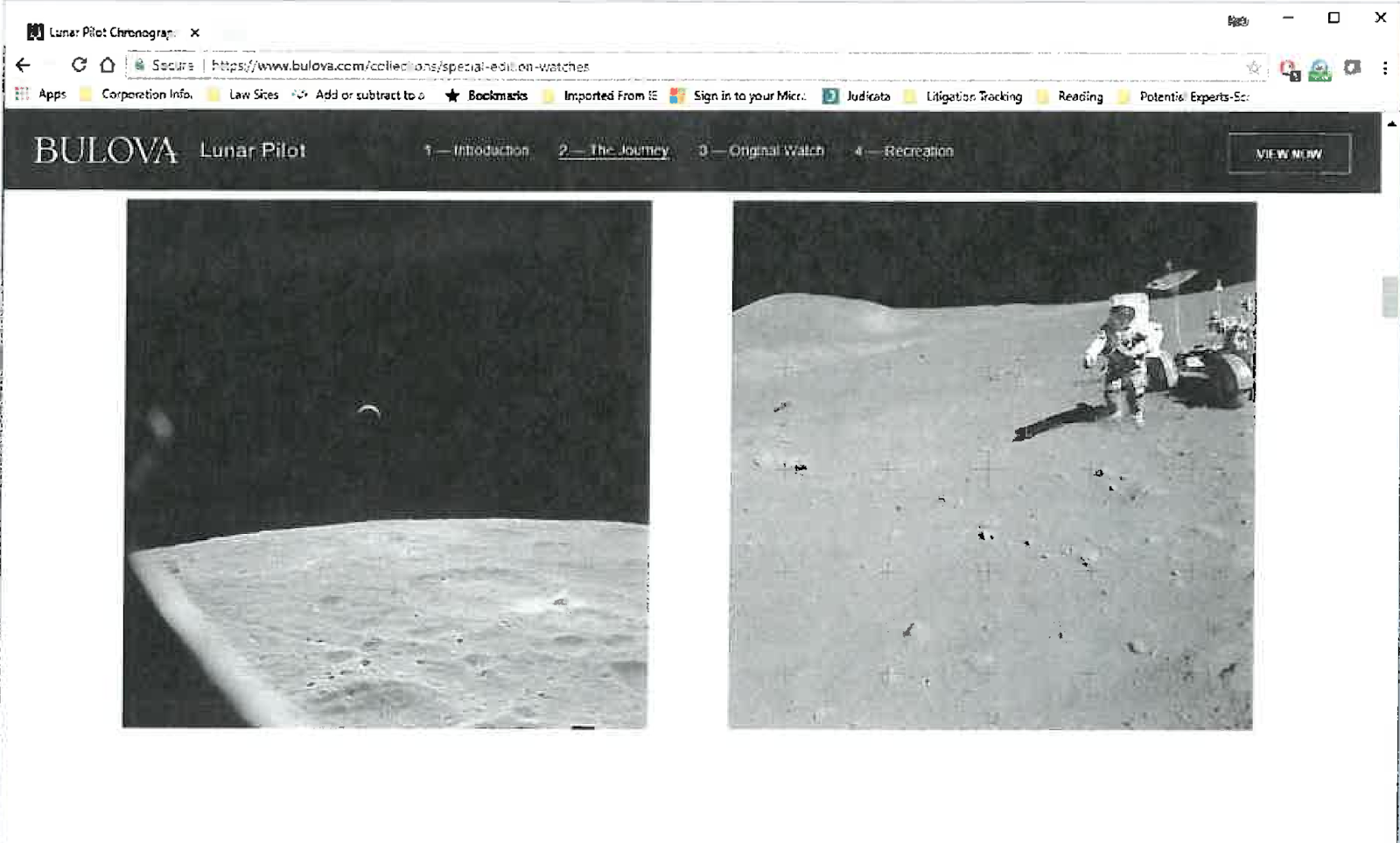 |
| Bulova website |
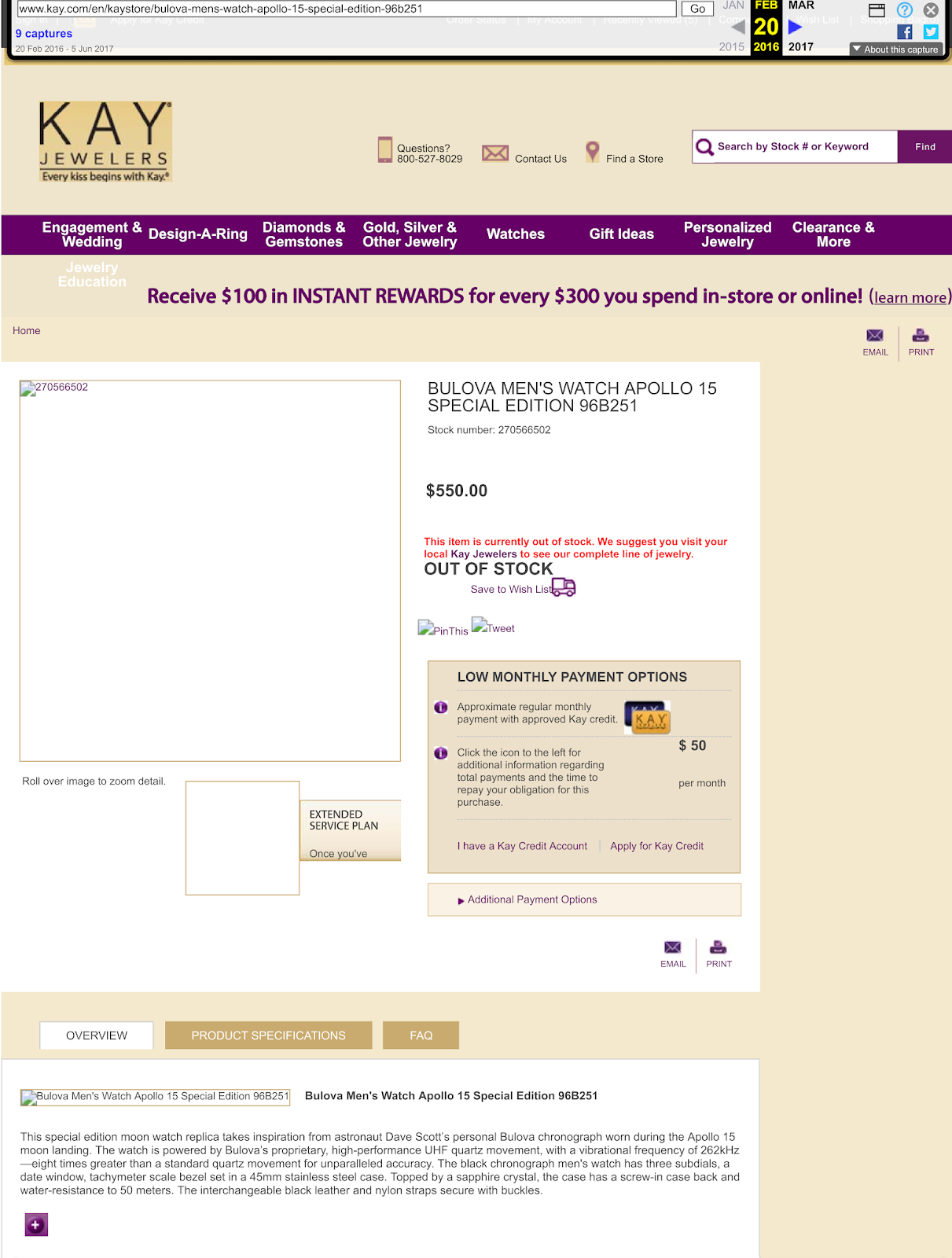 |
| Kay website (from Archive.org) with reference to Scott in text |
The court found disputed facts existed over whether the use
of Scott’s identity was incidental. “The rationale underlying this doctrine is
that an incidental use has no commercial value, and allowing recovery to anyone
briefly depicted or referred to would unduly burden expressive activity.” Relevant
factors include: “(1) whether the use has a unique quality or value that would
result in commercial profit to the defendant, (2) whether the use contributes
something of significance, (3) the relationship between the reference to the
plaintiff and the purpose and subject of the work, and (4) the duration,
prominence or repetition of the likeness relative to the rest of the
publication…. Even if the mention of a plaintiff’s name or likeness is brief,
if the use stands out prominently within the commercial speech or enhances the
marketability of the defendant’s product or service, the doctrine of incidental
use is inapplicable.”
of Scott’s identity was incidental. “The rationale underlying this doctrine is
that an incidental use has no commercial value, and allowing recovery to anyone
briefly depicted or referred to would unduly burden expressive activity.” Relevant
factors include: “(1) whether the use has a unique quality or value that would
result in commercial profit to the defendant, (2) whether the use contributes
something of significance, (3) the relationship between the reference to the
plaintiff and the purpose and subject of the work, and (4) the duration,
prominence or repetition of the likeness relative to the rest of the
publication…. Even if the mention of a plaintiff’s name or likeness is brief,
if the use stands out prominently within the commercial speech or enhances the
marketability of the defendant’s product or service, the doctrine of incidental
use is inapplicable.”
Scott offered evidence that his identity was used “repeatedly
and in a manner intended to take advantage of Scott’s reputation.” His name and
Apollo 15 “mission commander” title appeared or appear in many of the marketing
materials, including the descriptions on Bulova’s and Kay’s websites, the
promotional booklet, marketing copy for online and third-party retailers, a
press release, an interview between a Baselworld reporter and Bulova’s CEO,
website advertisements, employee training materials, and internal communication
documents about marketing strategy. [How internal documents can violate the right
of publicity is a bit beyond me.] For
example, an introductory power point to a third party retailer stated, “The
Moon Pilot Chronograph is based on the design of the Bulova watch worn on the
moon by Astronaut David R. Scott during 1971’s Apollo 15 space mission.” Another
statement repeated frequently in Bulova and Kay’s advertising: “After Apollo
15’s mission commander made lunar history—while wearing his personal Bulova
chronograph—we’re making history again.”
and in a manner intended to take advantage of Scott’s reputation.” His name and
Apollo 15 “mission commander” title appeared or appear in many of the marketing
materials, including the descriptions on Bulova’s and Kay’s websites, the
promotional booklet, marketing copy for online and third-party retailers, a
press release, an interview between a Baselworld reporter and Bulova’s CEO,
website advertisements, employee training materials, and internal communication
documents about marketing strategy. [How internal documents can violate the right
of publicity is a bit beyond me.] For
example, an introductory power point to a third party retailer stated, “The
Moon Pilot Chronograph is based on the design of the Bulova watch worn on the
moon by Astronaut David R. Scott during 1971’s Apollo 15 space mission.” Another
statement repeated frequently in Bulova and Kay’s advertising: “After Apollo
15’s mission commander made lunar history—while wearing his personal Bulova
chronograph—we’re making history again.”
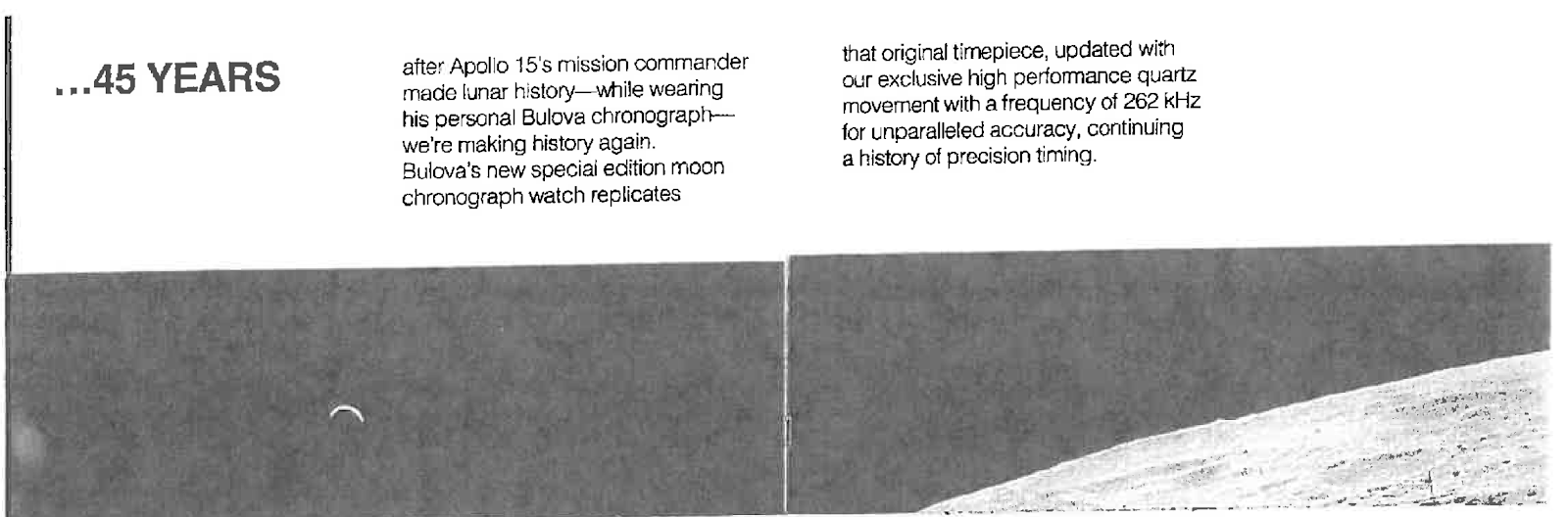


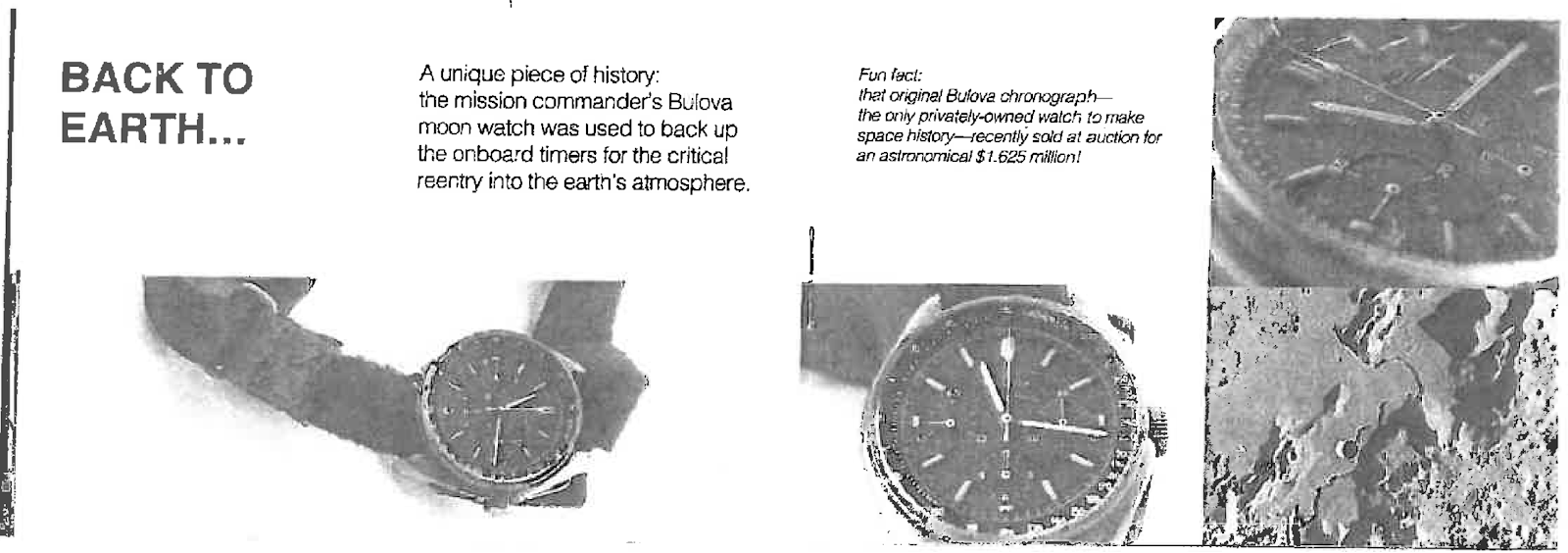

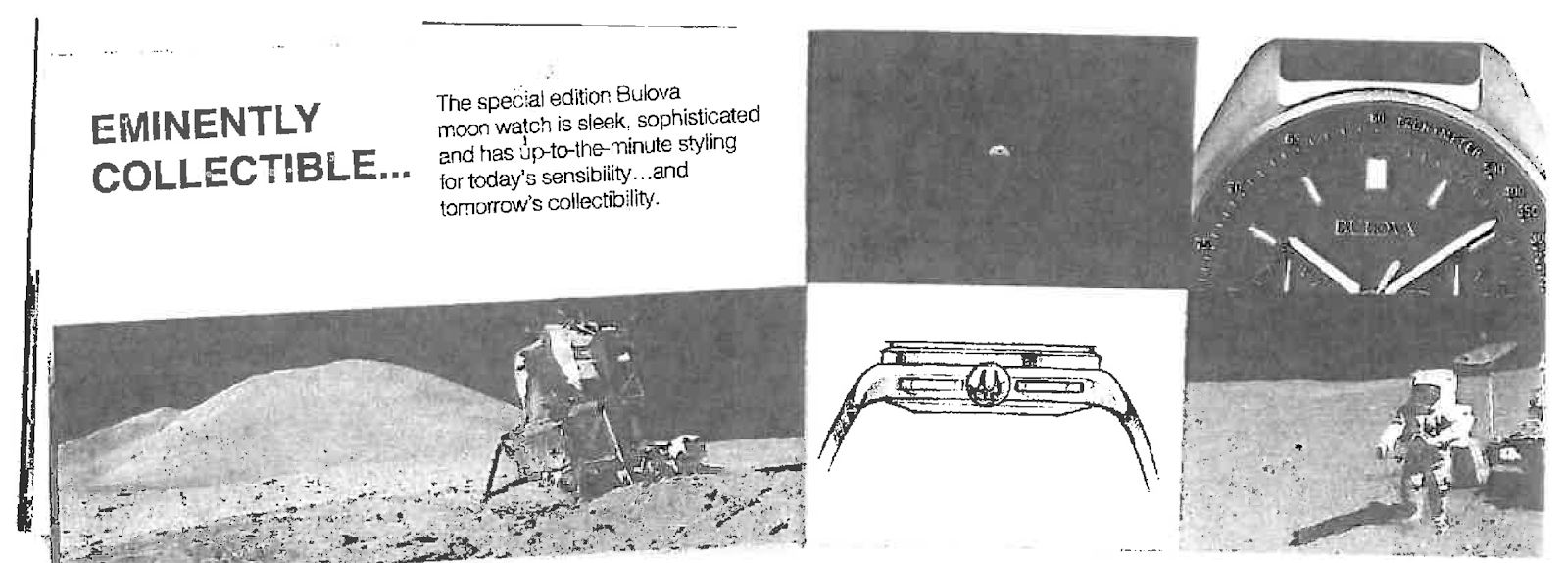 |
| images from the pamphlet with the watch |
In the prior Yeager case,
the court reasoned that the plaintiff’s name and identity were “unique and
non-fungible” because he was known for breaking the sound barrier for the first
time, and “[t]he use of his name and identity link[ed] defendant’s new
technology to plaintiff’s name and accomplishments” to create positive
associations in customers’ minds about the AT&T brand. “The same logic
applies here,” even though Bulova happens to be reciting facts, not making an
analogy (which should have been ok too, but at least didn’t suppress a truthful
account of the past). A jury could find
that the ads “deliberately invoked Scott’s name and historical significance as
one of the first humans to walk on the moon in order to increase the Moon
Watch’s marketability and appeal.”
the court reasoned that the plaintiff’s name and identity were “unique and
non-fungible” because he was known for breaking the sound barrier for the first
time, and “[t]he use of his name and identity link[ed] defendant’s new
technology to plaintiff’s name and accomplishments” to create positive
associations in customers’ minds about the AT&T brand. “The same logic
applies here,” even though Bulova happens to be reciting facts, not making an
analogy (which should have been ok too, but at least didn’t suppress a truthful
account of the past). A jury could find
that the ads “deliberately invoked Scott’s name and historical significance as
one of the first humans to walk on the moon in order to increase the Moon
Watch’s marketability and appeal.”
There were also disputed factual issues on the public
interest exception to the common law right/the statutory “public affairs”
exception, both of which protect “publication of matters in the public
interest, which rests on the right of the public to know and the freedom of the
press to tell it.’ ” These ads were
commercial speech, thus “subject to reduced free speech protection relative to
non-commercial speech.” [Yes, but that
reduced protection isn’t just applied as a discount to any advertisement’s free
speech value. Specifically, the court should
apply Central Hudson: substantial
government interest, actual advancement of that government interest, and
suppression of no more speech than necessary (though not narrow tailoring). It does not.]
interest exception to the common law right/the statutory “public affairs”
exception, both of which protect “publication of matters in the public
interest, which rests on the right of the public to know and the freedom of the
press to tell it.’ ” These ads were
commercial speech, thus “subject to reduced free speech protection relative to
non-commercial speech.” [Yes, but that
reduced protection isn’t just applied as a discount to any advertisement’s free
speech value. Specifically, the court should
apply Central Hudson: substantial
government interest, actual advancement of that government interest, and
suppression of no more speech than necessary (though not narrow tailoring). It does not.]
In balancing publicity against newsworthiness, courts must
consider “the nature of the precise information conveyed and the context of the
communication.” “Apollo 15 and space exploration certainly implicate some
degree of public interest,” but the context was too commercial. “The determinative inquiry for whether the
public interest exception applies to commercial speech is whether a defendant’s
use of a plaintiff’s identity is the commercial product itself, or is instead
used to promote some other tenuously related product.” The former is protected and the latter is
not, and this case was more like the latter, because defendants’ product wasn’t
speech, but a watch, and the [truthful] references to history and space
exploration simply helped to sell it.
consider “the nature of the precise information conveyed and the context of the
communication.” “Apollo 15 and space exploration certainly implicate some
degree of public interest,” but the context was too commercial. “The determinative inquiry for whether the
public interest exception applies to commercial speech is whether a defendant’s
use of a plaintiff’s identity is the commercial product itself, or is instead
used to promote some other tenuously related product.” The former is protected and the latter is
not, and this case was more like the latter, because defendants’ product wasn’t
speech, but a watch, and the [truthful] references to history and space
exploration simply helped to sell it.
True, Scott actually wore a Bulova watch to the moon. But a “fine
line … must be drawn between the historical event that was Apollo 15 and the
person that is David Randolph Scott.” [It
must? Why, under Central Hudson?] So Bulova
has “greater” license to boast about its connection to the Apollo 15 mission,
but that doesn’t “automatically” make Scott fair game. The court pointed to the differences between the
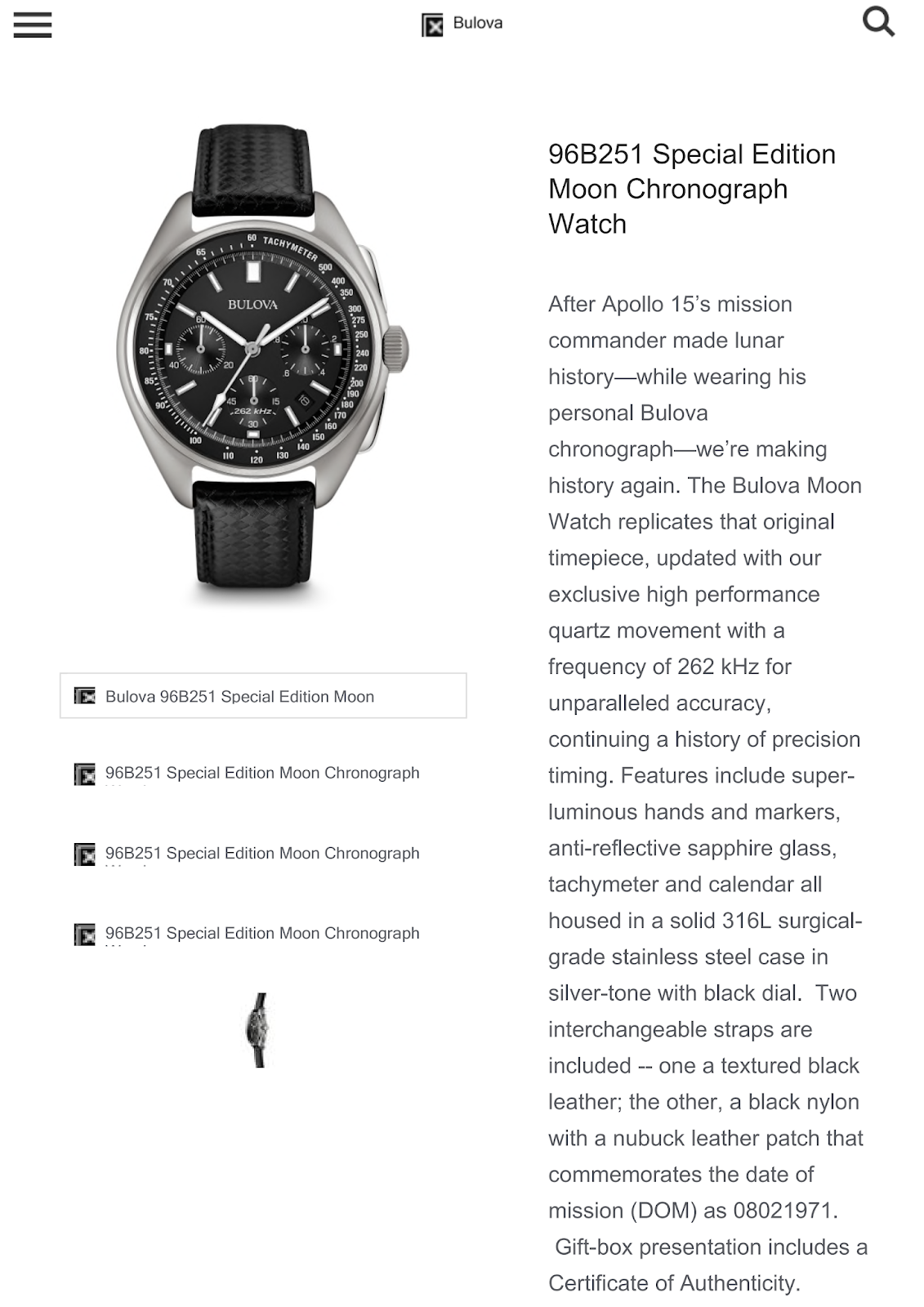
second and third versions of Bulova’s online description for the Moon Watch. The
second online description “strongly” evoked Scott’s success by stating: “After
Apollo 15’s mission commander made lunar history—while wearing his personal
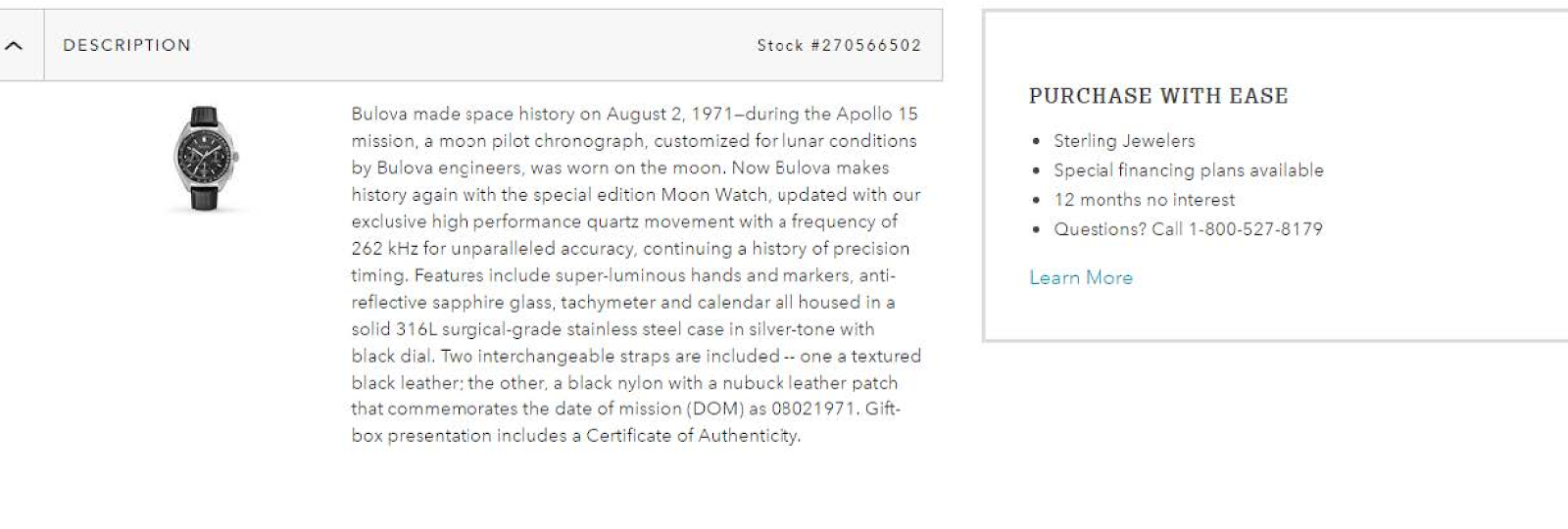
Bulova chronograph—we’re making history again.” The third online description said
instead: “Bulova made space history on August 2, 1971—during the Apollo 15
mission, a moon pilot chronograph, customized for lunar conditions by Bulova
engineers, was worn on the moon.” This moved away from Scott and toward
Bulova’s own involvement in the historical event. “Somewhere in that continuum there is a line.
While Bulova may legally showcase its legitimate connection to Apollo 15, the
Court cannot say as a matter of law that Defendants’ advertisements do not
cross the event horizon into the black hole of misappropriation.”
line … must be drawn between the historical event that was Apollo 15 and the
person that is David Randolph Scott.” [It
must? Why, under Central Hudson?] So Bulova
has “greater” license to boast about its connection to the Apollo 15 mission,
but that doesn’t “automatically” make Scott fair game. The court pointed to the differences between the
second and third versions of Bulova’s online description for the Moon Watch. The
second online description “strongly” evoked Scott’s success by stating: “After
Apollo 15’s mission commander made lunar history—while wearing his personal
Bulova chronograph—we’re making history again.” The third online description said
instead: “Bulova made space history on August 2, 1971—during the Apollo 15
mission, a moon pilot chronograph, customized for lunar conditions by Bulova
engineers, was worn on the moon.” This moved away from Scott and toward
Bulova’s own involvement in the historical event. “Somewhere in that continuum there is a line.
While Bulova may legally showcase its legitimate connection to Apollo 15, the
Court cannot say as a matter of law that Defendants’ advertisements do not
cross the event horizon into the black hole of misappropriation.”
 |
| initial Bulova description |
 |
| first revision |
 |
| second revision |
[I believe this test crosses the event horizon into inappropriate
vagueness. Also, since California common
law protects identity, why doesn’t “was worn on the moon,” along with being
awkward and terrible phrasing, still evoke the astronauts’ identities? Is it just that it doesn’t hint at who did
the wearing? Given the other information
available—and wait for the Wikipedia bit—why wouldn’t that equally identify
Scott, especially given the various reviews of the watch (below)?]
vagueness. Also, since California common
law protects identity, why doesn’t “was worn on the moon,” along with being
awkward and terrible phrasing, still evoke the astronauts’ identities? Is it just that it doesn’t hint at who did
the wearing? Given the other information
available—and wait for the Wikipedia bit—why wouldn’t that equally identify
Scott, especially given the various reviews of the watch (below)?]
But no: “Scott the astronaut, as distinguished from the
Apollo 15 mission or space exploration more generally, bears too tenuous a
connection to the non-speech commercial Moon Watch for the public interest
exception to shield Defendants from liability on summary judgment.”
Apollo 15 mission or space exploration more generally, bears too tenuous a
connection to the non-speech commercial Moon Watch for the public interest
exception to shield Defendants from liability on summary judgment.”
Defendants argued that the marketing booklets included with
the watch’s packaging, the online watch descriptions, and the 79-second
advertising video contained significant transformative elements, making them
exempt from liability. They also argued Scott wasn’t “readily identifiable” in
the photograph of him on the moon. The
court found that these weren’t sufficient grounds for summary judgment because
Scott identified other allegedly infringing materials. And the court didn’t assess whether summary judgment
ought to be granted as to those uses,
which would seem to be the next logical question; the court said that the
result would be the same no matter what, but the result on what goes to the
jury would be very, very different, so this seems to me to be very different.
the watch’s packaging, the online watch descriptions, and the 79-second
advertising video contained significant transformative elements, making them
exempt from liability. They also argued Scott wasn’t “readily identifiable” in
the photograph of him on the moon. The
court found that these weren’t sufficient grounds for summary judgment because
Scott identified other allegedly infringing materials. And the court didn’t assess whether summary judgment
ought to be granted as to those uses,
which would seem to be the next logical question; the court said that the
result would be the same no matter what, but the result on what goes to the
jury would be very, very different, so this seems to me to be very different.
As for the other uses, Scott provided evidence that defendants
used his name and identity in interviews, press releases, internal
communications such as training materials, public Wikipedia page edits [are
these commercial speech now?], and a certificate of authenticity issued along with
the watch.
used his name and identity in interviews, press releases, internal
communications such as training materials, public Wikipedia page edits [are
these commercial speech now?], and a certificate of authenticity issued along with
the watch.
Likewise, the Lanham Act false endorsement claims involved disputed
material facts. Scott’s most compelling
evidence was that “at least some consumers knew of Scott and his role in Apollo
15, were excited to buy the watch because of its connection to Scott, and may
actually have believed Scott endorsed the product.” That last bit, by the way, is pure
extrapolation.
material facts. Scott’s most compelling
evidence was that “at least some consumers knew of Scott and his role in Apollo
15, were excited to buy the watch because of its connection to Scott, and may
actually have believed Scott endorsed the product.” That last bit, by the way, is pure
extrapolation.


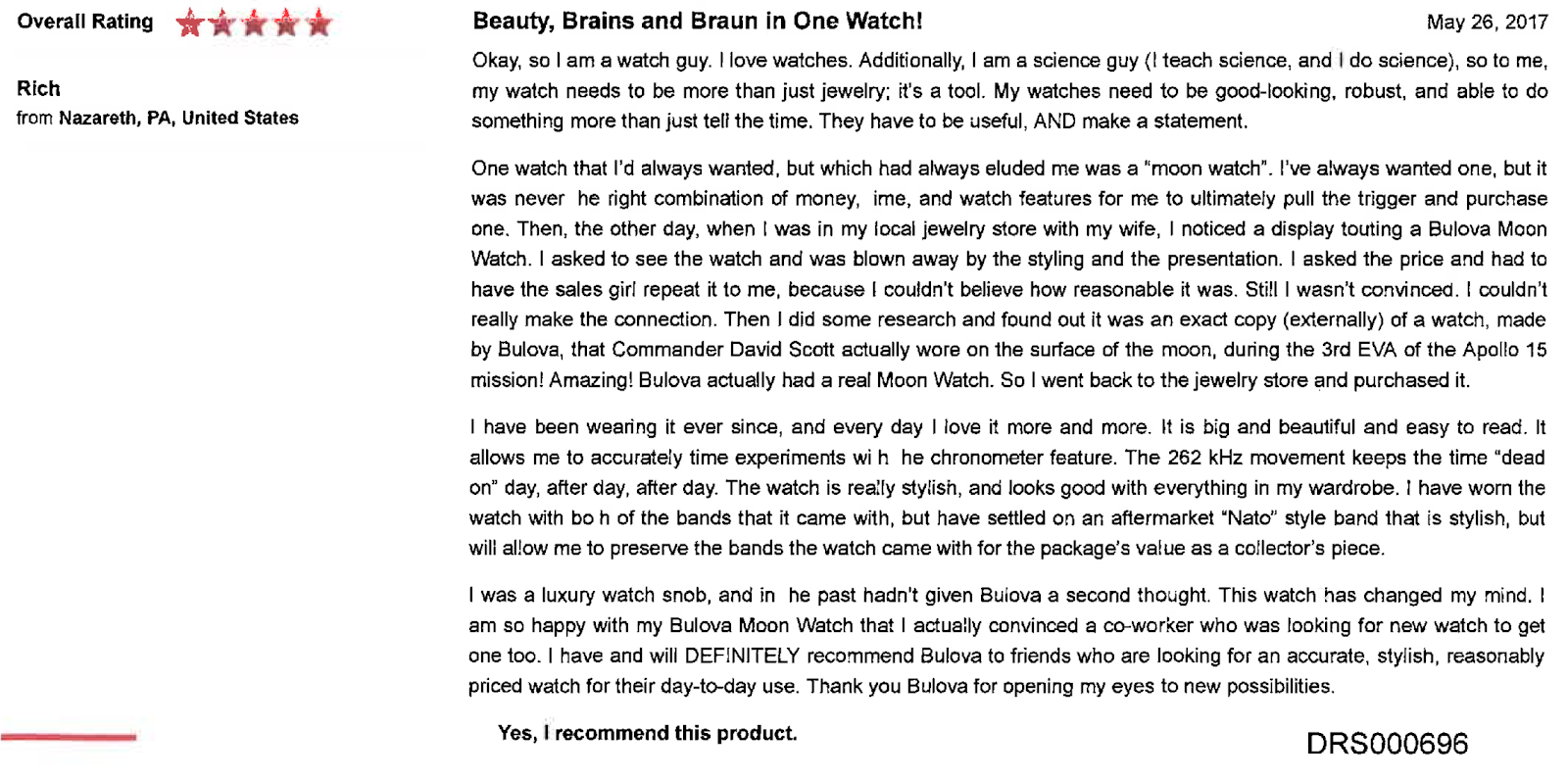
 |
| consumer reviews mentioning Scott |
One consumer review on Bulova’s website reads, “[I] found out
[t]hat other than the NASA Swiss watch, one other watch had been worn on the
[m]oon by [t]he Commander of Apollo 15 ‘Dave Scott’ on EVA 2. The watch in
question was the Bulova 96B251 Moon Watch.” Similarly, a Facebook user referred
to the Moon Watch as the “Dave Scott Re-Edition.” “[I]t is entirely reasonable
to infer that Defendants’ reference to the Moon Watch, Apollo 15, and Scott in
the same breath could confuse consumers about Scott’s role in the Moon Watch’s
marketing,” especially since they used his exact name, title, and likeness. Also,
Bulova may have actively sought Scott out to serve as a “brand ambassador,”
suggesting intent.
[t]hat other than the NASA Swiss watch, one other watch had been worn on the
[m]oon by [t]he Commander of Apollo 15 ‘Dave Scott’ on EVA 2. The watch in
question was the Bulova 96B251 Moon Watch.” Similarly, a Facebook user referred
to the Moon Watch as the “Dave Scott Re-Edition.” “[I]t is entirely reasonable
to infer that Defendants’ reference to the Moon Watch, Apollo 15, and Scott in
the same breath could confuse consumers about Scott’s role in the Moon Watch’s
marketing,” especially since they used his exact name, title, and likeness. Also,
Bulova may have actively sought Scott out to serve as a “brand ambassador,”
suggesting intent.
Nominantive fair use was factually disputed for one really
bad reason and one unfortunate, but case-law-consistent, reason. Bad reason: New Kids said that the test applies only “where the defendant uses
a trademark to describe the plaintiff’s product, rather than its own,” but defendants
used Scott’s identity to describe their own product, not Scott’s. That’s not an
accurate description of the New Kids
rule, in which the defendant’s product was a
poll about the New Kids: talking about their own product meant talking about
the plaintiffs. So too here. The use is purely referential: this is the
watch that Dave Scott wore. The use of
Scott is thus in reference to Scott himself, rather than trying to create a
different Scott mark (compare the analysis in the Grand Theft Auto/Play Pen case, where the court found no reference
to the plaintiff Play Pen).
bad reason and one unfortunate, but case-law-consistent, reason. Bad reason: New Kids said that the test applies only “where the defendant uses
a trademark to describe the plaintiff’s product, rather than its own,” but defendants
used Scott’s identity to describe their own product, not Scott’s. That’s not an
accurate description of the New Kids
rule, in which the defendant’s product was a
poll about the New Kids: talking about their own product meant talking about
the plaintiffs. So too here. The use is purely referential: this is the
watch that Dave Scott wore. The use of
Scott is thus in reference to Scott himself, rather than trying to create a
different Scott mark (compare the analysis in the Grand Theft Auto/Play Pen case, where the court found no reference
to the plaintiff Play Pen).
Unfortunate reason, deepening the incoherence in case law:
Factor three of New Kids was disputed
because of evidence supporting a likelihood of confusion finding. “Scott offers
evidence that consumers may have believed Scott endorsed or sponsored the Moon
Watch, referring to it as the ‘Dave Scott Re-Edition’ and retelling in
favorable online reviews the story of Scott taking his personal Bulova
chronograph to the moon. Whether Defendants’ advertisements suggests sponsorship
or endorsement by Scott is a highly factual matter and not suitable for summary
judgment.” But that’s not what factor
three started out as, even though other courts have done the same jiu-jitsu. Factor three started out as whether the
defendant did anything else to suggest sponsorship, as in saying “official” or “authorized.”
If likely confusion means that factor
three isn’t satisified, then New Kids
is neither a replacement for the ordinary confusion test (the formal 9th
Circuit characterization) nor a defense (because, as with KP Permanent, a defense that only works when there’s no confusion
isn’t actually a defense).
Factor three of New Kids was disputed
because of evidence supporting a likelihood of confusion finding. “Scott offers
evidence that consumers may have believed Scott endorsed or sponsored the Moon
Watch, referring to it as the ‘Dave Scott Re-Edition’ and retelling in
favorable online reviews the story of Scott taking his personal Bulova
chronograph to the moon. Whether Defendants’ advertisements suggests sponsorship
or endorsement by Scott is a highly factual matter and not suitable for summary
judgment.” But that’s not what factor
three started out as, even though other courts have done the same jiu-jitsu. Factor three started out as whether the
defendant did anything else to suggest sponsorship, as in saying “official” or “authorized.”
If likely confusion means that factor
three isn’t satisified, then New Kids
is neither a replacement for the ordinary confusion test (the formal 9th
Circuit characterization) nor a defense (because, as with KP Permanent, a defense that only works when there’s no confusion
isn’t actually a defense).
Also, Scott’s false advertising claim involved disputed
material facts. Scott argued that the
characterization of the Moon Watch as a “replica” was false because the
internal components of the Moon Watch differ from the original chronograph and thus
the watch wasn’t a “100%” replica according to Bulova’s own witness. Scott testified
that he had been injured by being associated with a watch that he would not
endorse, and submitted an expert declaration that Scott has lost potential
income from future endorsement deals. [The problem here isn’t injury, but injury causation: the lost income from future
endorsement deals, if any, isn’t plausibly connected to the falsity of any “replica”
related claims.]
material facts. Scott argued that the
characterization of the Moon Watch as a “replica” was false because the
internal components of the Moon Watch differ from the original chronograph and thus
the watch wasn’t a “100%” replica according to Bulova’s own witness. Scott testified
that he had been injured by being associated with a watch that he would not
endorse, and submitted an expert declaration that Scott has lost potential
income from future endorsement deals. [The problem here isn’t injury, but injury causation: the lost income from future
endorsement deals, if any, isn’t plausibly connected to the falsity of any “replica”
related claims.]
However, Scott’s evidence of emotional distress was merely
his declaration stating, “I have suffered emotionally because people may now
believe I have abandoned my private life in favor of commercially promoting
products which is not how I wish to be perceived by the public,” and, “I feel
humiliated, embarrassed, and mentally distressed because of the new public
persona Bulova and Kay’s have forced upon me; an Apollo astronaut that endorses
products, let alone a cheap and deceptive product.” This wasn’t enough because “it
describes at worst discomfort with a social image Scott fears he may have,” not
distress that no reasonable person can be expected to endure. There was also no
evidence of intentional or reckless disregard by the defendants.
his declaration stating, “I have suffered emotionally because people may now
believe I have abandoned my private life in favor of commercially promoting
products which is not how I wish to be perceived by the public,” and, “I feel
humiliated, embarrassed, and mentally distressed because of the new public
persona Bulova and Kay’s have forced upon me; an Apollo astronaut that endorses
products, let alone a cheap and deceptive product.” This wasn’t enough because “it
describes at worst discomfort with a social image Scott fears he may have,” not
distress that no reasonable person can be expected to endure. There was also no
evidence of intentional or reckless disregard by the defendants.
from Blogger https://ift.tt/2H5wjLF

 Rebecca Tushnet