exercise company affiliation and ad revenue don’t make diet review into commercial speech

GOLO, Inc. v. HighYa, LLC, 2018 WL 2086733, No. 17-2714
(E.D. Pa. May 4, 2018)
The court here declines to apply the Lanham Act to “companies
that generate income through websites that review the products of others,
without selling any products of their own.” GOLO sells a weight loss dieting
program that can be purchased through its website. Defendants are review
websites that purportedly assist consumers; HighYa has a marketing affiliation
with a limited number of suppliers (e.g., BowFlex Max Trainer), but both defendants’
principal source of revenue comes from ads. 
GOLO contested the fairness and accuracy of defendants’ online reviews,
leading to revision on one site and removal on the other, but GOLO wanted to
recover for the initial period.
Defendants’ editorial reviews principally rely on “publicly
available information,” rather than defendants’ own use or testing. GOLO’s website
contained a description of its program, backed by references to research
purportedly supporting the merits of the program. Defendants’ editorial reviews
primarily, if not exclusively, critiqued the statements in that description.
HighYa’s editorial review spurred dozens of comments from purported users, with
an average customer rating of 2.8 out of 5 stars. The link “was posted” across
different social media platforms, one of which contained the statement:
“Weight-loss #scams are everywhere. Is GOLO one of them?”
GOLO alleged that the title, “GOLO Weight Loss Diet Reviews
– Is it a Scam or Legit?” was misleading; much of the review was was based on
an outdated version of the GOLO program site; and  the focus of the GOLO program was not simply
combatting “insulin resistance,” as the review states. The challenged portions were
eventually removed.
The BrightReview article appeared in a similar form. The
average customer rating was 2 out of 5 stars, with three purported users giving
“highly negative ‘reviews.’ ” GOLO challenged statements about its study
evidence and claims.
GOLO alleged that the websites were “designed to appear
trustworthy, [and to] resemble internet versions of more traditional consumer
review publications”  but were owned by
or secretly related to the competitors of the products defendants review.
False advertising and false association claims only apply to
commercial speech. Though there was a specific product reference, the articles
still weren’t ads.  On their face, the
reviews didn’t promote any competing product, and didn’t explicitly propose a
commercial transaction. The court analogized to Tobinick v. Novella, 848 F.3d
935 (11th Cir. 2017). As there, the defendants “gained no direct economic
benefit from readers of the reviews’ decision,” and “[t]he content of the
reviews had no direct bearing on the revenue generated by traffic to the site.”  To the extent that the reviews were based
only on the content of GOLO’s website, “[t]he value of such a review to
consumers may be limited,” but that didn’t make it an ad.  Ad-based financial benefit was merely
incidental to the content.
The Lanham Act does allow liability “if websites purporting
to offer reviews are in reality stealth operations intended to disparage a
competitor’s product while posing as a neutral third party.”  However, GOLO hadn’t plausibly pleaded that
these review sites were shams.
Although “in the absence of discovery, a plaintiff’s ability
to confirm what might be well-founded suspicion is limited,” that wasn’t enough
here.  The court considered the general
content of the sites, including the fact that defendants responded to GOLO’s
objections by amending the reviews and specifically advising readers that
changes to the reviews were based on further information provided by GOLO. “Such
conduct does not plausibly support an inference that the purpose of the reviews
is to create an advantage for competing products.” Defendants also disclosed the
commercial relationship with BowFlex and other commercial affiliations, which
made the allegedly covert competition less plausible.  And to the extent that GOLO pled that defendants’
revenues were a product of web traffic, the favorable/unfavorable nature of a
review seemed irrelevant; sellers might even promote favorable reviews.
Nor did the affiliation with BowFlex render this a Lexmark situation in which “one
competitor directly injures another by making false statements about his own
goods or the competitor’s goods and thus inducing customers to switch.” “The
review discussing GOLO’s dieting program does not at all reference, or provide
a direct link to any exercise equipment, let alone to Bowflex.” Even if there
were a prompt to try exercise, it doesn’t follow that diet and exercise
compete; GOLO designed its program to work with exercise.  While direct commercial competition isn’t an “absolute”
requirement, these observations bore on the plausibility of the conclusory
allegation that defendants’ websites were covert competitors.
With Lanham Act false advertising and state coordinate
claims out of the way, only a Pennsylvania trade libel claim remained.  But Pennsylvania has a one-year statute of
limitations for trade libel claims, running from the date of the first
publication. GOLO alleged that HighYa’s initial review was posted in “March
2016,” and filed on June 16, 2017. GOLO argued that the revised version of the
article was published within the limitations period, and that it was re-published
when HighYa posted links to it through its social media accounts. But the only
HighYa social media post referenced dates back more than a year before filing,
and GOLO didn’t object to the revised article.
As for user comments, GOLO’s allegation that HighYa was the
true source of the comments “on information and belief” was insufficient in the
context of the other allegations.
As to BrightReviews, GOLO didn’t adequately plead falsity. Each
challenged statement was prefaced with language indicating that they are
observations based primarily on GOLO’s website: “ ‘The 2010 study [was]
performed with diabetics, not otherwise healthy individuals looking to optimize
insulin…[T]his seems to be their target market;…None of [GOLO’s] studies
appear to be peer reviewed for accuracy…;…and [W]e didn’t encounter any
clinical evidence on leading medical websites…that directly linked insulin management…and
weight loss.’ ” Though GOLO argued that these statements were inaccurate, it
didn’t address whether those observations could reasonably and fairly been made
based upon the information posted on its website at the time.
GOLO also argued that the reviews created a false impression
that its product was a scam, citing low the average user rating; HighYa’s
Twitter post, which stated, “Weight-loss #scams are everywhere. Is GOLO one of
them?”; the initial title of the article, “GOLO Weight Loss Diet Reviews – Is
it a Scam or Legit?”; and the fact that the reviews would appear prominently in
web searches for GOLO. But in the context of the review, the court didn’t see
an accusation of “a scam in the illegal, fraudulent sense, as compared to
communicating that the product might not produce its intended result.”

from Blogger https://ift.tt/2rsyf73

Posted in Uncategorized | Tagged , , | Leave a comment

Content Moderation at Scale, 2/2

You Make the Call: Audience Interactive (with a trigger
warning for content requiring moderation)
Emma Llanso, Center for Democracy & Technology & Mike
Masnick, Techdirt
Hypo: “Grand Wizard Smith,” w/user photo of a person in a
KKK hood, posts a notice for the annual adopt-a-highway cleanup project.  TOS bans organized hate groups that advocate
violence.  This post is flagged for
review.  What to do?  Majority wanted takedown, but 12 said leave
it up, 12 flag (leave up w/a content warning), 18 said escalate, and over 40
said take down.  Take down: he’s a member
of the KKK.  Keep up: he’s not a verified
identity; it doesn’t say KKK and requires cultural reference point to know what
the hood means/what a grand master is. 
Escalate: if the moderator can only ban the post, the real problem is
the user/the account, so you may need to escalate to get rid of the account.
Hypo: “glassesguru123” says same sex marriage is great, love
is love, but what do I know, I’m just a f—-t. 
Flagged for hate speech. What to do? 
83 said leave it up.  5 for flag,
2 escalate, 1 take it down.  Comment: In
Germany, you take down some words regardless of content, so it may depend on
what law you’re applying.  Most people
who leave it up are adding context: not being used in a hateful manner. But
strictly by the policy, it raises issues, which is why some flag it.
Hypo: “Janie, gonna get you, bitch, gun emoji, gun emoji, is
that PFA thick enough to stop a bullet if you fold it up & put it in your
pocket?”  What to do? 57 take it down, 27
escalate, and 1 said leave it up/flag the content.  For escalate: need subject matter expert to
figure out what a PFA is.  [Protection
from Family Abuse.] Language taken from Supreme Court case about what
constituted a threat.  I wondered whether
there were any rap lyrics, but decided that it was worrisome enough even if
those were lyrics.  Another argument for
escalation: check if these are lyrics/if there’s an identifiable person
“Janie.” [How you’d figure that out remains unclear to me—maybe you’ll be able
to confirm that there is a Janie by
looking at other posts, but if you don’t see mention of her you still don’t
know she doesn’t exist.]  Q: threat of
violence—should it matter whether the person is famous or just an ex?
Hypo: photo of infant nursing at human breast with
invitation to join breast milk network. 
Flagged for depictions of nudity. What to do? 65 said leave it up, 13
said flag the content, 5 said escalate, and 1 said take it down.  Nipple wasn’t showing (which suggests
uncertainty about what should happen if the baby’s latch were different/the
woman’s nipple were larger).  Free speech
concerns: one speaker pointed that out and said that this was about free speech
being embodied—political or artistic expression against body shame.  You have this keep-it-up sentiment now but
that wasn’t true on FB in the past. 
Policy v. person applying the policy.
Hypo: jenniferjames posts a site that links to Harvey
Weinstein’s information: home phone, emails, everything— “you know what to do:
get justice” Policy: you may not post personal information about others without
their consent.  This one was the first
that I found genuinely hard.  It seemed
to be inciting, but not posting directly and thus not within the literal terms
of the policy. I voted to escalate. 
Noteworthy: fewer people voted. Plurality voted to escalate; substantial
number said to take it down, and some said to leave it/flag it.  One possibility: the other site might have
that info by consent!  Another response
would block everything from that website (which is supposed to host personal
info for lots of people).
Hypo: Verified world leader tweets: “only one way to get
through to Rocket Man—with our powerful nukes. Boom boom boom. Get ready for
it!”  Policy: no specific credible
threats.  I think it’s a cop out to say
it’s not a credible threat, though that doesn’t mean there’s a high probability
he’ll follow up on it. I don’t think high probability is ordinarily part of the
definition of a credible threat. But this is not an ordinary situation, so.
Whatever it is, I’m sure it’s above my pay grade if I’m the initial screener:
escalate. Plurality: leave it up. Significant number: escalate.  Smaller number of flag/deletes.  Another person said that this threat couldn’t
be credible b/c of its source; still, he said, there shouldn’t be a
presidential exception—there must be something he could say that could cross
the line. Same guy: Theresa May’s threat should be treated differently.  Paul Alan Levy: read the policy narrowly: a
threat directed to a country, not an individual or group.
Hypo: Global Center for Nonviolence: posts a video, with a
thumbnail showing a mass grave. Caption: source “slaughter in Duma.”   “A victorious scene today,” is another
caption apparently from another source. I wasn’t sure whether victorious could
be read as biting sarcasm. Escalate for help from an area expert. Most divided—most
popular responses were flag or escalate, but substantial #s of leave it up and
take it down too. The original video maybe could be interpreted as glorifying
violence, but sharing it to inform people doesn’t violate the policy and
awareness is important. The original post also needs separate review. If you
take down the original video, though, then the Center’s post gets stripped of
content. Another argument: don’t censor characterizations of victory v. defeat;
compare to Bush’s “Mission Accomplished” when there were hundreds of thousands
of Iraqis dead.
Hypo: Johnnyblingbling: ready to party—rocket ship, rocket
ship, hit me up mobile phone; email from City police department: says it’s a
fake profile in the name of a local drug kingpin. Only way we can get him, his
drugs, and his guns off the street. Policy: no impersonation; parody is ok.
Escalate because this is a policy decision: if I am supposed to apply the
policy as written then it’s easy and I delete the profile (assuming this too
doesn’t require escalation; if it does I escalate for that purpose). But is the
policy supposed to cover official impersonation?  [My inclination would be yes, but I would
think that you’d want to make that decision at the policy level.] 41 said
escalate, 22 take down, 7 leave it up, 1 flag. Violate user trust by creating
special exceptions.  Goldman points out
that you should verify that the sender of the email was authentic: people do
fake these.  Levy said there might be an
implicit law enforcement exception. But that’s true of many of these
rules—context might lead to implicit exceptions v. reading the rules strictly.
1:50 – 2:35 pm: Content Moderation and Law Enforcement
Clara Tsao, Chief Technology Officer, Interagency Countering
Violent Extremism Task Force, Department of Homeland Security
Jacob Rogers, Wikimedia Foundation: works w/LE requests
received by Foundation. We may not be representative of different companies b/c
we are small & receive a small number of requests that vary in what they
ask for—readership over a period of time v. individual info. Sometimes we only
have IP address; sometimes we negotiate to narrow requests to avoid revealing
unnecessary info.
Pablo Peláez, Europol Representative to the United States: Cybercrime
unit is interested in hate speech & propaganda. 
 
Dan Sutherland, Associate General Counsel, National
Protection & Programs Directorate, U.S Department of Homeland Security:
Leader of a “countering foreign influence” task force. Work closely w/FBI but
not in a LE space.  Constitution/1A:
protects things including simply visiting foreign websites supporting terror.  Gov’t influencing/coercing speech is
something we’re not comfortable with. Privacy Act & w/in our dep’t Congress
has built into the structure a Chief Privacy Officer/Privacy Office. Sutherland
was formerly Chief Officer for Civil Rights/Civil Liberties.  These are resourced offices w/in dep’t and
influence issues.  DHS is all about info
sharing, including sensitive security information shared by companies.
Peláez: Europol isn’t working on foreign influence. Relies
on member states; referrals go through national authorities.  EU Internet Forum brings together decisionmakers
from states and private industry. About 150-160 platforms that they’ve looked
at; in contact w/about 80. Set up internet referral management tool to access
the different companies.  Able to analyze
more than 54,000 leads.  82% success
rate.
Rogers: subset of easy LE requests for Wikipedia & other
moderated platforms—fraudulent/deceptive, clearly threats/calls to violence.
Both of those, there is general agreement that we don’t want them around. Some
of this can feed back into machine learning. 
Those tools are imperfect, but can help find/respond to issues. More
difficult: where info is accurate, newsworthy, not a clear call to violence:
e.g., writings of various clerics that are used by some to justify violence.
Our model is community based and allows the community to choose to maintain
lawful content.
LE identification requests fall into 2 categories: (1)
people clearly engaged in wrongdoing; we help as we can given technical
limits.  (2) Fishing expeditions, made
b/c gov’t isn’t sure what info is there. Company’s responsibility is to
educate/work w/company to determine what’s desired and protect rights of users
where that’s at issue.
YT started linking to Wikipedia for controversial videos; FB
has also started doing that.  That is
useful; we’ll see what happens.
Sutherland: We aren’t approaching foreign influence as a LE
agency like FBI does, seeking info about accounts under investigation or
seeking to have sites/info taken down. Instead, we support stakeholders in
understanding scope & scale & identifying actions they can take against
it. Targeted Action Days: one big platform or several smaller—we focus on them
and they get info on content they must remove. 
Peláez: we are producing guidelines so we understand what
companies need to make requests effective. 
Toolkit w/18 different open source tools that will allow OSPs and LE to
identify and detect content.
What Machines Are, and Aren’t, Good At
Jesse Blumenthal, Charles Koch Institute: begins with a
discussion that reminds me of this xkcd
cartoon
.
Frank Carey, Machine Learning Engineer, Vimeo: important to
set threshold for success up front. 80% might be ok if you know that going
in.  Spam fighting: video spam, looks
like a movie but then black screen + link + go to this site for full download
for the rest of the 2 hours.  Very visual
example; could do text recognition. 
These are adversarial examples. Content moderation isn’t usually about
making money (on our site)—but that was, and we are vastly outnumbered by them.
Machine learning is being used to generate the content.  It’s an arms race. Success threshold is thus
important.  We had a great model with a
low false positive rate, and we needed that b/c if it was even .1% that would
be thousands of accounts/day. But as we’d implement these models, they’d go
through QA, and within days people would change tactics and try something else.
We needed to automate our automation so it could learn on the fly.
Casey Burton, Match: machines can pick up some signs like
100 posts/minute really easily but not others. Machines are good at ordering
things for review—high and low priority. 
Tool to assist human reviewers rather than the end of the process. [I
just finished a book, Our Robots, Ourselves, drawing this same conclusion about
computer-assisted piloting and driving.]
Peter Stern, Facebook: Agrees. We’re now good at spam, fake
accounts, nudity and remove it quickly. 
Important areas that are more complicated: terrorism.  Blog posts about how we’ve used automation in
service of our efforts—a combo of automation and human review.  A lot of video/propaganda coming from
official terrorist channels—removed almost 2 million instances of ISIS/Al Qaeda
propaganda; 99% removed before it was seen. We want to allow counterspeech—we
know terror images get shared to condemn. Where we find terror accounts we fan
out for other accounts—look for shared addresses, shared devices, shared
friends. Recidivism: we’ve gotten better at identifying the same bad guy with a
new account. Suicide prevention has been a big focus. Now using pattern
recognition to identify suicidal ideation and have humans take a look to see
whether we can send resources or even contact LE.  Graphic violence: can now put up warning
screens, allow people to control their experience on the platform.  More difficult: for the foreseeable future,
hate speech will require human judgment. We have started to bubble up slurs for
reviewers to look at w/o removing it—that has been helpful.  Getting more eyes on the right stuff. Text is
typically more difficult to interpret than images.
Burton: text overlays over images challenged us. You can OCR
that relatively easily, but it is an arms race. So now you get a lot of
different types of text designed to fool the machine.  Machines aren’t good at nuance.  We don’t get too much political, but we see a
lot of very specific requests about who they want to date—“only whites” or
“only blacks.”  Where do you draw the
line on deviant sexual behavior? Always a place for human review, no matter how
good your algorithms.
Carey: Rule of thumb: if it’s something you can do in under
a second, like nudity detection, machine learning will be good at it.  If you have to think through the context, and
know a bunch about the world like what the KKK is and how to recognize the
hood, that will be hard—but maybe you can get 80% of the way.  Challenge is adversarial actors.  Laser beam: if they move a little to the
left, the laser doesn’t hit them any more. So we create two nets, narrow and
wide. Narrow: v. low false positive rate. With wider net that goes to review
queue.  You can look at confidence
scores, how the model is trained, etc.
Ryan Kennedy, Twitch?: You always need the human
element.  Where are your adversaries
headed?  Your reviewers are R&D.
Burton: Humans make mistakes too. There will be disagreement
or just errors, clicking the wrong button, and even a very low error rate will
mean a bunch of bad stuff up and good stuff down. 
Blumenthal: we tend not to forgive machines when they err,
but we do forgive humans. What is an acceptable error rate?
Carey: if 1-2% of the time, you miss emails that end up in
your spam folder, that can be very bad for the user, even if it’s a low error
rate.  For cancer screening, you’re
willing to accept a high false positive rate. 
[But see mammogram recommendations.] 
Stern, in response to a Q about diversity: We are seeking to
build diverse reviewers, whose work is used for the machine learning that
builds classifications.  Also seeking
diversity on the policy team, b/c that’s also an issue in linedrawing. When we
are doing work to create labels, we try to be very careful about whether we’re
seeing outlying results from any individual—that may be a signal that somebody
needs more education.We also try to be very detailed and objective in the tasks
that we set for the labelers, to avoid subjective judgments of any kind.  Not “sexually suggestive” but do you see a
swimsuit + whatever else might go into the thing we’re trying to build. We are
also building a classifier from user flagging. 
User reports matter and one reason is that they help us get signals we
can use to build out the process.
Kennedy, in response to Q about role of tech in dealing w/
live stream & live chat: snap decisions are required; need machines to help
manage it.
Carey: bias in workforce is an issue but so is implicit bias
in the data; everyone in this space should be aware of that. Training sets:
there’s a lot of white American bias toward the people in photos.  Nude photos are mostly of women, not men. You
have to make sure you’re thinking about those things as you put these systems
in place.  Similar thing w/wordnet, a
list of synonyms infected w/gender bias. English bias is also a thing.
Q: outsourced/out of the box solutions to close the resource
gap b/t smaller services and FB: costs and benefits?
Burton: vendors are helpful. 
Google Vision has good tools to find & take down nudity.  That said, you need to take a look and say
what’s really affecting our platform.  No
one else is going to care about your issues as much as you do.
Carey: team issues; need for lots of data to train on, like
fraud data; for Vimeo, nudity detection was a special issue b/c we don’t have a
zero nudity policy.  We needed to ID
levels of nudity—pornographic v. HBO. We trained our own model that did pretty
well. Then you can add human review. But off the shelf models didn’t allow
that.  Twitch may have unique memes—site
tastes are different.  Vendors can be
great for getting off the ground, but they might not catch new things or might
catch too many given the context of your site.
Kennedy: vendors can get you off the ground, but we have
Twitch-specific language.  Industry
standards can be helpful, raising all ships around content moderation.  [I’d love to hear from someone from reddit or
the like here.]
Q re automation in communication/appeals: Stern says we’re
trying to improve. It’s important for people to understand why something
did/didn’t get taken down. In most instances, you get a communication from us
about why there was a takedown. Appeals are really important—allow more
confidence in the process b/c you know mistakes can be corrected.  Always a conundrum about enabling evasion,
but we believe in transparency and want to show people how we’re interacting
w/their content. If we show them where the line is, we hope they know not to
cross.
Burton: There are ways to treat bots differently than
humans: don’t need to give them notice & can put them in purgatory. We keep
info at a high level to avoid people tracking back the person who reported them
and going after them.
Transparency
David Post, Cato Institute
Kaitlin Sullivan, Facebook: we care about safety, voice, and
fairness: trust in our decisionmaking process even if you don’t always agree
w/it. Transparency is a way to gain your trust. 
New iteration of our Community Standards is now public w/full definition
of “nudity” that our reviewers use. We also want to explain why we’re using
these standards. You may not agree that female nipples shouldn’t be allowed
(subject to exceptions such as health contexts) but at least you should be able
to understand the rule.  Called us
“constituents,” which I found super interesting.  Users should be able to tell whether there is
an enforcement error or a policy decision. 
We also are investing more in appeals; used to have appeals just for
accounts, groups, pages. We’ve been experimenting w/individual content reviews,
and now we have an increased commitment to that.  We hope to have more numbers than IP, gov’t
requests, terror content soon.
Kevin Koehler, Automattic: 30% of internet sites use
WordPress, though we don’t host them all. Transparency report lists what sites
we geoblock due to local law & how we respond to gov’t requests. We try to
write/blog as much as we can about these issues to give context to the raw
numbers. Copyright reports have doubled since 2015; gov’t info requests 3x;
gov’t takedowns gone up 145x from what they once were. Largely driven by
Russia, former Soviet republics, and Turkey; but countries that we never heard
from before are also sending notices, sometimes in polite and sometimes in
threatening terms.
Alex Walden, Google: values freedom of expression,
opportunity, and ability to belong.  400
hours of content uploaded every minute. Doubling down on machine learning,
particularly for terrorist content. Including experts as part of how we ID
content is key.  Users across the board
are flagging lots content; the accuracy rates of ordinary users are relatively
low, while trusted flaggers are relatively high in accuracy. 8 million videos
removed for violating community guidelines, 80% flagged by machine learning.
Flagà
human review. Committed to 10,000 reviewers in 2018.  Spam detection has informed how we deal
w/other content.  Also dealing w/scale by
focusing on content we’ve already taken down, preventing its reupload.  Also important that there’s an appeals
process. New user dashboard also shows users where flagged content is in the
review process—was available to trusted flaggers, but is now available to
others as well.
Rebecca MacKinnon, New America’s Open Technology Institute:
Deletions can be confusing and disorienting. Gov’ts claim to have special
channels to Twitter, FB to get things taken down; people on the ground don’t
know if that’s true. Transparency reports are for official gov’t demands but it’s
not clear whether gov’ts get to be trusted flaggers or why some content is
going down. Civil society and human rights are under attack in many countries—lack
of transparency on platforms destroys trust and adds to sense of lack of
control.
Human rights aren’t measured by lack of rules; that’s the
state of nature, nasty brutish and short. We look to see whether companies
respect freedom of expression. We expect that the rules are clear and that the
governed know what the rules are and have an ability to provide input into the
rules, also there is transparency and accountability about how the rules are
enforced.  Also looking for impact
assessment: looking for companies to produce data about volume and nature of
information that’s been deleted or restricted to enforce TOS and in response to
external requests.  Also looking in governance
for whether there’s human rights impact assessment.  More info on superusers/trusted flaggers is
necessary to understand who’s doing what to whom. We’re seeing increasing
disclosure about process over time.
If the quality of content moderation remains the same, then
more journalists and activists will be caught in the crossfire.  More transparency for gov’ts and people could
allow conversations w/stakeholders who can help w/better solutions.
Koehler: reminder that civil society groups may not be
active in some countries; fan groups may value their community very strongly
and so appeals are an important way of getting feedback that might not
otherwise be available.  Scale is the challenge. 
Post asked about transparency v. gaming the system/machine
learning [The stated concern for disclosing detection mechanisms as part of
transparency doesn’t seem very plausible for most of the stuff we’re talking
about.  Not only is last session’s point
about informing bots v. informing people a very good point, “flagged as ©
infringement” is often pretty clear without disclosing how it was flagged.]
Sullivan: gaming the system is often known as “following the
rules” and we want people to follow the rules. They are allowed to get as close
to the line as they can as long as they don’t go over the line.  Can we give people detailed reasons with
automated removal?  We have improved the information
we have reviewers identify—ask reviewers why something should be removed for
internal tracking as well as so that the user can be informed.  A machine can say it has 99% confidence that a
post matches bad content, but that’s different—being transparent about that
would be different.
Koehler: the content/context that a user needs to tell you the
machine is doing it wrong is not the same content that the machine needs to
identify content for removal: nudity as a protest, for example.

from Blogger https://ift.tt/2KIrNl9

Posted in Uncategorized | Tagged , , | Leave a comment

Content Moderation at Scale, DC Version

Foundations: The Legal and Public Policy Framework for
Content
Eric Goldman gave a spirited overview of 230 and related
rules, including his outrage at the canard that federal criminal law hadn’t
applied to websites until recently—he pointed out that online gambling and drug
ads had been enforced, and that Backpage was shut down based on conduct that
had always been illegal despite section 230. 
Also a FOSTA/SESTA rant, including about supplementing federal
prosecutors with state prosecutors with various motivations: new enforcers, new
focus on knowledge which used to be irrelevant, and new ambiguities about what’s
covered.
Tiffany Li, Yale ISP Fellow: Wikimedia/YLS initiative on
intermediaries: Global perspective: a few basic issues. US is relatively unique
in having a strong liability framework. In many countries there aren’t even
internet-specific laws, much less intermediary-specific.  Defamation, IP, speech & expression,
& privacy all regulated.  Legal
issues outside content are also important: jurisdiction, competition, and
trade. Extremist content, privacy, child protection, hate speech, fake news—all
important around the world.
EU is a leader in creating law (descriptive, not normative
claim).  There is a right to receive
information, but when rights clash, free speech often loses out. (RTBF, etc.)  E-Commerce Directive: no general monitoring
obligation.  Draft copyright directive
requires (contradictorily) measures to prevent infringement.  GDPR (argh). 
Terrorism Directive—similar to anti-material support to terror
provisions in US.  Hate speech
regulations.  Hate speech is understood
differently in the EU. Germany criminalizes a form of speech US companies don’t
understand: obviously illegal speech; high fines & short notice &
takedown period.  AV Services directive—proposed
changes for disability rights.  UK
defamation is particularly strong compared to US.  New case: Lewis v. FB, in which someone is
suing FB for false ads w/his name or image.
Latin America: human rights framework is different.  Generally, many free expression laws but also
regulation requiring takedown.  Innovative
as to intermediary liability but also many legislative threats to
intermediaries, especially social media.
Asia: less intermediary law generally.  India has solid precedent on intermediary
liability: restrictions on intermediaries and internet websites are subject to
freedom of speech protections.  China: developing
legal system. Draft e-commerce law tries to put in © specifically, as well as
something similar to the RTBF. Singapore: proposed law to criminalize fake
news.  Privacy & fake news are often
wedges for govts to propose/enact greater regulation generally.
Should any one country be able to regulate the entire
world?  US tech industry is exporting US
values like free speech.
Under the Hood: UGC Moderation (Part 1)
Casey Burton, Match: Multiple brands/platforms: Tinder,
Match, Black People Meet.  Over 300
people involved in community & content moderation issues, both in house and
outsourced. 15 people do anti-fraud at match.com; 30 are engaged fulltime in
content moderation in different countries. 
Done by brand, each of which has written guidelines.  Special considerations: their platforms are
generally where people who don’t already know each other meet. Give reporters
of bad behavior the benefit of the doubt. 
Zero tolerance for bad behavior. 
Also not a place for political speech; not a general use site: users
have only one thing on their minds. If your content is not obviously working
towards that goal you & your content will be removed. Also use some
automated/human review for behavior—if you try to send 100 messages in the
first minute, you’re probably a bot.  And
some users take the mission of the site to heart and report bad actions.
Section 230 enables us to do the moderation we want.
Becky Foley, TripAdvisor: Fraud is separate from content moderation—reviews
intended to boost or vandalize a ranking. 
Millions of reviews and photos. 
Have little to no upfront moderation; rely on users to report. Reviews
go through initial set of complex machine learning algorithms, filters, etc. to
determine whether they’re safe to be posted. A small percentage are deemed
unsafe and go to the team for manual review prior to publication. Less than 1%
of reviews get reported after they’re posted.  Local language experts are important.  Relevance is also important to us, uniquely
b/c we’re a travel site.  We need to
determine how much of a review can go off the main focus.  E.g., someone reviews a local fish &
chips shop & then talks about a better place down the street: we will try
to decide how much additional content is relevant to the review.
Health, safety & discrimination committee which includes
PR and legal as well as content: goal is to make sure that content related to
these topics is available to travelers so they’re aware of issues. There’s
nobody from sales on that committee. Strict separation from commerce side.
Dale Harvey, Twitter: Behaviors moderation, which is
different from content moderation. Given size, we know there’s stuff we don’t
know. In a billion tweets, 99.99% ok is 10,000 not ok, and that’s our week.
Many different teams, including information quality, IP/identity, threats,
spam, fraud.  Contributors: have a voice
but not a vote—may be subject matter experts, members of Trust & Safety
Council—organizations/NGOs from around the world, or other external or internal
experts.
Best practices: employee resilience efforts as a feature.
The people we deal with are doing bad things; it’s not always pleasant.
Counseling may be mandatory; you may not realize the impact or you may feel
bravado.  Fully disclose to potential
employees if they’re potentially going to encounter this.  Cultural context trainings: Silicon Valley is
not the world.  Regular cadence of refreshers
and updates so you don’t get lost.  Cross
functional collaborations & partnerships, mentioned above.  Growth mindset.
Shireen Keen, Twitch: real time interactions. Live chat
responds to broadcast and vice versa, increasing the moderation challenge. Core
values: creators first.  Trust and safety
to help creators succeed. When you have toxicity/bad behavior, you lose users
and creators need users on their channels. Moderation/trust & safety as
good business. Community guidelines overlay the TOS, indicating expectations.  Tools for user reporting, processing, Audible
Magic filtering for music, machine learning for chat filtering. Goal:
consistent enforcement.  5 minute SLA for
content.  
Gaming focus allowed them to short circuit many policy
issues because if it wasn’t gaming content it wasn’t welcome, but that has
changed. 2015 launched category “creative,” still defining what was allowed. Over
time have opened it further—“IRL” which can be almost anything.  Early guidelines used a lot of gaming language;
had to change that.  All reported
incidents are reviewed by human monitors—need to know gaming history and lingo,
how video and chat are interacting, etc. 
Moderators come from the community. Creators often monitor/appoint
moderators for their own channels, which reduces what Twitch staff has to deal
with. Automated detection, spam autodetection, auto-mod—creator can choose
level of auto-moderation for their channel. 
Sean McGillivray, Vimeo: largest ad-free open video
platform, 70 million users in 150 countries. 
A place for intentional videos, not accidental (though they’ll take
those too).  No porn.  [Now I really want to hear from a Tube site
operator about how it does content moderation.] 
Wants to avoid being blocked in any jurisdiction while respecting free
speech.  5 person team (about half legal
background, half community moderation background) + developer, working w/others
including community support, machine learning. 
We get some notices about extremist content, some demands from
censorship bodies around the world. We have algorithmic detection of everything
from keywords to user behavior (velocity from signupàaction).  Some auto-mod for easy things like spam and rips
of TV shows. Some proactive investigation, though the balance tips in favor of
user flagging. We may use that as a springboard depending on the type of
content. Find every account that interacted w/ a piece of content to take down
networks of related accounts—for child porn, extremist content.  We can scrub through footage pretty quickly
for many things. 
There are definitely edge cases/outliers/oddballs, which is
usually what drives a decision to update/add new policy/tweak existing policy.  When new policy has to be made it can go to
the top, including “O.G. Vimeans”—people who’ve been w/the community from the beginning.  If there’s disagreement it can escalate, but usually
if you kill it, you clean it: if user appeals/complains, you explain.  If you can’t explain why you took it down,
you probably shouldn’t have taken it down. 
There’s remediation—if we think an account can be saved, if they show
willingness to change behavior or explain how they misunderstood the
guidelines, there’s no reason not to reverse a decision. We’re not parents and
we don’t say “because I said so.”
Challenges: we do allow nudity and some sexual content, as
long as it serves an artistic, narrative or documentary purpose. We have always
been that way, and so we have to know it when we see it. He might go for
something more binary, but that’s where we are. We make a lot of decisions based
on internal and external guidelines that can appear subjective (our nipple
appearance/timing index).  Scale is an
issue; we aren’t as large as some, but we’re large and growing with a small
team.
We may need help w/language & context—how do you tell if
a rant to the camera is a Nazi rant if you can’t speak the language?
Bots never sleep, but we do.
Being ad free: we don’t have a path to monetization.  We comply w/DMCA. No ad-sharing agreement we
can enter into w/them.  Related: we have
pro userbase.  Almost 50% of user are
some form of pro filmmaker, editor, videographer. They can be very
temperamental. Their understanding of © and privacy may require a lot of handholding.  It’s more of a platform to just share work.
We do have a very positive community that has always been focused on sharing
and critique in a positive environment. 
That has limited our commitment to free speech—we remove abusive
comments/user-to-user interaction/harassing videos.  We also have an advantage of just dealing
w/videos, not all the different types of speech, w/a bit of comments/discussion.  Users spend a lot of time monitoring/flagging
and we listen to them.  We weight some of
the more successful flaggers so their flags bubble up to review more quickly.
Goldman: what’s not working as well as you’d like?
Foley: how much can we automate w/o risking quality? We don’t
have unlimited resources so we need to figure out where we can make compromises,
reduce risk in automation.
McGillivray: you’re looking to do more w/less.
Keen: Similar. Need to build things as quickly as possible.
Harvey: Transparency around actions we take, why we take
those actions. Twitter has a significant amount of work planned in that
space.  Relatedly, continuing to share
best practices across industry & make sure that people know who to reach
out to if they’re new in this space.
Burton: Keep in mind that we’re engaged in automation arms race
w/spambots, fake followers, highly automated adversaries. Have to keep
human/automated review balanced to be competitive.
Under the Hood: UGC Moderation (Part 2)
Tal Niv, Github: Policy depends a lot on content hosted,
users, etc. Github = world’s largest software development platform. The heart
of Github is source control/version system, allowing many users to coordinate
on files with tracked changes. Useful for collaboration on many different types
of content, though mostly software development. 
27 million users worldwide, including individuals & companies, NGOs,
gov’t.  85 million repositories. Natural
community.
Takedowns must be narrow. 
Software involves contribution of many people over time; often a full
project will be identified for takedown, but when we look, we see it’s sometimes
just a file, a few lines of code, or a comment. 
15 people out of 800 work on relevant issues, e.g., support subteam for
TOS support, made of software programmers, who receive initial intake of
takedowns/complaints.  User-facing
policies are all open on the site, CC-licensed, and open to comment.  Legal team is the maintainer & engages
w/user contributions.  Users can open
forks. Users can also open issues.  Legal
team will respond/engage.  List of
repositories as to which a takedown has been upheld: Constantly updated in near
real time, so no waiting for a yearly transparency report.
Nora Puckett, Google
Legal removals (takedowns) v. content policies (what we don’t
want): hate speech, harassment; scaled issues like spam and malware.  User flags are important signals. Where
request is sufficiently specific, we do local removals for violation of local
law (general removals for © and child exploitation).  Questions we prompt takedown senders to
answer in our form help you understand what our removal policies are.  YT hosts content and has trusted flaggers who
can be 90% effective in flagging certain content.  In Q4 2017, removed 8.2 million videos
violating community guidelines, found via automation as well as flags and
trusted flags.  6.5 million were flagged
by automated means; 1.1 million by trusted users; 400,000 by regular users.  We got 20 million flags during the same
period  [?? Does she mean DMCA notices,
or flags of content that was actually ok?]. 
We use these for machine learning: we have human reviewers verifying
automated flags are accurate and use that to train machine learning algorithms
so content can be removed as quickly as possible. 75% of automatically flagged videos
are taken down before a single view; can get extremist videos down in 8 hours
and half in less than 2 hours. Since 2014, 2.5 million URL requests under RTBF
and removed over 940,000 URLs since then. In 2018, 10,000 people working on
content policies and legal removal.
Best practices: Transparency. We publish a lot of info about
help center, TOS, policies w/ exemplars.
Jacob Rogers, Wikimedia Foundation: Free access to
knowledge, but while preserving user privacy; self-governing community allowing
users to make their own decisions as much as possible. Where there are clear
rules requiring removal, we do so. Sometimes take action in particularly problematic
situations, e.g. where someone is especially technically adept at disrupting
the site/evading user actions. Biannual transparency report. No automated tools
but tools to rate content & draw volunteers’ attention to it.  E.g., will rate quality of edits to
articles.  70-90% accurate depending on
the type of content. User interaction timeline: can identify users’ interactions
across Wikipedia and determine if there’s harassment going on.  Relatively informal b/c of relatively small #
of requests. Users handle the lion’s share of the work. Foundation gets 300-500
content requests per year.  More
restrictive than many other communities—many languages don’t accept fair use
images at all, though they could have them. 
Some removals trigger the Streisand effect—more attention than if you’d
left it alone.
Peter Stern, Facebook: Community standards are at core of content
moderation.  Cover full range of
policies, from bullying to terrorism to authentic ID and many other areas.
Stakeholder engagement: reaching out to people w/an interest in policies.  Language is a big issue—looking to fill many
slots w/languages.  Full-time and outsourced
reviewers.  Automation deals w/spam and
flags for human review and prioritizes certain types of reports/gets them to
people w/relevant language/expertise. Humans play a special role b/c of their ability
to understand context.  Training tries to
get them to be as rigid as possible and not interpret as they go; try to break
things down to a very detailed level tracking the substance of the guidelines,
now available on the web.  It only takes
one report for a policy violation to be removed; multiple reports don’t
increase the likelihood of removal, and after a certain point automation shuts
off the review so we don’t have 1000 people reviewing the same piece of content
that’s been deemed ok. Millions of reports/week, usually reviewed w/in 24
hours. Route issues of safety & terrorism more quickly into the queue.
Most messaging explains the nature of the violation to users.  Appeals process is new—will discuss on Transparency
panel. 
Resiliency training is also part of the intake—counseling available
to all reviewers; require that for all our vendors who provide reviewers. Do audits
for consistency; if reviewers are having difficulty, then we may need to rewrite
the policy.
Community integrity creates tools for operations to tools,
e.g. spotting certain types of images.
Strategic response team. E.g., there’s an active
shooter.  Would have to decide whether he’s
a terrorist, which would change the way they’d have to treat speech praising
him. Would scan for impersonation accounts.
Q: how is content moderation incorporated into product
development pipeline?
Niv: input from content moderation team—what tools will they
need?
Puckett: either how current policies apply or whether we
need to revise/refine existing policies—a crucial part.
Rogers: similar, review w/legal team. Our product development
is entirely public; the community is very vocal about content policy and will
tell us if they worry about spam/low quality content or other impediments to
moderation.
Stern: Similar: we do our best to think through how a
product might be abused and that we can enforce existing policies. Create new
if needed.

from Blogger https://ift.tt/2HVT4TA

Posted in Uncategorized | Tagged , , , , , , | Leave a comment

CC-licensed or not? you be the judge

A knitting pattern I’m using comes with a CC license and license terms that seem distinctly un-CC.  For contracts folks out there, what license do I have?

It says CC-BY-NC-SA, but then “What does this copyright notice mean?” purports to explain “You do not have permission to make copies for anyone else (including your mother, mother-in-law, children, or friends)…. [Y]ou may not publish anything based on these patterns without prior permission. And finally, it means you may not use these patterns to make any items for sale, even if you’ve made minor modifications of the patterns.”  None of these limits are entailed by NC-SA.  (I think even the items for sale part isn’t, inasmuch as you wouldn’t be charging for the pattern but for the item.)

I take it that if the licensor were sophisticated, it would be uncomplicated to treat the “what does this mean?” notice as irrelevant, because it’s not true license language, which is above.  Does the fact that the licensor clearly doesn’t understand the CC license she’s using change matters?

from Blogger https://ift.tt/2I49LIw

Posted in Uncategorized | Tagged , | Leave a comment

Showing good-looking cuts of meat is puffery for pet food

Wysong Corp. v. APN, Inc. 2018 WL 2050449, — F.3d – (6th
Cir. May 3, 2018)|
Wysong, which sells pet food, sued six competitors for
violating the Lanham Act through pictures like this one:

“The bag features a photograph of a delicious-looking lamb
chop—but Wysong says the kibble inside is actually made from the
less-than-appetizing ‘trimmings’ left over after the premium cuts of lamb are
sliced away. The
district court dismissed the claims
, and the court of appeals affirmed.
Wysong argued literal falsity because the photographs on the
packages told consumers the kibble was made from premium cuts of meat, when it was
actually made from the trimmings left over after the premium cuts are gone.  But this wasn’t unambiguously false—a
reasonable consumer could understand the images as indicating the type of
animal from which the food was made (e.g., chicken) but not the precise cut
used (e.g., chicken breast).
Without a survey, pleading misleadingness required facts
supporting “a plausible inference that the challenged advertisements in fact
misled a significant number of reasonable consumers.” The complaint alleged
that contemporary pet-food consumers prefer kibble made from fresh ingredients
like those they would feed their own families, and that the accused packaging
tricked those consumers into thinking their kibble was in fact made from such
ingredients. But context matters, and “reasonable consumers know that marketing
involves some level of exaggeration.”  A
reasonable consumer at a fast-food drive-through doesn’t expect that his
hamburdger will look just like the one pictured on the menu.  Likewise, without more facts, “it is not
plausible that reasonable consumers believe most of the (cheap) dog food they
encounter in the pet-food aisle is in fact made of the same sumptuous (and more
costly) ingredients they find a few aisles over in the people-food sections.”
Wysong responded that  some pet foods, such as Wysong’s, do contain
premium-quality ingredients. But Wysong failed to explain “how that fact
impacts consumer expectations. Are these premium sellers even known to the
Defendants’ intended audience? Do their products compete with the Defendants’,
or do they cater to a niche market? Are there obvious ways consumers can
distinguish between the Defendants’ products and the fancier brands?” The
ingredient lists’ effect on consumers also needed to be explained: many of the
packages listed animal “meal” or “by-product” as an ingredient. “And that
information certainly suggests that the kibble is not made entirely from
chicken breasts and lamb chops.” 
Ultimately, the relevant market and the products’ labeling are crucial
in evaluating plausibility, but Wysong said next to nothing about them. And
that is fatal here, since the puffery defense is such an obvious impediment to
Wysong’s success.”

from Blogger https://ift.tt/2rq3WP4

Posted in Uncategorized | Tagged | Leave a comment

ABC doesn’t find getting rid of pro se (c) and TM claim so simple

 Manigault v. ABC Inc., 2018 WL 2022823, No. 17-CV-7375
(S.D.N.Y. Apr. 12, 2018) (magistrate judge)
An app owner’s copyright and trademark claims against a news
organization for broadcasting a news story about apps, including his, survive a
motion to dismiss on the merits (though the owner has to replead copyright
ownership).  Partly this terrible result
is from bad Second Circuit precedent, but partly it stems from a
refusal to consider the content of the accused TV segment on a motion to
dismiss, although doing so is clearly acceptable because the content is
integral to the complaint.  Despite the bad Second Circuit precedent, this is an easy case for dismissal.  Should I have an “argh” tag?
Manigault alleged that he “owns KeyiCam unregistered
Trademark, which KeyiCam is Software that takes a picture of a Key and provides
the biting code to end user.” ABC allegedly infringed his copyright and
trademark rights “by showing a picture of KeyiCam website” “in connection with
their News ‘Locked out? Smartphone app might be key to solving problems’ and
‘KeyMe addresses security concerns of key duplication.” ’ “ABC Inc advertised
on their [sic] website that… KeyMe isn’t the only game in town, though;
there’s also Keys Duplicated and KeyiCam.” Manigault alleged that ABC’s use of
the marks similar to KeyiCam “is likely to cause consumers mistakenly to
believe that the [goods identical or similar to KeyiCam] emanate from or are
otherwise associated with KeyiCam,” causing KeyiCam to lose business.
ABC explained that Manigault’s claim “arises from a consumer
news segment that was broadcast on [its 6abc’s] program” reported by journalist
Nydia Ha, which “lasted roughly three and a half minutes.” According to ABC,
the segment reported by its journalist “reviewed the phenomena of smartphone
applications … that allow consumers to create and store virtual copies of
their keys – digital copies which can then be used to order physical duplicates
of the keys if they are lost.” “The report focused on one service called
KeyMe,” explained how it works and “mentioned the names of the other two
services, a screenshot from each business’s web site was displayed on the
screen for about a second each.” ABC contends that it “also posted an article
on [its 6abc] website summarizing the news report,” which included “hyperlinks
to the websites for each of the companies mentioned in the report.”
Since Manigualt was pro se, his allegations had to be construed
liberally.
ABC argued that the complaint “is premised on the assertion
that the ABC news report is a commercial advertisement for key duplication
services. It is not, and so the Complaint must be dismissed as a matter of
law.” The magistrate deemed this argument “meritless,” because Manigault’s
allegations had to be taken as true on a motion to dismiss, and he alleged that
“KeyiCam appeared in ABC Inc advertisements” and “ABC Inc advertised on their
[sic] website that … KeyMe isn’t the only game in town, though; there’s also
Keys Duplicated and KeyiCam”; and “KeyiCam is mixed in the broadcasted
commercial in ABC News with other similar Startups such as Keyme and Keys
Duplicated that offer similar goods and services.”  This was enough.
Likewise, the magistrate rejected ABC’s argument that
confusion was implausible and that reference to KeyiCam was nominative fair
use.  Without discussing Twiqbal, the magistrate ruled that a
challenge to plausibility went to the merits of the trademark infringement
claims, as did nominative fair use (citing IISSCC) and First Amendment defenses,
thus requiring a summary judgment motion or trial.
So many problems. 
First: “confusion over what?” 
Construed as liberally as possible, the complaint still has no
allegation that there’s confusion over ABC’s connection with Manigault.  Mis-reporting, even assuming that’s what
happened, isn’t generally directly infringing, and at most secondary liability
would seem to be an issue.  Cf. the
Hangover case, in which the court points out that confusion over whether a piece
of luggage shown in a movie was actually from LV is not the kind of confusion
against which the Lanham Act is directed. Louis Vuitton Mallatier S.A. v.
Warner Bros. Entertainment Inc., 868 F. Supp. 2d 172 (S.D. N.Y. 2012) (granting
motion to dismiss).
The Second Circuit’s bizarre treatment of nominative fair
use has made this harder, but invoking a trademark doesn’t inherently remove
12(b)(6) as an option.  A motion to
dismiss should still be viable “where simply looking at the work itself, and
the context in which it appears, demonstrates how implausible it is that a
viewer will be confused into believing that the plaintiff endorsed the
defendant’s work.” Elec. Arts, Inc. v. Textron Inc., No. C 12-00118 WHA, 2012
WL 3042668, at *5 (N.D. Cal. July 25, 2012); see also Hensley Mfg. v. ProPride,
Inc., 579 F.3d 603, 610 (6th Cir. 2009) (affirming grant of motion to dismiss
where the defendant did not use the trademark to identify the source of its
products or to suggest an association between the defendant and the plaintiff);
Cummings v. Soul Train Holdings LLC, 67 F. Supp. 3d 599 (S.D.N.Y. 2014)
(granting motion to dismiss where confusion based on inclusion in artistic work
was implausible); cf. Kelly-Brown v. Winfrey, 717 F.3d 295 (2d Cir. 2013)
(recognizing that even descriptive fair use, an affirmative defense, can be
resolved on a motion to dismiss where the necessary facts are evident from the
complaint).  This practice is
particularly important given that nominative fair use protects important First
Amendment interests, and that early resolution of assaults on news reporting
prevents chilling core First Amendment-protected speech.  [Also why we need a federal anti-SLAPP law.]
Similarly, on copyright, the magistrate refused to consider
ABC’s fair use argument under 12(b)(6), considering it an issue only for
summary judgment motion or trial (not citing any cases).  Here’s one saying that 12(b)(6) is a fine
time to resolve clear-cut cases of fair use: TCA Television Corp. v. McCollum,
839 F.3d 168, 178 (2d Cir. 2016), cert. denied, 137 S. Ct. 2175 (2017).
However, Manigault failed to plead ownership of a valid/registered
copyright in any specific work, so the claim was dismissed with leave to
amend. 
The magistrate also held that there were no allegations that
ABC engaged in deceptive acts or practices, so claims for such under New York
law had to be dismissed—inconsistent with the TM claims, but it’s hard to be
surprised.

from Blogger https://ift.tt/2Ky74k3

Posted in Uncategorized | Tagged , | Leave a comment

Alzheimer’s Association and Alzheimer’s Foundation in keyword battle

Among other things, this case has some interesting things to say about IIC and proper controls in survey cases.
Alzheimer’s Disease & Related Disorders Association,
Inc. v. Alzheimer’s Foundation of America, Inc. 2018 WL 1918618, No. 10-CV-3314
(S.D.N.Y. Apr. 20, 2018)
The Association (counterclaim plaintiff) sued the Foundation
(counterclaim defendant), alleging that the Foundation’s purchase of
Asssociation trademarks as search engine keywords and use of the two-word name
“Alzheimer’s Foundation” constituted trademark infringement and false
designation of origin under the Lanham Act. The court found that confusion was
unlikely.
The parties first litigated confusion in 2007, starting with
fighting over checks made out to one entity but sent to the other.   The Association was formed in 1980 and is the
world’s largest private non-profit funder of Alzheimer’s research. It has more
than 80 local chapters across the nation providing services within each
community. In fiscal year 2016, the Association raised more than $160 million
in contributions and spent $133.6 million on program activities, including more
than $44 million on public awareness and education. The Association had nearly
9 billion “media impressions” and more than 41 million website visits in that
FY.  
In 2015, when survey respondents in the general population
were prompted for the first two health charity organizations that come to mind,
“respondents were vastly more likely to name the American Cancer Society (46%),
St. Jude Children’s Research Hospital (28%), American Heart Association (19%),
and Susan G. Komen for the Cure (10%), than they were to name the Alzheimer’s
Association (3%).” When they were asked which organizations “involved in the
fight against Alzheimer’s disease” they have heard of, the Association
registered 8-12% awareness from 2011-2015. Among the demographic groups that
the Association targets with its advertising messages, unaided awareness of the
Association among organizations “involved in the fight against Alzheimer’s
disease” hovered between 10% and 20% from 2009-2015. Aided awareness of
“Alzheimer’s Association” was roughly 25-32% among the general population, and
at 35-47% among targeted subgroups between 2011- 2015.  For the Foundation, those numbers were 15-19%
and 25-32% respectively.
The Association has a standard character mark registration
for ALZHEIMER’S ASSOCIATION, registered since June 8, 2004, but in use since
1988. The Association also has other registrations using “Alzheimer’s
Association” along with other words or with graphical elements, as well as
standard character marks for WALK TO END ALZHEIMER’S and MEMORY WALK. In 2016,
nearly 500,000 participants took part in Association walks in 630 communities,
raising more than $78.6 million. The Association websitet displays “alz.org”
and “Alzheimer’s Association” at the top of its landing page. Its principal
color is purple. 
The Alzheimer’s Foundation of America was founded in 2002 and
has more than 2,600 member organizations throughout the country that
collaborate on education, resources, best practices and advocacy. AFA has
awarded millions of dollars in grant funding to its member organizations for
services such as respite care. In 2010, AFA’s “revenues, gains and other
support” from “contributions and special events including telethons” was
approximately $6.6 million. Its website is at http://www.alzfdn.org, and principally
uses the colors teal and white. Its first registered mark, from 2006, is for
“AFA Alzheimer’s Foundation of America” with the organization’s “heart in
hands” logo.
The Foundation also has a registration for “Alzheimer’s
Foundation” plus the heart in hands logo.

The Foundation disclaimed any exclusive right to the literal
elements of these marks.  In 2014, the
Foundation filed for a standard character mark for “Alzheimer’s Foundation,”
now registered on the Supplemental Register with a claimed first use date of
2004.  Before 2009, its use of the
two-word name (without “of America”) was mostly limited to press releases and
sponsored ads online, as well as on the Foundation’s Twitter account.  Since 2004, the Foundation has described
itself in the header of online ads using the two-word name “Alzheimer’s
Foundation,” resulting in over 30 million impressions between June 7, 2004 and
the end of 2009. The Foundation also bought Association marks as keywords. From
April 2012 to June 2014, the Foundation ran sponsored ads that used the word
“Association” in the text, ending when the Association objected.
The Association also used keyword advertising, including
buying “Alzheimer’s Foundation” as a keyword until 2010.
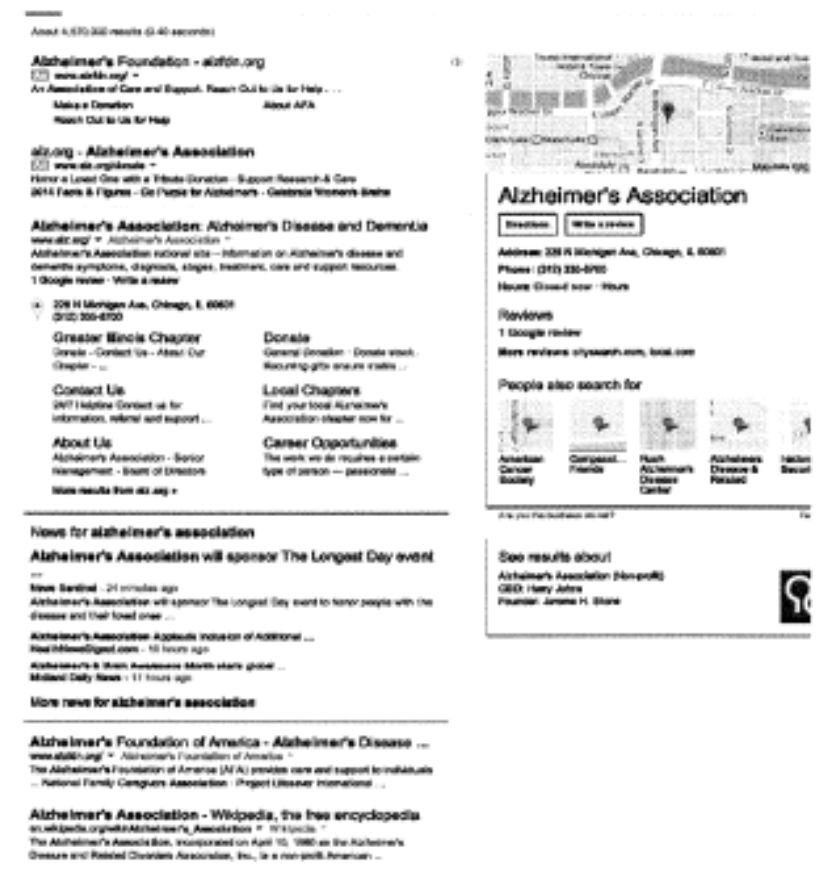
A Google search of “alzheimer’s association” from June 2014
showed the Foundation’s ad as the top result, with the main header as
“Alzheimer’s Foundation – alzfdn.org” with the tagline “An Association of Care
and Support. Reach Out to Us for Help….” The second and only other ad was
from the Association. Their header reads “alz.org – Alzheimer’s Association,” and
the tagline “Honor a Loved One with a Tribute Donation – Support Research &
Care.”

“Alzheimer’s Association” sometimes led to more clicks on the
Foundation’s sponsored ad than those received from its own brand. Indeed,
campaigns targeting Foundation’s competitors performed the best and comprised
roughly 40% of AFA’s keyword marketing budget.   During some of the relevant period, the
Foundation may have been using Association-related metatags, though the court
found this immaterial “as [site metatags] have likely not been used by search
engines since before 2009, and so have little effect on the ordinary prudent
consumer.”
On the Foundation’s donation page, there are many references
to “AFA” or “Alzheimer’s Foundation of America,” and no references to the
Association or use of any the Association’s marks. “At no point while on the
AFA website during the donation process would a consumer see any of the
Association Marks.” So too in reverse for the Association.
The Foundation was the first to complain of confusion, in
2004, when its then CEO wrote “a routine web search under ‘alzheimers
foundation’ led me to [the Association’s] site. ‘Alzheimer’s Foundation of
America’ is a registered service mark of our organization. It distresses me
that supporters of our respective organizations may be confused when searching
the internet.” This might not have related to sponsored ads, though. In 2014, a
Foundation employee wrote that a survey showed many people saying they donated
before or were “introduced to AFA through a fund raising event,” and speculated
that “several respondents may have us confused with the Association or with
‘the cause.’ ”
Between 2007 and 2012, the Association received more than
5,700 checks made payable to “Alzheimer’s Foundation” or a variant totaling
over $1.5 million. The Foundation received more than 5,000 checks between 2006
and June 2016 made payable to “Alzheimer’s Association” or near variants. A
large percentage of the Foundation’s online donors are first-time donors, and
that the average online donation, as well as check donation, is under $100.  The Foundation argued that the number of
Foundation-labeled checks received by the Association was only 0.1% of the
total number of checks received, and 0.252% of the total value of checks
received.
There was evidence that a check for the Association was
received alongside a printout of the Foundation’s internet donation form. When
asked why she had submitted the Foundation form, the donor claimed that she had
typed the Alzheimer’s Association name into her web browser and clicked on the
first entry that came up to download the form for donations and that she was
unaware that she was on the Foundation website.  No one testified about other donors or
potential donors contacting one organization looking to donate to the other,
apart from people asking about the difference between the Association and the
Foundation.
Other purported instances of confusion included that NBC’s
Today show ran a quotation the Association has provided alongside the
Foundation’s logo, but that was the logo with the words “of America,” and wasn’t
at issue in this litigation. In Celebrity Family Feud, the host once suggested
the show was raising money for “Alzheimer’s Foundation,” when it was actually
raising money for the Association. These instances didn’t have a clear link to
the Foundation’s allegedly infringing actions.
There was also two studies from the Association and an
expert critique by the Foundation.  Study
1 found 34% net confusion between the standard character marks “Alzheimer’s
Association” and “Alzheimer’s Foundation.”  The court found that this was somewhat
artificial but still probative to actual confusion. However, the court found
that the control—“Alzheimer’s Trust”—artificially inflated the net confusion
numbers.  They “pre-tested” two controls,
“Alzheimer’s Charity” and “National Alzheimer’s Foundation,” which, by
generating more confusion, would have yielded net confusion rates for
Alzheimer’s Foundation of 12% and 11% respectively. 
The expert said “Alzheimer’s Charity” wasn’t good because it
“sounded like a product category rather than a single real entity,” which
sounds fair to me, but the court didn’t like the expert’s explanation
overall.  He testified that his staff
never disclosed the results of these pre-test surveys to him, even though the
results were disclosed to the Association’s attorneys. “While it is legitimate
to run a pre-test or pilot study for the purposes of improving a study, no
credible explanation was offered for the changes made between the pre-test
survey and the reported survey, and this suggests a potentially improper
purpose.” 
Setting that aside, “Alzheimer’s Trust” was a weak control
term. Though testing a two-work mark made sense, “Trust” as a descriptor for a
charity was both more unique than “Foundation,” and more easily distinguished
from “Association” in part because of its multiple meanings. “Alzheimer’s
Federation” could have more clearly controlled for the confusion created by
reasons other than Foundation-specific reasons, or “Alzheimer’s Foundation of
America,” given that the Association was arguing that it was the two-word mark
that was confusing.  “[W]hat better way
to test that proposition than to compare its use with that of AFA’s full, and
undisputedly non-infringing name?”
Another study allegedly showed IIC.  Respondents were asked to type “Alzheimer’s
Association” into a search box and then were either shown results including the
Foundation’s disputed ads and other keyword ads (test condition), or organic
search results without ads (control condition). Respondents were asked to click
on the link/s they thought would take them to the website of the organization
for which they searched. If they clicked on the Foundation’s ad, they saw the
Foundation’s web page and were asked if they thought it was the web page of the
organization for which they had searched. If respondents didn’t select the
“Alzheimer’s Foundation” or control links, respondents were asked to click on
the link or links, if any, that they believe would take them to the website of
an organization affiliated with the organization they searched for.
There was a net rate of 20% sponsorship confusion, and, of
the 42% who were confused in the test condition, 74% remained confused as to
source or affiliation after viewing a screenshot of the Foundation’s web page
(31% of the total respondents in the test condition).
The court found it significant that the study design assumed
that participants asked to type in “Alzheimer’s Association” knew that it is a
particular organization. “Consumers cannot mistakenly associate the AFA ad or
website with the Association if they were not aware of the Association’s
existence to begin with.”  The test
stimulus was also biased—there was no sponsored ad for the Association, whereas
the Association also bid on its own marks as keywords, and often would have
appeared in the sponsored ads section as well.  The order of the ads would have changed based
on the organizations’ respective bids, and thus order bias was also implicated—a
bias that couldn’t be accounted for by the chosen control.  [citing Winnie Hung, Limiting Initial Interest
Confusion Claims in Keyword Advertising, 27 Berkeley Tech. L.J. 647, 666 (2012)
(stating that statistics show ad rank has a significant effect on consumers’
confusion).] 
The court, however, concluded that though the bias suggested
a lower actual confusion percentage, the study did use a real web page with
real ads that did actually result from typing in “Alzheimer’s Association” at
one point in time. “[I]f the Court were to find a likelihood of confusion based
on the one test stimulus used, it would constitute a Lanham Act violation just
the same.”  [Is that really likely confusion if there weren’t
evidence about how often it would have happened?]  
The study inflated net confusion because the first search
result in the control was the Association’s website, while the first search
result in the test condition was the allegedly infringing Foundation ad.  “A better control stimulus would have contained
non-infringing sponsored ads at the top that, if clicked, counted towards the
confusion rate for the control.” What was at issue was the specific ads, not
sponsored ads in general, and thus “only the offending item should have been
removed or replaced.”
Overall, the evidence “strongly militates against placing
much weight on the study evidence.”
The Association’s evidence of intentional attempts to
confuse also faltered.  Of possible
interest:  “AFA’s patent counsel filed
two false specimens of use”—in its filing for a standard character mark, t
counsel included as a specimen of use a page from its magazine in which the
words “of America” had been obscured. After the Association raised the issue, counsel
filed press releases as substitute specimens of use, which were accepted by the
USPTO.  The Foundation also filed a
section 8 declaration with respect to the composite mark and included one specimen
of use (among others) in which “of America” was removed and that had not
actually been used in commerce. The Foundation again filed an amendment after
the Association raised the issue, and the USPTO accepted the amendment.  There was no evidence that the Foundation was aware
of either of the false specimens of use. 
[Still, looks bad for the lawyers. To the extent that this increases the
expense/burden of litigation, it may raise questions that should be taken up
with an insurer.]
Because the Association didn’t challenge “Alzheimer’s
Foundation of America” in any context, the key question was the [marginal] likelihood
of confusion arising from the use of the two-word name and the Foundation’s use
of Association marks in search keyword ads and metagags. 
[One way to read this case might be as a cautionary tale for
the assumption that structures much discussion of the TM/unfair competition
interface—that there is something
that can really be done to limit confusion without disallowing use of generic
terms, or functional features, or whatever isn’t protectable by TM but may
still be contributing to consumer confusion. 
Then-Judge Ginsburg might have wanted
there to be a good solution for the two Blinded Veterans association, but we
have no empirical evidence that any intervention would work.]
[Also, another interesting question here is the appropriate
comparator keyword buy.  Suppose that the
Foundation had merely bought “Alzheimer’s.” 
Its ads should then have stilled displayed in response to a search for “Alzheimer’s
Association,” though possibly at a different price point depending on the
search engines’ practices. The consumer doesn’t know why the ad displays.  If that’s the appropriate comparator, then
the net confusion from buying the Association’s trademark would be zero.  Or should we also allow the Association’s
trademark rights to force the Foundation to use negative keywords, as
1-800-Contacts made its competitors do (in violation of antitrust law, as the
ALJ found)?]
Anyhow, the court noted that it wasn’t evaluating the
Foundation’s keyword buys in a vacuum, but rather the effect of the keyword
purchases in conjunction with the Foundation’s resulting ads.  Further, the key type of confusion was
IIC.  Was the Foundation engaging in a
bait-and-switch likely to confuse consumers, or offering consumers a choice?
Though the Association’s mark was incontestable, it was
still commercially weak, which was crucial to the court’s holding here.  As the Ninth Circuit has said, “a consumer
searching for a generic term is more likely to be searching for a product category.
That consumer is more likely to expect to encounter links and advertisements
from a variety of sources.”  Both
components of the Association’s mark were descriptive of the relevant
charitable endeavor. Althought the Association is the world’s largest
Alzheimer’s-related non-profit and the world’s largest non-governmental funder
of Alzheimer’s research, the consumer studies in evidence showed that the
mark’s secondary meaning was not strong. 
Between 10-20% unaided awareness among potential donors wasn’t much.
“Here, because of the weakness of the mark, it is not easy
to disaggregate the consumers searching for the Association as a specific
organization from those searching generically for an Alzheimer’s charity when
they type ‘Alzheimer’s Association’ or some similar derivation into a web
browser.” Relatedly, it was difficult to distinguish consumers confused by the
Foundation’s actions from those “confused simply by the similarity of the
descriptive marks.”
Mark similarity: the court reasoned that the proper
comparison was not the mark to the keyword buy itself, but the mark to the
resulting ads, because that’s how consumer confusion would manifest itself.  The Association argued that, in organic search
results, AFA’s website appears as “Alzheimer’s Foundation of America,” and that
the use of the two-word name in the ad header and sometimes “association” in
the ad text combined with the keyword buys to increase the similarity between
the marks/ads. 
The Foundation argued that, in context, the similarity was “mitigated
by the unique information and URL of its ads,” but the URLs http://www.alz.org and
http://www.alzfdn.org and ad text, e.g., “Honor a Loved One with a Tribute Donation.
Support Research and Care.” and “An Organization Providing Support for Your
Loved One with Alzheimer’s” weren’t particularly dissimilar. And differences in
the parties’ websites came too late.  The
ads were similar in appearance and meaning, favoring the Association.
The Foundation tired to argue that it was primarily focused
on providing care services while the Association focuses on funding research, but
that didn’t distinguish them in the market for donors.
Actual confusion was a key factor, but the evidence “must be
related to the actions or behaviors at issue.”  The evidence of 11,000 mislabeled or
misdirected checks was probative of confusion “generally,” but not by confusion
generated by the Foundation’s actions. 
Nor were the limited instances of confusion in the media and anecdotal
reports of consumer confusion persuasively related to the Foundation’s actions.
“In light of the descriptive nature of the marks, confusion between the
unchallenged ‘Alzheimer’s Foundation of America’ mark and ‘Alzheimer’s
Association’ supports the notion that it is the weakness of the marks and consumers’
inattention, not AFA’s specific disputed practices, that yields confusion.”  
Finally, the surveys’ flaws meant they merited little
weight.  The point of the surveys ought
to have been to pin down causation by focusing on the challenged behaviors, but
that was exactly what they did not do.
Intent: The Association argued that the Foundation complained
of the confusion created by the similarity in the organization’s names back in
2004, but, despite its own complaints and lawsuits, then proceeded to employ
Association marks in its metatags and as keywords, as well as attempting to
register a two-word mark without really using it.  The Foundation argued that it didn’t
intentionally use false specimens and that its internet ads had been similar
since 2004.  The court didn’t find the
Foundation’s trademark counsel “particularly credible in his explanation of the
false filings, but circumstantial evidence about AFA’s trademark applications
does not itself suggest an intention to capitalize on the Association’s goodwill
or to exploit confusion.”  And the
Foundation noted that the Association also bought Foundation keywords before
2010, and coexisted with the Foundation and its practices for six years before
suing.  When the Association complained
about the Foundation’s use of the word “association” in its ad text in 2014, the
Foundation removed the offending ads.
The court found that intent favored the Foundation.  “In many respects, the lack of direct
evidence of actual confusion undermines the Association’s attempts to argue
that AFA acted with the intention of exploiting consumer confusion.” The
evidence didn’t support the claim that the Foundation believed the specific practices
at issue here were causing consumer confusion. Because this factor failed, the
Association also failed to show the intentional deception vital to IIC.
Consumer sophistication: the relevant population was the
average consumer searching for the Association online and seeing the Foundation’s
ad, who are less likely to be institutional donors and many of whom are
first-time donors. “[I]n this day and age, the ability to complete a form on a
website does not itself make consumers particularly sophisticated.” This factor
favored the Association.
Weighing: the most important factors here were strength of
the mark, similarity of the marks, and evidence of actual confusion, two out of
three of which strongly favored the Foundation. 
A final consideration didn’t neatly fit within the Polaroid factors: “the labeling and segregation of online
advertising.” The “ad” label “heightens consumers’ care and attention in
clicking on the links, and further diminishes the likelihood of initial
interest confusion.”  [Or more likely,
contributes to ad blindness if it’s noticed at all.]
Highlighting my ongoing conviction that elaborating
causation stories makes actionable confusion less likely to be found, the court
elaborated that it was trying to figure out how many consumers fell into the
relevant subpopulations: (1) Those who weren’t confused, either because they
were using “Alzheimer’s Association” in a generic sense in their search or
because, on seeing the search results, they understood the difference between
the two organizations. (2) Those who clicked on the Foundation’s ad by mistake
and who were diverted because of the Foundation’s keyword buys and its use of
the two-word name “Alzheimer’s Foundation.” 
A subset of (2) could remain confused even after viewing the Foundation’s
website.  (3) Those who were mistakenly
diverted for other reasons, such as because of the inherently weak and
descriptive nature of the parties’ marks. “These consumers are ‘confused’ in
the colloquial sense, but would have been confused even if they searched the
word ‘Alzheimer’s’ alone or even if AFA solely utilized its full name.”  In light of the evidence, it was difficult to
identify the proportion of consumers in each group, and thus the Association
didn’t show a probability, as opposed
to a possibility, of confusion.
Finally, and perhaps exhausted by the effort so far, the court
rejected the Association’s attempt to cancel the Foundation’s marks.  As to one mark, the court accepted the dubious
rationale that filing a Section 8 declaration in 2017 showed lack of
abandonment.  Even though the court didn’t
see where the challenged mark, as opposed to the other mark, was included as a
specimen of use in that filing, “the filing of the application alone
demonstrates AFA’s intent to use the ‘014 Mark. Given the high burden placed on
the Association to establish abandonment, and the limited evidence adduced, the
Court cannot find abandonment.”  I can’t
see how that can be right—if the challenged mark isn’t in the filing, given
multiple years of alleged nonuse, that can’t be the end of the analysis, unless
there’s some sort of implicit tacking analysis going on.

from Blogger https://ift.tt/2r8Lzgw

Posted in Uncategorized | Tagged , | Leave a comment

competitor lacks Lanham Act standing absent allegations of why it in particular would be harmed by false advertising

Blue Star Press, LLC v. Blasko, No. 17-CA-111-OLG, 2018 WL
1904835 (W.D. Tex. Mar. 6, 2018) (magistrate judge R&R)
The parties make adult coloring books, typically marketed as
a means of relieving stress but proving stressful in this litigation. Blue Star
began successfully publishing adult coloring books in 2015, then began working
with defendants Reagan and Sada Lewis to create Christian-inspired coloring
books. However, Reagan allegedly secretly agreed to work on competing adult
coloring book publishing with his friend, defendant Sean Blasko, agreeting “to
fraudulently steal coloring book opportunities and sales from Blue Star, often
misappropriating Blue Star’s own Trade Secrets/Confidential Information to do
so.”  Blasko counterclaimed, alleging
that Reagan Lewis in fact stole trade secrets from him, including confidential
methods for “determining keyword search terms and online marketing and advertising,”
and for “obtaining sponsored ads on Amazon for books” with less “need for
‘good’ keyword search terms.”
The court found that Blasko’s counterclaim stated a claim
under the FDTSA.  Blue Star argued that
misappropriation had to be made with actual or constructive
knowledge, but Lewis was Blue Star’s employee at the time of the alleged
misappropriation. Blasko plausibly alleged that Lewis was acting within the
scope of his employment at Blue Star, and thus that Blue Star was vicariously
liable, a type of liability the court determined was available under the
FDTSA.  Even assuming, as Blue Star
argued, that Lewis’s secret relationship with Blasko was in violation of his
employment agreement with Blue Star, and that, had Blue Star known about it,
Lewis would have immediately been fired, agency/responsibility for Lewis’s acts
was a factual issue.
Blue Star did better against Lanham Act and state false
advertising-related counterclaims. Blasko alleged that Blue Star misled
consumers into believing that Blue Star had the lawful right to republish the
artwork in its books; misled consumers by passing its books off as books
published by their competitors; misrepresented that one or more of Blue Star’s
books were “NEW & EXPANDED”; and misrepresented that Blue Star’s artwork is
“all hand-drawn” and drawn “by independent artists” in Texas for Blue Star.
Lexmark’s
causation requirement had bite here, despite the fact that the parties directly
compete.  The court indicated that “Blasko
might have demonstrated the needed causal connection by alleging, for example,
that some of Blue Star’s claimed ‘knock-off’ publications mimicked Blasko
publications or that, unlike Blue Star’s publications, Blasko’s publications
actually were hand-drawn, created by independent artists, or created by local
or Texas artists.” But Blasko instead only conclusorily alleged harm.  Direct competition wasn’t enough; Blasko didn’t
allege how any of Blue Star’s alleged conduct took away from Blasko’s market
share, as opposed to that of other competitors.  Nor was it sufficient to allege that Blue Star
could sell at lower prices for higher margins and with less cost because Blue
Star does not pay for the proper licensing fees that Blasko pays, “including
for books containing the same themes and images such as the parties’ Dia de los
Muertos books.” The injury to Blasko could have resulted from any number of
other reasons—potential harm isn’t enough for standing.

from Blogger https://ift.tt/2HBAeRe

Posted in Uncategorized | Tagged , | Leave a comment

seller can’t sue customer for false advertising under Lanham Act because customer can’t sue seller either

Buckeye Int’l, Inc. v. Schmidt Custom Floors, Inc., 2018 WL
1960115, No. 18-cv-111-jdp (W.D. Wis. Apr. 26, 2018)
Buckeye sells floor finishing products, including Gym Bond, which
is supposed to help a clear topcoat adhere to a previously finished gymnasium
floor. Schmidt used Gym Bond on the floors of several sports facilities, but
the floors had problems with peeling. Schmidt turned to social media and email
to voice its complaints. Buckeye contends that the peeling was caused by
Schmidt’s faulty preparation of the floor surface, and sued for false
advertising and related claims. The court denied a preliminary injunction.
“A customer’s complaints about a supplier’s products and
services, even if posted on social media, are not statements made in commercial
advertising or promotion.” In addition, there was a genuine dispute about the
cause of the floor problems, making speech and counterspeech the appropriate
resolution for now.
Schmidt complained about Gym Bond and Buckeye on social
media and directly to Schmidt customers and trade associations, including
statements that Buckeye admitted that Gym Bond is defective and that Buckeye is
broke. The parties sharply disputed the truth or falsity of the statements.
Schmidt took down social media postings on Facebook, YouTube, LinkedIn, and
Google Review. (Schmidt was apparently very mad.)
The court explained that “commercial advertising or
promotion”
is broader than classic
advertising, and it is not limited to traditionally published or broadcast
materials. There is no requirement that the challenged communication be
distributed broadly to the general public, but there must be some public
dissemination. Individualized person-to-person communication, whether conducted
in-person or by means of correspondence, is not within the scope of the
statute.
Thus, Schmidt’s emails or personal discussions with its
customers, the trade association, or anyone else weren’t subject to the Lanham
Act.  [This seems to skip a step.  Were the emails individualized or personalized,
or was there a mass mailing trying to reach the relevant market?  Email ads are still ads.]
The social media posts were disseminated to some portion of
the public.  Still, “not every social
media posting would constitute commercial advertising or promotion”: what’s
needed is “a systematic communicative endeavor to persuade possible customers
to buy the seller’s product.” That’s where Buckeye’s claim faltered. Under Gordon & Breach test, Schmidt’s anti-Buckeye
social media postings wouldn’t be commercial advertising or promotion because
Schmidt and Buckeye are not competitors. [Though this rigid application of Gordon & Breach neglects the
subsequent effects of Lexmark, which
I believe removed the “competitor” prong from Gordon & Breach—and several subsequent cases have so
held.] 
This public complaining wasn’t “a prototypical negative
advertisement that disparages a competitor’s goods to promote one’s own. …Schmidt
is explaining that the trouble with its floor refinishing is not its fault. And
Schmidt is warning Buckeye’s customers about an alleged deficiency in one of
Buckeye’s products. There is no endeavor to persuade any potential customer to
choose Schmidt’s services.”  [Though
explaining that the trouble wasn’t its fault does seem to be designed to boost
Schmidt’s attractiveness to potential customers, as well as to criticize
Buckeye.]  Ultimately, Schmidt’s social
media postings weren’t “a systematic communicative endeavor to persuade
possible customers to buy the seller’s product.” “[T]he communications at issue
in this case are, at heart, those of a customer who is unhappy with a
supplier’s product,” and Lexmark indicates
that this isn’t generally within the Lanham Act’s purview. 
Lexmark said that
in the context of not letting the customer sue the seller for false advertising
of its own products’ characteristics;
Lexmark
itself is a disparagement case, and I read the case as allowing far
greater scope for disparagement claims. 
However, the court here thought that sauce for the goose was sauce for
the gander: if the customer can’t sue for false advertising, then the converse
should also be true. Thus, “[t]he public interest is better served by Buckeye
offering its counter-explanation rather than by shutting down Schmidt’s side of
the story.” Of course, causes of actions with heavier burdens of proof on
intent remain.

from Blogger https://ift.tt/2razK9H

Posted in Uncategorized | Tagged , | Leave a comment

1201 hearings, LA, streamlined video exemption

IN SUPPORT
Art Neill New Media Rights
Elizabeth Rosenblatt Organization for Transformative Works
Jack Lerner, Brian Tamsut, and Jovan C. Ardy UCI Intellectual Property, Arts, and
 Technology Clinic
Tisha Turk University of Minnesota, Morris
 IN OPPOSITION
Ben Sheffner Motion Picture Association of America, Inc.
 David J. Taylor DVD CCA and AACS LA
J. Matthew Williams Joint Creators II

Tisha Turk presented on problems with screen capture using
Movavi, one of the programs that the opponents want people to use.  She showed stuttering, jerkiness, pausing in
capture from Netlfix.  Results in
nonstandard framesize, which causes technical problems with editing and
export.  Capturing streaming is going to
be more prone to glitches due to additional layer of difficulty of
capture.  Many computers don’t have optical
disc drives at this point so streaming might be the only option. 
Opponents: Screencap programs have settings that can be
optimized.  Streaming: you don’t know
what the internet connection was and whether that was the problem.  Was the codec lossy or lossless?  The lossy format will require a certain
amount of compression. You can’t just sit down, use a screencap program for the
first time, and get perfect results. The ones we have offered fairly compensate
for every program.  Not familiar with
Movavi.  Had to learn screen cap programs
every three years now.  There are infinite
numbers. Also much easier to learn than Handbrake and video editing. As a
hobbyist, you can easily spend the time to learn how best to maximize the
results. 
Jack Lerner: Two points: Morrissette noted in his statement,
attached to Jt. Filmmakers—many sound difficulties with syncing, computer
noise, stereo effects & other important parts of the sound that aren’t
captured by screencapture.  Also, there
is no such thing as lossless screencapture for Blu-Ray.  Maybe he’s referring to highest possible
fidelity, but we have found nothing on the market that doesn’t drop frames and
lead to stuttering and other problems.   
Betsy Rosenblatt: Movavi is among the popular screencap
programs; there are several.  Does
screencap require circumvention: nobody knows. Which is one of the issues with
an exemption that deals with distinctions between types of programs.  Netflix: this stream was from Netflix, but we
have numerous reports of people using screencap who end up with just a black
screen.  There are certain sources from
which screencap is simply inadequate.  As
to whether screencap from streaming is different: it’s necessary to use
streaming for some things for unique or timely sources.  To say that one could have an internet lag
free screencap is true only for some materials. Resetting screen size was
suggested as an option: results in difficulty editing but also loss of material
on the sides of the screen—uses the aspect ratio of whatever computer you’re
working on.  Professor Turk can speak to
this w/other clips.  To the extent that
the stutter was supposedly a result of internet lag: that was created in an LA
home with high speed DSL; many people have worse.  Even in a perfect internet connection there
is frame loss and blurring.
Opponents: the relevance of screencap at this point goes to
whether the existing exemption beneficiaries have to make a good faith effort
to use it to get the quality they need before moving ahead with circumvention.
What’s the point of that if it may or may not be legal? The proponents have
consistently questioned its legality, which is why it should be retained. [But
that doesn’t explain why there should be a requirement to go to screencap
first, especially given its questionable legality, or why the exemption should
be written to distinguish between the two.]
CO: The proponents say it’s confusing.
Opponent exhibit: from a woman responsible for VOD output
for Discovery.  Transcoded AVI to
mp4.  [The unanswered questions here were
how these clips in the opponents’ exhibits were created, and how long it took
to get those clips to the condition that they could be imported and looked
good.  All the opponents’ exhibits start with the clips as if that were
simple, something that the opponents’ statement above indicates was probably
not the case.]  Asked to determine if
these clips would be usable as a deliverable for pro use, and the answer was
no. But if a small clip was used in a larger project, providers would accept
the whole project.  Using multiple
sources with multiple frame rates is common. You use the frame rate that the
majority of your clips use, and the hope is that the converted clips will look
ok.  Apple is the pickiest of the
providers, and has accepted some mixed cadences, just won’t accept a lot.  Inverse telecining: backwards conversion to
return it to its remaining frame rate. As long as it comes out converted, and
it’s a small portion of the project, it’s usable.
Opponent: screencap in lossless ODS format. Does drop
frames.
CO: how is it lossless then?
Opponent: they call it that. [!! My advertising prof senses
perk up.] It’s not frame for frame, but for a screencapture, it’s getting 9/10
of the frames, and there’s a lot of frames. 
We submitted something different to her [the video maker] than to you
b/c there was a learning curve in using the software.  It results in a huge file, but it is high
quality—someone who works for Discovery has said this could be included in a
final product for Apple.  A small piece,
as w/exemptions, is perfectly fine.  Every
work requires postproduction editing, and no one gets a perfect clip the first
time.
CO: we did find in 2015 that screencap wasn’t enough.  That’s the baseline we’re working from.
Opponent: we’ve shown that screencap has improved enough to
meet distribution standards. We aren’t dealing w/close analysis.  Any documentary film that uses an archived
clip has to deal with this processing problem regardless of how acquired.
Turk: Codec is just the format in which something is encoded
and decoded. Something can be coded in lossless format but all it encodes is
what it’s fed—a stream that has
dropped frames or is pixelated.
Neill: working with people on distribution
contracts—practically, most of the folks getting a contract related to
nonfiction, documentary, short films—these are small projects with modest
budgets. If you’re told to return and recut the video and find the source
material, that takes time and money and eats into subsistence return.  Upscaling isn’t sufficient; there’s Netflix
standards on upscaling that reject it. Far-fetched to say that distributors are
accepting this across the board. They will ask a filmmaker to go back.
CO: specific films?
Neill: reply comments have cites to client w/broadcaster who
rejected clip that was screencaptured.
Lerner: Also, documentary evidence about problems other than
framerate.  Taylor asserted that PBS and
Netflix don’t matter, but they are very important for documentarians—the record
referring to iTunes doesn’t cover PBS and Netflix, the key channel for
documentarians, and our record shows that PBS and Netflix don’t like screencap.
Our submission addresses ODS. It’s true that they accept 70s footage, but
that’s because they understand there’s nothing else available. If you try to
submit a modern screencap clip, that will be rejected.  Opponents have not submitted evidence of
broadcast standards. Also worth noting that the clip narrator isn’t here to be
asked questions.  [CO says that not all
the people mentioned in submissions here.]
Rosenblatt: inconsistency in the arguments.  The argument that screencap is good enough
for everything is fundamentally inconsistent with the argument that DRM is
necessary to prevent piracy. We’re asking people who make art and commentary to
sacrifice their vision; turning CO into art critics.
CO: not here to discuss whether DRM is valuable. [That’s
true, but the impact of exemptions is very much at issue here, and the fact
that it’s not preventing “piracy” is important.]
Opponent: we didn’t oppose renewal.  Expansion is on the table.  They’ve had a hard time establishing uses are
noninfringing. Compare that w/the quality of screencap, what we saw was that
the quality is pretty good, and that’s true w/experts too. Take that into
account when weighing blurry issue of noninfringing status against ease of
screencap.
CO: do you envision that the filmmaker has to actually get
rejected to use the exemption?
Opponent: it’s good faith/common sense; doesn’t require
rejection by the broadcaster. Requires sampling products on the market. If
you’ve been rejected in the past or you compare their standards to what you can
get, you don’t have to try again.
CO: so now the filmmaker rejected by the broadcaster can
circumvent from now on?
Opponent: that would be a common sense approach. Not sure if
it was eligible under existing exemption.
[So why do you have to go through this rigamarole if you
haven’t yet been rejected?  Good faith
makes sense where situations may vary, but ODS is ODS; it won’t work
differently from user to user.]
Opponent [Taylor]: didn’t mean to say PBS and Netflix didn’t
count.  My discussion w/expert: she
offered that in her experience, the most difficult company was iTunes.  Agrees w/Williamsn [opponent] about
significance of screencap. It’s an alternative for those looking to expand the
exemption. It continues to improve. [Then there’s no point in requiring people
to use one rather than the other.  It
just makes the exemption more confusing without having any more DRM-protecting
or copyright-protecting benefit.]
CO: Question re previous exhibit from DC?
Rosenblatt: It depends entirely on what you’re doing.  People who want to make seamless stories from
multiple sources have difficulty w/different frame sizes, frame rates. If you
want to focus in  on something, you can’t
do that dependably using something that will result in blurriness or loss of
material.  We aren’t looking for proof
that every use is fair, but for the significant possibility that fair use is
deterred.
CO: are people confused about screencapture as an
alternative?
Rosenblatt: Turk can address—but this is a law that
addresses more what happens after you make a thing than before.  1845 people responded to our survey Q about
what the DMCA was: 1400 hadn’t heard of it or didn’t know. Of the 440 who said
they did know, only 67 mentioned anticircumvention, and 6 mentioned
exemptions.  1/3 mentioned complicated,
confusing, convoluted.  The people who
knew about it said “I have little understanding do to the confusing and vague
language.”  “scared the pants off of
everyone in my middle school.” That’s the sort of user we’re dealing with. That
may not address directly your Q but it speaks to our argument that people
aren’t likely to seek out something that won’t work as well when there’s an
option that works, from the consumer standpoint, and they won’t have to go
through these multiple steps. They don’t understand why one means of achieving
a fair use would be illegal and another wouldn’t be.
CO: Seems in tension w/saying there’s a chill on uses.
Rosenblatt: there is a chill when people know, though it’s
fair to say there’s not as many of them. 
A lot of the trouble comes when someone who isn’t chilled b/c they don’t
know then has to interact w/ an institution like a school, traditional publisher,
library, who won’t facilitate/adopt their work, or when responding to a
takedown, or trying to get insured. That’s where the chill happens, not in the
initial creativity but in the use of what you’ve made. Turns the law into a
trap for unwary, makes fair uses more vulnerable to takedowns. When you
encounter a gatekeeper, like iTunes, it can turn out what you’ve done is
illegal even though it would have been legal if you used a different program.
CO: is it really just because people don’t know if they can
use screencap or not?
Rosenblatt: a few levels of confusion. Screencap is one.
They don’t know what noncommercial means: if it’s on YouTube.
CO: we’ve always contemplated YouTube in the exemption.  How is that confusing?  You asked for noncommercial.
Rosenblatt: Times have changed a bit regarding the way
content is delivered in the sense that noncommerciality and whether someone is
personally making money off their creation is just more complicated.  We are very much about noncommercial
creation, but we’ve had people come to us increasingly confused about what
noncommercial means.
CO: filmmaking and ebook aren’t limited by commerciality;
should they be?
Rosenblatt: we don’t propose a change to that.
Opponents: we support simplification, but you can’t do it at
the expense of following the law.  Even
the proposed exemption is college-level understanding. It’s difficult to craft
a legal rule that’s simpler.  Michael
Donaldson has tried to simplify fair use: would your use be clear to the
average viewer. If you apply that to most of the examples in the record, the
fair use doesn’t come through b/c the point isn’t perceivable to the average
viewer. That’s why you’ve drawn the lines where you have for filmmaking and
ebook authorship. Axanar: use of Star Trek in a “fan” film—no payment there,
and the court still said it wasn’t a fair use. The point of the work couldn’t
readily be perceived.  [Not really a
short exerpt there.]  There wasn’t enough
evidence to do “primarily noncommercial” before [that’s a mischaracterization
of the record; in that instance the CO indicated that “noncommercial” in its
definition encompassed the videos we were talking about, such as videos that
were made on commission]  the Dr. Seuss
v. ComixMix: transformative purpose, the fourth factor still failed fair use as
a matter of law b/c of potential harm to the market for derivative works even
if they didn’t license mashups [again, that’s a misdescription of the case; the
motion to dismiss on fair use as a matter of law failed, not the fair use
defense]. The law doesn’t mandate the simplest exemption.  [Nor does it bar it.]
Turk: The remix community uses what works.  I was mystified that screencap came up at
all.  The goal for a remix artist is to
get good quality video into the computer. Didn’t understand why anyone would be
asked to use something that doesn’t work as well.  Can’t you just know from past experience or
other people’s experience that this typically doesn’t work, and that another
thing works well, and participate in a community that gives advice about what works
well?  Can’t we just say, if it’s fair
use, get the video in a way that works for you and go?  I would never say don’t use screenap.  I wouldn’t do it. There might be cases where
someone wants or needs it, but I’m interested in the end result.  Is the quality good enough that someone won’t
just hit the back button?  Evidence is
that if something looks amateurish people don’t watch it. 
CO: Remix and education: K-12 remix activities—screencap
might be perfectly adequate?
Turk: It might be. Haven’t taught remix in those
settings.  I come back to: don’t disallow
it, but don’t impose it on people whose workflow or access to technology works
better w/a different format.
Taylor: We endorse joint creators’ proposal for simplifying
regulatory language. Improvement over actual statutory exemptions. Not very
difficult to understand, once you start looking at it.  If it’s so confusing, could provide them some
examples of what activities would look like. 
You could provide them examples from this rulemaking.
Neill: We’re dealing w/ a subset of noninfringing uses. The
analysis happens on each individual clip. That’s how a real fair use analysis
happens, regardless of whether it’s a documentary or YT video or some other
format.  Trying to avoid haplessly
violating law when making video on day to day basis.  There’s lots of possible kinds of confusion.
Looking back, we can see the evolution of filmmakers who do a variety of
different formats—not just fictional, but documentary, and other types. People
could turn around the next day and use a clip in a way that’s fair use and be
excluded as they weren’t the day before. We’re trying to deal with gaps—examples
of what’s ok won’t help if you’ve added all these additional layers of
requirements.  Many times these requirements
have never been developed/delineated in case law.
CO: we’re not looking to break new ground in case law.  [I think he was saying that the requirements
that decrease the scope of exemptions haven’t been delineated in case law,
because the requirements haven’t been requirements for making fair use.]
Lerner: 8 renewed exemptions have said that people need to
use clips which apply to the proposal for expansion, as well as a number of
examples for expansion, and the statute doesn’t require the limits that are on
the current exemptions.  House Commerce
Committee said that motion pictures could be an appropriate category for
exemptions, and the report goes on to say that it wouldn’t be appropriate to go too narrow in the sense of Westerns,
comedies, etc.
CO: how is all AV works limited?
Lerner: short portions.
CO: doesn’t go to class of works.
Lerner: motion pictures restricted in other ways, such as
short portions/commentary, then you’d have an appropriately narrow class under
the plain meaning of the statute and what Congress said in the legislative
history.
We aren’t asking you to break new ground for these uses:
short portions for criticism/commentary. Not controversial that many fanworks
are criticism/commentary; the Register is on record as saying so.  Juxtapose in order to say something new.
We’re not talking about a sequel but about a critique. Harry Potter; GWTW.
CO: Harry Potter wasn’t saying fan fiction was always fair
use.
Lerner: Sure, but many are, and that’s the proposition that
isn’t controversial given the record and the case law. 
CO: [adopts wrong characterization of Dr. Seuss v. Comicmix
as definitively not fair use] Give us specific guidance—where do we draw the
line?  [Short portions, criticism or
commentary] How do we protect only the fair uses.
Lerner: criticism or commentary/new meaning and expression.
CO: Dr. Seuss says it’s not just transformativeness but also
no effect on derivative market. And why should we drop noncommerciality? SCt
has said that the effect on the market is key. We also have to look at
commercial effects. How can we provide enough guidance? 
Lerner: first of all, if someone crosses the line, there’s
still a remedy for copyright infringement—you provide enough guidance that way.  [Why does the CO need to provide any guidance
in the exemption on what is noninfringing
other than the statute does?]
CO: we don’t want infringing uses, so how do we provide
guidance so they don’t cross that line? [I thought this was a proceeding about
anticircumvention, not designed to expand or contract fair use?]
Lerner: short portions makes a real dent. It won’t match
perfectly but that’s ok b/c there’s a remedy for infringement.  This is a phantom threat—if someone is going
to infringe, and they’ve ripped to commit infringement they’re claiming
criticism and commentary, you have statutory damages for that.
Williams: CO began by denying exemptions for fair use for AV
works. Then the CO decided it would specify certain categories of users, it
could get there.  [Fortunately we’ve
learned since then a bit more about what works and what doesn’t.] When you
disregard current boundaries that effort falls apart. Fair use isn’t an
appropriate category. TVEyes: transformativeness doesn’t moot the fourth
factor.  [Though the short portions
thing, as with every other case they’ve mentioned, distinguishes that inasmuch
as TVEyes offered people everything.] 
Often hard to perceive the parody/transformation in fanworks; use full
songs [of what relevance is that to the clips?].  What’s the potential harm to copyrighted
works? The fact that there are licensing options for fictional filmmakers and
ebook authors!  [That always have
anti-disparagement clauses.]  Wouldn’t say
it’s never fair use to make criticism and comment generally, that’s a harder
sell than criticism and comment of the work directly. Many of these examples
don’t comment on the work itself.
CO: is it appropriate/necessary to clarify existing
exemptions? If there are examples of things that should be included but
aren’t.  [Prosecution/defense uses are a
big deal here.]
Rosenblatt: one of the chief confusions is that people are
confused about whether they fit into the type of creator category that
distinguishes between existing exemptions. We aren’t here to litigate remix
video but to talk about where other things might fit in, like multimedia
ebooks, and uses that attorneys might make in litigation [yes!].  Documentary about a guy who’s exonerated by
footage showing that they were at a baseball game.  Makeup tutorials juxtaposing a face to a clip
from a movie. YT reviews of movies. Where do things fit in?  Makeup tutorial is criticism/commentary,
short portion etc. Audio only uses of AV works—podcasters who want to rip to
get high quality audio b/c listeners expect that.
CO: wants examples of ebooks/podcasts.
Rosenblatt: can follow up w/submission.  Also there are lots of people who have
questions: Quora: is it illegal to use audio trailer in my podcast?  Answers are all over the map. Audacity forums
where people say, I need to rip to get high quality audio, b/c Audacity won’t
let me use it w/o high quality.  I have
examples of these questions—could also make a follow up submission.
You could also have like Canada’s UGC provision does, uses
that don’t usurp the market.
CO: could we exclude users instead?  Uses that fall to the infringing side.
Rosenblatt: we’re not arguing to eliminate use, just user
categorization questions.
CO: you’re not talking about filmmakers. Collapsing all of
that. Is there a way to identify problematic use, gray area use?  [Shouldn’t the gray areas be left for
litigation, so as not to expand or contract
the scope of fair use?]
Rosenblatt: short clips.
CO: no one’s asked to remove that.  [Yes, that’s the point.]
Rosenblatt: that’s enough.
CO: the opponents say it isn’t.  [Why are we required to defer to them and not
to the other evidence in the record about the tiny size and contractual
restrictions of the licensing market, which by the way is not a “clip”
licensing market but a general licensing market, versus the size and variety of
the clip uses out there?]
Rosenblatt: educational/derivative uses are hard to separate—a
lot of derivative uses are educational. Doesn’t feel comfortable speaking to
opponents’ proposed language.
Neill: Williams skipped over the harm to © works from
clarifying the language.  There isn’t
any. What is the harm that’s on the record after so many proceedings?
Sheffner: Proponents say there’s no viable licensing market.  He says there is. 
CO: in 2015 rulemaking, the Register found that licensing
wasn’t viable. Speak to why it has changed. And to which uses there is a viable
market, e.g. comment and criticism.
Sheffner: MPAA represents 6 major movie studios, with
different divisions (movie, TV, news). 
Clip licensing is sometimes centralized and sometimes not.  Different philosophies and business
practices, can only speak in aggregate. Overall, every studio licenses clips.
They have websites with info about this. In most cases it can be done online
through forms, email, phone.  There was
an old FAQ that said only a fax, but looking more comprehensively there’s
actually phone or email. 
CO: requests ignored, low dollar value/smaller uses?
Sheffner: asked all 6 studios to address.  B2B only licensing? None of the companies outright
refused individual licenses, but vast majority was B2B, because they have the wherewithal
to engage in the project.  Nonetheless,
they do receive individual requests. 
Significant portion: individual can’t afford price of license. That
doesn’t mean there’s no viable market.  Bel
Air houses: most people can’t afford homes there, but there’s a viable real estate
market.  [If only copyrights were
intangible and nonexhaustible, unlike real estate.]
CO: licensing to remix artists?  Multimedia ebooks.
Sheffner: there is licensing. Hard to generalize about
criteria for licensing. None of them absolutely barred licensing in those
areas.  [Google Books case on factor 4 is
v. good on this—has to be significant as an impact.]
CO: is it frequent?
Sheffner: can’t say that in those specific categories.  Ebooks is a nascent market—there have been
licenses. There’s some experimentation. The licensing websites invite inquiries
from “all” uses—there’s no prohibition. Relatively unusual for there to be
individual licenses, but not unusual for there to be remix videos posted to
YT.  The content ID system identifies
them and monetizes them. Those aren’t licensed but are [he didn’t finish the
sentence because he can’t without doing something that his clients really won’t
want him to do].  [Does Content ID
distinguish circumvention from noncircumvention? How did the uploaders get the
footage?  Does that mean the
circumvention used to create the footage was not unauthorized under Sheffner’s
interpretation?]
CO: is it fair to say that’s an alternative to licensing b/c
you still make money?
Sheffner: it’s a nontraditional kind of license.
CO: is it really a license?
Sheffner: there’s a license agreement w/YT.  [That’s about the footage, not the
circumvention.  That doesn’t provide the footage
which is the precondition to make the video, as a real license might.]  Tolerated even if infringing b/c enforcement
cost too high.  New business model where
the work is identified and a license is granted to YT to allow that use even if
it otherwise might have been infringing. 
[Which suggests that circumvention has no adverse impact at all.]  Several thousand clip licenses per year, but
not much ability to give a breakdown fiction/nonfiction/education.  Can’t indicate monetary value, but licenses
exist in each category.
CO: nondisparagement clause?
Sheffner: can’t answer whether that would have prevented
licensing record examples from proponents. These have been discussed in previous
cycles; there’s no change in the record.
CO: we’re being asked to consider different types of uses.
Sheffner: this isn’t really an issue about 1201, but
contractual issue.
CO: but it bears on whether this is an alternative to circumvention,
if the use is prohibited under contract. [and on fair use!]
Sheffner: not much record evidence of these clauses, which
are vestiges, having substantial impact on ability to make fair uses. [because fair
users don’t license their clips ….]
CO: what effect is changing the exemption likely to have on
the market for © works?
Sheffner: clip licensing is a real market.  [what effect is non-screencap circumvention
likely to have on that market?]  It’s significant
though not dominant—people have jobs doing licensing.  Fair use looks at the aggregate effect on the
market of this kind of activity.  [Fair
use activity.] It absolutely would. Clip licensing revenue would dry up if all
clip uses were allowed.
CO: we’re talking about arguably fair use for purposes of
comment and criticism.  Proponents say
that if a use is fair there’s no right to payment. 
Sheffner: 1201 itself require that you look at, even if the
uses are fair, would allowing the exception cause substantial harm to the
market. [Really?  That’s not how I’ve
understood the statute—it’s the legitimate market for copyrighted works, not
the market for extortion based on technology. The statute wasn’t supposed to
eliminate fair use or enable it to be switched to fared use.]  Look at the aggregate effect on new business
models. 
CO: but also one of your new models is YT, which is not the
traditional way [where you don’t need DRM]. 
Do you have an idea which makes more? 
Or a percentage?  [Considered that
way, since YT is a billion-dollar market, I’m thinking that individual clip
licensing is probably smaller.]
Sheffner: The more people can break DRM, the less effective
it is and the less willing studios will be to use new business models.  [v. screencap?]
Normalization of ripping is dangerous [v. screencap?]  Exemptions need to remain narrow and focused.
Broader and less focused they are, the more it becomes nonspecialized and word
gets out.  [His assertion is not really evidence
of that; indeed, the record evidence is all to the contrary.  I wonder what the APA standard on this
is?]  Exemption shouldn’t swallow the
rule.  Difficult to quantify.
Neill: In past proceedings, piracy has come up. We haven’t
seen any direct evidence why an educator, artist, or filmmaker’s use of a short
clip will create piracy.  If you focus on
the harm, the Joint Creators make money off of even infringing uses through YT;
no one here is talking about infringing uses. 
The question is: unidentified harm that is unsubstantiated from people
making noninfringing uses. If any harm exists, it’s the inability to get a
license from noninfringing uses –which is not a harm.
CO: we also have to consider the adverse effect on the
market for derivative works/licensing.
Neill: I’ve worked with folks who have both licensed and
unlicensed clips. When a use should be licensed, that happens. Those licensing
markets are available to folks who want to make otherwise infringing uses; we
shouldn’t be concerned about licensing otherwise noninfringing uses.  When we look at our streamlined proposal,
there are specific limits.  As far as slippery
slope, our language is linguistically almost identical to past exemptions but
for the user language and the access control language—it’s been 9 years.  No evidence offered of some vast slippery
slope.
Williams: no studio policy against individual uses.  Sites in the record don’t ask you to verify
that you’re a registered corporation. 
Dr. Seuss says that even if a plaintiff doesn’t have evidence it’s
entered the mashup market, it’s potential if has licensed other uses [Again,
misdescription: there, the plaintiff alleged that it collaborated with other rights owners, such as Jim Henson
to do a Muppet-Seuss crossover; that doesn’t mean that “mashup” in general is a
standard or likely to be developed derivative market, or more relevantly that criticism
and commentary are legitimate markets].
CO: can individuals get clips that aren’t on the website?
Williams: yes, you can make contact with the studio. Whether
each studio would agree to find the clip you want, he can’t say.  There are also ebook examples: enhanced Harry
Potter series, enhanced GoT series. They don’t necessarily use clips from
motion pictures, but you could easily imagine them doing clips from the motion
pictures. Enhanced Roots with
archival footage of author interviews. Making of Indiana Jones: full of stills,
and those are always licensed [not true for academic work; see also the Grateful
Dead/Dorling Kindersley case] and they have the right to choose who they want
to partner with.
With Content ID, not speaking on behalf of studios, they are
licenses to YT, not to the individual end users. Whether that’s monetized or not
we can’t say across the board. They choose monetization, monitoring, and
blocking, subject to user responses. 
Agreements are highly confidential, but the fact that program has been
made available to address © concerns about mass number of users; there are tons
of other websites that don’t provide that kind of response system [and how many
views has the Pope?].  Thousands per year
of licenses v. thousands per week on YT: doesn’t mean there’s no harm or that
the studios aren’t trying to enter the market. 
Piracy: my clients don’t have a straight line of sight into who claims
the exemptions, who might have gotten a license. Cesar Chavez film: some
licensed, some not; no insight into whether there would have been a license w/o
the exemption. Nondisparagement clauses: they were in the record last
time.  All the things requested last time
are requested again, so that hasn’t changed. 
Filmmakers: there’s not any examples clearly prohibited by the nondisparagement
clause [and if you were the person making that decision, and not making it in
the context of this proceeding, that would be more relevant evidence, but you’ve
specifically disclaimed the ability to speak for any given studio.]
Not saying that you have to look at factor four even if the
use is fair, but if there are some things that are probably fair and others
that probably aren’t, you have to see if the spillover from an exemption will
cause harm to a market.
Lerner: Universal clips website requires users not to
disparage, criticize, belittle, parody, or negatively comment on. This is the
sword of Damocles that can be asserted at any time even after licensing.  Telling that Sheffner compared licensing to
one of the most exclusive housing markets in the US.  There is a licensing market, but it’s not
available to everyone.  Some of our clients
use it but most can’t afford it.  A lot
of what’s going on is fair use, and 1201 is holding us back.  How much money have studios lost due to
existing exemptions? No record evidence. Only harm they’ve articulated is a
threat of a marginal number of fair uses that turn out not to be fair. Sometimes
rightsholders just say no: MPAA member itself had to make fair use of the Steve
Jobs Apple TV ad.  Sometimes they don’t
call back: personal experience w/ a number of clients.  Orphan works problem.  People can’t afford licenses.  Dr. Seuss notwithstanding, a sufficiently
transformative use doesn’t require a license. 
Campbell v. Acuff-Rose found fair use possible despite negotiations about
license that broke ground.
MPAA’s proposed language doesn’t change anything.
Taylor: possibly give us an opportunity to review any language
before publication: would help in efforts to resolve/simplify.  Current exemption has misidentified AACS as
Advanced Access Control System, when it’s Advanced Access Content System.  If we’d been allowed to comment, we could
have corrected it.
CO: if you were to make a vid equivalent in the ebook world,
would you be editing the clip itself? 
Tandy said that remix artists could want to make ebooks. Current video
exemption involves a lot of clip editing—would that be true in an  ebook as well, or would it be unaltered clips
+ writing?
Turk: not sure.
Rosenblatt: the answer is yes, sometimes those ebooks would
need or want to alter the images themselves or the sound.  Examples focus in on particular part, or
split-screen where they are remixing the video as well as juxtaposing.
Lerner: the video exemptions are the only exemptions that
mandate specific technologies. That’s one reason we’ve asked for a tech-neutral
exemption: we benefit from seeing what has changed over time, as w/DVD,
Blu-Ray, etc.  AACS2.0 is no different functionally
from the other mechanisms.
Opponent: AACS2.0 is completely different. This proceeding
has given new formats an opportunity to grow before an exemption is
granted.  [v. screencap?]

from Blogger https://ift.tt/2Fe74lk

Posted in Uncategorized | Tagged , , , , , | Leave a comment