Lost goodwill isn’t irreparable harm without more specifics, court says

Alfasigma USA, Inc. v. Nivagen Pharmaceuticals, Inc., No. 17-cv-01974-MCE-GGH,
2018 WL 1567820 (E.D. Cal. Mar. 30, 2018)
The parties make “medical foods,” which are intended to be
used under a doctor’s supervision; subscriptions for their use are common
though not required. They are not eligible for reimbursement by Medicaid,
Medicare, or many private insurers. Alfasigma makes Foltx and Breckenridge makes
a generic version called Folbic.
The pharmaceutical industry allegedly maintains a database
in which generic foods can be linked to their name brand equivalent through an
honor system. If a generic company “represents to industry databases that its
generic medical food contains the same active ingredients in the same amounts
as a certain branded product, the databases will link the generic to the brand.”  Nivagen makes a generic that it represented
was equivalent to Foltx and Folbic, causing it to be linked. “But Nivagen also
characterized its product as a prescription drug that requires an ‘Rx’ on the
label, thereby entitling users to reimbursement.” Nivagen also allegedly caused
its product Niva-Fol to be shown as having a National Drug Code or National
Health Related Items Code number, which are for approved drugs and medical
devices only, but which would qualify Niva-Fol for federal reimbursement. This conduct
allegedly gave Nivagen a competitive advantage.
The court found that plaintiffs hadn’t shown irreparable harm . The
claimed damages were all financially-based: that Nivagen’s actions had or will cause customers to seek lower prices from plaintiffs and/or buy from Nivagen instead and that its conduct would cause a “loss of goodwill” with certain customers, lost
market share, and “other economic losses.” “To the extent courts may consider a
loss of goodwill to be intangible under certain circumstances, those
circumstances are not present here.” 
[When are they present?  Who
knows?]  The claimed lost goodwill was
the only potentially intangible harm, but was entirely speculative at this
point.
Plaintiffs also argued that their harm was irreparable
because Nivagen wouldn’t be able to satisfy a judgment against it. The court
found it unlikely that “Nivagen is taking customers and stealing market share
at a rapid pace, while also making little profit doing so.” But also, the cases
supporting finding irreparable harm involved defendants who were insolvent or
deliberately dissipating funds to avoid judgment; there was no indication that
Nivagen was either.
Finally, plaintiffs’ delay undercut claims of irreparable
harm. Breckenridge sent Nivagen a letter in June 2015 indicating it knew of the
database linkage and accusing Nivagen of false advertising and unfair business
practices. Plaintiffs still waited until September 2017 to file suit, and
waited until October to move for a preliminary injunction, only then
unsuccessfully seeking expedited discovery to support their request for an
injunction, “which provides at least a tacit admission that they do not have
sufficient evidence to support the Motion as it stands.”
Nor did the balance of equities tip in plaintiffs’ favor. “Plaintiffs
have failed to so much as allege that customers are in fact choosing Nivagen’s
product over their products, let alone that they are doing so at a rate that
puts Plaintiffs’ businesses at risk of greater damages than would be caused by
enjoining Nivagen—a much smaller entity—from advertising, promoting, or selling
its product, and requiring it to change its labeling, correct any false
statements already made, and recall any product already sold.”
Finally, though the public interest favored protecting
consumers from false advertising, it also favored competition.

from Blogger https://ift.tt/2q2Cc2p

Posted in Uncategorized | Tagged , , | Leave a comment

An actual jury verdict favoring plaintiff in false advertising case based on false patent claims

Hillman Group, Inc. v. Minute Key Inc., No. 13-cv-00707, 2018
WL 1532526 (S.D. Ohio Mar. 29, 2018)
Here’s a reminder that meaningless macho banter about the competition can come back to haunt you.  The parties compete in the self-service, automatic key
duplication industry. Hillman initially sued Minute Key, seeking a declaratory
judgment of non-infringement and invalidity of U.S. Patent No. 8,532,809;
Minute Key provided Hillman with a covenant not to sue, but Hillman’s claims
under the Lanham Act/Ohio Deceptive Trade Practices Act continued based on
allegedly false and misleading representations of patent infringement to
Walmart, the parties’ mutual customer for key duplication machines.  A jury trial resulted in a verdict in favor
of Hillman. 
Minute Key sought to overturn that verdict, arguing that
Hillman needed to demonstrate that its statements were “objectively baseless”
as part of the bad-faith requirement applied to false advertising claims based
on patent rights assertions. Minute Key argued that Hillman could not establish
objective baselessness without first proving that its kiosk didn’t infringe the
patent, which would have required pretrial claim construction by the court,
which didn’t happen.  The court agreed
with Hillman that claim construction was unnecessary when the claim terms—
“fully-automatic” and “fully automatic”—were clear on their face.  Indeed, Minute Key had repeatedly claimed in
its marketing materials that its product was fully automatic and Hillman’s was
not, and also a central MK witness agreed that the marketing materials used the
term synonymously with the patent. 
The jury found that Hillman proved by clear and convincing
evidence that Minute Key knew that Hillman’s FastKey kiosk did not infringe the
’809 patent but nonetheless represented to Walmart that it did. The court
instructed the jury that bad faith could be found in a clear case of knowledge
of noninfringement, or by showing that the claim was objectively baseless and
subjectively made as an attempt to interfere with Hillman’s business
relationship with Walmart. The jury was also instructed that a patent can’t be infringed
if even a single claim element is missing in an accused infringing product.  The court instructed the jury to give “fully
automatic” its plain meaning, but noted that the jury wasn’t being asked to
decide whether the Hillman kiosk infringed. 
The instructions also stated that “A patent holder is even allowed to
make representations that turn out to be false or misleading as long as the
representations are not made in bad faith.”
 
A reasonable jury could have found bad faith by clear and
convincing evidence. MK’s internal discussions distinguished its “fully
automated” kiosks from those of Hillman, a distinction it considered of “High”
importance.  The same day the CEO told a
board member that he was “[t]hinking about raising the patent card” with Walmart,
MK told Walmart that its kiosk was the “first and only fully automated,
self-service key duplication machine,” a statement repeated in direct
comparisons with Hillman in marketing behavior. Though MK engaged a patent
attorney to conduct an infringement analysis before telling Walmart about
potential infringement, it produced a chart that showed “‘blank’ or ‘zero’
entries in the chart next to the preamble to the claims that embody the
parties’ claim construction dispute.” Moreover, MK never provided any of the
marketing documents to the attorney. “The absent patent attorney in this case,
whom Minute Key curiously did not bring to trial, cannot save Minute Key on the
question of bad faith.”
The subjective component of bad faith was also supported by
the record.  After learning that MK would
be required to compete against Hillman in a head-to-head competition for
Walmart, a board member/investor asked the CEO “if there is any way we can use
the patent application to create some FUD [fear, uncertainty, and doubt] with
Walmart re Hillman.” Fagundo testified at trial that “FUD” is an acronym for
“fear, uncertainty, and doubt.”  Once MK
learned it lost the head-to-head pilot, the CEO emailed that he was “[t]hinking
about raising the patent card.”  And
here’s the bad stuff that almost always shows up in discovery:
“Fuck Hillman, they don’t know they are messing with a
pirate.” (the CEO); “Ha…love it. Always need a competitor and we will whack
them in time[;]” and “Need to whack them now!” (the CEO). After this civil
action commenced, “I’m pissed. I don’t want to win at the kiosk level – I
really want to hurt them – badly.” (to the CEO); and “We are and will continue.
If we were not they would not be fucking with us. Go to bed please;).” Further,
MK’s remarks surrounding the patent infringement allegation were “glib,” e.g.,
“Let the fun begin” and “Interesting developments at WalMart. They appear to [be]
taking the patent infringement letter very seriously[.]…It’s getting
exciting!” (the CEO).
A reasonable jury could also have found literal falsity,
given the absence of a need to engage in claim construction, and given that the
phrase “it appears” in the letter MK sent to Walmart needed to be interpreted
in context.  That message, “examined as a
whole, is not equivocal in nature, and the jury reasonably could read it to
state the fact that Hillman is a patent infringer.”  In the alternative, a reasonable jury could
have found that Walmart was actually deceived and that it influenced Walmart’s
purchase decisions.
Walmart’s Senior Manager for Home Services denied that MK’s
allegation of patent infringement “brought everything to a halt.” Rather, “it
was considered that Hillman was going to file a countersuit, which then
complicated things.”  However, this
testimony failed to account for that manager’s contemporaneous directive, sent
soon after he received MK’s message: “Due to the upcoming issuance of the
MinuteKey Patent that will occur on Tuesday and the cease order that will be
issued to the Hillman Group (FastKey) we will be using the MinuteKey Program
for all stores asking for the self-assisted key cutting kiosk.” All that was
necessary was proof that “the statement is material in that it will likely
influence the deceived consumer’s purchasing decisions,” and this email
sufficiently demonstrated this likelihood. Likewise, delaying Hillman’s
exercise of a contractual right to install kiosks in the relevant time period, and
denying Hillman (as well as its customer, Walmart) the revenue expected during
that time period, qualified as a “change” to the original purchasing decision.  A reasonable jury could have believed the
manager’s contemporaneous statements over his after-the-fact testimony.
In addition, a reasonable jury could have found “commercial
advertising or promotion.” This requires dissemination either widely enough “to
the relevant purchasing public” or “to a substantial portion of the plaintiff’s
or defendant’s existing customer or client base.” Here, the proper customer
“base” was the market for self-service key duplication kiosks and not key
duplication equipment generally. “Statements to a single customer can trigger
the protections of the Lanham Act ‘if the market at issue is very small and
discrete,’ but it was for the jury to decide whether the market at issue in
this civil action was properly limited to Walmart.” The evidence allowed this
conclusion, even though Home Depot, Lowe’s, Orchard Supply, Meijer, and Menards
were also allegedly in the market. There was testimony “that virtually every
FastKey ever built was and has always been in Walmart stores,” that, out of “a
thousand and twenty” FastKeys ever built, “a thousand” were in Walmart stores,
and that Walmart was “100 percent of [Hillman’s] focus” for self-service key
duplication.
The test for commercial advertising or promotion can focus
on an “existing” customer base, and doesn’t have to include a “potential,
possible, or even once-contemplated customer base.” No retailers besides
Walmart invited a 100-store to 100-store, head-to-head competition between
Hillman and MK; the jury could reasonably find in Hillman’s favor.
Similarly, a reasonable jury could have found causation and
harm based on the rollout freeze on installing kiosks. The jury awarded $164,072
in damages, which was half of the amount computed by Hillman’s witness
regarding the freeze in installation in different Walmart stores brought about
by the patent threat. The court thought this was likely related to the
testimony that Walmart had put a holiday installation blackout in place for
half the time covered; the jury also declined to award damages because of lost
placement of kiosks beyond the initial 1000 awarded by Walmart. The award
wasn’t speculative so the court left it alone.

from Blogger https://ift.tt/2q3jNlp

Posted in Uncategorized | Tagged , | Leave a comment

Can the argument that third party users of a term are engaged in nominative fair use defeat a genericism claim?

Illinois Tamale Co. v. El-Greg, Inc., 2018 WL 1534971, No.
16 C 5387 (N.D. Ill. Mar. 29, 2018)
This case raises the interesting question of whether it’s
possible to distinguish nominative fair uses from generic uses when looking at online
comments/reporting; the jury may not get much guidance on how to do that!
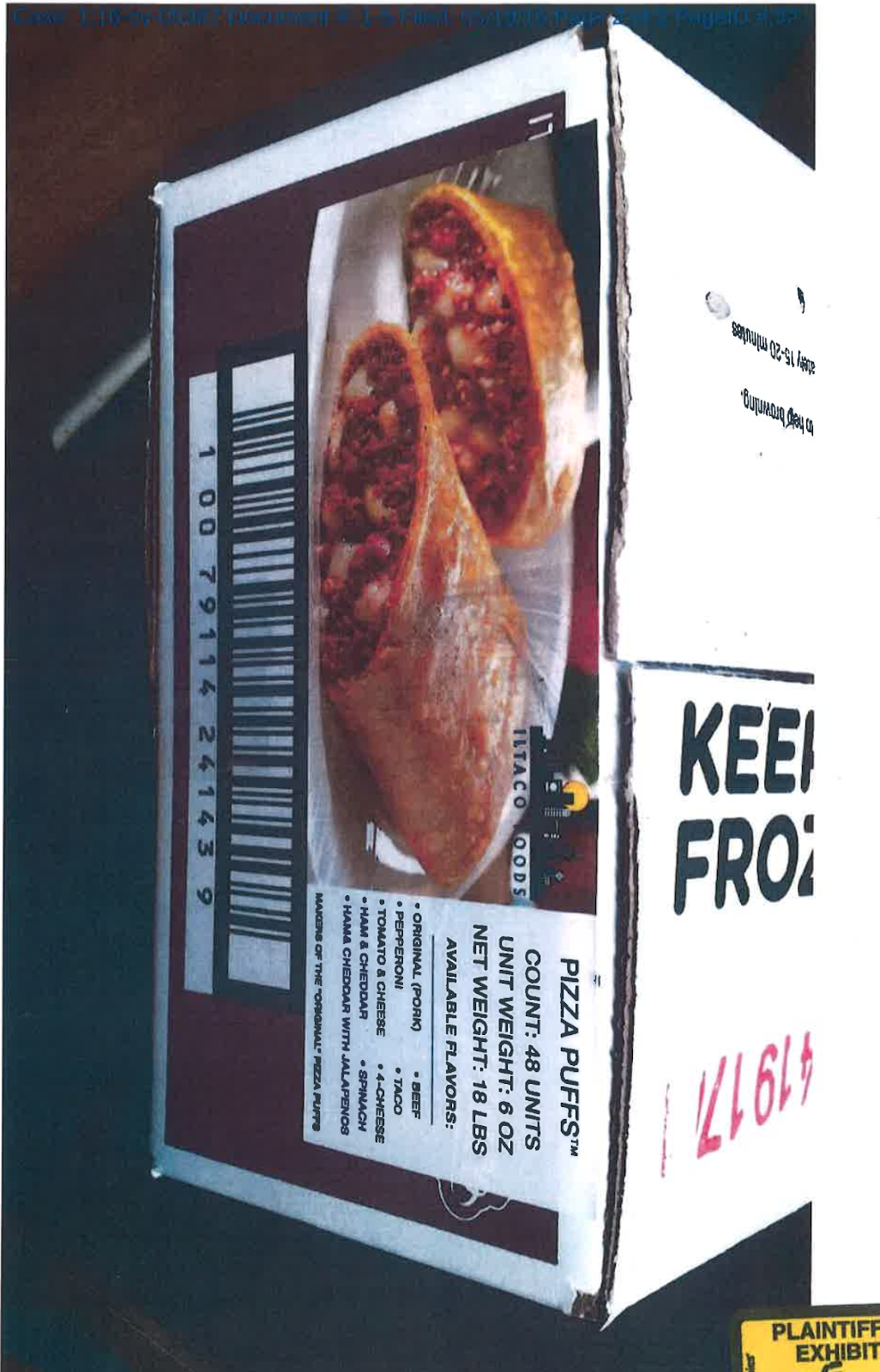
Illinois Tamale owns a registered trademark for PIZZA PUFFS
for “a frozen, hand-held stuffed sandwich or dough pocket filled with meat,
cheese, and sauce,” among other PUFFS trademarks. El-Greg used theproduct names
“Pizza Pies (Puffs),” “Chili Cheese Puff,” and “Veggie Pizza Puff,” and
allegedly similar slogans and packaging. The court denied El-Greg’s motion for
summary judgment on genericism and Illinois Tamale’s motion for summary
judgment on fair use.
Illinois Tamale’s slogan is “MAKERS OF THE ‘ORIGINAL’ PIZZA
PUFFS.” Although the word “pizza” is disclaimed, Illinois Tamale owns an
incontestable registration for PIZZA PUFFS. On its website, Illinois Tamale
describes its Pizza Puff as “Pork Sausage and Mozzarella Cheese with our
Home-Style Pizza Sauce Wrapped [in] a Soft Flour Tortilla.”
El-Greg sells the “Pizza Pie,” a copy of Illinois Tamale’s
Pizza Puffs product, described in El-Greg’s advertising as “Cooked Pork, Real
Mozzarella Cheese, Homemade Pizza Sauce with our blend of fresh spices wrapped
in a flaky tortilla pocket.” The parties have sold their products to Restaurant
Depot, a restaurant supply firm, for many years; the products are sold
side-by-side. In 2010, El-Greg changed its Pizza Pie label, but only for
products sold at Restaurant Depot, now referring to the product as “PIZZA PIES
(PUFFS).” El-Greg’s modified label has a layout similar to Illinois Tamale’s
Pizza Puffs label, and it includes the slogan “MAKERS OF THE ‘ORIGINAL PUFFS.’”
The parties’ Restaurant Depot labels:
 

Defendant’s Pizza Pies (Puffs)

Plaintiff’s Pizza Puffs

The parties sell other
products, including
variations on the same stuffed sandwich / dough
pocket theme. Additional stuffed sandwich items from Illinois Tamale include
Sloppy Joe Puffs; Taco Puffs; Gyro Puff; Ham & Cheese Puff; Pepperoni Pizza
Puff; Beef Pizza Puff; 4-Cheese Pizza Puff; Ham, Cheese & Jalapeno Puff;
BBQ Pulled Pork Puff; Reuben Puff; and Breakfast Puff, with registrations for a
number of these products, including Taco Puffs and the Gyro Puff. El-Greg sells
a similar “Chili Cheese Puff” item and phyllo dough “Spinach Puff” hors
d’oeuvres.
Whether or not a term is generic is a question of fact, but
it may be resolved on summary judgment “if the evidence is so one-sided that
there can be no doubt about how the question should be answered.” Though the
Seventh Circuit hasn’t decided who has the burden of persuasion for a
registered mark, it has noted that “an incontestable registration is more like
a bursting-bubble presumption of non-generic-ness” than an “indomitable
presumption” overcome only by strong evidence of actual generic usage of the
term. The court put the burden of persuasion on genericness on the defendant for
incontestable trademarks.
El-Greg’s evidence of genericness was (1) the PTO’s apparent
approval of use of the term to denote a type of good (in six registrations not
currently in force); (2) manufacturers’ and restaurants’ use of the term to
denote a type of good (two other manufacturers and nearly 400 restaurants); (3)
use of the term to denote a type of good in about 100 recipes published online;
(4) dictionary definitions (Urban Dictionary and Wiktionary); (5) use of the
term to denote a type of good in newspapers and other publications (over 200
times); and (6) use of the term to denote a type of good in connection with
other products and services (just under 90 examples in TV shows/ads for other
goods or services).
Illinois Tamale disputed the relevance of much of this
evidence, arguing that it does not compete with restaurants because it sells
Pizza Puffs only to wholesalers and retailers. The court
disagreed—noncompetitors’ uses can be considered “where that use contributes to
consumers’ common understanding of the meaning of the term.”  However, Illinois Tamale’s argument that the
“pizza puff” item on menus and in news articles could be designating Illinois
Tamale’s product, rather than a category of food, was better aimed.  Where the menus didn’t designate the source
of the “pizza puff” product or indicate that it is homemade, they could be
referring specifically to Illinois Tamale’s Pizza Puffs brand, as could many of
the articles that reference pizza puffs. [Capitalization appears not to matter
to the court here.]  “That said, the vast
majority of the articles and menus cited make no reference to Illinois Tamale,
nor do they otherwise suggest that they are referring to ‘pizza puffs’ as a
brand rather than a type of food product.”
Here’s what caught my eye: in responsing to the “pizza
puffs” recipes, Illinois Tamale argued that there are also thousands of recipes
for a homemade version of Hot Pockets; this might just show that Hot Pockets
are a “well-known brand[ ] [that] home cooks want to replicate.” There was also
variation in the recipes—some produced pizza-themed foods that bore little
resemblance to the Pizza Puffs product at issue, allegedly indicating that
consumers don’t use the term “pizza puff” to denote any particular type of food
product. Such use didn’t preclude genericness, but it wasn’t helpful to El-Greg
either.
Illinois Tamale also showed that a number of similar stuffed
sandwich / filled dough pocket products on the market are not named or
described as “pizza puffs,” and El-Greg sold its competing product as “Pizza
Pies” for over 20 years before changing its Restaurant Depot label. The term
“pizza puff” does appear in any dictionaries other than the crowd-sourced ones above,
and definitions of the word “puff” don’t encompass Illinois Tamale’s product. Several
recent news articles expressly identify Illinois Tamale as the source of the
Pizza Puff brand.
Ultimately, the court denied summary judgment to both sides;
there was “significant evidence” of generic use, but no showing that there was
no other name for the product. Thus, a reasonable juror could find either
way.  Similarly, the court denied summary
judgment on the issue of whether Illinois Tamale owned a “Puffs” family of
marks.
So too with descriptive fair use. On factor 1 of the
statutory test, Illinois Tamale argued that El-Greg couldn’t prove it uses
“Pizza Pies (Puffs)” in a non-trademark way because it was featured prominently
on the product label, but that wasn’t dispositive. But a jury could accept
El-Greg’s argument that putting “(Puffs)” after Pizza Pies on the label was not
trademark use, because of its placement and the parentheses, and that El-Greg’s
logo on the box served as the trademark. 
On factor 2, Illinois Tamale argued that “puffs” wasn’t merely
descriptive of its product, because it wasn’t a light, fluffy pastry, and
El-Greg only used the word “puffs” on its label for Restaurant Depot, where the
parties compete side by side. But a jury could agree with El-Greg, and
examining attorneys at the PTO, that “puffs” is descriptive for the
product. 
On factor 3, Illinois Tamale argued that El-Greg lacked good
faith because El-Greg had been involved in other disputes with Illinois Tamale
relating to its use of the word “puffs,” and also because the rest of El-Greg’s
product label clearly demonstrated an intent to copy Illinois Tamale’s label,
which El-Greg admits to having seen prior to creating its own label. [They both look to me exactly like the generic informative labels you’d expect to find
in a food warehouse that isn’t consumer-facing.] El-Greg argued that it added
the “puffs” descriptor because Restaurant Depot complained that people were
opening the boxes to identify the contents, and that it designed its label in
accordance with Restaurant Depot’s requirements. Though Restaurant Depot didn’t
require adding the word “puffs” to the label, that didn’t mean that El-Greg didn’t
make the change to address the problem of customers opening boxes to identify
the product.  A defendant’s good faith
can be judged “only by inquiry into its subjective purpose.” El-Greg’s
awareness of Illinois Tamale’s “Pizza Puffs” trademark and label was
insufficient to prove bad faith, even though “the similarities between the
parties’ labels and slogans is striking and could quite possibly be interpreted
as evidence of bad faith.” 

from Blogger https://ift.tt/2JaiklO

Posted in Uncategorized | Tagged | Leave a comment

Timeshare company can sue anti-timeshare law firm under Florida unfair competition law

Orange Lake Country Club, Inc. v. Castle Law Group, P.C.,
No: 17-cv-1044-Orl-31DCI, 2018 WL 1535719 (M.D. Fla. Mar. 29, 2018)
Plaintiffs are entities involved in selling timeshares;
defendants promise to help timeshare owners get out of their contracts.
Defendants allegedly use misleading advertising to solicit Orange Lake owners,
claiming a high likelihood of success, when in reality they are rarely
successful. Further, Castle Law allegedly advises its clients to breach their
contracts with Orange Lake as a way of increasing the chance that Orange Lake
will agree to let them out of their contracts.
Plaintiffs alleged false or misleading communications from
Castle Law in which it “guaranteed timeshare owners it would relieve them of
their timeshare obligations within one year to eighteen months.” Castle Law didn’t
dispute having made this statement or others, but referred to its standard
contract, which states that “Client understands and agrees that there is no
guaranteed result of the Firm’s services or that Client will recover money or
other property as a result of the Firm’s engagement. Client understands and
agrees that there is no way to determine the time frame in which the Client’s
case will be resolved and that there is no guarantee regarding the time
required to resolve your Claims.”  But “a
truthful disclosure is not necessarily sufficient to overcome the net
impression caused by a misleading communication. Even if every Castle Law
customer signed an engagement letter with the quoted language – something that
cannot be determined at this stage of the proceedings – it would not
necessarily require dismissal.”
On Florida Deceptive & Unfair Trade Practices Act
claims, the plaintiffs alleged that defendants violated FDUTPA by soliciting the Orange Lake owners misrepresenting to the Orange Lake owners
that Castle Law could legally represent them in Florida courts and falsely
informing clients who were Orange Lake owners that their timeshare matters had been
resolved. These allegations failed to state a claim because these alleged
violations would have [directly] harmed the Orange Lake owners, not the plaintiffs. In
addition, though, plaintiffs alleged that defendants’ advertising falsely induced
timeshare owners to stop making payments even though they were contractually
required to do so. Further, the advertising allegedly falsely portrayed
timeshare developers and associations, generally, and plaintiffs specifically,
as systematically engaging in fraudulent and deceptive conduct, tarnishing
their business reputations.  FDUTPA isn’t
limited to consumers, and competitors need not be the only parties aside from
consumers that can bring FDUTPA claims. 
Though the Lanham Act claims failed here (see below), the FDUTPA claims
survived because of the allegation about lost contractual payments.
Lanham Act false advertising: The allegedly false
advertising consisted of a website guarantee that Castle law would relieve
timeshare owners of their timeshare obligations within 12-18 months from the
date they sign up with Castle Law; a claim to have saved “6000+” customers
“millions of dollars” defending against timeshare developers with express
mention of one plaintiff; “[n]o matter your reason for wanting to get rid of
your timeshare, Castle Law Group can help”; Resort Relief guarantees relief,
promising “a 100 percent money back guarantee certificate for an added sense of
security”; a claim of 93% success at cancellation, and again with an express
mention of one plaintiff as a developer against whom it has achieved success.
But the alleged injury to plaintiffs’ reputation caused by false claims that
they were engaged in unlawful or illegal conduct couldn’t have happened as a
result of these allegedly false statements. 
“Misleading potential clients about Castle Law’s success rate in getting
timeshare owners out of their contracts does not harm the reputation of
timeshare developers or lenders.”  The implication is that lost contractual payments would solve the Lanham Act hurdle as well if otherwise properly alleged.
Section 817.41, Florida Statutes also makes misleading ads unlawful. But plaintiffs weren’t consumers and couldn’t allege that they relied
on any of the advertising. Some courts have held that “when the party alleging
misleading advertising is a competitor of the defendant in selling the goods
and services to which the misleading advertisement relates, an allegation of
competition is permitted to ‘stand-in’ for the element of direct reliance that
a consumer is obligated to plead.”  But
here, the parties didn’t compete; the plaintiffs “are in the business of
getting people into timeshares, while the Defendants are in the business of getting
them out. Though their target audiences necessarily overlap, the Plaintiffs and
Defendants are selling entirely different services. They are adversaries, not
competitors.”

from Blogger https://ift.tt/2pXozRl

Posted in Uncategorized | Tagged , | Leave a comment

Post-sale statements that prevent return of items can constitute advertising & promotion

Boltex Manufacturing Co. v. Galperti, Inc., 2018 WL 1535199,
No. H-17-1439 (S.D. Tex. Mar. 29, 2018)
The parties compete in the market for carbon steel
flanges.  Normalization is a heat
treatment process that changes the physical composition of carbon steel to
increase its machinability and toughness; it’s more expensive to make
normalized flanges than non-normalized (or forged) ones. Boltex sells
normalized flanges, made with processes compliant with ASTM standards, which
require heat treatment for certain types of flanges. Several processes are
available, but many customers will only purchase certain flanges if they are
normalized.  Boltex stamps its normalized
flanges to indicate their compliance with ASTM standards and provide a Mill
Test Report (“MTR”)—an industry-standard report “used to promote and certify a
material’s compliance with the appropriate ASTM standards, applicable
dimensions, and physical and chemical specifications.” Boltex charges more for
normalized flanges than for forged ones.
Defendants allegedly advertise some flanges as normalized
and as meeting the the ASTM standards in the same way as Boltex touts
normalization, but their flanges are allegedly not normalized and not
ASTM-compliant.
Defendants argued that stamping flanges and providing MTRs
wasn’t “advertising or promotion,” 
because MTRs and stamped flanges are “post-sale communications to
consumers who have already purchased a product[.]” Further, because the
statements are “only seen by the specific customer who has already purchased
the product” the statements weren’t disseminated sufficiently to the relevant
purchasing public within the carbon steel flange industry.
However, previous cases about package inserts weren’t
binding and were distinguishable. Here, the stamping and inclusion of MTRs,
rather than containing new false statements, allegedly confirmed the assumption
that consumers made when purchasing the flanges.  Stamping and MTRs allegedly allowed defendants
to “convince their distributors to ship and their end use customers to accept
non-compliant shipments” rather than returning them.  This was enough to state a plausible claim.

from Blogger https://ift.tt/2GryHNl

Posted in Uncategorized | Tagged , | Leave a comment

YouTube’s claims about allowing free speech are merely puffery, court holds

Prager University v. Google LLC, No. 17-CV-06064, 2018 WL
1471939 (N.D. Cal. Mar. 26, 2018)
Prager’s “mission” is to “provide conservative viewpoints
and perspectives on public issues that it believes are often overlooked or
ignored” by creating educational videos, though, despite its name, Prager “is
not an academic institution and does not offer certifications or diplomas.”
Google allegedly “hold[s] YouTube out to the public as a
forum intended to defend and protect free speech where members of the general
public may speak, express, and exchange their ideas.” However, Google allegedly
discriminated against Prager’s viewpoint by censoring certain videos that it
uploaded on YouTube by putting age restrictions on some of Plaintiff’s videos
and/or excluding them from YouTube’s “Restricted Mode” setting, which helps
schools and other content-screeners by keeping out content that violates
YouTube’s guidelines.  Although YouTube
has insisted in the past that Restricted Mode and age restriction filtering
aren’t supposed to filter out content based on political viewpoints, Google
allegedly restricted access to some of Prager’s videos “based on [Defendants’]
animus towards [Plaintiff’s] political identity and viewpoint.” Additionally,
Google allegedly “demonetized” some of Plaintiff’s videos—by preventing
advertisements from running on those videos—in a viewpoint-discriminatory manner.
 For example, Prager’s “Are 1 in 5 women
in college raped?” has been restricted by YouTube, but “Author Jon Krakauer on
new book ‘Missoula’ and college rape epidemic” uploaded by “CBS This Morning” has
no such restriction. Prager further alleged that content from some of its
restricted videos “was not restricted after it was copied and posted by other
content providers or vloggers.”
Prager asserted violations of the First Amendment, the
California Constitution, the California Unruh Civil Rights Act, the UCL, and
the Lanham Act, as well as breach of the implied covenant of good faith and fair
dealing.  The court kicked out the
federal claims and declined to exercise supplemental jurisdiction over the
state claims.
First Amendment: Google isn’t a state actor. Marsh v. Alabama “plainly did not go so
far as to hold that any private property owner ‘who operates its property as a
public forum for speech’ automatically becomes a state actor who must comply
with the First Amendment.”
Lanham Act: The alleged implication that Prager’s videos
were “inappropriate” was, first, pure implication; Prager didn’t identify any
Google statements about YT’s classification of those videos. The mere
implications arising from decisions to restrict access couldn’t constitute “commercial
advertising or promotion” within the meaning of the Lanham Act. Prager alleged
no facts that remotely suggested that Google restricted access to Prager’s
videos for any “promotional purpose” or “as part of an organized campaign to
penetrate the relevant market,” or that the implications of Google’s
restriction decisions regarding Prager’s videos was “disseminated sufficiently
to the relevant purchasing public to constitute ‘advertising’ or ‘promotion.’ ”
YT’s policies and guidelines setting forth what videos will
be restricted also didn’t constitute commercial advertising or promotion. They
were more akin to instruction manuals for physical products, which “are not
advertisements or promotions.”
Nor did Prager sufficiently allege harm resulting from the allegedly
false policies and guidelines. Although Prager alleged decreased viewership, ad
revenue, and advertiser relationships, nothing suggested that this harm flowed
from Google’s publication of its guidelines, as opposed to the decision to restrict
Prager’s videos.
Google’s allegedly false statements about its viewpoint
neutrality (“voices matter” and YouTube is “committed to fostering a community
where everyone’s voice can be heard,” YouTube’s “mission” is to “give people a
voice” in a “place to express yourself” and in a “community where everyone’s
voice can be heard,” and YouTube is “one of the largest and most diverse
collections of self-expression in history” that gives “people opportunities to
share their voice and talent no matter where they are from or what their age or
point of view”) were all puffery.  They
weren’t quantifiable or specific enough to be measurable.  Thus these statements were neither “[ ]likely
to induce consumer reliance,” nor “capable of being proved false.”
In addition, Prager didn’t sufficiently allege harm from these
statements, for the reasons given above.
Prager also alleged that it relied on false representations
contained in the parties’ agreements: YT’s representations that Google endeavors
to “help you grow,” “discover what works best for you,” and “giv[e] you tools,
insights and best practices for using your voice and videos.” First, these
claims were no more than puffery. Second, Prager lacked standing under the
Lanham Act as a consumer.

from Blogger https://ift.tt/2pRyhVY

Posted in Uncategorized | Tagged , , , , | Leave a comment

YouTube’s claims about allowing free speech are merely puffery, court holds

Prager University v. Google LLC, No. 17-CV-06064, 2018 WL
1471939 (N.D. Cal. Mar. 26, 2018)
Prager’s “mission” is to “provide conservative viewpoints
and perspectives on public issues that it believes are often overlooked or
ignored” by creating educational videos, though, despite its name, Prager “is
not an academic institution and does not offer certifications or diplomas.”
Google allegedly “hold[s] YouTube out to the public as a
forum intended to defend and protect free speech where members of the general
public may speak, express, and exchange their ideas.” However, Google allegedly
discriminated against Prager’s viewpoint by censoring certain videos that it
uploaded on YouTube by putting age restrictions on some of Plaintiff’s videos
and/or excluding them from YouTube’s “Restricted Mode” setting, which helps
schools and other content-screeners by keeping out content that violates
YouTube’s guidelines.  Although YouTube
has insisted in the past that Restricted Mode and age restriction filtering
aren’t supposed to filter out content based on political viewpoints, Google
allegedly restricted access to some of Prager’s videos “based on [Defendants’]
animus towards [Plaintiff’s] political identity and viewpoint.” Additionally,
Google allegedly “demonetized” some of Plaintiff’s videos—by preventing
advertisements from running on those videos—in a viewpoint-discriminatory manner.
 For example, Prager’s “Are 1 in 5 women
in college raped?” has been restricted by YouTube, but “Author Jon Krakauer on
new book ‘Missoula’ and college rape epidemic” uploaded by “CBS This Morning” has
no such restriction. Prager further alleged that content from some of its
restricted videos “was not restricted after it was copied and posted by other
content providers or vloggers.”
Prager asserted violations of the First Amendment, the
California Constitution, the California Unruh Civil Rights Act, the UCL, and
the Lanham Act, as well as breach of the implied covenant of good faith and fair
dealing.  The court kicked out the
federal claims and declined to exercise supplemental jurisdiction over the
state claims.
First Amendment: Google isn’t a state actor. Marsh v. Alabama “plainly did not go so
far as to hold that any private property owner ‘who operates its property as a
public forum for speech’ automatically becomes a state actor who must comply
with the First Amendment.”
Lanham Act: The alleged implication that Prager’s videos
were “inappropriate” was, first, pure implication; Prager didn’t identify any
Google statements about YT’s classification of those videos. The mere
implications arising from decisions to restrict access couldn’t constitute “commercial
advertising or promotion” within the meaning of the Lanham Act. Prager alleged
no facts that remotely suggested that Google restricted access to Prager’s
videos for any “promotional purpose” or “as part of an organized campaign to
penetrate the relevant market,” or that the implications of Google’s
restriction decisions regarding Prager’s videos was “disseminated sufficiently
to the relevant purchasing public to constitute ‘advertising’ or ‘promotion.’ ”
YT’s policies and guidelines setting forth what videos will
be restricted also didn’t constitute commercial advertising or promotion. They
were more akin to instruction manuals for physical products, which “are not
advertisements or promotions.”
Nor did Prager sufficiently allege harm resulting from the allegedly
false policies and guidelines. Although Prager alleged decreased viewership, ad
revenue, and advertiser relationships, nothing suggested that this harm flowed
from Google’s publication of its guidelines, as opposed to the decision to restrict
Prager’s videos.
Google’s allegedly false statements about its viewpoint
neutrality (“voices matter” and YouTube is “committed to fostering a community
where everyone’s voice can be heard,” YouTube’s “mission” is to “give people a
voice” in a “place to express yourself” and in a “community where everyone’s
voice can be heard,” and YouTube is “one of the largest and most diverse
collections of self-expression in history” that gives “people opportunities to
share their voice and talent no matter where they are from or what their age or
point of view”) were all puffery.  They
weren’t quantifiable or specific enough to be measurable.  Thus these statements were neither “[ ]likely
to induce consumer reliance,” nor “capable of being proved false.”
In addition, Prager didn’t sufficiently allege harm from these
statements, for the reasons given above.
Prager also alleged that it relied on false representations
contained in the parties’ agreements: YT’s representations that Google endeavors
to “help you grow,” “discover what works best for you,” and “giv[e] you tools,
insights and best practices for using your voice and videos.” First, these
claims were no more than puffery. Second, Prager lacked standing under the
Lanham Act as a consumer.

from Blogger https://ift.tt/2pRyhVY

Posted in Uncategorized | Tagged , , , , | Leave a comment

Open legal question doesn’t preclude fees award where manner of litigating is exceptional

Tobinick v. Novella, 884 F.3d 1110 (11th Cir.
2018)
The court of appeals held that the Octane Fitness standard
for “exceptional cases” applied to Lanham Act cases, and that the District
Court here didn’t abuse its discretion in awarding attorney’s fees to Novella.  As you may recall, Tobinick claimed that a
treatment he created works for spinal pain, neurological dysfunction, and
Alzheimer’s disease.  Novella, a
neurologist at Yale New Haven Hospital, wrote a blog post criticizing Tobinick’s
treatment as unsupported by medical evidence, so Tobinick sued for (1) false
advertising under the Lanham Act, and (2) unfair competition, trade libel, libel
per se, and tortious interference with business relationships, all under state
law.  After pretrial motions, the
district court granted summary judgment to Novella, holding that the blog posts
weren’t commercial speech as required by the Lanham Act.
Previously, the court of appeals had said that an
exceptional case under the Lanham Act was one “where the infringing party acts
in a malicious, fraudulent, deliberate or willful manner.” The District Court initially
denied a motion for fees by one defendant (a nonprofit associated with Novella),
determining that Tobinick had not pursued his Lanham Act claim maliciously or
fraudulently. Novella also successfully brought a special motion to strike the
state law claims under California’s anti-SLAPP statute, which was granted, entitling
him to fees and costs as to those claims. 
The district court held
that this was now an exceptional case, since a showing of subjective bad faith
or fraud was no longer required under Octane Fitness. The court noted that it had twice before ruled
against the plaintiffs on the issue of commercial speech, and even after this,
plaintiffs repeatedly sought to multiply the proceedings by adding new parties
and claims, moving for sanctions, and accusing Novella of perjury. The court
awarded fees as to those expenses incurred after the order granting summary
judgment for the nonprofit, over $220,000 (added to a smaller amount for the
anti-SLAPP claims for a total of almost $260,000).
Unsurprisingly, the court of appeals joined its fellows in
holding that Octane Fitness’s interpretation
of the identical patent statutory language applied equally to the Lanham Act. An “exceptional
case” under the Lanham Act thus requires only that a case “stands out from
others,” either based on the strength of the litigating positions or the manner
in which the case was litigated.
The court of appeals held that the district court didn’t
abuse its discretion.  That court had ruled
against Tobinick in three separate orders, and “[p]laintiffs repeatedly failed
to produce new arguments or evidence to distinguish the Court’s prior rulings.”
After two adverse rulings on commercial speech, and more than eleven months,
plaintiffs “repeatedly sought to multiply the proceedings by adding new parties
and claims,” creating 131 new docket entries in 6 ½ months after that summary
judgment, and bringing what the trial court viewed as baseless motions for
sanctions and accusations of perjury.  The court of appeals, however, didn’t place
much weight on the fact that Tobinick continued litigating his case even in the
face of a number of adverse rulings on whether the blog posts qualified as
“commercial speech,” because that was an open question in this circuit,
resolved by a published decision on the merits in this case. Even so, Tobinick’s
manner of litigating his suit was enough to make it an exceptional case.

from Blogger https://ift.tt/2IibeKC

Posted in Uncategorized | Tagged , , | Leave a comment

Walmart’s allegedly secret customer return blacklist could be misleading, unfair

Maestas v. Wal-Mart Stores, Inc., No. 16-cv-02597-KJM-KJN, 2018
WL 1518762 (E.D. Cal. Mar. 28, 2018)
Maestas allegedly bought a car battery from Wal-Mart that
purportedly came with a replacement and refund warranty. When the battery
malfunctioned and he tried to return it, Wal-Mart allegedly refused to give
plaintiff a replacement or refund because his name appeared on an internal
fraud database (based on allegations that he tried to use a bad check at a
Colorado Wal-Mart in 2000, thirteen years before his purchase).  Because he wasn’t warned of his ineligibility
for the warranty, he sued under the usual California statutory claims on behalf
of two putative classes of California consumers whose names also appear in
Wal-Mart’s fraud database. The court denied a motion to dismiss. 
Maestas adequately alleged an unfair business practice under
Rule 8(a). He explained how the alleged unlawful business act or conduct was
“immoral, unethical, oppressive, unscrupulous, or substantially injurious to
consumers.” The applicable test asks whether “the consumer injury is
substantial, is not outweighed by any countervailing benefits to consumers or
to competition, and is not an injury the consumers themselves could reasonably
have avoided.”  Maestas clearly
identified the practice at issue: Consumers on the fraud database buy products
in reliance on express replacement and refund warranties without any warning
that the policies do not apply to them, then Wal-Mart refuses to honor the agreements
when the consumers try to use those policies. He alleged that this practice of
profiting from false promises didn’t benefit consumers, and that consumers
cannot reasonably discover and avoid the injury because only Wal-Mart knows the
information that will lead it to reject warranty claims.
For alleged fraudulent practices, Maestas also satisfied
Rule 9(b). The question was whether the public was likely to be deceived.
Maestas identified what specific misrepresentations and omissions allegedly
deceived him: his ineligibility for the warranties was omitted from all
receipts and contracts, and he bought in reliance on the warranties.  When he tried to return the battery, a
Wal-Mart employee allegedly told him his ineligibility covered “any products” for
as long as he remained in the fraud database.
Wal-Mart also argued that, because the proposed class
entitled to refunds included consumers who bought products other than the battery
Maestas purchased, he hadn’t suffered an injury similar enough to his proposed
class members to confer class standing. The court disagreed: the injury wasn’t
based on the battery, it was based on the list and allegedly covered all
product lines. Nor would the court strike class allegations; the certification
stage was the more appropriate time to do that if appropriate.

from Blogger https://ift.tt/2pX41cz

Posted in Uncategorized | Tagged , , , | Leave a comment

reasonable consumers might not know just how big Apple iOS 8 is

Orshan v. Apple Inc. 2018 WL 1510202, No. 14-cv-05659-EJD (N.D.
Cal. Mar. 27, 2018)
The plaintiffs bought iPhones and iPads with 16 GB capacity running
earlier versions of iOS, which they later upgraded to iOS 8, which used
anywhere from 18.1%-23.1% (2.9-3.7 GB) of the capacity and made it unavailable
for personal storage. They alleged that, had they known this, they “would not
have upgraded to iOS 8,” “would not have purchased the 16 GB of storage
capacity or would not have been willing to pay the same price for it.” Further,
Apple allegedly exploits this discrepancy between represented and available
capacity by selling iCloud storage subscriptions and not allowing users to use
cloud storage from other vendors. They brought the usual statutory California
claims.
The court found plaintiffs failed to state a claim, though
one theory might be repleadable.  First, it
wasn’t reasonable to think that all advertised storage capacity would be
available for personal use.  In all its
materials, Apple clarified that the “actual formatted capacity” of these
devices would be “less” than the full 16 GB. Also,
iPhones and iPads are not hard
drives; they are fully functional devices that come pre-installed with an
operating system and applications. Consumers know and expect this. No
reasonable consumer would buy an iPhone or iPad and not expect that it would
not already include this software. Although an average consumer is not an
engineer, software and computers are pervasive enough in the modern world that
a reasonable consumer would at least expect that software would require some
storage space.
Second, a reasonable consumer might not have thought that
iOS 8 would be so bulky.  Apple didn’t make specific statements about
its size either absolutely or in comparison to iOS 7.  “In addition, a reasonable consumer is not a
software engineer and would not be expected to know, as a matter of common
knowledge, how much space iOS consumes or the relative size differences between
iOS 7 and iOS 8.” However, plaintiffs didn’t sufficiently plead their claims
with particularity. Their general statements about deceptiveness didn’t let
Apple pinpoint which of its statements, or its materials containing omissions,
gave rise to plaintiffs’ alleged expectations.

from Blogger https://ift.tt/2Glvx9x

Posted in Uncategorized | Tagged , | Leave a comment