YouTube videos aren’t commercial advertising/promotion even if some commercial info is in channel bio

Wealthy, Inc. v. Cornelia, 2023 WL 6379449, No. 2:21-CV-1173
JCM (EJY) (D. Nev. Sept. 29, 2023)

“This action arises out of a series of interviews published
on YouTube and conducted by Cornelia that plaintiffs perceive as defamatory.”
Defendant Buczkowski is the owner and operator of Wealthy, allegedly a “leading
entrepreneurship, finance, business, real-estate and self-improvement company.”
Buczkowski has 23,700 subscribers on YouTube, and his videos have garnered over
1.2 million views.

Cornelia also has a YouTube channel with approximately
150,000 subscribers, publishing videos on investing, business, and fitness that
have received over 13.8 million views. Cornelia published a series of videos
entitled “Authentic or Charlatan” in which he claims to expose “fake gurus on
social media.” Defendants produced multiple interviews with another internet
personality, John Mulvehill, a dating and self-improvement coach who made most
of the challenged statements: that Buczkowski (1) lied about his educational
achievement; (2) laundered money; (3) manufactured and/or sold illegal drugs;
(4) framed Mulvehill for his 2013 arrest in Las Vegas, leading to four felony
and four misdemeanor charges; and (5) was involved in the death of a
28-year-old woman who was the alleged victim in the arrest of Mulvehill.

Cornelia sued for (1) unfair competition and false
advertising under the Lanham Act, (2) defamation, (3) intentional infliction of
emotional distress, and (4) business disparagement.

Although the court didn’t apply Nevada’s anti-SLAPP protections
because they failed to show by a preponderance of the evidence that the
statements were made in good faith because their gist or sting was substantively
true, defendants still prevailed.

There was evidence that Cornelia researched Mulvehill’s
claims and sources, which was sufficient to show there was no actual malice on
his part. For example, in his deposition, Cornelia testified that he received
information from Mulvehill, including a video from a former employee of
plaintiffs who corroborated claims about plaintiffs’ unethical business
practices and their using young, unqualified people to write the instructional
and promotional material for plaintiffs’ courses. Cornelia never had any
information contradicting negative claims about plaintiffs when the videos were
published. “Even if Cornelia were mistaken, his conduct is not remotely close
to constituting reckless disregard.”

False advertising: This wasn’t commercial speech because the
accused videos weren’t ads. Although plaintiffs argued that defendants promoted
Cornelia’s “house hack expert book” and a “first 1,000 subscribers mentoring
program,” those were present in Cornelia’s biographical YouTube information,
not any of the videos themselves. “The subject of this action is the YouTube
videos themselves, not the YouTube channel as a whole.” The closest they got
was that, in the first video, Mulvehill said without prompting: “you do have
some real estate stuff on the side.” Cornelia said “right” and didn’t elaborate.


from Blogger http://tushnet.blogspot.com/2023/10/youtube-videos-arent-commercial.html

Posted in Uncategorized | Tagged , | Leave a comment

literal falsity of claim that website doesn’t allow checkout in under a minute supports preliminary injunction

Novation Solutions, Inc. (o/a DealMaker) v. Issuance Inc., 2023
WL 6373871, No. 2:23-cv-00696-WLH-KSx (C.D. Cal. Aug. 16, 2023)

DealMaker is a financial technology company that provides
its users with the ability to raise capital by conducting investment offerings
via its online platform. Issuance is a competitor: a financial technology
company with a retail capital raising and investment processing platform. Defendant
Marble is Issuance’s co-founder and chief executive officer.

DealMaker alleged that defendants stole its trade secrets
and also alleged violation of state and federal false advertising law. Shortly
after DealMaker first sued, Marble allegedly “embarked on a marketing campaign
that included disparaging remarks about DealMaker” and its products, claiming
falsely that:

These statements were allegedly made at an event in Miami
whose recording was uploaded to YouTube, as well as in a slide deck that was
uploaded to Deal Night’s website in accordance with Issuance’s marketing
agreement with Deal Night. The slide deck had disclaimer language that the
information on the slides was not complete, and that the slides contained
forward-looking statements.

challenged representations in slide form

For purposes of a preliminary injunction motion, the court
first considered literal falsity.

Challenged claim: DealMaker’s customers do not retain
ownership over their own data.  DealMaker
argued that the lack of any mention of the transfer of ownership of
confidential data in its TOS indicates that clients own their own data, while
defendants argued that the absence of any affirmative discussion was itself
evidence of lack of client ownership, whereas Issuance’s own terms promised
that the customer “owns and shall remain the sole owner” of its information. Defendants
pointed to DealMaker’s TOS provision that it could “use” client’s data for
DealMaker’s marketing purposes, and anecdotal evidence from a prior DealMaker
customer indicating that DealMaker “exploited and misused the customer’s
investor list for the purpose of contacting its investors to market other
companies’ securities offerings listed through DealMaker. DealMaker noted that
Issuance’s own terms include a provision that allows Issuance to license its
data.

This wasn’t literal falsity, given the silence of the
DealMaker TOS.

Challenged claim: DealMaker offers the same products and
services as [Issuance] at higher prices (8-10% as compared to 4-5%) and DealMaker’s
fees are charged as a percentage of capital raised. DealMaker argued that its
offers weren’t the same as Issuance’s so one-to-one comparisons were false, and
that its fees don’t depend on a percentage of capital raised. Defendants
offered examples of contracts that, they argued, had a fee structure of 8-10%.  DealMaker said those were contracts with DealMaker
Securities LLC, a registered broker dealer, which is a separate legal entity
and not a party to this lawsuit, and that its fees may be higher because it
offers additional services to its clients that Issuance does not. This was not
enough for literal falsity, since the slides didn’t claim that the parties
offered the same products. Also, a potentially reasonable reading of the
statement was that in the aggregate, DealMaker’s fees equate to 8-10% of the
capital it raises, rather than being explicitly a statement that its fees were
based on a percentage of what was raised. Ultimately, DealMaker didn’t show
that was false at this stage.

Challenged claim: DealMaker’s platform does not offer “checkout
in under one minute” to its customers, while Issuance’s platform does: This was
likely explicitly false. The slide clearly compared the parties’ platforms.
DealMaker’s evidence showed that checkout on its platform in less than a minute
was possible. This was a specific and measurable advertisement claim of product
superiority based on product testing and not puffery.

Challenged claim: DealMaker’s publicly disclosed “street”
valuation is $200 million.

Marble explained that he arrived at the $200 million
valuation by multiplying DealMaker’s $20 million estimated revenue for 2022 by
a multiplier of ten. DealMaker argued that as a private company, it does not
have a public valuation and thus this number is fabricated and false. Defendants
responded that the slide proposed a “street estimate,” which is an industry
term for an unofficial estimate and not a “publicly disclosed valuation” as
suggested by DealMaker.

“Street estimate” was sufficiently ambiguous that it was
susceptible to defendants’ interpretation.

Deception would be presumed for literally false statements. Also,
the statement was “published and promoted on an investor industry website,
presented at a forum focused on connecting potential investors and company
founders, and was directed at an audience of potential investors attending
industry events where potential clients in this industry are the most
susceptible to being deceived by the false statements.” This also took care of
materiality.

Injury can be “generally presumed” when the parties “are
direct competitors and defendant’s misrepresentations has a tendency to mislead
consumers.” This presumption was not rebutted.

In addition, irreparable harm was presumed from likely
success under the TMA. The other factors also favored a preliminary injunction
for the “under a minute” statement.


from Blogger http://tushnet.blogspot.com/2023/10/literal-falsity-of-claim-that-website.html

Posted in Uncategorized | Tagged | Leave a comment

Panels on Exploring the New Constitutional Limits on Trademark Law

FRIDAY, NOV 3 2023

8:45AM – 3:30PM More info

ADVANCED REGISTRATION REQUIRED

ATTEND AT THE UNIVERSITY OF NEW HAMPSHIRE FRANKLIN PIERCE SCHOOL OF LAW OR BY ZOOM. Full program.

from Blogger http://tushnet.blogspot.com/2023/10/panels-on-exploring-new-constitutional.html

Posted in Uncategorized | Tagged , , | Leave a comment

Amazon escapes liability for its Brand Registry advertising

Deetsch v. Lei, 2023 WL 6373073, No. 22-cv-1166-RSH-BLM (S.D.
Cal. Jul. 21, 2023)

Deetsch alleged that he owned design patents for CPAP pillow
products, which the Lei defendants infringed. They also allegedly used Deetch’s
image in ads and on packaging, and allegedly falsely claimed on Amazon that
their pillow products “were designed in the United States but are manufactured
in China.”

In December 2020, Deetsch notified Amazon of his patents through
the Brand Registry portal and asked Amazon to remove the Lei defendants’
products. He sent two letters by mail in March 2022, but was told he needed to
use the Brand Registry … which he had already done.

Amazon’s Brand Registry advertises “Automated Protections”
that are “[p]owered by Amazon’s Machine Learning.” Amazon claims its service
will “save valuable time,” allows users to report “patent[ ] and design right
violations,” uses “advanced machine learning that prevents bad listings,” and
can “[r]emove counterfeits instantly” “without the need to contact [Amazon].” Deetch
signed up for and paid for a Brand Registry service subscription, and submitted
multiple complaints through that system, allegedly to no avail.

Since the designs were not plainly dissimilar, infringement
was plausible.

False advertising, Lei defendants: The complaint didn’t
explain how “designed in the United States but … manufactured in China” was
materially deceptive and thus didn’t meet FRCP 9(b) pleading standards. A “true
statement that a product was designed in the United States” is not “a
representation that the product does not infringe any third party’s intellectual
property rights.” Motion to dismiss granted.

False advertising, Amazon defendants: The complaint didn’t
explain how any of the statements about the Brand Registry were false or
misleading. It wasn’t enough to suggest that “taking all of the statements
together, a consumer would reasonably expect the Brand Registry service to work
better or faster than it did for Plaintiff.” Even a reasonable consumer’s “disappointment
that a service did not work as well or as quickly as hoped” doesn’t show false
advertising. Also, plaintiff was a customer, not a competitor, and not within
the relevant zone of interests. (State law claims would have been better.)

False association, Lei defendants: Although he alleged that
they used his image, he didn’t allege that this would cause confusion, mistake,
or deception as to his association with the Lei defendants’ products, nor any
facts that would establish that his likeness is recognizable by would-be
consumers. Again, right of publicity would’ve been better.

A copyright claim was dismissed because the plaintiff had
yet to receive his registration; this couldn’t be corrected by amendment in
order to implement the command of Fourth Estate; the dismissal was without
prejudice to refiling a new action.

from Blogger http://tushnet.blogspot.com/2023/10/amazon-escapes-liability-for-its-brand.html

Posted in Uncategorized | Tagged , , | Leave a comment

accusing someone of patent infringement can be actionable disparagement if you know the patent’s invalid

Cap Export, LLC v. Zinus, Inc., 2023 WL 6381821, No.
2:21-cv-07148-JWH-MRWx (C.D. Cal. Sept. 28, 2023)

Cap Export alleged that Zinus fraudulently obtained a patent
after Zinus used the public domain bed-in-a-box sets of a non-party as the
basis for its patent application. Before it prevailed in the underlying patent
litigation, Cap Export alleged that defendants disparaged Cap Export and its
products as an infringer/infringing. Among other things, Defendants’ counsel sent
a letter to Cap Export’s customer 4Moda Corp. and to Amazon. Amazon responded
by shutting down 4Moda’s Amazon webpage, which allegedly caused Cap Export to
lose sales of its bed-in-a-box products. The underlying patent litigation
allegedly fraudulently induced Cap Export to enter into a $1.1 million consent
judgment, which defendants touted in a press release and advertised on Zinus’s
website even after the court vacated the stipulated judgment. Defendants
allegedly distributed the false advertisement to Cap Export’s online sales
partners—including Amazon, Walmart, and Wayfair—which caused a decrease in Cap
Export’s product ranking and sales, through Google Ads, and through a press
release published in July 2019 on the Business Insider website.

When the information about the prior art came in, the court
granted summary judgment in favor of Cap Export in the patent case and
invalidated the patent. There was a partly successful appeal to the Federal
Circuit, after which Zinus gave Cap Export a covenant not to sue.

Courts have generally harmonized the Lanham Act with the Patent
Act by requiring bad faith before claims about patent infringement can
constitute false advertising. Although the Ninth Circuit has held that statements
about copyright licensing status are not actionable under the Lanham Act, it
has referred with approval to the bad faith standard for patent-related claims,
and the court here noted that Lexmark, a Supreme Court case, concerned
false advertising claims based on accusations of infringement and expressed no
concerns about that.

Cap Export sufficiently pled disparagement in bad faith,
knowing the patent was invalid.

The litigation/fair report privileges did not, at this stage,
bar the related state law claims. The ads were not necessary for the
litigation, and the fair report privilege didn’t apply because Cap Export pled
that the statements didn’t match the court proceedings: Defendants claimed that
Cap Export infringed multiple “patents” and falsely asserted that Cap Export
“deliberate[ly] cop[ied] Zinus’ innovation, which could mislead those who
depend on Zinus’ exceptional product quality.”

Tortious interference: “Defendants targeted Cap Export’s
economic relationship with Amazon, Walmart, and Wayfair by sending
communications to those companies concerning the allegedly bad faith underlying
litigation, and Cap Export pleads that those communications damaged Cap
Export’s sales.” Given the alleged bad faith, this sufficed.

from Blogger http://tushnet.blogspot.com/2023/10/accusing-someone-of-patent-infringement.html

Posted in Uncategorized | Tagged , , | Leave a comment

knowingly false statement of regulatory compliance may be actionable

Dental Recycling North America, Inc. v. Stoma Ventures, LLC,
2023 WL 6389071, No. 4:23 CV 670 CDP (E.D. Mo. Oct. 2, 2023)

The parties compete in the market for amalgam capture
devices, which remove fillings (or pieces thereof) from dental office
wastewater. This is required by the EPA because fillings can contain toxic
mercury. EPA regs say that dental offices may comply by using amalgam capture
devices, “separators” and removal devices “other than separators.” Both options
require at least 95% removal efficiency; the former must use ANSI testing,
while the latter must use sampling averages. There’s no premarket approval.

Plaintiff alleged that Stoma falsely advertised that its
Capt-all device, which fits onto the end of a high volume evacuator valve, is
an amalgam separator and EPA compliant. However, it allegedly only treats
amalgam process wastewater that passes through its device, rather than all
potential sources of amalgam process wastewater in a dental office, which is
insufficient.

Stoma argued that representations about legality/legal
compliance were inactionable opinion. Prior cases have so found, unless there
was a clear statement to the contrary from a relevant authority (including a very
clear statute), or unless there was no good-faith belief in the statement about
legality.

Here, the plaintiff alleged that Stoma made/caused others to
make false statements that the Capt-all was tested and found to be an amalgam
separator when it knew that Capt-all did not meet the regulatory definition of
an amalgam separator. Stoma conceded that the Capt-all is not an amalgam
separator; the knowing falsity exception could apply, even if statements about
Capt-all being “compliant” with EPA regulations may not be actionable.

from Blogger http://tushnet.blogspot.com/2023/10/knowingly-false-statement-of-regulatory.html

Posted in Uncategorized | Tagged | Leave a comment

Proximate cause defeats false advertising claims against standard setting body allegedly packed by competitors

Geomatrix, LLC v. NSF International, — F.4th —-, 2023 WL
5925977, No. 22-1947 (6th Cir. Sept. 12, 2023)

Discussion
of opinion below
.

Geomatrix sells a septic system
that substantially differs from those sold by its competitors. It asserts
defendants, those competitors and NSF International (the primary
standard-setting organization for the wastewater product industry), conspired
to exclude its unique system from the marketplace.

The court of appeals affirmed the dismissal of the complaint—the
antitrust claim on Noerr-Pennington grounds, which I will now ignore.

NSF certification is practically required for residential septic
systems; at least 37 states have adopted its requirements into law. Although Geomatrix
obtained a Standard 40 certification, NSF—allegedly packed by competitors using
a different method—started to question whether Geomatrix’s method, which does
not require aeration devices to treat wastewater before it leaches into the
drain field, should be certified under that standard. This agitation for a new,
separate standard allegedly disparaged and promoted unfounded concerns about
Geomatrix’s system; one proposed different standard has been adopted in only
one state, and another proposed standard for high-strength systems (used by,
e.g., restaurants) that would exclude Geomatrix’s system. This allegedly harmed
Geomatrix’s business.

Lanham Act and state unfair competition law: Although Geomatrix
alleged disparagement, it failed to describe what “independent harm” occurred
in the market or how defendants’ actions actually “influenc[ed] consumers’
purchasing decisions.” Although the complaint states that NSF published false
statements to regulators and customers and then used the standard-setting
process to limit competition, and that individual defendants made false
statements about the reliability of T&D systems or adopted disparaging
terms, there was no description of how consumers “with[held] trade from the
plaintiff.”

Even if it had done so, Geomatrix didn’t plausibly allege
that these statements caused the harm: Geomatrix could not market its products
in certain states because state regulators did not approve their product, which
was the actual cause of Geomatrix’s injuries. “While Geomatrix contends that
its injuries resulted from the conspiracy by itself, the regulators’ decisions
were still an intervening cause and the proximate one. Any deception on
defendants’ part was not the cause of consumers’ decisions, for consumers were
not the ones who decided to do anything.”

Unusually, but soundly, the court proceeded to analyze the
Michigan common law unfair competition claim separately. Though courts usually
group competitor claims together under state and federal law, the court pointed
out that Lexmark is a rule of construction for the federal statute. “Michigan
common law does not rely on the words of a statute, let alone a federal one.”
The causes of action are similar for likely confusion/deception, but not for
statutory standing.

Still, Geomatrix needed to plead proximate causation, because
Michigan common law requires causation as an element of any tort action, and it
didn’t.

A similar fate awaited other Michigan common-law business
tort claims: business defamation/injurious falsehood, fraud/misrepresentation,
and interference with prospective economic advantage. For defamation/injurious
falsehood, the alleged statements weren’t “of and concerning” Geomatrix but about
systems of the type Geomatrix made, which apparently isn’t limited to
Geomatrix. Disparaging an industry or type of product isn’t defamation, and
injurious falsehood requires pleading special damages, which wasn’t done.

Fraud/misrepresentation and interference with prospective
economic advantage claims were also based on conduct immunized by Noerr-Pennington,
which the court predicted Michigan would apply.

Michigan Consumer Protection Act: covers only “conduct of a
business providing goods, property, or service primarily for personal, family,
or household purposes.” Standard 40 certification is not a “consumer” good or
service.

A concurrence would have resolved the fraud and tortious
interference with prospective economic advantage claims on different grounds,
declining to predict that Michigan would extend Noerr-Pennington to
them. The argument is pretty interesting: the Michigan lower courts that have
applied Noerr-Pennington to state law claims did so as a matter of First
Amendment reasoning directly, rather than constitutional avoidance (the
explicit ground on which Noerr-Pennington was decided). The concurrence
would give no deference to their First Amendment analysis, and it would go far
beyond NYT v. Sullivan in immunizing even knowingly false, fraudulent
statements. But proximate cause/damages would still lead to the same result.

from Blogger http://tushnet.blogspot.com/2023/09/proximate-cause-defeats-false.html

Posted in Uncategorized | Tagged , , | Leave a comment

Marketplace appearance: false advertising cases are fun!

 Transcript here.

from Blogger http://tushnet.blogspot.com/2023/09/marketplace-appearance-false.html

Posted in Uncategorized | Tagged , | Leave a comment

claims against Starbucks fruit drinks without named fruit can continue

Kominis v. Starbucks Corp., 2023 WL 6066199, No. 22 Civ.
6673 (JPC) (S.D.N.Y. Sept. 18, 2023)

Plaintiffs alleged violations of New York and California law
based on Starbucks’ allegedly misleading use of fruit words for drinks.  The court allowed some claims to proceed,
dismissing only unjust enrichment (duplicative under NY law/not allowed with
express warranty claims under California law) and fraud (failure to
sufficiently plead scienter).

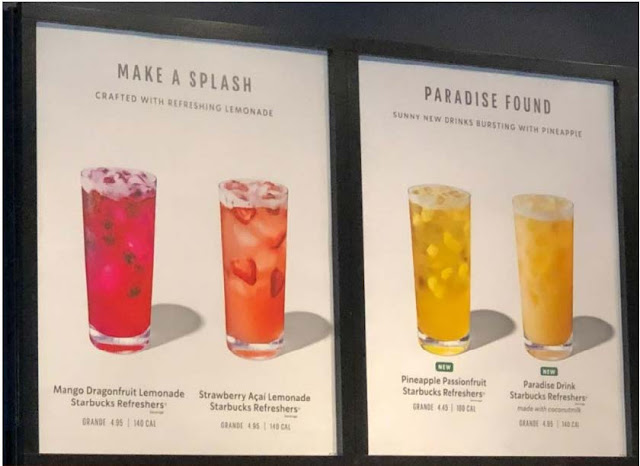
The “Mango Dragonfruit Lemonade Starbucks Refreshers” and
the “Mango Dragonfruit Starbucks Refreshers” allegedly contain no mango; the
“Strawberry Açaí Lemonade Starbucks Refreshers” and the “Strawberry Açaí
Starbucks Refreshers” allegedly contain no açaí; and the “Pineapple
Passionfruit Lemonade Starbucks Refreshers” and the “Pineapple Passionfruit
Starbucks Refreshers” allegedly contain no passion fruit. But they are “part of
[Starbucks’s] ‘Refresher’ line of beverages, marketed as fruit-based
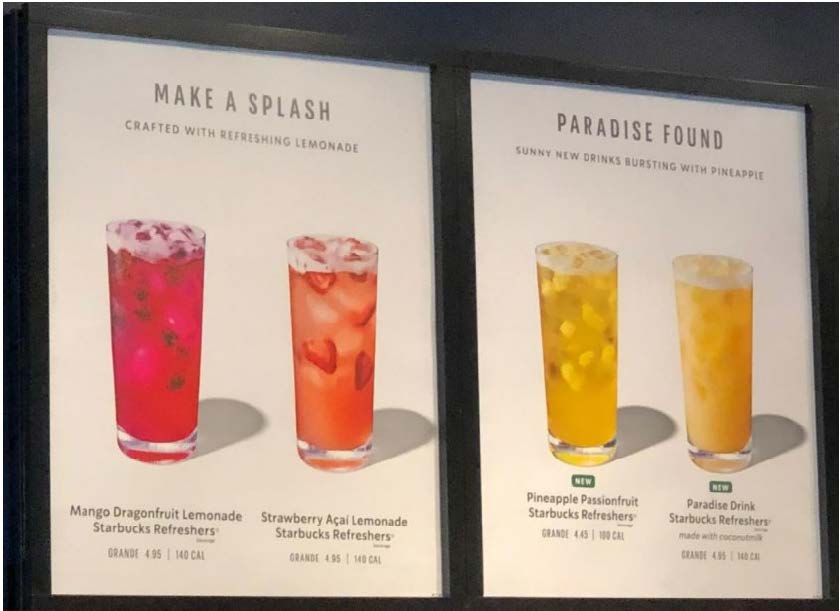
beverages.” The following marketing images allegedly show that “the presence of
fruit in the Products is central to the Products’ identity.”
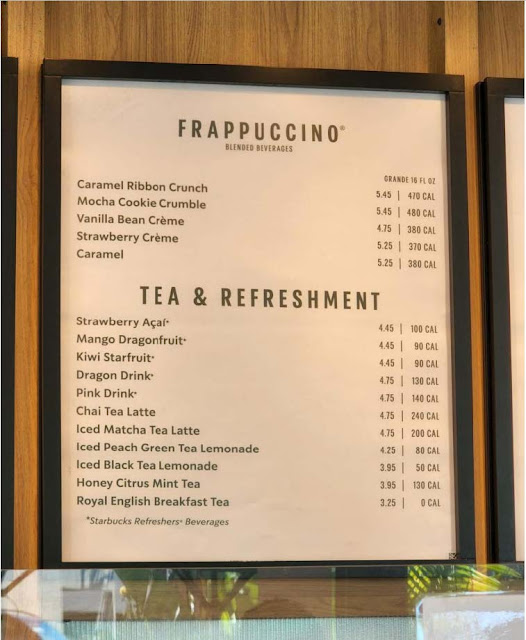
Starbucks menu board with names and prices
challenged products along with Pink Drink, Dragon Drink, Honey Citrus Mint Tea and others

challenged drinks with images of fruit floating in beverages

Instead of containing these fruits, “all of the Products are
predominantly made with water, grape juice concentrate, and sugar.” By
contrast, “Starbucks’ hot chocolate contains cocoa, its matcha lattes contain
matcha, and its honey mint tea contains honey and mint.” Also, “the Products do
in fact contain freeze-dried pieces of strawberries, pineapple, and dragon
fruit.” Starbucks allegedly does not affirmatively indicate anywhere which
ingredients are and are not in the Products. Plaintiffs alleged that the
“missing fruit ingredients are important to consumers because they are premium
ingredients, and consumers value them over the less nutritious and cheaper
grape juice concentrate found in the Products” at least in part because of
nutritional benefits from each of the respective fruits or their juices. Both states’
laws use the reasonable consumer standard. Indeed, the court noted, courts in
the Second Circuit have freely relied on Ninth Circuit cases. Has it been tightened
of late? The court considered two unpublished summary orders that it deemed to
articulate a “more demanding” standard: Axon v. Florida’s Natural Growers,
Inc., 813 F. App’x 701, 704 (2d Cir. 2020) (“To survive a motion to dismiss,
plaintiffs must plausibly allege that a significant portion of the general
consuming public or of targeted consumers, acting reasonably in the
circumstances, could be misled by the relevant statements.” (internal quotation
marks and brackets omitted) (quoting Jessani v. Monini N. Am., Inc., 744 F.
App’x 18, 19 (2d Cir. 2018))); Jessani, 744 F. App’x at 19 (explaining that
“plaintiffs must do more than plausibly allege that a ‘label might conceivably
be misunderstood by some few consumers,’ ” but instead “must plausibly allege
‘that a significant portion of the general consuming public or of targeted
consumers, acting reasonably in the circumstances, could be misled’ ” (quoting
Ebner v. Fresh Inc., 838 F.3d 958, 965 (9th Cir. 2016))).

Does the addition of “significant portion of the general
consuming public” change things? The court here doesn’t decide the issue
because, even under that standard, the claims survived.

Starbucks argued that its names accurately described the flavors,
not the ingredients. “[C]ontext is crucial” for a court’s determination of
“whether a reasonable consumer would have been misled by a particular
advertisement.” Here, the products were listed without any affirmative
statement one way or another about ingredients/flavors; there was no
ingredients list on the display. Parts of the names do refer to both a flavor
and an ingredient, e.g. strawberry, dragonfruit, and pineapple. This context
was mixed; a significant portion of reasonable consumers could be deceived.

This was unlike a product called “Açaí-Flavored Strawberry
Starbucks Refresher” or the like. “Starbucks’s position necessarily would
entail that two of the three parts of each name refer to actual ingredients
(i.e., dragon fruit, strawberry, pineapple, and lemonade), yet that a
reasonable consumer would somehow know the third term (i.e., mango, açaí, and
passion fruit) does not. The images of several of the Products add to this
information jumble, in that they depict the Products containing actual pieces
of fruit, just not the fruit apparently desired by Plaintiffs.” Starbucks argued
that a consumer would see the strawberry but not the açaí berry and thereby
conclude that the beverage contains only real strawberry. “But it is equally if
not more plausible that the image of real fruits would indicate to a consumer
that the drink contains all, not only part, of the fruits mentioned in the
Products’ name, especially given that fruit may be present in a drink in a
non-visible form, such as a juice.” Likewise, a consumer seeing drinks named
“Pink Drink” and “Dragon Drink” on the menu “may think that all of the names
are similarly fanciful or that only the fanciful names without a fruit
reference do not indicate the presence of actual fruit in the drink.” The other
items that contain the ingredients, like “Ice Matcha Tea Latte” which contains
matcha, “contribute to a reasonable conclusion that the names of the Products
refer to their ingredients as well as their flavors.”

 Unlike in other
cases, there was no explicit disclaimer, and there was no reason to think that
“mango,” “passionfruit,” and “açaí” are terms that typically are understood to
represent a flavor without also representing that ingredient—unlike in the vanilla
cases. “There is no comparable term that appears to distinguish the flavors of
mango, passion fruit, and açaí from the actual presence of those fruits, as
vanilla bean may do for vanilla.” Moreover, “nothing before the Court indicates
that the fruit flavoring in fruit drinks is frequently created by something
other than a fruit ingredient.”

Starbucks also argued that any confusion experienced by a
consumer could be dispelled by asking a Starbucks employee about the Products’
ingredients. “This argument fails for the simple reason that it assumes the
truth of facts not asserted within the Amended Complaint, namely that
Starbucks’s employees are aware of the full ingredient list of each of the
Products.” But even if the argument were to be considered, it failed on the merits.
A reasonable consumer is not expected to consult an ingredients panel to
correct misleading information on the front of a box, much less a barista.

from Blogger http://tushnet.blogspot.com/2023/09/claims-against-starbucks-fruit-drinks.html

Posted in Uncategorized | Tagged , | Leave a comment

New engagement ring opinion from Mass. appeals court

Read it here. Many years ago, I wrote a note about these disputes seeking return of engagement rings after a broken engagement, which is cited in the dissent–which also reads as an invitation to the Massachusetts Supreme Judicial Court to revisit its fault-based rule for when an engagement ring should go back to the (remorseful) giver.

from Blogger http://tushnet.blogspot.com/2023/09/new-engagement-ring-opinion-from-mass.html

Posted in Uncategorized | Tagged | Leave a comment