claim that Adidas NHL jerseys are not “authentic” versions of on-ice jerseys can proceed

Smith v. Adidas America, Inc., 2023 WL 5672576, No. 6:22-cv-788
(BKS/ML) (N.D.N.Y. Sept. 1, 2023)

A non-food case litigated by Spencer Sheehan, just
profiled in this New Yorker article.
Smith brought claims under NY and
other consumer protection laws as well as warranty and other common-law claims,
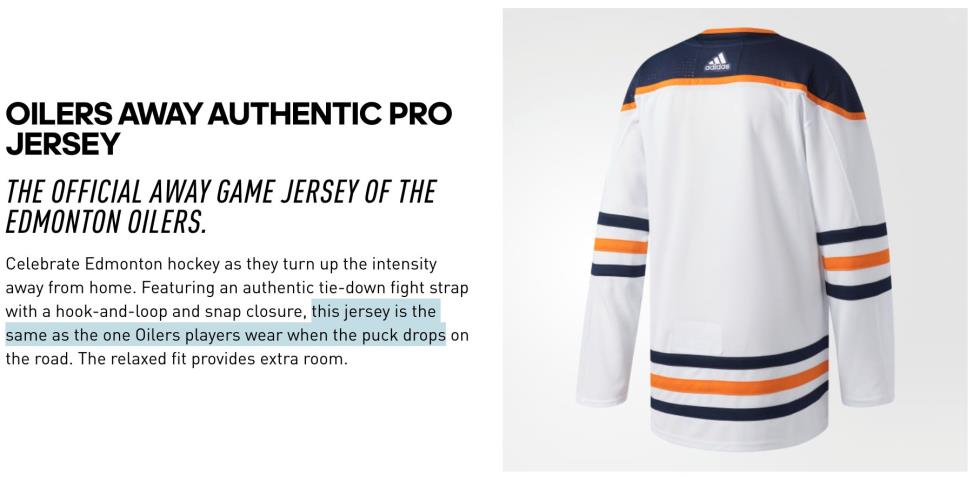
based on Adidas’s marketing of its NHL jerseys as “authentic.”

screenshot from complaint

Adidas is the “official manufacturer of the jerseys worn on
the ice by NHL players.” It identifies at least some of the NHL jerseys it
manufactures and sells as “authentic” and allegedly sells them at a “premium”
price. But they were allegedly not “the same as the one[s] … players wear
when the puck drops on the ice.” Specifically, Smith alleged, the quality of
the “fight strap” of the “authentic” jerseys is inferior as compared to the
fight strap of on-ice jerseys; the fabric of the “authentic” jerseys is half
the thickness of the fabric of the on-ice jerseys; the stitching of the
“authentic” jerseys is weaker and less durable than the stitching of the on-ice
jerseys, the neck holes of the “authentic” jerseys are larger than the neck
holes of the on-ice jerseys;the air-flow dimples of the “authentic” jerseys are
smaller and less effective than the air-flow dimples of the on-ice jerseys; the
logos, numbers, stripes, and names on the “authentic” jerseys are applied via
heat pressing while those features of the on-ice jerseys are double-stitched;
and the “authentic” jerseys are manufactured in Indonesia while the on-ice
jerseys are manufactured in Canada.

The complaint cited online complaints about calling NHL jerseys
“authentic” and said they should be called “replica” jerseys—which allegedly
sell for less. Smith argued that these complaints gave Adidas knowledge of the
problem, while Adidas argued that these complaints

Showed that “the physical differences [in jerseys] are …
widely known among hockey enthusiasts,” and that “a reasonable consumer would
not view the retail ‘authentic’ jerseys as identical to the on-ice ‘pro stock’
jerseys, because it is widely known that the two have not been the same for at
least 15 years.”

The court dismissed the MMWA claim for lack of subject
matter jurisdiction, and the warranty claims for failure to provide pre-suit
notice.

But the NY GBL claims survived. It was plausible that “authentic”
was “likely to mislead a reasonable consumer acting reasonably under the
circumstances.”

Adidas argued that Smith’s understanding of “authentic” was
merely subjective, and that, because it’s the official manufacturer of NHL jerseys,
any jersey it manufactures is, by definition, authentic. But a reasonable
consumer would not necessarily believe that “authentic” is synonymous with
“officially licensed.”

In addition, Smith provided relevant context to inform the
reasonable consumer’s understanding: Adidas allegedly describes the jersey as
“the same as the one[s] [NHL] players wear when the puck drops” and alleged
myriad ways in which they materially differed from those worn by NHL players. There
was no “alternative explanation” of “the same as the one[s] [NHL] players wear
when the puck drops” that “render[s] [P]laintiff’s inferences unreasonable.”

screenshot with “this jersey is the same as the one Oilers players wear when the puck drops” highlighted

Adidas argued that the differences were easily discoverable,
but so what? This wasn’t an omission claim, and Adidas isn’t allowed to make
easily disprovable affirmative misrepresentations.

But claims based on the laws of other states were
insufficiently specified, and there was no duty alleged as necessary for a
negligent misrepresentation claim. Also, the where/when wasn’t pleaded with
sufficient particularity for fraud, and unjust enrichment was dismissed for not
really being separate.

from Blogger http://tushnet.blogspot.com/2023/09/claim-that-adidas-nhl-jerseys-are-not.html

Posted in Uncategorized | Tagged , | 1 Comment

Microsoft’s PR agency got Gannett sued by sending it an ad for its Superbowl Ad Meter

Campbell v. Gannett Co., No. 4:21-00557-CV-RK (W.D. Mo. Aug.
15, 2023)

This is a copyright suit against Gannett for
advertising-like use of a photo taken by Campbell of NFL coach Katie Sowers;
the photo came from a screenshot of an ad run by Microsoft that played during
the Super Bowl. The Microsoft ad was licensed by Campbell and showed the photo at about the
40-second mark
. (Campbell’s lawyers are not serving her well by claiming
that §106A applies to this photo, but that doesn’t turn out to matter here.)

For decades, Gannett has conducted an annual survey of Super
Bowl commercials, called “Ad Meter,” through which anyone over 18 years old can
register to rate commercials submitted to Ad Meter. A PR rep sent an email to
Gannett stating, “I would like to submit Microsoft’s 2020 Super Bowl ad, ‘Be
The One,’ featuring Katie Sowers to the USA Today Ad Meter.” The email included
a YouTube link to the BTO ad and to high-resolution screenshots from the BTO ad,
but the email did not include the Sowers photo (this description is a bit
equivocal about whether the screenshots included the Sowers photo, but
I’ll assume it didn’t). A second request followed, asking, “Can we please be
included as part of the USA Today Ad Meter?”

A USA Today 2 producer downloaded the BTO ad from YouTube
and then took a high-resolution screengrab from the commercial that comprised
the Sowers photo. He uploaded the high-resolution screengrab of the Sowers
photo and the downloaded video into Presto, Gannett’s content management
system, and added tags including “USA TODAY” and “Ad Meter.”

Gannett derives revenue from the Ad Meter Platform, which
included its own advertisement and sponsorship revenue. Gannett did not use the
screenshot of the Sowers photo on Ad Meter, but instead on webpages promoting
Ad Meter. Each publisher defendant separately determined which content it
accessed on Presto to use for its websites and in its publications; their
webpages that included the screenshot of the Sowers photo would have displayed ads.

Campbell sued for copyright infringement,
contributory/vicarious copyright infringement, and CMI removal.

Gannett doesn’t get summary judgment on having a license
even though the contract with Microsoft granted it “an unlimited (including all
lifts, edits and versions) non-exclusive, worldwide, all channels, irrevocable,
license to use, market, promote, distribute, copy, reproduce, display, record,
re-record, electronically publish, publicly display, transmit, broadcast,
telecast, publicly perform, modify, alter, cache, synchronize with visual
images, create derivative works of, and/or publish the whole or part of the
[Sowers Photo], in any media whatsoever (whether now known or hereinafter
developed).” But this was a license to Microsoft, and Campbell argued that
Microsoft wasn’t allowed to reproduce, distribute, and publish the Sowers photo
as part of others’ advertising model (including news reporting). Instead,
Campbell argued that she intended to prohibit further sublicensing.

The court found that whether Gannett had an implied
sublicense couldn’t be determined on summary judgment. When she became aware of
the use, she promptly sent a C&D. (It feels like Microsoft and its PR
agency caused this problem.)

The court also rejected summary judgment on a fair use
defense. There were no changes in the content of the photo itself. “Even
assuming the purpose of Defendants’ use was to make the BTO ad available for
commentary and criticism, that purpose itself, in the context of this case, is
commercial” (citing Warhol).  And
this is really bad:

Both positive and negative
commentary or criticism
for the BTO ad would generate attention for
Defendants’ webpages and the services and products advertised there. The
ultimate goal of making the BTO ad available for commentary and criticism using
the Sowers photo is for the Publication Defendants or Gannett to generate more
revenue for the Ad Meter service and for any other of their services or
products advertised on Defendants’ webpages on which the Sowers photo was
placed. (emphasis added)

Remember, “Publication Defendants” are newspapers.  A reasonable jury could find that this factor
weighed in Campbell’s favor.

Factor two: a reasonable jury could find the photo “mostly
creative.” Given that Sowers made history “by being the first openly gay coach,
the second full-time female coach in the National Football League, and, when
the photo was taken, the first female to coach in the Superbowl,” a jury could
find that Campbell’s artistic choices weren’t mainly functional or
informational. Although I don’t think it matters, part one and part two of
those claims are completely unrelated—in fact, part one appeals only to the
importance of the subject matter and has nothing to do with Campbell’s
artistic choices, which remain entirely undescribed in the opinion.

Amount: the whole photo. The fact that it was used to link
to the whole ad didn’t matter.

Market effect: Gannett argued that (1) it was not a market
substitute because in many cases it was altered to include a play button, (2)
it generated no greater likelihood of non-compensated use by others than
resulted from its use in the BTO ad itself, which was on television and YouTube
without attribution or watermark, (3) it was transformational, and (4) using a
screenshot from within the BTO ad video as the means to view the video promotes
the sharing of art and science, and the image is already contained within the
published video. While this all makes sense, and Campbell appealed basically to
the idea that she must have lost out somehow, a reasonable factfinder could
conclude that the other factors all favored her and thus reject the defense.

CMI removal: Goes better for Gannett. It was undisputed that
the Sowers photo, within the BTO ad, didn’t include any CMI or restrictive
language. Campbell shifted her theory to one that the CMI was false because it
attributed the ad, and thus the screenshot from the ad, to Microsoft. But false
CMI is a different claim, one she didn’t bring. There was no proof that any
defendant removed her CMI or distributed the photo with knowledge of its
removal.

Profit disgorgement: “In a claim for disgorgement, the
copyright owner is first tasked with establishing a causal nexus between the
infringement and the infringer’s gross revenues.” “After that nexus is
established, ‘a rebuttable presumption that the defendant’s revenues are
entirely attributable to the infringement arises, and the burden then shifts to
the defendant to demonstrate what portion of the profits are not traceable to
the infringement.’”

In a previous case, the Eighth Circuit upheld the jury’s
conclusion that the plaintiff had established a nexus between the defendant’s
infringing use of his copyrighted work and its profits from the sales of the car
being advertised. There, (1) the infringement was the centerpiece of an ad that
essentially showed nothing but the car, (2) the defendant enthusiastically
presented the ad to its dealers as an important and integral part of its launch
of the car into the U.S. market, (3) sales of the car during the period that
the ad aired were above the defendant’s projections, (4) the ads received high
ratings on surveys that rated consumer recall, and (5) the defendant paid its
advertising firm a substantial bonus based on their success.

By contrast, a previous Ninth Circuit case cited with
approval in the car case, the evidence of a nexus was too speculative.  “The infringing use of the plaintiff artist’s
work was featured within a collage including other content that was pictured
only on one page of a multipage brochure advertising a concert series, and the
plaintiff’s claim for 1.5 percent of the defendant’s total revenues was based
on the defendant’s goal of generating a response rate of 1.5 percent to its
brochure as a whole.”

Plaintiff’s expert identified defendants’ revenue from ads
on websites containing the photograph and subscriber revenue related to the
Subscribe Now feature on their websites. The websites also displayed many other
photographs, news articles, videos, screenshots from other Super Bowl
commercials, and other content during the time they displayed the Sowers photo.
There is no way to track revenue from a single item of content, but each site that displayed the Sowers photo displayed it
along with ads that paid based on the number of impressions. Plaintiff’s expert
limited calculation of ad revenue for whole newspaper websites to their time displaying the
photo, but didn’t attempt any further attribution. Using numbers for the
websites as a whole was too speculative to establish a nexus. No rebuttable
presumption arose, and defendants got summary judgment.

In addition, Campbell was limited to one statutory damages
award. Even though each of the newspaper defendants were independent legal
entities that made their own decisions about what to put on their websites,
it’s the number of works infringed that counts. Where there’s a prime
tortfeasor that is jointly and severally liable with every other defendant,
that means one award. Gannett and the other defendants had a substantial and
continuing connection. The newspaper defendants each use and choose content
from Gannett’s content management system, and they were all its subsidiaries.  

But! There was a triable issue on willfulness, even though
the PR agency submitted the ad, and even though the Sowers photo had no
separate attribution or other information and thus there was no reason to
believe it had to be treated separately. Campbell argued that the USA Today
producer violated Gannett’s own copyright policy by downloading the ad from
YouTube and taking a high-res screengrab. I don’t see how this constituted
reckless disregard or knowledge of Campbell’s rights, but the court
thinks maybe: “It is undisputed that Defendants are affiliates in a large,
sophisticated media conglomerate that has written policies regarding
copyrights, copyright infringement, and avoiding such infringement.” Thus,
there was a jury question on willfulness. This seems wrongheaded to me;
now everyone will have to go through an extra step of confirming that they have
the rights including the rights to every individual element of an ad.

from Blogger http://tushnet.blogspot.com/2023/09/microsofts-pr-agency-got-gannett-sued.html

Posted in Uncategorized | Tagged | Leave a comment

SlimFast products aren’t “clinically proven,” even if the SlimFast plan is, allowing false advertising claim to survive

McCracken v. KSF Acquisition Corp., 2023 WL 5667869, No.
5:22-cv-01666-SB-SHK (C.D. Cal. Apr. 4, 2023)

McCracken alleged that SlimFast food products were falsely
advertised as “CLINICALLY PROVEN [ – ] LOSE WEIGHT & KEEP IT OFF” on the
front of their packaging. It was undisputed that none of the products she purchased
has been clinically tested or proven to cause consumers to lose weight or
maintain weight loss, though KSF pointed to additional disclaimers on the back
clarifying that the statements referred to KSF’s low-calorie “SlimFast Plan”
rather than to the products themselves. The products say on the back: “For over
40 years, millions of Americans have lost weight and kept it off using SlimFast
Original Meal Shakes, as part of the clinically proven SlimFast Plan. Clinical
studies prove the SlimFast Plan helps you effectively lose weight, and you can
see results in just one week!”

example of front package with “Clinically Proven: Lose weight and keep it off” claim
example of back with “Clinically Proven to Lose Weight Fast” caption with reference to SlimFast plan

: For over 40 years, millions of Americans have lost weight and kept it off using SlimFast Original Meal Shakes, as part of the clinically proven SlimFast Plan. 50 Clinical studies prove the SlimFast Plan helps you effectively lose weight …”

Although the court dismissed claims for equitable restitution and disgorgement because McCracken didn’t show that adequate legal remedies were unavailable, the remaining usual California statutory claims survived.  (The case was later dismissed after an individual settlement.)

McCracken incorporated NAD and NARB decisions into the complaint. In 2021, NAD found, among other things, that “a reasonable consumer could take away the message that [Defendant’s] clinically proven claim refers to any product upon which it appears” and that “ ‘Clinically Proven to Lose Weight & Keep It Off’ conveys a clinically proven weight-loss and maintenance message about each individual SlimFast product.” Since this claim hadn’t been substantiated for the food products, but still “expressly and by implication conveys the message that the current products themselves have been clinically proven to allow consumers to lose weight and keep it off,” NAD recommended changing the ad. KSF appealed, and NARB affirmed in relevant part.

First, this wasn’t an impermissible private claim merely alleging lack of substantiation. Instead, plaintiff plausibly pled that the “clinically tested” claim was an affirmative misrepresentation as to the food products. “[A] reasonable consumer viewing the front of Defendant’s SlimFast products might assume that the claim ‘CLINICALLY PROVEN [ – ] LOSE WEIGHT & KEEP IT OFF’ refers to the product on which the claim is made rather than to a weight loss plan that is not mentioned on the front of the packaging and that does not in any way depend on consumption of the product being sold.” Even knowing the SlimFast plan existed wouldn’t inherently preclude a belief that defendant actually tested its own products as part of the plant. NAD/NARB’s agreement on this bolstered its plausibility. Indeed, even the fine print didn’t “necessarily dispel the impression created by the front label that the product itself has been tested; consumers might assume that Defendant’s tests of the SlimFast Plan involved the products being sold (as they apparently did for earlier products).”

Finally, McCracken did have standing to seek injunctive relief because she was still interested in buying.

from Blogger http://tushnet.blogspot.com/2023/09/slimfast-products-arent-clinically.html

Posted in Uncategorized | Tagged , , | Leave a comment

plaintiff has standing to seek injunctive relief against allegedly falsely advertised penile implant

Peña v. International Medical Devices, Inc., No.
2:22-cv-03391-SSS-PLAx, 2023 WL 5667568 (C.D. Cal. Apr. 17, 2023)

Plaintiff brought the usual
California statutory claims
against Penuma, a penile implant/procedure, for
alleged misstatements about Penuma’s safety and efficacy. Here, we deal only with
the claims for injunctive relief. The Ninth Circuit has held: “[i]n some cases,
the threat of future harm may be the consumer’s plausible allegations that she
will be unable to rely on the product’s advertising or labeling in the future,
and so will not purchase the product although she would like to.” Also, in
“other cases, the threat of future harm may be the consumer’s plausible
allegations that she might purchase the product in the future, despite the fact
it was once marred by false advertising or labeling, as she may reasonably, but
incorrectly, assume the product was improved.”  

Peña argued that he has standing to pursue injunctive relief
to prevent future harm because “Plaintiff continues to desire a safe, effective
penile implant. If the Penuma device and procedure were redesigned to be safe
and effective for cosmetic penile enlargement, FDA-cleared for this use, and
truthfully marketed, Plaintiff would purchase a Penuma device and procedure in
the future.” He also argued that he wouldn’t be able to rely on the ads in the
future without injunctive relief. This was sufficient. (Humans really want to
believe certain things; I guess I do think there are people who would try
again.)

Were legal remedies inadequate? Peña and class members
alleged they “suffered irreparable injury” from the alleged misrepresentations
and “[t]heir bodily integrity has been violated, creating a substantial risk of
permanent injury.”  Coupled with the
allegations about the likelihood of future injury absent an injunction, that
sufficiently pled an inadequate remedy at law.

from Blogger http://tushnet.blogspot.com/2023/09/plaintiff-has-standing-to-seek.html

Posted in Uncategorized | Tagged , , , | Leave a comment

gray marketer’s counterclaims against Toyota survive, but it still must defend itself

One case, two opinions.

Toyota Motor Sales, U.S.A., Inc. v. Allen Interchange LLC, 2023
WL 5206884, No. 22-cv-1681 (KMM/JFD) (D. Minn. Aug. 14, 2023)

This opinion deals only with Allen’s counterclaims. Allen
distributes Toyota replacement parts, manufactured by authorized suppliers
around the world.  According to Allen,
Toyota USA “sells Toyota Parts in the United States at prices substantially
higher than those charged by Toyota in other places.” The Toyota parts sold by
Allen Interchange and Toyota bear the same part number, and according to Allen
Interchange, are identical in design, function, and quality. Toyota USA sued
Allen for grey marketing in violation of the Lanham Act and related claims,
asserting that material differences included the existence of a
manufacturer-backed warranty, the shipping and packaging of the parts, and the
appearance and condition of the parts.

Allen counterclaimed for antitrust and related unfair
competition/tortious interference claims. The court declined to dismiss the
counterclaims.

Lanham Act false advertising: Allen alleged that Toyota’s
statements that “[t]he purchase … of unauthorized, gray market parts within [Toyota
USA’s] PMA [Primary Market Area], or anywhere, is … a breach of your dealer
agreement” constituted false advertising because the agreement in fact allows
for purchases of Toyota parts from other sources, including for non-warranty repairs.
The counterclaim also alleged false/misleading use of the term “Genuine Toyota
Parts”; statements about safety of “gray market parts” even though they are
made by Toyota entities; and misleading assertions about Allen Interchange’s
products in flyers depicting a pallet with Toyota parts recognizable as an
Allen Interchange shipment.

Toyota argued that its statements were literally true, but
literally true claims can mislead—a classic question of fact. Plus, statements
about commercial activities are actionable and Allen adequately alleged
falsity. 

Toyota Motor Sales, U.S.A., Inc. v. Allen Interchange LLC,
2023 WL 5207389, No. 22-cv-1681 (KMM/JFD) (D. Minn. Aug. 14, 2023)

This is the trademark side of the case. The court denied
Allen’s motion for joinder of Toyota Japan and allowed key claims to proceed.

This case is one of several that makes me think that a
coherent version of trademark could emerge from cases like Abitron and Lexmark:
registered trademarks get special treatment, even including (though I think
it’s a bad idea) not having a harm requirement as an element of the cause of
action, whereas unregistered/§43(a) claims need to show harm. This isn’t
directly implicated by the case, but the reasons we might have different
treatment are.

In particular, Toyota USA doesn’t own the Toyota marks; it
is a licensee. This was a matter of statutory standing, not Article III
standing.

First, the dilution claims require an “owner” of a famous
mark to bring suit. Thus, they were dismissed. While some cases have allowed an
exclusive licensee to do bring a dilution claim, Toyota USA didn’t plead that it was the exclusive
licensee and acknowledged in its briefing that it wasn’t. Being an exclusive
authorized importer and distributor was not enough, because an “exclusive
licensee” is the sole entity with an interest in a trademark, while an
“exclusive importer and distributor” could be one of multiple entities with
such an interest.

Anyway, even if Toyota USA could be considered an exclusive
licensee, the relevant cases covered only §43(a)(1)(A), not §43(c), which explicitly
uses the term “owner” when identifying who may bring suit, whereas § 43(a) uses
the broader language of “any person.” Minnesota’s trademark statute also said that
“[t]he owner of a mark that is famous in this state may” seek an injunction in
the event of trademark dilution. Likewise, “[o]nly the owner of the trademark
has standing to seek relief for common law trademark infringement.”

Allen is definitely not out of the woods, because
§43(a)(1)(A) is still available, but that should matter to the burden Toyota
USA faces, including the Court’s language in Lexmark about proof of
harm, which is not limited to false advertising.

from Blogger http://tushnet.blogspot.com/2023/09/gray-marketers-counterclaims-against.html

Posted in Uncategorized | Tagged , | Leave a comment

“major flaw”/”tendency to shear” false advertising claims fail

Shepard & Assoc., Inc. v. Lokring Tech., LLC, 2023 WL
5229803, No. 1:20-cv-02488 (N.D. Ohio Aug. 15, 2023)

Lokring sells fittings for pipes and other transfer systems
for fluids and gases, as well as tools used to install them. Its distributors
have exclusive territories. Shepard was an exclusive distributor, but the
relationship broke down. This opinion addresses third-party trade secret and
unfair competition claims against Tube-Mac; I won’t cover the trade secret
claim (which is what linked Tube-Mac to Shepard).

The emails at issue all had the same basic outlines: They
said the sender previously worked for Shepard and touted Tube-Mac products. It also criticized Lokring
products and toolings and stated that “The major flaw in the Lokring design is
the thin cross section in the middle of the fitting where the two pipes meet….
Over time there is a tendency for the Lokring fittings to shear at that thin cross
section as shown in the attached picture.”

The “major flaw” statement was false, Lokring argued,
because the basis that the writer gave in deposition was merely testimony that
there had been customer feedback that they didn’t like the thin cross section.
Its head of product development testified that the thin cross section had, as
designed, worked acceptably for over 25 years. But this testimony showed that
the Lokring products did in fact have a thin cross section in some cases.
Characterizing this as a “major flaw” was not actionable. Something can be
designed, and still be flawed. “It is not inherently false to say that a
thinner pipe connector may be more susceptible to corrosion or breakage than it
otherwise would be if it were made thicker.” At least, this wasn’t literally
false.

Tendency to shear: This was more susceptible to empirical
testing and truth. Lokring argued that there was no data to support the claim,
and that the fitting in the photo sheared because of installation error. But
the burden was on Lokring to show falsity, and it didn’t submit expert or other
technical evidence to show literal falsity. And its witness’s testimony was
inconsistent about whether the picture showed shearing in a pipe that had been
installed correctly. Thus, it didn’t show literal falsity. Lokring also didn’t
submit evidence of how many consumers were deceived. It offered an email from
Dow Chemical as evidence of confusion:

I am going to respectfully ask that
you please stop contacting my peers in Deer Park I Houston Hub and
misrepresenting the Pyplok fitting as a “LOKRING equivalent”. The Pyplok
fitting has not been evaluated by our Dow piping discipline team and is not
approved for use at Dow.

As you can see, this email didn’t indicate any deception
about quality/design flaws in Lokring products.

Tube-Mac thus prevailed on summary judgment.

from Blogger http://tushnet.blogspot.com/2023/09/major-flawtendency-to-shear-false.html

Posted in Uncategorized | Tagged | Leave a comment

Zillow’s “agent” and “other” tabs were literally false where some agents ended up in “other” purgatory

REX – Real Estate Exchange, Inc. v. Zillow, Inc., 2023 WL
5334389, No. C21-0312 TSZ (W.D. Wash. Aug. 18, 2023)

Zillow aggregates listings of real properties that are for
sale or for rent. Before January 2021, Zillow’s websites displayed on one page
(or in one tab) all homes for sale in a certain region regardless of how they
were listed, i.e., by a real estate agent, a real estate broker, a realtor, or
an unrepresented owner. Then Zillow unveiled a two-tab design, which segregated
content between tabs (or webpages) labeled as “Agent listings” and “Other
listings.”

According to Zillow, the two-tab display resulted from
Zillow’s efforts to comply with the National Association of Realtors model
“no-commingling” (or segregation) rule, which had been adopted by roughly
two-thirds of the multiple-listing services (MLSs) that had agreed to provide
Zillow with data feeds. This rule requires segregating listings obtained
through such data feeds from listings obtained from other sources.

REX’s listings come from licensed brokers and agents; they
qualified as agent listings, as opposed to for-sale-by-owner (“FSBO”) or
non-agent listings. Nevertheless, REX’s for-sale listings were relegated, along
with FSBO and non-MLS listings, to the “Other listings” page because REX’s
brokers and agents were not members of the MLSs from which Zillow was receiving
data feeds.

Before Zillow launched the two-tab system, it evaluated the
associated risks. A 2019 investigation of tabs labeled “Agent listings” and
“Other listings” revealed “critical comprehension concerns warranting further
iteration.” In November 2020, Zillow’s research indicated that eight of the
twelve participants in a study (described as “buyers,” meaning individuals
trying to purchase a home who had previously used one of Zillow’s platforms)
“assumed” that “other” meant “non-agent” listings, while the other four buyers
thought “other” meant non-Zillow-agent or agent “not approved by Zillow.”

Zillow’s FAQ said:

“Agent Listings” are properties
listed by real estate agents in the MLS. “Agent Listings” do not include homes
for sale by owner, non-MLS auctions or foreclosures. “Other Listings” are for
sale by owner, non-MLS auctions, foreclosures and other properties. “Other
Listings” do not include properties listed by agents in the MLS.

If an agent lists your home on the
MLS (even through a limited-service brokerage), it will appear under “Agent
Listings.” If you advertise your home on Zillow as for sale by owner, it will
appear under “Other Listings.”

The FAQ did not indicate that the “Other listings” tab might
include homes for sale by agents or brokers who were not MLS members. It also
failed to define MLS or to clarify that some licensed real estate agents and
brokers do not belong to an MLS.

Zillow recorded a 32% increase in complaints during the
weeks after the transition. Comments included: “Why prop up agents when the
whole point of your app is to circumvent the need for a high commission agent?”
and the like. A user test comment: “Oh…oh no…I wouldn’t even think to click
on a separate list. I just assumed all the homes would be in this list.” The
Other tab was clicked during only 4–7% of sessions, and 80% of the FSBO page
views were lost.

Meanwhile, Zillow perceived REX to be “an industry
disruptor” that had not been well received by other agents and brokers because
it did not share its listings with MLSs (in other words, it did not
“syndicate”), and it did not “pay a buy side commission.” The National
Association of Realtors requires that MLS participants, when listing homes for
sale, make “blanket unilateral offers of compensation” to other MLS members serving
as buyers’ agents. Zillow internally acknowledged that REX was “poised to be a
casualty” of the change, and in fact it was.

Falsity/misleadingness: Misleadingness was a fact issue that
couldn’t be resolved on summary judgment; Zillow’s own internal records might
suffice as extrinsic evidence for that.

Literal falsity: The Third Circuit has held that, although a
plaintiff has the burden to prove falsity, a court may find that “a completely
unsubstantiated advertising claim by the defendant is per se false without
additional evidence from the plaintiff to that effect.” And an assertion of
fact may be literally false by necessary implication “when, considering the
advertisement in its entirety, the audience would recognize the claim as
readily as if it had been explicitly stated.” Under these standards, “Agent
listings” and “Other listings,” considered together and in context, were
literally false by necessary implication. “When the labels are viewed
side-by-side, the unambiguous assertion is that one tab includes homes listed
for sale by agents and the second tab contains all other listings, i.e., homes
for sale by their owners or by non-agents.”

It was undisputed that REX was a broker and/or agent. Thus,
“[b]y relegating REX’s listings to the ‘Other listings’ tab, Zillow falsely
stated by necessary implication that REX was not (or did not employ) an agent.”
Zillow’s own study showed that no participant construed the tab labels in the
way that Zillow proposed to the court (i.e., agent listings and additional
agent listings). (Unsurprisingly, because that’s a Borgean category: what could
distinguish “agent listings” from “additional agent listings”?) The FAQ didn’t
fix the deceptiveness because it didn’t define “MLS” or indicate that agents
didn’t have to belong to an MLS.  Summary
judgment on falsity to REX.

from Blogger http://tushnet.blogspot.com/2023/09/zillows-agent-and-other-tabs-were.html

Posted in Uncategorized | Tagged | Leave a comment

claims about legality of insurance service are falsifable

Route App, Inc. v. Heuberger, 2023 WL 5334192, No.
2:22-cv-00291-TS-JCB (D. Utah Aug. 18, 2023) (magistrate)

Route is a package tracking company that provides shipping
insurance to e-commerce merchants. Heuberger was a Route customer who then
launched a competitor, Navidium. Route sued for breach of contract, commercial
disparagement and defamation per se, intentional tortious interference with
contractual relations, false advertising, and contributory trademark
infringement.

The breach of contract claim survived.

Commercial disparagement/trade libel/injurious
falsehood/defamation per se: The challenged statements were opinion. Even
potentially verifiable facts—such as whether claims are “more often than not
denied,” whether Route requires a police report to be filed for a lost package,
or whether Route commits a “serious breach of customer data”—“when read in the
statement’s full context, would be understood as hyperbolic or figurative and
clearly representing an opinion.”

Route also alleged that Heuberger tortiously interfered with
valid contracts between Route and third-party merchant partners by: using
confidential information to develop Navidium; engaging in commercial
disparagement; making fraudulent misrepresentations about Route and Navidium;
inducing Route’s merchant partners to use Navidium; and engaging in unlawful
activity, including collecting a fee without proper insurance licenses or
permits. Route alleged that Heuberger stated in online posts and messages that
he “created Navidium to ‘screw with’ and ‘tak[e] down’ Route, because he
‘hate[s] Route.’ ” Route argued that Heuberger misled Route’s then-clients by
portraying Navidium as a “technology that facilitates the lawful sale [of]
shipping insurance” despite such services being “illegal.” The court wasn’t
sure whether Route could show causation, though Route alleged that an
increasing number of merchants who discontinue Route’s services appear to cite
“the false statements made in Heuberger and Navidium’s solicitations.” Whether
these acts were justified was fact-intensive and couldn’t yet be resolved.

False advertising: 
The comments about Route were opinion and not actionable under the
Lanham Act. But Route’s allegations that Navidium misrepresented or implied
that merchants can lawfully offer shipping insurance or shipping protection
without obtaining insurance licenses or permits and that Navidium is a shipping
insurance company or technology “are straightforwardly factual assertions the
veracity of which may be determined” by a review of the applicable law and an
investigation of Heuberger’s marketing of Navidium. Other cases say that legality claims are usually opinion unless offered by someone with legal expertise, but the court doesn’t discuss the issue.

Contributory trademark infringement: Defendants allegedly knowingly
facilitated infringement of Route’s trademarks by installing versions of the
Navidium widget under the names “Route Plus” and “Route Pro,” infringing its
registered “Route” mark for shipping protection/e-commerce tracking. Defendants
responded that Navidium is fully merchant-run after installation, and that
Heuberger did not know and had no reason to know that merchants were replacing
the Navidium name. Route counters that “[b]ecause Navidium has no product
offerings that do not include expert installation, Heuberger or another
Navidium representative modifies the Navidium widget code to include the name
and/or text chosen by the merchant every time the white-labeled Navidium widget
is installed.” This was sufficiently pled. Not clear to me: does anyone but the merchant internally see the widget? If not, what confusion could there be?


from Blogger http://tushnet.blogspot.com/2023/09/claims-about-legality-of-insurance.html

Posted in Uncategorized | Tagged , , | Leave a comment

state consumer protection law gives competitor plaintiff more leeway than Lanham Act, court holds

SME Steel Contractors, Inc. v. Seismic Bracing Company, LLC,
— F.Supp.3d —-, 2023 WL 4463246, No. 2:17-cv-00702-RJS-DAO (D. Utah Jul.
11, 2023)

The parties compete in the design of buckling-restrained
braces, which are structural devices that help buildings withstand seismic
activity. One of the defendants (Hinchman) used to work for plaintiff SME. Although
BRBs are increasingly being “used in new structural steel construction
projects, the BRB industry is still developing and might be considered a ‘niche
product’ even within the steel construction industry.” I’m going to ignore the
patent claims.

Hinchman asked the University of Utah to evaluate and test
five of [based on later discussion, SBC’s] BRBs. The University issued a report
concluding two of the five BRBs did not satisfy American Institute of Steel
Construction (AISC) 341-10 requirements. The report stated, “Further
development is required for improving these two BRB types.”

Defendant SBC sent a ninety-page document titled “Design
Manual” to at least six prospective clients, including the statement: “These patented
methods have now been tested and qualified for use on projects in accordance
with governing building codes (AISC 341).” It also made lots of claims about
the experience of its “team,” including their participation in specific named
projects. It claimed a “[p]roduce capacity of over 5000 BRBs per year.” The
Design Manual also included several technical drawings of BRBs, which allegedly
infringed plaintiff Core-Brace’s registered drawings.

Plaintiffs also publicized the resulting lawsuit among
customers, which triggered counterclaims.

Core-Brace alleged both false advertising and false
association from the statements in the design manual and related documents. The
court found that Core-Brace lacked standing: “a plaintiff suing under § 1125(a)
ordinarily must show economic or reputational injury flowing directly from the
deception wrought by the defendant’s advertising; and that occurs when
deception of consumers causes them to withhold trade from the plaintiff.”

Even if, as Core-Brace argued, “the recipients of
Defendants’ materials were instrumental in the Defendants being awarded the
projects to the detriment of Core-Brace,” that didn’t constitute evidence that
the recipients considered or relied on the alleged misrepresentations. Core-Brace
didn’t need to definitively exclude other reasons, but it needed to identify
evidence “demonstrating a nexus between the alleged misrepresentations and its
injury.” This was a failure of proximate cause.

The Tenth Circuit has held that courts may presume injury “once
a plaintiff has proven that the defendant has falsely and materially inflated
the value of its product (or deflated the value of the plaintiff’s product),
and that the plaintiff and defendant are the only two significant participants
in a market or submarket.” But Core-Brace failed to show literal falsity or
provide extrinsic evidence of actual confusion.

The statement “[p]roduce capacity of over 5000 BRBs per year”
was not literally false . Acause SBC could use third party manufacturers;
“produce” was ambiguous, unlike “fabricate.” Also, even though SBC had produced
less than 9 BRBs, it wasn’t literally false to say what it could
produce.

What about “patented methods have now been tested and
qualified for use on projects in accordance with governing building codes (AISC
341)”? Two didn’t, but SBC argued that it only offered BRBs that
satisfied the testing requirements. This was ambiguous.

And “greatly overstat[ing]” defendants’ experience and
qualifications wasn’t literally false.

Nor did Core-Brace provide consumer surveys indicating
confusion or any examples of actual confusion, or evidence indicating why SBC
was awarded specific projects over Core-Brace.

Core-Brace argued that deception could be presumed because
of defendants’ bad intent.  But the only
evidence was that Hinchman would have known what potential clients were looking
for and that Core-Brace “was the only other major competitor in the
marketplace.” Summary judgment for defendants.

Plaintiffs did better on aspects of their Utah Truth in
Advertising Act (UTAA) claims that did not require showing likely confusion.
(Is there a harm requirement? If there was no confusion, could there be harm?)
Specifically:

Subsection (e) states that a deceptive trade practice occurs
when a person “represents that goods or services have sponsorship, approval,
characteristics, ingredients, uses, benefits, or qualities that they do not
have or that a person has a sponsorship, approval, status, affiliation, or
connection that the person does not have.”

Subsection (g) states that a deceptive trade practice occurs
when a person “represents that goods or services are of a particular standard,
quality, or grade, or that goods are of a particular style or model, if they
are of another.”

No Utah cases explain the proof requirements, but the words
“likelihood of confusion” aren’t in there. So it could go to trial. I don’t know on what statements, since the court rejected the Lanham Act false advertising claims (and see just next for even more weirdness).

But UTAA claims for deceptive trade practices failed.
Subsection (b) states that a deceptive trade practice occurs when a person
“causes likelihood of confusion or of misunderstanding as to the source,
sponsorship, approval, or certification of goods and services” And subsection
(c) states a deceptive trade practice occurs when a person “causes likelihood
of confusion or of misunderstanding as to affiliation, connection, association
with, or certification by another.”

Using the trademark likely confusion factors, no reasonable
jury could find likely confusion.

Since this wasn’t a trademark case, similarity was
inapplicable/neutral. (Um.) Core-Brace analogized to a celebrity persona case,
but the court didn’t think a corporation was the same, and anyway defendants
weren’t using pictures of the plaintiff corporation. 

Core-Brace asks the court to
compare its persona to the ninety-page Design Manual, with specific attention
to the drawings, project list, logo, and statements regarding testing.220
Although the court can compare the drawings, logo, and project list, it is
unclear how to compare statements about testing, particularly because the
Design Manual includes SBC’s testing report from the University of Utah. It is
also unclear how to weigh those aspects against the remainder of the Design
Manual—including the fact that the Design Manual is repeatedly labeled as
property of SBC and does not mention Core-Brace.

Thus, this factor wasn’t relevant. Still, trademark logic is
so powerful that the court goes on! (Which may say something about the
weaknesses of multifactor balancing tests in general.)

The intent analysis then suggests that a jury could infer
bad intent because … Hinchman was a former employee familiar with Core-Brace
and thus intended to benefit from Core-Brace’s goodwill, despite the lack of
similarity in company names. This is bananapants, and the fact that the court
rejects the claim on other grounds doesn’t make it less so.

There was no evidence of actual confusion; that defendants
won bids that Core-Brace lost and may have intended to “capitalize” on
Core-Brace’s reputation wasn’t a substitute.

Similarity of products/marketing favored Core-Brace, because
the parties compete.

Degree of care: favored defendants. BRBs are expensive and
sold through a bidding process.

Strength of mark: Although the court decided it couldn’t
evaluate similarity and thus dropped it from the analysis, it could evaluate
strength—which basically amounts to a bias against competing against big market
players. A jury could conclude that Core-Brace had a strong reputation among
BRB buyers, so this favored Core-Brace.

Intuitively, the court seems to understand that it’s not
doing the right kind of analysis; although the factors weighed in Core-Brace’s
favor counting-wise, the court still concludes that no reasonable jury could
find confusion likely. The weights of product similarity/mark strength were
outweighed by the expense of the goods/sophistication of the consumers. The
lack of confusion evidence also mattered some. (Note that, in this analysis,
Coke’s lawsuit against Pepsi, or against any new market entrant in the 12-ounce
soda market, should proceed, since Coke wouldn’t be arguing that the name
infringed—it would be arguing that the competition did, and soda is the
opposite of BRBs in sophistication/expense. Coke can likely produce a survey, too.)

Intentional interference with economic relations: no summary
judgment for defendants. Again, the court doesn’t seem to have any interest in
the idea that the background principle is free competition. Interference is
intentional even if a defendant does not act with a purpose of interfering, but
knows “interference is substantially certain to occur as a result.” Defendants
pointed out that plaintiffs were seeking a “de facto noncompete that is
enforceable in perpetuity against any former employee,” whereas Hinchman signed
a non-compete clause that expired six months after his resignation. This was
just a “policy argument.”

What about the improper means element? Because summary
judgment for defendants wasn’t complete, intentional interference with economic
relations could also proceed. (Note that the patent claims and the copyright
claims, which failed on the merits, couldn’t satisfy this element anyway because
of preemption.)

Copyright: even if there was a genuine dispute of material
fact on infringement, summary judgment to defendants because Core-Brace didn’t
show damages. (The alleged infringement took place before the registration.) To
recover indirect profits, a copyright owner must show a “causal link between
the infringement and the indirect profits.” Once again, the fact that companies
that received the design manual later bought BRBs from defendants didn’t show
damage causation.

Plaintiffs’ defamation claims also proceeded, based on
emails defendants sent to third parties discussing the present litigation. Defendants
merely asserting the statements were hyperbole and not defamatory—without even
identifying the statements—wasn’t enough. (I would have thought identifying the
statements was plaintiffs’ burden, but perhaps that has been done elsewhere.)

For roughly similar reasons, the counterclaims for
defamation, deceptive trade practices, and intentional interference with
economic relations based on plaintiffs’ dissemination of lawsuit-related
documents to potential customers also survived. At least sauce for the goose is
sauce for the gander? Interestingly, the court says that one reason a jury
could find the counterclaim statements factual (e.g., that defendants lacked relevant
experience and could “endanger human lives”) was because they were in the
“factual background” section of the documents.

from Blogger http://tushnet.blogspot.com/2023/09/state-consumer-protection-law-gives.html

Posted in Uncategorized | Tagged , , , | Leave a comment

AMG Capital didn’t change monetary remedies for civil contempt

Federal Trade Commission v. National Urological Group, Inc.,
2023 WL 5541756

No. 21-14161, — F.4th —- (11th Cir. Aug. 29, 2023)

Nearly 20 years ago, the FTC sued appellants, alleging they
had misrepresented their weight-loss products to consumers. The district court
granted injunctive relief and ordered them to pay $16 million in equitable
monetary relief, which was then available. “Years later, the district court
found that they had violated the injunction, held them in civil contempt, and
ordered them to pay an additional $40 million in contempt sanctions.” Before that
judgment was collected, AMG Capital limited the FTC’s authority to seek
equitable monetary remedies directly in district court without first going
through an ALJ. The court of appeals affirmed the district court’s holding that
AMG had no bearing on a district
court’s contempt powers.

In the underlying litigation, the district court permanently
enjoined the defendants from making unsubstantiated claims regarding their
weight-loss products. After finding they’d violated the injunction, the court
held them in contempt. The contempt sanctions were to be deposited with the
court and used by the FTC to reimburse consumers. Through garnishment, the FTC
has collected about $2.3 million so far.

Defendants argued that the FTC cannot seek equitable monetary remedies via contempt when it
cannot do so directly under § 13(b). Not so. These sanctions were imposed for
violating the injunction against prospective conduct, and the ability to impose
such injunctions was untouched by AMG.
“When a district court enters an injunction, whether under § 13(b) or any other
authority, it generally retains inherent contempt powers to remedy violations
of its own orders.”

from Blogger http://tushnet.blogspot.com/2023/09/amg-capital-didnt-change-monetary.html

Posted in Uncategorized | Tagged , , | Leave a comment