Non-alphanumeric logo isn’t CMI

CoStar Group, Inc. v. Commercial Real Estate Exchange Inc., No.
CV 20-8819 CBM(ASx), 2021 WL 3566415 (C.D. Cal. Jun. 9, 2021)

CoStar owns a number of digital marketplaces containing listings
of real estate for sale and for lease. Its LoopNet is allegedly “the leading
digital marketplace for commercial real estate,” and contains CoStar’s
copyrighted images, data from the CoStar database, and edits made by CoStar to
“improve marketability.” Defendant CREXi is trying to build its own online
commercial real estate marketplace and auction platform. It allegedly CREXi
“harvest[ed] content, including broker directories, from CoStar’s subscription
database without authorization by using passwords issued to other companies.” This
opinion addresses only CoStar’s CMI claims.

The court agreed with CREXi’s argument that CoStar’s watermark
wasn’t CMI. It didn’t include the copyright symbol (©) or any identifying
information about the author of the work, such as a web address or company name.
Its logo “can be described as five small light grey parts that form a circle.” (Interestingly,
it doesn’t seem to use grey for its regular logo—perhaps black disappeared into
too many photos.)

One version of CoStar logo (which is elsewhere usually accompanied by its name)

Although CoStar alleged that this identified its ownership
of the image, that was a legal conclusion; the logo itself didn’t contain any
identifying information about the author of the work as required by § 1202(c). McGucken
v. DMI Holdings, CV 18-4837, 2019 U.S. Dist. LEXIS 60852 (C.D. Cal. Apr. 9,
2019), accepted “45SURF” superimposed onto a photo as CMI because “it
identified plaintiff and his brand as the author and owner of the photographs”;
he used that as his professional name. But CoStar’s logo “does not include the
author’s name, title, an alphanumerical designation, or identifying symbols
referring to such information.” See also Maule v. Anheuser Busch, LLC, No.
17-00461, 2018 U.S. Dist. LEXIS 125805 (E.D. Pa. July 27, 2018) (“Visit Philly
Skyline Dot Com” superimposed on picture was not CMI: it “did not contain
Maule’s name or any identifying information about him as the author of the
photograph or owner of the copyright to that work … nor does it inform the
public that something is copyrighted [or] prevent infringement.”)

from Blogger https://ift.tt/2Uo93Bd

Posted in Uncategorized | Tagged | Leave a comment

reasonable consumers of manuka honey know its price and grading scheme

Moore v. Trader Joe’s Co., 4 F.4th 874 (9th Cir.
2021)

Trader Joe’s markets its store brand Manuka honey as “100%
New Zealand Manuka Honey” or “New Zealand Manuka Honey,” but Moore alleged that
because Trader Joe’s Manuka Honey actually consists of only between 57.3% and
62.6% honey derived from Manuka flower nectar, Trader Joe’s engaged in “false,
misleading, and deceptive marketing” of its Manuka honey. FDA guidelines permit
labeling honey by its “chief floral source,” given that busy bees cannot be
prevented from foraging on different types of flowers, despite their keepers’
best efforts, and plaintiffs’ own tests indicated that Manuka was the chief
floral source. The court concluded that the 100% claim wouldn’t deceive a
reasonable consumer, with some plausible arguments and one really bad argument
(it was so cheap that no reasonable consumer would believe it was Manuka honey,
which assumes a lot of highly calibrated knowledge among consumers that seems a bit inconsistent with a motion to dismiss).

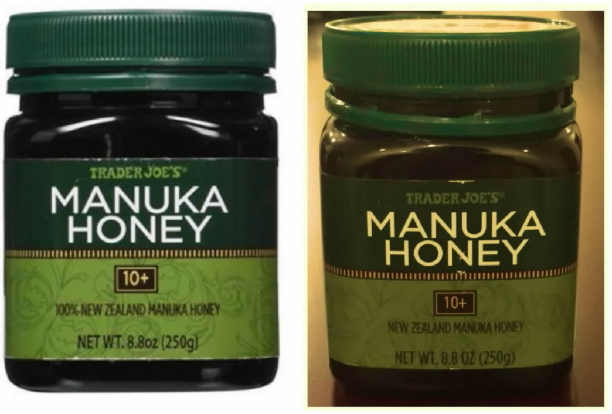
100% New Zealand Manuka Honey and New Zealand Manuka Honey jars

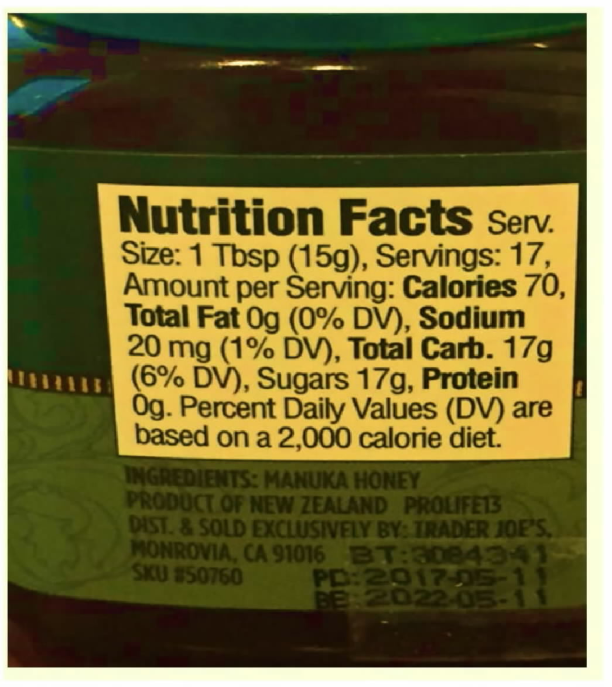
Identical nutrition panel on both showing the only ingredient as manuka honey

Manuka honey supposedly has antibacterial properties and health
benefits; this, plus geographic barriers to widespread production, result in
high demand and low supply and “a price far in excess of other honeys.” Manuka
honey producers grade the purity of Manuka honey on the Unique Manuka Factor (UMF)
grading system, from 5+ to 26+ based on the concentration of honey derived from
Manuka flower nectar. A bottle of Manuka honey 92% derived from Manuka flower
nectar costs approximately $266, or $21.55 per ounce.

TJ’s Manuka Honey is labeled with a UMF grade of 10+, “a
relatively low grade, and sells for the comparatively low price of $13.99 per
jar, or $1.59 per ounce.”  The ingredient
statement lists Manuka honey as the sole ingredient.

Plaintiffs brought the usual California claims. I think that
the court wouldn’t have to rest on factual claims about the details of what
consumers understand about Manuka honey if it had admitted that what is really
going on here is balancing: given the unique production/collection of honey
products, there’s no simple way to explain to consumers what’s going on, so requiring
a more complicated explanation would obscure more than it prevented deception.
(Though a 5 to 26 scale is pretty weird, LSAT-level weird, and perhaps it really
would be more helpful if they indicated that 10+ wasn’t all that Manuka-y.)

Anyway, TJ’s Manuka Honey met the FDA standard, being derived
from between 57.3–62.6% Manuka flower nectar (as estimated by pollen count). Taking
into account “all the information available to consumers and the context in
which that information is provided and used,” “other available information
about Trader Joe’s Manuka Honey would quickly dissuade a reasonable consumer
from the belief that Trader Joe’s Manuka Honey was derived from 100% Manuka
flower nectar.”

Specifically, “information available to a consumer is not
limited to the physical label and may involve contextual inferences regarding
the product itself and its packaging.” Though, as the Seventh Circuit has held,
“[d]eceptive advertisements often intentionally use ambiguity to mislead
consumers while maintaining some level of deniability about the intended
meaning[,]” as with the “100% Grated Parmesan” full of non-cheese, there was nothing
like such conduct here. “Bees make the Manuka honey, without input from Trader
Joe’s or any other manufacturer. Trader Joe’s does not insert any additional
ingredients to produce the product or mix Manuka honey with other, non-Manuka
honeys to dilute it.” And a consumer wouldn’t make an unreasonable or fanciful
interpretation of “100% New Zealand Manuka Honey” because of: (1) the
impossibility of making a honey that is 100% derived from one floral source,
(2) the low price of Trader Joe’s Manuka Honey, and (3) the presence of the
“10+” on the label, all of which is readily available to anyone browsing the
aisles of Trader Joe’s.

“Although a reasonable consumer might not be an expert in
honey production or beekeeping, consumers would generally know that it is
impossible to exercise complete control over where bees forage down to each
specific flower or plant.” Of course, consumers are unlikely to think of (1)
when they browse the aisles. They may very well assume to the contrary even if
they’d see the unlikelihood—surely not the impossibility; are there not
greenhouses and fields of monocultures around the world?—if forced to work the
problem through. (1) is really a cost-benefit analysis: consumers may assume
the wrong thing, but correcting that assumption isn’t worth the information costs
especially given that there are no single-source honeys.

(2) assumes a really high degree of calibration of
understanding, beyond “it is expensive” to “I know the right retail price for
high grade honey and I understand that this goes beyond what TJ, a savvy buyer
known for its good deals on house brands, could do.” I think that’s a bad idea
on a motion to dismiss; it, as with the truffle oil case that invented this consideration,
authorizes sellers to deceive bargain-hunters because they aren’t as
sophisticated about pricing as the court thinks (without actual evidence) they should
be. But plaintiffs didn’t help themselves by alleging that manuka honey
consumers “know[s] that the concentration of manuka [nectar, as measured by
pollen,] as opposed to other honey pollens can vary significantly from brand to
brand depending on what measures have been taken to maximize manuka purity” and
“attach importance to representations that communicate a higher purity level.”

The court here thought that consumers of Manuka honey, “a
niche, specialty product, are undoubtedly more likely to exhibit a higher
standard of care than ‘a parent walking down the dairy aisle in a grocery
store, possibly with a child or two in tow,’ who is ‘not likely to study with
great diligence the contents of a complicated product package.’ … Rather, an
average consumer of Manuka honey would likely know more than most about the
production of the product and the impossibility of a honey that is 100% derived
from Manuka flower nectar.” In a footnote, the court pointed to Broad City’s
parody of the “perceived high-brow nature of the product,” where a main
character under the influence of heavy medication buys it at Whole Foods in a grocery
trip costing $1,487.50; it’s sarcastically described as “so reasonably priced.”
Yeah, that’s real motion-to-dismiss-worthy evidence, speaking of sarcasm.
Anyway, the $1.59 per ounce cost of the honey should have signaled relatively low
pollen count.

(3) assumes that consumers know the rating scheme, and don’t
think it’s 1-10, which is possible though not necessary given the allegations
of the complaint. I myself had certainly heard of manuka honey and its purported
special properties, but I had no idea of a 5-26 rating scale. The court:

While there are no other details on
the jar about what “10+” means, the presence of this rating on the label puts a
reasonable consumer on notice that it must represent something about the
product. Reasonable consumers of Manuka honey would routinely encounter such
ratings and would likely have some knowledge about them. … Thus, even a
consumer with cursory knowledge of the UMF scale would know Trader Joe’s Manuka
Honey was decidedly on the lower end of the “purity” scale.

Why is a reasonable consumer of Manuka honey someone used to
encountering the expensive stuff, rather than someone who’s read about it and
happy to find an affordable version in the local TJ’s?

Anyway, the name was ok, and so was the use of “Manuka
Honey” as the sole ingredient on the ingredient statement, as provided for by
the FDA’s Honey Guidelines.

from Blogger https://ift.tt/2W3huCw

Posted in Uncategorized | Tagged , | Leave a comment

Claims that timeshare exit services are legal and effective were not puffery

Bluegreen Vacations Unlimited, Inc. v. Timeshare Lawyers
P.A., 2021 WL 3552175, No. 20-24681-Civ-Scola (S.D. Fla. Aug. 11, 2021)

Another timeshare versus timeshare exit false advertising
case. Marketing Defendants allegedly falsely advertise timeshare exit services
by promoting a legitimate process to exit timeshare contracts. The Marketing
Defendants allegedly advertise their services on the Third-Party Marketing
Defendants’ websites that rate various timeshare exit companies. The Lawyer
Defendants allegedly execute a letter directed to Bluegreen that is intended to
“cut off any communication between Bluegreen and the Bluegreen timeshare
owners, and constitutes the entirety of the ‘service’ the Lawyer Defendants
perform.” And the Credit Repair Defendants allegedly manipulate the timeshare
owners’ credit reports and remove negative trade lines related to the timeshare
owner’s default on the timeshare contracts and file false police reports
claiming identify theft on behalf of timeshare owners to discourage credit
bureaus from reporting negative information.

This opinion considered only the marketing defendants. First,
the court rejected the argument that Rule 9(b) applied to the false advertising
claims. Noting only that local courts “tend to apply Rule 8 when addressing
motions to dismiss claims under the Lanham Act,” the court followed that trend.
And it found that the particularity requirements of Rule 9(b) do not apply to the
FDUPTA claims. Under FDUPTA, “the proscription against unfair and deceptive
acts and practices sweeps far more broadly than the doctrine of fraud or
negligent misrepresentation, which asks only whether a representation was
technically accurate in all material respects.” And because “FDUTPA’s elements
are more particularized than those of common law fraud,” Rule 9(b)’s concerns
with subjecting defendants to unfounded allegations of fraud are lessened by
the required specificity. Because “FDUTPA claims seek a remedy for conduct
distinct from traditional common law torts such as fraud[,]” “the uniqueness of
the cause of action place[s] it outside the ambit of Rule 9(b).”

So too with tortious interference.

There is in general a division among courts on the pleading standard for state consumer protection claims; I wonder if there’s any correlation between whether the defendants are, in the court’s perception, ordinary advertisers, and the results.

Bluegreen also stated a claim for Lanham Act false
advertising by alleging that the Marketing Defendants falsely claimed their
services were legal and effective: “Our team at Timeshare Compliance as has a
proven track record of persuading developers to exit timeshare contracts. We
will remove all liability from your timeshare contract.” They advertised a
“proprietary strategy of resolving timeshare contracts,” which was allegedly “to
trick timeshare owners to withhold payments to Bluegreen and to hide their
fraud through credit repair services and letters from lawyers falsely affirming
the legality of the Marketing Defendant’s services.” Their cold calls allegedly
said that “TSC’s service permits the Bluegreen owner to safely stop payments to
Bluegreen” and that “the Bluegreen owner is guaranteed to receive a legal
release from their timeshare obligation.” Evidence of misleadingness or of
specific timeshare owners fooled by the scheme wasn’t required at this stage.

This wasn’t puffery/opinion: Claims about “a 100% guarantee
and top ratings, as well as advertisements that owners would not be liable at
all under the timeshare contracts could constitute facts on which a consumer
may rely.”

The other claims survived too.

from Blogger https://ift.tt/2VShepH

Posted in Uncategorized | Tagged , , | Leave a comment

Alleging sponsorship/endorsement confusion can’t defeat clear nominative fair use

Pasadena Tournament of Roses Ass’n v. City of Pasadena, 2021
WL 3553499, No. 2:21-CV-01051-AB-JEMx (C.D. Cal. Jul. 12, 2021)

For over a century, PTRA has hosted the Rose Parade and Rose
Bowl Game as part of its annual New Year’s Day Celebration. It does so at the
Rose Bowl Stadium under three contracts with Pasadena, including a Master
License Agreement, Trademark Agreement, and Trademark Consent Agreement. Under
these agreements, PTRA is the exclusive owner of the Rose Bowl Game trademark
and owns the mark for use in connection with the annual game. For many years,
the parties worked together behind the scenes to help ensure the success of the
annual game. PTRA alleged that Pasadena disrupted that relationship by
interfering with its trademark rights in statements made in news articles and
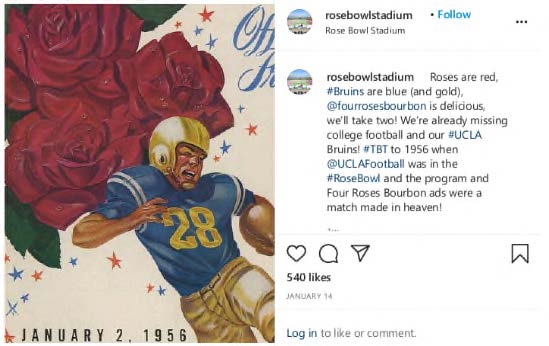
via an Instagram post:

IG post using #RoseBowl and 1956 Rose Bowl program image

The pandemic led the 2021 Rose Bowl Game to be played in
Texas. Pasadena objected that, in the event of a force majeure, the MLA gave it
the right to restrict PTRA from hosting the Rose Bowl Game in a venue other
than Rose Bowl Stadium. The parties strongly disagree about this issue and PTRA
sought declaratory judgment concerning the parties’ rights with respect to the
Rose Bowl Game and its related intellectual property.

There was no controversy as to whether Pasadena had an “ownership”
interest in the relevant trademarks. And there wasn’t a sufficient possibility
of future harm that would justify a declaratory judgment interpreting the
contract such that PTRA could host the Rose Bowl elsewhere if a force majeure
event occurred.

Trademark/unfair competition claims: these were all based on
 alleged use of the “Rose Bowl” mark in
an Instagram post made on the Rose Bowl Stadium’s official Instagram account,
together with an image of the official program from the 1956 iteration of the
Rose Bowl Game. Pasadena said this was (1) nominative fair use and (2) an
expressive work protected by the First Amendment.

The Instagram post was before the court and was NFU. The Rose
Bowl game wasn’t readily identifiable without “Rose Bowl.” The IG post used
“#RoseBowl” in plain text to describe the 1956 Rose Bowl Game program depicted
in the post.

PTRA argued that, because Pasadena has referred to the Rose
Bowl Game as “the game” in the past, the Rose Bowl Game was readily
identifiable without using the term. But those past posts included video clips
that used “Rose Bowl” to identify “the game.”

And Pasadena used only so much of the mark as was necessary.
The term was used twice, but that’s not per se unreasonable. The question here
was not whether it was necessary to use “Rose Bowl” at all, but whether it used
only so much of the mark as is reasonably necessary to identify the Rose Bowl
Game.

Finally, the post had nothing to suggest association or
sponsorship by PTRA. Pasadena posted from its Instagram account,
@rosebowlstadium. “It did not use any express or implied language of
sponsorship or endorsement or ‘tag’ Plaintiff’s accounts.” Conclusory allegations
of possible confusion “are insufficient to plead there was a suggestion of
association or sponsorship.”

The court noted that the parties had been partners for
decades. “Plaintiff has consistently benefitted from Defendant’s promotion of
Plaintiff’s game and its history and likely encourages such promotion. … [T]hat
this claim is being brought now is puzzling to the Court and it is clear that
this claim is not the crux of the parties’ conflict.”

False advertising: Pasadena’s mayor allegedly gave an
interview to the New York Times and stated that “the city [ ] shares a
trademark on the name of the game with the Tournament of Roses Assocation
[…]” and that “The football game belongs to the City of Pasadena and the
people of Pasadena.” But the only statement at issue is the second, which was
the only one actually attributed to the Mayor.

This was not “a representation of fact with respect to who
owns the marks,” but rather “appears to reflect Defendant’s pride for the
nearly 100-year-old annual football game held in Defendant’s Rose Bowl Stadium.”
Expressing an opinion of its own, the court found that PTRA “cannot reasonably
dispute that, separate and apart from intellectual property ownership, the
heart and soul of the Rose Bowl Game belongs to the people of Pasadena.” Thus,
this was merely opinion or puffery and not the type of statement “reasonably
interpreted as a statement of objective fact” surrounding the intellectual
property ownership.

This also got rid of the breach of contract claim, which was
based on the alleged trademark infringement and false advertising.


from Blogger https://ift.tt/2VTGtbc

Posted in Uncategorized | Tagged , | Leave a comment

Illinois unfairness claims against opioid marketers continue

City of Chicago v. Purdue Pharma L.P., No. 14 CV 4361, 2021
WL 1208971 (N.D. Ill. Mar. 31, 2021)

Chicago alleged unfair and deceptive misconduct in multiple
defendants’ marketing, commercializing, and promoting their opioid products. (Perdue
is first in the list but it’s a bunch of them, so parts of this case will
survive the bankruptcy whatever happens there.) There were a bunch of kinds of
allegedly deceptive marketing related to misrepresentations and failures to
disclose. There were also alleged unfair practices related to diversion of
opioids into illicit channels. Defendants allegedly didn’t comply with their
statutory duties to maintain suspicious-order-monitoring systems (“SOMS”), and
concealed their failure from the public, misrepresenting that they were in
compliance with their obligations under the law. This led to the rise of “pill
mills” and an increasing number of deaths and hospitalizations.

Among other things, the court addressed whether the City
adequately pled unfairness under the Illinois Consumer Fraud Act. Courts look
to the FTCA for guidance on ICFA, and thus consider: “(1) whether the practice
offends public policy; (2) whether it is immoral, unethical, oppressive, or
unscrupulous; (3) whether it causes substantial injury to consumers.”

The parties focused on the public policy element; the City
argued that defendants violated their duties to monitor and prevent diversion
under the CSA (Controlled Substances Act). Defendants rejoined neither the
CSA nor its implementing regulations impose any duties owed to consumers that
might reveal a relevant public policy; it just guided the DEA in enforcement.
But, as the MDL court earlier in this case held, the CSA and its implementing
regulations impose an ongoing duty on DEA registrants. “Given that, as the
Court has explained, defendants were under legal duties, imposed under the CSA,
to monitor for suspicious orders and halt shipments of them, the Court has
little doubt that their alleged failure to do so offends public policy,
particularly under circumstances in which consumers of their products and the
consumers’ communities were likely to be injured by addiction and its
consequences.”

However, public policy wasn’t dispositive, “because
plaintiff’s allegations of immoral, unethical, oppressive, or unscrupulous
conduct causing substantial injury to consumers are sufficient to state a claim
on their own.” In particular, this was “oppressive” conduct because it deprived
consumers of choice:

By promoting the use of their
products for chronic or long-term pain while concealing the risks, including
the risk of addiction, they not only caused consumers with chronic pain to use
their product, but also, a reasonable factfinder could conclude, they put these
consumers in a position in which they were compelled by their addiction to
continue buying defendants’ product, whether via legal or illicit channels. In
other words, the consumers, having been tricked into buying defendants’
products, had little alternative but to submit to defendants’ alleged
misconduct and continue to buy the products, even in illicit channels, if
necessary. This is enough to state a claim by itself.

There was also no preemption by the CSA.

Defendants contested harm causation because the City alleged
oversupply in the aggregate without identifying specific orders that should
have been refused, but the court agreed with others that the “very existence of
the duties to maintain effective controls supports the notion that opioid
misuse is foreseeable.” Any intervening acts, “including decisions by
prescribers, patients, distributors, pharmacies, and third-party criminals,”
were “reasonably foreseeable, and thus not superseding acts” that broke the
chain of proximate causation.


from Blogger https://ift.tt/3CNeScM

Posted in Uncategorized | Tagged , | Leave a comment

reasonable consumer isn’t required to interpret ingredient list for naturalness

Moore v. GlaxoSmithKline Consumer Healthcare Holdings (US)
LLC, No. 20-cv-09077-JSW,  2021 WL
3524047 (N.D. Cal. Aug. 6, 2021)

Moore alleged that GSK falsely labeled certain ChapStick
products with the claims “100% Natural,” “Natural,” “Naturally Sourced
Ingredients,” and “100% Naturally Sourced Ingredients.” The products allegedly contain
non-natural, synthetic, artificial, and/or highly processed ingredients. The
products are

100% Natural Lip Butter; Total Hydration 100% Natural Lip
Balm; Total Hydration Essential Oils Lip Balm; Total Hydration Moisture + Tint
Lip Balm; and Total Hydration Natural Lip Scrub, which come in a variety of
scents and shades, though Moore alleged that they were substantially similar,
identifying twelve allegedly non-natural (etc.) ingredients. Moore alleged that
she routinely the Total Hydration 100% Natural Lip Balm in Eucalyptus Mint and
Fresh Citrus scents and the Total Hydration Essential Oils Lip Balm in the
Happy scent, relying on the natural representations on the label. She alleged a
continued desire to purchase the products if they didn’t contain any
non-natural ingredients but was currently unable to rely on the truth of the
natural representations. She brought the usual California statutory claims, along
with breach of express warranty and unjust enrichment.

Based on these allegations, Moore had Article III standing
for products she didn’t buy, because the products and alleged
misrepresentations were substantially similar. Differences might impact class
certification or summary judgment, but they weren’t enough to defeat
substantial similarity for the purposes of standing. She also had standing to
seek injunctive relief. As with prior cases, desire to buy the properly labeled
product plus inability to rely on the truth of the packaging constituted a
cognizable risk of future harm. Moore alleged that as “an average consumer who
is not sophisticated in the chemistry, manufacturing, and formulation of
cosmetic products,” she would not be able to differentiate between cosmetic
ingredients that are natural and those that are synthetic. Thus, she alleged
that she was at risk of reasonably, but incorrectly, assuming that GSK fixed
the formulation. “[E]ven if Plaintiff is now aware of some synthetic
ingredients, it is plausible that she would still be unable to rely on the
Products’ labeling in the future given her allegations that she cannot
differentiate between synthetic and natural ingredients.” In any event, the
court didn’t think that she should be required to bear the burden of
scrutinizing the ingredient list to figure out if the products were really
natural.

Moore also adequately stated a claim under Rule 9(b). As to
misleadingness, she alleged a definition of natural and alleged that she
interpreted the natural representations as claims that the products contained
no non-natural, artificial, and/or synthetic ingredients. She also provided a
definition of “synthetic” and alleges how each challenged ingredient is
non-natural, synthetic, or artificial. Moore further plausibly pled deception
by reasonable consumers. Numerous courts in the Ninth Circuit have found it
plausible that a reasonable consumer could understand similar ‘natural’
statements, including ‘100% natural,’ ‘natural,’ and ‘naturally-sourced,’ to
mean that a product does not contain any non-natural ingredients.” Contrary
cases involved limited natural representations, such as “Made with 100% Natural
Moisturizers.”

from Blogger https://ift.tt/2VNesC4

Posted in Uncategorized | Tagged , , , , | Leave a comment

IPSC: Remedies and Creativity

Panel 24 – Remedies:

Thomas F. Cotter, Nominal Damages—and Nominal Damages
Workarounds—in Intellectual Property Law

TransUnion v. Ramirez—FCRA case where D allegedly failed to
use reasonable care and people were falsely identified as potential terrorists;
sought statutory damages, but most Ps were unable to show that the info had
been distributed to third parties. These Ps didn’t suffer concrete harm and
lacked standing to sue. Congress can’t enact an injury into existence and can
provide a remedy only for concrete harms, which can include intangibles like
emotional distress if they’re recognized by the relevant body of law and
proven.

Several modern-day remedies were enacted to reduce the risk
that IP owners would otherwise be able to recover only nominal damages—reasonable
royalties for patents; statutory damages for © infringement; disgorgement of
total profits for infringement of design patents. These nominal damages workarounds
are available without proof of lost profits or quantifiable harm to the D. Reasonable
royalties are based on a legal fiction of a hypothetical bargain; can a
hypothetical injury be concrete? He thinks the answer is mostly yes—history and
tradition offer a meaningful guide to what counts as an Article III injury.

IP derives much of its value from opportunity to license, so
it often makes sense to think of reasonable royalty as a cognizable harm. By
contrast, elsewhere it might not make as much sense to think of the problem as
a lost opportunity to license, e.g., the listing of someone as a terrorist.

Are these workarounds an appropriate response to the domain-specific
problems or would reasonable royalties be appropriate across the board?

Basically, reasonable royalties are superior to statutory
damages and disgorgement for public policy reasons. Inconsistency/predictability
critiques could be applied to reasonable royalties too, especially in patent,
but there are some ways to deal with that, and it might be easier in © and
design patent where the damage awards are lower.

Are nominal damages appropriate where the conditions for the
use of the workaround aren’t present? E.g., owner failed to register in a
timely fashion and she doesn’t prove actual damages or entitlement ot
injunction b/c infringement has ceased—is court obligated to dismiss the case
for lack of subject matter jurisdiction? Patry says Copyright Act doesn’t
permit nominal damages, but he’s not sure that’s right. Predecessor Act and
Lanham Act both said/say nothing about nominal damages but courts sometimes
award them. They aren’t a consolation prize for a plaintiff who fails to
plead/prove actual damages; they’re damages by default. Suppose a patent owner
fails to substantiate its damages theory with admissible evidence—the statute
says “in no event less than a reasonable royalty.” Nominal damages are often a species
of general damages. If there’s no proof, there should be nominal damages.

Are there any circumstances in which the award should be
nominal or zero damages as a matter of law? Yes, e.g. where D would have been
no worse off had it used a noninfringing alternative, at least where it’s
possible to quanitfy the value of the difference b/t infringement and next best
noninfringing alternative, though that might be harder in ©. What if D offers
to manufacture/sell an invention but doesn’t follow up with sales? Some cases
allow big damages for a hypothetical bargain. Without use, maybe there’s no
reasonable royalty under the statute, which does speak of a reasonable royalty for
the “use.” NPEs should be able to get reasonable royalties—no reason that a
practicing entity’s lost licensing royalty is a cognizable harm while an NPE’s
isn’t.

Are there any implications for injunctive relief? Before
courts awarded reasonable royalties, in the 19th century they
sometimes awarded established remedies for the entire patent term, and there
was no injunction because that was an adequate remedy at law. Courts usually
awarded injunctions b/c that was hard to prove; but now it’s not a stretch to
say they should just award reasonable royalties prospectively as an adequate
remedy.

RT: Why is the paper about “IP” and not patent & © with
a trade secret chaser? The analysis doesn’t seem as successful for TM, ROP. Related:
if damage is an element of every claim under Article III then why are nominal
damages ok? Aren’t they just the invention of an element of the claim?

A: Not sure there’s a principled basis for the distinction
made for nominal damages—the majority in one recent case approving it was
written by Thomas who of course dissented in the TransUnion case. History and
tradition is an important consideration in determining when courts may award
nominal damages.

RT: Which is particularly weird for patent because that
seems to be saying that the common law [not legislatures] get to decide what is
a harm, but there is no common law patent (and common law © is a very different
thing than statutory ©).

Matthew Sag and Pamela Samuelson, Hysteresis: An Empirical
Study of Copyright Injunctions After eBay v. MercExchange

In 2012, study found eBay ignored/ineffective in © cases;
cited in only 11% of cases; applied in a cursory way; continued to grant
injunctions at high rates. Maybe it took some years to take effect. Reviewed
about 70 cases in which injunctions were denied; there are patterns.
Hysteresis: it takes time for changes to propagate through a system.

Collected 330 cases 2000-2019. There are a lot of easy
piracy cases where it just wouldn’t matter what the standard was, you’re going
to get an injunction. Overview: eBay was never as poorly cited in cases where
it would be likely to have an effect as the early literature would suggest; it’s
now better cited (around 50% in nondefault cases; citations to eBay or its
progeny start out at 40% and jump to mid-60s). One category: in nondefault
permanent injunction cases, the citation level hasn’t increased, but that’s
because it was always strongly cited in that subset. There are fewer successful
injunction Ps, and that category has increased, showing evidence of delayed
effect, except for where preliminary injunctions were concerned where the drop
was substantial and immediate. Grants bounce around from year to year; weirdly,
the permanent injunction grant rate goes up immediately after eBay, then goes
down and down. In preliminary injunctions, the grant rate goes down immediately,
even before Winter. At the same time, number of injunction cases are going
down, while damages claims aren’t going down at the same rate. There is an
apparent selection effect where Ps aren’t pressing injunction claims as
aggressively.

Why such different results from Liu’s 2012 study? Did a full
replication study b/c didn’t have access to Liu’s data on reported cases (506);
we found 86 using that methodology, 29% of which cited eBay. It wasn’t really
based on reported cases, but unreported cases that were available on WL and
Lexis. This really matters because those cases were chock full of easy cases
padding out the decisions, particularly unreported default judgments.

Takeaways: if you had the view that eBay didn’t affect ©
cases, you can’t hold that view any more. Or empirical studies, you really have
to think about the difference between easy cases and hard cases, label cases
carefully, and think about mechanics of legal change. Don’t believe everything
you read! Don’t extrapolate from everything you read. If our study had included
unreported cases, we would likely report much higher rates of injunction.

My reaction: hysteresis is very plausible in general—after the
TMA and its explicit statutory command, we’re still getting cases citing eBay
in TM/advertising cases and that’s just a matter of diffusion of knowledge.

Jorge Contreras: Other people did say that there were big
changes in ©; that was always his understanding. Reported/unreported cases are
complicated—there can be value to unreported cases, as in the patent world. And
they matter to practice. Maybe benefit in reporting both sets of results and
explaining why you think they differ.

Panel 23 – Creativity and Culture:

Amy Adler and Jeanne Fromer, Memes on Memes

[Came in midstream b/c of other panel attendance] Memes further
blur the commercial/noncommercial distinction, as well as the idea/expression distinction
[snowclones!]. With a meme, the expression becomes the idea. [I think this
might be a characteristic of images that memes bring to the forefront]. Memes
move faster than life +70—they become stale in months. Selective enforcement is
also huge—everyone can use the meme except a few targets. Decentralizes
authorship: the work becomes what’s important b/c it spreads, decontextualized.

How could © respond?

One possibility is do nothing, but leaving it alone is a bit
dangerous. Could shift norms, and that could be bad. Another possibility: go
down the attribution route. But it’s very impractical in this context. How do
you attribute things that keep changing and shifting? Another option: tailor ©
to new realities of meme culture. Selective enforcement feels much more
troublesome from a free speech perspective when you’re disallowing only a few
people from use.

Jennifer Rothman: the disallowed use is most likely to be
fair use. Reducing term would also be much harder than making other changes
like attribution. [I think those are different and both significant kinds of “hard”—the
former is political, the latter is in enforcement/implementation]

Madhavi Sunder: Is this new or part of the broader critiques
we’ve had for a long time?

Fromer: the paper goes into this; there are strands of this throughout
© but tech makes copying that much easier and the rise of the visual also has
had a real impact.

Adler: also, looking for the author of a meme is, in a way,
folly.

Madhavi Sunder, Intellectual Property Is Theft!

Began career celebrating appropriation—e.g., appropriation
of Indian stories to tell new lesbian narratives. Still thinking about it, but
in different ways now. Cultural appropriation and racial justice: as a place of
redress and potential remedies, as with the Washington Football team. Social
movements brought down brands that TM law couldn’t. George Floyd’s death had
implications beyond criminal law [RT: perhaps only beyond criminal law
and not within it, unless something changes about qualified immunity].
Dispossession of Black intellectual and physical labor—history and continued
source of our nation’s wealth as founded on expropriation of racial minorities.
Racial capitalism: defining resources from Black communities as nonproperty and
free for the taking. Reparations claims have moved from property to IP.

Of course, “art is theft,” as Picasso says, and there are
arguments that culture can’t be owned. Has agreed with those values and
impulses, but trying to hone in on when cultural exchange crosses into
misappropriation or theft. Trying to create a definition that does more than
focus on taking of resources from one culture to another, but starts with
Ijeamo Oluo’s focus on exploitation by a more dominant culture. W/o that,
cultural appropriation becomes much less harmful. And there’s distributional
harm—redistributing benefits of innovation away from subordinated group.

3 kinds: cultural degradation; misappropriation; racial
capitalism.

Cultural degradation: understanding relationship b/t
representation and structural racism. Jim Crow, before it came to be the
moniker of structural racism, was a brand. A created minstrel character in 1830:
the performer happened on a disabled older Black man; was taken by the man’s
movements and created a character mimicking/mocking him. Racist brands have
continued despite the Lanham Act’s bar on disparaging marks (until invalidated
in 2017). People feared that would usher in racist marks, but huge culture
shift occurred instead. Navajo Nation’s litigation to control designs as marks—offers
possibility of better control (in litigation against Urban Outfitters).

Misappropriation: Traditional knowledge/global fashion
brands taking designs from indigenous communities: a lot of pushback from
culture ministers around the world. Asking not just for credit but for
partnership. And the old idea that artists can just take what they want is
under attack. Such borrowing often happens with “blithe thoughtlessness,
creative entitlement”—that’s what’s being called out now. Cases brought by
collectives against Neiman Marcus, other fashion proprietors: what’s being
taken is the work of individual artists. Using © and “cultural appropriation”
as a legal claim; case was settled.

Racial capitalism: how to contend w/appropriation that
occurs when culture only becomes valuable when mediated through white
performers. Copyright in dance—claim for © in the Carleton dance was rejected,
but Beyonce’s choreographer received a copyright in popular dance choreography
and has started a firm to help young choreographers get power over their art,
has talked about “authentically Black” dance and art and wants to protect that
against Fortnite and other exploitation. Controlling dance might be an important
place to start affirming Black voice and body, taking back what minstrelsy appropriated.

RT: intersectionality: guessing you don’t now object to the Indian
lesbian stories; does race have indexical priority here? [Also, I’m again going
to recommend Ashley Mears’ Very Important People, which is about how women’s
beauty capital is valuable only in the hands of men.] Concerns about whether
move from tangible to intellectual is just another way to keep resources out of
the hands of the poor—who gets hired to create is still largely determined by
who got into a well-known college, and so middle and upper class Blacks are the
face of continued appropriation from poor Black communities.

A: yes, focusing on power, both within and among communities.

Trevor Reed, Restorative Licensing

Tribes/mascots are examples of wins against cultural appropriations.
Trying to identify IP rights and ways to remedy violations. Judicial colonialism
makes it difficult for tribes to enforce their own rights structures. We don’t
have good numbers on quantity of Native American creations being used by other
institutions w/o their permission. What we do know: a significant number of settler
institution holdings likely are within the subject matter of tribes’ IP laws.
Bootlegged recordings, looting, graverobbing, acquired from someone not
authorized to transfer IP. While most institutions don’t adhere to tribal IP
laws, there’s nothing inherently inferior about them; tribes are separate
sovereigns and Copyright Act is silent about preemption of tribal laws.

Johnson v. M’Intosh—indigenous sovereignty is held inferior
to colonizers’ sovereignty, based on outdated assumptions about race and
culture. Have to use federal IP or other law to make claims. NAGPRA is the
prime example recognizing right to demand return of patrimony taken in
violation of tribal law. Can also enforce law when there’s entry onto tribal
lands, but most appropriation is off the land. Institutions have also started
to take private action to recognize tribal IP. Different standards, some of
which recognize tribal interests overriding IP defaults, some of which balance,
some of which don’t recognize tribal interests. Some acknowledge harm; others appear
motivated by efforts to increase inclusivity or limit liability. Some require
consultation w/tribes before making indigenous IP available; some require
repatriation where gathered illegally or w/o consent; others only allow input
on whether materials are culturally sensitive, which reflects institution’s
view of what tribes should be concerned about.

Violation of tribal IP laws is not just an ethical matter.
It is experienced by indigenous individuals and their communities as a
violation of the law. Judicial colonialism makes it difficult to enforce those
rights in settler courts; restorative justice may provide a framework for
resolving claims.

Columbia U decided to take responsibility for
misappropriating tribal music. Many of their collectors had violated tribal laws.
Went to communities to understand what the harms were and what expectations the
tribes had for Columbia to make them whole. Shame, embarrassment, psychological
issues that result from disclosure of private material to public: Boy Scouts
performed material outside tribal control; record labels made ceremonial sounds
available to the public. Bad public policy resulted from having lives depicted
w/o authorization. Community closed more now b/c of fears of unauthorized rampant
appropriation. Children being confused about right source of knowledge in the
community. Community wanted enforcement of their own IP rights and structures.

How do we repair the harms of the past and meet the
expectations of communities going forward? Extend tribal jurisdiction over
specific cultural materials just as state and federal IP law governs.
Institutions must learn tribal IP laws; provide restitution to the community
for violations of such laws; police themselves going forward; maintain contacts
w/tribe to ensure correct administration. Many institutions are willing to
interact though not clear they’re willing to subject selves to liability.

What about patrons/general public? Restorative justice doesn’t
talk much about the community surrounding the offender. The real concern is not
the institution, but the entities using the institution’s resources.
Restorative licensing framework: bring the institution, patrons, users under
the tribe’s jurisdiction. Exercising jurisdiction under nonmembers could be
tricky, but can be done with contractual provisions involving choice of law,
conditional licensing as with EULAs limiting uses to those allowed by tribal
law. Repatriation of any copies for violation.

Chris Buccafusco: Who is the tribe for these purposes with
older materials? Eastern Band of Cherokee may have different approaches than
two tribes in Oklahoma. Possibility of race to the bottom about who has the
right to license things.

A: could recognize tribes as constituted now, or religious
authorities w/in tribe as subgroup having sovereignty. Could be that Eastern Band
has separate jurisdiction. Timing and way tribe settles that could be helpful.

Betsy Rosenblatt: Restorative justice framework seems useful
and valuable for beyond tribal sovereignty and to other conceptions of
differing norms bases. So thinking about negative spaces: if/how this is
different from other norms-based subcultures. Calls for legally enforceable
licensing attached to these processes seem to require more tangible/concrete
links.

A: key question: what’s the justification for treating these
materials differently? There are groups trying to create their own sovereignty,
like Creative Commons [I thought he was going to say the “sovereign citizens”
movement] [BR says that CC requires contractual privity]. We’re talking about
dispossession. Were it not for judicial colonialism, you would have to obey
tribal rights. [In the US, you don’t have to obey British IP rights to the
extent they conflict with US © law and/or the First Amendment. But I take the
argument to be more that, if there weren’t a US, we’d be living under different
tribal legal systems entirely. But would those systems really look like current
tribal law? That seems like a big reach, since other nations have also settled
on various consensus ideas about IP—even to the extent of a couple of mandatory
exceptions and limitations. There is not international consensus about most
issues relating to traditional knowledge. In the hypothetical, have the nations
joined Berne? Lack of full sovereignty has insulated tribes from many of the political
pressures that would otherwise be brought to bear by IP industries—the RIAA/MPA
don’t lobby them because they don’t have to. (Compare what happened when pharmacos
tried to use the tribes for patent laundering.) I think using the sovereignty
argument as a way to distinguish the tribes from other groups is in some
tension with the argument for using restorative justice because of the violations
to which the tribes have been subjected.]

JohnJohn Uket, Transforming Policymakers into Innovators in
the Civil Service of Developing Countries

Nigeria as example: head of civil service/bureaucracy adopted
mission statement to provide professional and efficient services that are
responsive to citizens and other stakeholders. But this isn’t possible w/o
innovation in civil service structure.  About 90,000 civil servants in Nigeria. Many
struggles, including low overall trust in government. Innovation struggles in
government which has a more rigid operating system which emphasizes stability,
certainty, and predictability. Requires leadership: openness to incremental and
transformational ideas from inside and outside the structure. Openness to risk
as well as feedback—fear of risk means nothing happens. Human factors are key
to dissemination of innovation and that has to be understood before success.

Q: Consider path dependence literature too.

from Blogger https://ift.tt/3iHzOK9

Posted in Uncategorized | Tagged , , , | Leave a comment

Lexmark applies to false endorsement, defeats noncelebrity claim (for now)

Abrahams v. Simplify Compliance, LLC, 2021 WL 1197732, No.
19-3009 (RDM) (D.D.C. Mar. 30, 2021)

From 1985 to 2003, Plaintiff Daniel
Abrahams contracted with the Thompson Publishing Group (“TPG”) to author a
series of publications related to the Fair Labor Standards Act. TPG eventually
sold the publication rights to Abrahams’s works to Columbia Books in 2013,
which, in turn, sold the rights to Defendant Simplify Compliance (“Simplify”)
in 2016. Simplify then purportedly terminated Abrahams’s publication agreement,
refused to pay him any fees or royalties, and continued to market, sell, and
distribute his publications.

He sued for D.C.-law tort and contract claims and one
federal claim under the Lanham Act. The Lanham Act claim was based on the
continued publication of updates and newsletters “hold[ing] [Abrahams] out to
the public as editor of the publications via its website, among other media, on
a global basis.” Simplify allegedly “lists [Abrahams] as the premier editor of
the [ ] publications … [and] claims [that Abrahams] serves on the [e]ditorial
[a]dvisory [b]oard for these products.”

Do Lexmark’s zone of interests and proximate cause
requirement apply to false endorsement? Yes, they do. Thus, “a plaintiff may
not prevail on a false association claim without alleging a commercial injury.”
But Abrahams failed to do so. He didn’t allege “the type of commercial harm
that the Lanham Act seeks to prevent,” but relied on “mere conclusory
statements,” or “[t]hreadbare recitals of the elements” of injury, which are categorically
insufficient “to ‘state a claim to relief that is plausible on its face.’ ” It
was therefore insufficient to allege that Simplify “has deprived [him] of the
fundamental value of his name and abilities with regard to editing the
publication,” and claims that because Simplify “holds [him] out [ ] as an
editor without permitting him to control the quality of the work,” it has
“depriv[ed] him of the ability to maintain his reputation and standing in the
marketplace.”

Compare the following analysis to the treatment of a
standard trademark claim:

Missing from these allegations,
however, is any explanation of how Simplify’s conduct harms Abrahams’s
cognizable commercial interests. Abrahams does not claim that the publications
are of substandard quality or that he disagrees with or disapproves of their
contents, such that his association with the publications risks his reputation
(indeed, Abrahams authored or edited the publications himself). Nor does
Abrahams allege that he has found it more difficult to market his own products,
labor, or identity as a result of Simplify’s purportedly false association, or
that any individual has declined, or is likely to decline, to do business with
him as a result of Simplify’s actions. A similar flaw attends Abrahams’s claim
that Simplify “is likely to confuse purchasers to believe, contrary to fact,
that the publications are authorized, endorsed, or sponsored by [Abrahams].”
What commercial injury does this alleged confusion produce? Abrahams’s
complaint does not say.

Loss of compensation was definitely a cognizable injury
under Article III, but it wasn’t Lanham Act commercial injury. Even if alleging
merely an existing intent to commercialize an interest in identity was
sufficient under the Lanham Act, “Abrahams’s complaint would still fail because
it contains no allegation that Abrahams intends to commercialize his identity
in any way.” He argued in his motion papers that he was doing so because “his
law firm bears his name, and his website too,” but that wasn’t in the complaint
and the court wasn’t going to speculate about whether that would be enough.

from Blogger https://ift.tt/3ABiFI1

Posted in Uncategorized | Tagged , , , | Leave a comment

Cracks in the foundation: Laches and proximate cause defeat auto glass false advertising claim

Campfield v. Safelite Gp., Inc., 2021 WL 1215869, No.
2:15-cv-2733 (S.D. Oh. Mar. 31, 2021)

Plaintiffs alleged that Safelite misrepresented the nature
and characteristics of plaintiffs’ products to consumers in violation of the
Lanham Act. Safelite counterclaimed for various business torts/CFAA violations.
Safelite managed to kick out the Lanham Act claim for want of proximate cause.

The parties compete in vehicle glass repair and replacement
(VGRR) services. Safelite’s business focuses on “sale and installation of
replacement windshields.” It primarily serves insurance companies,
administering their glass breakage coverage; commercial customers who have
vehicle fleets; and indivudal consumers who may or may not have windshield
damage insurance. Plaintiffs focus on the sale of products used to repair
cracks longer than six inches (called “long cracks”), as well as the service of
performing such repairs.

Safelite follows the “dollar bill” rule and neither
recommends nor performs long-crack repairs. In 2007, ANSI approved windshield
industry repair standards, the Repair of Laminated Automotive Glass Standards
(ROLAGS), that stated windshield cracks up to fourteen inches are repairable. Plaintiffs
alleged that the dollar bill rule is no longer the prevailing view in the
industry, and that Safelite’s internal documents show that it knew that the
repair of windshield cracks “up to 24 [inches] … can be safe and is viable.” Safelite
allegedly falsely advertised that (1) “if damage spreads beyond the size of a
dollar bill, a replacement will be necessary”; (2) “when a chip is smaller than
a dollar bill, it can usually be repaired without replacing the windshield.”

Safelite counterclaimed for trade secret theft not related
to advertising.

Prior opinions narrowed the case in Lanham Act relevant
ways. As to basic Lanham Act coverage: (1) Safelite’s statements to
policyholders in its role as a claims administrator are not commercial
advertising or promotion under the Lanham Act [hmmm]; (2) Safelite is not
liable for any statements made by insurance companies regarding the dollar-bill
rule, even if drafted by Safelite [double hmm; seems at least secondary
liability would be appropriate]; (3) Safelite may be liable for statements it
made directly to insurers, including in brochures and educational materials, if
these statements were made for the purpose of ultimately influencing customers
or even insurance companies to buy (or contract for the provision of)
Safelite’s goods and service, as opposed to for the purpose of explaining an
insurance company’s existing policies; and (4) unsurprisingly, statements made
by “Safelite’s front-line sales force” directly to consumers may be “commercial
advertising or promotion.”

As to substance, the first category of challenged statements
(“if damage spreads beyond the size of a dollar bill, a replacement will be
necessary”) could be literally false, while the second category needed to be
proven misleading.

Laches: The parties agreed that Ohio’s two year statute of
limitations was analogous, so if they actually or constructively knew of the
alleged violative activity more than two years before the August 2015 filing,
there’d be a presumption of laches. Safelite argues that “Plaintiffs knew of
Safelite’s dollar bill policy and thought it was false and misleading decades
before they filed suit.” By 1998, Campfield (a relevant person and
counterdefendant) was telling insurance companies that Safelite was lying to
consumers by using the dollar bill rule. He also unsuccessfully sued insurance
companies and Safelite based on similar claims in the past, including in 2003
and 2004.

Plaintiffs argued that they rebutted a presumption of
prejudice, that there was good cause for their delay, and that Safelite’s
“egregious” conduct excused the delay.

As to prejudice, they argued that Safelite wasn’t going to
stop no matter what, with a relevant person saying, in response to the new
ROLAGS standards, that “[a relevant entity] has made it clear to insurance
companies that it is not going to change its repairable dimensions to include
crack repair until we research the safety implications.” That wasn’t enough to
show that Safelite would have ceased its conduct if ordered to do so by a
court, which was the relevant question. [Is “ordered by the court” really the
relevant question for assessing prejudice? I thought it was whether Safelite
would have had, and possibly taken, an opportunity to minimize the damage it
was causing by changing its conduct/building goodwill some other way.] More
plausibly: “Every year that Plaintiffs delayed in bringing this lawsuit is
another year that Safelite continued its use of the dollar bill rule,
prejudicing Safelite by increasing potential damages that Plaintiffs could
claim as well as increasing money Safelite invested in promoting the dollar bill
rule.” So the presumption of prejudice applied.

Did they have good cause for delay? Plaintiffs argued that
their previous losses meant that they couldn’t sue until there was a real
industry standard. But elsewhere plaintiffs expressly denied that their claims
depend on the ROLAGS industry standard. There was also no evidence that the
nature of Safelite’s statements to insurers or consumers materially changed
after the earlier litigation, meaning that there was no analogue to progressive
encroachment. Anyway, the industry standard came to be in 2007, eight years
before filing.

Was Safelite’s alleged conduct egregious enough to avoid
laches because it involved safety? In a footnote, the court said that economic
harm to consumers wasn’t enough to be egregious conduct. Plaintiffs failed to
create a genuine issue of material fact as to whether the statements put
consumers at risk. Although an expert stated that “in [his] professional
opinion the risk of personal injury or death to a driver or passenger in a vehicle
accident can result more from improper windshield replacement than an improper
windshield repair,” he didn’t specifically testify that Safelite windshield
replacements “put consumers’ safety at risk.” Rather, he testified that
Safelite’s windshield replacement process complies with the Auto Glass
Replacement Safety Standard (AGRSS), which in his view means that it is safe
for “everyone who rides in that car.” He was not aware of a single instance in
which a Safelite windshield replacement failed and caused injury or death to a
consumer.

Thus, laches barred plaintiffs from obtaining some of their
requested damages, but not injunctive relief or post-filing damages because
there was no estoppel. Safelite argued that egregious delay could bar
injunctive relief in false advertising cases, but the court saw no reason to
distinguish them from trademark cases, which do allow injunctive relief even
when damages are lached.

Were plaintiffs’ injuries proximately caused by Safelite?
Plaintiffs provided testimony from nine customers (individuals who perform
long-crack repair) that Safelite’s use of the dollar-bill rule makes it more
difficult for them to sell long-crack repair to their own customers, and that
if underlying demand for repair increased they’d definitely buy more of
plaintiffs’ products. They also argued that Safelite’s ads denigrated their
products/services, given that “Plaintiffs’ business is premised on long-crack
repair … Safelite advertises, markets, and promotes just the opposite,” and
that Plaintiffs are the “face of long-crack repair” whose success depends “on
the industry’s acceptance of that practice.” One expert’s surveys found that
individuals who did not see statements advertising the dollar bill rule were
more likely to repair instead of replace a windshield with a long crack.

Under Lexmark, economic or reputational injury
flowing directly from deception “occurs when deception of consumers causes them
to withhold trade from the plaintiff. That showing is generally not made when
the deception produces injuries to a fellow commercial actor that in turn
affect the plaintiff.” That was the case with respect to the first harm
argument; it was too indirect. (Since plaintiffs’ customers are apparently
unconcentrated, that means that they could never recover unless a court allowed
a plaintiff class.) Absent the allegedly false advertising, car owners would
need to choose one of plaintiffs’ customers to perform the repair, making
demand increase enough for those customers to order more of the products. This
was too speculative. True, the plaintiff in Lexmark sold to customers
too, but it was allegedly 100% or nearly of the market, which doesn’t seem to
be the case here.

Plaintiffs’ own expert said:

The fact that, Safelite
notwithstanding, the crack repair industry is “highly fragmented” and that the
competition between Safelite and Ultra Bond is multi-faceted makes assessing
the particular impact of Safelite’s actions to Ultra Bond difficult. …While Ultra
Bond’s position as a leading seller of Long Crack repair supplies suggests that
Safelite’s gains result in lost market opportunities for Ultra Bond, estimating
Ultra Bond’s losses is difficult because not every lost repair would have been
from Ultra Bond.

The disparagement argument was more legally sound, but still
unavailing. Plaintiffs didn’t show that Safelite denigrated their product by
name or singled out their products, as opposed to a concept of long-crack
repair.

Because proximate cause is an element of the cause of
action, the claim failed even as to injunctive relief, not just monetary
damages.  “In the absence of proximate
causation, no Lanham Act claim—whether for monetary damages or injunctive
relief—can proceed.” Comment: Super important statement after the TMA. If this
applies to trademark claims as well, then harm is still a requirement of some
sort even with a presumption of irreparable harm after the cause of action has
been adequately made out.

Summary judgment for Safelite.

from Blogger https://ift.tt/3CEqzCB

Posted in Uncategorized | Tagged , | Leave a comment

IPSC Panel 20 – Copyright Theory

Shyamkrishna Balganesh, The Institutionalist Turn in Supreme
Court Copyright Jurisprudence

[Mandatory laptop update delayed my entry; this is a
typically rich paper]

Institutionalism example: commitment to Congress to decide
in Eldred in Golan.

Substantive disagreement takes the language of interpretation
in Kirtsaeng.

Methodology comes to the center in Aereo.

Textualism becomes an acceptable method in Star Athletica:
there’s a plain meaning (despite an 8-way circuit split). Continuity with other
areas of law; greater unanimity; Breyer-Ginsburg split becomes less important.

GvO is a win for fair use (good) but also a bad application
of textualism to copyrightability. Court has no role in linedrawing
copyrightability under 102(b), even though the legislative history is clear
that courts were supposed to do that. [To me this is why textualism is often
quite empty; 102(b) itself is quite clear about not protecting things that are
part of protectable works.] Then the dissent says you’re overriding
congressional policy by applying fair use. Breyer is sort of genius in using
fair use—where textualism really cannot make any inroads.

Glynn Lunney: Cautious about stories that rely on a plan
since it’s 9 Justices with different motives. Breyer’s treatment of factor four
in GvO doesn’t seem very textualist.  Are
we going to see an insistence that reproduction requires wholesale copying,
instead of allowing copying of any significant part to be infringement?

A: Sure, not a concerted plan in the institutionalist turn.
But the language of institutionalism makes its way into the structure of the
cases and the outcomes reveal that. And he expects that the Court will stay
away from the reproduction right; that means it will stay in the lower courts
that aren’t particularly committed to institutionalism.

Matt Sag: Cert grants do show a pattern when it knew it was
going to be 8 members—remedial © cases make sense when they know they’ll be split
on hot-button ideological issues. But that wouldn’t be a © agenda, rather a
Court management agenda. They need to keep some of the cases uncontroversial. Also,
was Star Athletica textualist really? He just refuses to interpret it and insists
the language is clear! [Again, reinforces my opinion about what textualism is.]

A: focus on plain/clear meaning whenever possible and no
recourse to legislative history. Does influence how they write opinions—see also
Georgia v. PRO dissent where Thomas says the statute is completely clear. Definitely
the Court is caught up in other disputes about institutionalism and © proves to
be the perfect vehicle.

Stephen Yelderman, The Supreme Court’s Fragile Copyright Law

Sometimes the Court disrupts well settled caselaw, even when
the apparently settled law has been accepted by industry and engendered
significant reliance. This overt disruption is unpredictable. Most circuit law
doesn’t get overturned. Generates uncertainty even when the Court doesn’t act.

Examples of overt disruption: Stewart v. Abend. Rohauer had explicitly
teed up the issue for cert and the Court had denied; it was written by Judge Friendly;
it had a yes or no answer; and the Court let it sit for 12 years and industry
had relied on it, including making new movies based on books or promoting those
movies. Movie studios told the Court that in their arguments, saying 100s of
films were in jeopardy. SCt didn’t care, though it engaged w/Friendly’s
arguments as arguments, which he would have said was fine.

This happens repeatedly, including where the relevant
circuit law is more than 2 decades old and the reliance interests ran to $100s
of millions.

There are a number of vital provisions that have evaded SCt
review, like the DMCA [yikes], and that means that a new question lacks SCt guidance.
Without SCt cases nearby, it’s hard to argue for intervention in the absence of
a circuit split. Contrast with patent law, where Court is more active. Among
the results: reliance on 2d/9th Cirs. Other circuits often defer to
them. But the Court is happy to override them and doesn’t consider overriding
them as a stare decisis issue despite the reliance interests.

How many doctrines that are important pillars found only in
circuit law? A lot! Notice how many of the key cases we teach are circuit/district
cases. No choice, because they are not found in SCt law. De minimis exception;
right and ability to control; lots of DMCA issues; character copyright. What
protects that circuit law? They are open to different interpretation—regardless
of your method of statutory interpretation. Some are even the result of
judicial interpolation [the professor exception to works for hire!].

Court does take questions 20 years after they arise. And
after it’s denied cert before. And after reliance has developed. The best thing
that could possibly happen for industry/reliance interests is that the Court
stays out of it. The only constraint is that 4 Justices must take an interest
at the same time. Cert and merits process don’t talk to each other, especially
w/r/t reliance interests in old circuit law.

Does that mean that the Court should never overturn old
cases? Or always grant cert as soon as a split arises? No, sometimes the
precedent is wrong and should be reversed; sometimes questions do merit
percolation and the Court has limited resources [the declining number of cert
grants suggests that its resources are much greater than are being used now,
though]. But he does argue that these considerations should be taken into
account at some point in the process.

Jeanne Fromer: why is this about © as opposed to just
anything that the Court doesn’t hear regularly? Should this be a broader
project or what are the © specific issues? Does this say anything about how
well the SCt decides cases.

Xiyin Tang, Privatizing Copyright

Example: YT private deals with record labels, now model for Europe’s
mandatory licensing law. Antidemocratic effect of allowing large parties to
rewrite © rules with no public oversight. Music Modernization Act removed all
consideration of public policy in compulsory licensing of music, removing four
public-interest-oriented factors that required maximizing availability of
works. The new rates are unapologetically market-based and take privately negotiated
agreements as the lodestar. Follows the model of §1201, which allowed private
decisions. But those older changes were more democratic and transparent than
the new privatization. 1201 at least has rulemaking with public hearings and
published rules. Even software end-user agreements are at least accessible to
consumers who putatively agree to them. It’s no surprise that those essentially
backfired to the industry—1201 led to an entire countermovement of © users who
organized under broad umbrella of access to knowledge. By contrast, today’s users
are largely complacent—they don’t know what the deals actually say. One
possibility: revive © misuse. State consumer protection statutes? Could try to
represent a group of users whose videos were blocked, though there would be
commonality issues. The heart of the paper is not solutions, but about rethinking
the internet’s transformative potential because of lack of participation in
rulemaking can lead to lack of ability to participate in making new creative
works.

Lunney: why do platforms agree to these? Threat of ©
litigation? Threat of legislation? Helping create a barrier to entry? Second,
is there any feedback the other way? If © was narrowed, would that change the
contractual situation.

A: the paper says it’s a mix of motives. Avoid litigation;
more problematic explanation is certainly monetization—they could make more
money by tracking what users were watching and if you want to monetize the
content it’s harder to rely on the safe-harbor, so this was a win for YT and
for the content owners. Who it isn’t a win for is the creators/users being
tracked and monetized. FB has also been pressured to do this. [Though Lunney’s
point is perhaps that saying FB was pressured may mistake FB’s market power—who
has more market cap, FB or the labels?] Anticompetitive effects are also
significant.

Bruce Boyden: Is it private contracts driving the problem or
the non-© restrictions? What if YT on its own decided to pull videos it thought
were made with external content, regardless of fair use? Can they pull down
anti-vax videos without implicating the concerns you have? He thinks it has to be
the contracts. So why exactly forming a contract that goes beyond what © might
require is a problem. [I kind of think the whole paper is about that from a
democratic perspective.]

A: one section of the paper is dedicated to artists’
objections. A leaked agreement between FB and one content holder—artists can
object to the use of their music in connection with anything for any reasons;
the label gets a certain number of such objections per month. But that could be
critical/fair use.

Jake Linford: YT is providing the service to noncommercial
users for free, in exchange for data mining. That’s just part of the ecosystem.
It may not be unique: well heeled central players get better treatment in tax
law; CVS gets a better deal from TM owners because it is big enough to
negotiate. Maybe this is a window into a bigger world where you get whatever
you can negotiate. Maybe individual user or even a collection of users lack
leverage. Is the goal then to read contracts in light of hypermuscular fair
use, and how would you sell that to courts? [Or the goal could be to change the
law of contracts to disallow some provisions.]

A: there was a version of © misuse that would have
prohibited provisions that went beyond ©, like prohibiting reverse engineering;
those cases have been neutered. We could revitalize the doctrine—Omega v.
Costco concurrence. It’s also useful to bring light to what these clauses say.

Matt Sag: Is it the privatization or the lack of democratic
input or the lack of transparency that really is the core? How do we evaluate
the extent of that problem versus the efficiency of the scale of Content ID?

A: Lack of public insight into new rules. Ability to take
down things for any reason. If those provisions wouldn’t be upheld in court,
they might not exist.

Glynn S. Lunney, Jr., Transforming Fair Use

From his perspective, © (and patent) is in a better place
now than in decades—vast increase in number of people who can be published
authors; memes have become popular ways of distributing points of view; and
there are cat videos. Key differences: initial investments to create and
distribute are now often trivial. Before, only the privileged few could share
writings or music with the public at large. Often, the value of these works
comes from the fact that they are copied—not unique objects. In the past, a
book was often published once and then not reprinted; no matter the duration of
©, access deteriorated.

When everyone can hire a lawyer, standards are probably
better than rules. In the new digital world, © should be weak, narrow, and
short. In the digital environment, a book from 50 years ago can still be
available online. Rules are better—for drivers’ license, we say 16 or older—because
we want everyone to paritcipate. So too with rules when everyone is an author.
Not perfectly just but more sensible in aggregate. Compulsory licensing is one
option, but noninfringement is simpler: compulsory licensing with rate set to
zero.

What then? Congress is hopelessly captured, which leaves the
courts—and fair use is the main safety valve they can use, so that’s where they’ve
turned. The earlier claim that analysis must generalize the effect on the
market if the use were universally repeated (even in Folsom v. Marsh) is
empirically false; if it were true, libraries would destroy the book market,
which they don’t. GvO is more careful empirically—new market, ease of transition
for programmers, size of what was copied. For the first time in a SCt decision,
court says you have to take public benefits of copying into account in market
harm analysis. But it is hard to separate the value generated by programmers
from the value generated by fan fiction authors—it can’t really confine the
rule to software on a factual basis. And we don’t live in a world where we can
actually do the full utility analysis of whether Progress is better served by
voting for Google or for Oracle. Looking for natural experiments: current
results suggest that incentives don’t matter—more $ for Oracle wouldn’t lead to
more and better future versions of Java. Music shows that throwing $ at the
music industry doesn’t work—the highest revenue period for the industry, the
90s, is the least popular.

Given that we aren’t going to get reform from Congress, we
have to focus on courts—300 out of 120,000 words was unfair; right now any
copying needs justification. His proposal: for non-full copying, any penalty
needs justification.

Yelderman: You briefly alluded to natural monopolies being
easier in real world—strikes him as counterintuitive.

A: in the ideal world we wouldn’t need intermediaries at
all. Platforms have developed into monopolies, but 1000s of people set up webcasting
in their own homes. [That still required an intermediary, at least the wires] In
the analog era, you needed a bro

[Display right seems to be heading in the wrong direction; unexplored
ground in plain meaning of the distribution right which on its plain meaning terms
no digital delivery can implicate directly to correspond w/your suggestions
that the reproduction right should really mean reproduction, not copying of a
tiny chunk]

Lisa Macklem, A Tale of Two Cases: A Fairer Approach for
Creativity and Innovation

Oracle + Canadian case holding that Access Copyright tariff
isn’t mandatory. What the decision says about collecting societies doesn’t
apply to every situation. Both decisions affect ability to research/access
materials to learn a craft and innovate. Pursuant to NAFTA replacement, Canada
is about to increase term to life+70 and change the rules about intermediaries,
which currently assume innocence/place burden on accuser. Also looking into AI.
Struggling to keep up with tech. Seems obvious to make fair dealing exceptions
illustrative instead of closed.

Canadian court said in essence that the real parties in
interest weren’t present—© owners. Lower courts had misinterpreted some things
about access/fair dealing. Focused on context, like GvO—what are the facts in
the case? What is going on with users? Helps balance legislation.

If the result had been otherwise, one instance of
infringement could have made a university liable for the full tariff, millions
of dollars. They were getting licenses and finding other ways of getting access
to students, but they weren’t getting licenses from Access Copyright—and the
ruling was that they didn’t need to do so.

Looking at the institutional perspective and institutional
nature of copying was an error in the lower courts in Access Copyright—failed to
look at individual students. Funds saved by not subscribing went to legitimate
educational uses, not to profit. Access Copyright argued that in theory a whole
book could have been copied in chunks each distributed to a different student,
but that was the wrong approach; generalizing would penalize larger schools
over smaller ones.

Pam Samuelson: Acknowledgement that reuse can benefit
creativity is really significant in the cases.

from Blogger https://ift.tt/3iFcQmM

Posted in Uncategorized | Tagged , | Leave a comment