IPSC: Copyright and Trademark

Panel 17 – Copyright Substantial Similarity

Crossprogrammed with my panel; I came here first because I
had more experience with the first paper in the other panel.

Clark D. Asay, An Empirical Study of Copyright Law’s
Substantial Similarity Test

1005 cases found. Significant rise in substantial similarity
litigation starting in 2006—tripled. Possibly related to internet adoption. Share
of 9th Circuit opinions also exploded in 2006. Courts don’t do
really prong one beyond assessing access (not independently assessing copying).
50% of opinions use access as the sole means to resolve prong one, 80% rely on
it alone or in combination with some other factor or subtest. Only about 25% of
cases assess similarity under prong one, whether striking, substantial,
probative, or otherwise. Experts only used under prong one in 3.8% of opinions.
Under prong two, that’s 11.5%. Direct evidence, which court says is quite rare,
is used in 17% of opinions. Rare, but not much rarer than assessing similarity
under prong one. Ps win prong one around 77% of the time.

Prong two is a mess. Ordinary observer is most popular, 28%
(47% in 2d Cir). Extrinsic/intrinsic in 24%, 64% w/in 9th.
Abstraction/filtration/comparison only 11%.  No test at all, nearly 24%; total concept and
feel 21%, striking similarity, 18.5%.

A little over 65% of opinions rely on multiple subtests. No
dominant subtest, even w/in circuits. Courts frequently rely on multiple conflicting
subtests in the same opinion. Ordinary observer and reasonable observer language
are used inconsistently.

Experts are used more frequently under prong two than under
prong one.

Defendants win substantial similarity decisions slightly
more than Ps.

Whether a court engages with copyright limitations in the
decision appears to make a big difference about who wins the case. 60% invoke
some limitation; P wins 2/3 of the time when court doesn’t mention limitations;
D wins 2/3 of the time when court does do so.

Annemarie Bridy: reproduction right? Derivative works?

A: we coded for which right; substantial similarity applies
to any right according to treatises.

Matt Sag: What looks like an increase over time may be an
artifact of the way cases became available on WL post-2002 or so. Break out
reported/unreported for all your analysis to deal w/that.

Bruce Boyden: 9th Circuit screws this up. Is
probative similarity prong one? Is it extrinsic similarity? Pre-Rentmeester,
all you did under prong one was examine access and then jump to extrinsic/intrinsic.

A: we saw that sometimes. We coded extrinsic analysis as prong
two when it focused on protectable expression. Earlier 9th Circuit
opinions did often use “extrinsic” as prong one; we tried to avoid
interpretation and rely on what it said it was using; did code some as unclear. 

Panel 18 – Trademark Liability:

Jake Linford, Justin Sevier, Allyson Willis, Sex, Drugs, and
Trademark Tarnishmyths

Sex/drugs inherently tarnishing? Courts take that as a
truism. Prior attempts to measure tarnishment: Buccafusco et al 2016 focused on
porn parodies, found burnishing except among very conservative consumers.

Bedi and Reibstein 2020 found marginal evidence of tarnishment
in a single-impression, centrally processed experience (they’re paying
attention); stronger tarnishment with multi impression, peripheral processing (they’re
not paying attention).

Their studies: we might see tarnishment in the brand
context, and stronger among conservatives.

Asked consumers to rate and pick among Reese’s and Snickers.
Test subjects saw sexy M&M and Reefer’s Cup. Other tests: McDonald’s
sexualization with M changed to woman’s spread legs; Titleist/Titties; Enjoy Cocaine;
Sour Patch/marijuana .

Control to tarnishment—They rated the brand as stronger if
they saw the tarnishing stimuli. Target choice—those who picked the tarnished
brand increased significantly over control. Change in brand strength mediates
purchase choice. Perception of brand strength leads to preference.

If you split conservatives and liberals, that’s marginally
or not significant for conservatives and significant for liberals. For Reese’s
and Titleist, burnishment for conservatives, for Coca-Cola and McDonald’s,
there’s tarnishment among conservatives; liberals show burnishment among all
but most for Titleist.

In the control group, men were more disposed to pick target
brand than women; in treatment, women shifted dramatically enough to make them
look like the source of statistical significance.

Second proposed experiment: Stoner Skittles and Satan Shoes.
There is some evidence on social media that people were blaming Nike (then
again, people on social media blame Biden for the Delta variant, so).

Previous experiment: exposed to 4 ads for CHICKS FILL A,
people saw a drop in rating for tastiness and wholesomeness of Chik-Fil-A,
though it recovered after 8 ads (if I am understanding the graph).

Tarnishment, they concluded, takes multiple impressions; and
reading a news story removes focus from tarnishing stiumuli; consumers better
control effect when their attention is drawn to it.

Do too many people already know the Satan Shoes were
unsponsored, and if so, does that make the instrument a bad one?

Nicholson Price: Is there a theory justifying the use of
multiple hypothesis testing?

Chris Sprigman: Did you cut by age, not just gender? With
57% women panel, it’s possible there’s an age skew in the panel in the way
people look at ads/internalize messages.

Felix Wu: If some people are confused, then you’re mixing up
people who are confused and people who experience what the law calls dilution.

Alexandra Roberts: Agreed, there are complicated first sale
issues with Satan Shoes given that they are Nike shoes, but customized.
So there are issues about what even constitutes confusion or dilution!

Luminita Olteanu, The
‘trade-mark-law-as-innovation-catalyst’ trap: why it would be wise to

conceptualise innovation outside the realms of branding and
dilution protection

Broader PhD project: reconceptualized dilution test for EU.
Current approach is unpredictable/not rigorous when there’s no evidence of
actual harm. Relaxation of proof requirement of harm or unfair advantage conceals
other normative goals. But, the other potential normative goals, including
innovation incentivization, are unconvincing/unsound. Marketing literature may
show appropriate methods to evaluate trademark reputation, or potential harms
or unfair advantages.

Dev Gangjee has written about how this new justification is
sneaking in—EC says “The mark works in this case as an engine of innovation:
the necessity to keep it relevant promotes investments in R&D”; WIPO says branding
helps firms recover investment in innovation, providing them a further
incentive to innovate; diluting may reduce economic rents. It’s creeping into
EU law, e.g., AG Opinion in Google France.

They’re using innovation in a very broad way. Not all
innovations are good or desirable: innovative advertising may target consumers
in vulnerable positions; innovative branding can be employed for discriminatory/racist
ad targeting. Also innovation is ill defined.

Literature claims: strong TM protection is likely to lead to
investment into strengthening the mark, not to innovation in product; and TMs
are more valuable for incremental innovation than basic, so that might induce
overinvestment in existing tech rather than new and untried tech. Empirical
research showed reduced R&D spending following the FTDA.

The indicators used by the claimants don’t measure
innovation; TM registration counts aren’t innovation. Since brands can be used
anticompetitively or to promote the wrong type of innovation, skepticism is
required in applying an innovation rationale.

Glynn Lunney: Many aspects that we now call dilution showed
up as expanded likely confusion issues. That literature may be of use. Arnold
Plant said the case for monopoly can’t be justified on the basis that the
profits of monopoly will go to desireable things.

Sprigman: never understood the economics of this [me neither].
If you raise expected returns to innovation for incumbents, it’s possible that
they will innovate more (and also that they won’t). But you’re also raising market
entry barriers, so new entrants will innovate less. So how would you know? It’s
related to the question of whether market power promotes innovation. That’s
quite a bet with a lot of downsides. Confused as to how we got where we are
[though the larger defense of monopolies from the Chicago School does provide
some clues, I think].

McKenna: European economists did try to demonstrate
empirically that TM registrations were associated with firms that they thought
were innovative; they made those claims in causal terms, though they were probably
showing that successful firms with new products often registered TMs. Did that
literature peter out and now we are getting a new wave of less empirical, more
theoretical literature, or is the current discussion derived from that?

Linford: do we think of certain types of marks as
innovative? Fanciful marks are a kind of innovation, though maybe not what you
mean by innovation. Exploring that could be fruitful.

A: one element of this is that patent is our IP system for
innovation; TM excludes functional features, so the claims about “innovation”
writ broad are untrue.

Wu: Good to make clear that descriptive claims are really
cover for normative claims about value of branding. Innovation is being defined
as including brand value, and once you define it that way then it looks like TM
protects innovation. No need for causal claims!

RT: maybe design rights are causing the crossover here
because they are also accustoming people to think both “everything is an
innovation” and “everything is protectable.”

Robert W. Woods and Derek E. Bambauer, Is the Bloom Off the
“Tea Rose”? Reevaluating the Tea Rose Doctrine for the 21st Century

Does the internet age change things by making it very easy
to spread your reputation and business around the world? There’s a circuit split
on whether good faith in a remote junior use means absence of knowledge or also
incorporates an intent to trade upon the senior user’s mark. In theory, there’s
no consumer confusion in a remote area, so why would that matter? [And why
would knowledge mean bad faith, if you also knew they were remote?] Natural
zone of expansion theory also is accepted in some courts and not in others.
Some courts follow the common law and some courts rely on the federal statute—so
there is a doctrinal soup, and also the world has changed around the doctrine,
which is having trouble adapting. Maybe there are two different subsystems, one
for registered and one for unregistered. Institutional competition among courts
and legislatures; also sometimes the Lanham Act controls state law and
sometimes it doesn’t. Theory and doctrine seem to fit least well together in
this doctrinal area.

Questions: how does this doctrine interact with concurrent
registrations? What are courts actually doing? Some troubling internet
exceptionalism here. Notice to competitors and consumer protection might both
indicate that Tea Rose is a bad idea. Registration providing nationwide rights
is a fiction, but one upon which the Lanham Act is founded.

Most controversial possibility: propose that Congress eliminate
unregistered marks at state/federal levels. State registration could allow
pockets, reducing burdens on small businesses/startups, but limit part of 43(a)
and state protections for unregistered marks. The thought is that there’s
really no remoteness left.

We could also allow the likely confusion analysis to do all
the work for us. We could just build in geographic considerations from Tea Rose
and Dawn Donut into the LOC test. We could expand on 33(b) and limit exceptions
to registered marks. But that might lead to some gaming of the system by
different states.

Lunney: this would be the last thing on his list to fix in
TM. The doctrine benefits small businesses, lots of which are purely local and
don’t want to expand. Requiring them to get a TM registration is unrealistic. And
consumers adjust.

A: Fair, and consumers do adjust, but that’s a burden that
we often want to take away from them.

Rosenblatt: Strength of the mark is tied into this. There
are hundreds of Broadway Pizzas—this is not an obsolete doctrine for many kinds
of marks.

Jennifer Rothman: are you suggesting eliminating all TM
protection for unregistered marks? That would be extreme and raise distributive
justice issues. Why disfavor limited area markholders? State registries are
also somewhat problematic given that they offer virtually no review—not clear
what we gain by sending people to them.

A: agrees that state registry quality is important; they’re
ministerial generally but can solve the notice problem. Recognize that it’s a
steep hill to climb.

McKenna: the original Lanham Act was not supposed to cover unregistered
marks; it was supposed to be common law protection, and courts just created
that. So it wouldn’t be radical [as long as state common law wasn’t preempted].

Linford: consider Lady Antebellum/Lady A case—the earlier
artist didn’t have a TM registration. If you do your system, that’s a shift
from first to use to first to file.

Would your proposal also have implications for famous
foreign marks?

A: yes.

Bita Amani: TMs in Transition, with Carys Craig—argues that
the shift to first to file was not good for Canada. Slippery slope for removing
the use criterion for purposes of protection in the registry. The US is the
last bastion of use as the basis for protection, and that should stand.

Wu: Question: are you proposing preemption or merely that
there’d be no federal protection? Tea Rose originally was not about federal law
at all. [Federal law has to have some preemptive effect, I would think.]

A: strong and weak version of proposal. Paper defends strong
version: unregistered marks cause problems. Lesser options may at least
ameliorate the problems. 

Rebecca Tushnet, House Brands: The History of an Idea

Interested in this area of the law since I was a baby law
professor getting followed in a Wal-Mart and kicked out of a Walgreens for
taking pictures.

Partially a descriptive project: the case law, as well as
the people producing empirical literature, aren’t as favorable to national
retail stores as a trip to the CVS would seem to suggest. Very common for
shampoo, tampons, cereal, soda—basically any core grocery/pharmacy product.

Empirical literature mixed/plaintiff favorable [my doubts
about its solidity since the confusion stuff often makes assumptions about
confusion or defines it in ways that many lawyers would not; interesting
antitrust-ish claims with some literature saying it’s anticompetitive free riding
on national brands by distributor chains which has resonance with current
arguments about Amazon.

Cases mixed at best [Splenda: court reached split results,
finding too-close similarity in some versions and enough difference in others.]

Practice nonetheless entrenched for major brands of household
basics (courts are more likely to find actionable with third-party copiers and perfume)
(contrast to the Amazon practice which applies to anything Amazon sees is
selling)

(1)  Why?
What combination of profit and incentive to litigate on both sides generates a
practice that is far more favorable to copiers than the blackletter law might
seem to indicate?

(2)  Is
this what unfair competition would look like as a general rule for trade dress?

Dennis Crouch: In many situations traditionally some
retailers communicate and push back against the mark holder: if you want shelf space,
you have to allow us to sell this. Amazon might disrupt this tradition and spur
more litigation.

Lunney: you’d like to have price or market share data as
generic comes closer or further apart. [But very hard to get; hard to think
that consumers make the distinctions about small variations in the packages the
way the Splenda court assumed. As I think about it, the fact that all the
different store brands—Giant and Food Lion &tc—lined up against each other
in that case may well have affected the court’s decision to split the baby,
even though consumers would never see them that way.]

Sprigman: those colors are quasi-functional—different sweeteners
branded very powerfully w/colors, and likewise soda flavors. Is any harm
transitory because consumers learn? What message do consumers learn? Is it that
supermarkets and CVS use this, but not bodegas? Shaping competition in a way
that favors major players. [Competition considerations go not only CVS v. bodega
but CVS v. J&J]

Laura Heymann: On the shelf versus there’s no referent—in a dollar
store, you’re likely not to see the major brand comparator on the shelf. Does
that affect the analysis? Also how does the confusion get operationalize:
physically grabbing the wrong product even though intellectually the consumer
knows that the store and national brand are distinct.  [those things cut against each other: if it’s
not paired on the shelf there’s no risk of pure accidental grabs; but maybe
being on the same shelf increases the likelihood of such accidents based on
peripheral cues]

Rothman: Intent also matters. House brand producers are
viewed as good actors providing consumers with a meaningful choice. Knockoffs
are seen as targeting a particular product and usurp its value. [here’s the
weird thing: the case law isn’t that favorable. Maybe the law doesn’t actually
shape perceptions. The Splenda case is an example: it’s a mixed result, though
the intent is the same throughout.]

Chris Buccafusco: The world we have seems like the perfect
response to fair v. unfair competition. There are two different sets of source
identifiers being used: the word mark, which mostly is doing a really good job
of minimizing confusion, and trade dress, which is doing a really good job of
signalling a genre of products to consumers. So isn’t that the best of both
worlds?

[But why only allow this for CVS and not for a third party
copier? And there probably is a tradeoff of increased accidents for the not
attentive shopper and increased benefits from the shopper who uses trade dress
to make a simple comparison]

McKenna: Power of the brand name as opposed to retailer—British
Brands Group is extremely upset about products in grocery store/pharmacy that
look similar to national brands. They were not allowed, as a matter of law, to negotiate
over retail placement or slotting fees, so the backstory is about retailers/competition
policy.

The good cases say you can’t get so close that the package
is confusing about identity, but we aren’t interested in sponsorship or affiliation
confusion. Consumers may know that brands sometimes produce house brands, so
what would sponsorship or affiliation confusion even look like?

RT: when the national brands do make house brands, the
packages tend to look completely different. But consumers may not know or care
about that, and this version of unfair competition may require a notional reasonable
consumer, not an empirical average consumer, to draw its lines.

from Blogger https://ift.tt/3sgW14T

Posted in Uncategorized | Tagged , , , | Leave a comment

IPSC Panel 14 – Copyright Authorship & Ownership

Timothy J. McFarlin, A Copyright Ignored? Mark Twain, Mary
Ann Cord, and the Meaning of Authorship

Twain used the story of formerly enslaved cook Mary Ann
Cord, changing her name to Aunt Rachel. Told story “repeated word for word as I
heard it.” Letter: “I have not the altered the old colored woman’s story except
to begin it at the beginning, instead of the middle, as she did—and traveled
both ways.” He said it had no humor in it (recounted her history, including
seven children who were separated from her by enslavers). He also sets the
scene, so 20% is that, but 80% is her words as he remembered them.

Taking him at his word: Did Twain infringe her common-law
copyright? Would that still exist today? [Federal preemption.] Atlantic Monthly
first published Twain’s work, credited to him alone, in 1874. Searching for any
surviving descendants.

Cord told Twain the story in NY, which is governed by
Hemingway’s Estate v. Random House (NY Ct App 1968). Twain thought he should
have ownership of his lectures—“my lecture was my property.”

No evidence of express consent; is telling it in front of
him implied consent for him to publish it in his name w/no payment? Seems
unlikely. Twain gave her a signed & inscribed copy after publication, which
descendants donated to UMd decades back. Inscription: “to Aunty Cord with his
kindest regards,” says it’s a “libelous portrait” but well meant; perhaps
referring to stereotypical illustration that accompanied publication.

If no consent, then arguably no fixation, then no federal
preemption under 301(b). Adverse possession doesn’t fit b/c of lack of
exclusivity. Statute of limitations/laches has been watered down federally by Petrella,
but perhaps NY state court would apply it more strictly—or could accept a claim
for equitable relief, like attribution, going forward. Unsettled; hard to say
Cord & family intentionally or even negligently sat on their rights. Did
Twain make fair use? There’s some transformation in organization; used entire
work/market substitute so Cord wouldn’t be able to sell her narrative a publisher.
If a household worker had listened to Twain tell a story and published it, would
we think it was fair use?

Crux: was Cord an author? Fits into “slave narrative” genre,
which influenced Twain. Twain called it “a curiously strong piece of literary
work to come unpremeditated from lips untrained in the literary art.”

Betsy Rosenblatt: 2 questions worth separating—is Cord an
author and is Twain an author are different important questions. They’re both
authors. What do we do with that? It’s not clear that giving Cord’s estate
ownership would be social justice, but that’s a question worth asking.

Shani Shisha, Copyright Pragmatism

Formalities provoked a strong pragmatic reaction from
courts. Prototypical 19th case: Publishing agreement is silent on
ownership; publisher complies w/formalities and author doesn’t. The choice is
invalidate the © for failure to comply with formalities, or hold that author
implicitly assigned the © to the publisher, saving the © in its hands. Problem:
statute appeared to require written assignments, recorded in clerk’s office.
Determined to prevent forfeiture, courts found—often on very thin evidence—that
authors implicitly transferred rights, defying statute. Pulte v. Derby: Author
didn’t want a 3d edition published; publisher said it was the owner, court
agreed because, though the agreement was silent, without publisher’s efforts to
comply, the © would have been abandoned to public. Publisher thus got the © and
the evidence of that was published “under the eye of the complainant. He,
therefore, sanctioned it.”

There’s a parallel line of cases reaching the opposite
conclusion when compliance w/formalities isn’t at issue. In some contexts
(e.g., paintings), courts effectively flip the default; there’s an assumption
of assignment unless the parties agreed otherwise. SCt provides an ex post
rationalization: before the author registers the rights, the author doesn’t
have a ©, so the statutory requirement of written assignment doesn’t apply
before registration.

To prevent forfeiture, some courts create equitable
co-ownership: Registrant is the formal proprietor, but author is equitable
co-owner and there’s a constructive trust w/registrant trustee on behalf of
author.

What should we make of this? First, tradition of aggressive
pragmatism turning almost entirely on forfeiture; courts laundered facts and
defied statutory directives. Also, issue of doctrinal drift—rules on implicit
transfer grew from this specific context. And we should be talking more about
implied permission, not © ownership per se. The court understood that what the author
meant to do was to give the publisher an implied license to use/distribute
work; given the risk of forfeiture, they had to frame these facts as an issue
of assignment.

Zvi Rosen: Wheaton v. Peters starts out very formalist—you didn’t
separately deliver the copies that you delivered to the gov’t, so no
protection. Signed letter from Librarian of Congress wasn’t enough: very
formalist. 1834 Act didn’t make written assignment mandatory, just rules for
bona fide purchases. These aren’t copyright cases, but common law copyright cases—courts
are using assignment rules b/c they think they aren’t statutory cases. So you
should go more into common law/statutory distinction. Copyright Office had a
report on contributions to periodicals in the 1960s—there was an old case
saying that there was no ©, which made everyone unhappy.

A: my point is exactly that: that these cases are about
contracts/implied consent. A lot of them involve courts thinking about
statutory copyrights. Courts look to the statute, understand the statute to be
controlling, but still do this. Definitely true that they weren’t entirely
pragmatic. Sometimes formalities compelled forfeiture. As for 1834 Act, it did
say an unrecorded assignment was fraudulent and void—and these were read into
the contracts by the courts ex post. [Rosen says: void against subsequent BFP,
not void in general]

Michal Shur-Ofry: do we see a larger trend of shift between
pragmatism and formalism in other areas of the common law?

Sarah Polcz, Coauthorship for Minor Contributors: Empirical
Evidence of Efficiency

Focusing on songs. Rules about what counts as coauthorship used
to be good for songs, bad for movies; now they’re good for movies, bad for
songs. Minor contributors to films would likely have qualified as coauthors
under existing law; courts thus changed the law. [Interesting characterization;
courts themselves wouldn’t have said they were changing anything, but that’s
certainly not dispositive!] New test: coauthor must have had control over the
whole work.

Some scholars say default ownership share should be
proportional to contribution. In songwriting, that’s not how people prefer
splits. Of 1.2 million cowritten songs, 63% of musical groups treat lesser
contributors equally. But maybe an inefficient norm has taken hold. No impact
on # of albums released. Equal credit=much more likely to be in top decile of
sales, highly significant even controlling for other factors. Coauthorship for
lesser contributors significantly predicted that a band that had one gold album
would go on to have other gold albums.

Providing evidence against courts’ key empirical assumption
that equal shares for lesser contributors will harm creative works via
demotivating majority contributors. Equal rewards for lesser contributors are
actually positive; creators’ preferences are driven by prior relationships.
These results can guide creators and attorneys even in the absence of congressional
or judicial action.

Equality and friendship are linked. Role labels help us
organize relationships. Balance in an equality relationship depends on equality
in allocation, but not on measuring contributions. People strongly desire
certain relationships to be equality-based. Market pricing model focuses on measuring
contributions and shapes other relationships. They’re incommensurable. Equality
is a specific moral demand, not about generosity/asymmetry.

Prior friendships impact whose contributions count and what
they’re worth. Prior friendship significantly influences split allocation where
the hypo is that subject writes a song and other person provides suggestions
and refinements. If they started a band with a friend, nearly 70% preferred
equal split, while under 50% picked an equal split when it was not with a
friend. Those who chose equality, whatever condition they were in, used
equality matching (which isn’t limited to friendship). They know they’re mostly
responsible for the song, but feel a moral relationship dominates.

In the gold record set, coded prior friendship or none. For
uneven songwriting contribution bands, most significant factor for equal shares
was prior relationship. Stable over time though magnitude of effect may change
over time.

Friendship can help us predict whether equal shares would be
preferred. Should replace control doctrine with industry-based rules that can
provide predictability.

Andrew Gilden: does friendship mean friendship or intimate
connection—dating, family

A: it’s a peer relationship. Used public data on whether
they said they were friends, neighbors, schoolmates, preexisting peer
relationship before the economic venture. Initially coded family members
differently but there was no difference—they were almost all siblings, and they
were peer relationships.

Rosenblatt: compare credit to avoid copyright disputes.
Credit might have a different relationship to quality and friendship. People
may be willing to share proceeds if they’re already pretty popular. Ed Sheeran
already has money from “Shape of You.” Maybe music is better and therefore more
popular if the people making it already know each other.

A: Interesting result: hard to renegotiate an initial split,
and people became friends when they spent all that time together, but didn’t
necessarily renegotiate.

Andres Sawicki: effects of nonmonetary compensation? Usually
disproportionately allocated across band members—lead singer/guitarist versus
bassist/drummer. So how does that dimension factor in; are they spitting the
financial proceeds in ways that are balanced in the fame dimension?

What else might be driving success? How long the people have
been making music together?

A: controlled for a lot of that, including who gets the lion’s
share. Guitarist who is the songwriter may be more reluctant to split equally
with the main singer.

Chris Buccafusco: might be able to tease out causality—does unequal
share degrade friendships? How do the bands persist or not over time?

Trevor Reed: why?

A: some people who didn’t share equally said that they didn’t
want to share royalties so they could pursue side hustles; if they shared
equally then the group would want their full time commitment, which might be related
to prior relationships.

Eva E. Subotnik, Dead Hand Guidance: Deconstructing the
Posthumous Control of Visual Art

Following aesthetic instructions after death: law and
theory. There don’t seem to be many clearcut examples of visual artists trying
to micromanage work posthumously; more literary examples. But there does seem
to be need/desire for more guidance to be given by artists in that successors want
to have that guidance. We should encourage artists to be more specific but not
to create binding instructions; guidance is not the same thing. Literary and visual
art works are not sufficiently distinct to justify different treatment; enforcing
interests from the grave can create conflicts with ©. E.g., can parts of a
triptych be reproduced separately? Living generations are often not interested
in fulfilling those wishes, making them practically unenforceable (gave Van
Gogh virtual exhibit as an example); should not misrepresent to artists the
likelihood of specific instructions being binding.

Guy Rub: sometimes it can be helpful for the artist to blame
“the lawyers” or “the business” for control claims and perhaps vice versa?

A: these companies tout themselves as helping artists/taking
work out of their hands. E.g., advice to reserve one piece of art per year or
series to have a representative sample of your work that you could keep as a
collection. Business of managing visual artists’ estates has just seemed to
explode, and it’s not entirely clear why.

Bita Amani: Theberge case in Canada—transferred authorized paper
backed posters to canvas for resale. Deals with © and moral rights, first sale,
users rights.

Guy Rub, The Challenges of Posthumous Moral Rights

Exist in Europe, but not as such in US, except for works
created & never sold before VARA’s effective date; coauthored work where an
author remains alive; the year in which the artist dies. Presumably, the heir
can sue, maybe. Probably can waive it too. Found one case in which deceased
coauthor’s heirs sued w/the living coauthor.

Five states provided postmortem rights before VARA;
assumption was that states would continue to do so. That was a compromise. No
state has joined those five, and they’re rarely used. One decision found: a
failed California claim by heirs.

Also of course economic rights can provide partial protection
for postmortem moral rights.

EU didn’t and probably won’t harmonize moral rights, unclear
why. Some countries provide postmortem rights tied to economic rights duration:
Germany, Netherlands, Austria. France and Italy provide perpetual protection.
These rights are not absolute, especially postmortem rights. German takes an
approach of “fading of rights.” French approach: Victor Hugo’s grand-grand-grandson
sued an author for a sequel to Les Miserables, in which the villain is neither
dead nor the horrible person of the Broadway musical. Court said: after economic
rights expire, you can’t just block sequels. Balance with freedom of
expression. At the same time, European harmonization maybe should mean that
harmonized exceptions to © apply to moral rights. Open question when you can
make fun of a character, for example.

Moral rights can be, and often are, cleared and generate a
lot of income, which may seem odd given that they’re supposedly nonwaivable.
Clearing rights becomes more difficult after the artist’s death: there were 15
Hugo heirs, and the court held that any one of them could assert his moral
rights. There are also dead hand issues: you’re supposed to implement Victor
Hugo’s rights, not the opinions of his heirs—and Hugo made conflicting statements
about what he wanted. So practical concerns about what would offend him arise.
Normatively concerning; risk of stagnation.

Waiting for Godot: Initially cross-gender casting was held
to violate the estate’s moral rights, but this appears to be eroding. Why?

Removing Confederate statues: moral rights claims if the
rights were perpetual? Other examples of racially offensive art placed by public
authorities in public places.

Expanding moral rights, especially postmortem, would require
us to think very carefully about balancing. There aren’t VARA fair use cases,
though technically it applies; there isn’t a very good fit b/t fair use and
original works. Is it worth the candle? Not for personality interests, and
interests in preservation don’t fit well with moral rights.

RT: Question: does waiver/clearance by one person continue when
they die and the moral right descends to their heirs? Or does clearance have to
be done all over again?

A: He thinks the answer is yes. Blanket licenses aren’t
allowed; you need to approve specific alterations. But his intuition is yes
that when there is a waiver/approval, it applies to heirs.

Michal Shur-Ofry: how many of your arguments also apply to
postmortem economic rights?

from Blogger https://ift.tt/3lSdAXJ

Posted in Uncategorized | Tagged , , | Leave a comment

no preemption of state claims where FDA didn’t regulate cosmetic talc at all

Johnson & Johnson v. Fitch, No. 2019-IA-00033-SCT, —
So.3d —-, 2021 WL 1220579 (Miss. Apr. 1, 2021)

The Mississippi AG sued J&J under the Mississippi
Consumer Protection Act for selling talcum powder products, alleging that
J&J failed to warn of the risk of ovarian cancer in women who used talc. J&J
argued that the MCPA didn’t cover FDA-regulated labels and that if it did it
was preempted. In 1994 and 2008, citizen petitions to the FDA requested a
cancer warning on cosmetic talc products; the FDA denied both because it “did
not find that the data submitted presented conclusive evidence of a causal
association between talc use in the perineal area and ovarian cancer.”

The MCPA prohibits acts that constitute “unfair or deceptive
trade practices in or affecting commerce,” and provides that “[i]t is the
intent of the Legislature that in construing what constitutes unfair or
deceptive trade practices that the courts will be guided by the Federal Trade
Commission and the federal courts to Section 5(a)(1) of the Federal Trade
Commission Act (15 USCS 45(a)(1)) as from time to time amended.” But the FTCA,
J&J argued, explicitly excludes the regulation of labels on cosmetics,
which it commits to the FDA. The state pointed out that “[t]he FTC Act’s false
advertising prohibition does not include labeling, but that limit explicitly
applies only ‘For the purposes of sections 52 to 54,’ not § 45(a)(1), the
section in which the Act instructs courts to be ‘guided’ by.” Also, “guided by”
doesn’t mean “determined by.” Given that, at the federal level, the FDA and FTC
together cover the waterfront, but that “[i]f judges in Mississippi were bound
by the federal Act, then Mississippi would be left without a legal mechanism to
address labeling issues,” the state supreme court agreed with the AG.

Moreover, federal law didn’t preempt the claim. The FDCA has
an express preemption provision covering cosmetics. Except as otherwise
provided, “no State or political subdivision of a State may establish or
continue in effect any requirement for labeling or packaging of a cosmetic that
is different from or in addition to, or that is otherwise not identical with, a
requirement specifically applicable to a particular cosmetic or class of
cosmetics” under relevant federal law.

However, by its plain language, preemption only applies if
the FDA adopts “a requirement specifically applicable” to a given cosmetic,
which it has not. Instead, the FDA decided not to act.

Comment: I would think that the natural reading would be
that if there are no federal requirements at all for talcum powder—which seems
to be the missing premise here, itself somewhat unlikely—then there’s
preemption if the state tries to add any. But: “the preemption statute
requires the existence in federal law of a positive expression of regulation
applicable to a specific product.”

Nor did implied preemption apply.

from Blogger https://ift.tt/3jEf4SE

Posted in Uncategorized | Tagged , , , | Leave a comment

false advertising as a workaround when municipal codes are copied?

International Code Council, Inc. v. UpCodes, Inc., 2021 WL
1236106, Nos. 17 Civ. 6261 (VM) & 20 Civ. 4316 (VM) (S.D.N.Y. Mar. 1, 2021) (presently on appeal)

ICC, a nonprofit that develops model codes for
design/construction that are often adopted by government entities, sued for
false advertising and unfair competition by UpCodes, alleging that they falsely
claim to provide updated and accurate building codes on their website, when in
fact the posted codes contain numerous errors. The court granted UpCodes’
motion for summary judgment.

ICC develops the codes through a
consensus process and revises the codes regularly to reflect changes in the
industry. ICC publishes revised I-Codes every three years, and it also
publishes custom codes that reflect versions of the codes as adopted by states
and local governments (the “Custom Codes”).

That’s costly. It sells I-Codes and Custom Codes through its
online store, along with access to additional features through its
premiumACCESS tool. “[I]ts primary funding source is the sale and licensing of
publications containing its copyrighted works.”

Meanwhile, UpCodes is a for-profit that provides access to
materials and tools of particular importance to building professionals, such as
the state and local building codes that govern their projects. It allegedly
sold or gave away unauthorized copies of the I-Codes and Custom Codes to both
customers and prospective customers. In addition, while UpCodes claims its
codes are up-to-date and contain integrated amendments, UpCodes’s codes allegedly
actually contain numerous errors.

The complaint alleged that UpCode falsely asserted that the
posted codes are “always up to date”; the UpCodes website said customers would
“never work from outdated code,” “Your code library in one place, always up to
date,” “Codes are organized by state and jurisdiction to provide a full
understanding of the applicable codes for your project,” and “Understand all
the requirements for your jurisdiction in one place”; on Twitter they claimed that
their codes are “kept up-to-date with all the amendments integrated natively
into the code”; it claimed that it provides the building industry with “ ‘a
complete understanding of relevant material’ for their projects” and helps
customers “surface the most critical code sections.”  ICC alleged reliance, including a customer
review saying he was “much more comfortable knowing that my team is working off
the most up-to-date codes.”

Likewise, ICC alleged that UpCodes falsely claimed: “Integrated
Amendments: … Never miss important requirements in your jurisdiction”;
“UpCodes has the adopted codes as enacted by the state or local jurisdiction”;
and “While some states provide integrated codes … Where these are not
provided, UpCodes has integrated the local amendments ….” Etc. On Twitter,
UpCodes claimed that their copies of building codes are “kept up-to-date with
all the amendments integrated natively into the code,” and separately that they
had integrated “all 973 amendments” to the New Jersey 2018 codes.

However, ICC alleged errors in UpCodes’s Wyoming, Virginia,
Oregon, and New Jersey codes. The errors include: posting the entire text of a
model code as the state code when it wasn’t incorporated in its entirety (this
meant, among other things, posting appendices for Wyoming that included Tsunami-Generated
Flood Hazards); failing to incorporate certain amendments the states made to
the codes; and failing to include appendices that were adopted.

Finally, UpCodes allegedly falsely claimed to be the “only
source” of state amendments integrated into the model code, when in fact ICC
also offers custom codes on its website.

Once upon a time, this was a copyright dispute. When the
court ruled mostly in favor of UpCodes, though reserved for trial whether
UpCodes infringed by copying “model codes as model codes or indiscriminately
mingl[ing] the enacted portions of the model codes with portions not so enacted”
as a factual matter, ICC filed this new suit, which the court consolidated.

Falsity as to amendment integration: UpCodes argued that its
claims weren’t adequately alleged to be false, because “two dozen” errors among
“tens of thousands” of Integrated Amendments wasn’t plausibly false or
misleading. ICC responded that the errors it identified were merely
representative, not an exhaustive list, and that two dozen errors among
thousands was sufficient for falsity. The court declined to rely on “vague and
conclusory” allegations about “additional, unidentified errors” under Twiqbal.
But even if the complaint plausibly alleged more errors, the statements about
amendment integration were neither literally nor impliedly false. ICC acknowledge
that UpCodes does have “some” integrated amendments, so its claim to offer
integrated amendments was not rendered false by (1) not having all the possible
integrated amendments or (2) having errors in the integration; those things
went to accuracy and completeness, as discussed below.

Falsity as to accuracy/completeness: UpCodes argued that its
claims of accuracy and completeness were nonactionable puffery, not material,
and not plausibly the source of injury because ICC has more errors than
UpCodes’s website.

Even a statement that could in theory be proven true or
false, and isn’t a vague statement of opinion, can be puffery if it is “an
exaggerated, blustering, and boasting statement upon which no reasonable buyer
would be justified in relying.” That was the case here. Claims to provide “a
complete understanding of relevant material,” a code library that was “always
up to date,” and that ensured that customers “never work from outdated code”
were exactly the type of “exaggerated” and “boasting” statements “upon which no
reasonable buyer would be justified in relying.” The court noted that numerous
courts have treated the terms “accurate” and “complete” as puffing language,
and putting them in the context of legal requirements didn’t change matters.
Accuracy is important in building, but “codes are not static, nor are the laws
that rely on them. As changes in law occur, some delay between the adoption of
those changes, their dissemination to the public, and their publication on the
UpCodes website is not only understandable, but expected.” Thus, no reasonable
consumer would believe that “the codes are instantaneously updated and at all
times error-free.” And the complaint didn’t plausibly allege “rampant” errors
by plausibly alleging errors in the codes of four states.

This was further supported by a disclaimer on the UpCodes
website (cited in the complaint, but that might not be necessary since the
website is integral to the complaint), which expressly disclaims liability for
“any errors or omissions in the information or content” on its website and
expressly disclaims warranting that the services provided will be “error-free.”
Although in the copyright decision, the court made reference to “rather
surprising oversights,” UpCodes corrected issues when notified by ICC.

Falsity as to unique services: ICC’s own screenshot shows
that UpCodes claims to be the only source of integrated codes only for
“jurisdictions [that] do not provide integrated code books.” ICC didn’t allege
that the statement as qualified was false.

The state-law claims thus failed too.

from Blogger https://ift.tt/3CHoa9U

Posted in Uncategorized | Tagged | Leave a comment

CA’s Prop 65 warning unconstitutional for acrylamide warnings for being scientifically overcertain

California Chamber of Commerce v. Becerra, 2021 WL 1193829, No.
2:19-cv-02019-KJM-EFB (E.D. Cal. Mar. 30, 2021)

California allegedly compelled businesses to display
misleading warnings about the dangers of acrylamide, a carcinogen. The Council
for Education and Research on Toxics (CERT) intervened because it often files
lawsuits against businesses that do not display warnings about acrylamide.

The court granted an injunction against the law because genuine
scientific dispute over the harms to humans of acrylamide meant that the
disclosure was not “purely factual and uncontroversial,” so not ok under Zauderer,
and the state didn’t meet its burden under any higher standard.

Acrylamide is a toxic chemical first
detected in food in 2002, but not newly there. It often forms as a result of a
reaction between sugars and the amino acid asparagine, which naturally occur in
many foods. Roasting, baking, frying, or otherwise cooking food at a high
temperature appears to cause acrylamide to form, whether at home or at
industrial scale. According to the U.S. Food & Drug Administration (FDA),
the foods that contribute the most acrylamide to the American diet are baked
and fried starchy foods like french fries, chips, crackers, donuts, pancakes,
and toast. Coffee also contains acrylamide, as do almonds, olives, and asparagus.

It’s well established that acrylamide increases cancer in
animals; more acrylamide means more cancer. The studies do use very high doses,
not real-world doses. “[M]any public health authorities have concluded that
exposure to acrylamide probably increases the risk of cancer in people.” Some
researchers—some with ties to the food/beverage industries—think that rats and
mice react differently to acrylamide. And for obvious ethical reasons, there
aren’t clinical human studies, though in vitro human cell studies suggest that
acrylamide causes DNA changes that are known to cause breaks and mutations in
chromosomes, which can in turn cause cancer; in the International Agency for
Research on Cancer (IARC) database of 1,600 human tumor genomes, about one
third of the tumor genomes could be connected to acrylamide. “This may mean
that a large portion of human cancer is connected to acrylamide exposure.”
However, dozens of epidemiological studies have failed to find a connection. This
may simply be because food diary studies are unreliable, especially given the ubiquity
and uniformity of acrylamide exposure—plus, the effects may not surface for decades,
so a short-term study won’t be helpful.

It is thus unsurprising that, despite their conclusions
about “probable” or “likely” links to cancer, government authorities haven’t
urged people to avoid acrylamide-containing foods, though the FDA has offered
guidance to reduce consumption. “At the end of the day, however, because
acrylamide is found in so many foods, it is probably impossible to avoid it
completely. The FDA advises Americans not to attempt removing fried, roasted,
and baked foods from their diets.” California public health authorities specifically
decided not to warn against acrylamide exposure in coffee; the State found
“inverse associations—decreasing risk with increasing coffee consumption—for
[some] human cancers.”

But non-coffee sources remain subject to the warning
requirements of California’s Safe Drinking Water and Toxic Enforcement Act of
1986, more commonly known as “Proposition 65.” Businesses must not knowingly or
intentionally expose people to chemicals “known to the state to cause cancer or
reproductive toxicity” without a “prior clear and reasonable warning.”   A chemical “must be listed even if it is
known to be carcinogenic or a reproductive toxin only in animals.”

Regulations require warnings to name the chemical and to be
displayed “prominently,” “with such conspicuousness” that they are “likely to
be seen, read, and understood by an ordinary individual.” A warning may include
more information than this, but only if the addition “identifies the source of
the exposure or provides information on how to avoid or reduce exposure.” There
is a safe harbor warning: “Consuming this product can expose you to [name of
one or more chemicals], which is [are] known to the State of California to
cause cancer. For more information go to http://www.P65warnings.ca.gov/food.”

California has settled cases by allowing more nuanced
warnings: in potato chip litigation, it allowed the warning to say the chips
“contain acrylamide, a substance identified as causing cancer under
California’s Proposition 65.” The warning further explained that foods other
than chips contain acrylamide and that acrylamide is not added to these foods,
but rather is “created when these and certain other foods are browned,” and
that the “FDA has not advised people to stop eating potato crisps and/or potato
chips…or any foods containing acrylamide as a result of cooking.”

Proposition 65 allows for exceptions, as with coffee; under
the regulations, 0.2 micrograms/day poses no significant risk and needs no warning,
and higher levels of exposure are permitted when “chemicals in food are
produced by cooking necessary to render the food palatable or to avoid
microbial contamination”; and the law grants businesses an affirmative defense
if they can prove the alleged exposure “poses no significant risk assuming
lifetime exposure at the level in question,” but the court concluded that these
paths were too risky to be a defense to the First Amendment claim.

Here, the only safe path—the safe-harbor warning—would be:
“Consuming this product can expose you to acrylamide, which is …known to the
State of California to cause cancer. For more information go to
http://www.P65warnings.ca.gov/food.” First, by “asserting vaguely” that consumption
could expose the consumer to acrylamide, a chemical most people have likely
never heard of, “the warning implies incorrectly that acrylamide is an additive
or ingredient.” And the warning required consumers to make several leaps—that
it meant that animals get cancer more often when they consume doses hundreds of
times larger than the amounts in the food, that scientists presume (absent
other evidence) this means cancer in people, and that therefore the chemical is
“known” to cause cancer in humans. (Necessary implication!) “People who
read the safe harbor warning will probably believe that eating the food
increases their personal risk of cancer.” There was indeed some evidence for
that, but the epidemiological studies didn’t find it, and “California has also
decided that coffee, one of the most common sources of acrylamide, actually
reduces the risk of some cancers.”

Thus: “the safe harbor warning is controversial because it
elevates one side of a legitimately unresolved scientific debate about whether
eating foods and drinks containing acrylamide increases the risk of cancer.”

The state couldn’t adopt private definitions of what it
means for California to “know” that acrylamide causes cancer, “or by showing
the warning contains no affirmative falsehoods. Statements are not necessarily
factual and uncontroversial just because they are technically true.”

The court commented that these problems could have been
avoided by allowing businesses to explain that acrylamide forms naturally when
some foods are prepared; that California has listed acrylamide as a chemical
that “probably” causes cancer or is a “likely” carcinogen or that the chemical
causes cancer in laboratory animals; and that acrylamide is commonly found in
many foods and that neither the federal government nor California has advised
people to cut acrylamide from their diets. Although this was okayed in the
potato chip litigation, it wasn’t obviously available to others without
litigation, based on the statute and the regulations. On the current record,
the court agreed that “only the safe harbor warning is actually useable in
practice,” and the state couldn’t “ ‘put the burden on commercial speakers to
draft a warning that both protects their right not to speak and complies with
Proposition 65.’ If the seas beyond the safe harbor are so perilous that no one
risks a voyage, then the State has either compelled speech that is not purely
factual, or its regulations impose an undue burden.”

This case was distinguishable from the earlier CTIA cellphone
radiation warning case in three ways: First, the CTIA warning only “hinted”
at potential dangers, for example by referring vaguely to “safety,” but “its
text was a purely factual summary of federal regulation about radio frequency
radiation.” This wasn’t even argued to be “controversial as a result of
disagreement about whether radio-frequency radiation can be dangerous to cell
phone users.” But the truth of whether acrylamide is “known to cause cancer” is
“the subject of controversy,” even if it wasn’t a political or moral
controversy.

Second, CTIA involved an unchallenged federal mandatory
disclosure of the same information; the ordinance at issue just required more
prominence. Here, “[n]o regulatory or public health authority has advised
against consuming foods with acrylamide.” [… That’s not what this disclosure
says either.]

Third, the ordinance in CTIA allowed businesses to
add information, whereas “Proposition 65 does not permit businesses to add
information to the required warning at their discretion, and thus prevents them
from explaining their views on the true dangers of acrylamide in food.”

Since Zauderer didn’t apply, it also flunked Central
Hudson
and any higher standard of scrutiny. “There is no question that
protecting the health and safety of consumers is a substantial government
interest.”   But at this stage of the
litigation, the required warning likely does not “directly advance” that
interest and is “more extensive than necessary” because it misleadingly implied
that the science about the risks of food-borne acrylamide was settled. The
state could also fund scientific research and pursue public awareness campaigns
to further its interest. “Regulators could also modify safe harbor warnings to
eliminate inaccuracies and controversial statements.”

The court cautioned that it was not invalidating “existing
consent decrees, settlements, or other agreements. For example, this order does
not permit businesses that have already agreed to display a certain warning do
take those warnings down, and businesses that have agreed to reformulate their
products to reduce acrylamide content are not permitted by this order to breach
those agreements.” And the court noted the risk of misinterpretation or misuse
of this injunction to attack warnings about other carcinogens and reproductive
toxins. “California has a substantial and likely compelling interest in
protecting people from exposure to dangerous chemicals, including chemicals
that have been shown to cause cancer or reproductive harm in experimental
animals, even if epidemiological evidence is inconclusive.” But at this stage,
the court granted the preliminary injunction.

from Blogger https://ift.tt/3CFmsWW

Posted in Uncategorized | Tagged , , | Leave a comment

trolling over gnomes–no, really–on Amazon

Shenzhen Tange Li’an E-Commerce Co. v. Drone Whirl LLC, 2021
WL 3474007, No. 1:20-CV-00738-RP (W.D. Tex. Aug. 6, 2021) (R&R)

Shenzhen sought a declaratory judgment that a design patent
for a toy gnome figurine was unenforceable and invalid, given that defendant/counter-plaintiff
Tatiana Mironova allegedly purchased its stuffed gnome toys, then switched
manufacturers and obtained a patent for an identical ornamental design without
authorization. Mironova then allegedly filed intellectual property complaints
against its storefront on Amazon.com fraudulently claiming infringement of her
patent rights and copyrights. Amazon delisted Shenzhen’s products. Shenzen also
brought claims under Texas law for unfair competition, tortious interference
with existing business relationships, fraud, and business disparagement. (The
parties agreed to judgment on the pleadings holding a key patent invalid.
Nonetheless this is now a patent case.)

The defendants (collectively Drone Whirl) counterclaimed
that Shenzhen retaliated after Drone Whirl stopped buying gnome dolls from
Shenzhen by interfering with Drone Whirl’s business on Amazon.com. Shenzhen allegedly
placed orders without paying for them to “lock up” Drone Whirl’s gnome
inventory; bribed Shenzhen’s customers to submit bad reviews of Drone Whirl’s
products; and distributed pamphlets to its customers containing false or
misleading statements about Drone Whirl’s products. It counterclaimed for
unfair competition under the Lanham Act, as well as Texas common-law claims of
fraud, breach of contract, business disparagement, and tortious interference
with existing and prospective business relations.

In relevant part, the Shenzen pamphlet began:

We are aware that there are a number of companies who are
committing design infringements on our products. Producing versions of our
products and selling them on the internet, particularly AMAZON. Using our
products description, our pictures that we have taken of our own products even
our brand to falsely exploit our reputation, in order to make quick sales.
Then, they are manufacturing cheap imitations with the intent of selling them.
There are only 3 shops (shop name: ITOMTE, ITOMTE INC., Hi Gnome) that are
currently authorized to sell our products on AMAZON ….

Not discussed in the opinion, but relevant—the pamphlet
offers various incentives for reviews of competitors. Is this legitimate, either
under general advertising law, or Amazon policy?

Without discussion of the broader caselaw about legal claims, the
magistrate concluded that stating that a company engaged “design infringements”
to manufacture products that are “cheap imitations” of Shenzhen’s “authorized”
products were all “statements of fact that are capable of being proved false or
misleading.” Alleging that these statements disparaged Drone Whirl (not named,
but implicated) and that they were likely to confuse consumers was sufficient
for falsity/misleadingness, and alleging that the statements were in emails and
a pamphlet sent to customers was sufficient to allege commercial advertising/promotion.

from Blogger https://ift.tt/3Au8ZiD

Posted in Uncategorized | Tagged , , | Leave a comment

NYIPLA student writing competition

 The New York Intellectual Property Law Association (NYIPLA) is currently accepting submissions for the Hon. William C. Conner Intellectual Property Law Writing Competition. Further information can be found on: https://www.nyipla.org/nyipla/ConnerWritingAwards.asp.


Award Name

Hon. William C. Conner Writing Competition

Award Provided by

New York Intellectual Property Law Association (NYIPLA)

Deadline

Sunday, February 27, 2022

Number of Awards

One (1) first place award in the amount of $1,500 and one (1) runner-up award in the amount of $1,000.

Provider Website URL

www.nyipla.org

About NYIPLA

The New York Intellectual Property Law Association serves as a vehicle to promote the development and administration of intellectual property interests. NYIPLA strives to educate the public and members of the bar in this particular field and continually works with foreign associations to harmonize the substance and interpretation of international conventions for the protection of intellectual property. Today, the NYIPLA exceeds 1,500 intellectual property attorneys practicing throughout the United States and abroad. The Association has a combined total of twenty-four active Committees and Delegates, whose scope covers all aspects of intellectual property law and practice and related topics, including alternative dispute resolution, legislative oversight and amicus briefs, meetings and forums, and continuing legal education.  

About the Award

The Hon. William C. Conner Writing Competition was established to recognize exceptionally written papers that are submitted by law students and is presented each year at the Annual Meeting and Awards Dinner. The competition is open to students enrolled in a J.D. or LL.M. program (day or evening). The subject matter must be directed to one of the traditional subject areas of intellectual property, i.e., patents, trademarks, copyrights, trade secrets, unfair trade practices, antitrust, and data security/privacy issues. Entries must be submitted electronically by Sunday, February 27, 2022, to Richard Brown, rbrown@daypitney.com.

For Eligibility and Submission Requirements Visit

https://www.nyipla.org/nyipla/ConnerWritingAwards.asp

Contact

Lea Tejada

E-mail Address

admin@nyipla.org

Contact Phone Number

(201) 461-6603

Fax Number

(201) 461-6635

Mailing Address

2125 Center Avenue, Suite 616, Fort Lee, New Jersey 07024

from Blogger https://ift.tt/3xGx0B3

Posted in Uncategorized | Tagged | Leave a comment

false advertising & bankruptcy law: $18 million for deceptive campaign in violation of automatic stay

In re Windstream Holdings, Inc., 627 B.R. 32 (S.D.N.Y. 2021)

Plaintiffs/Debtors argued, and the court held in relevant
part, that defendants (Charter) breached the automatic stay by a literally
false and intentionally misleading advertising campaign to induce the Debtors’
customers to terminate their agreements with the Debtors by telling them that
bankruptcy risked impairment of their service. (Charter, notably, had
previously been the victim of a similar campaign by DirecTV when Charter filed
for bankruptcy ten years prior, and obtained a TRO against DirecTV, which the
court doesn’t mention here but might bear on the concept of willfulness.)  

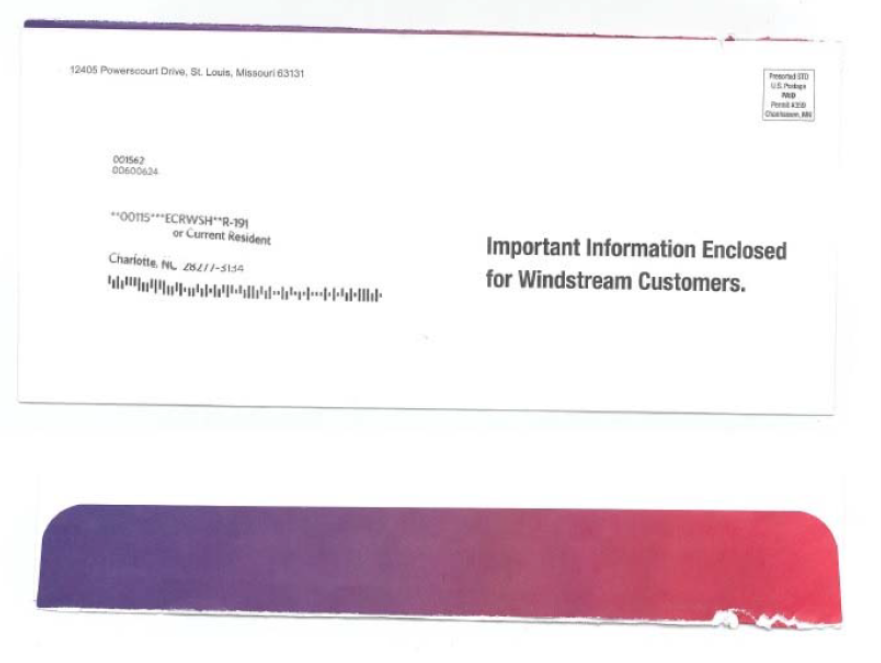
As alleged in the initial complaint, Charter mailed
solicitations whose envelopes “used Windstream’s trademark and copied the same
distinct color pattern from Windstream’s current advertising campaign.”

“Important Information Enclosed for Windstream Customers.”

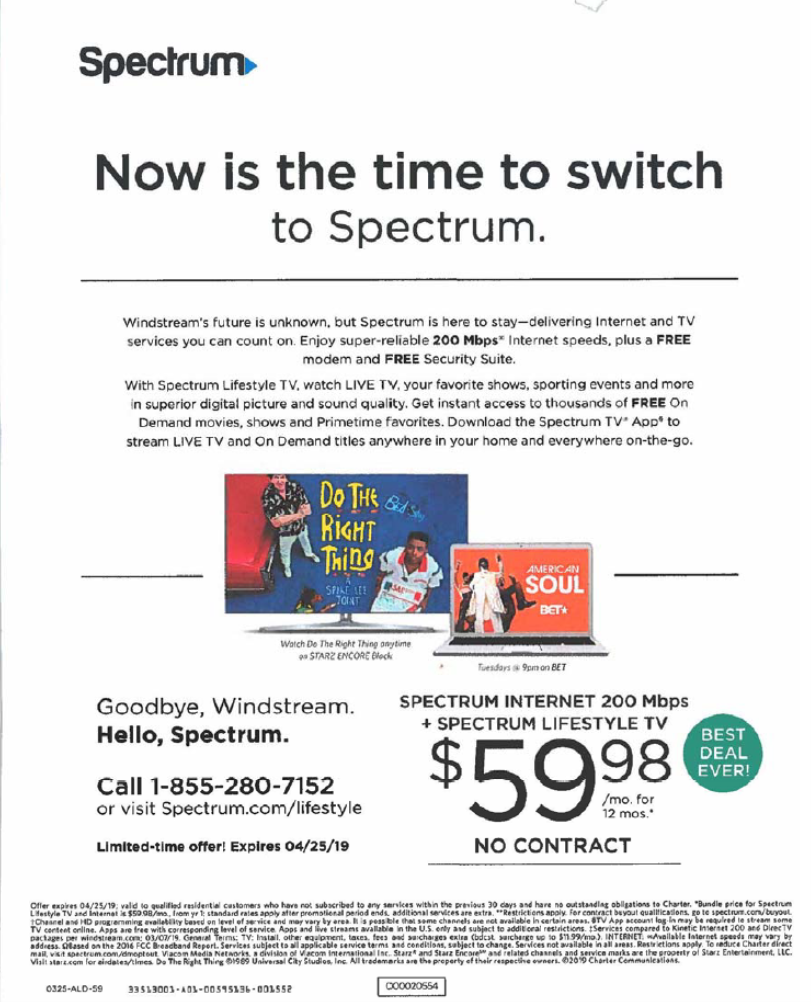
Text: Windstream Customers,

Don’t Risk Losing Your Internet and TV Services.

Windstream has filed for Chapter 11 bankruptcy, which means
uncertainty. Will they be able to provide the Internet and TV services you
rely on in the future? To ensure you are not left without vital Internet and TV
services, switch to Spectrum.

With a network built for the future, Spectrum is here for
the long haul . . . .

Windstream’s future is unknown, but Spectrum is here to
stay—delivering internet and TV services you can count on. . . .

Example consumer call alleged in the complaint: “…. I got a
letter in the mail saying that ya’ll were going bankrupt and for me to go with
Spectrum so I have gone to Spectrum and I have just called to have the services
of Windstream disconnected.”

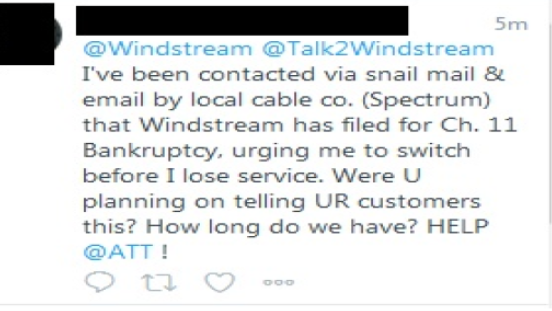
On social media:

“Were U planning on telling UR customers” [to switch before they lose service]?

This opinion considered whether Charter was liable in civil
contempt and the amount of harm caused by its conduct to the relevant creditors.
The court found that yes, Charter was in contempt of the automatic stay, and should
be sanctioned $19,179,329.45 for the losses caused by intentionally and
wrongfully interfering with the Debtors’ customer contracts and good will.

Along with knowledge of an order and failure to comply with
it, civil contempt generally requires “that (1) the order the contemnor failed
to comply with is clear and unambiguous, (2) the proof of noncompliance is
clear and convincing, and (3) the contemnor has not diligently attempted to
comply in a reasonable manner.” If there’s “a fair ground of doubt as to the
wrongfulness of the defendant’s conduct,” civil contempt isn’t appropriate. But
an additional bad faith/willfulness finding isn’t required. The touchstone is
not an intent to violate, but an intentional act in violation of the order; an
objectively unreasonable belief that one is complying with the order does not avoid
a contempt finding.

Courts have sometimes been more aggressive when treating
violations of the automatic stay, which “aims to prevent damaging disruptions
to the administration of a bankruptcy case in the short run.” Given the
importance of the automatic stay to multiparty bankruptcy cases and the
continuing judicial supervision of a bankruptcy case, “it is logical to require
those in doubt whether the stay applies to seek clarification from the court or
be sanctioned for shooting first and aiming later.” Certainly no more than an
objective standard for a clear violation is required.

This made the nonadvertising part of the case easy: Charter
breached the automatic stay when it terminated services to some of debtors’
customers based on debtors’ default on prepetition obligations.

Of possible interest to cyberlaw folks, Charter argued that
it was unable to comply, because its termination of service was wholly
mechanical, arising from “automatic nonpayment protocols” programmed into its
computerized billing system. The court disagreed: “[I]t is not really a defense
for a large and sophisticated entity like Charter that provides services to
many customers, some of whom inevitably will file for relief under the
Bankruptcy Code, to argue that its systems do not have an effective fail-safe
to prevent it from violating the automatic stay.” Charter didn’t argue that it
couldn’t create systems to override automated collection activity. “Turning a
blind eye to the automatic stay by choosing systems that are incapable of
complying with it is not tantamount to an inability to comply nor with making
diligent efforts to comply in a reasonable manner.”

For advertising folks: Charter was also held in contempt for
interfering with debtors’ customer contracts and goodwill “through Charter’s
literally false and intentionally misleading advertising campaign intended to
create the impression, using mailings designed to seem as if they were coming
from the Debtors, that the Debtors were going out of business.” There was clear
knowledge of the automatic stay, given that “Charter premised the campaign on
false assertions regarding the Debtors’ bankruptcy cases.”

The Bankruptcy Code automatically stays “any act to obtain
possession of property of the estate or of property from the estate or to
exercise control over property of the estate.” It’s not confined to acts to
collect or enforce a claim or judgment against the debtor, but was designed to
ensure that a trustee or debtor in possession maintains control of the estate’s
property and to protect against its “dismemberment” in furtherance of an
eventual equitable distribution to creditors. It covers executory contracts,
which are property of the debtor’s estate, and protects them both against termination
and “other interference that would have the effect of removing or hindering the
debtor’s rights” in violation of the statute. Goodwill is also well recognized
property of the estate.

Comment: This is an interesting question given that
TM/advertising people tend to define goodwill differently than general business
valuation people, especially in the TM/false advertising context. Is a
counterfeiter of products of a bankrupt entity in violation of the automatic
stay if it knows about the bankruptcy? Or say an unrelated competitor to a
bankrupt pharmaco starts falsely advertising comparatively about its
painkillers without reference to the bankruptcy. Does its awareness of the stay
mean that its false advertising violates the automatic stay? A few of the cited
cases seem to say yes, but even the closest analogous case seems to have been
premised on prior contractual dealings: Alert Hldgs., Inc. v. Interstate
Protective Services, Inc. (In re Alert Hldgs., Inc.), 148 B.R. 194 (Bankr.
S.D.N.Y. 1992) (court summary: “intentionally deceptive advertising that
interfered with debtor’s customer contracts and harmed goodwill automatically
stayed”; contempt defendants had previously sold the relevant accounts to the
debtor); see also Phillips v. Diecast Marketing Innovations, LLC (In re
Collecting Concepts), 2000 Bankr. LEXIS 615 (court summary: “preliminary
injunction granted against interference with debtor’s goodwill and executory
contracts by competitor in violation of section 362(a)(3)”; competitor was in
negotiations to buy the business line before bankruptcy and had dealings with
relevant party with prepetition debtor’s knowledge).

The court noted that many such decisions didn’t require “acts
for which the violator would be liable under applicable non-bankruptcy law” as
long as there was simply interference with the debtor’s contract rights. Where
the acts were clearly lawful under applicable non-bankruptcy law, courts use a
balancing test, but that didn’t matter here because the literally false and
intentionally misleading advertising campaign was not “ordinary course
commercial conduct,” but rather unlawful under nonbankruptcy law.

Defendants unhelpfully argued that they subjectively didn’t
believe they were violating the stay, which didn’t matter. Nor could they cast
off blame onto their ad agency or their consultant. Defendants authorized the
campaign “to be modeled on a prior campaign relating to a competitor that was ‘shutting
down service’ to create doubt whether the Debtors would remain in business,”
and anyway acts of their agents in violation of the stay would be imputed to
them.

Defendants also argued that applying the automatic stay to
their advertising would violate the First Amendment, and (implicitly) that the
First Amendment provided them with a fair ground for doubt that the automatic
stay applied. But First Amendment rights can be restricted when they are an
integral part of conduct that violates a valid statute, such as that providing
for the automatic stay. (This seems to treat the false advertising as speech
rather than conduct; that creates problems when it comes to, say, truthful
comparative advertising that also implicates the estate, but apparently that is
not unique to this case. Cited: Collier v. Hill (In re Collier), 410 B.R. 464 (Bankr.
E.D. Tex. 2009), “in which the posting of a sign that said, ‘Brad Collier owes
me $943.23. Will you please come and pay me!’ was not protected by the First
Amendment because it was debt collection activity prohibited by 11 U.S.C. §
362(a)(6), and In re Andrus, 189 B.R. 413 (N.D. Ill 1995), “which held that
conduct including the posting of signs stating that the debtor ‘Went Bankrupt!
He Didn’t Pay His Bills! He Is A Deadbeat! This Is a Public Service
Announcement’ and ‘Gene Andrus, Where’s My Money?’ was not protected speech,
but, rather, properly prohibited.” Also—and perhaps even more sound—false/misleading
commercial speech isn’t protected by the First Amendment. The automatic stay “protects
a strong governmental interest threatened by the Defendants’ conduct.” By contrast,
defendants’ primary case, In re National Service Corp., 742 F.2d 859 (5th Cir.
1984), involved a defendant who “accurately reported a debtor’s bankruptcy
status on a billboard commissioned from it by the debtor which otherwise would
have inaccurately implied that the debtor was affiliated with a financially
healthy company and therefore could pay its bills.” There, the addition “was
found to be primarily informational; there was no act to harm and thus no
violation of section 362(a) of the Bankruptcy Code.” Seems like a lot of work
is being done by “harm” there, which is pretty manipulable when it comes to
intangibles. Another case cited by the court, In re Golden Distribs., Ltd., 122
B.R. 15 (Bankr. S.D.N.Y. 1990), found that “the debtor’s former salespeople did
not harm the debtor’s goodwill or contracts because they had not appropriated
any customer lists or similarly protected information and the former customers
who changed their allegiance did not have contracts with the debtor.” But of
course that doesn’t mean they didn’t harm the debtor’s goodwill—it means that
outside of bankruptcy, they didn’t commit a tort.

But did these defendants nonetheless have a fair ground for
doubt about whether their advertising campaign violated the stay” The provision
has sometimes been found to be ambiguous with respect to the meaning of “any
act … to exercise control over property of the estate,” but only in irrelevant
contexts (e.g., when the alleged violator of the stay has a strong
countervailing interest that would be affected, such as when federal law
precluded a nonbankruptcy injunction against a union’s actions in contacting prospective
customers). This last one, coming out of a Trump bankruptcy, strikes me as a
solid precedent to protect truthful comparative advertising that damages the
estate—but that’s not relevant here. The court considered the Trump case
relevant when it’s tricky to determine “the nature and extent of the estate’s
interest in the property.” But there was no ambiguity here—the debtor had uncontroverted
evidence that debtors’ customer contracts’ average duration at the time of the
stay violation was 50 months—and anyway the caselaw clearly points to the rule
that if a party isn’t sure, it should seek relief from the automatic stay.

Future guidance: “Although every corporation expects
legitimate advertising by competitors, and thus such advertising does not ‘exercise
control’ over its property, improper advertising such as the Defendants’
clearly and objectively interfered with the Debtors’ customer contracts and
goodwill and thus clearly was precluded by section 362(a)(3)’s plain terms and
the caselaw applying them.” Again, this is a manipulation of what counts as “control”
to insert “wrongful” in front. And the automatic stay isn’t overbroad simply
because it “could conceivably be applied more broadly to advertising in general”;
“the foregoing caselaw sufficiently cabins that application for there to be no
fair ground of doubt that Charter fell on the wrong side of the statute when it
undertook to mislead the Debtors’ customers to end their contracts and impaired
the Debtors’ goodwill.”

For the advertising violations, the court basically accepted
debtors’ evidence of (1) lost profits from customers who switched to Charter as
a result; (2) corrective advertising costs; (3) “the cost of a promotional
campaign to recover market share, or new customer momentum lost because of the
breach,” and (4) related attorneys’ and expert witness fees and expenses. While
Lanham Act courts are sometimes hesitant about damages from categories (2) and
(3), the court here was satisfied that “corrective advertising is a
well-recognized component of damages for harm caused by wrongful advertising,”
and defendants didn’t fight very hard on whether the corrective advertising costs
were reasonable and causally related to their ad campaign. Though they did
object to (3), the court was satisfied that the $4 million campaign was “incurred
because of and in response to Defendants’ ad campaign,” based on testimony that
it was “the most aggressive campaign that [Plaintiffs] have run,” “was
absolutely uncommon for [Plaintiffs],” and was aimed to address the Charter
campaign’s “profound impact on [Plaintiffs’] business, and we didn’t see it in
the non-Charter [Exchanges],” where the false advertising campaign didn’t
occur.

Nor did (3) unfairly duplicate lost profits because it was
trying to win back lost customers. It surely stood to reason that some of the
promotional campaign reached former customers, but still, “damages for wrongful
advertising can include both lost profits and the cost of damage control
programs, including corrective advertising, at the same time.” Plaintiffs’
witness testified credibly that before the false ad campaign, they were on a
growth trajectory, but after, they were “behind plan” by about 5000 customers.
The promo program was primarily designed to recover suppressed demand. That met
plaintiffs’ burden of showing that (3) was a category of damages separate from
lost profits—or, in the alternative, that established that (3) approximated the
value of plaintiffs’ lost goodwill. And here’s an interesting statement
relevant to my point about goodwill above: “Defendants’ contention that this
should be precluded because the Debtors’ monthly operating reports filed during
their bankruptcy cases showed no erosion in goodwill clearly misses the mark;
GAAP goodwill for purposes of the Debtors’ monthly operating reports is not
business goodwill for purposes of calculating damages.”

Plaintiffs also received a chunk of their attorneys’ fees;
if willfulness was required for that, they showed it. “While the ratio of
Plaintiffs’ fees and expenses to Plaintiffs’ damages is high ($9,183179.45 /$9,996,200),
a large portion of the legal fees and expenses were incurred in response to
several questionable litigation choices by Defendants” as well as the costs of
obtaining the cessation of the false advertising. 

from Blogger https://ift.tt/3yMBiYY

Posted in Uncategorized | Tagged , | Leave a comment

3 things that all mean the same thing: a slogan isn’t a TM for ad injury insurance purposes

Travelers Indemnity Co. v. Luna Gourmet Coffee & Tea Co.,
2021 WL 1293314, No. 19-cv-02039-RM-NYW (D. Colo. Apr. 7, 2021)

The underlying litigation involves class actions against
coffee distributors, wholesalers, and retailers arising out of the allegedly
misleading use of the name “Kona.” There was a Kona coffee farmer plaintiff class
and a consumer plaintiff class. They alleged that the underlying defendants
wrongly profited from the goodwill of Kona, which injured Kona farmers by
having excessive supply which drives prices down and by causing consumers to
conclude that Kona coffee is “nothing special.” As to defendant Boyer (the relevant
defendant), the class actions alleged that it falsely designated the  geographic origin of its coffee with the
intent to deceive, when the products actually contained little to no Kona
coffee.

Travelers insured Boyer, which sought coverage.  The personal and advertising injury policy at
issue bars coverage for knowing violation of rights; material published with
knowledge of falsity; failure of goods to conform to quality/performance
statements; infringement of ©/patent/TM/trade name/trade dress/trade secret/ “other
IP rights or laws,” with the standard exception to the last for advertising
injury “arising out of any actual or alleged infringement or violation of
another’s copyright, ‘title’ or ‘slogan’ in your ‘advertisement.’”

There’s also an exclusion for material published prior to
the policy period, which Travelers alleged applied, but Colorado law directs
courts to look at the complaint itself, which doesn’t make that clear. Its
evidence was from websites, and it didn’t request judicial notice.

The policies covered disparagement of people or products in
ads, defined in the Policies as “a notice that is broadcast or published to the
general public or specific market segments about your goods, products or
services for the purpose of attracting customers or supporters.” Travelers
argued that the underlying actions concerned product labels/packages, which
aren’t ads. That seems wrong given the definition, but the court rejected this
argument on the narrower ground that there were underlying allegations that Boyer’s
also used marketing and advertising to tell consumers the packages contain
coffee from Kona.

But did Boyer’s use of “Kona” disparage Kona farmers just
because it allegedly harmed their goodwill? No. Implied disparagement was
insufficient; the theory was “too remote to constitute disparagement within the
meaning of the Policies or the element of the claim under Colorado or
Washington law.” And it definitely didn’t disparage Kona consumers.

What about infringement of “slogan”? “Slogan” is defined in
the Policies as “a phrase that others use for the purpose of attracting
attention in their advertising” that “[d]oes not include a phrase used as, or
in, the name of: (1) Any person or organization, other than you; or (2) Any
business, or any of the premises, goods, products, services or work, of any
person or organization, other than you.”

First, Travelers argued that a slogan can’t be a single
word. “Priceless,” Boyer responded—and also pointed out that it was actually
accused of using “Café Kona” and “Kona Blend.” The court agreed with the former
argument, but not the latter, since those weren’t the accused matter, “Kona”
was.

Second, Travelers argued that “Kona” was used in the name of
the Kona coffee products and, by definition, a slogan does not cover phrases
used in another company’s products. But there were Kona farmers who do not use
“Kona” in their product names, such as “Rancho Aloha.”  

Finally, Travelers argued that “slogans are catchy
stand-alone phrases or mottos, not brand names or product descriptions, relying
on Laney Chiropractic & Sports Therapy, P.A. v. Nationwide Mut. Ins. Co.,
866 F.3d 254 (5th Cir. 2017).” Relatedly, it claimed that neither “Kona” nor
“Kona Coffee” or “Kona Café” are “used to attract attention” in advertising. Although
the court here didn’t rely on Laney, it still agreed with Travelers,
which is… a bit puzzling from a TM theory perspective.

The underlying complaint showed that the Kona farmers used “Kona,”
“Kona Coffee,” and “Café Kona,” to describe the products or brand names used by
Boyer’s, not as “a phrase that others use [here, Kona farmers] for the purpose
of attracting attention to their advertisement.” Instead of use of Kona as a “slogan”
or “advertising tagline,” they were seeking to protect Kona as a “source
identifier.”

CJ Cregg is right

So, no coverage. Comment: A slogan can be a trademark, which is to say a source identifier–and a source identifier is definitely something used for purposes of attracting attention. But the insurance policies distinguish slogans from trademarks. It’s something they certainly can do, but the language of trademark can’t explain it. And in fact this interpretation seems to render coverage a null set: If a slogan is something used to get attention, but that doesn’t work as a source identifier for the plaintiff, then the plaintiff will not be able to assert cognizable rights that could be infringed (setting aside copyright, separately listed in the exclusion to the exclusion). It would be more natural, from a TM perspective, to define a slogan as words distinct from the product name that are prominently used to sell the product. A slogan answers neither “who am I?” nor “what am I?” but provides an indication of “who.”

from Blogger https://ift.tt/3lOKQzm

Posted in Uncategorized | Tagged , , | Leave a comment

aiding and abetting liability in false advertising cases

 Bonus: Civil RICO claims survive!

Sihler v. Fulfillment Lab, Inc., 2021 WL 1293839, No. 3:20-cv-01528-H-MSB
(S.D. Cal. Apr. 7, 2021)

Defendants allegedly used fake celebrity endorsements and
reviews and misrepresentations about price and limited availability to induce
consumers to buy weight-loss pills, then charged consumers more than they
originally agreed to pay, made it difficult or impossible to return the
products or receive a refund, and operated “false front” websites to mislead
banks and credit card companies investigating chargebacks.

For example, plaintiff Sihler saw an internet ad for “InstaKeto,”
claiming that it was featured on Shark Tank. She chose “Buy 3 bottles, Get 2
free” promotion with the expectation that she would be billed for three bottles
of the product at $39.74 each, but her debit card was charged for $198.70, the
price of all five bottles. When she called, the representative told her she
would have to ship the bottles back at her own expense to obtain a partial
refund; she didn’t receive any money back.

Defendants’ ads allegedly are deleted after a few weeks or
months to avoid detection; the terms and conditions of purchases, including the
refund and return policy, are hidden or buried on the landing page, and consumers
do not need to read or acknowledge the terms in order to complete their
purchase. When consumers dispute charges with banks or credit card companies,
defendants allegedly used a “false front” website that was similar to the
original landing page, but the terms and conditions were clearly stated, the
false advertisements are removed, and the actual purchase prices of the
different options were listed, thus deceiving the investigators. Defendants also
allegedly used multiple shell companies, each of whom signs up for a unique
merchant account, which are rotated so that they won’t flagged for fraud due to
high levels of chargebacks.

Plaintiffs’ amended complaint, like their first one, stated
claims for violations of the CLRA, FAL, and the unfair, fraudulent, and
unlawful prongs of the UCL. They identified multiple problems with the ads and
alleged how they’d be false or misleading to a reasonable consumer: the
pictured and quoted celebrities have not in fact endorsed the Keto Products in
question, there is not actually a limited supply of Keto Products remaining,
and they will not “Buy 3 Get 2 Free.” And using a “false front” website for financial
institutions would also be misleading and deceptive to a reasonable consumer.

The remaining issue was whether specific defendants were
plausibly alleged to be directly or indirectly liable.

Plaintiffs alleged that defendant Beyond Global created the ads
containing the false statements; created and operated the landing pages viewed
by consumers and the “false fronts”; opened hundreds of merchant accounts; and
charged one plaintiff’s credit card. That was enough for direct liability.

Plaintiffs also alleged that defendants TFL and Nelson aided
and abetted Beyond Global’s violations and conspired with it to violate the
CLRA, FAL, and UCL. These allegations were also sufficient: aiding and abetting
requires facts making it plausible “that defendants either ‘(a) [knew] the
other’s conduct constitute[d] a breach of duty and [gave] substantial
assistance or encouragement to the other to so act or (b) [gave] substantial
assistance to the other in accomplishing a tortious result and the person’s own
conduct, separately considered, constitute[d] a breach of duty to the third
person.’ ”

The court focused on (a); a plaintiff must “plead sufficient
facts to permit a ‘reasonable inference’ that [the defendant] knew of the
‘specific wrongful act[s]’ of fraud by the [principal(s)] at the relevant
time.” Although states of mind can be alleged generally, the pleader still has
the burden of alleging “the nature of the knowledge a defendant purportedly
possessed,” here actual knowledge of the pirmary violation.  A defendant’s “decision to ignore suspicious
activity or red flags is sufficient to demonstrate actual knowledge” for aiding
and abetting liability. Allegations about a defendant’s knowledge and
familiarity with the structure and operation of an alleged fraudulent scheme are
also relevant. Similarly, “ordinary business transactions” can satisfy the
substantial assistance element of an aiding and abetting claim “if the
[defendant] actually knew those transactions were assisting the [principal] in
committing a specific tort. Knowledge is the crucial element.” Defendants didn’t
contest the substantial assistance element.

Here, plaintiffs alleged that TFL and Nelson had actual
knowledge: they knew how the fraudulent scheme worked, that they were shipping
products sold using deceptive and unfair advertising, that the ads and websites
were false and misleading, and the nature of the tortious conduct being
committed by Beyond Global and Doe defendants. They allegedly “directly run” ad
campaigns for their clients, including Beyond Global. TFL’s website allegedly provides
a variety “Affiliate Marketing Resources,” and its marketing director’s
LinkedIn profile states that his duties include “Run[ning] and monitor[ing]
marketing campaigns.” TFL and Nelson also allegedly integrated TFL’s custom
software into the landing pages, which would have necessitated knowledge of the
deceptive and misleading content on those websites. In addition, they allegedly
ignored “a significant number of red flags,” receiving and processing customer
returns and complaints. They also received complaints on TFL’s BBB page, one of
which specifically mentioned viewing a false Shark Tank advertisement; TFL/Nelson
“responded to several of these comments, demonstrating that they read them and
were aware of their contents” and supporting a reasonable inference that they
were aware of comments to which they did not directly respond in the same
period.

The court also rejected the argument that providing order
fulfillment software didn’t mean they would have been aware of the website
content. “It is plausible that an entity responsible for integrating order
fulfillment software with a client’s website would have knowledge of the
content, representations, and general nature of the website. And it is very
plausible that providing assistance with advertising campaigns for clients
would necessitate knowledge of the content of the advertisements and the nature
of the campaign.” Of course this could be revisited on summary judgment.

Shockingly, civil RICO claims also survived, despite being civil
RICO claims.

Tan v. Quick Box, LLC, 2021 WL 1293862, No.
3:20-cv-01082-H-DEB (S.D. Cal. Apr. 7, 2021)

A similar case. Noted because the court found that the
following allegations sufficiently pled aiding and abetting liability: The
relevant defendants had prior experience helping other clients run free trial
scams, knew the elements and hallmark characteristics of such schemes, and knew
the main defendants were operating such a scheme. The design, implementation,
and utilization of the relevant defendants’ load balancing software
necessitated the their knowledge of the entire scheme: it was designed and used
for rotating merchant accounts to avoid detection of a scheme to defraud
consumers. The relevant defendants provided coaching services on how to apply
for, manage, and rotate merchant accounts, as well as designing and
implementing advertisements, and participated in a months-long onboarding
process with the main defendants.

Defendants argued that they merely licensed legitimate,
commercial software for lawful use only. But under Twiqbal, plaintiff
alleged more: They specifically advertised their ability to help companies who
had been “shut down” by helping them “get real merchant accounts” and providing
“chargeback mitigation.” The aiding/abetting defendants’ website and press
materials make several references to “load balancers” and merchant account
managing. Load balancing, defined as “distribution of Transactions between or
among Merchant ID numbers in order to avoid minimum thresholds,” is expressly
prohibited by VISA and Mastercard. Plaintiff alleged that there is no
legitimate reason to be rotating hundreds of merchant accounts and employing
chargeback caps and pointed out that the aiding/abettind defendants didn’t
offer a potential lawful purpose for their load balancing software. They could
try at summary judgment.

Civil RICO claims also survived here.

from Blogger https://ift.tt/37xnllK

Posted in Uncategorized | Tagged , , | Leave a comment