prescription and OTC products can directly compete; many non-FDCA-based claims survive

Scilex Pharmaceuticals Inc. v. Sanofi-Aventis U.S. LLC, 2021
WL 3417590, — F.Supp.3d —-, 2021 WL 3417590, No. 21-cv-01280-JST (N.D. Cal.
Aug. 5, 2021)

Scilex sells an FDA-approved, prescription-strength topical
analgesic self-adhesive patch, ZTlido (lidocaine), which is allegedly often prescribed
off-label, including for general neuropathic pain (e.g., back and spinal pain).
It brought Lanham Act and California FAL/UCL claims over defendants’ allegedly
false advertising of their respective OTC lidocaine patches.

Article III standing: Defendants argued that Scilex’s
allegations of harm to its goodwill and lost profits were conclusory and that
the parties don’t compete for the same customers. But defendants were plausibly
direct competitors because they all “sell lidocaine patches that treat pain
through the skin.”

“A party may prove its injury (1) by using lost sales data,
that is ‘actual market experience and probable market behavior,’ or (2) ‘by
creating a chain of inferences showing how defendant’s false advertising could
harm plaintiff’s business.’ ” And direct competition plus materiality can create
such a chain of inferences, as here. For competition, plaintiff alleged that “ZTlido
is regularly prescribed for the off-label use of treating general neuropathic
pain – the same purpose for which OTC lidocaine patches are marketed and used,”
and the court noted that “the competition between prescription and OTC
lidocaine patches is reflected in [defendant] Hisamitsu’s advertising itself,
which draws direct comparisons between OTC and prescription patches.” In two blog
posts, Hisamitsu asserts that the “4% of lidocaine” found in its patches “is
close to the 5% lidocaine patch you would get with a prescription” and that the
Hisamitsu patches “followed the same principles used for the Rx (5% Lidocaine)
version …. The only change they made was to improve the price.” “[T]he extra
steps necessary to acquire a prescription patch – including getting the
prescription from a doctor – do not change the fact that Scilex and Defendants
are competing for the same consumers.”

Likewise, Scilex adequately alleged that its injury was fairly
traceable to its ads, despite defendants’ argument that there were other
explanations for Scilex’s failure to gain market share and that there are other prescription lidocaine patch producers. Footnote: Even
though ZTlido has only been approved by the FDA for relief of pain associated
with post-herpetic neuralgia, a complication of shingles, off-label use is
allegedly permissible, so its lost sales for off-label uses may be legitimately
compensable. Scilex isn’t required to show that the ads were the only reason
for reduced sales, so arguments about the crowded market weren’t helpful at
this stage. The fact that defendants’ ads preceded ZTlido’s entry into the
market doesn’t “foreclose the possibility” that the ads caused consumers to
choose defendants’ OTC products when they had a choice.

Redressability: Defendants argued that there was no “substantial
likelihood” that Scilex would gain the sales it claims to have lost if the challenged
ads were enjoined, because Scilex “would still be legally precluded from
advertising the ZTlido patch for any use other than the narrow indication
allowed by [the] FDA.” But that’s not relevant to the lost profits argument,
which is part of causation.

Statutory standing under the Lanham Act: You can guess how this
will go; I don’t think putting this as an Article III standing challenge was
helpful.

Must the plaintiff allege its own reliance to prevail
on its UCL/FAL claims? Scilex was seeking only injunctive relief under the
UCL/FAL. Although this judge had previously required such allegations, the
court was now convinced that recent cases to the contrary were more persuasive:
a non-consumer plaintiff has standing as long as the plaintiff alleges a
sufficient causal connection between the falsity and its losses. In re
Tobacco II
did say “that ‘[t]here are doubtless many types of unfair
business practices in which the concept of reliance … has no application,’ ” and so injury “as a result of” the defendant’s conduct can be proved without showing
that the plaintiff relied on the misrepresentation; Proposition 64’s aim
of requiring actual injury isn’t served by barring competitor plaintiffs as a
class.

Since FAL/UCL relief is equitable, plaintiffs also have to
show that they lack adequate remedies at law, but this can mean injunctive relief
when damages wouldn’t protect against future harm, so that’s ok too (at this
stage at least).

On the merits: Defendants argued that the claim of implied
FDA approval wasn’t cognizable because Scilex didn’t allege any affirmative
representation of FDA approval or sponsorship, and there’s no private cause of
action under the FDCA. This worked better: Mylan Laboratories, Inc. v. Matkari,
7 F.3d 1130 (4th Cir. 1993), held that implied misrepresentation-of-approval
claims must fail because the act of placing a drug on the market with standard
package inserts doesn’t falsely imply FDA approval. By contrast, JHP
Pharmaceuticals, LLC v. Hospira, Inc., 52 F. Supp. 3d 992 (C.D. Cal. 2014),
accepted allegations that defendants had put products on “industry ‘Price
Lists,’ and that ‘buyers believe that all prescribed drugs identified on the
Price Lists are … FDA-approved.’ ” That was more than merely putting a
product on the market. But Scilex didn’t allege similar actions, only that
defendants claimed that their products “desensitize aggravated nerves” and targeted
neck and back pain. It didn’t point “any reason that consumers would believe
these statements imply FDA approval,” especially since the statements “seem to
merely describe the effect of their products. … More is required to imply FDA
approval.”

Likewise, allegations about a “commercial containing [an]
individual in [a] white lab coat, referred to as ‘Dr. Bob’ in a doctor’s office
and labeled as ‘Bob Arnot, MD, Former Chief Medical Correspondent,’
recommending [Hisamitsu’s] product to apparent patient who asks what he should
use for back pain” weren’t sufficient. Scilex didn’t explain why such an ad
would lead consumers to believe that the product is FDA-approved or
prescription-only. Scilex can’t use the Lanham Act to make defendants say on
labels or in ads the specific uses the FDA has approved OTC lidocaine patches
be used for.

Hisamitsu also argued that Scilex didn’t sufficiently allege
how or why Hisamitsu’s statements – including “ ‘Maximum Strength,’ ‘Apply for
8 Hours,’ ‘Numbing Relief,’ ‘Blocks Pain Receptors,’ ‘Desensitizes Aggravated
Nerves,’ ‘for temporary relief of pain … back, neck, shoulders’ ” etc. – were
false or misleading. Scilex alleged
that these statements falsely “impl[y] that Defendants’ products completely block
pain receptors, eliminate responses to painful stimuli, and provide a numbing
sensation,” “impl[y] that Defendants’ products provide pain relief by
desensitizing nerves and/or pain receptors,” and “impl[y] that Defendants’
products contain ingredients that target nerves.” Since Scilex alleged that
lidocaine “is used to treat pain by depressing sensory receptors in the nerve
endings in the skin, which prevents pain signals from reaching the brain,” it
wasn’t clear why statements about the effects of lidocaine patches were
misleading. It wasn’t enough that the FDA’s Tentative Final Monography for
External Analgesic Drug Products for Over-the-Counter Human Use “declined to
grant approval for external analgesic products to be permitted to state on product
labels that these products ‘numb[ ]’ pain or ‘completely block[ ] pain
receptors.’ ” If defendants were violating the FDCA/FDA regulations, that was a
matter that couldn’t be resolved in a Lanham Act case.

Scilex successfully alleged that “MAXIMUM STRENGTH” “[f]alsely
states that [the] product[ ] contain[s] and deliver[s] to the area of pain the
maximum amount of lidocaine available in patch form” and “[m]isleadingly
implies that [the] product[ ] [is] superior, or at least equivalent, in
efficacy and results to prescription-strength lidocaine patch products.” Hisamitsu
argued that, in the context of the entire package, there was a disclaimer that
the tagline referred to products available without a prescription. The disclaimer
was in small font on a separate panel; that certainly wasn’t enough to grant a
motion to dismiss.

Scilex also successfully alleged that “apply for 8 hours’ …
[m]isleadingly implies that [Hisamitsu’s] product[ ] continuously adhere[s] to
the body and continuously relieve[s] pain for the specified amount of time.” Hiramitsu
argued that it didn’t make claims about how long the product adheres to the
skin or if the strength of the product remains effective for all eight hours,
and anyway Scilex didn’t allege materiality. Nope. Scilex plausibly alleged that
“apply for 8 hours” misleads consumers to believe that the product will adhere
to their skin and be effective for eight hours. It further alleged that
consumers “have experienced considerable problems with patch adhesion and patch
detachment prior to the 8 … hours for which [Hisamitsu] claim[s] [its]
patches adhere” and that if patches are “even partially detached, there may be
uncertainty about … the rate and extent of drug absorption.”

However, the court dismissed claims that a TV ad misleadingly
implied that the parties’ products were equivalent in efficacy and that the
parties’ products were interchangeable; there was no allegation that the TV ad made a
comparison to prescription patches. Hisamitsu argued that its blog posts (that the
product was “close to the 5% lidocaine patch you would get with a prescription”
and that the product “followed the same principles used for the Rx (5%
Lidocaine) version…. The only change they made was to improve the price so as
to make the product more accessible to the general public”) weren’t misleading
because they highlighted that there was less lidocaine and directed patients to
consult a doctor before switching. “The Court first rejects Hisamitsu’s
position that a consumer is not misled so long as they are directed to consult
with a physician. Such a rule would allow any manner of misleading
advertisement.” And the statements at issue clearly made
superiority/equivalence claims. It was plausible that consumers would be misled
to believe that Hisamitsu’s patch was interchangeable with or as effective as a
prescription lidocaine patch.

Defendants argued that the claims were barred by laches, but
the causes of action weren’t available before ZTlido entered the market in February
2018. Scilex sued less than three years later, within any applicable (borrowable)
statute of limitations, so there was a strong presumption against laches.

from Blogger https://ift.tt/37xG1BU
Posted in Uncategorized | Tagged , , , | Leave a comment

IPSC Panel 12 – Identity, Data, and Privacy

Dustin Marlan, The Dystopian Right of Publicity

Privacy problems (surveillance) are often analogized to the dystopia
of 1984; ROP problems stemming from infinite transferablility can be analogized
to Brave New World (1932). A state of unfreedom that is apparently chosen and
pleasurable (though enforced by drugs and conditioning). This is relevant to
the extent that everyone has a ROP. ROP is also criticized when applied to use
of celebrity personae in expressive works. Is that a preference for amusement
over discourse? There are only about 18 celebrity personality cases/year. That’s
not nothing and litigated cases aren’t everything, but wants to focus on publicity
interests of average citizens: the pleasurable servitude problem. Risk of
identity loss means that “everyone belongs to everyone else,” as the slogan
used in Huxley’s book goes. Class action ROP lawsuits against social media:
result was broader consents in TOS. Voluntary relinquishment of identity
control in return for the benefits of social media. Commodification of identity
as a prerequisite for social media access. Social, political problem; social
networks get monopolies over human capital.

Proposal: clickthrough policies designed to educate the
public, maybe choices. 1A shouldn’t be a barrier to regulation b/c the use for
endorsement is commercial speech.

Rothman: Does not agree that ROP is the coined opposite of
the right of privacy, nor that it should have a purely economic and commercial
focus. See her book. Also in her count there are 100s of ROP cases/year—order of
magnitude more.

RT: Suggestion: Read Ashley Mears, Very Important People, on
pleasurable exploitation and its relation to commodification and anti-commodification
norms. Doesn’t have policy discussion itself, but has implications for
solutions where individual relations seem pleasurable. Discussion seems
indifferent to hidden data use; endorsement is almost literally the tip of the
iceberg of individual data use. Proposal seems pretty weak tea; disclosure won’t
work if they can still condition access on agreement.

A: On disclosure: Wants to be realistic about what could
happen.

Wu: seems more unwitting [without thinking about it one way
or another] and unavoidable transfer than pleasurable transfer. But in context
of social media, the pleasure is inextricable from the agreement [and it’s not
surprising that the agreement would then be experienced as, at least, not a
problem].

Bita Amani, Authoring Identity: Copyright, Privacy, and
Commodity Dissonance in the Digital Age

Emerging threats to capacity for self-authorship seem
greater than in the past—here, algorithmic errors may generate disruptions in
identity construction. Personal experience with multiple Bita Amanis with related
interests. This has led to problems both with health care (corrected),
misattribution of credit (interviews), and database connections as if they were
all the same author.

Why should we care? Misappropriation; interference w/connection
b/t author and text. Moral rights as a solution? Not clear. Peter Doig,
well-known artist: denied
creating a particular work
; the owner claimed it was Doig’s work, and had
to defend his identity to assert it wasn’t his work. The plaintiff pointed to
style indicia of it being his. (Doig
won; it was another guy named Peter Doige.)
Privacy may have untapped
potential for dealing with these misattributions, especially false light. Even
true facts can be actionable; defamation is not required for intrusion on
privacy/public disclosure of embarrassing facts. (Comes out of case involving nasty
divorce where one party posted videos involving the kids on YT.)

Victoria Schwartz, Joint Privacy

[picking up kid; interesting project using ideas of joint authorship
as a lens on issues of privacy that arise when people create information (or
even just have information, as w/DNA) together and so sharing one’s own information
or life story necessarily implicates others.]

Uri Y. Hacohen, User-Generated Data Network Effects

Network effects are key to current tech companies, whether
via reviews, userbase, or otherwise. AI increases the power of network effects—making
Google’s predictive results better. Many problems, including price discrimination,
manipulation. Possible changes: changing liability regime so that they are more
liable depending on what they know (e.g. that the user is a child); simple
payment requirements to pay for harm [Pigouvian tax, I think]; management
rights for users. Does not want to break up (at least as first solution) b/c that
just means more entities with the data creating privacy and security problems,
but we may not have a choice.

Felix Wu: Amazon, Google, and FB actually had different core
businesses and if they’re all gulping this data then we have oligopoly, not
monopolies. Even in a world of perfect competition, wouldn’t they be competing
for who can manipulate best?

A: for FB, more data = more problems; right now they aren’t
sharing as much as they might.

Wu: Some would say that innovation from the scale isn’t
worth it; give up the marginal benefits and limit the size.

from Blogger https://ift.tt/3CeUilj

Posted in Uncategorized | Tagged , , , , | Leave a comment

IPSC Panel 9 – Crosscutting IP

Derek E. Bambauer, Everything You Want: The Paradox of
Tailored IP Regimes

Customized IP has benefits (avoids lowest common denominator
[or highest] problem), but also costs: manipulation to shift from one regime to
another; colleciton of information by decisionmakers.

Standard debate assumes semi omniscience of designer
neutrally concerned with social welfare. What if rules are largely written by
the regulated parties? Bespoke systems are often underutilized by their own
designers and outmoded. The paradox of getting your way and finding it
unsatisfying.
Examples: Vessel Hull Design Protection Act. Industry pushed very hard against
cheap copying, and yet as of 2019 there were only 538 registrations in 20 years
versus hundreds of thousands of utility patents. Was more heavily used 1999-2003.
It seems that boat designers/manufacturers used C&Ds under this regime, but
there were 1100 utility patents on boat hulls and 20 design patents since 2013,
which was the last boat hull registration. Sharp shift to regular regime. Fed.
Cir. found in one key case that boat hulls didn’t infringe if the decks were
different. Registration is fast—takes a month—versus patent, but term of
protection is only 10 years.

Computer chips: Semiconductor mask works, 1984. Through 2012,
only about 1000 registered. Technical reason: as chips have grown in size and
specialization, reverse engineering is more expensive than designing them from
scratch.

Audio Home recording Act: Excluded general purpose
computers, so whoops. Diamond Rio case: excluded MP3 players. Customers didn’t
like paying more for DAT; CDs won.

It’s hard to write and get passed exactly what you want—industry
insiders may compete. Also, as a tailored regime begins to flow closer to a
generalized regime, it falls down the gravity well of the general field and is
overtaken. Maybe small changes are easier to pass.

Industries design for current needs and not for what it may
evolve to because innovation is difficult to predict (like the future),
especially if generated by upstart or edge firms or driven by wider tech
changes. Even if we assumed incumbents have better info, their own internal
pressures exist to align legal rules w/existing business models. Give and take
of legislative process may be better when it harnesses information from more
stakeholders than those who are generating the IP. Tailored regimes may also be
tightly coupled and fragile—subject to disruption/irrelevance from one unfavorable
judicial ruling, like boat hulls.

Generalized regimes are more adaptable, adjustable by more
institutional stakeholders (judges, admin agencies, the bar). Overton window:
you get your specialized regime; it’s difficult to revisit that after something
changes because the legislature thinks it’s done. Copyright Term Extension Act:
blatant rent extraction generates or increases opposition. When Big 3 automakers
requested their own tailored design regime to exclude repair parts, Congress didn’t
want that.

Bespoke regimes may divert innovation—music industry was
successful in delaying and killing off DAT, but that allowed the rise of the
CD, and MP3s, and then Napster and P2P.

IP industries have historically been terrible at
prognostication, as w/the VCR. Maybe we should be less worried about attempts
at incumbent protection/rent extraction via IP.

Even if my thesis is right, it will still be an irresistable
lure/strong optimism bias, which will cause incumbents to concentrate on
legislative activity instead of innovation under the standard IP system.

Jake Linford: are there overlaps with patents and boat hulls
suggesting two bites at apple.

Bruce Boyden: another reason is that crafting a bespoke
system takes years, making narrow legislation more likely to be out of date.

Mark McKenna: Another explanation was maybe these bespoke regimes
weren’t addressing actual problems; overrepresentation of people w/specific litigation
interests.

Betsy Rosenblatt: If they solve problems, general systems
might be much better at solving specific problems and not advantaging opportunists—a
narrow protection might be harder to manipulate.

RT: Before coming to a conclusion about comparative
advantage, consider what creates trolls in more general system: different kinds
of exploitability of larger systems. Consider compulsory licensing as a midway
point here as well. Also, the history of DMCA was that 512 was the price (which
the © industries thought was small) for 1201; 1201 turned out not to be worth
it, which supports your argument, but also indicates that matters can be more complex
if there is horsetrading across regimes. 

Mala Chatterjee, Understanding Intellectual Property:
Expression, Function, and Individuation

© and patent differ in breadth and type of rights (copying
requirement v. independent invention). Treated as distinct and scholars warn
against overlapping rights. But what are the subject matters and how are they
to be distinguished?

Argues that defining difference b/t creative works and
inventions is the way in which they are individuated. Creative works are
author-individuated while inventive works are structure-individuated. Two acts
of authorship can’t result in the same creative work, only structurally identical
works, while two acts of inventorship can result in the same invention.

An author who has made something has said something. Sets
aside what counts as expressive work, but the defining feature of the category
is speech. Expression is the kind of thing for which where it comes from makes
a difference to what it is. Author’s work is uniquely hers even if others might
also be connected to it and might make things that look alike. Pierre Menard;
appropriation art where the point is that it is structurally identical to
something else—Warhol’s Brillo Boxes and Pettibone’s Brillo Boxes, and this
matters to their aesthetic properties.

Inventions are importantly different from creative works in
being tools: instrumentally valuable for some specified end. This isn’t to say
that it doesn’t matter at all who invents: it could be historically relevant
that both Liebnitz and Newton invented calculus, but that doesn’t make calculus
different.

Vindicates core features of the structure—originality as ©
requirement—must come from author, not must be novel. Independent creation is
likewise justified. For patent, this makes sense of utility, novelty, and lack
of independent creation defense. Ownership is of linguistic description of
structural properties of invention.

For ©, standards of proof are wrong if they allow inference
of copying from structural similarity alone; theory also refutes rejections of
transformativeness where clear meaning to audiences is different even w/o
structural change. Also relevant to some patent doctrines (sorry).

Jeremy Sheff: Paul Goldstein has told this story several
times—quotes a colleague saying if Shakespeare had died as a child, we would never
have had Hamlet, but if Newton had died as a child, we would still have
calculus. He sees this as something about teleology of patent and ©: what they
are and what ends they’re for. Do you care about ends?

A: don’t know what it means for design of legal systems unless
paired with theory about aims of legal systems.

Linford: is this reputational? Richard Prince is understood
to have a different meaning/authorship of his works because of his reputation.
That might have implications for what counts as authorship in cases like
Garcia. Is this bringing in concepts from TM/ROP about branding? Could a patent
turn on the personality of the creator?

A: recognizing that creative works are more tied to authors
generally than invention is. Need to look for authorial intent, but part of
what tells us is whether that results in successful communication is context
surrounding the actor. But not saying that authorial intent wholly constrains
the work.

Mark McKenna: sounds like Abraham Drassinower’s theory—he says
he’s explicating a view inherent in © as a system not a metaphysical view that
there are things that are inventions out there in nature. Are you making an
argument that these are not just legal constructs but things that are true
about the world?

A: aligned with Drassinower but one important difference is
that she is starting not just with legal system but with works and practices
surrounding them and arguing that they are plausibly real things in the world.

Betsy Rosenblatt: pace Amy Adler, doesn’t your approach kill
all of © if it’s about individuated expression? © is at odds with that at least
for the sorts of works that are personally expressive. We don’t care about authenticity
of an air conditioner manual, but it’s still in ©. Also urge you to include
recipient/dialogical creation of meaning, which helps you—an invention is
structurally the same to every recipient and expression isn’t.

A: not quite all of ©, though it does suggest limits. 

Dilip Sharma, Arbitrability of Intellectual Property
Disputes

Indian cases have long pendencies, making arbitration more
attractive. WIPO offers mediation and arbitration services. Number is rising,
and expected to rise in India. Court: Booz Allen v. Hamilton—only disputes
involving rights in personam are arbitrable and IP isn’t. Delhi High Court also
held that © infringement can only be dealt with by courts because the statutory
remedies are all there is. But Eros v. Telemax allowed arbitration: law said
that every © suit or civil proceeding should be instituted in a district court;
but interpreting that to bar arbitration would be too broad where the IP
dispute arises out of a commercial contract. Another case: patent disputes
about infringement were not about in personam rights and were arbitrable.

Other nations: much more pro arbitration. Countries may
require registration of arbitral award before it’s enforceable. India needs
legislative support.

RT: Does India recognize UDRP results? It’s mandatory for registrants
to agree. Possible model?

A: to the extent required by international rules, yes, but
not much support.

Ana Alba: consider enforceability of international arbitrations—that
is also required in some cases.

Mauritz Kop, Quantum Technology: Waiving or Pledging IP?

General principles of quantum mechanics: physics of very
small + engineering. Superposition, entanglement, tunneling: defies laws of
physics on the macro level. Applications: computing, communication, sensing, simulation,
basic research, and AI. Not yet many use cases beyond cybersecurity, finance,
and defense; consequences remain mostly unknown. Dual military/civilian uses
are possible necessitating export controls and shared tech transfer policies.
Foresees heavy regulation and chilled innovation given the very high risks. Key
principle: equal access to benefits. Similar motivation to open COVID pledge,
but key quantum tech is now controlled by a handful of multinationals, universities,
and gov’ts. Could we temporarily override rights in quantum tech to repair
market power problems?

Should build on adjacent fields like CRISPR, nanotech, which
also require huge initial investment. Looking for mechanisms beyond social solidarity.
Right now waiving IP would have no effect without sharing knowhow, since
patents don’t disclose that right now; there is no skilled workforce available;
clean rooms are very expensive. Pledging IP looks promising given the current
limited number of stakeholders. Lack of consensus about whether a special
regime is needed.

Sheff: questions about resource limits being more important
than IP

Rosenblatt: given those resource requirements, maybe history
of nuclear regulation is more important than history of AI regulation

from Blogger https://ift.tt/3AfeMbL

Posted in Uncategorized | Tagged , , | Leave a comment

IPSC Panel 5 – Copyright, Distribution, and Access

Jacob Victor, Copyright’s
Law of Dissemination: trying to disaggregate dissemination from use of a work in
new creativity/e.g., transformative fair use. Focus: liability exceptions and
regulatory regimes that facilitate large scale distribution of works by direct
distributors or via platforms that enable or enhance public
consumption/enjoyment of those works. Statutory carveouts: broadcast radio of
sound recordings; publication for print disabled, §108 library exceptions.
Judicial: Google Books/utility expanding fair use; Sony v. Universal safe
harbor; first sale; operating outside ©’s exclusive rights (Aereo) [largely
failed]; admin state—compulsory licenses, recording device levy; other: ASCAP/BMI
consent decree; DMCA safe harbors; Section 1201 exceptions.

Trends and patterns:
whether a use is compensated or uncompensated. Starting w/uncompensated radio
broadcast for sound recordings/OSP safe harbor; compulsory fee for §114 uses;
ASCAP/BMI consent decrees—one question is whether the license will actually be
paid per the statute or whether it will backstop private negotiations. Digital
TV: operating outside © failed, and Aereo also failed to get a §119 compulsory
cable license.

Conventional wisdom:
Incoherent mess; regimes generally unrelated to each other, primarily products
of industry lobbying, little meaningful institutional design, anachronistic
like jukebox compulsory licensing fees. Political economy is helpful, but if we
look at actual operation, there are subtle patterns of latent normativity. (1)
Dealing with transaction cost problems (though thinks that’s likely
overstated); (2) ©’s inherent distributional inefficiencies; (3) market power
barriers to innovation in dissemination—removing bottlenecks based on market
power; (4) non-efficiency considerations—libraries, disability rights,
distributive justice. (2)-(4) are all within the conventional incentives/access
tradeoff lens.

Not claiming it’s fully
coherent, but it’s not just a sui generis response to a single industry’s
market failure. Frame can help diagnose problems with current system like
complexity, inconsistency (lack of a terrestrial broadcast sound recording
performance right), failure to keep up with tech change (Aereo maybe should have
been eligible for a cable-like compulsory license), poor institutional design
(Music Modernization Act tweaks but does not fundamentally change complex
system).

Sheff: why is coherence an
aim? If we are pursuing goals that conflict, we might have to pick which is
more important in a given context.

A: Because there’s already
a pull for coherence; we can make it better by being more explicit

Lisa Macklem: consider how
courts often land on wrong analogies for new tech. Also purpose as a consideration
in finding infringement.

A: Fair use has been a
good example of courts moving beyond static statutory language for new tech,
but they may defer to Congress when Congress didn’t imagine what happened.
 

Bita Amani and Mark
Swartz, Cultivating Copyright Custodians for the Digital Age: Law, Libraries,
and the Public Interest in Lending

Pandemic + important Canadian
SCt case on education and © motivated this discussion of rapid acceleration of
library efforts and ability to offer digital materials. Pandemic: students who
had ordered books weren’t able to get them; some were overseas. There was
pushback to coordinated call for libraries to use exceptions and limitations,
but these were important for users—emergency access through Internet Archive
and HathiTrust; fair dealing scans for patrons; generally able to meet info
needs more or less.

CCH decision, 2004: fair
dealing is a user right; only if a library doesn’t make out fair dealing does
it need the library exemption. Fair dealing test: needs an allowable purpose;
if allowable, consider purpose, character, amount, nature of work, available
alternatives, and effect of dealing on the work.

Canadian fair dealing: preservation
isn’t listed as a fair dealing purpose, but library exception allows
maintenance or management copying for the permanent collection. Underutilized
because of risk tolerances. Exception doesn’t apply where an appropriate copy
is commercially available in medium/quality appropriate for the relevant
purposes (but that limit doesn’t apply if the copying is for record keeping
purposes, insurance/police investigations, or for restoration). But the law
does apply to at-risk rare or unpublished originals, or for change to an
alternative format if the original (or tech required to use the original) is
obsolete or is becoming obsolete—and need to use something via the internet may
qualify for this exception.

Libraries need not rely
exclusively on this exception for their patrons because fair dealing is
available too. Format-shifting is important, but libraries have now
transitioned to licensing born-digital items and bundled deals dominated by
large publishers. This is the oncoming crisis. Libraries should own eBooks so
they don’t risk losing access or control over the information they can provide
to patrons.

Contracts should not be
permitted to override exceptions and limitations. NY and MD have new laws:
publishers who offer ebooks to public have to offer licenses to libraries on
reasonable terms. UK campaign to investigate academic ebook market is a similar
push. Amazon is changing its tune, and may sell to libraries soon. But we need
changes to Canadian law to ensure that contracts can’t override fair dealing
and TPMs can’t be used to prevent fair dealing. Libraries also have to assert
format-shifting and controlled digital lending rights. Explore digital
exhaustion for libraries. Libraries have to assert roles as custodians of
information and providers of access.

Linford: Physical space
limited what libraries could keep in their holdings in the past; how does that
bear on these changes?

Swartz: these are
different problems. The physical space problem has solutions for academic libraries:
offsite storage, collection management to ensure it represents needs of users.
But the library owns that content and is able to exercise user
rights/exhaustion/first sale. The digital world has switched to the library as
temporary waystation not under its control, paying yearly to offer the same
materials.

Amani: pandemic illustrates
the problem: they were unable to get publishers to respond to give patrons
access to materials that the library physically had but could not get into
patrons’ hands physically.
 

Kylie Pappalardo,
Copyright licensing and distribution in Australia’s screen industries

Pop. Approx. 26 million;
until 2015, mostly free to air TV, two public service broadcasters, three
commercial channels, one cable subscription service. So what is available to
the Australian public? Significant overlap in availability of top films
(blockbusters) 2010-2015 in Australia and US, but also significant numbers that
are only available in one place or another, especially in 2017, where 40% of
whole were available to both. By 2021, there were more films overall and more
convergence. Many gaps in the long tail in the US, not just in Australia—all time
box office films, almost half not available in the US. There’s not much overlap
in the repertoires of the three different streaming services (Netflix, Prime
Video, one other)—true in the US too even with many more providers.

Contrast to music: near complete
overlap in US/Australia availability, and also more significant overlap in
Tidal, Spotify, and Deezer coverage (main Aus. services).

Research agenda: why isn’t
screen content as widely available as music? Could it be? Can costs/logistics
of screen production and distribution which are connected by complicated contracts
be reconciled with public goal of broad, affordable, and sustained availability?
Can we reimagine a copyright system that is more distributively equitable and
efficient?

Macklem: regulations of
mandated local content may also make a difference—and tax credits for
production in the country have made a difference in Canada.

A: In Australia, there are
quotas on free-to-air content but not on streaming services; there are tax
credits; leads to complicated questions about how to count something as
Australian—is the Marvel film that films on the coast really an Australian
film?
 

D.R. Jones, Under the
Umbrella: Assessing Recent Court Decisions that Promote Public Access to the
Law

The key principle: law
must be available, and people need access to it. Before Fed Register and CFR,
people didn’t always know the law. Two cases went to SCt before it was known
that the provision at issue didn’t exist. Making available but only in a place
that’s difficult to access is not enough. Recent cases: GA v. PRO; ASTM v. PRO
(DC Cir.), and Int’l Code Council v. UpCodes (SDNY).

GA v. PRO: SCt focused on
authorship: creation by officials means not authored by © claimant. Doesn’t
cover all situations. What about model codes/standards drafted by private
organizations then adopted into law? UpCodes said GA v. PRO didn’t apply because
of the limited authorship test used by the SCt, but there are other ways to
support the principle of access to the law. Thorough decision: access to law
prevails over interests of © holder; posting the law as law is allowed.

Risks: almost back to
where we were before the Fed. Reg. Issues finding standards in print and
online. State case: P lost a counterclaim b/c no one could find the standard;
Indiana SCt discusses in 2017 difficulties in accessing a standard.

Linford: then how should
we subsidize the creation of law?

A: Access to law is the
key value here (so, some other way).

 Liam Sunner, How the
European Union’s obligation to include and incorporate human rights as part of
its external relations and trade of intellectual property, implies the
inclusion of the Convention on the Rights of Persons with Disabilities within
this obligation 

EU initiative to
mainstream consideration of human rights in “all areas of its external action
without exception.” But the EU doesn’t necessarily have much power to back up
its commitments. Marrakesh Treaty: can be traced to Art. 30(3) Convention on
Rights of Persons with Disabilities, which requires parties to ensure that IP
rights aren’t unreasonable or discriminatory barriers to access to cultural
materials by persons w/disabilities. Marrakesh identifies a clear human rights
violation and provides explicit mechanisms for addressing it. In human rights
terms, addresses disability rights, right to education, right to participate in
cultural life. CRPD defines education very broadly.

CJEU asked: does Marrakesh
fall w/in common commercial policy? Have to examine both treaty purpose and
treaty content to see if it’s an EU competence. Concluded that access was not
within common commercial policy so EU didn’t have exclusive competence to enter
into the treaty for the countries.

EU has had direct impact
on IP chapters and copyright exceptions/limitations in trade agreements.

Felix Wu: what is the
ultimate practical significance of whether these treaties/conventions are incorporated
into EU law? Given the member states we have, what would change? Is there a
realistic prospect that member states wouldn’t sign?

A: depends on the member
states. In practice, there could be political constraints on accepting human
rights constraints from treaties, or practical limits.

Wu: are your arguments
limited to access for disability purposes or do they extend to access rights
generally?

A: the latter—Marrakesh is
an example.

from Blogger https://ift.tt/3iplndz

Posted in Uncategorized | Tagged , , , | Leave a comment

IPSC: Copyright & Trademark

Panel 2 Copyright Enforcement:

Faye Fangfei Wang, Resolving Copyright-related Cases Over the Internet
with the Assistance of Artificial  Intelligence in Europe

Automated notice and takedown/Content ID with appeal mechanism as an
example of how the new European rules are supposed to work. Automated
mechanisms are supposed to be used for identification but not legal assessment.
Conflict over whether this is a general monitoring obligation. Proposed Artificial
Intelligence Act requires assessment of AI to ensure that it doesn’t distort
behavior or cause physical or psychological harm: this interacts with the ©
regime. Identifying audio/video is a challenging task where there are changes
in speed, background noise, etc. Use as part of a lecture, video game being
played, etc. Risk assessment/risk scale should be part of the integration—degree
of confidence in detection should matter to treatment.

Cathay Smith: Do you foresee a point in time at which an AI might be able
to make a fair use/fair dealing decision in the moment? Consider example of
police officers playing music to deter online posting of video of their actions—exploiting
the automated systems.

A: not ready yet. But fair use/dealing typically involves reproduction of
a limited portion, and AI could calculate portion. This may be one factor.
Identifying reason for reproduction may be far harder for an AI—commentary or just
attractiveness.

RT: “Limited portion” is more true with video and songs, less true with
photography. The European regime doesn’t seem to have given any thought to how
this will work with photography; does AI make distinctions? Also interested in
reactions to German implementation proposals which seem to have some thresholds
attached, not just sliding scale.

A: Content ID is video and audio; AI may be able to match pictures.

Elizabeth Townsend Gard, Creativity in the Shadow of the Case Act

Podcast for
creators focused on quilting and copyright; online copyright camp for creators,
mostly women—educating creators on nuances is empowering and they spread the
world. Disrupted by CASE Act. Reviewing the comments on CASE Act: the comments
were focused on procedure. EFF doesn’t want fair use cases in the system; MPAA
does. Comments demand ease and accessibility but the discovery rules are
insanely complex, which is a concern. There is fear and threats surrounding
opting out on both sides. Librarians are threatening people: you might have
bigger fees; some tell patrons not to opt out. Should there be public lists of institutions
that plan to opt out so that people don’t waste the fees on filing? There’s no
conversation about creativity. CASE Act is detracting from education about the
fundamental principles of copyright.

In comments: Songwriters
say that they can’t afford to file cases if there will be opt-outs, despite
their activism in pushing for CASE in the first place. Science Fiction authors:
won’t be useful for SWFA. The creators themselves are saying it’s not for them.
Big corporations say they’ll opt out; libraries the same. Then who is this for?

How do you
separate TM and ©? The disputes often overlap. The CASE Act doesn’t seem to
help.

RT: Who is it
for? I think it’s for photographers. I wonder what it would be like if it had
been written just for photographic works.

A: Is hearing
other creators say “it’s my time for revenge!” and also people worried about
liability so they may not opt out. It’s the uncertainty that is so difficult.

Dmitry
Karshtedt: Overlap with constitutional issues in patent: resolution of claims
in administrative proceeding. The policy issues you raise are different but
perhaps there’s an interaction with the constitutional issues.

A: The comments
raise the constitutional issues. It wasn’t really fully baked when it passed
and the fact it went through Dec. 20 as part of the Covid package created
problems. Putting David Carson, with a track record with the Office, in charge suggests
they really want it to work, but it’s still half-baked in terms of
implementation details.

Dmitry
Karshtedt and Sean Pager, Volition and Intent in the Law of Direct Copyright
Infringement

Patent and ©
treat these areas very differently. Advent of new tech changed focus from
direct to indirect, and back to direct again. Congress amended the statute to
ensure that retransmissions of cable would be public performance; then the
issues shifted to copying. Netcom raised the problem of volition for copying
for online servers. Aereo brought direct infringement back into focus where
Netcom had seemed to settle the issue; put pressure on the line between direct
and indirect liability. Netcom said that volition was lacking when the user was
the one who made the copy and the service was a passive conduit and could not
be directly liable though indirect liability was possible in theory; it was
almost a moral distinction. Aereo complicates that. Cable-likeness established
its direct liability. It’s unclear if there’s a direct infringer, which matters
because there can’t be indirect liability without someone else directly liable.
Loosely similar to divided infringement in patent law where no one person
infringes but their conduct together does.

Confusion: 9th
Circuit thinks that volition is still an element; SDNY courts have held in the
embedding context that volition is not an element after Aereo and embedding can
be infringing display.

Scalia’s dissent
was focused on Aereo’s lack of curation, but they don’t think that matters.
Indirect liability depends on the associated circumstances. If you set up a webcam
in a coffee shop, and someone happens to sing a song that gets transmitted, you
are responsible for the resulting public performance even if you lack knowledge
that it happened. Thus, even if the majority’s cable-likeness test is
unsatisfying, Aereo’s setup was directly responsible for the public
performance, which justifies liability in this case. Cablevision has a much
more elegant analysis: asks whether contribution to creation of infringing copy
is so great that it warrants direct liability even though another party has
made the copy. For Aereo, only the tech entity is responsible for the public
performance. Both majority and dissent in Aereo agree that on-demand providers
perform. SDNY opinion on display gets to the same result through proximate
causation, which they don’t think is right—causal responsibility is different.

The way
forward: a causal responsibility approach to direct liability. Rooted in moral
philosophy, criminal/tort law about innocent instrumentalities.

Aereo doesn’t
have a purely passive role; functions automatically at behest of user. Aereo
could be said to be supplying a product, but Aereo has the ability to control.
Simplistic to say that only button-pusher can be a direct infringer. Did the
defendant play a substantial enough role in the user’s acts to become causally
responsible? Did defendant control the circumstances in which the user
performed the acts in question? Aereo transmit content on demand, and the user
triggers that by pushing a button. In the aggregate, this is infringing public
performance because Aereo is causally responsible.

So we think
that public display SDNY results are correct because D are causally
responsible. But Usenet simply provides access, which is not enough for causal
responsibility, so 9th Cir. Giganews can be right too (Perfect 10?).

Matt Sag: intent?

A: intent
exists as an element but not w/r/t specific works, just general intent that
there will be a performance. If your whole service is designed so that content
can be transmitted to people, then hard to deny knowledge that it will get transmitted.
[That sounds a lot like indirect liability to me. The underlying idea is that
all or most of what gets transmitted will infringe, and that’s a standard
indirect question.]

RT: (1) Perfect
10? (2) Haven’t you just shoved the Aereo question into the phrase “in the
aggregate” because the right is public performance, not performance, so we have
to decide what counts as a performance to the public, so that you’re assuming
the conclusion? Compare Dropbox which happens to back up multiple copies of The
Big Lebowski, each downloaded by a different iTunes user that has legitimately
paid to do so?

A: it’s a
different kind of intent. In the public performance cases you do have to answer
the aggregate question, which goes back to the transmit clause which defines
public as including different places and different times. The mens rea is not
whether the underlying work is ©d but whether a performance will occur. [What
distinguishes that from a copy shop?]

A: the copy
shop has set up technology that allows the user to make a copy, who is causally
responsible. But the webcam creates a transmission that would otherwise not
exist.

Bruce Boyden:
proportion of infringing uses can’t be the distinction; even if it’s substantially
certain that infringement will occur, you can’t be sure which or when. It has
to be about whether the overall purpose is ok. The purpose of the copy shop is
to allow copying of things, some of which will infringe; the purpose of Aereo
is to retransmit network signals, where it’s not a matter of uncertainty about
what will be retransmitted.

A: important to
consider equities between user and technological provider. The user in the copy
shop has to take a book to the copy shop and make a choice about what to copy,
whereas the user of Aereo will not be liable on their own because they aren’t
making a public performance. [This seems to assume the conclusion: there must
be liability for one party, as opposed to the conduct being legal in its
entirety.] Maybe we’re going back to Breyer’s functional analysis, but for
cases like Polyvore it may provide a more satisfying analysis.

Sag: is this
principle or policy?

A: trying to
start from first principles. The waiter who delivers the poison is less
causally responsible than the person who creates the poisonous drink. [I think
this embeds the conclusion of whether there was poison in the drink in the
analysis of who is responsible for delivering the poison. If it’s not public
performance/display, then it’s just a drink, not a poisonous drink.] Being a button
pusher is not the sine qua non of liability, though maybe indirect liability
gets to the question easier.

 TM:

Mark A. Lemley and Mark P. McKenna, Trademark Spaces

There is a space on a product where TMs go—on the back of
a computer in the center, as a logo on clothing. But others are harder.
Stitching on pockets? Sometimes hard to tell whether something is a design or a
brand. Seabrook Farms: design elements around a name/logo are not marks. By
contrast, Georgi vodka case says that a big O can count as a TM and may be inherently
distinctive even though it circles a logo; maybe it’s part of the logo itself.
Other packaging elements can serve as middle elements, like color on packaging/multiple
colors on packaging. Finally, Tom Lee’s fabulous empirical studies: when you
put something in the “TM space” on a box of cookies, many people will perceive
it as a TM even with a generic term.

Courts and the TTAB are evaluating branding at step zero
for both products and packaging, without taking evidence, often without knowing
they’re doing it, based largely on intuitive sense of whether consumers are
likely to view an image as serving a tm function. Much of that intuition stems
from TM spaces. TM owners can create new spaces, conditioning user response,
but doing so requires more than secondary meaning for one mark—Louboutin’s red
soles don’t mean that any color sole automatically functions as a TM. TTAB and
courts should make findings on TM spaces; we should require secondary meaning
as a default outside an established TM space. Even if you are in a TM space,
you still need to show distinctiveness. Cts/TTAB should make broader findings
about whether a space is a TM space generally. W/understanding of inherent
distinctiveness as a place, makes it easier to require secondary meaning as a
default in places outside the TM spaces. But putting generic word in TM space
shouldn’t generate ownership of that generic word. If in a TM space, do normal
Two Pesos analysis; if not in a TM space, secondary meaning required regardless
of whether inherent distinctiveness might be possible in another space.

Linford: what do you do about the fact that TM owners are
now willing to slap logos everywhere, e.g. on race cars. [I will note that’s
not everywhere generally; it is everywhere on race cars, and that might matter!
Betsy Rosenblatt has a similar response: that may ID what is actually an ad space
not an ordinary product, and racecars and sports jerseys are now equivalent to
billboards]

McKenna: some TMs may only work as marks because their
placement is rare. [tragedy of the commons!]

Jeanne Fromer: Brunetti’s lawyer had a discussion of
collar marks.

Lemley: Lululemon registration case is a really interesting
example: moving a logo outside of a Tm space so it looks like a stylized thing
on a jacket may not move the meaning.

RT: (1) Booking may make your recommendations of limits
(when FUDGE COVERED COOKIES is in the TM space it’s still generic) impossible
because restrictions will always be on scope of rights not existence of the
mark in the first place. (2) Interaction with Grace McLaughlin’s article on marks in the TM space that fail to function nonetheless. (3) Descriptiveness refusals
in ITU cases— Eastman Kodak v. Bell & Howell versus the 1/64th Mattel
case—provide useful analysis.

Lemley: on (1), yeah that’s a problem; maybe everything is
malleable and TM is whatever you say loudly enough is a mark. 

Jennifer E.
Rothman, Navigating the Identity Thicket: Trademark’s Lost Theory of
Personality, The Right of Publicity, and Preemption

The interface b/t TM and ROP is a mess—Joseph Abboud case isn’t just a
fair use case; court avoids the question of whether he could transfer his ROP
by holding he didn’t, and the court found no false endorsement, but those
questions don’t go away b/c one court dodges them. People are starting to claim
these kinds of things more commonly. Not always owned by same P—high profile cases
involving chefs who purportedly transferred both TM and ROP to another and then
transferee claims that they can’t use their own names on their own restaurants.
Happened with a wood-fired pellet company too.

Hubert Hansen IP Trust v. Coca-Cola led to $10 million jury award, more
than what Michael Jordan got; CC owned Hansen’s Soda founded by Hubert Hansen
(d. 1951 when postmortem rights didn’t exist). Grandkids sued for ROP violation.  Even assuming that Hansen’s family succeeded
to postmortem rights, how to reconcile that with CC’s ownership of the TMs? CC’s
ability to use photos of him, references to his life story? If CC owns all the
IP except the ROP, what does that mean for the successors? Can they start their
own juice business and use his name in advertising?

Conflict preemption as a possibility. Claim: federal TM has as one
objective protecting autonomy-based and dignity-based personality interests,
along with the others that are more commonly referenced. (1) Natural/sacred
right to one’s name; (2) limits on using another person’s identity; (3) limits
on transferability of personal marks; (4) limits on abandonment. These doctrines
are largely intact from the 1800s even if we have forgotten why they exist.

Implications: we should further restrict alienability of personal marks
(distinguish de jure and de facto marks—can’t always separate identity from
person—Ford Motor Co.—we might initially have thought Ford integral to the
corporation, but now we know it’s distinct); we should continue robust latitude
to use one’s own name/identity after transfers of marks; shores up TM’s
negative spaces by permitting confusion when we tell the truth/provide
information about self; and finally explains TM’s expansionist impulses and
provides a means of limiting them when only corporations and not natural persons
are involved.

Implications: Hansen: CC has the rights to do what it did, but Hansen heirs
have rights to use name in juice though maybe not as marks.

Abboud: if didn’t transfer ROP, has a lot of flexibility to do what he
wants.

Two bad options: ROP swallows up TM to become mutant TM law, or if we don’t
have that, we have TM law that vastly overlooks and shuts down legitimate
personality-based interests often asserted as ROP but also are adequately
protected under TM properly understood.

McKenna: historically names wouldn’t have been (technical) TMs; this would
have been unfair competition law. Limits on the remedies in these cases would
have been true in any unfair competition case. All of unfair competition got
assimilated into TM; all the remedial modesty went away. Is there anything
special about names or is it just a consequence of the collapse of all unfair
competition law into TM? It’s fine to say that names should be pulled back out
for specific reasons, but why it happened may matter.

A: paper covers differences in context of personal marks.

Victoria Schwartz: Negative v. positive rights: ability to tell one’s own
story versus the ability to block others from telling a related story—may deserve
different treatment. Name versus other aspects of identity may also change the
analysis. Could CC really tell Hansen’s life story in its ads? Is that the same
as using his name?

RT: consider literature on ideological drift/preservation through transformation—right
now you seem to be resting a lot on “we used to do it this way.” But it would
be actively shocking if 1800s judges understood how celebrity and market
dynamics worked now. These doctrines crumbled at the edges for reasons that
seemed good to their proponents; I think you should confront more directly that
it’s not obvious why 1800s cases would be right now.

A: Thinks there is a normative case for separating out personality
interests and will defend that directly.

Felix Wu: names v. other things?

A: interesting changes in this over time/different cases—signature/likeness
may not transfer with transfer of name because more connected to moral
interests.

from Blogger https://ift.tt/2WX5p23

Posted in Uncategorized | Tagged , , | Leave a comment

From the archives: knitalikes

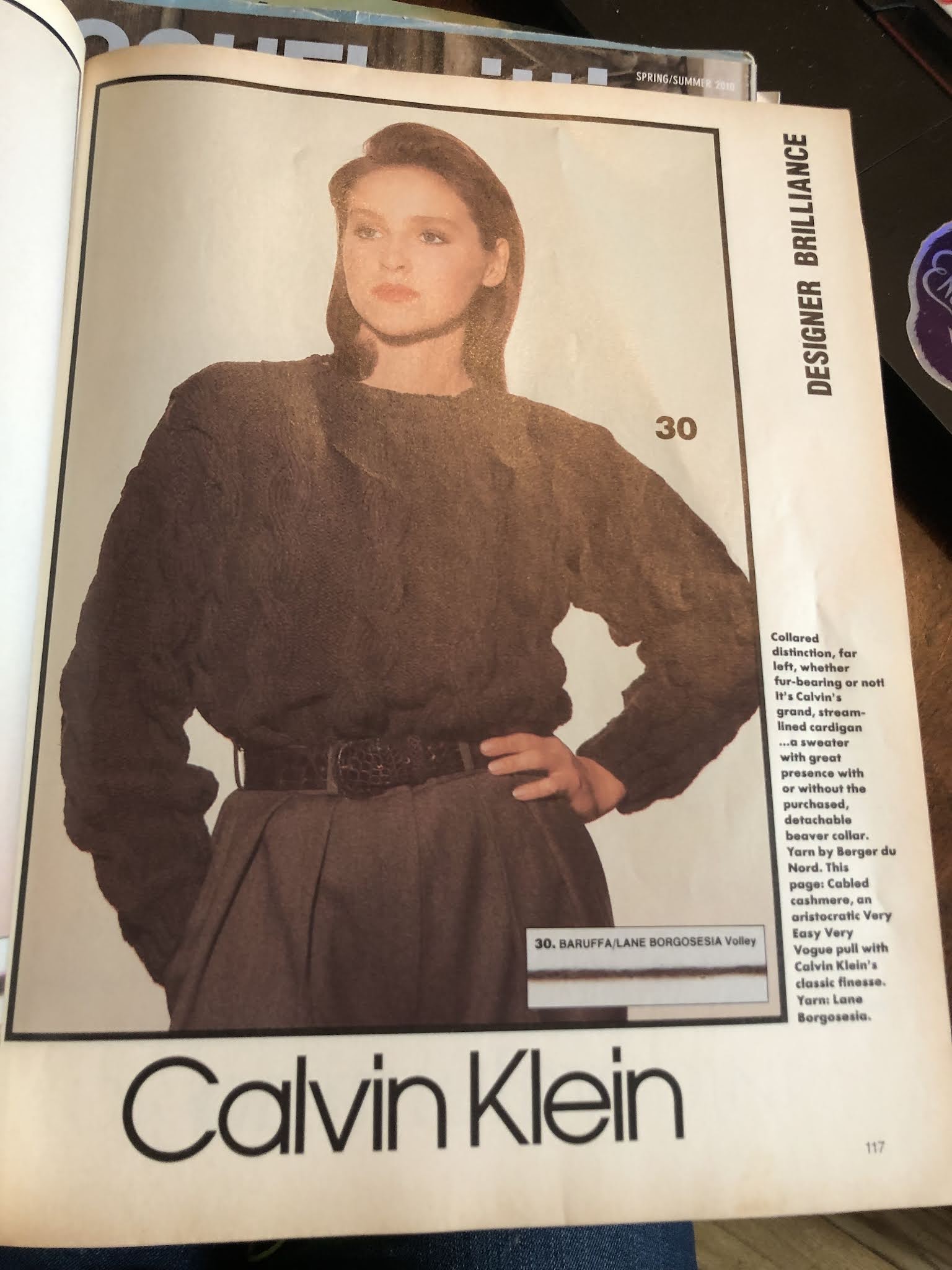
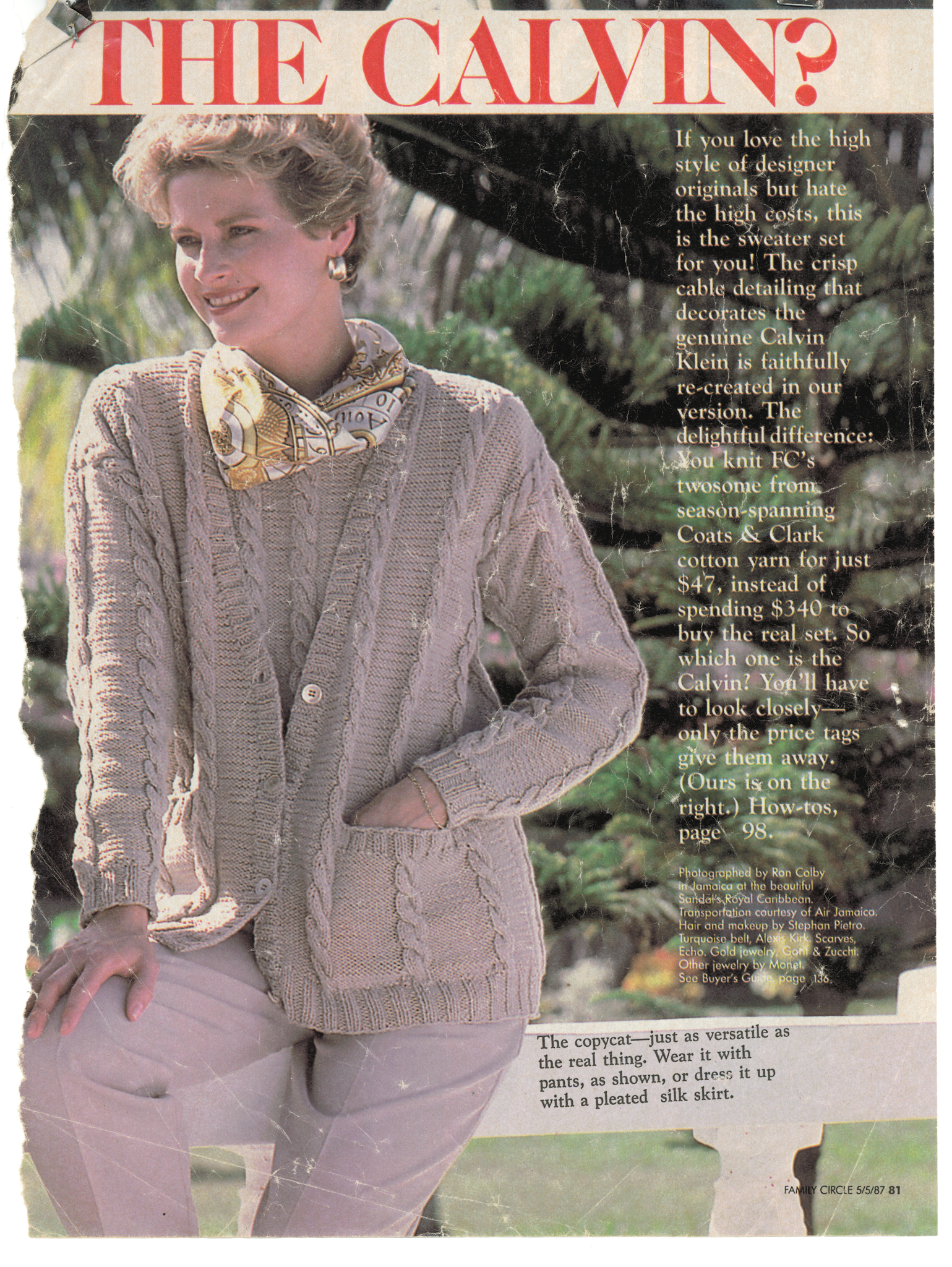
Found going through old knitting magazines, a version of the “splurge or steal?” fashion spread for knitters: “Which One Is the Calvin?” Text: If you love the high style of designer originals but hate the high costs, this is the sweater set for you! The crisp cable detailing that decorates the genuine Calvin Klein is faithfully re-created in our version. The delightful difference: You knit [Family Circle’s] twosome … for just $47, instead of spending $340 to buy the real set. So which one is the Calvin? You’ll have to look closely–only the price tags give them away. [The person who saved these didn’t save the left side of the image, but the magazine goes on to say that the one below is the Family Circle version.]

The kicker: Calvin Klein also authorized knitting patterns. Does that matter?

from Blogger https://ift.tt/2TvqlMi

Posted in Uncategorized | Tagged | Leave a comment

Honey Badger Don’t Care (4th of July edition)

 Seen on the street:

from Blogger https://ift.tt/3AubySG

Posted in Uncategorized | Tagged | Leave a comment

An Antitrust Framework for False Advertising, out now

Michael A. Carrier & Rebecca Tushnet, An Antitrust Framework for False Advertising, 106 Iowa L. Rev. 1841 (2021)

From the introduction:


Federal
law presumes that false advertising harms competition. Federal law also
presumes that false advertising is harmless or even helpful to competition.
Contradiction is not unknown to the law, of course. This contradiction, though,
is acute. For not only are both the regimes at issue designed to protect
competition, but they are both enforced by the same agency: the Federal Trade
Commission (“FTC”), which targets “unfair competition” through antitrust and
consumer protection enforcement.

Anticompetitive
conduct, the focus of antitrust law, increases price and reduces quality. False
advertising, the focus of much consumer protection law, deceives consumers and
distorts markets. Both types of conduct harm consumers. Despite this overlap,
nearly all courts have dismissed private antitrust claims based on false
advertising. They have concluded that the conduct cannot violate antitrust law.
Or they have presumed that the harm is de minimis. This makes no sense. As the
Supreme Court has long established, “false or misleading advertising has an
anticompetitive effect.”

Courts’
concerns stem from the reasonable notion that not every instance of false
advertising violates antitrust law. And (usually implicitly) they have worried
about applying antitrust’s robust remedies of treble damages and attorneys’
fees. These courts fear that antitrust liability will disincentivize companies
from engaging in advertising that is merely questionable and that might provide
useful information to some consumers. But false advertising law preserves a
robust space for puffery and debatable opinions; overdeterrence concerns don’t
justify analysis that is inconsistent with both the economics and psychology of
advertising and that, at a minimum, essentially makes it impossible to bring a
successful antitrust case based on false advertising. Nor do the Lanham Act’s
remedies for false advertising fully address harms to competition. Reasoning
that conduct that is already illegal on other grounds need not concern
antitrust law ignores the multiple other contexts in which breaches of
non-antitrust laws are considered to be potential antitrust violations.

We
begin by introducing the laws of antitrust and false advertising, explaining
the regimes’ objectives and methods. We then survey the antitrust caselaw,
critiquing three approaches courts considering false advertising claims have
taken. Finally, we introduce our antitrust framework for false advertising
claims. At the heart of the framework is a presumption that monopolists
engaging in false advertising violate antitrust law, with that presumption
rebuttable if the defendant can show that the false advertising was
ineffective. The framework also applies to cases of attempted monopolization by
incorporating factors (falsity, materiality, and harm) inherent in false
advertising law, along with competition-centered issues on targeting new market
entrants and entrenching barriers to entry. To illustrate how our framework
should work, we apply it to an important area: advertising for biosimilars,
which are pharmaceutical products with a substantial and growing role in
treating numerous diseases.

False
advertising that exacerbates monopoly power has been dismissed by antitrust law
for too long. This Essay seeks to resolve the contradiction in the law by
showing how false advertising threatens the proper functioning of markets.

from Blogger https://ift.tt/2RJtWpa

Posted in Uncategorized | Tagged , , , | Leave a comment

Reading list: Discrimination is Unfair: Interpreting UDA(A)P to Prohibit Discrimination

Stephen Hayes & Kali Schellenberg, Discrimination is
“Unfair”: Interpreting UDA(A)P to Prohibit Discrimination

https://papers.ssrn.com/sol3/papers.cfm?abstract_id=3832022

This
Article explores a theory that discrimination is a type of “unfair” practice
covered by federal and state laws prohibiting unfair, deceptive (and sometimes
abusive) acts and practices (“UDA(A)Ps”). An “unfair” practice is defined by
statute as something “(1) likely to cause substantial injury to consumers; (2)
which is not reasonably avoidable; and (3) that is not outweighed by
countervailing benefits to consumers or competition.” Discrimination fits
neatly within this statutory language, and its incorporation as an unfair
practice is consistent with the purposes and traditional guardrails around
application of UDA(A)P law, as well as general principles in civil rights
jurisprudence


Applying
the “unfairness-discrimination” theory would fill important gaps in the
existing patchwork of antidiscrimination laws, which currently leave large
swaths of the economy unregulated and unprotected from a variety of
discriminatory practices, including those with a disparate impact. By taking
seriously the plain language of UDA(A)P law, federal entities like the CFPB and
FTC, state attorneys general and agencies, and in some cases private
individuals, could make great strides towards ensuring that entire markets and
industries are not free to discriminate.

from Blogger https://ift.tt/2Rm7Zfs

Posted in Uncategorized | Tagged , | Leave a comment

Reading list: The Kids Don’t Stand a Chance: Unfair and Deceptive Advertising in Children’s Apps

 Mary Kate Fernandez,  The Kids Don’t Stand a Chance: Unfair and Deceptive Advertising in Children’s Apps, 66 Loy. L. Rev. 211 (2020)

Intro: 

The University of Michigan released a startling study (“the
Michigan Study”) in October 2018 which unveiled that “manipulative and
disruptive” advertisements are deceptively built into phone applications (“apps”)
designed for children.
 The results of this study led
members of the United States Senate and several public interest groups to
petition the Federal Trade Commission (“FTC”) to investigate apps marketed
specifically to children.
 The current federal administrative
regime for regulating deceptive advertising targeted at children, however,
falls far short of what is necessary to enable the FTC or any other federal
agency to respond to the revelations in the Michigan Study with meaningful
protections for children.

A striking passage on host selling:

This advertising practice, illegal during children’s television
programming, is fundamentally unfair to child consumers. Yet, multiple apps
designed for children heavily employ host-selling.

 For example, in PAW
Patrol: Air and Sea Adventures
, the commercial characters are not only the
object of gameplay but also have interactions with the user.
 Characters make faces
indicating feelings of disappointment when the user does not click on locked
items that require payment.
 App characters also
show disapproval when the player is unable to accomplish a certain mission
because he did not make a required purchase.
 The Michigan Study
stated that such tactics “could be characterized as social pressure or validation”
and “may also lead children to feel an emotionally charged need to make
purchases.”
 In Doctor Kids,
the main character bursts into tears if the player does not make an inapp  purchase.
 In Barbie Magical
Fashion
, Barbie narrates and specifically encourages users to use “locked”
items that require making a purchase.
 

Most problematic of the
host-selling examples was Strawberry Shortcake Puppy Palace. In this
app, Strawberry Shortcake instructs users to choose a puppy to play with, but
only one out of eight puppies can be played with for free. 
Every other puppy is
locked.
 If the child selects a
locked puppy, Strawberry Shortcake says, “Oops. To play with [name of puppy],
you’ll need to get the puppy pack. Or you can unlock everything and get the
best deal.”
 Throughout the game,
Strawberry Shortcake has thought bubbles. Some tell the user that the puppy is
sad, and the user should give the puppy what it wants. But oftentimes the item
that the puppy “wants” is locked, and when the child selects it, Strawberry
Shortcake tells the child to buy “the activities pack to keep the puppy happy.”

from Blogger https://ift.tt/2SoVBvg

Posted in Uncategorized | Tagged , , | Leave a comment