11th Circuit protects (at least some) truthful references to product creation

Webster v. Dean
Guitars, — F.3d —-, 2020 WL 1887783, No. 19-10013 (11th Cir. Apr. 16, 2020)
Buddy Webster (pka
Buddy Blaze), a successful guitar maker and technician, in the mid-1980s modified
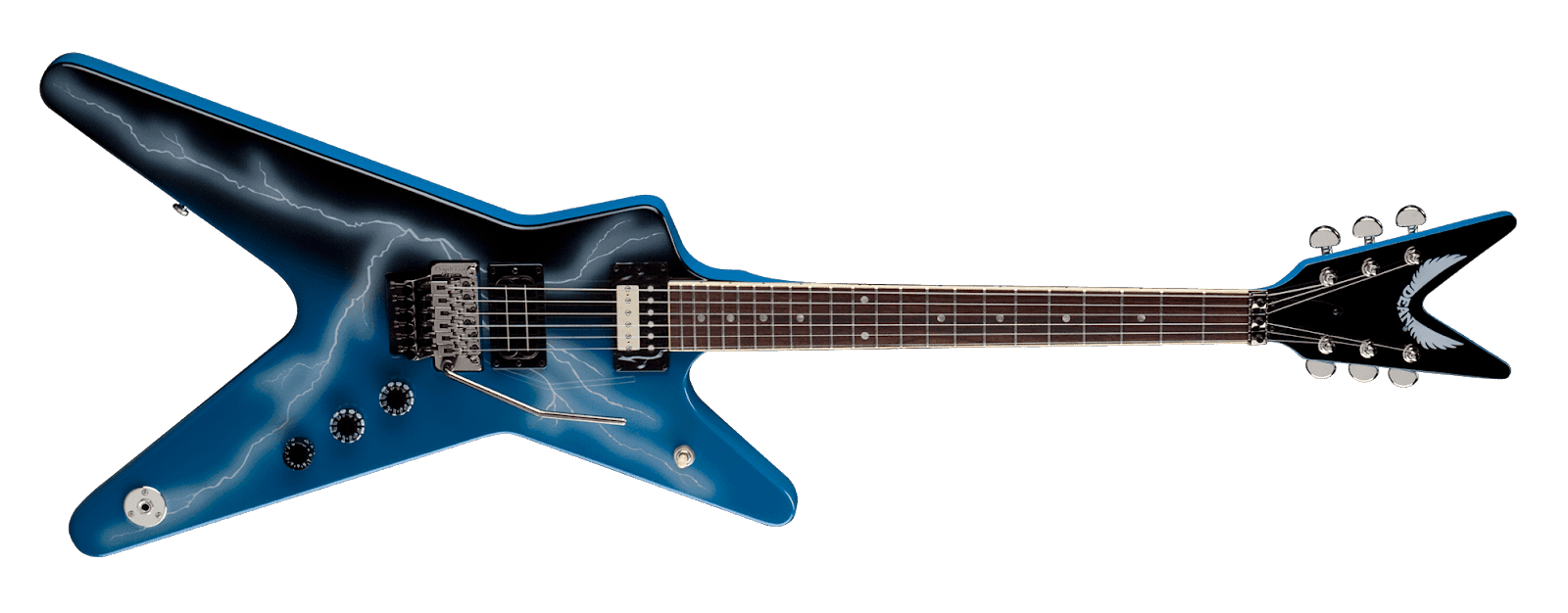
a Dean guitar and commissioned someone to paint a lightning storm graphic on it;
he gave the guitar to Darrell Abbott, late guitarist of the heavy-metal band
Pantera.
Abbott called the
guitar “The Dean from Hell” (DFH). In 2004, Abbott entered an endorsement-type
contract with Dean, but he died shortly thereafter. Since 2004, Dean has
produced and sold guitar models based on Abbott’s guitar and featuring the
lightning storm graphic, without Webster’s consent and without paying him
royalties for the use of the design. In 2017, Webster sued Dean and others for copyright
infringement, unfair competition, and false endorsement. The court of appeals
affirmed the district court’s grant of summary judgment to Dean et al.
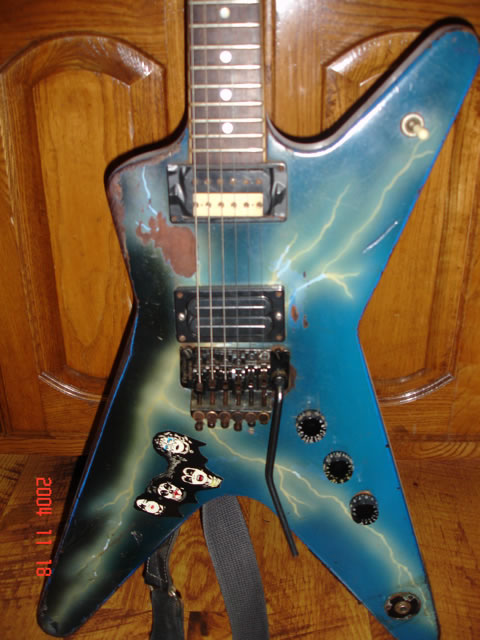
 

Dean from Hell

Dean’s DFH

Copyright
infringement: this was fundamentally a claim over ownership, not general
infringement, and thus it didn’t have general infringement’s rolling accrual.
Webster first learned about the sales of the reissued guitar in December 2004,
and learned of a cheaper, imported version called the Cowboy from Hell in 2006.
In 2006, he emailed then CEO of Dean, Elliot Rubinson, and told him that Dean
could not sell the reissues without his permission, but Dean did not stop
selling the guitars. In 2007, Webster complained again, and Rubinson responded:
I have taken some time and spoken to several “people in the know” and
the consensus concerning [the lightning storm graphic] is that [Abbott’s]
estate is the legal owner of it. With that said, I still would like to work
with you on [an Abbott] project because I am not about making enemies but
keeping friends…. Rita and I have plans to do a relic [DFH] and would like you
involved for a royalty. Is that of interest?
Webster testified
that, in a subsequent phone call, Rubinson suggested that he sue Abbott’s
estate if he was still upset.  Despite
the lack of royalties for the DFH, Webster worked with Dean in 2009 to create
and sell his own signature guitar model—the “Buddy Blaze ML.” He also willingly
appeared in multiple interviews in 2008 and 2009 discussing his role in the
history of the original DFH; Dean posted some of them to its YouTube channel. In
one, he stands in front of the original DFH recounting its history. In another,
he appears in an interview alongside Rubinson “promoting the Buddy Blaze ML,
speaking about the history of the original DFH, and comparing his Buddy Blaze
ML model with the DFH.” The third is similar; there’s no mention of the reissues.
From 2009 to 2015,
Dean released several other versions of the DFH, the “Rust from Hell,” the
“Black Bolt,” and the “Limited USA Dean from Hell.” In 2016, Webster retained
counsel and obtained a copyright registration in the lightning storm graphic.
The court of appeals
agreed with the district court that ownership was the gravamen of the claim
here, and Webster had reason to know that his alleged ownership rights were
being violated as early as 2004, when he first learned that Dean was producing
DFH reissues. Even if that weren’t enough, Rubinson’s email in 2007 stating
that “the consensus concerning [the lightning storm graphic] is that [Abbott’s]
estate is the legal owner of it” “was certainly sufficient.” His claim therefore
accrued in April 2007 at the latest, and the three-year limitation period
expired long before he brought his copyright claim in 2017.
Lanham Act/unfair
competition claims: the district court reasoned that there was no evidence that
Dean used a false or misleading statement to sell the DFH reissues. Dean just posted
Webster’s own statements in the video interviews (which he said he wasn’t
harmed by), and there were no statements that Webster endorsed, sponsored, or
derived income from the DFH reissues. One person stated in a declaration that
he attended a NAMM show and “heard Dean representatives using Buddy’s name when
selling guitars like the one that Buddy Blaze re-built for [Abbott],” but there
was nothing untrue or misleading about that.  [Note: Dastar would be an easy way to get here.]
Webster argued that,
in context, the interviews were likely to cause confusion “because, after
viewing the videos on Dean’s website and reading Dean’s advertising copy for
the DFH reissues, a reasonable person would assume that Webster was working
with Dean on the reissues.” Webster relied on statements by Dean advertising
the DFH reissues as similar to “the one that Buddy Blaze painted” and featuring
the “iconic, [DFH] lightning bolt paint job.”  The court of determined that these statements
were not false or misleading. The videos were Webster discussing his undisputed
involvement in the creation of the DFH, and none stated that Webster was
promoting or selling the DFH reissues. “The statements in these videos do not
become misleading, nor do they imply that he endorses or benefits from the sale
of the DFH reissues, simply because they appear near Dean’s advertisements of
DFH reissues.”
False endorsement: Webster
argued that his presence in Dean’s promotional materials and videos “was
‘inescapably interpreted’ by the audience of guitar-enthusiasts [as] an
endorsement.” The court of appeals applied the multifactor LOC test, but found
that since the claims were based on videos in which Webster “appeared to
willingly promote his legacy as creator of the DFH,” only “(6) the intent of
the alleged infringer to misappropriate the proprietor’s good will; and (7) the
existence and extent of actual confusion in the consuming public” were relevant.
 The court doesn’t explain why it
discounts the other factors, but presumably it means that things like
similarity of marks and similarity of goods point in the wrong direction from
common sense where there is truthful, useful information that the seller should
be able to convey—similar to the justification for nominative fair use. Still
not clear to me why it’s these two factors that should bear the weight, but I
guess that’s what you get if you don’t have nominative fair use.
The court of appeals
rejected Webster’s implicit argument that, “given his notoriety in the
guitar-enthusiast world, the mention of his name near or in relation to the DFH
reissues must have caused consumers to mistakenly believe that he endorsed the
sale of the reissues.”  Instead,
confusion is not simply to be assumed “when a mark is used in the proximity of
advertising for a product, especially when a legitimate use of that mark is
clear from the context.”  There was “little
or no evidence” of intent to misappropriate his goodwill: these were just his
own interviews, “several years after he became aware of the DFH reissues,
willingly discussing the history of the DFH to promote his legacy and sell his
own guitars. He does not mention the DFH reissues in the interviews.” [Would it be intent to misappropriate if someone else truthfully discussed his history? This is a variant of the question of distinguishing use from misappropriation.] And there
was no evidence of consumer confusion. Affirmed.

from Blogger https://ift.tt/2XQvWwd
Posted in Uncategorized | Tagged , , , | Leave a comment

reasonable consumers wouldn’t think Dunkin Donuts Angus Steak was intact piece of meat

Chen v. Dunkin’
Brands, Inc., No. 18-3087-cv, — F.3d —-, 2020 WL 1522826 (2d Cir. Mar. 31,
2020)
Plaintiffs sued Dunkin
for deceptively marketing the Angus Steak & Egg Breakfast Sandwich and the
Angus Steak & Egg Wake-Up Wrap, alleging that Dunkin deceived consumers
into believing that the Products contained an “intact” piece of meat when the products
actually contained a ground beef patty with multiple additives. There wasn’t
jurisdiction over the out of state plaintiffs’ claims, and no reasonable
consumer would have been fooled under GBL §§ 349 and 350.

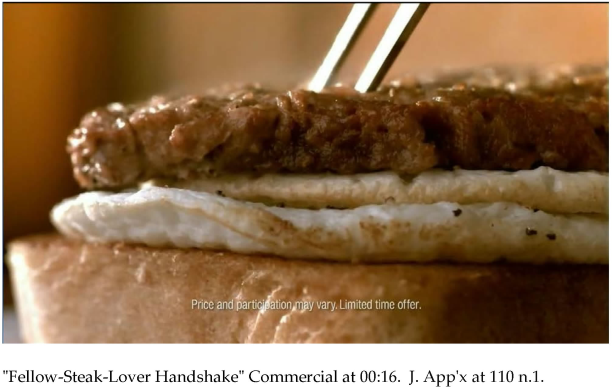
All three challenged
ads “conclude with multiple zoomed-in images that clearly depict the ‘steak’ in
the Products as a beef patty.” And “steak” doesn’t always mean a slice of meat;
 it is also defined as “ground beef
prepared for cooking or for serving in the manner of a steak” by the Merriam-Webster
Online Dictionary, as in chopped steak, hamburger steak, and Salisbury steak.  In the context—the sandwiches cost less than
$4 and less than $2 respectively, and they’re marketed as grab-and-go products
that can be consumed in hand, without the need for a fork and knife—a
reasonable consumer would not be misled into thinking she was purchasing an “unadulterated
piece of meat.”

from Blogger https://ift.tt/2XI4DnW

Posted in Uncategorized | Tagged , | Leave a comment

1201 claim to control device features survives

Philips North
America, LLC v. v. Summit Imaging Inc., 2020 WL 1515624, No. C19-1745JLR (W.D.
Wash. Mar. 30, 2020)
But I was told that
after Lexmark and Chamberlain, manufacturers weren’t using §1201
claims to control devices!
The parties compete
to sell ultrasound imaging devices for hospitals and medical centers; Philips
sells related ultrasound hardwre devices. Philips’ Ultrasound Systems are
driven by one of two software platforms that Philips developed and owns: (1)
Philips Voyager Platform and (2) Philips Common Platform. Each PUS has features/tools
that are only enabled by license, and Philips aleges it uses “multiple layers
of technological controls to protect” their copyrighted works from unauthorized
access, and that the software and access control systems are trade secrets and
that those systems contain other trade secret information.
Summit allegedly hacks
into Philips’ software and alters the Ultrasound Systems in order to enable
features or options for which Philips’ customers have not paid Philips, and
trains Summits customers on how to circumvent Philips’ access controls. Summit
allegedly advertises that its Adepto tool is a “legal solution” or a “legal
alternative” to working with Philips in order to enable additional features and
options.
Defendants moved to
dismiss DMCA §§1201 and 1202 claims, Defend Trade Secrets Act claims, Uniform
Trade Secrets Act claims, false advertising claims, Consumer Protection Act
claims, and contributory copyright infringement claims.
Philips adequately
pled that its Ultrasound Systems are protected by “a technological measure that
effectively controls access to a work” under §§ 1201(a)(1) and (a)(2): (1)
user-specific codes; (2) user-specific hardware keys; (3) machine-specific
codes and hardware keys; (4) software files with licensed features and optional
add-on controls; (5) machine-specific configuration files that control
compatibility between the systems and software and/or the systems and replacement
parts; and (6) software disabling if a user attempts to make use of an
unlicensed feature. And Philips sufficiently alleged circumvention of those
access controls: defendants allegedly remove the hard drive from the Ultrasound
Systems and run their Adepto program on the hard drive, which changes
configuration files and software files in order to enable unlicensed options on
the hard drive, and force compatibility with otherwise incompatible transducer
parts.
§1202, modifying
CMI: Not plausibly alleged. The only CMI identified with any specificity in the
complaint is “the terms and conditions of the use of the software,” which allegedly
resides on “machine readable configuration files.” But Philips didn’t plead
facts explaining how defendants falsify, remove, or alter Philips’ terms and
conditions. Motion to dismiss granted with leave to amend.
DTSA and UTSA causes
of action also survived.
False advertising
(including state Consumer Protection Act): To the extent that the claim was
based on statements about the legality of defendants’ services, these were
inactionable statements of opinion because the statements “purport to interpret
the meaning of a statute or regulation.” And, though there is a “well-established
exception” to the bar against false advertising claims based on opinion
statements for an opinion statement “by a speaker who lacks a good faith belief
in the truth of the statement,” Philips failed to adequately plead that
defendants lacked a good faith belief in the truth of their statements.  Again: leave to amend.
Contributory
copyright infringement: adequately alleged because the Adepto tool allegedly
created copies of Philips’ software and log files [are the log files
copyrightable? Are they copyrightable by Philips? Seems unlikely].

from Blogger https://ift.tt/34HSkJQ

Posted in Uncategorized | Tagged , , , , , | Leave a comment

Humvees in Call of Duty are constitutionally protected realism, not confusing/diluting

AM General LLC v. Activision
Blizzard, Inc., No. 17 Civ. 8644 (GBD) (S.D.N.Y. Mar. 31, 2020)
The district court
allows Humvees to appear in realistic videogames by performing a full confusion
analysis, despite purporting to follow Rogers v. Grimaldi.
The Humvee has become
“an iconic and a ubiquitous symbol of the modern American military.” AMC has
granted licenses to use the Humvee trademark “on or in connection with a wide
variety of products,” including toys and at least four video games. Humvees
have also appeared in “a wide variety of other media, including Hollywood
blockbusters, … television series, … and Academy Award-winning dramas,” as well
as in video games. 
Call of Duty is a
popular, realistic military video game. Humvees are depicted in nine Call of
Duty games, sometimes in the background or mentioned; players sometimes ride in
a Humvee for several minutes during a scene or level and they can occasionally “assum[e]
control of the (Humvee],” including by firing a turret-mounted machine gun. Humvees
are also shown in several trailers for the games and in Call of Duty-brand d strategy
guides. Activision also licensed a toy company to manufacture Call of
Duty-branded construction sets, two of which include toy vehicles that
allegedly bear the distinctive elements of the Humvee’s trade dress.          
An instruction
manual for Call of Duty 4: Modern Warfare included the following language:
All title, ownership rights and intellectual property rights in and to
this Program (including but not limited to any patches and updates) and any and
all copies thereof (including but not limited to any titles, computer code,
themes, objects, characters, character names, stories, dialog, catch phrases,
locations, concepts, artwork, animation, sounds, musical compositions,
audio-visual effects, methods of operation, moral rights, any related
documentation, and “applets” incorporation into this Program) are owned by
Activision, affiliates of Activision or Activision’s licensors.
Similar language
occurs in other manuals for other iterations. Activision also received a letter
in 1998 complaining about the use of Humvees in the video game Sin, which is
unaffiliated with the Call of Duty franchise; Activision supposedly “agreed to
remove [Humvee] vehicles from the video game Sin.”
Infringement: Rogers
is the test for uses in artistic works generally, not just for titles. But then
the court cites a title-v-title case for the proposition that a First
Amendment-sensitive analysis must be done using the Polaroid factors,
which is not the rule in the Second Circuit when the plaintiff doesn’t own
rights in the title of an expressive work. 
Rogers prong two is meaningless if it’s just likely confusion all
over again, but the court cited Twin Peaks Prods., Inc. v. Publ’ns lnt’l, Ltd.,
996 F.2d 1366, 1379 (2d Cir. 1993) (title v. title) and DeClemente v. Columbia
Pictures Indus., Inc., 860 F. Supp. 30, 51 (E.D.N.Y. 1994) (which indeed also
completely misread Rogers as just something to think about when you’re
doing the multifactor confusion analysis, which is kind of amazing if you’ve
read Rogers, which among other things rejects a consumer survey and
evidence of confusion by sophisticated marketers).
By contrasting a
non-title trademark case (the Hangover case with Louis Vuitton) with a
title-v-title case (The Book of Virtues v. The Children’s Audiobook of Virtues), the
court concludes that “an artistically relevant use will outweigh a moderate
risk of confusion where the contested user offers a ‘persuasive explanation’ that
the use was an ‘integral element’ of an artistic expression rather than a
willful attempt to garnish the trademark owner’s goodwill for profit.”  At least the court is clear that the Humvees don’t
need to be “metaphysically” required for the game; an integral element
is one that “communicate[s] ideas—and even social messages,” either “through
many familiar literary devices (such as characters, dialogue, plot, and music)”
or “through features distinctive to the medium (such as the player’s
interaction with the virtual world).”
Of course there was
artistic relevance. “Featuring actual vehicles used by military operations around
the world in video games about simulated modern warfare surely evokes a sense of
realism and lifelikeness to the player who ‘assumes control of a military soldier
and fights against a computer­ controlled or human-controlled opponent across a
variety of computer-generated battlefields.’”
Proceeding to the Polaroid
factors, the court found that the use wasn’t explicitly misleading because
it wasn’t confusing. [sigh] It even quoted Rogers: “no amount of evidence showing
only consumer confusion can satisfy the ‘explicitly misleading’ prong of the
Rogers test because such evidence goes only to the ‘impact of the use’ on a
consumer.” And then it did the multifactor confusion test anyway.
Unsurprisingly, some
distortions appeared in the multifactor test: the court said that the marks
weren’t very similar because the purpose of the uses were different. “Plaintiff
s purpose in using its mark is to sell vehicles to militaries, while Defendants’
purpose is to create realistically simulating modern warfare video games for
purchase by consumers.” AMC’s licensing practices were “sporadic and marginal”
and thus didn’t show market overlap. And anyway, First Amendment considerations
required the court to give minimal weight to bridging the gap.
AMC’s survey
allegedly “found that 16% of consumers shown actual video game play from
Activision’s games were confused as to AM General’s association with Call of
Duty.” That wasn’t enough, given Rogers.
Bad faith: the 1998
letter couldn’t show bad faith, because Activision didn’t respond to it;
silence wasn’t probative of Activision’s agreement about rights in the Humvee.  Nor were a handful of statements by
Activision employees, the use of Humvees decorated with Call of Duty logos at
several in-person promotional events, or the statements in user guides evidence
of an intent to confuse:
For instance, the user guide statements do not affirmatively tell
consumers that Activision either owns or licenses the Humvee IP. All that reasonably
may be said is that a paragraph in miniscule type buried in a user guide—a
paragraph which does not allude to, let alone mention, Humvees at all—does not “tell
consumers” much of anything. Indeed, such back-end boilerplate provides no
basis for “confusion between the two companies’ products.”
Sophistication: The Hangover
court noted that “moviegoers are sophisticated enough to know that the mere presence
of a brand name in a film, especially one that is briefly and intermittently shown,
does not indicate that the brand sponsored the movie.” Here, “[t]here is no
reason to believe that video game players are any less astute.”
Trade dress claims:
Same thing, “[g]iven the improbability of confusion between a vehicle and a
video game—or, in the case of the contested toys, between a plastic figurine
and a full-blown military machine.”
Unfair competition/false
designation of origin. Same thing. “The only thing remotely close to a ‘false
designation’ is the legalese buried inside several games’ user guides,” which
wasn’t enough.
Lanham Act false
advertising: There were no literally or impliedly false statements.  NY false advertising: same. Also, AMC didn’t
show injury.
Federal and NY
dilution: NY dilution is “essentially the same” as federal dilution, and
without evidence of the quality of Activision’s games, AMC failed to show
tarnishing or blurring. If any dilution did occur, it would be “tolerated in
the interest of maintaining broad opportunities for expression.” [Also in the
interest of obeying the federal statute’s requirements and exemptions, but here
I won’t quibble.]

from Blogger https://ift.tt/3aoFYrm

Posted in Uncategorized | Tagged , , , | Leave a comment

Rogers continues to collapse into transformativeness in the Ninth Circuit: dog toy edition

VIP Products LLC v.
Jack Daniel’s Properties, Inc., No. 18-16012 (9th Cir. Mar. 21, 2020)
VIP Products sells the “Bad Spaniels Silly Squeaker” dog toy, which
resembles a bottle of Jack Daniel’s Old No. 7 Black Label Tennessee Whiskey,
but has light-hearted, dog-related alterations. For example, the name “Jack
Daniel’s” is replaced with “Bad Spaniels,” “Old No. 7” with “Old No. 2,” and alcohol
content descriptions with “43% POO BY VOL.” and “100% SMELLY.”
Jack Daniel’s sued
for trademark infringement and dilution, and the district court enjoined the toy.
The court of appeals found that the trade dress was nonfunctional and distinctive,
but the dog toy was an expressive work entitled to First Amendment protection, so
the district court decision was reversed and remanded for Rogers treatment.

VIP’s purported goal
in creating Silly Squeakers was to “reflect” “on the humanization of the dog in
our lives,” and to comment on “corporations [that] take themselves very
seriously.” While the Jack Daniel’s label says, “Old No. 7 Brand Tennessee Sour
Mash Whiskey;” the label on the Bad Spaniels toy instead has the phrase “the
Old No. 2, on your Tennessee Carpet.” A tag states that the “product is not
affiliated with Jack Daniel Distillery.”
The nominative fair
use defense failed because VIP didn’t use the mark itself, but rather a changed
version with “significant differences.” E.S.S. Entm’t 2000, Inc. v. Rock Star
Videos, Inc., 547 F.3d 1095, 1099 (9th Cir. 2008).
However, Rogers
v. Grimaldi
applied. Like greeting cards, “the Bad Spaniels dog toy,
although surely not the equivalent of the Mona Lisa, is an expressive work.” It
used “word play to alter the serious phrase that appears on a Jack Daniel’s
bottle— ‘Old No. 7 Brand’— with a silly message— ‘The Old No. 2.’” In an attempt to distinguish the old Dr. Seuss case, the court says that book made
“no effort to create a transformative work with ‘new expression, meaning, or message,’”
while Bad Spaniels “comments humorously on precisely those elements that Jack
Daniels seeks to enforce here.” [Note how Rogers is slowly collapsing
into transformativeness in the Ninth Circuit—continuing Gordon v. Drape Creative.]
Vacated and remanded
for Rogers analysis; although the district court is supposed to consider
both prongs, it’s hard to see how it could find a lack of artistic relevance,
and even after Gordon, the finding of transformativeness (and the fact
that Jack Daniel’s doesn’t make parody dog toys) seems to dictate the result on
explicit misleadingness.
Dilution: this is “noncommercial”
speech—it does more than propose a commercial transaction—so there can be no
dilution by tarnishment. The court phrases it in a weird way: “Although VIP
used JDPI’s trade dress and bottle design to sell Bad Spaniels, they were also
used to convey a humorous message.” Of course plenty of ads convey a humorous
message; the issue here is that the dog toy is the product being sold, as
opposed to being an ad for a separate product. Thats what makes
it noncommercial speech, not the fact that it was humorous.
I guess it’s a
better opinion than that in the Hummer/Activision case, which also reaches the
right result with grimace-worthy reasoning?

from Blogger https://ift.tt/34IMqYZ

Posted in Uncategorized | Tagged , | Leave a comment

lawsuit against supplement for implying arthritis claims not preempted

Yamagata v. Reckitt
Benckiser LLC, 2020 WL 1505724, No. 17-cv-03529-VC (N.D. Cal. Mar. 30, 2020)
A very clear opinion. Yamagata challenged
RB’s advertising for joint supplements under California and NY law. As the court
explained: “If the boxes are best understood as making assertions about the
ability of the supplements to alleviate the symptoms of arthritis, those
assertions violate federal law, and the state law claims attacking them are not
preempted. If the boxes are best understood as not making assertions relating
to arthritis, those assertions are authorized by federal law, and the state law
claims are preempted.” The court found that the former was the case.
The court had certified
two classes—one of California buyers and one of New York buyers. RB moved for
summary judgment, arguing (1) preemption, (2) its products work as advertised,
and (3) the plaintiffs’ full refund theory had to fail because the supplements
were not worthless.
Preemption: “The key
constraint, for the purposes of this litigation, is a [federal] ban on
statements implying that the supplement mitigates, treats, prevents, or cures a
specific disease or class of diseases. Some of the assertions on the Move Free
Advanced labels do just that, and so they are not protected by the preemption
provision.” Generally, federal law allows supplements to make structure/function
statements [the court helpfully notes that these are called “claims” by the
regs but that’s confusing in this context], but not statements implying that
the supplement can “diagnose, mitigate, treat, cure, or prevent a specific
disease or class of diseases.”
First, is this a
jury issue? It’s partly a factual question insofar as it depends on what the label
statements mean, but the court determined that preemption is nonetheless a
question of law and so it would be decided by the court, even if that required
resolving factual disputes.  See Merck
Sharp & Dohme Corp. v. Albrecht, 139 S. Ct. 1668 (2019) (“a judge, not the
jury, must decide the preemption question,” and  “courts may have to resolve subsidiary factual
disputes that are part and parcel of the broader [preemption] question”).
The FDA says that the
key factor distinguishing a structure/function statement from an implied
disease statement is “whether the labeling suggests that the product will
produce a change in the characteristic signs or symptoms of a specific disease
or class of diseases.” The regs then list a series of ten criteria (one with
five subparts) relevant to that determination, and then provides examples of
statements that would fall on either side of the line: A statement that a
supplement “reduces joint pain,” for example, is off limits; a statement that
it “helps support cartilage and joint function” is not. The reason is that joint
pain is a characteristic symptom of arthritis, so statements about relieving
joint pain impliedly claim to mitigate the disease of arthritis. As the court
noted, “That may seem like a stretch, and it may even seem that the specific
reference to cartilage and joint function draws a closer link to arthritis than
does the broader ‘joint pain.’ But the idea that the FDA’s dictates may conflict
with intuitions only confirms that this preemption determination, while
fact-based, depends ultimately on application of the law.”

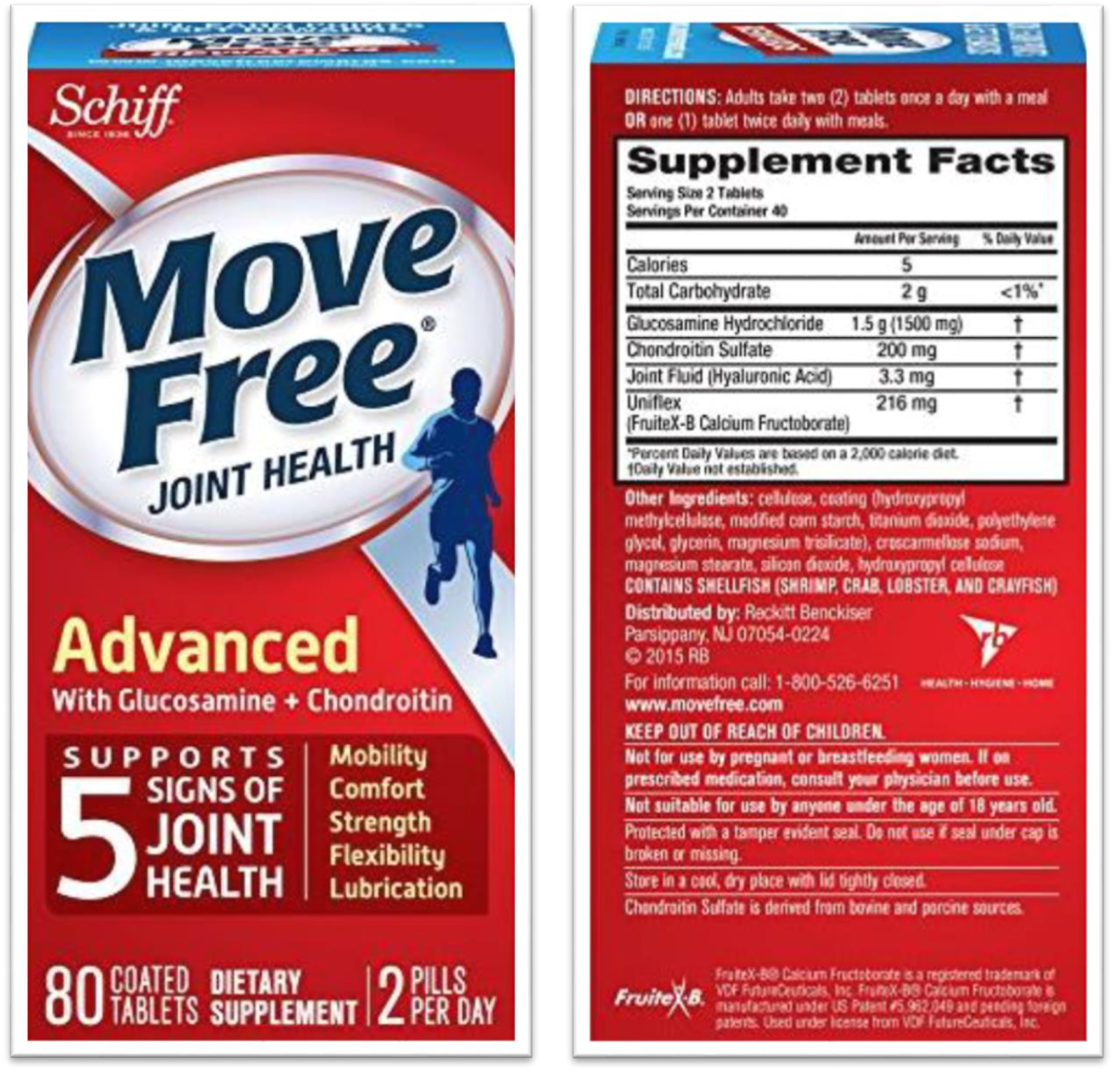
front and back

sides

Applying this
framework, the accused labels implied that the supplement can mitigate, treat,
or prevent arthritis. First, “supports joint comfort” was dangerously close to
a statement that a supplement “reduces joint pain;” it’s hard to articulate a
meaningful difference between the two. And a statement that is a structure/function
statement in isolation “can improperly imply an effect on a disease if other
parts of the label associate the supplement with a disease.” Relevant context
includes the product name, any pictures or symbols, citations to journal
articles, and statements about the formulation of the product, if printed on
the label.  Here, the ads contained “elements
closely associated with arthritis,” most prominently the Arthritis Foundation
logo, accompanied by the following statement: “Move Free™ is a Proud Sponsor of
the Arthritis Foundation®: Move Free™ is proud to support the Arthritis
Foundation’s efforts to help people take control of arthritis.” Even though the
“support” was clearly financial, “the logo and statement nonetheless draw an
explicit link between the supplement and arthritis,” which was relevant to the
meaning of the other statements on the label.
The court also
pointed to the citation to a journal article in the “Journal of Aging and Research,”
along with the choice to highlight glucosamine and chondroitin on the front of
the box. Osteoarthritis is “nearly universal…by age 80,” so a citation to an aging
journal on a joint supplement label was suggestive of arthritis, and industry
marketing research finds that about half of arthritis sufferers view “glucosamine
&/or chondroitin” as “the most effective arthritis treatment.” For the same
reason as “supports joint comfort” was an implied disease statement, the
statement that the product “supports 5 signs of joint health: mobility,
flexibility, strength, lubrication, and comfort” was also an implied disease
statement.
The court highlighted
that it was not determining falsity; it was determining whether the claims were
technically structure/function statements or implied disease statements solely
for purposes of preemption.  RB was not
constrained in its ability to argue about whether the labels implied, under
state law, that the supplement would mitigate arthritis.
Falsity/misleadingness:
RB relied on the purported benefits of calcium fructoborate alone, and not on
the effects of glucosamine or chondroitin, but there was a triable issue of
fact: RB had some evidence based on randomized control trials that calcium
fructoborate can benefit joints, while the plaintiff’s expert called the
methodology and reliability of those studies into question and another cultured
pig cartilage in various concentrations of calcium fructoborate and found no
positive effect. A jury could go either way.
Full refund theory:
RB argued that even if the supplements do not help joints, they are not
worthless because some of the ingredients can provide benefits unrelated to joint
health. “But people purchase joint supplements for the advertised joint health
benefits. … If the plaintiffs received none of the advertised joint health
benefits, they are entitled to a full refund.”

from Blogger https://ift.tt/34FjEIH

Posted in Uncategorized | Tagged , , | Leave a comment

T-Mobile is plausibly liable for acts of explicitly authorized dealers

City of New York v. T-Mobile
USA, Inc., 2020 WL 1498522, No. 451540/2019 (Sup. Ct. N.Y. Mar. 23, 2020)
The City of New York
and the New York City Department of Consumer Affairs (DCA) sued T-Mobile, its subsidiary
MetroPCS New York, and 42 dealers, alleging violations of the Consumer
Protection Law and regulations. The court refused to dismiss the action against
T-Mobile and MetroPCS.
T-Mobile allegedly deceptively
targeted lower income consumers under its “lower-priced prepaid (no contract)
wireless brand” Metro by T-Mobile, formerly known as MetroPCS. The allegedly
deceptive practices included “selling used phones as though they were new”; “deceiving
consumers about financing”; “overcharging consumers”; “providing defective
receipts”; “failing to provide a receipt”; and “making deceptive
representations about the Metro by T-Mobile refund policy.” (NYC rules provide
that receipts must be offered for any consumer purchase over $20, and must be
provided on request for $5-20 purchases.)
T-Mobile argued that
it couldn’t be held liable for the alleged unlawful conduct by independent
dealers because T-Mobile has no contract with those dealers giving them actual
authority to act on behalf of T-Mobile, and the facts didn’t support a theory
of apparent authority. DCA sought to hold T-Mobile liable for two types of
deception: (1) its “30-Day Guarantee” was, in fact, only a limited 7-day return
policy with several conditions; and (2) the “Virtual Chat Assistant” on the
T-Mobile website (which was obviously T-Mobile’s responsibility) failed to
fully and correctly disclose the return policy. First, DCA sufficiently alleged
that T-Mobile was liable for deceptive acts by the Corporate Stores run
directly by T-Mobile’s subsidiary MetroPCS because those stores create the
impression of agency based on the relationship between the parties. And at a
minimum, the pleadings created a factual question whether T-Mobile is liable
under the apparent authority doctrine for the conduct of the dealers who were
labeled “authorized” not only in their signs but on the website and via conduct
in the stores.
DCA also alleged
deception by MetroPCS in its stores: selling used phones as if new; financing
terms that double the cost of the phone; overcharges via improper taxes and
activation payments; failure to provide receipts; and defective receipts. MetroPCS
apparently accepted responsibility for Corporate Stores, and it acknowledged
that it executed Indirect Dealer Agreements giving dealers actual authority to
act on behalf of MetroPCS, but it argued that their limited actual authority didn’t
extend to wrongful conduct. But that couldn’t be resolved at the pleading
stage: MetroPCD didn’t show as a matter of law that the dealers were at all
times “acting antagonistically” to the interests of MetroPCS.

from Blogger https://ift.tt/2VfTpW2

Posted in Uncategorized | Tagged , | Leave a comment

A blueberry bagel that is mostly imitation blueberry is plausibly misleading

Izquierdo v. Panera
Bread Co., No. 18-CV-12127 (VSB), 2020 WL 1503557 (S.D.N.Y. Mar. 30, 2020)
Panera sold a “blueberry
bagel” that allegedly wasn’t.  [My father
thinks that bagels with fruit etc. in them already aren’t bagels, but the
allegation here is about the blueberry.] The court dismisses plaintiff’s claim
for injunctive relief because he isn’t likely to be injured again, but otherwise
denies the motion to dismiss his consumer protection claims.
The ingredient list
for the Bagel “is not displayed in-store,” but allegedly “contains only trace
amounts of real blueberries” and a “far greater proportion of imitation
blueberry ingredients.” Even inspecting the product, a reasonable consumer
allegedly couldn’t identify this fact. For context, Panera also sells a
Blueberry Muffin, which contains “fresh blueberries” as the second-to-last
ingredient and no imitation blueberries, and allegedly “[e]ven low-cost,
supermarket-shelf blueberry bagels contain only real blueberry ingredients,” so
that “[a] reasonable consumer would expect a blueberry bagel sold at a
bakery-café that stresses its healthfulness and authenticity to contain more
real blueberries than its low-cost, supermarket-shelf counterparts.”
The Second Circuit
isn’t as easy on future purchases as the Ninth, so plaintiff didn’t
successfully plead likely future injury and lacked standing for injunctive
relief.
However, he
plausibly alleged misleadingness to a reasonable consumer. The bagel is
advertised in stores with a placard reading “Blueberry” and online as a
“Blueberry Bagel,” and it allegedly appears to contain discrete pieces of fruit
scattered throughout the bagel. “It is plausible that a reasonable consumer
would believe that these visible pieces are real blueberries, in light of the
placard on the basket and their normal expectations of blueberry baked goods,”
especially given that it appears under a sign advertising Defendant’s
commitment to “clean food” and “menu transparency,” and is sold alongside a
Blueberry Muffin that contains only real blueberries.
It was not enough
that the bagel did contain some blueberries and that the ingredient list was “readily
available.” It can be “materially misleading to suggest a product contains a
greater proportion of a preferred ingredient than it actually does, even where
there is a visible ingredients list that states the correct composition of the
food.” (Citing Mantikas v. Kellogg Co., 910 F.3d 633, 639 (2d Cir. 2018)
(involving “whole grain” and “made with whole grain” claims where crackers were
primarily enriched white flour), and some earlier cases.)  Although this was a close case, the court
noted that there were no allegations that a customer purchasing the bagel
in-store would have ready access to an ingredients list prior to making a
purchase, and anyway Mantikas made clear that “a reasonable consumer
should not be expected to consult the Nutrition Facts panel on the side of the
box to correct misleading information set forth” elsewhere on the packaging.
Similarly, plaintiff
adequately, though barely, pled injury by alleging that the bagel had
“significantly less value than it warranted.” A price premium theory was
plausible, even though every Panera bagel sells for the same price; the
appropriate comparator could be other blueberry bagels, which plaintiff alleged
are “low-cost” yet contain “only real blueberry ingredients.”
Fraud was also,
though just barely, alleged. The facts alleged with particularity suggested “conscious
misbehavior or recklessness,” including: (1) Panera knew the bagel’s true
composition, as evidenced by its publication of the ingredient list; (2) Panera
produced the bagel in such a way that the imitation blueberries are
indistinguishable from the real blueberries; (3) Panera purposely advertises
“menu transparency” and its “clean” food; (3) Panera is aware of consumer
beliefs about the healthful qualities of blueberries; and (4) Panera sought to
capitalize on those beliefs and its branding to sell more bagels by calling it
a Blueberry Bagel.

from Blogger https://ift.tt/2z6ec5S

Posted in Uncategorized | Tagged , | Leave a comment

TheRealReal is ok except where it is FakeFake

Chanel, Inc. v. The
RealReal, Inc., 2020 WL 1503422, No. 18-CV-10626 (VSB) (S.D.N.Y. Mar. 30, 2020)
Very interesting
case: Chanel sued TRR for trademark infringement etc. for allegedly
overclaiming its association with Chanel by prominently advertising how much
Chanel there was on its fashion resale platform. The court rejects Chanel’s claims
except to the extent they’re predicated on the sale of alleged counterfeits, in
what is a real victory for resale platforms under present circumstances.
TRR offers
purportedly genuine secondhand Chanel products as part of its luxury resale
offerings, and in 2018 acknowledged that Chanel was one of the most popular
brands bought and sold through consignment.
As you read these
claims, consider how many of them might be puffery at least in isolation: TRR
advertises itself as “the world’s largest online marketplace for authenticated,
consigned luxury goods” and says “[a]uthenticity is the cornerstone of The
RealReal.” It claims that it has “developed the most rigorous authentication
process in the marketplace,” that it is “the only resale company in the world
that authenticates every single item sold,” that “[t]here is no other resale
company doing more to remove fakes from the market every day and put
counterfeiters out of business,” that its “dedicated Quality Control team
provides an additional layer of control to help prevent fakes from being sold
on [its] site,” and that its “team works diligently and is constantly
innovating to ensure [it] … keep[s] fraudulent products off the market.” Its FAQ
says: “[u]nlike most resale companies, The RealReal takes possession of all
items and physically evaluates every item to authenticate it.” Also: “We employ
over 100 brand authenticators, gemologists, horologists and art curators. … Our
authentication process and all of our internal processes are changing
constantly, driven by new technologies like machine learning and AI.”
TRR claimed to use “a
rigorous, brand-specific authentication process” in which “high risk” items
were “sent to authenticators with significant authentication experience, who
are highly specialized in specific categories. Many of these authenticators
join The RealReal from the luxury brands themselves—like Tiffany, Hermès and
Rolex—or auction houses like Sotheby’s and Christie’s and have a deep knowledge
of the markers, materials and craftsmanship behind genuine products. They
assess each item based on these and other characteristics.” Low risk items, “such
as contemporary brands with clear authenticity markers, are sent to be
authenticated by our copywriters, who have a minimum of 30 hours of authentication
training.” TRR claims that its Quality Control team adds an additional layer of
protection and that it leverages data to use algorithms to ensure that “high
risk” products get the most scrutiny.
The TOS state: “You
acknowledge and agree that The RealReal’s authentication process is in-house
and independent. Brands identified on the Site are not involved in the
authentication of the products being sold, and none of the brands sold assumes
any responsibility for any products purchased from or through the website.
Brands sold on the Site are not partnered or affiliated with The RealReal in any
manner. However, The RealReal fully cooperates with brands seeking to track
down the source of counterfeit items, which includes revealing the contact
information of consignors submitting counterfeit goods.”
TRR takes possession
of all goods sold, and “[u]pon receipt, … evaluate[s] each item … to
determine, in its sole discretion, its authenticity, quality, and value.” TRR
could refuse to accept an item; if it determined that an item was counterfeit,
it would notify the consignor and give them an opportunity to prove authenticity;
any item finally determined to be counterfeit would be destroyed, not returned.
Chanel investigated
TRR’s Chanel offerings in 2018, and found at least seven counterfeit handbags
that allegedly differed in quality from real Chanel, “and some contained cartes
d’authenticité with serial numbers that did not correspond to the genuine
serial numbers designated by Chanel for those particular styles of handbag.” When
Chanel notified TRR, TRR asked for additional substantiating information. After
that, TRR removed the identifying serial numbers from all of its Chanel-branded
leather goods product listings, and may have removed physical serial number
tags from Chanel handbags. The complaint quoted two customer reviews in which
customers state that they were sold counterfeit Chanel handbags. Chanel alleged
that TRR’s authentication experts do not have the necessary qualifications to
authenticate Chanel products, and have failed to identify counterfeit Chanel
bags. It argued that TRR didn’t disclose sufficient information for consumers
to understand that Chanel is not involved in The RealReal’s authentication
process, or affiliated with The RealReal’s business.
Opening principles: At
the motion to dismiss stage, Chanel argued, the court couldn’t consider
nominative fair use, because it was an inherently factual inquiry. But it’s Chanel’s
burden to plead sufficient factual content to plausibly allege why Defendant’s
use of its trademarks is not permissible under the nominative fair use doctrine.
However, “where counterfeit marks are involved, it is not necessary to perform
the step-by-step examination of each Polaroid factor because counterfeit marks
are inherently confusing.”
Application: the
complaint didn’t plausibly allege infringement, false endorsement, or unfair
competition based on TRR’s use of genuine Chanel marks, but did plausibly
allege infringement based on advertisement and sale of counterfeits.
The Lanham Act “does
not prevent one who trades a branded product from accurately describing it by
its brand name, so long as the trader does not create confusion by implying an
affiliation with the owner of the product.” Though Chanel’s marks had great
strength, and though there might be direct competition with new products, “the
complaint also includes evidence suggesting that secondary fashion markets
bolster primary markets,” and Chanel’s lack of its own secondhand market meant
that there was no direct competition. There was no evidence of customer confusion
over affiliation or of TRR’s bad faith. And the luxury market was relatively
sophisticated and high-priced. “Balancing these factors, it is highly unlikely
that a customer buying a secondhand Chanel product from The RealReal—which
unambiguously holds itself out as consignment retailer in a luxury market—would
confuse the nature of The RealReal’s business, the source of its products, or
its affiliation—or lack thereof—with Chanel.” 
Many of the other Polaroid factors weren’t apposite for a secondhand
goods case: “the similarity of the marks, the evidence of bridging the gap, and
the respective quality of the products in question are not as relevant where,
as here, the marks used and goods sold by Defendant are indeed the same as the
Plaintiff’s marks and goods. Such is the nature of resale markets.”
This fact also made
the use of Chanel’s mark necessary to identify TRR’s goods, for nominative fair
use.  Furthermore, Chanel didn’t plausibly
allege facts suggesting that The RealReal “stepped over the line into a
likelihood of confusion by using [Chanel’s] mark[s] too prominently or too
often, in terms of size, emphasis, or repetition.” TRR has a Chanel page briefly
describing Chanel and advertising products with the Chanel marks, it also has
brand-specific pages for nine other luxury fashion brands. There were no facts
suggesting that TRR displays Chanel-branded goods “more prominently than other
luxury-brand goods,” or that it used Chanel marks “in any other capacity than
to identify Chanel products as Chanel.”
There were also no
non-conclusory allegations to suggest that The RealReal inaccurately depicts
its relationship with Chanel or Chanel’s products and services. Statements that
“[m]any of [its] authenticators join The RealReal from the luxury brands
themselves—like Tiffany, Hermès and Rolex,” were insufficient to allege a
probability of customer confusion. This was especially true given The
RealReal’s disclosure that “[b]rands identified on [its website] are not
involved in the authentication of the products being sold, and none of the
brands sold assumes any responsibility for any products purchased from or
through the website,” and that “[b]rands sold on the [website] are not
partnered or affiliated with The RealReal in any manner.”
Although another court
has held that “guarantees of authentication [ ] themselves may be taken as
suggesting sponsorship or endorsement by Chanel,” this court found that “such
guarantees, without more, are sufficient to demonstrate a likelihood of
customer confusion, especially since the law requires ‘a probability of
confusion, not a mere possibility.’” In the contrasting case, WGACA, the
defendant allegedly overemphasized Chanel; sold “more Chanel-branded products
… than those of any other brand”; and had “social media pages include[d]
quotations of Coco Chanel” and photographs of Chanel products accompanied by
the hashtags “#WGACACHANEL” and “our #WGACACHANEL.” And its letters of
authenticity stated, for example, “[t]his letter confirms that item
Q6HCHK00KB000 Chanel Black Long Tissue Box is an authentic Chanel decoration.” “Such
an authenticity guarantee is materially different from the authenticity
statements on The RealReal’s website.”
However, allegations
about counterfeits were different. TRR wasn’t like eBay because it was plausibly
directly liable as the actual seller, not the mere facilitator of sales. TRR
had “sole discretion” to “approve for sale, price, display, market, and make
available for sale the goods sold through its website and retail locations.”
[What do you want to bet that eBay’s TOS also let it control these things,
albeit that it does not generally use its power to set price terms? Cf. recent
discussions about price gouging for PPE on eBay.  Increasing
the price of items to a level that is much higher than is considered fair or
reasonable is not allowed on eBay
,” the platform itself says. [PS eBay:
does what’s going on with Liberty wooden jigsaw puzzles count? Because that’s a
wild ride.]]  Still, TRR, unlike eBay,
was “more than a platform for the sale of goods by vendors.” Even though it
didn’t formally take title to the merchandise, it “maintain[s] [the] inventory
of merchandise,” and upon receipt of products from consignors “b[ears] the risk
of loss” for the products. Thus it was the seller.
The court pointed
out that TRR benefited by “curating the products offered through [its] market
and defining the terms on which customers can purchase those products,” and
thus “must bear the corresponding burden of the potential liability stemming
from its ‘sale, offering for sale, distribution, [and] advertising of’ the goods
in the market it has created.”
False advertising: For
the counterfeits but only for the counterfeits, under the facts alleged, TRR’s
authenticity claims were literally false, and even if not, they were
misleading.  However, to the extent that
Chanel was pleading that the use of its marks for authentic goods misled consumers
into thinking there was an affiliation, the court rejected that as a false
advertising theory for the same reasons given above, and it rejected Chanel’s
claim of false advertising based on The RealReal’s use of the term “vintage.”
TRR made a lot of
authenticity claims. Its statement “we ensure that every item on The RealReal
is 100% the real thing” was “an unambiguous representation of fact that all of
the products advertised and sold by The RealReal are 100% authentic.” This
interpretation was bolstered by TRR’s statements distinguishing itself from
other luxury consignment retailers, including its representations that “[t]here
is no other resale company doing more to remove fakes from the market every day
and put counterfeiters out of business,” that it is “the only resale company in
the world that authenticates every single item sold,” and that “[u]nlike most
resale companies, The RealReal takes possession of all items and physically evaluates
every item to authenticate it.” It identifies its authenticators as “experts,”
and among the experts listed on its website are four authenticators with
particular expertise in authenticating Chanel handbags. The court noted that “[t]o
authenticate does not mean, as The RealReal suggests, to merely ‘guarantee that
each item offered for sale’ has gone through The RealReal’s ‘authentication
process.’” [This seems like it could be fixed, but at time of writing it seems
the same. Disclosure: I have bought from TRR and have been satisfied with my
purchases; I have no reason to question the authenticity of the items I bought.]
As Tiffany v.
eBay
made clear, “the law prohibits an advertisement that implies that all
of the goods offered on a defendant’s website are genuine when in fact … a
sizeable proportion of them are not.” A sufficient disclaimer might suffice to
avoid falsity, but TRR didn’t show “where on its website or advertising it
acknowledges the existence, or even the possibility, of counterfeit products in
its marketplace.” Its FAQ, for example, doesn’t answer the question:
Q: Are there many fake products on The RealReal?
A: We have developed the most rigorous authentication process in the
resale marketplace.
The court pointed
out that Tiffany didn’t define “sizeable proportion,” and seven might
not be that, but the complaint survived a motion to dismiss.
The court also found
“noteworthy,” though unnecessary, the contrast between TRR’s customer-facing
ads and its shareholder disclosures. In its IPO, TRR explained:
From time to time we receive counterfeit goods for consignment. While
we have invested heavily in our authentication processes and we reject any goods
we believe to be counterfeit, we cannot be certain that we will identify every
counterfeit item that is consigned to us. As the sophistication of
counterfeiters increases, it may be increasingly difficult to identify
counterfeit products. We refund the cost of a product to a buyer if the buyer
questions its authenticity and returns the item. The sale of any counterfeit
goods may damage our reputation as a trusted online marketplace for
authenticated, pre-owned luxury goods which may impact our ability to attract
and maintain repeat consignors and buyers. Additionally, we may be subject to
allegations that a pre-owned luxury item we sold is not authentic despite our
confirmed authentication of such item. Such controversy could negatively impact
our reputation and brand and harm our business and operating results.
“The attempt at
transparency evident in the above disclosure paints a much different picture
from that conveyed to consumers shopping at The RealReal’s stores or on its
website. This lack of customer-facing transparency undermines the Lanham Act’s
goal of ‘protecting persons engaged in commerce [ ] against unfair competition.’”
State law claims:
same results. Where state law requires bad faith, Chanel adequately alleged
that as to counterfeits: TRR’s initial response was to remove identifying
serial numbers from its Chanel product listings, and possibly to remove
physical serial number tags from Chanel handbags sold to customers. “A reasonable
inference based on The RealReal’s conduct is that it removed product serial
numbers from its site and physical products to deprive Chanel and consumers of
a legitimate tool for identifying counterfeit goods. Recognizing that discovery
might demonstrate that The RealReal had honest motives for removing these
serial numbers from its product listings and products, Chanel’s allegations are
sufficient to allege bad faith at this stage, and its New York state common law
claim can proceed” as to the counterfeits.
However, as to §§349-350
claims, Chanel didn’t show injury to the public interest over and above
ordinary trademark infringement, especially since these were luxury goods not
generally accessible to the public at large and not implicating public health
or safety.

from Blogger https://ift.tt/3elHNbH

Posted in Uncategorized | Tagged , , | Leave a comment

grey goods: materiality is key

Dentsply Sirona, Inc.
v. Dental Brands For Less LLC, No. 15 Civ. 8775 (LGS), 2020 WL 1643891 (S.D.N.Y.
Apr. 2, 2020)
Trademark confusion
is sometimes a normative conclusion, not an empirical one, even though the
language surrounding it is empirical. Here, the court states a rule: “In a
gray-market-goods case, if the goods are not ‘genuine’ then a likelihood of
confusion exists.” One could frame this as a presumption that it’s not
cost-effective to allow defendants to rebut: it is so likely that non-“genuine”
goods confuse consumers about their qualities that we don’t allow a defense.
But the way that courts define “genuine” often stretches to a bunch of things
that consumers are unlikely to care about, and include contexts where the
divergences between the foreign and domestic products are fully disclosed, so I
can’t ultimately buy this as an empirical claim.  

Grey goods cases are much more plausible not
as trademark cases but as unfair competition cases—though we really should focus
on materiality.  Here, I suspect the court pays more careful attention to materiality because it has been cued by the false advertising claims; possibly the plaintiff could’ve gotten a better result if it had only argued trademark infringement.
The court
explains that goods aren’t genuine if “they do not conform to the trademark
holder’s quality control standards or if they differ materially from the
product authorized by the trademark holder for sale.” And materiality has “a
low threshold …, requiring no more than a slight difference which consumers
would likely deem relevant when considering a purchase of the product.” The
court found a factual question on materiality here; Dentsply identified various
differences between the foreign and domestic products, “including that Dental
Brands’ warranty provides less protection and is harder to access; that Dental
Brands customer service is inferior to Dentsply’s; and that Dental Brands’
packaging contains irrelevant information that can confuse or mislead
customers.”  Dental Brands argued that
the product inside the packaging was identical, and that its dentist customers “care
only that they can get the same product from Defendant at a more economical
price than what Plaintiff offers.” 
Evidence from Dentsply’s sales database reflected “conversations between
Plaintiff’s distributors and dentists suggesting that the dentists do not care
about the differences and care only about the price.” 
It’s reasonable to
let circumstantial evidence (differences in warranty/customer service) count as
evidence of materiality, but it’s disturbing to me how many other courts are willing
to treat warranty differences as dispositive evidence, especially when the
differences are disclosed to consumers; not every defendant has a database of customer
conversations to point to.  Here, the
court is explicit that survey evidence is not required for materiality. Also,
the database statements probably weren’t inadmissible double hearsay. The
distributor statements were likely admissible as business records and the
dentist statements were likely a statement of the declarant’s then-existing
state of mind.
Unsurprisingly, the
same facts could also support a false advertising claim (under the Lanham Act
and NY GBL §349) for a reasonable jury.
Dilution: No,
Dentsply is no Beyonc
é. “The
record provides that members of the dental industry are aware of the Dentsply
trademarks, but offers no evidence that the mark is recognized by the general
public.” This also prevented a finding of sufficient distinctiveness under
state law.
Tortious
interference claims also failed.

from Blogger https://ift.tt/2xCPmtZ

Posted in Uncategorized | Tagged , | Leave a comment