Patent grants and gender bias

Spotted via Colleen Chien, on patents and gender bias:

The researchers found that women inventors with common names
had an 8.2% lower chance of getting their patents approved. But the difference
in probability of approval fell to 2.8% for those with rare names, where it
would be tougher for an examiner to guess the applicant’s gender.
When it came to future citations, patents that listed common
female names were cited 30% less frequently than those held by people with
common male names. That disparity did not simply vanish for women with rare
names; it actually reversed. Their patents were cited approximately 20% more
frequently than patents listing rare male names.

from Blogger http://bit.ly/2vJFEkV

Posted in Uncategorized | Tagged , | Leave a comment

Journal article merited better disclosure of affiliation w/competing group, not a lawsuit

Board of Forensic Document Examiners, Inc. v. American Bar
Ass’n, — F.3d —-, 2019 WL 1930310, No. 18-2653 (7th Cir. May 1, 2019)
The Board of Forensic Document Examiners is a non-profit
organization that certifies forensic document examiners (currently about 12),
who analyze and compare handwriting and provide expert testimony in judicial
proceedings. Thomas Vastrick, a forensic document examiner certified by a
different, much larger organization (the American Board of Forensic Document
Examiners), wrote an article in The Judges’ Journal, a peer-reviewed scholarly
journal published by the ABA. Vastrick’s article offered guidance for judges in
evaluating the qualifications and credentials of handwriting experts. He urged
judges to look for experts certified by the American Board and warned judges to
“be wary of other certifying bodies.” His biography identified him as a “board
certified forensic document examiner out of Orlando, Florida, with over 37
years of experience,” including service as chairman of the “Questioned
Documents Section of the American Academy of Forensic Sciences” and
participation in a handwriting study funded by the National Institute of
Justice.
The Board asserted claims of defamation per se and invasion
of privacy on behalf of all of its members, as well as civil conspiracy, false
advertising under the Lanham Act, and violations of state competition laws.  The specifically challenged statements:
“An appropriately trained forensic
document examiner will have completed a full-time, in-residence training
program lasting a minimum of 24 months per the professional published standard
for training. Judges need to be vigilant of this issue. There are large numbers
of practitioners who do not meet the training standard.” “The American Board of
Forensic Document Examiners … is the only certification board recognized by
the broader forensic science community, law enforcement, and courts for
maintaining principles and training requirements concurrent with the published
training standards. Be wary of other certifying bodies.” The article cautioned
judges “to look out for” examiners “[c]ertified by [a] board other than the American
Board of Forensic Document Examiners.” The article also cautioned against any
“[m]ember of American Academy of Forensic Sciences but not the Questioned
Document Section.”
The Board alleged that these statements misled readers about
the qualifications of its certified examiners. First, the professional
standards allegedly require only the equivalent of a 24-month full-time
training program, not a full-time, in-residence program as such. The second and
third statements, which identified the American Board of Forensic Document
Examiners as the only reputable certifying body, allegedly falsely implied that
the plaintiff’s members were unqualified, even though, like the American Board,
the Board is accredited by the Forensic Specialties Accreditation Board. And
Vastrick allegedly harmed one person in particular by warning judges about
forensic examiners who are members of the American Academy of Forensic Sciences
generally but not the American Academy’s Questioned Document Section
specifically; this person apparently is the only examiner who fits this
description.
The Board argued that these statements were defamatory per
se because they falsely imply that its experts do not meet the published
professional training standards for forensic examiners. “But not all statements
that doubt or impugn an individual’s professional abilities are actionable.” Opinions
are nonactionable, even if they concern the topics covered by defamation per
se.
Context showed that the statements were opinion, not
verifiable facts. The article appeared in a scholarly law journal, in an issue
devoted to “Forensic Sciences—Judges as Gatekeepers.” Anyone who read it would
understand that this was “but one practicing expert’s view on how judges should
attend to their gatekeeping obligations.” “Nobody reading the article in this
context could reasonably have seen Vastrick’s statements as assertions of fact
subject to falsification.”  This is
especially reasonable because the Journal warned readers that “[a]rticles
represent the opinions of the authors alone” and “provide opposing views” for
readers to consider. Vastrick also used the language of opinion: “I, as a
practicing forensic document examiner, would like to respectfully suggest ways
to differentiate between the true professional and the lesser-qualified
practitioners.” A label isn’t enough, but it helps the context.
Breaking down the statements also revealed their opinion
status.  For example, Vastrick discussed
the qualifications of “an appropriately trained forensic document examiner.” “This
express qualification—’appropriately trained’—signaled that Vastrick was
offering his own view on adequate qualifications for a forensic examiner, not
describing factual, objective standards for qualifications.” The assertion that
the American Board “is the only certification board recognized by the broader
forensic science community, law enforcement, and courts,” “likewise reflects
the expression of a viewpoint, as the statement is so broad as to lack
objective, verifiable meaning.”  It’s
true that Vastrick should in a moral sense have disclosed his affiliation with
the American Board in the article, but that didn’t make his statements
defamatory.
This conclusion also disposed of the Lanham Act claim.

from Blogger http://bit.ly/2PPWurq

Posted in Uncategorized | Tagged , , , | Leave a comment

Copying before-and-after surgical photos can be false advertising despite Dastar

Aesthetic Associates, Inc. v. Key West Institute for Plastic
Surgery, Inc., No. 18-10059-CIV-MARTINEZ-OTAZO-REYES, 2019 WL 1922854 (S.D.
Fla. Feb. 5, 2019)
Plaintiff, whose principal is Dr. Portuese, sued defendants
for copyright infringement, removal of CMI and false advertising in passing off
Dr. Portuese’s surgical results as their own. A patient consented to
before-and-after pictures of a rhinoplasty, to be posted on Portuese’s
websites; plaintiff registered the copyright.
Defendants allegedly posted the same before-and-after
patient photographs on their social media accounts in a manner that attempts to
pass off Portuese’s surgical results as those of defendants.
Defendants said Dastar
barred the claim; the court disagreed. 
Plaintiffs alleged the use of copyright photos with false
representations of fact “in a manner likely to cause confusion and deceive the
public into believing Dr. Loessin performed the surgery depicted in the
before-and-after patient photographs and that he can obtain those results.”  That was enough to state a claim for reverse
passing off.  It wasn’t just a restated
copyright claim.  [Less convincingly, the
court distinguishes Dastar because
the copyright here isn’t expired—irrelevant—and because defendants didn’t
“manufacture” the photo at issue, but of course they did “manufacture” their copy; the whole point is that they
made an unauthorized copy, but didn’t “make” the expressive content of their copy. 
The court should have rested on its better reasons.]

from Blogger http://bit.ly/2WrQ7gF

Posted in Uncategorized | Tagged , , , , | Leave a comment

court rejects contributory false advertising under Lanham Act

Telebrands Corp. v. My Pillow, Inc., 2019 WL 1923410, No.
18-CV-06318 (N.D. Ill. Apr. 30, 2019)
Telebrands sued My Pillow (maker of a “patented pillow
product,” which I’m so tempted to call PPP) for breach of contract, breach of
implied contract, tortious interference with business expectancy, unjust
enrichment, and quantum meruit. My Pillow counterclaimed for false advertising
in violation of the Lanham Act, violations of the Illinois Uniform Deceptive
Trade Practice Act (IUDTPA) and the Illinois Consumer Fraud and Deceptive
Business Practices Act (ICFA), unfair competition, fraud, and breach of contract.
Here, the court dismisses some of the counterclaims.
The counterclaim alleged that My Pillow and Telebrands
entered into a License Agreement under which My Pillow had the right to market
its pillows directly to consumers and Telebrands had the exclusive right to
“advertise, promote, market, distribute, and sell” the My Pillow pillows in
certain stores. The License Agreement required Telebrands to comply with all
applicable laws in performing under the License Agreement, including the FTC
Act. It automatically terminated by its terms in 2014, but the parties
continued their business relationship through a series of purchase orders.
After that time, Telebrands allegedly agreed not to engage
in false advertising of the My Pillow product and to prevent its retail clients
from engaging in false advertising, but didn’t. 
For example, in September 2018, Walgreens.com allegedly listed My
Pillow’s product as “Telebrands My Pillow” and showed a box image that
contained an endorsement of the product as “National Sleep Foundation Official
Pillow.” But My Pillow was, at the time, subject to a consent decree that
prohibited My Pillow from making any health claims about its product or
advertising it as an “official” product of any organization. Although it
informed Telebrands of the decree, and Telebrands agreed to ensure that its
retail clients remove from its advertisements all health claims and/or
statements that My Pillow is the “official” pillow, Telebrands allegedly failed
to monitor its retail clients’ advertisements to ensure the retailers complied
with My Pillow’s directives. My Pillow’s CEO allegedly met with a Telebrands
representative and showed them examples of false advertising from Telebrands’
retailers. The rep then offered to indemnify My Pillow for any damages incurred
from the false advertising.
Telebrands also allegedly agreed to prohibit and prevent its
retail clients from purchasing “ad words” on Google and other search search
engines, but didn’t.
The court applied Rule 9(b) to all the counterclaims as
grounded in fraud.
Telebrands argued that My Pillow’s Lanham Act claim failed
because it was based entirely on statements appearing on the websites of
third-party retailers. My Pillow argued that Telebrands is subject to
contributory liability.  The court
disagreed.  Under Lexmark, My Pillow had to plead and prove “economic or reputational
injury flowing directly from the deception wrought by [Telebrands’]
advertising.” [That alteration is doing a lot of work used to defeat a
contributory liability theory.]
Duty Free Americas, Inc. v. Estee Lauder Companies, Inc.,
797 F.3d 1248 (11th Cir. 2015), held that a plaintiff could assert a claim for
contributory false advertising, analogizing to contributory trademark
infrignement. Under that standard, the “plaintiff must show that a third party
in fact directly engaged in false advertising that injured the plaintiff” and
that the “defendant contributed to that conduct either by knowingly inducing or
causing the conduct, or by materially participating in it.”

But the Seventh Circuit hasn’t recognized contributory false advertising. “[S]uch
a claim would be inconsistent with Lexmark’s proximate cause formulation.”  [No it wouldn’t!  It would just identify the primary false
advertiser.  Lexmark didn’t address secondary liability.] Anyway, the court
rejected the claim even assuming the DFA standard
applied, because My Pillow didn’t allege that Telebrands engaged in the alleged
false advertising by inducing, causing, or materially participating in the
conduct.
[Courts recognize
contributory trademark infringement all the time; the relevant statutory
language supporting this type of liability, or lack thereof, is the same.  Say it’s not sufficiently pled, that’s fine,
but it’s no surprise that the court doesn’t give any reason that trademark and false advertising ought to be treated
differently.]
Because the IUDTPA, ICFA, and unfair competition claims were
the same as the Lanham Act, they also failed. 
[I often wonder why people don’t make more out of statutory
differences.  While what constitutes
deceptive advertising might and probably should be consistent across the
statutes, they often don’t have the same language for things like primary v.
secondary liability.  The precedents
linking Lanham Act and state law claims are about the core issue of
falsity/materiality/damage.]
Finally, My Pillow did meet the Rule 9(b) particularity
requirements for fraud with regards to indemnification for/policing of false
advertisements based on the CEO’s meeting with a specific Telebrands rep, but
failed to allege sufficient details regarding AdWords, including which words
should be covered, the content of ads, the identity of the relevant retail
clients, or when or where the allegedly violative ads appeared.
Breach of contract failed; it was just a reassertion of the
failed alleged violations of the Lanham Act, the IUDTPA, and the ICFA as a
breach of the compliance-with-law clause of the contract. The only other
specific statute that My Pillow identified was the FTC Act, but it didn’t
allege any specifics that support that claim.

from Blogger http://bit.ly/2DVoBB0

Posted in Uncategorized | Tagged , | Leave a comment

Legal Applications of Marketing Theory, part 5 (me on puffery)

Rebecca Tushnet, Harvard Law School, On Puffery
Puffery is a concept that purports to be about things
consumers ignore and don’t rely on. It is in fact a concept about things courts
ignore and won’t rule on.  At the moment,
marketing and other empirical work has essentially nothing to say about puffery
in the courts; puffery consists of precisely the elements of advertising for
which courts neither require nor allow empirical evidence of consumer
reaction.   That doesn’t make the
doctrine wrong, but it does mean that explanations for the doctrine should not
be founded in unsupported, mostly unsupportable judicial claims about how
consumers think and what claims they disregard. 
Instead, puffery should be about what kinds of claims are too difficult
to evaluate for their truth in judicial settings.  That’s an epistemological determination that
judges are actually well qualified to make.
Let me back up a bit: In modern advertising law in general,
only factual misstatements are actionable. 
Puffery is an overlay onto the fact/opinion divide: it allows courts to
reject liability for what might look like factual, verifiable claims (such as
the cheapest prices in the universe, or even the cheapest prices in West
Virginia ) because they are too exaggerated or vague to be believed by
reasonable consumers.  The Fifth Circuit
wrote, for example, that “non-actionable ‘puffery’ comes in at least two
possible forms: (1) an exaggerated, blustering, and boasting statement upon
which no reasonable buyer would be justified in relying; or (2) a general claim
of superiority over comparable products that is so vague that it can be
understood as nothing more than a mere expression of opinion.”  The FTC has reasoned similarly. 
Courts think, without evidence, that consumers don’t rely on
puffery.   This conclusion is also
normative, and it has distributional consequences—it is about how consumers
should behave, not about what advertisers should say. As Learned Hand wrote,
“There are some kinds of talk which no sensible man takes seriously, and if he
does he suffers from his own credulity.” 
The influential treatise Prosser & Keeton on the Law of Torts says
that an advertiser has a privilege “to lie his head off, so long as he says
nothing specific.” 
Ivan Preston argues that current puffery doctrine is a
mistaken evolution from nineteenth-century cases involving individual buyers
and sellers that held that buyers couldn’t sue for fraud based on statements
that they could easily have verified or disproved themselves.  When buyers were unable to verify the claims,
however, the law provided them redress. But as the puffery doctrine developed,
he argued, it turned into a rule that consumers treated certain claims as
meaningless and therefore rejected them at the outset.  He argues that this new rule was not only
unconnected to its historical foundation in fraud law, but also was
inappropriate for modern mass advertising where the complexity of factual
claims combined with their sheer volume mean that consumers can’t actually
investigate most of the factual claims they receive.
One Additional piece that has to be understood before the
full scope of the problem is understandable: advertising law, like trademark
law, is probabalistic.  If 25% of
consumers (net of control) are confused or deceived, almost any court would
grant relief.  Deception, that is,
doesn’t need to be universal to be actionable by a competitor, or by the
FTC.  Deception doesn’t even need to be
the most likely outcome for a given target consumer as long as a substantial
number of consumers are likely to be deceived. 
Resulting problems in the law of puffery: First, it is a
problem for the conventional justification of the doctrine that puffery
actually works, in the sense of getting consumers to buy things.  Even the FTC has accepted that puffery works:
C&H Sugar was ordered in 1977 not to call its brand “superior” to or
otherwise different from other granulated sugars without substantiation.  In 1995, it successfully argued that it
shouldn’t be barred from using ads such as “I love C&H the best” or
“C&H tastes best,” which harmed it because its competition was free to make
similar unsubstantiated claims. The FTC granted the modification, because
competing ad campaigns were able to “take advantage of C&H’s inability to
counter claims that … constitute puffery. . . .”  But, of course, if C&H needed puffery to
compete, then puffery was affecting consumer behavior.
If puffery didn’t work, we should probably expect it to be
rare.  Courts occasionally make the point
that advertisers both want to affect consumers and are likely have greater-than-average
insight into what might affect consumers in the sale of their particular
thing.  It seems like the setup to a
joke: why do claims appear in ads?  The
obvious answer seems to be: to get to the sale. 
One thing we might do when advertising claims are challenged in court,
then, would be to presume that a factual claim matters to consumers.  The key questions we should have would be
about whether a significant group of consumers receives a factual message
specific enough to be falsified.  [We could
still recognize that there are parts of ads that aren’t claims as such—for
example, elements of ads that functioned to attract attention, thence to
deliver a factual claim.]  I would
suggest that the concept of unbelievability adds nothing further to the
question of falsifiability—it’s possible that a sufficient exaggeration means
that no falsifiable factual message has been conveyed, but we really don’t know
that at the wholesale level, without looking at the specific exaggeration and
the market.
I want to work through two examples from the FTC to show
what I mean when I suggest that the current conception of puffery as meaning
something about actual consumer perception is not working very well.
First, the FTC Endorsement Guides.  If you think that puffery is about
subjectivity and variation among consumers’ understanding and that reasonable
consumers don’t rely on puffery, the FTC’s approach to endorsements shouldn’t
make sense to you. The FTC takes the position that an endorser has to disclose
connections to an advertiser when they wouldn’t be obvious from context and
when knowledge of the connection would be relevant to the consumer in weighing
the endorsement.  So far, so good. But
the FTC—quite rightly, I think—requires disclosure even when the endorser is
otherwise just offering her opinion: these clothes are so cool! This hair color
looks fabulous on me! Failure to disclose the connection is deceptive where the
audience is likely to believe that the speech is uncompensated opinion.  If the underlying claim is pure immaterial
puffery of the kind on which consumers are irrebuttably presumed not to
rely—and the underlying claim in a social media endorsement is often indeed
exactly that kind of claim—how can it possibly be important to consumers to know
that the endorser is being compensated?
The answer is that consumers, in general, want opinions to
be in some sense authentic, and they care about whether a speaker is getting
paid; her influence will be less if she discloses that payment.  The fact of the financial connection is
itself verifiable, so its absence can be misleading, even if all that gets said
in an endorsement is stuff that consumers weren’t supposed to be relying on as
a matter of law. The endorsement guidelines thus inherently, if covertly,
recognize that puffery does work. 
Because puffery works, it is important to regulate undisclosed
endorsements, whether or not they make other factual claims.  The lack of disclosure gives us a factual
hook of sufficient specificity that the courts and the FTC can handle:
determining whether there was in fact an undisclosed relationship.
Second, the FTC Green Guides. In puffery discussions, courts
often say that vagueness matters: some words or statements are too vague to
have one specific meaning.  That was the
rationale, for example, in a case involving the claim “America’s Favorite
Pasta.”  There are different possible
meanings of vagueness: a statement might be too vague even for an individual to
get a specific message in response to the statement, but the statement might
also have a lot of varying interpretations among heterogeneous consumers, at
least some of which have specific definitions in mind. The AFP court endorsed
the latter view, saying that favorite might mean most-purchased, but it might
also mean that people liked it best but couldn’t often afford it.  Yet if the thought is that different
consumers will fill out words like “favorite” with different meanings, then we
could if we put the empirical work in actually figure out what those meanings
are and whether they’re shared across a substantial number of relevant cases.
Which brings me to the Green Guides: The FTC’s general rule
for advertisers is that they have to substantiate factual claims that are
conveyed to a substantial number of relevant consumers.  FTC, relying on its own research into the
meaning of general environmental benefit claims (“green” and “eco-friendly”),
found that substantial numbers of consumers understood a variety of things from
those claims:
61 %: made from recycled materials;
59 %: recyclable;
54 %: made with renewable materials;
53 %: biodegradable;
48 %: made with renewable energy;
45 %: non-toxic;
40 %: compostable
27 %: no negative environmental impact.
As a result, the FTC said in its Green Guides that
(b) Unqualified general environmental benefit claims …
likely convey that the product, package, or service has specific and
far-reaching environmental benefits and may convey that the item or service has
no negative environmental impact. Because it is highly unlikely that marketers
can substantiate all reasonable interpretations of these claims, marketers
should not make unqualified general environmental benefit claims…..
I think this is a correct treatment of vagueness that has
multiple plausible falsifiable meanings. If a substantial number of consumers
receives a sufficiently specific and false meaning, we should be concerned.
Thinking of puffery as being about consumer comprehension
instead of administrability leads courts into mistakes. Example: In Date v.
Sony Electronics Inc., 2009 WL 435289 (E.D. Mich. 2009), Sony advertised its
television as offering “Full HDTV,” and “1080p” (the best available
technology). The TVs, however, could not display a 1080p signal. Instead, at
best they could display an upconverted 1080i (interlaced) signal from a 1080p
device. The upconversion process results in undesirable artifacts like
feathering that make the viewing experience worse.
Sony argued that its claims were puffery, based on a prior
similar case. In Johnson v. Mitsubishi Digital Electronics America, Inc., 578
F. Supp. 2d 1229 (C.D. Cal. 2008), the court concluded that, although
Mitsubishi designated its television set as a 1080p television set, the phrase
1080p “does not convey a specific claim that is recognizable to the targeted
customer.” The Johnson court thought 1080p only had meaning for engineering
professionals, and that all that the plaintiff wanted was a top-of-the-line set
(top of the line is classic puffery). Because he didn’t understand what 1080p
meant, the claim was puffery to him.
The Date court pointed out that Sony put the term on its
specification sheet addressed to consumers, suggesting that it wasn’t puffery.
But more evident, I would argue, was that 1080p had a specific meaning, and
consumers didn’t need to know its technical requirements in order to be moved
to act by it any more than they need to know how their statins work or why the
drugs are called statins.  If a consumer
receives a message that she thinks is factual, credible and material, even if
she can’t be particularly specific about the details, then she can be harmed if
that message is false.  And it was really
easy to prove that 1080p was false as applied to the Sony TV.  But focusing on consumer understanding leads
to errors like the Mitsubishi court’s.
Some preliminary thoughts about implications: First, I want
to revisit the difficulty that puffery works: Puffery may be effective in
influencing purchases without being either provable or falsifiable in conventional
judicial terms. Thus, a determination that a claim is pure puffery should
arguably trump evidence that it actually influences consumers—but only if the
reason for finding puffery is the difficulty of proof of truth, rather than
vagueness or multiple possible meanings. And, as I suggested earlier,
exaggeration should be rejected as a separate defense or category of puffery;
the question is always what factual message consumers are likely to receive, if
any.  If the claim is “we’ll save you a
million dollars on car insurance,” we can ask whether a substantial number of
consumers receives a message that they can expect to save a significant amount
compared to other insurers, and whether that message is false.  The lawyers’ fighting would of course shift to
whether the inquiry into falsity was a manageable judicial task from current
disputes over puffery—but at least we’d have better definitions, and courts
forced to consider heterogeneous groups of consumers might even be moved to
look more rigorously for multiple possible meanings in an ad, where
appropriate.
What’s the proper boundary of falsifiability, then?  I think it should have to do with the
difficulty of getting reliable results from consumers, or of figuring out what
the possible specific factual meanings are.
This approach also has implications for judicial treatment
of images. The Second Circuit has said that 
Time Warner Cable, Inc. v. DirecTV, Inc., 497 F.3d 144 (2nd Cir. 2007):
“Unlike words, images cannot be vague or broad.” While one standard definition
of puffery—general claims of superiority that are so vague as to be
meaningless—fits images badly, the other—“an exaggerated, blustering, and
boasting statement upon which no reasonable buyer would be justified in
relying,” could be applied.  This to me
gets it absolutely backwards!  Not all
images have completely transparent meanings; especially in ads, images need to
be interpreted.  So images absolutely
could convey a vague or broad meaning, depending on what the ad was doing. But
the Second Circuit’s abandonment of verifiability and focus on reasonable
reliance led it to judge consumers—and to find them wanting.  In Time Warner Cable, Inc. v. DirecTV, Inc.,
497 F.3d 144 (2nd Cir. 2007), DirecTV ran Internet ads showing unwatchable TV
images contrasted to sharp and clear images. The district court agreed with
Time Warner that DirecTV’s own rationale for running the ads—that consumers
were highly confused about the then newly emerging HD technology and needed to
be educated that both digital equipment and digital signals were required to
experience HD quality—was reason to think that consumers might rely on the ads.
The court of appeals found that the district court clearly erred. The ads were
not even remotely realistic, and the court found it difficult to imagine that
any consumer, no matter how unsophisticated, could be fooled into thinking
cable’s picture quality would be that bad. 
I would suggest that’s a problem of the court’s imagination; a consumer
might know that “ordinarily” her cable wouldn’t be anything near that bad. But
why would a consumer transitioning to HDTV have been confident about what cable
would look like when she attached an analog cable feed to her new HDTV?
A final thought on the role of cost-benefit analysis: One reason
we might reject liability even if a significant number of consumers receives a
false factual message from a claim is that the claim provides benefits to a
different group of consumers, significant in size or in some other way.  That’s not a justification that requires a
puffery defense, nor does a puffery defense obviously help explain what
benefits the nondeceived consumers might be getting—by definition, if the issue
is puffery then they’re not getting specific truthful information, though maybe
they’re getting enjoyment from a cool ad. 
A clearer understanding of puffery could help us when we ask “is there
anything lost to the nondeceived group if we get rid of or reformulate the part
of the message that’s causing the deception?”
Q: more discussion of online reviews by individuals. Their
ability to puff all they want if unaffiliated may be some of their
attraction.  Also compare to gov’t:
cities can puff all they want about how they’re great places to live. If we
regulate puffery in advertising, won’t people be vulnerable to deception by
uncaught puffers?
RT: I don’t think there’s any evidence that the general
advertising regime can teach consumers an appropriate level of
skepticism—credulity seems to vary by demographics.  I want people at least not to be fooled when
they buy TVs.
Q: cheap talk/costly talk in economics: at what point is
information ignorable?
Q: remedies: research suggests you can’t combat puffery
w/facts, only w/anti-puffery: “best pen on earth” has to be fought with “worst
pen on earth.”
RT: similar to Green Guides, where even adding explanation
“green: made with recycled materials” conveys a bunch of other green claims.
Q: endorsement: isn’t the problem that the person who’s
selling is anticipated to puff, but if someone else is puffing, it’s
interpreted as their unbiased opinion to which people can pay attention?
RT: but that still means that there’s actionable information
in the semantic content of the words—to say consumers don’t rely on puffery is
just wrong.  It’s true that the deceptive
part is the failure to disclose, but it then affects whether the puffery is
“credible.”

from Blogger http://bit.ly/2WngMuW

Posted in Uncategorized | Tagged , , , | Leave a comment

Legal Applications of Marketing Theory, part 4

Legal Applications of Marketing Theory, part 4
Steve Ansolbahahere & Jacob Gersen, Harvard University,
Dept of Government & Harvard Law School, Consumer Confusion in the Law of
Food (Are People Misled?)
Pom Wonderful case: Pom Wonderful Pomegranate Blueberry 100%
juice; 85% pomegranate juice and 15% juice from concentrate.  Minute Maid made a Pomegranate Blueberry
blend of 5 juices with almost no pomegranate juice.  Kathleen Sullivan for Coca Cola said that
consumers weren’t so unintelligent not to recognize the blend; Kennedy says “I thought that this was pomegranate
juice.” 
So what are people thinking, and in particular what do they
want (what are their most material preferences)?  Nelson’s theory of search, experience, and credence
claims.
Survey about which drink would be sweeter: POM 19%, Minute
Maid 43%  [remainder: no difference]
Tastes better: 30% versus 28%
Costs more: 51% versus 15%
Is organic: 29% versus 7%
Is a Pomegranate drink: 54% POM, 10% minute maid
Regression: which would you buy?  Real pomegranate juice matters; taste is
important; nutrition is important
Survey about role of price versus health versus taste.  Labels affect perceptions of various
attributes; filtered through value or weight that people place on each
attribute. Health and nutrition are usually what people care about most, so
inferences about those things have very large effects.
Health claims about foods are tightly regulated; consumers
are trying to get information that they can’t get from the info so they are
making lots of cross-attribute inferences.
Halo/horn effects: inferences across all dimensions at once
come from the label GMO: people assume that it’s as bad as trans fat, as bad as
high calorie.
Q: Pom established perception of health w/juice.  Effect could be coming from the color of the
juice, even from Minute Maid.  It
wouldn’t be linear.
A: probably true.
Q: consumer preference not to be fooled?
A: there probably is—Scroogled campaign was effective in
accusing Google of malfeasance.
Q: represented Ocean Spray in similar case. It wasn’t just
the color; the labels had pomegranates all over them and not the juices that
made up the bulk of the product. 
Pomegranate was a hot ingredient! But the health point is important. The
attributes aren’t just correlated but in some sense the same; healthy is highly
regulated so sellers have found lots of other ways to say it. Any claim about
presence/absence of any nutrient is interpreted by consumers as a general
health claim.  So are you just getting at
“health”?
A: there were pomegranates on both products’ labels, but
health/nutrition perceptions differed between Pom and Minute Maid.
Q: but it tracked the health conclusions.
A: mindful of what is activating those impressions—it’s not
consistent or easy.
Q: preference for truth speaks to a remedy, not necessarily
a consumer preference. If I’m misled about something not material to my choice,
maybe I don’t deserve $, but the labeler should still possibly be punished for
lying.  Distinction b/t info given to
consumer/respondent and actual label—when I rely on a label for health related
information, I actively search for it. Color isn’t something I actively search
for—I receive it passively. 
A: we varied things like calorie content, sugar, in our
tests.
Q: but drawing their attention to it may make a difference.
A: he’s skeptical that people don’t look at labels.  A lot of people do, not every single time,
but at least at purchase initiation.  If
there was no benefit to saying it, the company wouldn’t spend money to say it.
They think it matters.
RT: I would have some Qs about the role of the TM versus the
specific juice, including what they think “pomegranate drink” means.  It could be just a brand effect/people
thinking “pomegranate” means Pom Wonderful. 
If that’s true then the regulatory challenge is even greater.
A: Doesn’t seem to happen with Wesson v. Mazola oil, or Muir
Glen v. Swanson canned tomatoes.  [Which
might be perfectly consistent w/a brand effect to the extent that Minute Maid
and Pom are known for particular slices of the juice market, whereas those
brands don’t have distinctive health/nutrition profiles in their categories.]
Discussion re: harm to consumer v. harm to competitor being
different things.
David Hosp & Mark Puzella, Orrick & Orrick, Profit
Disgorgement in Trademark Litigation
Needs to be tied to the relevance of causation.  Came out of work for Wal-Mart on Wal-Mart’s
litigation over Backyard for grills (v. Backyard Barbecue for another store).  Found to have been willful infringement.  Now it’s a disgorgement case: but whatever
Wal-Mart sells, it sells $1 billion—over $1 billion of grills/grilling
accessories. The Lanham Act allows profit disgorgement. How do you fight out a
damages battle where the damages might even be trebled [but it couldn’t go over
$1 billion—it has to be compensatory and not a penalty, not like antitrust].
The judge was thinking $500 million.  We
tried it and got it down to about $35 million. 
Reversed on appeal; tried to jury and got $90 million verdict, now on
appeal.  Comes down to the Q of damages
definition.  Lanham Act doesn’t define
infringer’s profits; case law is over the map. 
Damages have to be attributable to the infringement.  P’s burden: show revenues. D’s burden: show
what shouldn’t be counted, including costs of goods sold.  If you start with $1 billion, that might get
you down to $450 million—now what?
Figure out what’s attributable to the brand.  If you’re looking for a $25 grill, nobody
cares it’s called Backyard.  Different
possible surveys, regression analysis. 
Juries understand hard numbers. 
Ultimately, P’s burden of showing revenues, but attributability gives D
a chance to attack causation. The burden is on D to show lack of causation, but
that still ought to be open as an avenue for the D to show it’s not tied to the
infringement.
When he was starting out, people didn’t think TM cases
involved damage awards. That’s changing, particularly as patent law is being
curtailed in its competitive uses. 
Companies are shifting to trade dress claims.  Mahindra: offroad vehicle they’ve been making
for 70 years, initially under license from the Jeep corp. Sued by Fiat/Chrysler
for trade dress infringement. Causation will get a lot of attention under the
next few years.
Q: Going to defend the jury. 
You use names in your presentation for authority—doesn’t that indicate
something about the value of names? 
Maybe that’s the role of the jury: to think about how they do their
shopping and whether it matters.
A: We want to figure out the appropriate structure for
showing that names matter.  [Or trade
dress.]  Our chapter seeks a
framework.  The jury needs instructions.
Q: Backyard v. something else. What’s the counterfactual?
Wal-Mart not selling grills, or using the name Frontyard, or Weber, or
something else?
A: Wal-Mart took Backyard off its products; used same
labels, color scheme, etc. except it had no name whatsoever.  “Grill” instead of “Backyard Grill.” No
impact on sales/sales went up slightly. 
We would view that as the counterfactual.
Q: would you advise your client next time to roll out
different styles in different places to establish the counterfactual?
A: we deal with that a lot. 
W/a large corporation, you have to assume that the profit margin on
white label is so much higher than national brands that companies are moving
more and more into white label. They like having a brand name; they want it to
be descriptive; inevitably someone has a registration for something that’s at
least borderline close. [See Barton Beebe & Jeanne Fromer’s empirical work
proving this.] That is a recipe for getting sued.
Q: why isn’t a company as big as Wal-Mart doing small
experiments to measure possible damages?
A: this is a newer issue; we’ll see more companies hit with
large verdicts.  There are also internal
pressures from marketing folks who fell in love with a name and got it
cleared.  Legal knows it can’t be the
department that always says no.
Q: (1) what survey form/controls did you end up using that
are public? (2) hypothesis: causation is important and underthought at this
stage b/c modern TM lacks a materiality requirement in the first place, which
it should have preserved from the old common law. (3) Also, be interested to
have you speak to relationship b/t irreparable harm and difficulty calculating
damages—does showing that it’s really hard to trace damages support the
pre-eBay practice of having injunctive relief be standard?
A: survey asked people their motivations for purchase. Need
more work on surveys about causal relationships with sales—may see more of
those in survey world.
Q: survey world can definitely produce! Why did Wal-Mart
choose a name if it can sell grills w/o?
A: consumers expect to see a name. Marketers want something
that actually fits w/the product category, doesn’t turn the consumer off.
Doesn’t have to drive sales, just make sense to the consumer.  Interesting Q whether it is actually
necessary.
Q: causality argument on disgorgement makes it a mirror
image of a lost profits claim. If the P can seek either form of remedy, is
there a concern that by pushing causality into disgorgement we’re taking away
one of the remedies the legislator thought was important?
A: depends on the case. 
Maybe there is a name that really does drive sales.  Reverse confusion case.  Damages and profits are related, for sure.
They should relate to one another.
Q: how much is a conceptual challenge v. challenge of
proof?  Conceptually it’s clear that the
damages are either lost profits or disgorgement of d’s profits.
A: there is a conceptual challenge b/c the language of the
Lanham Act allows for both [if not duplicative].  There were instructions on both and awards for
both in our case.  Notion of causation is
not very well explored in the case law.
August Horvath, Foley Hoag, Damages Estimation in Consumer
Deception Class Actions:  Legal and Methodological Issues
Chapter is about consumer class action damages: there’s a
lot of blame to be spread around on judges, litigators, expert witnesses,
system of litigation structure.  It’s
unrealistic to say there’s no such thing as a model that can estimate classwide
damages—judges will reject it because it will remove the remedy [I’m not so
sure about that]. 
In most jurisdictions, the only way to show damage is to
show price premium; the other possible ways to show harm don’t work in American
courts.  What happened hypothetically in
a world without the false claim? 
Consider: powdered infant formula with powerful brand + false claim
about preventing allergies.  Creates a
new demand curve compared to the equilibrium pre-false statement.  Doesn’t affect the supply curve at all, since
falsity is costless (unlike incorporating a patented feature into a product).
Conventionally there should be a volume increase and a price increase.  Companies don’t really know their own demand
curve (or supply curve), though, which complicates things.  Executive may choose b/t trying price
increase and looking for volume increase. 
In theory, false advertising damages to consumers are from just that
change in price and supply.
But conventional damages models for class actions look at
WTP, at consumers rather than at the consumer/producer interface. The basic
Lanham Act damages measure is profits/damages diverted.  Does conjoint analysis get us to the actual
surplus affected by shifting the demand curve? No, it doesn’t.  No conjoint analyst has ever convinced him
that it explains the interaction between supply and demand, or whether the
price produced by conjoint analysis lives anywhere on a supply/demand
curve.  In principle, a part worth is
individual to each consumer—some value an attribute negatively, positively, not
at all.  But experts assume there is a
part worth for each attribute representing WTP. 
If the distribution is normal instead of uniform, then it’s not clear the
result is the same.  If the center is the
mean, then raising the price by that amount would seem to lose half the
consumers (the attribute wouldn’t be worth paying that much for the half below
the mean), so seller won’t do it. 
The supply curve is also relevant.  Some experts then assume that they’d raise
prices so that the supply would be the same and the price would be higher. But
that’s a completely unrealistic assumption about pricing. Courts have accepted
it b/c they’re desperate.  Supply side:
the words courts use to explain constraints on manufacturer other than
demand—but it’s not quite the right words because of the presence of
retailers/middlemen.  Wal-Mart has price
requirements; the formula maker had no ability to raise prices at will.  At most it can take the increased sales at
the same price.  Need more sophistication
but at the same time learn the sloganeering that helps explain them to courts
to avoid the bad analyses that courts have accepted in the past few years.
Q: vast majority of conjoint analysis he’s seen in
litigation are crap b/c experts who produce them don’t understand it.  There are perhaps a dozen people who could do
that right; his guess is that Horvath hasn’t seen those.  The supply/demand curves presented reflect
monopolies, not competitive markets.  If
Minute Maid has a false advertising campaign changing the probability of
choice, competitors may or may not react; if you recognize a competitive
market, the best way to explain it is not by adhering to a curve like
that.  The best way to analyze it is a
market simulation with a variety of competitors. If you change an attribute in
conjoint analysis, you change a market share that is simulated by, say, 1000
respondents.  Need experts who understand
the power of the tool.
Q: Some of these could be argued as estimates of the maximum
possible change—the jury could see that simply.
Q: Conjoint is sensitive to so many small things; uniformity
in design is lacking, even before you run any simulation.
A: at the level of class certification, that’s not where we
need to focus—that’s for later in the analysis. 
That kind of objection will be dismissed by the court as weight v.
admissibility—the court just wants to know whether the model in principle can
do the job at this stage.

Michel Pham, Columbia Business School, A Consumer Psych
Perspective on Source Identification and Confusion
Consumer source identification—similar to identification of
painter of a painting.  How does it work?
Long-term memory & knowledge.  For
source identification to take place, consumer needs sufficient exposure to the
stimulus. Opportunity to process: sufficient sensory access to stimuli (size,
location, distance, movement, lighting conditions, loudness), pace (speed of
movement, rate of speech).
Attention is limited. 
Attention depends on level of involvement (greater in context of active
purchase decision, lower elsewhere as in post-sale confusion allegations).  Stimuli are more likely to attract attention,
all else equal, if they are large or intense, vivid in color, contrast
w/background, are centrally or prominently located. Not just driven by physical
characteristics; greater for familiar and recognizable stimuli.
Next, perception: the mental registration of sensory inputs
into a coherent, unitary whole. Perception is holistic and strongly oriented
towards organization and pattern matching, not compositional/feature by
feature. We group things that are proximate, we fill in missing info that seems
consistent. Subject to least noticeable variation.  Perception is subject to the principle of
just-noticeable differences. People can only perceive things that exceed a
certain threshold.  Adidas v. Payless:
three stripes v. four.  That may not be
bigger enough to be recorded.  Five
stripes may look different enough.
Perceptions of similarity of A & B are driven by degree
of overlap b/t features of A and features of B. Tversky’s theory of similarity.
Converse v. Skechers: why do the shoes look similar?  A lot of common features and few not common
features.

Categorization: labeling and identifying objects as belonging to a
group/category we already know. (Here
is an awesome post about categorizing a “dog.”
)  Fundamental to human functioning. Identifying
a product as belonging to a particular brand is a classic example of
categorization; brands function like categories in consumers’ minds.
Categorization is often spontaneous, “automatic.” Holistic and based on overall
configurations.  Consumers may not be
able to verbalize the basis of categorization-based source identifications.
Cues used in categorization have three characteristics: they’re observable, typical
of the category, and atypical of things that aren’t in the category.
For categorization to take place, the match to typical
category cues doesn’t have to be perfect. Everything else equal, stimuli are
more likely to be categorized in categories that are highly
accessible/well-known brands: a glass of soda will be shorthanded as a “Coke.”
Comprehension: interpreting a stimulus to extract
higher-order meaning from it. Inferences based on existing knoweldge. Two
common rules: representativeness: attribute to brands that are perceived to be
most representative of, or semantically related to the stimulus. Prominence:
attribute to brands perceived to be large and prominent in the marketplace. So
if I show you a soccer/football championship and ask who’s the sponsor, people
will say Gatorade; if I show a chess championship, they guess Microsoft is the
sponsor.  Ongoing case: RBX and Reebok
shoes—does one suggest the other?
Q: seems to resemble machine learning w/images. Anything to
be learned?
Q: dual processing theory? System 1/system 2?
A: don’t like that theory; not a good division. But a little
alignment: front end looks a bit like system 1, back end more like system 2.
Q: common for products to have lots of attributes, but
consumers are limited in perceiving them.
A: the number of cues you use isn’t not necessarily taxing
mentally if you’re pattern matching. 
More of an issue: if you have competing cues.
RT: (1) Role of preference for or against cognition? [He
thinks it doesn’t mean that they categorize differently in a first pass.] (2) Special
problems of trade dress: need some extra principles to figure out what should
happen when some of the similarity is due to functional features. [You can
control for role of the functional features by changing them in controls.] But
that’s not the end of the question: one could have a rule that confusion caused
by similarity in unprotectable features must be ignored, or one could have a
rule that the defendant is required to stay further away in other ways—add
differentiating extras—if it uses those unprotectable features.  [He agrees that part is for lawyers to fight
about.]
(3) Sponsorship research on attribution of sponsorship to
prominent brands, e.g. Samsung will be more easily perceived as a sponsor of
the Olympics just b/c it’s prominent. 
But doesn’t that mean that sponsorship, association, affiliation and
approval based on similarity as
opposed to based on prominence will be difficult or impossible to detect? Is
this about what kinds of controls we should be using in sponsorship cases?
Bert Huang, Columbia Law School, Marketing Ethics Through
Law
Effects of law on trolley problem: what if we tell subjects
(1) criminal law prohibits turning trolley, (2) there’s criminal law, but not
enforced, (3) law considers it justified, (4) duty to turn trolley, but not
enforced, (5) legal duty to turn trolley. 
Can knowing law influence moral intuitions?  People who learn it’s criminal tend not to
say it’s morally required to turn the trolley; if it’s required, they tend to
say it is.  Asked if it’s morally
prohibited to turn, they are more likely to say yes if it’s legally
prohibited.s
Looking for: Ethical questions where ethics can go both
ways, and law can believably go both ways, and scenario is easily imagined.
For example: search engine paid results. Google Assistant
gives oral results; should it have to label ads? Is it ethical?  Ask them what if the law said there’s a need
to disclose ads versus it’s fine b/c of the First Amendment.  Or Free app sells your data to marketers,
discloses but knows nobody reads the fine print.  What if the law said that wasn’t a real
choice v. the law said it’s fine.
Dietary supplements: claims are based on junk science but
there are no negative studies showing harm. What if the law said: first, need
good science v. claim is fine until harm is proven. [I’d be interested in
checking doctor v. marketer as the speaker for this.]
Q: California’s Made in the USA high standard—95% of value
has to be made/sourced in the US. New Balance makes shoes that don’t meet that
standard: 70% of the value comes from the US. 
Expressed in its marketing.  There
was a settlement.  New Balance is the
only major manufacturer w/manufacturing in the US.
Q: Slack fill: ask if it’s ok. Product packaging: Barbara
Kahn’s work on the shape of the package influencing perception of amount.
RT: Wal-Mart’s Equate headache remedy comes in a red box
marked migraine and a green box marked headache; the green is much cheaper. The
ingredients are the same.  Is that
ethical?  Also: Ask them about parol
evidence/salesperson who lies!
Q: ask advertisers too what they think is ethical, not just
consumers.
Q: why this question? What is the ultimate goal?
A: knowledge.
Q: ethics of pricing: AZT for AIDS when it first came out.
Q: difference b/t political speech and advertising: why is
lying ok in #1 and not #2?
Q: do people favor monopolists v. competitive markets?

from Blogger http://bit.ly/2DRHx3E

Posted in Uncategorized | Tagged , , , , , , | Leave a comment

Legal Applications of Marketing Theory, part 3

Lorin Hitt, Vildan Altuglu, Samid Hussain, & Matteo Li
Bergolis, Wharton & Cornerstone Research, Cornerstone Research, Cornerstone
Research, Valuation of Privacy: Assessing Potential Harm from Unauthorized Access
and Misuse of Private Information in Consumer Class Actions: Disputes over use
of data allegedly beyond consented use and over data breaches. Need a method for
computing damages classwide if you’re going to have a class action.  Reliable, feasible, and common is required. 
Different methods have been proposed. Reliability is
determined by ability to address variation across consumers in nature of
private info and preferences about this info; ability to address unique aspects
of privacy (privacy paradox).
What is misuse of private info?  Consumers mostly don’t even look at their
contracts. Should it be dependent on what the contract says?  So should we do a cost-benefit tradeoff? Look
at expected uses v. unexpected uses? Consumers have different preferences over
things like retail loyalty cards in return for tracking, office surveillance
(54% would accept a camera on them to prevent theft), free social media (33%
think it’s acceptable in exchange for targeted ads even though 80% are on FB
which is that).
Theory 1: intrinsic value of privacy: inherent value to
society. Independent of consumer and type of info. As a nonmarket good, you’d
estimate value from surveys (e.g., contingent valuation). Issues: it’s an old
school concept, not so consistent w/class actions where harm is alleged to class.
Inconsistent w/heterogeneity in preferences & info; ignores cost-benefit
tradeoffs. Expressed preferences methods are especially unreliable for privacy
(privacy paradox).
Q: why isn’t there a market for this information?
A: it’s been tried and failed.  A lot of people will just give you permission
if asked, it turns out. You could try secondary markets as well (e.g., value to
landlords, to info aggregation services). Another answer: Other markets for
personal info do exist, but the big ones aren’t legal.  On the dark web, you can use secondary market
data to value privacy.  Highly volatile,
though in persistence, quality, price.
Data breaches have same problem with heterogeneity, but there’s
no compensating benefit to consumer. Weirdly, consumers sometimes feel safer
after learning of breach. But causality is difficult b/c there are so many
breaches—even if you experience identity theft, which breach led to that theft?
Possibilities: difference-in-difference analysis of rate of
identity theft incidences before and after breach; same for changes in credit
scores, credit lines, bankruptcies. There doesn’t seem to be much effect &
it’s shortlived; financial loss is small. 
But most studies have looked at small data breaches, not 140 million
people as w/Equifax.  Still remains a Q:
life cycle of effects.  Alternatives:
hedonic models.  Contingent/conjoint
valuation.  Q: is privacy actually an
attribute? (focalism bias; the privacy paradox) 
What is the price of a zero price good (given that zero price is
special)?  Privacy paradox makes expressed
preference methods unreliable. Existing studies show widely, perhaps implausibly,
varying results.
Increased consumer vigilance following breach is an
issue.  Studies also show that PII can be
inferred from other info: I can guess your SSN with reasonable accuracy if I
have other significant info about you. Main point: the research here is just
starting. In doing research must be mindful of heterogeneity/accounting for it.
Orly Lobel, Samuel Becher, & Yuval Feldman, San Diego,
Victoria University of Wellington & 
Bar Ilan University, Poor Consumer(s) Law: The Case of High Cost Credit
and Payday Loans
Marshmallow test/delayed gratification as predictor of
success. Revisited recently (w/more emphasis on what child’s world has already
taught them about trusting promises about the future).  What is poverty?  Hard to compare different countries. A
billion people by one metric count as wealthy (over $32/day, adjusted by cost
of living by country), while 2 billion are $8-32/day, 3 billion $2-8, 1 billion
less than $2 and in extreme poverty.  46
million people in the US.  Experience of
poverty has effects on the brain: poor mothers predictably have less emotional
regulation in response to baby’s cries. 
There are 5,500 Walmarts in the US, 14,000 McDonald’s, and 18,000 payday
loan places in the US. 12 million borrowers in the US w/ave. interest rate of
391% compared to credit card average of 15%. $9 billion in fees alone. 80% of
the loans are rolled over.
Bertrand et al.: a photo of attractive woman has the same effects
on demand for bank loan offers in an ad as reducing the interest rate by 5% in
the ad. Overoptimism can be a significant driver of excessive borrowing, but
poor people are less overoptimistic than non-poor people. Present bias: poor
suffer more from that—give too much weight to the present at the expense of the
future—they are very stressed.  Behavioral
economics: info overload as a problem; confirmation bias; the ostrich effect/information
avoidance.  [The Fyre Festival is a
prominent example of all of this happening, with the difference that a bunch of
people participating in the marketing or trying to attend weren’t poor and
therefore didn’t suffer catastrophic consequences—though the workers who were unpaid
suffered more and differently.] Financial worries, time pressure, negative
stereotypes, and emotional distress all take up cognitive resources leaving less
for evaluating offers. Poverty is punishment for a crime you didn’t commit.
Poor children also hear 30 million fewer words than wealthy kids—affects brain
development.  Poverty does not grant vacations,
so you don’t get a break.  And poverty is
expensive: fees and interest rates paid (or consider Desmond’s Evicted, which notes that rents in poor
areas are often about equal in dollars to rents in rich areas nearby, but the
properties rented are much different). 
Self-control in and of itself can’t overcome economic & social disadvantages.
Farmers in India: IQ test results were correlated with the harvest—after the
harvest they “gained” 9-10 points, a big difference.
We don’t argue that payday loans should be outlawed, as in
12 states.  Balance: these loans may
indeed offer some aid in extreme circumstances, especially with no other source
of credit. But: 70% of people who take payday loans don’t use it for
extreme/unforeseen circumstances, but for everyday bills.  Industry claims that these loans are
expensive b/c of low repayment, though some states already cap extensively w/no
real problem, as in Colorado.
Recommendation options: (1) Large scale policies like ex
ante fixes (e.g., Universal Basic Income); raising minimum wages. (2) Lender
regulation for responsible lending. (3) Improving borrowers’ financial decisionmaking.  We can try to manipulate system 1 with nudges,
encourage use of system 2. Personalization/differentiated regulation a
possibility. Nudges: default requiring payment of whole amount & not
rollover; to rollover requires counseling; or rollover that defaults to paying
80% of the whole next time.  Bank apps
offer reminders about saving—we could do the same with payday loans. Could
present information in other ways, not just interest rate but “dollars owed” to
evoke loss aversion.  Can compare the
rates to alternatives, e.g., credit cards or postal banking. System 2: one main
reason people say they choose payday loans is the ease: there’s little paperwork.
[This reminds me so much of Tressie McMillan Cottom’s Lower Ed.] But if it’s
too easy they don’t think about it enough. Create more roadblocks: video
tutorials, repayment plans that people would have to fill out, vanishing option
test (if you didn’t have this, what would you do?).
Q: how is this going to work for people who already are
stressed and depleted?
A: the point is to get them to stop and not just use system
1. We’re not expanding their bandwidth, but directing them to use whatever they
have in this situation. Can also test readability of disclosures.  Disclosure of rollover risks; ask people why
they think they’re different or what they’ll do if they have to roll over the
loan.
Marshmallow test: it wasn’t the ability to delay gratification
that predicted success, but environment and background of tested children.  Those who didn’t fear that it was now or never
for the marshmallow, who were confident that two marshmallows would appear
later, were more willing to wait. Without changes, people will not be able to
think clearly about taking payday loans.
Q: Why aren’t businesses competing with lower interest rates
to take market share?
A: the market is not competitive; these businesses are
centered around poor, minority consumers. 
Q: one of the options: offer people alternatives (online lenders)—make
that available.
A: Yes; sometimes people prioritize ease of getting the
money over searching.
Q: unfair to blame poor people for being stupid. People at
our income level are giving away trillions of dollars. It’s irrational for rich
people to vote, or to pick stocks instead of investing in Vanguard. Rich people
go to church, which is irrational.  [I
feel that the presenter was not blaming poor people for being stupid.]  We look at others’ bad choices. Why play on
our guilt by ignoring rich people’s errors? 
[Because rich people’s errors don’t immiserate them?]
A: I’m not saying that we’re smarter than them. There are
enormous positive benefits from getting poor people out of poverty, which is
hard to get out of without structures. 
Other market failures grounded on irrational behavior exist, but in this
case, even rich people should endorse helping poor people get not poor.
Q: but it has nothing to do with payday loans.  They have payday loans because no one will
sell them stocks. [?]
A: Payday loans are reinforcing poverty by trapping people
into loans they can’t pay. Let’s solve other problems too!
Q: Colorado example: what happened to the supply side in
Colorado?
A: many branches closed, but people still have access to
credit, with less interest and fees. 
Q: was there displacement into other states?
A: doesn’t know. 
Online lending is also a Q.  But
payday loans are still available in Colorado, capped at 35%.
Q: predatory practices generally are a problem: studies
about microloans in India & interest rates being quite high given low default
rates.
Tom Wesson, Mark Pelofsky, David Heller, & Erich
Schaeffer, York University, Global Business Experts Group, Voluble Insights,
Voluble Insights, Social Media Evidence in Commercial Litigation
Social media are useful for lots of reasons: (1) contemporaneous
reactions, not harmed by decay of memory; (2) don’t have to distort the
environment with a survey question.  You
can also risk losing control of a narrative where the other side uses social
media evidence and you don’t.  Complements
consumer surveys. Already being used by attys and experts in all kinds of
cases; courts are still figuring out how to make sense of it, but most courts
have found it probative. USPS sued Lance Armstrong for violating his agreement
by using performance enhancing drugs.  Harmed the Post Office instead of helping.  Challenge: show that goals of partnership, which
ended in 2004, were harmed by 2014 confession. 
We looked at social media (Twitter) for posts that talked about
Armstrong & doping, and found spikes corresponding to timing of events. Can
also get data for industry-specific bulletin boards. For Armstrong, peak
activity was much more than for Alex Rodriguez & Maria Sharapova who had
similar scandals.
Do people connect that to USPS?  Some do—and it’s timestamped.  Even two and three years after the interview,
people are still mentioning USPS in connection w/his doping.
Q: [but does it matter how many people talk about Armstrong
& doping without mentioning the
USPS?  OK, it turns out I misinterpreted
that question, which I now have.]  The
question asked was really whether there was any connection to negative events and the mention of the
USPS. For example, if he has a new girlfriend, does that cause a spike in
attention?  And do people mention USPS
when talking about that?
A: could look. But there are also memes featuring Armstrong
in USPS gear, so the negative association continues to be enforced.
Social media evidence from both sides: pink slime, or lean
finely textured beef, made by centrifuging beef trimmings.  Safe, leaner, cheaper and gets 20 lbs more
meat per cow; or a cheap filler used only in dog food at first that didn’t
belong in people food.  Spring 2012: ABC
ran a bunch of stories about it.  BPI,
the major maker of pink slime, took exception and sued for defamation, claiming
$1.9 billion in damages subject to trebling because of South Dakota’s Agricultural
Food Products Disparagement Act.  Blamed
ABC for the term “pink slime.”
Social media for BPI: very clear increase of use of the term
b/c of ABC’s reporting. Stories on ABC’s FB page received a lot of consumer engagement;
they were very popular ABC stories in terms of number of comments received
relative to other ABC stories.  Allegedly
false claims: not nutritious; not meat or beef; BPI committed fraud/impropriety
in acts w/USDA; not safe for consumption. 
All these claims were repeated/discussed 1000s of times on social
media. 
However, before ABC news mentioned pink slime, there were
more than 18,000 posts in the first three months of the year mentioning the term,
such as when McDonald’s and other restaurants announced they weren’t using it.
The line starts to go up the day before ABC’s report, b/c a number of other
outlets reported that USDA bought 7 million pounds of pink slime for use in
school lunches.  Hard to say all the
negative attitudes were driven by ABC’s reporting. Nor was an alternative for
the phrase: LFTB wasn’t used to identify this product in social media before;
98% of mentions used “pink slime.”
Q: correlation w/sales?
A: BPI closed 3 of 4 plants.
We work to clean the data: false positives, spam, irrelevant
posts, duplicates. Standards are evolving. Newness of field offers us
opportunity to apply cutting edge techniques.
One issue: expert may equate social media w/survey evidence,
but there are important differences. Not asking the same Qs, like what percentage
of overall population is confused—represents people on social media.  Other challenges: distinguish sarcasm from
truth; you have to read them.  Social
media is heterogeneous in a lot of ways.
RT: I wonder about the relationship between the use of this data
and courts’ already troubling tendencies to rely on anecdotes over data. Consider
for example the Armstrong fans or antifans or Armstrong-indifferent people who
don’t tweet even if they aren’t mad at the Post Office; how many people talk
about Armstrong & doping without
mentioning the USPS; and related baseline questions seem to me to make this
stuff extra risky, which is not in any way to say it shouldn’t be done.  Teach people the differences from surveys!
A: look for correspondences w/other evidence.  And sometimes using search with words won’t
work given how much is done online w/images.
Scott Hemphill & Jacob Gersen, NYU Law School &
Harvard Law School, Evergreening and the Coca-Cola Bottle
Bottle was introduced in 1917 when CC was really struggling
with copycats/fraud like Coke-Ola, Koke, etc. 
Sold at the pharmacy soda fountain, the syrup was often replaced
w/something cheaper/sweeter.  First, they
go to court a lot—it created and distributed three volumes that look like court
reporters of the Coca-Cola cases! 
Inherent vulnerability was the initially descriptive name from the coca
leaf and kola nut, which appeared on the label at first.  By 1903-05, the cocaine had mostly been
removed and the kola nut was only used in trace amounts.  So the suit against Koke led to claims of
unclean hands.
The bottle might help—Coke’s legal department came up with that,
not the marketing department, so go legal! 
There used to be just a diamond-shaped label, which was easy to emulate.  Contest chose a new bottle in 1915, then they
used a bunch of design patents in 1915 (ungainly and prone to tip), 1923, 1937
(looks more like a modern Coke bottle).  According to lore, they decided to use cocoa
pods to inspire the ridged/bulgy design. 
If true, sort of misdescriptive. 
1915 design patent and production 1916 model


Eventually, 1960, PTO allows registration of container shape as a mark.  Two forms of evergreening: additional patents
w/later expiration dates; trade dress protection as an end run around patent
protection.  May be either bad or good.
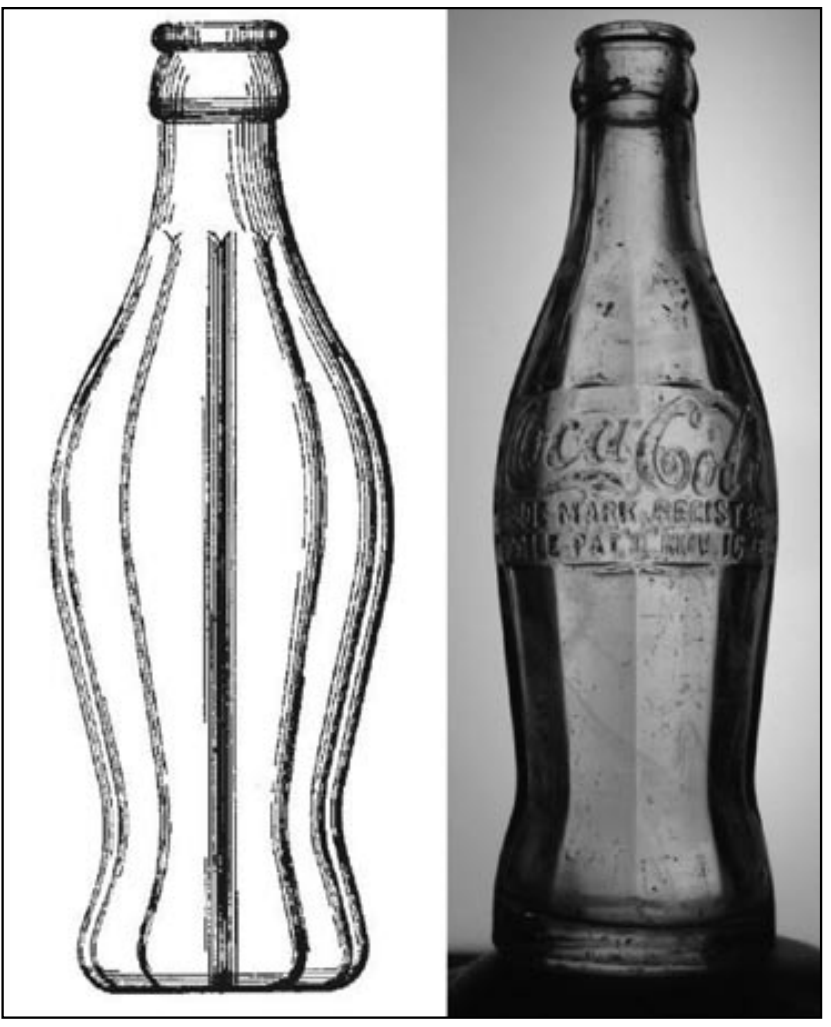
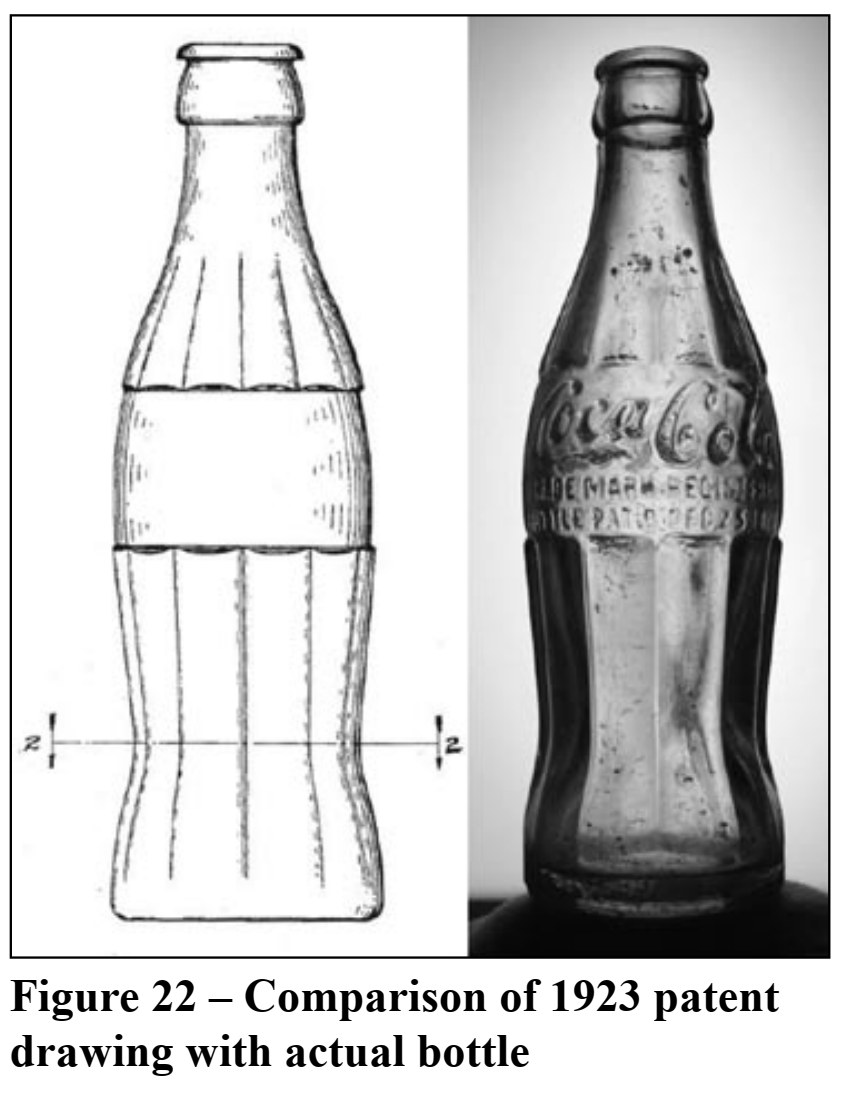
There are some additional design patents of doubtful validity.  1916 production bottle looks a lot more like
the 1923 patent than the 1915 design, so is the 1923 patent valid? (see this great article on tracking
the shape of the bottle
 from which the pictures above are taken).  It’s
possible, though also a stretch, to think that the 1916 bottle would infringe
the 1915 design if unauthorized.  But
once that 1915 patent expired, shouldn’t folks have been free to sell their own
bottles in that shape?  [I was expecting
a discussion of the on sale bar, maybe anticipation; that 1916 bottle sure
looks like it ought to trigger the on sale bar for the 1923 bottle.]
Evergreening is a common strategy in other areas, such as
pharma. Is there a link?  It may depend
on what we think we’re protecting. Aesthetic features of a bottle? Brand investment/source
identification? Exclusivity on attractive design?
Should Kellogg
treatment for functionality be applied to expired design patents as well as expired
utility patents?  Courts have
unhesitatingly said no, but perhaps they should hesitate.
Q: we have no idea what optimal incentives are in any IP
field.  Better to say: isn’t it interesting
to look at how law evolves when it has no idea what the welfare answer is?
Perpetual exclusivity was probably not what Congress wanted
under utility patent system; what about design/TM systems?
RT: [Role of incontestability is really significant here.  If you convince the PTO once to register your
design and wait five years, you can get perpetual protection even without actual
secondary meaning persisting over time. 
Congress wasn’t thinking about trade dress & incontestability’s
interactions (in part b/c it’s pretty clear they didn’t expect registration of
trade dress) and that creates a significant “perpetual patent” problem.] [And
by the way, you can get a registration through a presumption of secondary
meaning from showing five years of substantially exclusive use … which a design
patent will have given you, plus more years beside.  The PTO need not accept exclusive use as sufficient
evidence of secondary meaning, and it does not necessarily apply the
presumption in all product design cases, but the statute gives it a bunch of
freedom.]
[my love of TerraCycle as an example: TerraCycle puts its
fertilizer in recycled bottles, including recycled Coca-Cola bottles.  It’s an example of defendant-side
functionality; even if the bottle isn’t functional for people who are making
their own new bottles, it is for the business model that incorporates
recycling.]
Q: from this morning: look at internal and external evidence
about their intent to create secondary meaning and their success in doing so.
Q: possible rule providing that you can’t register a TM for
a design patent for five years after the expiration of patent protection?  [Also would have to know, as Sarah Burstein
has emphasized: What is the patented design?]
A: yes, that would affect incentives. The hesitation is that
maybe it’s ok to allow registrations. 
Source identification is often a good thing. The anxiety is that one form
of transient/temporary protection turns into something else.
Q: the problem is strategic behavior where a party seeks the
first right (design patent) to secure the second (TM).
A: does it distort claims made about the product during the
period you’re seeking protection? That would be a reason to try to avoid this
behavior.
Q: related to whether there’s intent—are firms trying to
earn a return on investment on brand? 
One should perhaps not be allowed to fall into trade dress protection,
but should have to show investments were made. 
[This would be an easier rule for courts to tolerate if we recognized a separate
role for unfair competition.]

from Blogger http://bit.ly/2GU5Crc

Posted in Uncategorized | Tagged , , , , , | Leave a comment

Student writing competition on tech law

Georgetown Law’s Institute for Technology Law & Policy and The Georgetown Law Technology Review are pleased to announce a new student writing competition to encourage original writing in the field of tech law and policy.

2018-2019 TOPIC

Entrants are invited to submit papers addressing a legal or public policy question relating to artificial intelligence, machine learning, the use of data analytics and/or algorithmic decision-making. Example topics include: questions of data ownership, questions relating to transparency or testability, questions relating to intellectual property, privacy, consumer protection, competition, issues of bias and discrimination, or product liability; or subject-matter- specific legal issues arising from various applications of a technology. Preference will be given to papers that are relevant to current legal and public policy debates or present an original perspective.

PRIZE

Up to three winners will be selected, with a First Prize of $4,000, a Second Prize of $2,000, and a Third Prize of $1,000.
Winning papers may be selected for publication in The Georgetown Law Technology Review.


QUESTIONS?

from Blogger http://bit.ly/2Vfo8UU

Posted in Uncategorized | Tagged | Leave a comment

Commercial Speech and the First Amendment, NYC, June 3 (invitation)

Register at this link.

From Yale Law School’s Abrams Institute for Freedom of Speech – The 4th Commercial Speech and Commercial Speech Conference
COMMERCIAL SPEECH POST-NIFLA v. BECERRA: LEGITIMATE CHECK ON COMPELLED SPEECH OR WEAPONIZATION OF THE FIRST AMENDMENT?
Panelists:
  • Robert Post – Sterling Professor of Law at Yale Law School, New Haven, CT
  • Coleen Klasmeier – Partner and Global Coordinator of the Food, Drug and Medical Device Regulatory Practice Area Team at Sidley & Austin LLP, Washington, D.C.
  • Jane Bambauer, Professor of Law, James E. Rogers College of Law, The University of Arizona, Tucson, AZ
Moderator:
  • Joel Kurtzberg – Partner, Cahill Gordon & Reindel LLP, New York, NY
While the United States Supreme Court’s recent decision in National Institute of Family and Life Advocates v. Becerra is technically not a commercial speech case, the decision is part of a recent trend of cases applying strict scrutiny, with few exceptions, to “content-based regulations of speech,” defined broadly as any law that targets speech based on its communicative content. Assuming the Supreme Court means what it says in NIFLA and other recent decisions, how far are the Justices willing to go in undoing government regulation of speech? Does NIFLA mark the death-knell of Central Hudson? Will strict scrutiny apply to most future regulations of commercial speech? Is the future one filled with challenges to the vast array of governmental regulation that engages speech?
THE CONSUMER “RIGHT TO KNOW” VERSUS THE FIRST AMENDMENT
Panelists:
  • – Johan Verheij Memorial Professor of Law and Director, Center for Business Law and Regulation, Case Western Reserve University School of Law, Cleveland OH
  • Rebecca Tushnet – Frank Stanton Professor of the First Amendment, Harvard Law School, Cambridge, MA
  • – Partner, Appellate and Constitutional Law Group and Co-Chair, Administrative Law and Regulatory Practice Group, Gibson, Dunn & Crutcher LLP, Washington, D.C.
Moderator:
  • Jonah Knobler, Partner, Patterson Belknap Webb & Tyler, New York, NY
Increasingly, governments at all levels are requiring product manufacturers to disclose information in their labeling or advertising, and plaintiffs are seeking to hold manufacturers liable in tort on the theory that the failure to disclose such information is “misleading” or “unfair.” Meanwhile, the subject matter of these disclosure requirements (or asserted requirements) continues to expand beyond traditional health-and-safety warnings to include information about, e.g., country of origin, inclusion of GMO ingredients, and use of ingredients or materials “tainted” by unfair labor practices or international conflicts.
This panel will address the tension—if any—between such mandatory disclosure regimes and manufacturers’ First Amendment right to refrain from compelled speech.
DRAWING THE LINE BETWEEN “NEWS” AND COMMERCIAL SPEECH
Panelists:
  • Mary Engle – Associate Director, Division of Advertising Practices, Federal Trade Commission, Washington, D.C.
  • Paul Safier – Of Counsel, Ballard Spahr LLP, Philadelphia, PA
Moderator:
  • Terri Seligman – Partner and Co-Chair of the Advertising, Marketing & Public Relations Group, Frankfurt Kurnit Klein & Selz, New York, NY
This panel will focus on recent decisions defining what is and is not commercial speech from the broad perspective of newsworthiness. Recently, there have been several decisions in which the courts and National Advertising Division have been forced to distinguish between news and commercial speech. Are we seeing a trend toward more liberal interpretations of “news” or “newsworthiness”? What implications does this line-drawing have for the right of publicity, native advertising, and custom content? Where will the increasing use and monetization of data fall on the news/commercial speech divide?
Hosted by
Patterson Belknap Webb & Tyler1133 Avenue of the Americas
New York, NY 10036
Additional sponsors: Ballard Spahr LLP, Davis Wright Tremaine LLP, Frankfurt Kurnit Klein & Selz PC
Application for New York accreditation of this program is currently pending.

from Blogger http://bit.ly/2V1uIJu

Posted in Uncategorized | Tagged , , , , , | Leave a comment

Commercial Speech and the First Amendment, NYC, June 3 (invitation)

Register at this link.

From Yale Law School’s Abrams Institute for Freedom of Speech – The 4th Commercial Speech and Commercial Speech Conference
COMMERCIAL SPEECH POST-NIFLA v. BECERRA: LEGITIMATE CHECK ON COMPELLED SPEECH OR WEAPONIZATION OF THE FIRST AMENDMENT?
Panelists:
  • Robert Post – Sterling Professor of Law at Yale Law School, New Haven, CT
  • Coleen Klasmeier – Partner and Global Coordinator of the Food, Drug and Medical Device Regulatory Practice Area Team at Sidley & Austin LLP, Washington, D.C.
  • Jane Bambauer, Professor of Law, James E. Rogers College of Law, The University of Arizona, Tucson, AZ
Moderator:
  • Joel Kurtzberg – Partner, Cahill Gordon & Reindel LLP, New York, NY
While the United States Supreme Court’s recent decision in National Institute of Family and Life Advocates v. Becerra is technically not a commercial speech case, the decision is part of a recent trend of cases applying strict scrutiny, with few exceptions, to “content-based regulations of speech,” defined broadly as any law that targets speech based on its communicative content. Assuming the Supreme Court means what it says in NIFLA and other recent decisions, how far are the Justices willing to go in undoing government regulation of speech? Does NIFLA mark the death-knell of Central Hudson? Will strict scrutiny apply to most future regulations of commercial speech? Is the future one filled with challenges to the vast array of governmental regulation that engages speech?
THE CONSUMER “RIGHT TO KNOW” VERSUS THE FIRST AMENDMENT
Panelists:
  • – Johan Verheij Memorial Professor of Law and Director, Center for Business Law and Regulation, Case Western Reserve University School of Law, Cleveland OH
  • Rebecca Tushnet – Frank Stanton Professor of the First Amendment, Harvard Law School, Cambridge, MA
  • – Partner, Appellate and Constitutional Law Group and Co-Chair, Administrative Law and Regulatory Practice Group, Gibson, Dunn & Crutcher LLP, Washington, D.C.
Moderator:
  • Jonah Knobler, Partner, Patterson Belknap Webb & Tyler, New York, NY
Increasingly, governments at all levels are requiring product manufacturers to disclose information in their labeling or advertising, and plaintiffs are seeking to hold manufacturers liable in tort on the theory that the failure to disclose such information is “misleading” or “unfair.” Meanwhile, the subject matter of these disclosure requirements (or asserted requirements) continues to expand beyond traditional health-and-safety warnings to include information about, e.g., country of origin, inclusion of GMO ingredients, and use of ingredients or materials “tainted” by unfair labor practices or international conflicts.
This panel will address the tension—if any—between such mandatory disclosure regimes and manufacturers’ First Amendment right to refrain from compelled speech.
DRAWING THE LINE BETWEEN “NEWS” AND COMMERCIAL SPEECH
Panelists:
  • Mary Engle – Associate Director, Division of Advertising Practices, Federal Trade Commission, Washington, D.C.
  • Paul Safier – Of Counsel, Ballard Spahr LLP, Philadelphia, PA
Moderator:
  • Terri Seligman – Partner and Co-Chair of the Advertising, Marketing & Public Relations Group, Frankfurt Kurnit Klein & Selz, New York, NY
This panel will focus on recent decisions defining what is and is not commercial speech from the broad perspective of newsworthiness. Recently, there have been several decisions in which the courts and National Advertising Division have been forced to distinguish between news and commercial speech. Are we seeing a trend toward more liberal interpretations of “news” or “newsworthiness”? What implications does this line-drawing have for the right of publicity, native advertising, and custom content? Where will the increasing use and monetization of data fall on the news/commercial speech divide?
Hosted by
Patterson Belknap Webb & Tyler1133 Avenue of the Americas
New York, NY 10036
Additional sponsors: Ballard Spahr LLP, Davis Wright Tremaine LLP, Frankfurt Kurnit Klein & Selz PC
Application for New York accreditation of this program is currently pending.

from Blogger http://bit.ly/2V1uIJu

Posted in Uncategorized | Tagged , , , , , | Leave a comment