CFPB hiring

 Of possible interest; excerpts:

The Consumer Financial Protection Bureau is recruiting attorneys and non-attorneys at all experience levels to join our Enforcement team.… We are offering opportunities in multiple enforcement positions in our Washington, D.C. headquarters and in our regional offices located in San Francisco, New York, Chicago, and Atlanta. We also have flexible telework polices in place, allowing employees to be either office or telework primary. Positions will include Enforcement Attorneys as well as several non-attorney positions include analysts, paralegals, e-litigation support specialists, economists, and more!

from Blogger http://tushnet.blogspot.com/2023/10/cfpb-hiring.html

Posted in Uncategorized | Leave a comment

Old Bay or 420 Bud?

 This sticker doesn’t seem particularly likely to confuse to me, and dilution is bunk:

from Blogger http://tushnet.blogspot.com/2023/10/old-bay-or-420-bud.html

Posted in Uncategorized | Tagged , | Leave a comment

TM co-owner can’t challenge uses authorized by other co-owners (bonus Lexmark reasoning)

Reed v. Marshall, 2023 WL 6963661, No. H-21-3942 (S.D. Tex.
Oct. 20, 2023)

In 1991, Reed and defendants Marshall and Harris formed the
recording group Jade, and in 1992 they signed an exclusive recording agreement
with a now-defunct label, Giant. The Giant agreement provided that the service
mark “JADE” would be held exclusively by the Jade Group, that at no time would
more than one member of the Jade Group appear on a non-Jade Group recording,
and that no additional members would be added to the Jade Group without Giant’s
consent. The three principals registered JADE for “entertainment services,
namely live performances by a musical group,” identifying the owner as “JADE,”
a California “partnership,” “composed of Joi Marshall, Deyelle Reed and Tonya
Harris.” In 1995, Harris decided to stop performing with Jade, and the members
pursued individual careers.

In 2013, Marshall and Harris posted a video to YouTube.com
titled “Jade — Continuum,” which included vintage footage of Jade, including Reed,
from the 1990s, and promotional material for a new recording featuring Holloway
under the name “JADE.” Reed objected, claiming to own “equal ownership and
rights” to the Jade name and also claiming violation of her right of publicity.
In 2014, Marshall and Harris appeared together at the Judge Mablean Ephraim
Foundation red carpet where they identified themselves as “Jade.”

In 2018, in anticipation of a reunion tour, the three filed
an application to register the service mark “JADE” for “Entertainment services
in the nature of live musical performances” and related services. Marshall and
Harris later entered into an agreement with defendant Holloway, pursuant to
which Holloway would “create/contribute to live performances and promotions …
as ‘work for hire.’” When Reed learned that Marshall and Harris had hired Holloway
to sing in her place at a “90’s Kickback Concert” tour using the Jade mark, she
objected again.

Defendants admitted that they performed as Jade at a “90’s
Kickback Concert” held in three different locations in 2021; they did not
account to Reed for any profits.

Reed alleged that Holloway was violating §32 of the Lanham
Act. Marshall and Harris responded that they, as co-owners, consented to her
use (while performing with them), and no agreement with Reed barred them from
doing so. The court agreed with defendants. Although Reed was clearly within
the statute’s zone of interests, there was no evidence that her injuries were
proximately caused by a violation of the statute. There was no argument or
authority that, by performing under the mark with Marshall and Harris, Holloway
infringed Reed’s rights. This is why co-ownership is disfavored in trademark—but
co-ownership is not prohibited. Courts have uniformly held that federal claims
for infringement cannot be maintained against co-owners because “[c]o-owners of
trademarks hold ‘equal and unfettered rights of use.’ ” As one court explained,
“[b]ecause co-owners are naturally associated with the same source, … use by a
co-owner cannot create confusion as to the source among consumers.” Although a
co-owner might be entitled to an accounting, that was not a federal claim. It
follows that “a valid licensee of one co-owner of a trademark cannot be liable
to another co-owner for infringement.” This reasoning also disposed of
contributory/vicarious infringement claims against Marshall and Harris.

§43(a) false designation of origin/false advertising: Lexmark
applied to both, and Reed failed to present evidence that she suffered an
injury to a commercial interest in sales or business reputation proximately
caused by the defendants’ misrepresentations. There was no evidence that Reed
marketed services under the mark such that its single source identifying value had
been fractured or undermined. And there was no authority that Marshall and
Harris needed her authorization to use the mark in commerce. Although joint ownership
might potentially lead to confusion, there was still no commercial injury to Reed’s
business reputation or sales. Reed didn’t identify evidence that defendants
used Reed’s likeness or voice in advertising materials, or credited Holloway
instead of Reed for her performances/recordings (also Dastar-barred, by
the way; the court discusses a lot of pre-Dastar 9th Circuit
precedent that can’t be valid any more).

Dilution also failed. “[F]ederal claims for dilution — like
claims for infringement — cannot be maintained against co-owners.”

The court declined to exercise supplemental jurisdiction over
the Texas dilution and ROP claims. (I would expect they’re preempted.)

from Blogger http://tushnet.blogspot.com/2023/10/tm-co-owner-cant-challenge-uses.html

Posted in Uncategorized | Tagged , , , | Leave a comment

New Jot on Article 17

 I review an interesting article here.

from Blogger http://tushnet.blogspot.com/2023/10/new-jot-on-article-17.html

Posted in Uncategorized | Tagged , | Leave a comment

it is unfair to fail to disclose paid promotion/for influencers not to do due diligence on what they promote

In Re Ethereummax Investor Litig., No. CV 22-00163-MWF (SKx),
2023 WL 6787827 (C.D. Cal. Jun. 6, 2023)

EMAX is a cryptocurrency project centered around the
EthereumMax, which can be traded, spent, or otherwise transacted between token
holders. EMAX Tokens were sold on decentralized exchanges, which require users
to pay potentially significant “gas fees” in order to process the transaction
on the Ethereum blockchain. They were launched without a “whitepaper”—a roadmap
for growth/success. Subsequently, however, EMAX did release a whitepaper in
October 2021, which explained the business model for EMAX, and which plaintiffs
alleged revealed that EMAX’s “entire business model relies on using constant
marketing and promotional activities, often from ‘trusted’ celebrities, to dupe
potential investors into trusting the financial opportunities available with
EMAX Tokens.” This was, they alleged, a pump and dump scheme.

This is one of two opinions—the next revisiting this one,
which dismisses some claims but allows others. I’ll focus, as usual, on the
false advertising bits and ignore the securities law parts. Initially, the
court denied the motion to dismiss consumer protection law claims simply
because the complaint also alleged violation of state securities laws and
consumer protection laws don’t cover securities. “Given the issue of whether
the Tokens are a “security” is a genuinely unanswered legal question, it would
be unfair (and contrary to Rule 8) to prohibit alternative pleading at this
stage of the litigation.” Plus plaintiffs properly articulated a theory of harm,
including a price premium theory. And plaintiffs’ claims involved affirmative
misrepresentations, so influencers like Kim Kardashian didn’t need to have
knowledge of the falsity. By contrast, statements of “belief” in future growth
were classic puffery. And claims based on Floyd Mayweather’s failure to
disclose he was paid to promote EMAX tokens were dismissed because plaintiffs
failed to show he had a duty to disclose.

Previously, the court rejected RICO claims in part because
the court read the first version of the complaint to claim that the price was the
result of celebrity endorsements that increased the popularity of the Tokens. “That
market participants were willing to (and that Plaintiffs in fact did) pay more
because celebrities were connected to the Tokens did not appear to the Court to
be a concrete loss sufficient to establish a RICO ‘injury.’” But the amended
complaint added a lot more detail, making it plausible that the price was distorted
or manipulated, not just a real result of celebrity glamor spillover.

For example, defendants allegedly promoted the ability to
use EMAX Tokens for purchases in nightclubs like Club LIV and Story, and their
price “dropped sharply on the news that EMAX Tokens would not be available for
payment at Club LIV as promised.” “If Plaintiffs can prove that objectively
reasonable people are willing to pay more for cryptocurrencies that can be used
at venues in the real world than they are willing to pay for Tokens that cannot
be so used, Plaintiffs may be able to prove that they paid more for EMAX Tokens
than the fair market value.”

Although Kardashian primarily made these claims for use at
nightclubs, “presumably” the corporate executive defendants could be jointly
liable on a showing that this was done on their/the company’s behalf.

Another theory of harm came from allegations that the
executive defendants and some of the promoter/influencer defendants were selling
off their tokens as they promoted them, engaging in market manipulation. Difficulties
quantifying the amount weren’t dispositive at this stage. They adequately
alleged that the price rose when the tokens were promoted and then fell based
on the undisclosed and allegedly unfair selling activities of the insider defendants
who possessed massive amounts of free tokens. However, plaintiffs would
ultimately bear the burden of showing that the alleged unfair conduct caused
their losses, which would require them to isolate the price increases
attributable to specific wrongdoing by specific defendants. Defendants noted
that the price of the tokens was already increasing three days before one of
Kardashian’s post, and went down right after both of her posts, which they
argued meant there was no price premium. Although the court agreed that volatility
and other factors could make proof difficult, it pointed out that this scenario
was also consistent with a story that “the insiders were accumulating Tokens
prior to the impending posts, causing the price to rise, and then selling off
immediately after the posts, causing the price to plummet – leaving those who
bought in reliance on the post with losses and providing the insiders, who sold
off in tandem with the posts, a profit.”

Did plaintiffs plead that legal remedies were inadequate? It
was quite possible that they’d lack an adequate legal remedy if CLRA claims are
inapplicable to intangible goods and the tokens are also not securities; this
was enough for unjust enrichment. “However, the Court emphasizes that legal
remedies must actually be unavailable or inadequate for Plaintiffs to
eventually recover on the equitable claims. Therefore, abandoning the
securities claim simply because the equitable claims appear to be easier to
obtain will not be a viable option.” Also, the plaintiffs didn’t even try to
specify inadequacy as to unjust enrichment, so that claim was kicked out, but
the court declined to dismiss UCL/FAL claims on this ground. Plaintiffs were
plausibly eligible for restitution under the UCL/FAL. There was no privity
requirement as long as the plaintiffs had an interest in the money and proof
that the defendant “may” have acquired a benefit from an unfair practice.

Kardashian’s posts:

Liv and Story now exclusively accepting crypto (EthereumMax)
first post, touting usability at nightclubs

One post indicated that Club LIV and Story were “now
accepting” EMAX Tokens “for all table reservations and bookings.” This statement
was plausibly false when made. And knowledge of the falsity is not required for
an affirmative misrepresentation. The FAL explicitly provides that plaintiffs
can recover for advertisements that were “known, or which by the exercise of
reasonable care should be known, to be untrue or misleading.” “With the ‘exercise
of reasonable care,’ (i.e., simply confirming the truth of the statement with
the people on behalf of whom she was promoting), Kardashian should have known
that Club LIV lacked the immediate ability to accept the Tokens at the time of
the May Post.”

More generally, the court reasoned: “As a paid spokesperson,
a celebrity endorser stands in the shoes of the company she is promoting, and
such an endorser should be expected to take at least some steps to confirm the
truth of any statement she wishes to disseminate to the public.”

Kardashian’s second post:

Kim Kardashian post about her "friends" telling her that Ethereum Max was giving back to the community by burning 50% of the admin wallet
Ethereum Max “burned … literally 50% of their admin wallet”

This was allegedly false/misleading because it wasn’t an
organic sharing of what friends had told her, but paid promotion, and also
because the content of the message created the false impression that the EMAX
Tokens were scarce because it indicated that the founders had “burned” “50% of
their Admin Wallet.” The first theory wasn’t convincing: “sharing what my
friend just told me” would not, in this specific context, imply that she wasn’t
being paid. The post included a “#AD” disclaimer “making it clear that Kardashian
was being paid.” Although the hashtag was toward the bottom of the post, “given
there is a banner in big and bold font stating ‘SWIPE UP’ placed below the
string of hashtags, any reasonable consumer would inevitably see the hashtags
before swiping up to purchase the Tokens.” Plus, “based on the Court’s common
sense and experience, hashtags are a commonly used mechanism of communicating
information on social media platforms and one would reasonably expect to see
such an advertising disclaimer in the form of a hashtag below the substance of
the post.” The explicit “not financial advice” statement also arguably made her
spokesperson status clearer.

Also, it was Kim Kardashian:

Given Kardashian’s background and
experiences, there is nothing to suggest that she was speaking on her own
behalf, and she did not even imply that she was using or buying the Tokens
herself. It is widely understood that Kardashian is paid for many of her social
media posts, and therefore, it should not come as a surprise to any reasonable
consumer that she was paid for the June Post given it included the “#AD”
disclaimer.

But there was still potentially deceptive content: Even if
400 trillion tokens were in fact burned, plaintiffs sufficiently alleged
misleadingness given that two quadrillion Tokens had been originally created:

The only possible reason that a
business would pay someone to tell millions of followers that its product was
rapidly being “burned” is to create an impression of scarcity, which as a
matter of common sense economics, is intended to drive up demand and price.
Advertising that conveys messages concerning limited supply or limited time
offers are meant to create a sense of urgency and will inevitably be material
to consumers who want the product or price offered. The scarcity statement in
the June Post was clearly framed in a way to make the burning of 400 trillion
Tokens appear to be a large number because it suggested that 50% of the entire
universe of Tokens had been burned, and consumers reasonably would expect to be
told if the percentage related to some metric other than the total universe of
Tokens.

The court also gave weight to the allegation that at least
one consumer survey found that 19% of respondents that saw the post invested in
EMAX Tokens as a result.

Floyd Mayweather: The only misrepresentations/omissions
directly attributable to him as potentially false advertising were statements
at the “Bitcoin 2021” conference and the fact that he wore clothing with the
EMAX label during widely publicized events without disclosing that he was being
paid to do so. The statement “I believe there’s gonna be another cryptocurrency
just as large as Bitcoin someday” made while wearing a t-shirt with
“EthereumMax” emblazoned across the chest was clearly puffery.

Plaintiffs also alleged that, by wearing a shirt and boxing
gear bearing the EMAX name and allowing EMAX to use his name and fame to
promote EMAX in association with the Mayweather vs. Logan Paul fight, without
disclosing that Mayweather was being paid to do so, Mayweather falsely led
consumers to believe that he was organically interested in EMAX and that he was
a key investor in the Token, as opposed to a paid celebrity endorser. This had some
logic:

[C]onsumers may believe that a
celebrity’s use or association with a product says something about the product
if they tend to trust that celebrities’ judgment or believe the celebrity has
valuable insight on a particular product’s features. That reliance alone would
not give rise to a claim for false advertising. However, if the consumer is
aware that the celebrity has used/worn a product, not because of its inherent
benefits, but because he or she is being paid to do so, that could change the
consumer’s perception of the product.

However, this was an omission theory of liability. Courts usually
only find an omission fraudulent or deceptive: (1) when the defendant is in a
fiduciary relationship with the plaintiff; (2) when the defendant had exclusive
knowledge of material facts not known to the plaintiff; (3) when the defendant
actively conceals a material fact from the plaintiff; and (4) when the
defendant makes partial representations but also suppresses some material
facts. But plaintiffs didn’t allege that any of these occurred.

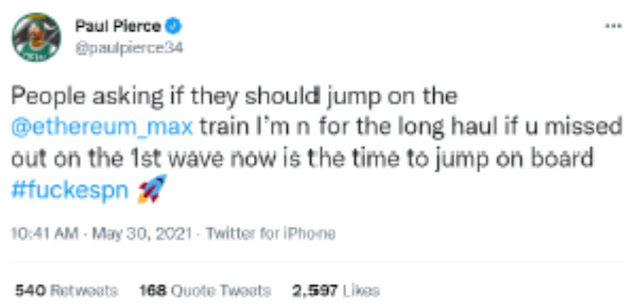
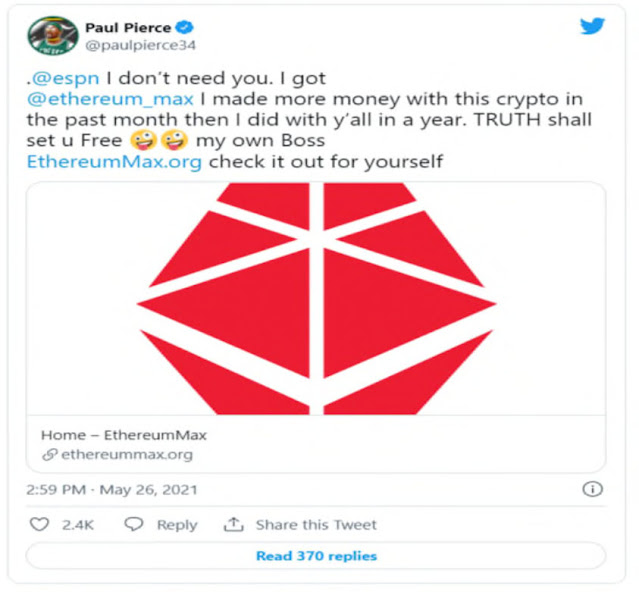
Paul Pierce: He allegedly falsely represented that he made
substantial money through EMAX investments (though much of his returns were
attributable to selling the free EMAX Tokens he obtained as compensation for
his promotions) and that he was committed to investing in EMAX as a long-term
investment (despite the fact that he was simultaneously selling off large numbers
of EMAX Tokens).
tweet from Paul Pierce claiming he made more money from Ethereum than from ESPN

post showing $2.5 million value of "investment"

tweet in which Paul Pierce says he's in for the long haul with rocket emoji

This was different from the allegations against Mayweather: “he
explicitly represented that he was an actual investor in EMAX, making it even
more important that he disclose his payments.” Not only that, but he also
failed to disclose that his “investment” in EMAX was largely based on free
Tokens given to him in exchange for his posts, rather than on his having
actually paid money for them and having the tokens rise in price. This made it
plausible that reasonable consumers would take away a false meaning. These were
not forward-looking but claims that he had already “made more money” in “the
past month” than he did in a year at ESPN, which was a specific, measurable
statement of existing fact.

Pierce argued that reasonable consumers would have to know
he was a paid promotor, but the court disagreed that it would be obvious to a
reasonable consumer that Pierce had been paid to promote EMAX in the form of
EMAX Tokens. “The difference is important because had Pierce actually invested
large amounts of money in EMAX, his incentive would be aligned with other
investors — namely, to ensure the price stayed high. But since he was given
EMAX Tokens for free, he had much more incentive to sell the Tokens given any
amount sold would produce a return.”

So too with the “long haul” statement.  “His statement was an affirmative
representation of his personal investment position, which could be proven false
if Plaintiffs can prove that reasonable consumers have a common understanding
of what ‘long haul’ means in the relevant context.”  His trading activity lasted a total of 16
days, “and that fact alone could suggest falsity.” Three days after telling
investors he was invested for the “long haul,” he sold 9.7 trillion EMAX
Tokens. Materiality was a closer question, since Pierce isn’t a well-known
financial advisor.

But consumers didn’t need to think of him as a sound financial
advisor to rely on his statements, given his statements that he had a sizeable
position worth over $2 million. It was plausible for consumers to believe that
he had a large enough stake that his long-term retention would significantly
impact the market price, and plaintiffs alleged that his trading activity did
in fact affect the price drastically.

Other statements against the company/executives weren’t sufficiently
pled as false advertising (see below for unfairness analysis). The court thought
that certain things were vague puffery: the statement that “technological
upgrades” were on the way for EMAX; that EMAX had secured a “landmark
agreement” with the Mayweather team; that there wouldn’t be a “rug pull”; and that
the founders were “looking to lock their wallets.”

UCL unfairness: California courts have different approaches
to unfairness. Some require anticompetitive conduct, though that’s only
mandatory for cases brought by competitors. Some balance the utility of the
conduct against the alleged harm. And some apply the FTC Act standard. The
court here applied the balancing test, informed by FTC test considerations.

The unfairness UCL claim against the promoter/influencer
defendants seemed to be based on celebrities’ promotions of worthless
investments to their loyal followings without at least vetting the Tokens
and/or disclosing that they received substantial compensation for their
promotions. That against the company executives as well as Mayweather and
Pierce focused on allegedly knowing orchestration of a “pump-and-dump” scheme.
And perhaps the executives’ conduct was unfair because they knowingly solicited
investor funds with no legitimate business plan for sustainable returns.

Promoter liability: Defendants argued that there was no substantial
injury, and that plaintiffs could have avoided the injury by doing better
research instead of making investments based on celebrity endorsement. Plaintiffs
pointed to an FTC Report noting that cryptocurrency has become “an alarmingly
common method for scammers to get peoples’ money” and that since the start of
2021, more than 46,000 people have reported losing over $1 billion in crypto
scams,” which is more than any other payment method.

Under the balancing test, a practice is “unfair” if the
conduct is “immoral, unethical, oppressive, unscrupulous or substantially
injurious to consumers” and the “utility” of the “defendant’s conduct [does not
outweigh] the gravity of the harm to the alleged victim.” Plaintiffs adequately
alleged uinfairness against the promoter defendants “based on the practice of
touting an investment opportunity to their followers without vetting the
opportunity or disclosing compensation for their endorsements.” This was at
least “unscrupulous”; even as to Kardashian, it was still plausible “that the
practice of touting a financial investment to her millions of loyal followers
(and encouraging them to purchase), without any sound basis for believing it to
be a worthwhile investment is an unscrupulous and thereby unfair practice.”

And the FTC report made it more plausible that plaintiffs acted
reasonably: “it cannot be the case that the many thousands of people that have
been defrauded by crypto scams are all unreasonable consumers.” It was also
significant that the posts were specifically aimed at “already-dedicated
followers,” who were by definition “predisposed to place significance on what
the celebrities they follow are doing and saying” and “particularly vulnerable
to the messages conveyed to them.” Plus, the relevant information—that the
celebrities were promoting for pay instead of from an honest belief—was not
disclosed anywhere by anyone, so more research wouldn’t have helped. Also, “Defendants
do not offer a single countervailing benefit of allowing celebrities to endorse
unvetted products without disclosing that they are being paid to do so.” The
court also noted that its position was supported by the SEC’s position on the
matter (the FTC thinks so too!).

The pump-and-dump scheme was also sufficiently alleged to be
unfair (if not barred by securities laws). “[T]he fact that the securities laws
prohibit such conduct demonstrates that the claim is tethered to legislative
public policies and advances the spirit of such laws.”

The third theory—solicitation of investments promising
substantial returns despite the lack of any legitimate business plan—also sufficed
against the executive defendants. “The practice is certainly unscrupulous and
unethical, and (as has been discussed) caused losses to at least certain
consumers, leaving them with a ‘practically worthless digital asset.’” Investment
promoters are in a position of trust and are expected to responsibly and in
good-faith manage the funds they solicit.

Finally, injunctive relief requests were dismissed because
future harm was not plausible.


In Re Ethereummax Investor Litig., No. CV 22-00163-MWF
(SKx), 2023 WL 6787458 (C.D. Cal. Oct. 3, 2023)

After the previous decision, the plaintiffs amended the complaint
one last time. I’ll only mention relevant consumer protection law changes.

The court previously granted leave to amend to articulate
Mayweather’s duty to disclose the nature of his involvement to support
Plaintiffs’ fraud-by-omission claims under California, Florida, New York, and
New Jersey state consumer protection laws. A failure to disclose a fact can
constitute actionable fraud or deceit “when the defendant has exclusive
knowledge of material facts not known or reasonably accessible to the
plaintiff.” And plaintiffs sufficiently alleged materiality. Mayweather didn’t
identify any cases or otherwise demonstrate that the distinction between being
just a paid promoter and an actual backer is categorically immaterial as a
matter of law. It wasn’t just that he was a paid promoter—that was possible for
consumers to know—but that he omitted the fact that he wasn’t an actual
investor.

This time, the complaint sufficiently alleged that one
executive, Perone, was personally involved in some of the wrongful conduct. It
was not enough to allege that he controlled social media accounts by virtue of
his role as CEO. But plaintiffs alleged more: that he created EMAX and the
company, and was its sole director. “Based on these allegations, it is
plausible that Perone actively and directly participated in the social media
posts.”

from Blogger http://tushnet.blogspot.com/2023/10/it-is-unfair-to-fail-to-disclose-paid.html

Posted in Uncategorized | Tagged , , | Leave a comment

Claims against “Southern Comfort” malt beverage not preempted

Del Rosario v. Sazerac Co., 2023 WL 6318083, No. 23-cv-1060
(AS) (S.D.N.Y. Sept. 28, 2023)

Sazerac sells a malt version of its famous Southern Comfort
whiskey. Plaintiff alleged that Sazerac designed this malt version to look just
like the original one, misleading consumers in violation of New York laws on
deceptive practices and false advertising. Although the court dismissed her
unjust enrichment claim as duplicative, the main claim survived Sazerac’s
preemption argument.

Along with using the same name, colors, themes, fonts,
symbols, and spacing as the whiskey, and including the word “Original” on its
front label, the malt version’s “statement of composition” reads “Malt Beverage
with Natural Whiskey Flavors, Caramel Color and Oak Extract.” “Natural Whiskey
Flavor” allegedly misleads consumers into thinking that the beverage contains a
non-negligible amount of whiskey, and “Oak Extract” allegedly “creates the
false impression” that the beverage was “aged in barrels.”

Sazerac argued that federal regulation required these terms.
But it’s possible to comply with both state and federal law, there’s no
preemption by impossibility. The relevant federal regulation requires malt-beverage
labels to include a statement of composition identifying added coloring
materials, artificial sweeteners, and “flavoring material(s) used before, during,
and after fermentation.” However, it wasn’t “evident from the face of the
complaint” that “whiskey flavors” was even a flavoring material, and anyway the
regulation offered obvious alternatives: flavoring materials can be
“specifically identified (such as ‘Ale fermented with grapefruit juice’) or
generally referenced (such as ‘Ale with natural flavor’).” Sazerac didn’t
explain why it couldn’t use “Malt Beverage with Natural Flavors” (or some other
general reference) instead. Sazerac didn’t argue that giving producers choices
on generality was a significant objective of the regulation. So too with “Oak
Extract.”


from Blogger http://tushnet.blogspot.com/2023/10/claims-against-southern-comfort-malt.html

Posted in Uncategorized | Tagged , , | Leave a comment

no injury to alcoholic kombucha producer from competitor’s false no-alcohol/low-sugar label (cute dogs are also involved)

Tortilla Factory, LLC v. GT’s Living Foods, LLC, No. CV
17-7539 FMO (GJSx), 2023 WL 6296900 (C.D. Cal. Sept. 27, 2023)

Interesting bench trial result that finds no proximate
causation of plaintiff’s injury from defendant’s false advertising. Despite finding
the plaintiff’s expert’s testimony about sugar and alcohol levels in
defendant’s kombucha “credible and compelling,” lack of harm doomed its case.
(But that suggests that some AG might want to get involved, especially as to
whether GT should be selling its products without the alcohol warning label.)

The basic allegations: defendant’s kombucha had much higher
levels of sugar and alcohol than advertised, allowing defendant to sell it
without an alcohol warning and to get consumers who didn’t want those levels of
sugar and alcohol to choose it. Tortilla Factory’s Kombucha Dog has
approximately 1.25% alcohol by volume and is sold as an alcoholic beverage,
with a government-required warning label. It also uses pictures of rescue dogs
on the label. And Tortilla Factory entered into an exclusive distribution deal
that was a disaster—the distributor let lots of accounts die.

Meanwhile, GT is the leading kombucha seller in the market,
with about 50% market share as of 2018, but there are about 300+ kombucha
brands in the US, with California the most competitive state given lots of
local brands.

Tortilla Factory simply couldn’t show the requisite harm.
Although it argued that it expended significant amounts on corrective
advertising about authentic kombucha and sugar, the court found that it was
just typical advertising “undertaken by any small business entering a
competitive market.”

And more generally, the misrepresentations about the amount
of alcohol in, and lack of a government alcohol warning label on, certain of
GT’s products would not have decreased Tortilla Factory’s sales. A customer who
wanted a product that didn’t have enough alcohol to need a label would have
instead purchased “one of dozens of available nonalcoholic kombucha drinks in
the market.” Tortilla Factory’s own expert testified that the alcohol label was
very important to consumers and was a drag on sales. And his survey was suspect
because he showed consumers the front of a Kombucha Dog bottle with images of
rescue dogs, but only the back and side of GT’s Classic bottle, and conceded
that “the photo of a cute dog could inject bias into the result[.]”

Because the alcohol part was so important, the sugar
misrepresentations became unimportant: again, a consumer who wanted lower sugar
content would have chosen a different nonalcoholic kombucha beverage even if
GT’s had been properly labeled, and there was no evidence about consumer
reactions to sugar labels.  

Evidence about Tortilla Factory’s prior customers who
eventually sold GT’s also didn’t show harm causation from falsity, as opposed
to other factors like the disaster distributor or GT providing special flavors
(also, GT sold kegs to some customers, and the evidence of falsity related to
bottles, not kegs; I don’t know the science here so I don’t know if that would
likely make a difference).

from Blogger http://tushnet.blogspot.com/2023/10/no-injury-to-alcoholic-kombucha.html

Posted in Uncategorized | Tagged | Leave a comment

TM and takings claims against Puerto Rico fail: license plates/tags aren’t use in commerce

Clemente Properties, Inc. v. Urrutia, No. 22-1373 (GMM),
2023 WL 6201397, — F. Supp. 3d — (D.P.R. Sept. 22, 2023)

Plaintiffs own Roberto Clemente’s IP rights and a
registration for ROBERTO CLEMENTE for “figurines, statues and statuettes made
of non-precious metal; beer cans made of non-precious metal sold empty.” (The
district court doesn’t appear to care about what the registration is for; I had
to look it up.) They sought at least $45 million from the government of Puerto
Rico for issuing a commemorative license plate for the fiftieth anniversary of
Roberto Clemente’s “Hit 3000,” at $21/plate. There was also a mandatory $5
charge for a commemorative vehicle certificate tag that was yellow, had the
figure of Roberto Clemente with the name “Clemente,” the number “21,” the
number “50,” and phrase “3000 hits.” The revenues were transferred to the
Roberto Clemente Sports District Fund for the use of the Department of Sports
and Recreation.

Plaintiffs brought trademark and related claims, including
takings claims, all of which the court dismissed.

The First Circuit has repeatedly held that Puerto Rico is
entitled to Eleventh Amendment sovereign immunity, which Congress has not
successfully overridden with respect to Lanham Act claims. Nor had the
Commonwealth waived its immunity. “While Plaintiffs seek prospective relief,
they have provided the Court with no basis from which it can infer any
possibility of an ongoing violation of federal law.” For trademark, any request
was moot since the law requiring the sale of license plates and license labels
expired by its own terms on December 31, 2022.

Anyway, there was no viable claim. (Sometimes less is more.
It can’t have helped that plaintiffs claimed that the use infringed tarnished
not only the RC trademark, but also the “trademarks, names and likeness of his
sons as individual businessmen and representatives of the mark.”)

The court began with the proposition that Lanham Act claims
require both “use in commerce” and “commercial use.” Even accepting the
validity of the registration, plaintiffs failed to allege a use of the mark in
commerce “in connection with” “goods or services.” Although they alleged that
they were going to sponsor their own license plates, they didn’t actually
allege that they had done so. The confusion inquiry is “not applied to assess
confusion in the abstract; it is focused on the likelihood that commercially
relevant persons or entities will be confused.”

License plates and vehicle certificate tags are issued by
the Department of Transportation. They are “governmental property intended
primarily to serve a governmental purpose, and inevitably they will be
associated with the state that issues them.” Thus, “not only are these not the
classes of products or services that trademark law protects, but issuing motor
vehicle license plates and tags cannot be considered commercial use, as it is a
clear government activity.”

Plus, the plates and tags depicted Clemente in the context
of “an event of historical significance for both Puerto Rico and Major League
Baseball.” The court doesn’t explain its reasoning but it seems to think this
bolsters the conclusion that this was not a trademark use.

False advertising: No Lexmark standing for want of
proximate cause. Plus, there was no commercial advertisement or promotion.  The plates and tags couldn’t be considered ads.
Further, depicting Clemente in historical context was descriptive, not
misleading. Although plaintiffs alleged that defendants implied, by using
Clemente’s name, that funds raised would go to them, as owners of the mark,
those were “conclusory statements of unspecified injury and of the type that
was not intended to be protected by the Lanham Act.”

Takings: Even if trademarks are protected by the Takings
Clause, sovereign immunity still applied. Also there was no expropriation of
the trademark here.  There was no
permanent physical invasion nor a complete deprivation of all economically
beneficial use. “Plaintiffs remain free to use their trademarks as they wish.”

Claims against
individual defendants failed for all those reasons, plus qualified immunity.

from Blogger http://tushnet.blogspot.com/2023/10/tm-and-takings-claims-against-puerto.html

Posted in Uncategorized | Tagged , , | Leave a comment

proximate causation isn’t as easy when there’s no disparagement

HomeLight, Inc. v. Shkipin, No. 22-cv-03119-PCP, 2023 WL
6284738, — F.Supp.3d —- (N.D. Cal. Sept. 27, 2023)

HomeLight runs an online platform that matches real estate
agents with homebuyers and sellers and requires any agent who accepts a
referral resulting in a sale to pay 25% of their commission to HomeLight.
Shkipin operates an alternative agent-matching platform, HomeOpenly, that does
not charge referral fees and instead obtains revenue from advertising and
auxiliary services. HomeLight sued him for false advertising and trademark violations,
and Shkipin counterclaimed under federal antitrust law, federal false
advertising law, and California’s UCL. I will only discuss the (unsuccessful)
advertising-related claims.

Proximate cause: None of the challenged statements allegedly
disparaged HomeOpenly, so Shkipin needed to allege how deceptive statements
about HomeLight directed at shoppers on HomeLight’s own website “necessarily
caused advertisers not to buy ads from HomeOpenly.” Even assuming a there is a
direct relationship between the number of HomeOpenly visitors and its ability
to sell ads, and that HomeLight’s deceptive statements resulted in some
reduction in the number of shoppers visiting HomeOpenly’s website, this was “too
attenuated to establish proximate cause.” This was especially true given the
countercomplaint’s other plausible explanation for why online home shoppers
might find HomeLight’s website but not HomeOpenly’s: HomeLight’s heavy spending
on various forms of online and TV advertising that Shkipin characterized as
“highly effective.”

Separately, he didn’t properly allege
falsity/misleadingness. Challenged statement: “Our service is 100% free, with
no catch. Agents don’t pay us to be listed, so you get the best match.” The
countercomplaint alleged that the failure to mention that partner agents do pay
referral fees is a “deceptive omission.” But this didn’t plausibly plead that
the omission deceived a substantial segment of HomeLight’s audience, especially
since the counterclaim included a HomeLight webpage specifying that “HomeLight
receives a portion of the agent’s commission as a referral fee.”

Challenged statement: “HomeLight is operated in compliance
with all state and federal housing laws.” Not actionable because it includes a
legal conclusion rather than a statement of fact.

Challenged statement: “The agents we recommend on HomeLight
typically can save you thousands on your home purchase.” Not a promise of
specific results.

Challenged statements such as: “We’ve designed a solution
that allows you to sort through over 2 million agents from all of the top real
estate brokerages in order to find the perfect one for you.” No allegations of
facts contradicting transaction/agent numbers and the rest was subjective
non-actionable puffery.

from Blogger http://tushnet.blogspot.com/2023/10/proximate-causation-isnt-as-easy-when.html

Posted in Uncategorized | Tagged | Leave a comment

EDNY judge doesn’t have a beef with Wendy’s and McDonald’s ads

Chimienti v. Wendy’s Int’l, LLC, No. 22-CV-02880 (HG), 2023
WL 6385346 (E.D.N.Y. Sept. 30, 2023)

Plaintiff alleged New York statutory and common law claims
based on allegations that Wendy’s and McDonald’s misleadingly advertised the
quantity of food contained in various menu items sold at their restaurants by making
the food look bigger in pictures with more toppings and thicker patties. The
court dismissed the claims, mainly because the advertisements were not
misleading as a matter of law.

Plaintiff alleged, for example, that in McDonald’s
advertisements, “the beef patty extend[s] all the way to the edge of the bun,”
but the patty “comes nowhere near the edge of the bun” when a hamburger is
actually served. Defendants allegedly use uncooked, or partially seared, burger
patties for their ads because “fully cooked burgers tend to shrink and look
less appetizing.”

First, the plaintiff failed to allege the necessary injury
because he didn’t allege that he saw the specific ads he identified as misleading.
Even if he had seen them, they were mostly puffery:

Defendants’ act of advertising
their products in a manner that makes them visually appealing … makes no
objective claims about Defendants’ products. Defendants’ efforts to present
appetizing images of their products are no different than other companies’ use
of visually appealing images to foster positive associations with their
products, which courts within the Second Circuit have held to be immaterial
puffery as a matter of law.

Depiction of the size of products, however, relates to an
objective fact and is therefore not puffery. Still, a reasonable customer would
not have been misled, given that the allegation was that the ads used the
identical amount of uncooked meat that a customer would receive cooked: “This
concession that both the advertisements and the products served in stores contain
the same amount of meat is fatal to Plaintiff’s claims.” (I’m not sure this
makes sense. If I thought I was seeing the cooked version, then by hypothesis I
expected even more meat, since the uncooked version would have been even
bigger.) Also, “the entirety of the advertisement on each website page
describes in objective terms how much total food customers would receive.” They
had calorie information, and Wendy’s said theirs was made with a “quarter-pound*”
of beef with the asterisk referring to “[a]pproximate weight before cooking.” Quoting
“various social media personalities who complained about the size and quality
of Defendants’ products” didn’t change this result. “[W]hile plaintiffs are not
required to meet the heightened pleading requirements of Rule 9(b) for GBL
claims, plaintiffs must do more than plausibly allege that a label might
conceivably be misunderstood by some few consumers. Instead, [p]laintiffs must
plausibly allege that a significant portion of the general consuming public or
of targeted consumers, acting reasonably in the circumstances, could be
misled.”

Plaintiff didn’t make any toppings-specific arguments, and
anyway, the ads don’t specify the quantity of the toppings, “so their depiction
of toppings does not become misleading simply because Defendants’ actual
products may contain less than Plaintiff’s ‘personally preferred amount’ of
toppings.”

Also, ads can’t support a breach of contract claim.

from Blogger http://tushnet.blogspot.com/2023/10/edny-judge-doesnt-have-beef-with-wendys.html

Posted in Uncategorized | Tagged , | Leave a comment