Classmates.com, the right of publicity, and copyright preemption

Callahan v. PeopleConnect, Inc., 2021 WL 5050079, No.
20-cv-09203-EMC (N.D. Cal. Nov. 1, 2021)

Plaintiffs in this putative class action alleged that
PeopleConnect misappropriated their names, photographs, and likenesses and used
the same in advertising its products and services, “including reprinted
yearbooks and subscription memberships to the website Classmates.com.” They
sued for ROP violations, intrusion on seclusion, and unjust enrichment.

The court rejected the CDA §230 defense because PeopleConnect
would only count as providing “information provided by another information
content provider” if the other info content provider had given it the yearbooks
contemplating that they could be published online. And there was at least a
question of fact whether the yearbook authors/publishers had done so; rather
the yearbooks seemed to have been provided by users/purchasers. A service
provider can be “held accountable if, e.g., it is obvious that the person or
entity providing information to the service provider is not the creator or
developer of the information.” [I’m guessing the court means to cabin its
holding to situations in which the service actively decides to put specific
content online instead of just serving as a user conduit for, e.g., revenge
porn.] Here, it was obvious that yearbook users/purchasers weren’t
creators/developers of the yearbooks.

Copyright preemption: PeopleConnect did a little better. Plaintiffs
argued that, because PeopleConnect didn’t own copyright in the yearbooks, it
had no standing to assert copyright preemption. The court rejects this argument,
for good reason. (The court doesn’t mention it, but one reason clearly implicated
by this situation is first sale: if someone has a lawfully made copy of a
yearbook to sell, their lack of copyright ownership shouldn’t affect the fact
that ROP claims against the sale are preempted.) The Ninth Circuit has clearly
held:

Whether a claim is preempted…does
not turn on what rights the alleged infringer possesses, but on whether the
rights asserted by the plaintiff are equivalent to any of the exclusive rights
within the general scope of the copyright. The question is whether the rights
are works of authorship fixed in a tangible medium of expression and come
within the subject matter of the Copyright Act. If a plaintiff asserts a claim
that is the equivalent of a claim for infringement of a copyrightable work,
that claim is preempted, regardless of what legal rights the defendant might
have acquired.

Jules Jordan Video, Inc. v. 144942 Canada Inc., 617 F.3d
1146 (9th Cir. 2010). Allowing such a claim would provide “a de facto veto over
the [copyright holder’s] rights under the Copyright Act,” [including its rights
to tolerate use/also would provide a veto over fair uses].

But were the claims preempted? Yes, as applied to ads for copies
of yearbooks, but no, as applied to ads for the subscription service. “[U]sing
a portion of the copyrighted work to promote the copyrighted work does not take
a publicity-right claim outside of copyright preemption.” This distinction
between the reprints and the service doesn’t make a ton of sense to me, but
perhaps I misunderstand the subscription service—if it gives you access to the
materials in the yearbooks, then I don’t understand why the ruling on the
yearbooks doesn’t also cover the service. This seems to me like saying that ROP
claims are preempted for advertising a movie, but not for advertising that you can
see that movie on HBO. But the court cited another case with favor that declined
to find copyright preemption because defendant did not simply “display[ ] or
publish[ ] photographs depicting Plaintiffs”; “[w]here, as here, the platform
containing a plaintiff’s photograph sells information about the plaintiff and
not limited rights to his image alone, the Copyright Act will not preempt a
claim concerning the use of the image.” So the ROP and unjust enrichment claims
were preempted only to the extent they were based on advertising for reprinted
yearbooks.

In addition, the complaint stated a claim for ROP
violations: The statute requires injury, and plaintiffs asserted an economic
injury because “[i]f a defendant uses a plaintiff’s name and/or likeness to
advertise, then it can reasonably be inferred that the name and/or likeness has
some economic value, even if small.” California courts have clearly held that
“the statutory right of publicity exists for celebrity and non-celebrity
plaintiffs alike.” And statutory damages were also available, even if the only injury
was economic and not mental anguish.

Nor was endorsement required to violate the statutory ROP,
only use of name or likeness. And the public affairs exception in the statute
didn’t apply. The exception is “based on First Amendment concerns” but is “not
coextensive with [the First Amendment].” It covers “something less important
than news, … related to real-life occurrences.” But only reprinted yearbooks had
a potential connection to public affairs; the subscription membership “clearly
does not.”

Plaintiffs also brought a derivative UCL unlawfulness claim,
which additionally requires that a plaintiff must have “suffered an injury in
fact and…lost money or property as a result of the unfair competition.” The
alleged loss of IP rights qualified as economic injury/lost money or property.

Intrusion upon seclusion: “PeopleConnect understandably
argues that Plaintiffs could not have a reasonable expectation of privacy
because their names and likenesses were used in yearbooks which (1) were
clearly intended for public distribution and (2) ultimately had no restrictions
on their dissemination.” But an expectation of privacy need not be of “absolute
or complete privacy.” This was a fact question, but fortunately for
PeopleConnect, plaintiffs failed to plead that intrusion took place in a manner
highly offensive to a reasonable person. Plaintiffs alleged that dissemination
to millions was offensive and that at least some of the information was “highly
sensitive, including photographs of Plaintiffs as minors and information about
where they grew up and attended school.” But “it is entirely speculative that
Plaintiffs’ information was actually disclosed to millions,” and the
characterization of the information as highly sensitive was “hyperbolic.”  Dismissed with leave to amend.

from Blogger https://ift.tt/3q0sai8

Posted in Uncategorized | Tagged , , , , , | Leave a comment

facially plausible false advertising claim can be added to TM complaint

In case you’re looking for a roadmap for leave to amend: 

Ideavillage Products Corp. v. Copper Compression Brands LLC,
2021 WL 5013799, No. 20 Civ. 4604 (KPF) (S.D.N.Y. Oct. 27, 2021)

Ideavillage sued CCB for trademark infringement and false
designation of origin related to Ideavillage’s “Copper Fit” line of
copper-infused compression garments. Here, the court granted leave to amend to
add a false advertising claim.

Ideavillage uses the “As Seen on TV” model to sell its
stuff, as well as its own website/Amazon. One of its  most popular products is a line of copper-infused
compression clothing, marketed under the trademark “Copper Fit,” allegedly
designed to alleviate muscle and joint soreness and pain. Defendants also
market and sell copper-infused compression products online, including on their
own website/Amazon. They allegedly advertise their products using the term
“copper” in close proximity to the term “fit” “and have deliberately caused
searches for Copper Fit products to yield results for Defendants’ products”
[the horror!].

The deadline for amended pleadings was in January 2021, with
fact and expert discovery currently set to close in November 2021, and January 2022,
respectively, after several extensions. In May 2021, plaintiffs moved for leave
to file a second amended complaint to add a false advertising claim based on statements
on CCB’s website. A “court should freely give leave when justice so requires,” but
when a scheduling order is in effect, deadlines for amendment of pleadings “may
be modified only for good cause and with the judge’s consent.” The “primary
consideration” in determining whether good cause exists “is whether the moving
party can demonstrate diligence.” The standard is typically not met “when the
proposed amendment rests on information that the party knew, or should have
known, in advance of the deadline.”

Plaintiffs alleged that they only recently discovered that
certain website statements were (allegedly) false and misleading after they initiated
a test buy of certain of defendants’ products “[i]n or about late January
2021,” and performed tests on samples of these products. This allegedly
revealed the falsity of representations that Copper Compression products have
the “highest copper content, [g]uaranteed” and that their products are
constructed with “85% copper-infused nylon[.]”

Defendants argued that plaintiffs should have investigated
sooner. “While the Court agrees with Defendants that Plaintiffs likely could
have initiated test buys of and performed tests on Defendants’ publicly
available compression products earlier, Plaintiffs have nevertheless presented
acceptable justification for their delay.” Plaintiffs argued that, despite
their general awareness of the relevant statements, it was only through
discovery that they “recently [became] aware of the extent to which Defendants
prominently, and repeatedly use these claims in connection with” their
advertising. Materials revealed in discovery can support a finding of good
cause.

Though plaintiffs weren’t wholly unable to investigate
sooner, they weren’t dilatory once they became aware of the key facts. They initiated
test buys in or about late January 2021, received the products in or about
mid-February 2021, and received preliminary testing results in or about
mid-April 2021. “Within a matter of weeks,” they informed defendants of their
intent to add a claim and then in mid-May filed notice of the motion to amend. “At
this relatively early stage in the proceedings, with fact discovery still open
and prior to any dispositive motion practice, the Court does not find that
Plaintiffs’ failure to investigate Defendants’ advertising claims at an earlier
time, when it had no basis to suspect their falsity, constitutes a lack of
diligence that would negate a showing of good cause.”

There was no reason to “conflate Plaintiffs’ knowledge of
certain of Defendants’ advertising with knowledge of the existence of a viable
claim for false advertising.” Using ads that have been on defendants’ website
since the inception of this case didn’t defeat a finding of good cause, because
“[a party] need not prove that they uncovered new facts or law in order for
this Court to grant leave to amend.”

Moreover, permitting the amended complaint wouldn’t be
prejudicial in any legally relevant respect. “[M]ere allegations that an
amendment will require the expenditure of additional time, effort, or money do
not constitute ‘undue prejudice.’ ” Though it would expand the scope of
discovery somewhat, it would not alter “the focus of the entire case,” or cover
new products. In addition, defendants apparently already conducted their own
testing, which they paid for before the formal institution of a false
advertising claim. Also, “as discovery is ongoing and ample time remains before
trial, allowing the amendment would not significantly delay the resolution of
the dispute.”

Nor would amendment be futile.   Plaintiffs specified at least two allegedly
deceptive statements: (i) that defendants’ products “contain the highest amount
of copper,” and (ii) “that all of Defendants’ Products are made with 85%
copper-infused nylon.” They alleged materiality and deception as well as injury
to them as direct competitors. It wasn’t important that they failed to specify
which lab they used or to attach the test results to the complaint, or to
allege that none of defendants’ products contained 85% copper.

from Blogger https://ift.tt/3mp1k0F

Posted in Uncategorized | Tagged , | Leave a comment

Lanham Act willfulness satisfies Bankruptcy Act willful/malicious standard

In re Better Than Logs, Inc., 631 B.R. 670, No. 20-20160-BPH
(D. Mont. Jun. 11, 2021)

A rare bankruptcy/false advertising interaction. Creditor Everlog
sued BTL for patent infringement and false advertising; BTL ultimately
defaulted and Everlog was awared nearly $1 million in damages, of which almost
$180,000 was allocated as disgorgement for false designation of origin/false
advertising, on the theory that BTL falsely described its products as
manufactured in Montana when, in fact, the concrete “blanks” used in BTL’s
products were poured in China.

BTL then entered bankruptcy and listed the Everlog judgment
as disputed. Everlog’s proof of claim was for over $1.2 million, including the
judgment, post-judgment interest, and projected damages from BTL’s alleged
continuing infringement of its patent.

Of relevance here, Everlog argued that the false advertising
damages were nondischargeable in bankruptcy. Everlog relied on the finding of
the district court that BTL acted “willfully” in falsely describing its
products as manufactured in Montana and awarding Everlog $117,116 in disgorged
profits accordingly. The creditor has the burden of showing nondischargeability
by a preponderance of the evidence; the relevant exception is § 523(a)(6), which
excepts from discharge any debt “for willful and malicious injury by the debtor
to another entity or to the property of another entity.” This exception applies
only where the debtor intends the consequences of their act, not simply the act
itself, and both willfulness and maliciousness is required.

BTL argued that summary judgment was inappropriate because
the district court didn’t consider whether the false advertising was “malicious.”
Because this was a default judgment, the court here looked to both the district
court’s order and the material allegations of the complaint.

In the Ninth Circuit, the “willful injury” requirement is
satisfied only if “the debtor has a subjective motive to inflict injury or when
the debtor believes the injury is substantially certain to result from his own
conduct.” Lanham Act false advertising requires injury or likely injury. [Does
false designation of origin require injury as an element of the cause of action?
If it’s a trademark claim, it does not.]

And “[a]n award of disgorged profits based upon false advertising
or false designation of origin is appropriate only upon a showing that the
defendant’s violation was willful.” NB: No longer true under Romag!

“Willfulness” under the Lanham Act “requires a connection
between a defendant’s awareness of its competitors and its actions at those
competitors’ expense.” “Only deliberate conduct will satisfy this standard;
mere negligence will not.” The willfulness holding was a finding that BTL acted
deliberately when it falsely advertised its products, and that BTL was aware of
Everlog and acted in a manner that was detrimental to it, causing Everlog
injury. “At a minimum, BTL was substantially certain its conduct would result
in injury to Everlog.” Thus, issue preclusion applied to willfulness.

“Naliciousness” under § 523(a)(6) requires: 1) a wrongful
act; 2) done intentionally; 3) which necessarily causes injury; and 4) is done
without just cause or excuse. Prior case law establishes that “a debtor’s
decision to act in violation of a law despite knowing the legal way to conduct
business satisfied the malice prong.” The undisputed facts here led to the same
conclusion. The district court found that BTL looked into the “Made in USA”
standards and chose to market its products as manufactured in Montana, despite
the fact that they were partially manufactured in China. The willfulness
finding also satisfied elements (2) and (3). BTL argued that it researched and
worked with the State of Montana to verify its products qualified for the “Made
in Montana” designation. But it relied on testimony that the district court
considered and rejected. Thus malice was also subject to issue preclusion.

Was this issue actually litigated, though? “[A] default
judgment is generally not entitled to [issue preclusion] because there is no actual
litigation of the issues.” Here, the “actual litigation” requirement was
satisfied on these facts because BTL initially actively participated in the
prior litigation for over a year but eventually abandoned its efforts. “[A]ll
that remained at the time Everlog moved for entry of BTL’s default were two
final pretrial conferences and the trial itself.”

from Blogger https://ift.tt/2XXBEip

Posted in Uncategorized | Tagged , | Leave a comment

Seen in NYC: the Twix bar that isn’t.

 Yum. “A shortbread cookie topped with a layer of caramel, a layer of chocolate ganache, dipped in dark chocolate and drizzled with white chocolate.”

from Blogger https://ift.tt/3jGn1Yt

Posted in Uncategorized | Tagged | Leave a comment

Timeshare case: proof of causation/damages is difficult especially w/o grasp of Bayesian probability

Wyndham Vacation Ownership, Inc. v. Sussman, 2021 WL 4948099,
No. 6:18-cv-2171-GAP-DCI (M.D. Fla. Sept. 20, 2021)

In this timeshare exit false advertising litigation, the
court excludes Wyndham’s expert. Timeshare exit entities like defendant TET
used “online advertising and oral sales pitches to timeshare owners to convince
them to sign up for TET’s service.” TET then contracted with Sussman, an
attorney, who would receive a timeshare owner’s documents, send letters on
behalf of that owner to timeshare businesses, and communicate with those
businesses to get the owner out of his or her obligations. Wyndham claims that
TET and Sussman falsely advertised and induced timeshare owners to breach their
contracts with Wyndham by ceasing payments. Wyndham’s expert surveyed
timeshare owners who are not related to this case to gauge their responses to
TET’s advertisements. Scene-setting:

A repeated issue in all these cases
is how the timeshare companies can prove that the timeshare exit entities
caused their damages—i.e., did the entities induce each of the timeshare owners
at issue to stop making their timeshare payments. The most obvious route to
proving these cases would be to solicit testimony from the owners as to their
reason for breaching their contracts. However, these lawsuits have involved
hundreds of timeshare owners, and obtaining testimony from every owner would be
a labor-intensive effort. Hoping to avoid such a task, the timeshare companies
have attempted, with little success, to find a shortcut.

It’s not enough to add up the total of all missed payments
without a link between the defendants and the owners’ actions. In a previous
timeshare case, the court ruled that, “absent direct testimony from the owners
regarding their missed payments, [plaintiff] would not be permitted to proceed
to trial based on the expert’s testimony.” The court then “entertained the
possibility that statistical evidence, rather than direct testimony, might
support causation.” The plaintiff thus offered a statistical expert who used a
subset of “influenced” accounts and extrapolated those to the remaining
hundreds of accounts at issue.  “This
testimony was excluded as unreliable due to the +22% margin of error the
expert’s method produced, and significant issues with the way the expert
obtained his data.”

This time, Wyndham tried a consumer survey of timeshare
owners. Respondents saw a TET webpage, a video performance of TET’s sales
presentation script, and a welcome email that TET used. Survey questions
included whether respondents believed they were being told to stop making
timeshare payments and whether they would be inclined to stop making timeshare
payments. The expert opined that, based on the survey: (1) 32.2% of the
respondents believed the statements in the emails told them to stop making
timeshare payments; (2) 18.5% of those respondents were either very likely or
somewhat likely to act on those instructions and stop making payments; and (3)
the survey results “demonstrate that [TET] customers were likely misled by
[TET’s] sales practices and believed that it was appropriate to cease making
payments to their timeshare company.”

However, the expert did not perform any statistical or other
analysis comparing the sample population to Wyndham’s owners. He didn’t explain
explain why his methodology reliably enabled the trier of fact to apply his
results on causation to the owners at issue in this case. “[T]his
case is not about the average consumer. This case is about an identified set of
timeshare owners, every one of whom acted on facts and circumstances specific
to him or her. [The expert] may have analyzed timeshare owners in general but
his failure to connect his analysis to the Wyndham owners renders his remaining
opinions irrelevant to this case.” A jury couldn’t extrapolate the results to
the 270 defaulting Wyndham owners at issue, especially since, per the survey, only
16 of those 270 would likely stop making payments as a result of TET’s ads, and
it wasn’t clear which 16 to pick for purposes of calculating damages.

[This last bit seems like an error about the nature of the universe
of Wyndham owners at issue—as I understand it, the 270 did stop, one way or
another, so rather than the probability of whether someone who saw the ads would
rely on the ads to stop making payments, P[A|B], we really need to know whether
someone who stopped making payments did so because they saw the ads, P[B|A],
something that needs more information to be calculated even if we know P[A|B].
The survey is relevant to show P[A|B], which itself is relevant to the overall
question though insufficient on its own.] 

Wyndham Vacation Ownership, Inc. v. Sussman, 2021 WL 4949162,
No. 6:18-cv-2171-GAP-DCI (M.D. Fla. Sept. 27, 2021)

With the expert out, Sussman did much better on the
substantive causes of action. The remaining claims against him were for
contributory false advertising in violation of the Lanham Act; tortious
interference with existing contracts under Florida law; civil conspiracy to
commit tortious interference; and violations of Florida’s Deceptive and Unfair
Trade Practices Act.

The Lanham Act false advertising claim was based solely on
TET’s oral sales presentations (OSPs).  Such oral statements, if widely disseminated,
can be commercial advertising.  But there
wasn’t sufficient evidence that TET “routinely” told Wyndham’s timeshare owners
to stop making timeshare payments in the OSPs. TET’s script for the OSPs didn’t
contain an instruction to cease making timeshare payments. The owner testimony
wasn’t consistent—only one said she was told to stop making timeshare payments
during a sales presentation. TET officers’ testimony didn’t specify that any
instructions to stop payments were disseminated during a sales presentation. Thus,
Sussman got summary judgment.

Tortious interference: There was no testimony that Sussman
ever told a TET-referred client to stop paying. “In every owner deposition that
Wyndham submitted, the owner states they stopped paying because of TET, not
Sussman. In fact, when asked about Sussman, the owners stated that they had no
recollection of speaking with him or who he even was.” No tortious
interference.

Conspiracy to commit tortious interference: Was there an
agreement with TET? Not a written one, but “Sussman told TET that he would not accept any owner who had
not stopped or did not intend to stop making payments to his or her timeshare
company. Sussman explained that this was because he could not successfully
negotiate a release for any owner who continued to make payments on their
timeshare—i.e., carry out the service he was being paid to do.” Thus, a jury
could reasonably find an agreement that TET would interfere with Wyndham’s
contracts.

What about damage causation? Three relevant owners testified
that they stopped paying because of TET, so that created an issue of fact on
whether TET caused the breach for those three. But what about the other 247
relevant owners? There was only testimony about TET’s general practices in
communicating with clients, and the fact that 208 of the 250 relevant owners
stopped making their timeshare payments after hiring TET. “Wyndham’s
circumstantial evidence may permit a juror to infer that TET interfered with
some contracts, but no juror could reasonably infer from this evidence that TET
proximately caused Wyndham’s damages…. Without some form of direct testimony
from these owners or expert testimony to fill in the gaps between TET’s general
practices and the decisions of the individual owners, Wyndham cannot prove
causation.” TET’s CEO stated by affidavit that,while some company
representatives advised clients to stop making payments, TET did not have a
companywide policy of doing so,” and that “clients had varying reasons for not
wanting to pay; some had already planned to stop making payments and others
could not afford to pay anymore.” Without the owners’ testimony, a factfinder couldn’t
determine which owners would have stopped paying regardless of TET’s
involvement.

FDUTPA: Sending letters about the timeshares fell within
FDUTPA’s definition of trade or commerce. However, as to loss causation,
Sussman was entitled to summary judgment on the damages claim with respect to
any owner who didn’t testify about causation, though injunctive relief was
still possible. 

from Blogger https://ift.tt/3beVGI9

Posted in Uncategorized | Tagged , , , | Leave a comment

Court rejects “buy button” false advertising claim because consumer hasn’t yet lost access to “purchased” content

Caudel v. Amazon.com, 2021 WL 4819602, No.
20-cv-00848-KJM-KJN (E.D. Cal. Oct. 15, 2021)

Disagreeing with
a case against Apple
, the court here concludes that Amazon’s “buy” option
that doesn’t give consumers ownership does not harm consumers who haven’t (yet)
lost access to the content, rejecting the price premium theory for reasons that
don’t make much sense to me.

The complaint alleges that Amazon charges around $10 less
for renting electronic video content rather than purchasing it, but that the
“buy” button doesn’t actually give consumers ownership, and that reasonable
consumers would not agree to the higher fee if they understood that purchased
video content might disappear from their digital libraries at some point in the
future.

“[T]he majority of courts have consistently found economic
injury when the products contain an actual defect and are allegedly worth less
than what the consumer paid. But see Andino v. Apple, Inc., No. 20-01628, 2021
WL 1549667, at *2 (E.D. Cal. Apr. 20, 2021).” [No discussion; just a “but see”
and a summary of the result.]  Although
Caudel alleged that she “receive[d] a product worth less than [its actual]
value,” there was just “a potential risk” of losing video content, which is
“not concrete and particularized” as to her.

Me: But what about the price premium she alleged she
personally paid? Why is that not concrete and particularized as to her, not to
mention not just “imminent” but materialized in the money gone from her pocket?
The implicit claim is that if there wasn’t an “actual defect,” then there can’t
have been a price premium, but plenty of things can be worth less than you paid
for them without an “actual defect.” That’s kind of the point of false
advertising law generally, and certainly the “Made in the USA” cases make clear
that deviation from what you were promised as part of the bargain is a
potential cause of economic loss.

from Blogger https://ift.tt/30T5Pbz

Posted in Uncategorized | Tagged , , | Leave a comment

Puzzlingly calling a venue name a “title,” court nonetheless rejects claim against MTV show

MGFB Properties, Inc. v. ViacomCBS INC., 2021 WL 4843905, NO.
5:19cv257-RH-MJF (N.D. Fla. Sept. 22, 2021)

The Flora-Bama lounge and entertainment complext is
“regionally famous,” and MTV created a national TV series, MTV Floribama Shore.
The district court granted summary judgment on the resulting trademark claims,
reasoning that plaintiffs’ likelihood of confusion showing was “not strong
enough to meet the standard that applies to artistic works. This is so in part
because the plaintiffs and defendants use the competing marks in substantially
different settings.” From the fact section:

The record gives no reason to
believe that, had there been no Flora-Bama, the defendants would have come up
with the name Floribama Shore on their own.

This does not mean, however, that
the defendants intended to benefit from the plaintiffs’ goodwill. The
defendants believed the name Floribama Shore was superior on its own merit to
such alternatives as “Florida Shore” or “Gulf Shore.” The show, after all, would
feature the perceived culture on a Florida panhandle beach—a culture that was a
closer match to Alabama than to many places on the Florida coast or Gulf of
Mexico, including, for example, those in south Florida. “Floribama” fit.

The plaintiffs’ evidence of likely confusion, “while not
strong,” would have withstood summary judgment in a commercial use case. “But
the standard is more exacting when a junior user’s artistic expression is in
the mix.” The court applied Rogers v. Grimaldi with the original title-v-title
exception, not the Ninth Circuit version that first rejected the exception but
later reincorporated title-v-title into the broader Gordon v. Drape Creative
epicycle. The Eleventh
Circuit adopted Rogers, but did not specify whether it was adopting the Rogers
title-v-title footnote, so the court here turned to subsequent Second Circuit
precedent, specifically Cliffs Notes, Inc. v. Bantam Doubleday Dell Publishing
Group, Inc., 886 F.2d 490 (2d Cir. 1989). This was a title-v-title case in
which Rogers did not strictly apply, but the First Amendment concerns
for protecting the defendant’s noncommercial speech warranted applying the
likely confusion factors with special care. In Twin Peaks Productions, Inc. v.
Publications International, Ltd., 996 F.2d 1366 (2d. Cir. 1993), another
title-v-title case, the court emphasized: “the finding of likelihood of
confusion must be particularly compelling to outweigh the First Amendment
interest recognized in Rogers.” The Eleventh Circuit subsequently cited Cliffs
Notes
with approval for the propositions that Rogers is generally
applicable to works of artistic expression and that, “when deciding whether an
artistically expressive work infringes a trademark,” a court must “carefully
‘weigh the public interest in free expression against the public interest in
avoiding consumer confusion.’ ”

The court rejected defendants’ argument that, under the
Ninth Circuit Empire test, an artistically relevant title can violate
the Lanham Act only if it explicitly misleads as to the source or content of
the work. “If that were indeed the law, and if ‘explicitly’ were construed as
strictly as the defendants say it should be, then the defendants would easily
prevail on the Lanham Act claims in the case at bar.” But it isn’t clear
that’s what the Ninth Circuit thinks, after Gordon, and anyway the
title-v-title exception plus First Amendment-flavored balancing to favor
artistic works is superior (apparently because it gives more weight to “the
interest in trademark protection,” though why that should ever override First
Amendment rights to engage in noncommercial speech in cases of nonexplicit
misleadingness—that is, why liability for implied endorsement would satisfy
strict scrutiny—is left as an exercise for the reader).

[FWIW, in my view Cliffs Notes is better than Gordon
because Gordon inappropriately generalized the very particular
circumstance of the title of a conventional expressive work to create a
rule that allows the plaintiff to prevail even when the putative infringement
stemmed from use in content, e.g., the punchline of a joke. Stated that
way, it is a much broader exception to Rogers and a much less justified
one. For one thing, the only reason the Rogers court even contemplated
liability for noncommercial speech was the special marketing role played by
titles in particular. For another, the followup Second Circuit case, Cliffs
Notes
—unlike Gordon—says you have to remember the important First
Amendment interests at stake even when you’re back in multifactor test land.]

Why is this even relevant, anyway? As the court notes, “[t]he
plaintiffs’ use of its mark Flora-Bama relates primarily to its facility, not
to the title of an artistic work.” Unconvincingly, the court says,

But the mark has occasionally been
used in the title to artistic works, and in any event, artistic works are
performed at the Flora-Bama. So the exception applies to the plaintiffs’
claims, at least to the extent the defendants’ title MTV Floribama Shore could
be found misleading and confusingly similar to the plaintiffs’ titles.

This part is not persuasive. “Occasionally been used in the
title to artistic works” is a red herring. It does not appear that any trademark
rights
stem from such uses—they seem to have been referential—or that
plaintiffs own any valid trademark rights for artistic works (the ones mentioned in the
opinion are CMT’s broadcast of a show, Kenny Chesney: Live from the Flora-Bama
and Chesney’s song Flora-Bama). [I’m sure they have contracts saying
that they permitted these uses, but so what? That doesn’t give them affirmative
trademark rights for songs or TV shows.] Likewise, the idea that because songs are
performed at a venue, then the venue is an “artistic work” with a “title”
doesn’t make sense. That’s like saying that, because Ford Motor Co. has
published corporate histories in its name, sponsors Masterpiece Theater, and
creates extensive social media content, “Ford Motor Company” is now a title for
Rogers purposes, or that the existence of The
Texas Rangers: The Authorized History
or The
Code: An Authorized History of the ASME Boiler and Pressure Vessel Code

makes those entities into titles for Rogers purposes.

Nonetheless, defendants still win.

Strength: Incontestability “counts for more in the Eleventh
Circuit than in most others.” But the “nature of the mark” was more important.
It was “geographically descriptive—a portmanteau of the names of the two states
on whose border the plaintiffs’ establishment sits,” but also commercially
strong in pointing specifically to plaintiffs, at least before the MTV show.
Similarity: Pronunciation was identical, spelling slightly different, MTV
always used “Shore” after “Floribama,” and they usually insert “MTV” before “Floribama.”
Also, “[t]he graphics are wholly distinct.” Overall cuts both ways.

And here is where the weirdness of calling the name of a
venue a “title” kicks in. On the similarity of goods and services, the court
appropriately focused on the things in which plaintiffs had rights—bar/lounge/concert
services. Thus, the parties’ goods and services were highly dissimilar, as were
the trade channels/customers.

Intent was neutral: Defendants copied the name, but there
was

a convincing explanation for
choosing the name on the merits, unrelated to the plaintiffs’ goodwill. While
not previously used for the purpose, the term “Floribama” well describes the
geographic area hosting the culture depicted on the defendants’ show. And
Floribama Shore follows the pattern set by Jersey Shore, the first show in the
series. The defendants’ target market—a national television audience—far
exceeds the reach of the plaintiffs’ goodwill. There is no reason to believe
the defendants adopted Floribama Shore for their national television series
based not on the title’s own merit but to trade on the Flora-Bama’s regional
popularity.

Actual confusion: also neutral, despite “the plaintiffs’
poorly constructed surveys and some evidence of confusion, primarily in social
media.” This evidence was “scant” and mostly “ambiguous,” e.g., “a social-media
user’s misspelling of ‘Floribama’ in a post about the defendants’ show hardly
indicates confusion with the Flora-Bama. Social media abound with misspellings
and grammatical errors, and it is unlikely many English majors post comments
about the defendants’ show.”  So too with
casual inquiries by Flora-Bama customers—such customers “may suspect there is a
connection, or may suspect there is none, or may simply be making small talk.”
There was no evidence of material confusion:

The record includes no evidence
that any individual ever decided to watch—or not to watch—Floribama Shore
because the individual believed the show was related to or endorsed by the
Flora-Bama. And the record includes no evidence that any individual ever
decided to go—or not to go—to the Flora-Bama because the individual believed it
was related to or endorsed by Floribama Shore. The same is true of the parties’
collateral products, including the plaintiffs’ shows and licensed song.

Given the First Amendment interests at stake, this wasn’t
enough. “Here the defendants’ primary intent was expression—conveying to the
audience the subject of the television series—not exploiting the plaintiffs’
mark,” and the court emphasized “the substantial disparity in how the
plaintiffs and defendants use their marks.” This result also protected “the
small amount of consumer products Viacom CBS has sold using the Floribama Shore
name,” which generated $99 in revenue. [Citing Empire:] “When Rogers
and its progeny protect use of a mark in the title of an artistic work, the
same ordinarily is true for the sale of consumer products that display the
title and are otherwise noninfringing.”

The court would also construe state law to avoid a conflict
with the First Amendment (and apply the rule that state and federal trademark
principles are generally the same), including state dilution law.

Then some more sigh-worthy dicta: Although the Florida
dilution statute has an explicit exclusion for “[n]oncommercial use of the mark,”
the court wasn’t convinced that “use of a mark in an artistic work is always
noncommercial,” because previous cases finding that noncommercial speech was
noncommercial involved lampoons, documentaries, or “speech intended primarily
to express a viewpoint,” Smith v. Wal-Mart Stores, Inc., 537 F. Supp. 2d 1302
(N.D. Ga. 2008), so the court declined to settle the issue. [Mattel, Inc. v.
MCA Records, Inc., 296 F.3d 894 (9th Cir. 2002), cited as the “lampoon,” was
super super clear that its result did not depend on the nature of the
commentary but on the characterization of the song as noncommercial speech, but
I suppose the court here thought the facts overrode the stated reasoning.]

Separately, plaintiffs failed to show the requisite Florida
fame, rather than fame in the Flora-Bama’s geographic area.

from Blogger https://ift.tt/3BcDObA

Posted in Uncategorized | Tagged , , | Leave a comment

“virologist developed” etc. plausibly implies disease prevention

Corbett v. PharmaCare U.S., Inc., 2021 WL 4866124, No.
21cv137-GPC(AGS) (S.D. Cal. Oct. 19, 2021)

This is a putative class action for violations of consumer
fraud statutes in the sale of Sambucol, a dietary supplement that contains a “proprietary
extract” of black elderberry. Plaintiffs brought the usual California claims;
warranty claims; and Massachusetts and Missouri consumer protection claims.

“In March 2020, sales of the elderberry supplements
increased by 415% over prior years as consumers sought to buy products that
would offer ‘immune support’ from the coronavirus.” Plaintiffs had two
theories: (1) the products were illegal to sell under the FDCA/DSHEA and
California’s Sherman Law; and (2) false advertising by affirmative statements
and omissions:

Under the DSHEA, a “new” dietary
ingredient (those not used in the United States before 1994), may be used in
dietary supplements but must first be submitted to the FDA prior to sale unless
the ingredient has been “present in the food supply as an article used for food
without being chemically altered.” … Dietary supplements that contain
undisclosed NDIs are “adulterated” for purposes of the FDCA. Because the
elderberry extract was not marketed as a dietary ingredient in the U.S. before
1994, and is an NDI, the FAC maintains that Defendant did not notify the FDA
with the required NDI notification for its elderberry extract. As such,
Plaintiffs allege that Defendant’s Products are illegal to sell because the
elderberry extract is adulterated and misbranded under the FDCA and
California’s Sherman.

In addition, defendant allegedly made prohibited implied
disease claims, not merely structure/function claims, by marketing the products
as “scientifically tested”, “virologist developed”, “developed by a world
renowned virologist”, along with advertising that the products “support[ ]
immunity” or claim “immunity support.” “Scientifically tested” was allegedly
misleading because no published studies of the products exist, and the existing
studies test a different elderberry extract, and because it improperly
suggested that the products were effective against disease. And the products
were allegedly misbranded because the labeling fails to include adequate
directions for use and because they claimed “high antioxidant levels” in
violation of regulations.

The named plaintiffs allegedly saw and relied on the
misleading representations, and believed that the products were legally sold
supplements.

PharmaCare argued that plaintiffs lacked California
statutory standing because the alleged fact that the products were illegal
didn’t establish standing. However, plaintiffs alleged material
misrepresentations and reliance. The Ninth Circuit has explained that the
“misrepresentation of prescription pet food as medicine or FDA-controlled can
be a material fact for a reasonable consumer—particularly for a pet owner who
is dealing with possibly a sick or unhealthy pet,” and so too for humans. “They
do not merely allege a regulatory violation but base their claims on
misrepresentations arising from regulatory violations.”  The same analysis applied to Missouri’s
consumer protection law, which requires “a causal connection between the
ascertainable loss and the unfair or deceptive merchandising practice” but not
reliance. And to Massachusetts law, which does require reliance.

NLEA preemption:  The
NLEA expressly preempts any state law that establishes “any requirement
respecting any claim of the type described in section 343(r)(1) of this title
made in the label or labeling of food that is not identical to the requirement
of section 343(r) of this title.”  PharmaCare argued that its use of the phrase
“supports the immune system” was an acceptable structure/function claim and
thus allegations of an implied disease claim were preempted.

 As FDA regulations
state, “[i]mplied disease claims do not mention the name of a specific disease,
but refer to identifiable characteristics of a disease from which the disease
itself may be inferred.” Courts may consider extra-label materials when determining
whether certain advertising is an implied disease claim. The FDA warned that
its general rule wasn’t “intended to establish whether any particular
structure/function claim is appropriate for any specific product,” and that “an
otherwise acceptable structure/function claim might nevertheless be false or
misleading for other reasons.” But, as an example, “supports the body’s
antiviral capabilities” or “supports the body’s ability to resist infection”
would be a disease claim, in contrast to “supports the immune system,” “[a]
more general reference to an effect on a body system that did not imply
prevention or treatment of a disease state…” Id. The FDA explained that the
distinction “is one of specificity.”

PharmCare argued that “supports the immune system” “helps
you…stay healthy” and “arms you with the best protection nature has to offer”
were acceptable structure/function claims. By themselves, that would be true,
but plaintiffs also alleged label and extra-label statements and alleged that, “viewed
in their totality, they are either explicitly or implicitly claiming to
mitigate or prevent disease.” In particular, “scientifically tested”,
“[v]irologist [d]eveloped”, contain “the most extensively researched” extract
“in the world” and “[d]eveloped by a world renowned Virologist,” allegedly
necessarily implied disease prevention “because a virologist is an expert that
deals with viruses and the disease they cause.” So to with other claims like “stay
healthy through the toughest season” which allegedly implied cold/flu
protection, and a FAQ entry answering  “What are the traditional uses of black
elderberry?” with the statement that it is “used in traditional remedies for
colds, coughs, and upper respiratory infections.” PharmaCare’s homepage website
states, “Get that NOT WORRIED ABOUT A 5 HOUR FLIGHT IN THE MIDDLE SEAT kinda
feeling”: a reasonable consumer could understand this statement as promising
protection from the COVID virus or other transmissible diseases. 

from Blogger https://ift.tt/3EtTp8T

Posted in Uncategorized | Tagged , , , | Leave a comment

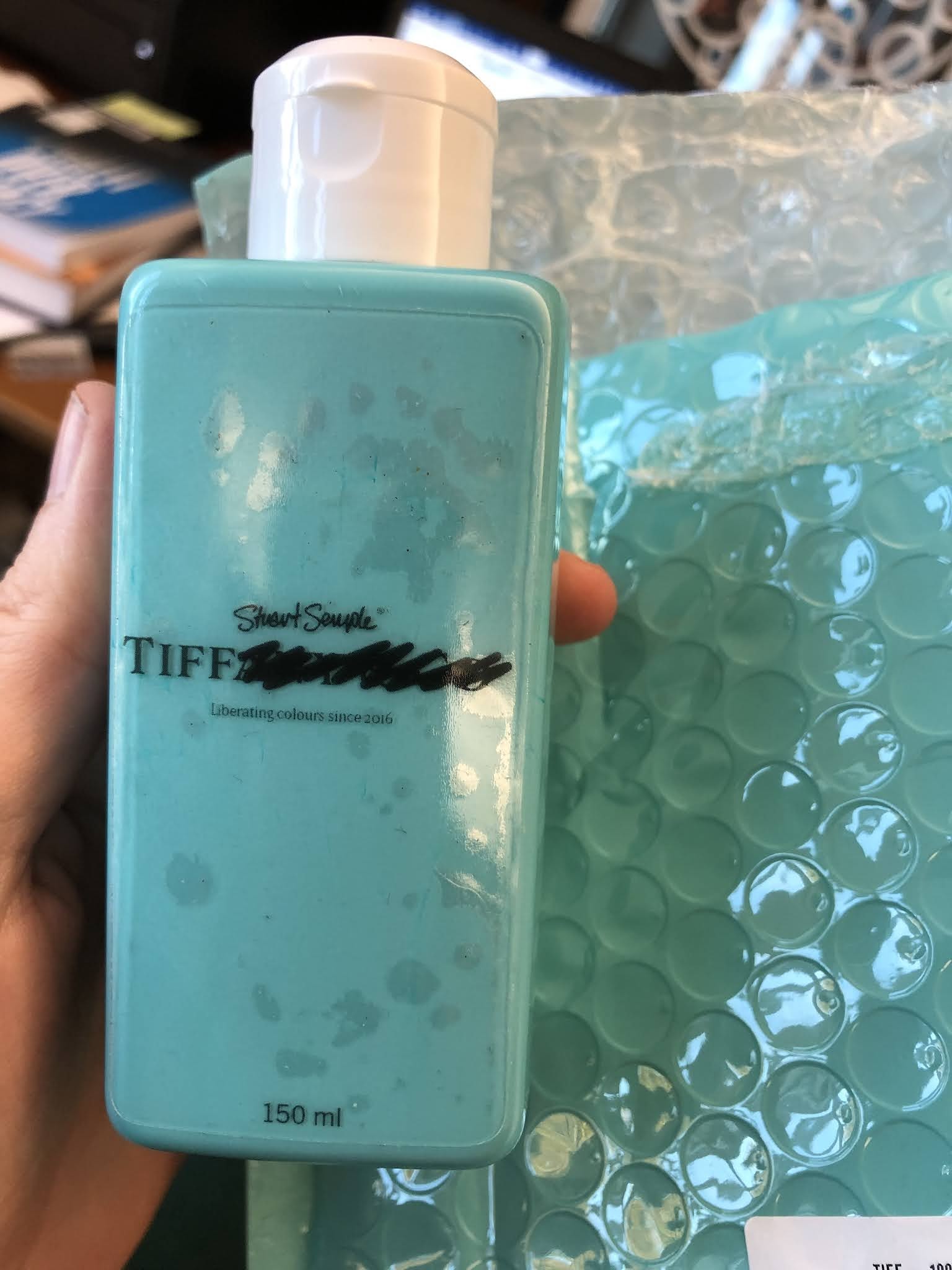
Tiffany blues

 Today’s swag for use in class, Stuart Semple’s Tiff (or is it Tiff—?):

packaging

from Blogger https://ift.tt/3vpXx6r

Posted in Uncategorized | Tagged | Leave a comment

Trump loses motion to dismiss Electric Avenue case on fair use grounds

Grant v. Trump, No. 20-cv-7103 (JGK) (S.D.N.Y. Sept. 28,
2021)

Eddy Grant sued Trump and his campaign for retweeting a
pro-Trump video that used Grant’s famous “Electric Avenue” without authorization.
Although the motion to dismiss was far better argued than the average Trump filing,
it still failed—in the process signaling that the effects of Warhol may
not be limited to visual art, as many had hoped.

The animated video was 55 seconds long. It begins with a
depiction of a high-speed red train that displays “Trump Pence KAG [Keep
America Great] 2020.”

After the red train passes, the
beginning of Electric Avenue can be heard clearly, along with an excerpt of a
speech by President Biden. Around the same time, a slow-moving handcar,
operated by an animated likeness of President Biden, comes into view bearing
the words “Biden President: Your Hair Smells Terrific.” The video—in
particular the contrast between the trains and the unflattering nature of the
excerpted language from President Biden—appears intended to criticize President
Biden and depict the strength of former President Trump’s campaign.

Grant’s song appears throughout the last 40 seconds of the
video.

Fair use can rarely be decided on a motion to dismiss, the
court said, and this wasn’t one of those cases.

Transformativeness: Just because the video and song served
different purposes didn’t make the video transformative. “While it is true that
the animation is partisan political commentary and the song apparently is not,
the inquiry does not focus exclusively on the character of the animation;
rather, it focuses on the character of the animation’s use of Grant’s song.”
Under Warhol, when there isn’t “obvious[]” comment or relation back, or
use of the original “for a purpose other than that for which it was created,”
then “the bare assertion of a ‘higher or different artistic use[]’ is
insufficient to render a work transformative.” Here, “the video’s overarching
political purpose does not automatically render its use of any non-political
work transformative.”

The use of the song itself in the video was “best described
as a wholesale copying of music to accompany a political campaign ad.” Compared
to other political cases like the Don Henley/Running on Empty case, “the use here
does far less—if anything—to modify the song or to comment on the song or its
author,” whereas in Henley defendants changed lyrics and provided their
own vocals, and supposedly poked fun at Henley’s own liberalism, and
still that wasn’t transformative because the ad took too much in relation to
any legitimate parodic purpose. Here, there was no editing of the “lyrics,
vocals, or instrumentals at all.” Further, “the animation does not use Electric
Avenue as a vehicle to deliver its satirical message, and it makes no effort to
poke fun at the song or Grant.” This was less-favored satire rather than
parody, and “defendants have offered no justification for their extensive
borrowing.”

Cariou, by contrast, involved fair uses where works were
“obscured and altered to the point that [they were] barely recognizable.” The
non-fair-use-as-a-matter-of-law works in Cariou “superimposed other
elements that did not obscure the original [work,] and … the original [work]
remained …     a major if not dominant
component of the impression created by the allegedly infringing work.” Likewise,
in Warhol, there was no fair use because the secondary work “retain[ed]
the essential elements of the [original work] without significantly adding to
or altering those elements.”

So too here. Electric Avenue wasn’t edited at all and was “instantly
recognizable”; the additional audio of President Biden’s speech did nothing to
obscure the song; and the song, which lasted over 2/3 of the video was, “a
major component of the impression created by the animation, even though it
appears that the video’s creator could have chosen nearly any other music to
serve the same entertaining purpose.”

Brown v. Netflix, Inc., 462 F. Supp. 3d 453 (S.D.N.Y. 2020),
aff’d, 855 F. App’x 61 (2d Cir. 2021), found a documentary’s unauthorized use
of a song to be transformative and fair, but that case was readily
distinguishable. That film used 8 seconds of a song as part of the film’s “commentary
on the burlesque art form and its resurgence in Portland, Oregon.” The film
combined the burlesque performances “with cultural commentary on topics such as
gender, sexuality, and the artistic process,” and incidentally captured a dancer’s
use of the song as background for her performance. “The use here is different
in magnitude and kind: the song plays for more than two-thirds of the animation
and plays no discernible role in communicating the video’s overarching
political commentary.” Brown, by contrast, used the brief excerpt as
part of a performance about which the documentary was commenting, and the
content of the song “substantively contributed to the burlesque act.”

Also, the use here was commercial because “commercial” in
§107 doesn’t mean commercial, but “whether the user stands to profit from
exploitation of the copyrighted material without paying the customary price.”
[Really sad that GvO didn’t address this—there seems to me no chance
that the current textualist Court would accept this conflation of a factor one consideration
with factor four’s market inquiry.] The use in Henley was commercial because
defendants “stood to gain publicity and campaign donations from their use of
Henley’s music.” Here, “the possibility of commercial advantage cannot be
excluded at this point, especially in light of the instruction from the Second
Circuit Court of Appeals that ‘the profit/non-profit distinction is context
specific, not dollar dominated.’”

Another SDNY case, MasterCard Int’l Inc. v. Nader 2000 Primary
Comm., Inc., No. 00-cv-6068, 2004 WL 434404 (S.D.N.Y. Mar. 8, 2004), held that
a political advertisement’s parody of a popular MasterCard commercial was a
noncommercial use because the candidate used the original work “as part of his
communicative message, in the context of expressing political speech.” But that
wasn’t the same as the use here. “Nothing about the song was integral to the
video’s political message,” and in their arguments, “the defendants explicitly
disclaim any overlap between the purposes of the song and the video.” [Note the
move here from whether the defendant’s overall product was commercial to whether
the use of the plaintiff’s work was commercial—I am not sure that’s supported
by the statute; I am sure that carving works up this way is going to make fair
use harder to litigate and resolve, and will require inquiry into meaning that
contrasts sharply with Warhol’s disavowal of any such inquiry—a sort of
heads I win, tails you lose effect. FWIW, I think the use here is plausibly
nontransformative but noncommercial, and that market effect can make
noncommercial uses unfair.] Confirming that the court is making its commerciality
finding dependent on its transformativeness finding, the court reiterates that
the video wasn’t parodying the song or using it for commentary, unlike the Nader
ad. “Moreover, there is a well-established market for music licensing, but the
defendants sought to gain an advantage by using Grant’s popular song without
paying Grant the customary licensing fee.”

Nature of the work: creative and published, but “the fact
that a work is published does not mean that the scope of fair use is per se
broader.” But factor two has limited weight.

Amount/substantiality: Quantity and quality favored
plaintiffs. “The introductory portion of the song that is used in the animation
is immediately recognizable. The excerpted portion of the song also includes
the chorus, which … is of central importance to the original work.” While the
excerpt was only 17.5% of the song’s total length, it played for 72.7% of the ad’s
duration. The quantity and value were plainly not reasonable in relation to the
purpose of the copying. “

Market effect: Market analysis “embraces both the primary
market for the work and any derivative markets that exist or that its author
might reasonably license others to develop, regardless of whether the
particular author claiming infringement has elected to develop such markets.”
And it was “plain that widespread, uncompensated use of Grant’s music in
promotional videos—political or otherwise—would embolden would­be infringers
and undermine Grant’s ability to obtain compensation in exchange for licensing
his music.” Grant didn’t need to show that he intended to enter the market for
licensing music to promotional videos, especially on a motion to dismiss, given
the defendants’ burden to show lack of market harm.

The fourth factor also, per GvO, “take[s] into
account the public benefits the copying will likely produce.” Though political
speech, and in particular “[t]he act of ridiculing and lampooning public
figures[,] is a rich part of our First Amendment tradition,” denying fair use—especially
denying a motion to dismiss on fair use—won’t chill “legitimate political
satire. Creators of satirical videos like the one at issue here must simply
conform any use of copyrighted music with copyright law by, for example: paying
for a license; obtaining the copyright owner’s permission; or ‘transforming’
the chosen song by altering it with new expression, meaning, or message.” Defendants
could reassert fair use at the summary judgment stage on a more developed
factual record.

from Blogger https://ift.tt/3v7baXQ

Posted in Uncategorized | Tagged | Leave a comment