Peloton’s innovation claims were puffery, but music ads were a problem

Peloton
Interactive, Inc. v. Icon Health & Fitness, Inc., 2021 WL 2188219, No.
20-662-RGA (D. Del. May 28, 2021)

The
parties “compete in the at-home fitness market and offer products that allow
consumers to attend live and on-demand fitness classes from home.” They’re
fighting over cross-allegations of patent infringement, violation of state
deceptive trade practices acts, and violations of the Lanham Act. I’m only
addressing ICON’s counterclaims for false advertising, not the patent part of
the ruling.

ICON
counterclaimed that Peloton has made false claims in advertisements regarding
its status as an innovator and as a tech company, e.g., that it was a “very
hardcore technology company. We make a tablet computer better than apple … We
are as hardcore of a tech shop as anything in NYC right now.” Peloton also
stated that was Bike is the “first of its kind.” ICON said this was false
advertising, particularly because Peloton licensed the relevant technology from
ICON. “Innovator” and “hardcore technology company” were non-actionable puffery.
So was “first of its kind,” apparently for vagueness/bluster reasons.

ICON
also challenged statements by Peloton’s CEO implying that Peloton has no
competitors, such as “Nobody else provides them, so we’re kind of a category of
one.” These too were broad, generalized claims of superiority without any
reference to a specific product or characteristic.

Finally,
ICON alleged that Peloton engaged in a misleading, bait and switch advertising
scheme with respect to the availability of music on its platform. Though none
of the cited ads referenced any artist or song in particular, the court
understood ICON to be alleging “that the playlists linked in the Instagram
posts contained music that Peloton lacked a license to or soon removed from its
platform.” Peloton rejoined that its challenged Instagram posts “advertise only
the availability of Peloton’s playlist feature.” 
These
claims did survive. “Telling consumers that they can ‘find the perfect tunes
for [their] on demand ride[s]’ and ‘see the artists and songs powering your
on-demand rides’ and linking to specific playlists reasonably suggests that the
songs contained in the playlists are available on Peloton’s platform.”

State-law
claims were treated similarly.

from Blogger https://ift.tt/396I00W

Posted in Uncategorized | Tagged , | Leave a comment

gold buyer’s “up to 90%” payment claims were plausibly misleading

Express
Gold Cash, Inc. v. Beyond 79, LLC, 2020 WL 9848431, No. 18-CV-00837 EAW
(W.D.N.Y. Dec. 15, 2020)

Previous opinion. 
The parties compete in the market for buying gold from ordinary people.

In
2010, the Today Show—a morning television show aired on the NBC network—aired a
segment in which it mailed a single item of gold to ten different mail-in
precious metals dealers and compared the prices offered. The Today Show
received the highest offer from Defendant, which offered 90% of market value.
From 2011 to the present, Defendant has published various advertisements
stating that it is ranked or rated “#1” by the Today Show.

Previously,
some false advertising claims were dismissed, but claims “based on the Today
Show-related advertising” were sufficiently pled. Plaintiff sought to amend the complaint, omitting, inter alia, claims
regarding “latest payouts” stock photographs but adding allegations that
defendant “deceives customers by falsely advertising on its website that it
offers the ‘highest payouts in the industry’ and ‘will pay you … up to 90%
for your precious metals.’ ” It sought to add additional allegations about
customer reviews and test transactions, and about how defendant’s business
operations materially changed since 2010.

Proposed
new claims regarding defendant’s statements that it pays “up to 90%” of the
value of gold and has the “highest payouts in the industry” were not futile. Plaintiff
detailed three test transactions in which the potential sellers were initially
offered 33-53% of the value of their gold items, only receiving final offers of
up to 87% of the items’ value after a series of negotiations in which the defendant
was unresponsive and gave false information. While the proposed complaint
didn’t plausibly allege literal falsity—it didn’t show that defendant never
pays 90% and it didn’t provide context on standard payouts in the industry—it
did plausibly allege misleading advertising. That’s a question of fact.
Further, the plaintiff identified “specific customer reviews that evidence
confusion regarding the prices paid by Defendant, including reviews stating ‘[Defendant]
should do what they advertise and pay 90% of what the gold/jewelry is worth,’”
etc. These specific factual allegations were sufficient to make it plausible
that consumers were confused or misled.

The
defendant argued that these allegations improperly to hold it liable for
“statements made directly to individual consumers.” True, wide dissemination is
required for commercial advertising or promotion, but the ads challenged here
were statements on defendant’s public webpage and otherwise disseminated to the
public; individual consumers’ complaints were evidence of those statements’
effects.

Nor
was the court persuaded that “highest payouts in the industry” were mere
puffery or opinion. Particularly when coupled with the specific assertion that
such payouts were up to 90% of an item’s value, that wasn’t vague or
unbelievable.

from Blogger https://ift.tt/3AcA1vh

Posted in Uncategorized | Tagged | Leave a comment

student social media use of school colors/logo not plausibly confusing

Arizona Board of Regents v. Doe, 2021 WL 3684116, No.
CV-20-01638-PHX-DWL (D. Ariz. Aug. 18, 2021)

Doe, a real asshole (“deeply unsympathetic,” to use the
court’s terms), advertised “ASU Covid Parties” on a similarly-named Instagram
account and spewed a lot of bile as well as, in its first post, using ASU’s
colors. The Board sued Doe for trademark infringement and related claims; Doe
defaulted. Nonetheless, the court—correctly—refused to allow the Board to expand
trademark and false advertising law to this conduct. The only evidence of
actual confusion was a tweet: “#ASU having COVID parties and claiming it’s a
hoax? I am stopping my alumni [membership] and removing my alumni sticker from
my car and sending back my ASU alumni plate. I am embarrassed to be associated
with thus [sic] ignorant behavior.”

Interestingly, Instagram allegedly refused a TM takedown
request because “the reported party appears to be using your trademark to refer
to or comment on your goods and services,” despite persistence by ASU’s outside
counsel.  However, when the Board sued
and moved for a TRO, Facebook agreed to disable the “asu_covid.parties” account
and prevent the accountholder from creating new accounts, so the Board agreed
to dismiss it as a defendant.

All of ASU’s claims required likely confusion or deception.
That just wouldn’t happen to a reasonably prudent consumer. Only one post, the
first, used ASU’s distinctive maroon and gold colors and ASU’s logo, and the
surrounding context would prevent likely confusion. The accountholder posted
the first two comments in the thread, the second of which was: “Those of you
coming back to Phoenix. We about to get fucking lit.” “Although it is not
uncommon for universities to attempt to appeal to students by imitating their
vernacular, no university would drop the f-bomb in an official party
invitation,” and a reasonable consumer would not have thought ASU was inviting
them to get drunk. “Many of the subsequent messages from the ‘asu_covid.parties’
account affirmatively criticized—often in profane and vulgar terms—ASU’s
leadership and official policies. … Many things can be said about these
offensive and outrageous statements, but it is not plausible (to put it mildly)
that a reasonably prudent consumer would believe ASU was the source or origin
of them.”

Although the one tweet called out “#ASU,” it wasn’t clear
from the “haphazardly worded tweet” whether this individual was actually
confused or simply disgusted that ASU students were sponsoring COVID parties.
Even assuming that 0.0002% of the alumni base believed that the profanity-laden
posts were actually coming from ASU, that didn’t show confusion. “Tellingly,
the comments to the posts suggest that readers believed the ‘asu_covid.parties’
account belonged to a student or group of students, not the university.” And
Doe “expressly identified himself as a community advisor (i.e., student) and
railed against ASU’s administration and official policies.”

Even if other factors like strength of the mark and
similarity of marketing channels favored the Board, “the remaining Sleekcraft
factors are unimportant” in a case, such as this one, where “no rational trier
of fact could find that a reasonably prudent consumer…would likely be
confused.”

What about initial interest confusion? It didn’t apply
because even the initial post using maroon and gold  “was too crude and profane to create initial
confusion as to its source and origin.” But, “[m]ore broadly, it cannot be the
case that every social media post written by a college student that happens to
use the school’s colors and/or logo in the post, and identifies the school’s
location as the location of the poster, creates initial interest confusion and
qualifies as an actionable trademark violation.”

State trademark dilution: the court, somewhat
disappointingly, declined to exercise jurisdiction over the claim rather than
resolving it.

from Blogger https://ift.tt/3hPIsFN

Posted in Uncategorized | Tagged , | Leave a comment

infant/child painkiller case dismissed as preempted

Youngblood v. CVS Pharmacy, 2021 WL 3700256, No.
2:20-cv-06251-MCS-MRW (C.D. Cal. Aug. 17, 2021)

Another infant/children acetaminophen consumer protection
case. This one dismisses the claims as completely preempted by the FTCA.

Plaintiffs argued that their claims are consistent with the
FDCA and FDA regulations because of the federal prohibitions on false or
misleading labeling. However, a Tentative Final Monograph (TFM) issued by the
FDA in 1988 and rendered a final administrative order under the FDCA in 2020
was more specific. TFM prescribes labeling requirements for over-the-counter
analgesics for children, including acetaminophen. It directs that products for
children between two and 12 years of age be labeled “for Children,” bear
specific warnings for that age group, and provide specific dosing instructions
for different age ranges. Products for “[c]hildren under 2 years” must bear the
instruction “[c]onsult a doctor.” A drug complying with the TFM and general
labeling regulations “is generally recognized as safe and effective and is not
misbranded.”

One recent case with the same theory rejected preemption on
the same grounds, while another found preemption. The court here found that the
plaintiffs’ theory sought to do more than bring the packaging at issue in line
with federal requirements. Plaintiffs complained that the infants’ product,
which is labeled for children between two and three years of age, “does not
state that it is … the same medicine contained in the Children’s Product.”
They sought “clear disclosures that there is no pharmacological distinction
between ‘Infant’s Product’ and ‘Children’s Product’ and that the two products
can be used interchangeably in a manner that is safe to infants and children
alike.” They didn’t explain how these requirements were identical to the
requirements of the 1988 TFM. A win for them would penalize CVS for not making
“representations beyond what the 1988 TFM requires for children’s acetaminophen
products.”

from Blogger https://ift.tt/2VAHyoq

Posted in Uncategorized | Tagged , , , | Leave a comment

two Zillow false advertising cases, divergent outcomes

REX – Real Estate Exchange Inc. v. Zillow Inc., No. C21-312
TSZ, 2021 WL 3930694 (W.D. Wash. Sept. 2, 2021)

Rex sued Zillow and the National Association of Realtors for
antitrust and false advertising violations. Surprisingly, the antitrust claims
survive, as do false advertising claims agains Zillow.

NAR “is the nation’s largest trade association for real
estate professionals.” Membership includes multiple listings services (MLSs).
NAR’s optional Segregation Rule requires members’ listings obtained through
MLSs internet data exchange feeds to be “displayed separately from
listings obtained from other sources.” NAR also adopted a mandatory rule that
requires a seller’s agent to include in any MLS listing a predetermined offer
of commission to a buyer’s agent, thereby prohibiting any party from later
modifying that commission. “NAR’s members allegedly encourage their customers
to offer high commissions for buyers’ agents, resulting in historically high,
static commissions throughout the United States, with total commissions
averaging about 5.5 percent of a home’s sale price.”

REX is a licensed broker that employs licensed real estate
agents across the nation, but it is not a member of NAR or any MLS and thus has
not agreed to comply with any of NAR’s rules. Home sellers who choose REX’s
services can negotiate a buyer agent commission, and thus pay a total average
commission of 3.3 percent of a home’s sale price. REX lists its customers’
homes on various real estate aggregator websites, including two of Zillow’s
websites, Zillow.com and Trulia.com, the first and fourth most visited real
estate aggregator sites in the US. REX’s listings were historically displayed
on Zillow’s primary search page alongside the listings of MLS participants.

But then “the growth and substantial inventory of
Zillow-owned homes placed Zillow in a new position: Instead of focusing on
being an open access point for consumers to display and access residential real
estate listings, Zillow’s interests turned to its own substantial home
inventory.” In late 2020, Zillow announced that it would join forces with NAR
and several MLSs, publicly committing that “all Zillow-owned homes will be
listed on the MLSs with commissions paid to agents representing buyers.” NAR’s mandatory
Buyer Agent Commission Rule is allegedly the “paramount reason that real estate
commissions are two to three times higher in the United States than in
comparable international markets.” Zillow also announced that it would begin to
use MLS data feeds to populate its websites.

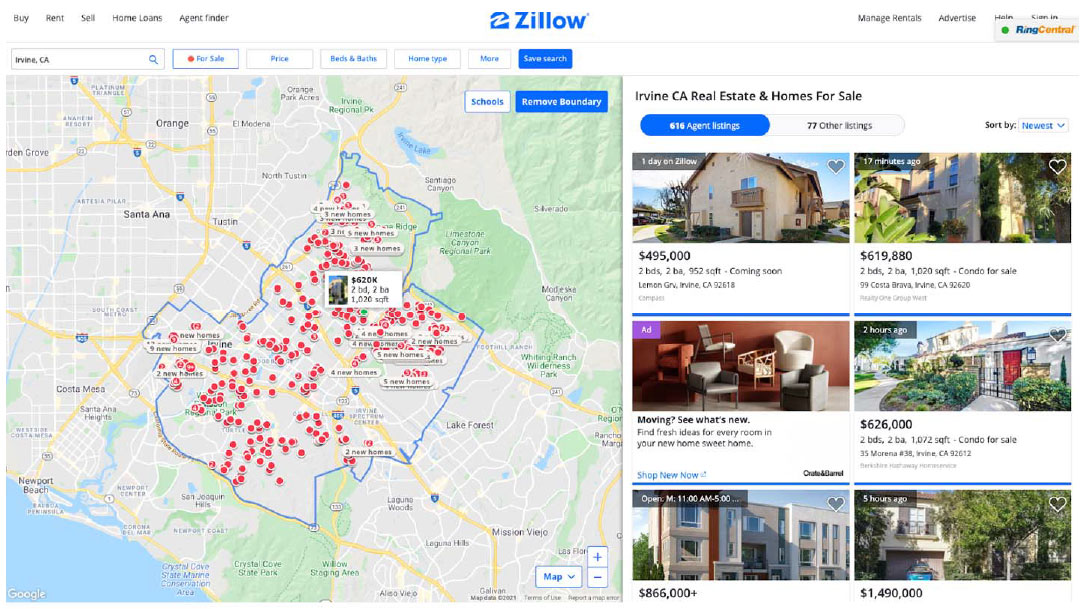
Zillow’s redesigned website, complying with NAR guidelines,
created a separate page or tab, called “Other listings,” that is concealed
behind the primary results page or tab, called “Agent listings.” As a result, consumers see only a portion of available homes
at a time. Even though REX’s customers’ homes are all listed by licensed real
estate agents, its lisitngs are now in “Other listings” rather than “Agent
listings.” REX alleged that this was deceptive and harmful, and resulted in
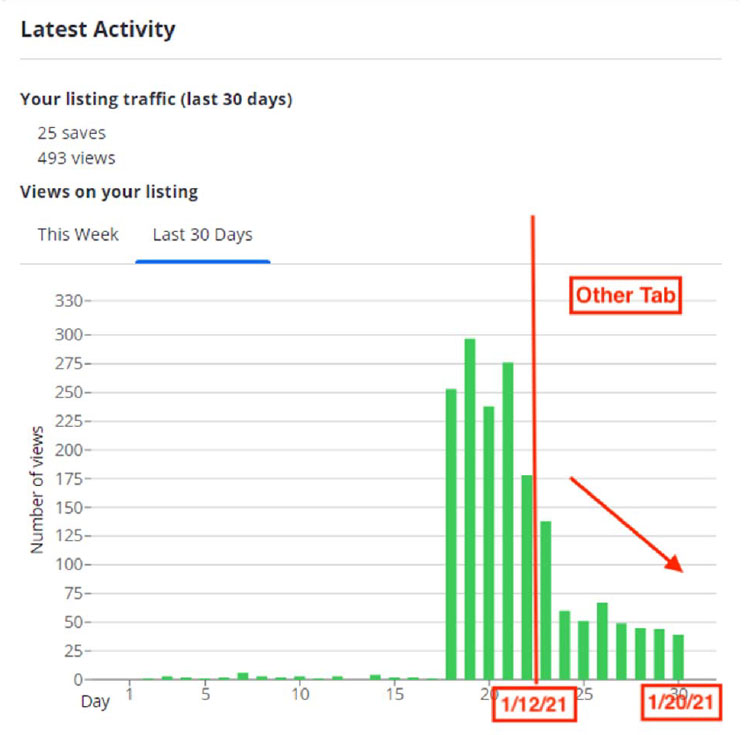
views plummeting on Zillow’s websites, causing “a corresponding drop in sales
and…lost brokerage service revenues to” REX.

redesigned tab; “other listings” in gray, top right

views after the change

The court found that the antitrust claims were sufficiently
well pled.

Lanham Act claim: Was this commercial advertising or
promotion? The key question was the Gordon & Breach element asking
whether the challenged commercial speech was “for the purpose of influencing
consumers to buy defendant’s goods or services,” a requirement not affected by Lexmark.

The complaint alleged that Zillow joined the NAR and MLSs to
promote its inventory of Zillow-owned homes. It then changed its websites to
comply with the new MLS rules and insulate MLS brokers from competition. The
allegations that Zillow adopted the misleading labeling system “for the purpose
of influencing its customers to use the Zillow Offers business, as well as the
services of other MLS agents, by concealing or discouraging the services of
non-MLS agents like Plaintiff,” were sufficient.

However, REX failed to state a Lanham Act claim against NAR.
“There are no other allegations explaining what NAR did to design or encourage
this particular labeling system on Zillow’s websites, let alone when, where,
and how NAR did it.”

So too with the Washington Consumer Protection Act claims.
Zillow argued that its conduct was “reasonable in relation to the development
and preservation of [its] business.” That was a factual issue inappropriate for
a motion to dismiss, even if such a business purpose defense was available. But
NAR got off the hook for the same reasons as with the Lanham Act claim. 

Picket Fence Preview, Inc. v. Zillow, Inc., No.
2:21-cv-00012, 2021 WL 3680717 (D. Vt. Aug. 19, 2021)

Picket Fence, which publishes listings for homes that are
for-sale-by-owner (FSBO), alleged that Zillow’s policy of providing free online
listings for FSBO homes violated the Vermont Consumer Protection Act and the
Lanham Act and constituted state law unfair competition. The court dismissed
the claims.

“A major incentive for homeowners to advertise with
[Plaintiff] is reaching potential buyers directly through [Plaintiff’s]
publications and avoiding a 6-8% real estate commission” that is typically paid
to real estate agents and brokers. When an FSBO seller lists real property on
Zillow, potential buyers see “Contact Agent” prominently displayed. Agents can
allegedly pay to get their name on the listing or to be the only contact for a
listing. The “Get More Information” tab lists the contact information for
“Premier Agents” first “and the owner is listed at the bottom of the list.”
Zillow allegedly makes it difficult or impossible to contact the owner.

This is allegedly a bait and switch; FSBO sellers “may lose
potential sales” from these listings “because Premier Agents may redirect
potential purchasers to other properties if the [FSBO seller] is not willing to
share a commission with the Premier Agent” or if another property would provide
the Premier Agent with “a better commission.” While Zillow “claims that it is
offering a service for free, [ ] in reality [it] is charging the Premier Agents
so they can advertise on the website of those free ads and receive hijacked
inquiries from deceived buyers.”

Picket Fence, which charges for FSBO listings, allegedly
lost a lot of business to Zillow, and was one of the few remaining FSBO
publications to survive Zillow.

First, Picket Fence lacked standing to sue on behalf of FSBO
sellers.  And it couldn’t sue under the
VCPA because it wasn’t a consumer. Nor could it bring a predatory pricing claim
because it didn’t allege that the free listings weren’t free or below cost, or
that there was a dangerous probability that Zillow would raise prices once competitors
were driven from the market.

Lanham Act claim: Lexmark standing existed, but deception
wasn’t plausibly pled. Picket Fence argued that Zillow misleadingly failed to
“disclose that interested shoppers would be directed to Premier Agents.”
However, since 2017, Defendant’s website has included a disclaimer stating that
“[b]y pressing Contact, [potential buyers] agree that Zillow Group and its
affiliates, and real estate professionals may call/text [potential buyers]
about [their] inquiry.” And Picket Fence failed to identify any representation
that any sales would be “commission free” or any promise that a real estate
agent would not be involved in a subsequent sale. “An FSBO seller remains free
to refuse to deal with a real estate agent and free to refuse to pay a real
estate agent’s commission even if it uses Defendant’s website. Defendant’s
listing focuses only on a preliminary step in a real estate transaction with no
promise as to what happens thereafter. Stated differently, a customer who is
promised a free listing is not promised a commission free sale either directly
or by implication.”

from Blogger https://ift.tt/3npCLBX

Posted in Uncategorized | Tagged , , | Leave a comment

“tested” can misleadingly imply high performance on test

Carder v. Graco Children’s Products, Inc., — F.Supp.3d
—-, 2021 WL 3909953, No. 2:20-CV-00137-LMM (N.D. Ga. Aug. 31, 2021)

Plaintiffs from fifteen states alleged that Graco made false
and misleading representations about two models of children’s car seats,
specifically marketing them as being (1) “side-impact tested” and (2) safe for
children as small as thirty pounds and as young as three years old. Graco
allegedly knew since 2002 that the seats didn’t appreciably reduce the risks
associated with side-impact collisions (and that there are no federal safety
standards for side-impact testing); that Graco’s own testing didn’t show that
the seats were safe in side-impact collisions; and that the seats weren’t safe
for children under forty pounds or younger than four years old.

A couple of points: The claims didn’t fail under Rule 9(b)
even though some plaintiffs didn’t plead the exact model they purchased or the
exact time, date, and price of their purchases; those details aren’t required
to satisfy Rule 9(b), which requires specificity about “the particulars of the
allegedly misleading statement itself, not .. the circumstances of the
plaintiff’s conduct in reliance on that statement.”

Could the advertising mislead a reasonable consumer? Graco
argued that its statements were true, but the court accepted that, “at the very
least, reasonable consumers could believe that Booster Seats advertised and
represented as ‘side-impact tested’ would offer appreciably increased safety in
side-impact collisions.” And plaintiffs alleged that they didn’t. Even
accepting that “side-impact tested” was literally true, it could still mislead
a reasonable consumer. [Cue XKCD reference.]

There’s a lot of discussion of various state consumer
protection acts. As to state safe harbor provisions, Graco argued that its
seats complied with federal safety standards set by the National Highway Traffic
Safety Administration, but its alleged conduct (stating that the seats were
safe for kids under forty pounds) was neither “required” or “specifically
permitted” by NHTSA. Manufacturers are required to use a label stating a
recommendation for maximum and minimum child sizes, with a lower bound
prohibiting booster seats for kids under 13.6 kg, but it is left to
manufacturers “to determine what that specific safety recommendation should be.”
And NHTSA prohibits misleading labels or instructions, so if “side-impact
tested” misleadingly suggested that the seats offered increased safety in
side-impact collisions, this representation would violate federal rules rather
than complying with them.

However, claims for injunctive relief under Illinois law
failed because plaintiffs didn’t allege an intent to repurchase the seats.

from Blogger https://ift.tt/2YSbXA1

Posted in Uncategorized | Tagged , | Leave a comment

Reading list: The Confusion Test in European Trade Mark Law

Ilanah Fhima & Dev S. Gangjee, The Confusion Test in
European Trade Mark Law
(2019)

A very helpful overview. From a US perspective, offers real
insights into how a system of registration primacy differs from a system of use
primacy. A couple of points that I specifically noted: the authors conclude,
based on “a substantial number of cases,” that courts that consider similarity
of marks first are more likely to find confusion. “This is because once the
tribunal has invested the effort in conducting the highly case-specific
comparison of the marks and found them to be similar, it is less likely to
dismiss confusion based on the comparatively formalistic comparison of goods. On
the other hand, if goods are considered first, it is easier to place more
reliance on this element of the test without having one’s perception clouded by
the work done to compare the marks.” I’m not sure one could say the same about
US cases.

It’s also striking how comparatively little distinctiveness
of the mark, or of shared elements of the parties’ marks, matters in the
European analysis versus US analysis, which is more likely to give a narrower
scope to a weaker mark. (Both approaches give broader scope to especially
strong marks, but European cases seem less willing to do the inverse.) That may
be something that relates to use-based versus registration-based approaches. As
the authors report, an analysis of European General Court decisions found “that
the distinctiveness of the senior mark had very little if any bearing on the
outcome of cases” and “visual similarity of marks played the greatest role in
assessing similarity of marks.” (As they note later, visual similarity may loom
larger in Europe because of language differences—for those who don’t understand
the meaning of a word in another language, conceptual similarity doesn’t really
matter.)

Unlike US cases, in Europe, distinctiveness (or relative
lack thereof) “cannot override the importance of similarity of marks and of
goods,” and the court often rests on similarity of marks and goods only,
wihtout reaching any result on “what the mark’s level of distinctiveness
actually was.” Language differences also inform this result: even where the
majority of EU languages would consider a common element to be descriptive, if
some might not, the doctrine indicates that people who used those languages
would perceive greater similarity and therefore face a greater likelihood of
confusion. As the authors conclude, “[t]he undesirable consequence of this
approach to global appreciation is to grant a broad legal monopoly to ‘weak’
marks.” The CJEU shows the greatest favoritism to weak marks, whereas the
EUIPO, national registries, and national courts “are more sceptical and seek to
narrow the scope of protection for such marks.”

Also, some useful statistics: As of mid-2018, “shapes or
three-dimensional marks constituted 0.55% (10,279) of EUTM applications and
0.41% (6,231) of registrations, while pure colours constituted 0.01% (104) of
EUTM applications and 0.01% (95) of registrations.” And I appreciated the point
that “the most revealing indicator of the commercial significance of colour and
external packaging marks is the extent to which the tobacco industry has sought
to preserve them” in its pitched battle against plain packaging requirements.

from Blogger https://ift.tt/3zccsBb

Posted in Uncategorized | Tagged , | Leave a comment

tortious interference claim from false advertising survives, but why bother?

Logistick, Inc. v. AB Airbags, Inc., — F.Supp.3d —-,
2021 WL 2433944, No. 3:21-cv-00151-BEN-MDD (S.D. Cal. Jun. 15, 2021)

Logistick sells disposable load bars which are used to
secure cargo freight during transport. AB allegedly began advertising for a
similar product, claiming that its load bars have “30% more Holding Power than
similar Disposable Load Bars,” allegedly an admitted reference to Logistick. AB
allegedly acquired one of its older products and performed faulty testing on
the load bars in order to incorrectly claim that its product has 30% more
holding power.

Here, AB moved to dismiss the negligent interference with
prospective economic relations claim, and didn’t succeed. The tort requires (1)
the existence of a valid economic relationship between the plaintiff and a
third party containing the probability of future economic benefit to the plaintiff;
(2) the defendant’s knowledge (actual or construed) of (a) the relationship and
(b) that the relationship would be disrupted if the defendant failed to act
with reasonable care; (3) the defendant’s failure to act with reasonable care;
(4) actual disruption of the relationship; and (5) resulting economic harm.

AB argued that its ad never mentioned or referenced
Logistick, so it couldn’t interfere with Logistick’s business. Further, it
argued, Logistick basically just recited the elements about future
relationships and knowledge. Although that seems right to me, the court
disagreed.

Courts have held that a tortious interference claim that
rests on “a hope of future transactions” is insufficient to support a claim of
tortious interference. But here it was sufficient to allege that “Plaintiff had
an ongoing business relationship with John Doe customers that probably would
have resulted in a future economic benefit to Plaintiff,” and “Defendant knew
or should have known of this relationship between Plaintiff and John Doe
customers,” at least where “the Complaint confirms that Plaintiff will disclose
the customers’ names upon the entry of a protective order.” The facts were
specific enough to put “the defendant on notice that a third-party, indeed,
existed.”

Plaintiff also sufficiently alleged knowledge by alleging
that “Defendant knew or should have known of this relationship between
Plaintiff and John Doe customers.” As a direct competitor, it knew or should
have known of these relationships when it engaged in comparative advertising
referencing Logistick’s product.

Likewise, Logistick plausibly alleged that AB knew or should
have known that its relationships would be disrupted, even without alleging
that any third party saw the ads. And it plausibly alleged actual disruption in
its relationships causing economic harm by alleging pretty much that. “[G]iven
both parties were competitors, it is reasonable to infer that an allegedly
false statement based on allegedly faulty testing comparing Defendant’s product
with ‘similar products,’ could damage competitors, like Plaintiff.”

The court did express doubt about whether these claims would
survive summary judgment. Comment: I often tell students that, absent
individually negotiated contracts for six figures or more, tortious
interference claims just run up the lawyers’ bills. This case does not convince
me otherwise.

from Blogger https://ift.tt/3txjyis

Posted in Uncategorized | Tagged , , | Leave a comment

expert admissibility, literal falsity receive close review in drug disposal case

In re C2R Global Manufacturing, Inc., No. 18-30182-beh,
2021 WL 1347193 (E.D. Wis. Bkrcy. Mar. 30, 2021)

Previous denial
of injunctive relief
. There are a number of opinions in
this case—the judge spent time on this rather unusual false advertising
analysis in a bankruptcy case, including taking care with the expert evidence.
I’m only going to discuss a few highlights, but it makes useful reading for
those seeking a review of case law on admissibility for experts in false
advertising cases.

The parties compete in the market for drug disposal
devices. Plaintiff Verde designated its current CEO, Sundby, as a non-retained
expert witness. C2R sought to exclude his testimony with respect to any
opinions about “consumer perceptions,” that is to say, consumers’ mental
impressions when presented with C2R’s advertisements, including how consumers
are likely to interpret those advertisements, whether the advertisements are
likely to confuse or deceive consumers, and whether consumers are likely to
rely on the advertisements in making purchasing decisions. Examples from his
declaration: “[C]ustomers rely and depend on drug deactivation products to
actually deactivate the pills and tablets that the products are advertised as
being able to deactivate.” “[T]he drug-deactivation market as a whole is harmed
by C2R’s continued misrepresentations regarding the Rx Destroyer™ product
capacity” because “when C2R advertises a product using activated carbon that
does not work as represented, that casts doubt on all products using activated
carbon” and “customers lose faith that any products are capable of deactivating
medications as advertised.” “Cost is a central factor in the purchasing
decision and it is directly related to the capacity of the products available
to the customer.” “As a result”—because consumers read C2R’s capacity
advertisements to indicate that Rx Destroyer products deactivate medication at
a lower price-per-pill than the Deterra system—“consumers choose to purchase RX
Destroyer™ rather than Deterra.”

The court granted C2R’s motion in part, and reserved
ruling on the remainder until trial, which would be to the bench, making the Daubert
motion more of a matter of allowing the parties to prepare for trial more
efficiently than of protecting a jury.

Sundby had expertise in the drug disposal industry.
Lanham Act cases (primarily trademark and trade dress infringement cases) have
“excluded expert opinions on customer perception—opinions such as what a word
in an advertisement means, whether customers are (or are not) likely to be
misled or confused by advertising, and whether customers would recognize a
party’s trade dress—when the expert was an industry expert, but not a
perception expert, and therefore did not base his or her opinion on a valid
consumer survey or similar empirical data.”

Verde rejoined that an expert need not conduct consumer
surveys or consumer market research before offering any opinions related to
customer reliance or perceptions. While this is true, it doesn’t mean that “an
expert may offer his own opinions about likely consumer deception or consumer
mental impressions in place of a properly conducted consumer survey.” Verde
argued that surveys/market research were less relevant  “where the customers at issue are not
predominantly individual consumers,” but instead are organizations and
institutions who make purchasing decisions through businesspeople, nurses,
doctors, pharmacists, and public health professionals. But the case law is to
the contrary. It is true that an expert can be qualified purely based on
experience in the industry, but that didn’t mean Sundby could testify about
everything. He wasn’t the same as a consumer or dealer testifying about their
own deception.

Thus, Sundby was not qualified to offer opinions on
consumer perceptions— “opinions typically offered by experts with training and
experience in conducting and interpreting consumer surveys.” This covered at
least his statements that C2R’s capacity overstatements led consumers to think
that C2R’s product had a lower price per pill than Verde’s system, and that “as
a result,” consumers chose the former over the latter. “Both of these
assumptions involve predictions about a consumer’s thoughts and impressions
after reviewing C2R’s advertisements—in other words, how consumers perceive the
statements at issue in this litigation.” However, the other statements in the
declaration were about the effect of false advertising on the drug deactivation
market in general (and Verde in particular), and product features relevant to
customer purchasing decisions. “Sundby’s lack of expertise in consumer
perceptions or behavioral linguistics is not, by itself, a reason to exclude
these additional opinions.” (Note that the second—what’s material to consumers—is
a matter of consumer reaction, but one that people in the industry might be
particularly able to know in general.)

Similar analysis applied to the reliability of his
opinions:

Sundby can testify about his own experiences with
customers over the years—provided such testimony is not inadmissible for other
reasons—but Verde has not persuaded the Court that any opinions Sundby intends
to offer about the likely thoughts or perceptions of Verde’s target consumers
are sufficiently reliable to be admitted. To the extent Sundby intends to rely
on his “industry experience” rather than a consumer survey to opine on likely
consumer perceptions—and, more particularly, that consumers in general would
interpret “capacity” in C2R’s advertisements to mean “capacity to deactivate”
and, as a result, would be more inclined to purchase C2R’s products over the
competition—Sundby has not adequately explained why his chosen methodology
(apparently based on experience including conversations with others in the
industry) is appropriate or reliable.

Sundby could offer testimony “on subsidiary factual
issues relevant to the question of deception, such as typical advertising and
marketing channels in the industry, the types of consumers in the target
market, the sales process, and other circumstances helpful to providing a full
context for the advertising at issue—provided that Sundby is able to lay a
proper foundation for such testimony at trial.” For the same reasons, he could
testify on the effect of false advertising on the drug deactivation market, or
product features relevant to customer purchasing decisions, at least for now
and subject to cross-examination.

Nor could Sundby offer the excluded testimony as lay
testimony, because that would exceed the scope of his personal perceptions. He
could, however, offer “specific examples of consumer deception that he has
witnessed” along with the admissible testimony described above, if given a
proper foundation. 

In re C2R Global Manufacturing, Inc., No.
18-30182-beh, 2021 WL 1347160 (E.D. Wis. Bkrcy. Mar. 30, 2021)

Here, Verde won partial summary judgment on the
literal falsity of certain capacity statements about its competitor’s drug
disposal product. 

C2R’s advertisements claimed that the Rx Destroyer
“destroys” and “[d]issolves, adsorbs, and neutralizes” medications. C2R also
advertised that its products meet DEA disposal standards by making drugs
“scientifically irretrievable.” And it advertised specific pill capacities by
size, though sometimes with asterisks saying this was approximate. Its capacity
claims were based on calculations and other tests of activated carbon in the
medical literature, not on actual testing with pharmaceuticals, which it deemed
impractical given the variety out there. Unfortunately, its expert’s
calculations assumed that the products contained more activated carbon than
they actually do, and plaintiff Verde had a number of other criticisms. Verde’s
Director of R&D also conducted multiple tests of C2R’s products using
different drugs and concluded that they were “incapable of deactivating
medications up to their capacity claims.” After litigation began, C2R also
retained another expert, whose tests showed varying levels of adsorption, but
who also concluded that there were other deactivating ingredients in the
products besides activated carbon.

C2R also posted a document on its website appearing
to summarize the results of a test conducted on C2R’s NarcGone product, by an
unidentified lab described only as DEA-certified. According to this one-page
summary, “Based upon 5 grams methamphetamine, 65% adsorbed in 2 hours, 86%
adsorbed in 24 hours, 94% adsorbed in 4 days and 100% in 7 days.” C2R omitted
additional test results: “When 12.5 grams of methamphetamine was added 70% was
absorbed in 7 days.” When relevant witnesses were questioned, C2R was not able
to provide additional detail about the testing.

Verde argued that the challenged advertisements
conveyed the message that C2R’s products had the capacity to deactivate or
neutralize approximate amounts of medication and that this deactivation or
neutralization was accomplished by adsorption to activated carbon, regardless
of the medication placed inside—that is, regardless of whether a given sized
pill contained 5 mg of drug or 200 mg. C2R instead argued that its ads conveyed
that its products render approximately the stated number of pills “safe for
disposal” (not fully deactivated) using a variety of mechanisms, activated
carbon adsorption being one. Some of its advertisements—not all of which
contained “capacity” representations—stated that the products contain, and
operate using, more than just activated carbon. So, C2R said, its ads were
ambiguous about what they did. C2R argued that its ads were also ambiguous
about pill size, and that it was more plausible to read the capacity representations
as referencing 5 mg or 30 mg tablets, rather than 200 mg tablets. Its pre-suit
expert made assumptions based on 5 mg and 30 mg pill sizes, and his
calculations were linked on its website and sent to customers with C2R’s
advertising.

The court agreed with Verde that some of the ads
relied on claims about the activated carbon alone, not the accompanying liquid,
but not all the ads. As for pill size, the evidence didn’t show that the
expert’s assumptions about pill size were conveyed with each ad, and even if a
link to those assumptions were provided, “it would be insufficient to change
the plain language of the advertisements at issue—particularly the former
‘Q&A’ webpage, which expressly states that ‘[c]apacity [is] based upon
200mg Advil™ tablet[s].’” C2R used to advertise that “[c]ombinations of
medications added to the Rx Destroyer are limitless.” “C2R now wants to walk
back the unqualified language of its advertisements, urging the Court to find
its message equivocal…. That the statement at issue is broad—and not limited to
pill sizes of 30 mg or less, as C2R now may wish it were—does not make it
ambiguous.”

However, ads about pill “capacity” or how much a
product “holds” were more ambiguous, since the ads didn’t explicitly define
capacity or hold to mean ability to adsorb/deactivate. But did they necessarily
imply adsorption/deactivation? The Seventh Circuit has neither adopted or
repudiated the doctrine. [I’d say that by emphasizing what an ad means to any
“linguistically competent” person, it has adopted the doctrine, but sure.] The
doctrine has never been rejected by any other court of appeals, and is readily
used in district courts around the country. The court here would use it, but
carefully: there must be no more than one plausible reading for necessary
implication to apply.

Relevant considerations include the surrounding
context, which includes the nature of the business at issue and the product
being sold. (Citing Avis Rent A Car System, Inc. v. Hertz Corp., 782 F.2d 381
(2d Cir. 1986), for the nature-of-the-business/product factors; that case
wasn’t explicitly a necessary implication case, but falsity of the claim “Hertz
has more new cars than Avis has new cars” did turn on whether you counted only
cars for rent or also counted cars that were available for sale after their
rental lives ended.)

“Here, the text of the advertisements that surrounds
the ‘capacity claims,’ as well as the nature and purpose of the Rx Destroyer
products, provide relevant context for the Court’s analysis.” The court
concluded that, with respect to one webpages, “[t]he clarity of the statement
of purpose, combined with the statement of capacity (using the word ‘hold’),
conveys the single message that the product will perform its advertised
function—neutralization and adsorption of active medication ingredients by
activated carbon—up to the stated capacity.” Nothing in the ad suggested that
“hold” meant, for example, mere storage—in context, it meant neutralization.
Other pages/flyers weren’t quite as clear.

Verde didn’t show that consumers would see the flyers
together with other C2R ads. Nor has Verde offered any evidence of the nature
and sophistication (or lack thereof) of the “audience to which the statement[s]
[are] addressed.” Thus, the court wouldn’t assume or infer that consumers
reading the flyers would go to the website and learn more that would put the
pieces together for them—not for literal falsity by necessary implication.

Were those literal messages false?  The initial predictive model “cannot prove or
disprove the falsity of C2R’s capacity claims; they merely predict, rather than
measure, the actual performance of the Rx Destroyer products.” So his
predictions wouldn’t allow a reasonable factfinder to find that the products
do, in fact, have the represented capacities. In a footnote, the court
commented that it would be different if the ads had included an express
disclaimer within the body of the advertisement, e.g., “product capacity
numbers are based on theoretical modeling performed by Dr. Henry Nowicki, in
which he predicts adsorptive capacity of the Rx Destroyer carbon based on pills
of up to 30 mg.”

However, it wasn’t enough for summary judgment that Sudafed
and Claritin tests showed deactivation levels of only 59% and 68%,
respectively. These two tests standing alone weren’t enough when other (hotly
contested) test results of ibuprofen, Advil, and aspirin showed 90%
deactivation.

It was concerning that the math showed that there
wasn’t enough carbon to adsorb the advertised pill capacity when using 200mg
pills, which was one of the pill sizes C2R chose to advertise. Still, there
wasn’t literal falsity. (I really don’t see why the 200mg claim wasn’t
literally false.)

Lesson: Even strong claims can fail to win summary
judgment.

from Blogger https://ift.tt/2YKvhPD

Posted in Uncategorized | Tagged , , | Leave a comment

slack fill and “healthy” claims unite in one case

Stewart
v. Kodiak Cakes, LLC, 2021 WL 1698695, No. 19-cv-2454-MMA (MSB) (S.D. Cal. Apr.
29, 2021)

Plaintiffs
alleged that Kodiak was liable for “(1) non-functional slack fill and (2)
deceptive marketing practices” for its pancake and waffle mixes.

Defendant
misleadingly labels and advertises its products as having “no preservatives” as
well as being “free of artificial additives,” “non-GMO,” “healthy,” and
“protein-packed.”

After
deciding that it would consider marketing material incorporated by reference
into the complaint and dismissing nationwide/out-of-state class claims, the
court turned to the request for injunctive relief. Here, plaintiffs mostly
lacked standing because they could tell from the box whether the slack fill
amount/quantity or box size had changed, so they wouldn’t be fooled again by
the inability to rely on the package. As for the allegedly deceptive marketing,
they could check the ingredients to see if the products still contain
preservatives; artificial additives; unhealthy levels of fat, cholesterol,
sugar, and vitamins; or insufficient protein. However, they did have a
continuing injury of being unable to rely upon “non-GMO” marketing statements
in deciding whether to buy the product in the future.

For
representations not made on the product packaging, most plaintiffs didn’t
sufficiently allege reliance, though one plaintiff did plausibly plead reliance
on the “healthy” statement on the online store.

The
parties argued over whether a reasonable consumer could rely on the size of a
box instead of weight, price per ounce, serving sizes, and final product output
listed on the box, especially if they were buying online. Plaintiffs pointed
out that Kodiak didn’t argue that its slack fill was functional and argued that
a baking mix that requires cooking is more susceptible to deception than other
things. The complaint included a picture comparing the opaque exterior box next
to a clear interior sealed bag containing the product mix—and using a ruler to
show the difference. The exterior box was roughly nine inches tall, the
interior bag was about eight-and-a-half inches tall, and the content of the bag
was under four inches tall. They alleged that competitors sell products with
“significantly more product” than Defendant, which “lead[s] consumers to the
reasonable assumption that [Defendant’s products] contain the same amount of
mix.” For example, one Kodiak package contains 12.7 ounces of product while a
similarly sized competing product contains 32 ounces of products.

Courts
have divided on similar slack fill claims. Though many have found that disclosure
of number of servings defeats deception, others have reasoned that, e.g.,

a
reasonable consumer is not necessarily aware of a product’s weight or volume
and how that weight or volume correlates to the product’s size. In other words,
the fact that the Products’ packaging accurately indicated that a consumer
would receive 141 grams or 5 ounces of candy does not, on its own, indicate to
a reasonable consumer that the Products’ box may not be full of candy and that,
instead, 35.7% of the box is empty. Rather, a reasonable consumer may believe
that 141 grams or five ounces of candy is equivalent to an amount approximately
the size of the Products’ box.

The
underlying question is something like: Do reasonable consumers know “how much”
five ounces really is, in the abstract, if they don’t have something like “X
Oreos” to compare it to?

The
court here concluded: “Substantial, nonfunctional empty space may be a factor
that could plausibly mislead a reasonable consumer.” Further:

The
reasonable consumer does not don Sherlock Holmes garb to scrutinize an entire
aisle filled with shelves of a various pancakes by comparing the exact weight
of each box’s content with the price across a dozen brands or shaking and
manipulating each box to detect the nature of the hidden culinary treasure.
Although consumers take into consideration certain labels and information
provided on the packaging, consumers plausibly do not perform intense
word-by-word detective work for each product they toss in their shopping cart.
To some degree, “consumers may reasonably rely on the size of the packaging and
believe that it accurately reflects the amount she is purchasing.”

Still,
reasonable consumers also consult serving size and product yield information.

So
what to do? Baking mix wasn’t part of a high-end market where large and weighty
packages are expected, and plaintiffs’ allegations suggested that empty space
in pancake packaging is not the market norm. And while some of the labels
stated the final product yield, “other labels only provide serving size in
cylindrical cups and list an approximate number of those servings per container.”
At this stage, it was plausible that “the reasonable consumer is unlikely to
convert cylindrical cups plus other ingredients into the approximate product
yield of the finished pancakes, waffles, or other baked goods.”

What
about online purchases? This argument failed because the slack fill allegedly
violated the California Fair Packaging and Labeling Act, and thus formed the
basis for unlawfulness UCL violations, and because, even online, consumers
could plausibly rely on the online product’s picture—without a measure of
reference—to assume that the container’s size bears some relation to amount of
its contents. As to online purchases, the CFPLA provides that there is no
nonfunctional slack fill where “[t]he mode of commerce does not allow the
consumer to view or handle the physical container or product.” But it also says
that, if it doesn’t impose the same requirements as the relevant section of the
FDCA/its regulations governing slack fill, then the federal requirements are
incorporated instead. The federal rules don’t distinguish between modes of
commerce, so the CFPLA doesn’t either.

The
court also rejected Kodiak’s argument that the CLRA claim had to be dismissed
as to the slack fill theory because the CLRA requires a representation and
slack fill is not a representation. “Construing the CLRA liberally as required
by statute, the Court finds that exaggerated box size and slack fill
allegations can form the basis for a CLRA claim.”

Thus,
the result was split: plaintiffs plausibly alleged deception where the
packaging didn’t provide information about final output, but didn’t plausibly
allege deception where it did.

Likewise,
various ingredient claims survived, though the court was skeptical “how
consumers of baking products would be misled by the presence of [allegedly
artificial additive or preservative] leavening agents.” However, plaintiffs
didn’t define “non-GMO” or provide further allegations to assess whether the
challenged ingredients were plausibly genetically modified or how a reasonable
consumer would be misled.

And,
in context, “healthy” wasn’t necessarily puffery used to describe a muffin mix,
but reasonable consumer wouldn’t be misled by the “Healthy Living on a Budget”
blog post that stated, “[b]ut now that the kids are back in school, it’s even
more important to have a healthy breakfast every morning.” “The paragraph
merely provides generalizations of breakfast and does not mention Defendant’s
products.” Likewise, a reasonable person would not find “protein-packed” to be
misleading. The grams of protein were listed clearly on the front of the box, and
if there were any remaining uncertainty, the nutrition facts label would dispel
it (as opposed to correcting a falsehood, which the nutrition facts can’t do).

Did Sonner
preclude all equitable claims? Not to the extent that plaintiffs showed future
harm; having standing to seek injunctive relief also meant lacking an adequate
remedy at law to at least some degree. And, unlike in Sonner, the
plaintiffs weren’t “pursuing equitable remedies to the exclusion of a remedy at
law,” so the court declined to dismiss the equitable claims at this time.


from Blogger https://ift.tt/2X89noq

Posted in Uncategorized | Tagged , , | Leave a comment