Reading List: Greg Klass on false advertising law as private law

Gregory Klass, FalseAdvertising Law and New Private Law, Forthcoming as:
False Advertising Law, in Oxford Handbook of New Private Law (Andrew Gold et
al. eds., Oxford Univ. Pr.) 

One might reasonably
wonder why a chapter on false advertising law appears in a volume on private
law theory. In the United States false advertising law lives in statutes and
regulations; it is enforced by federal agencies and state attorneys general;
and its rules can seem designed more to promote consumer welfare and market
efficiency than to enforce interpersonal obligations or compensate for wrongful
losses. If one views the divide between public and private law as a fixed
border between independent regions, false advertising law appears to fall in
the domain of public law.
This chapter’s
working hypothesis is that that picture is a false one.
Although it can be
helpful to distinguish private from public law, the line between them is not so
sharp. Laws that fall on the private side of the divide can be designed in
light of purposes and principles commonly associated with public law, and vice
versa. U.S. false advertising law provides an example.
Despite the fact
that it is commonly classified as public law, one can find in it structures,
functions, and values commonly associated with private law. The structural
features include horizontal duties, transfer remedies, private enforcement, and
judge-made rules. These features are partly remnants of earlier private law
causes of action. But as legislators and courts adapted those old actions to
the new phenomenon of mass consumer marketing, they imposed on advertisers new
types of obligations. Those obligations suggest, to use Henry Smith’s term, an
emergent ethics of false advertising. Although it differs from its common law
ancestors, false advertising law can be understood within the private law
framework.
False advertising
law is unusual in that it imposes on advertisers one duty owed to two distinct
categories of persons. The duty not to engage in deceptive advertising is owed
both to consumers, who might be deceived by an advertisement, and to honest
competitors, who might lose sales as a result of consumer deception.
The content of the
duty differs from false advertising law’s common law ancestors. With respect to
consumers, common law duties not to lie or negligently make false statements
are replaced by the responsibility not to cause consumers to hold false
beliefs. Inquiries into meaning and truth thus give way to questions about
cause and effect. With respect to competitors, common law duties not to defame
are replaced by a duty to adhere to commonly recognized rules of the
marketplace. The wrong of calumny is supplanted by the wrong of cheating. Like
other areas of private law, there are ethical aspects to these legal
obligations. But they differ from those of false advertising law’s common law
ancestors.
This chapter argues
also that although an advertiser’s duties can be understood in private law
terms, advertising’s one-to-many structure poses practical challenges to
traditional private law mechanisms and the values sometimes associated with
them. Despite the fact that U.S. false advertising law includes
backward-looking consumer remedies, the small sums at stake, the difficulty of
proving causation and individual loss, and the costs of distributing awards
make it difficult to fully compensate consumer victims. For some of the same
reasons, consumers often do not exercise their power to sue false advertisers.
Finally, although the relevant statutes are drafted to invite judges to develop
something like a common law of false advertising, courts of general
jurisdiction are ill-equipped to make many of the factual determinations false
advertising law requires.
Part One provides a
brief introduction to U.S. false advertising law and identifies several
structural features associated with the private law. Part Two analyzes false
advertising law’s consumer-oriented duties. Part Three discusses an
advertiser’s duties to its competitors. Part Four examines practical
impediments to consumer lawsuits, consumer oriented remedies, and adjudicative
resolution of false advertising claims. These impediments suggest often unnoticed
factual predicates of the traditional private law framework.
 

from Blogger https://ift.tt/2YBFUC5
Posted in Uncategorized | Tagged , | Leave a comment

9th Circuit panel divides on evidence of injury in false advertising case

VBS Distribution,
Inc. v. Nutrivita Laboratories, Inc., — Fed.Appx. —-, 2020 WL 2086557, No.
18-56317 (9th Cir. Apr. 30, 2020)
The parties compete
in the market for nutritional supplements and television programs. VBS sued for
Lanham Act and California state unfair competition law violations, as well as
other claims, and the district court granted
summary judgment to defendants on everything
. The court of appeals affirmed
on false advertising over a dissent, affirmed on trade dress claims, and
reversed and remanded on trade secret/related claims.
One of the big post-Lexmark
questions was: while Lexmark made clear that disparagement was
actionable, would the standard it articulated for harm make it harder for
non-dominant firms to challenge competitors’ false, but nondisparaging, claims
about themselves?  The answer, I think,
is yes, it’s somewhat harder.
The district court
granted summary judgment on VBS’s false advertising claim because it found “no
evidence [that VBS] suffered any economic or reputational injury” from defendants’
claim that their supplement was “100% natural herbal” (translated). It was not
enough to submit a declaration from the CEO stating “These false Advertisements
have deprived us from being able to fairly compete in the marketplace, and have
diverted sales away from us. When customers see the two similar products they
will be persuaded by the content on the packaging, such as the false claims
made in the Advertisements. The false claims cause consumers to believe their
product is superior to ours, and that causes consumers to purchase their
product over ours.” It was a “conclusory, self-serving affidavit, lacking
detailed facts and any supporting evidence, … insufficient to create a genuine
issue of material fact.” Moreover, the CEO’s declaration wasn’t specific to the
“100% natural herbal” statement, but referred collectively to various allegedly
false statements, most of which were no longer at issue.  This wasn’t the kind of evidence required
(citing cases involving testimony from consumer survey and economics expert, or
evidence of a wholesale distributor switching products). “The dissent’s
contrary approach would enable every Lanham Act plaintiff to survive summary
judgment, which is not correct.”
Trade dress: the
district court found that VBS didn’t show that its claimed trade dress (a TV
show format) was nonfunctional. The court of appeals affirmed.
Trade secret:
reversed, because there were disputed issues of fact as to whether VBS took
reasonable measures to ensure the secrecy of its customer lists. Although VBS
admitted that it shared the identity of its customers with its vendors, “[p]roviding
alleged trade secrets to third parties does not undermine a trade-secret claim,
so long as the information was ‘provided on an understanding of
confidentiality.’” And VBS’s CEO testified that he orally conveyed VBS’s
confidentiality policy to vendors; one vendor’s declaration confirmed this even
absent a provision in their written agreement. Also: “Multiple declarations
from VBS employees confirmed that VBS’s customer lists are stored on computers
that are password-protected,” VBS required its employees to sign
confidentiality agreements, and its employment agreements with one of the
appellees obligated her to keep VBS’s “customer lists” confidential.  Reversed for further proceedings, along with VBS’s
breach of fiduciary duty and civil conspiracy claims.
Judge Bybee
partially dissented on the false advertising claim: The plaintiff’s burden on
injury at the summary judgment stage is “quite lenient,” given that “an
inability to show actual damages does not alone preclude a recovery under” the
Lanham Act. Damages may be awarded “even without a showing of actual consumer
confusion” as long as there is evidence tending to show that the false
advertisement “likely” caused injury. VBS’s “sparse” evidence should have been sufficient
to survive summary judgment. The dissent pointed out that the parties seem to
be competing for the same subpopulation. 
“VBS’s evidence shows that, where JN-7 Best is sold, Arthro-7 is
sometimes the only competing product and is displayed alongside JN-7 Best on
the same shelf.”  VBS also provided
evidence of falsity and materiality to the target population (Vietnamese
individuals who “value vegetarianism”), as well as evidence that the falsity
appeared in multiple ads, including a well-circulated Vietnamese newspaper, making
it “reasonably likely that the false statement induced some consumers to
purchase Arthro-7 rather than JN-7 Best.” 
This case was
distinguishable from cases where there wasn’t “any” evidence of injury.  “At trial, VBS may well lose if it is unable
to provide anything stronger. But at this stage of the proceedings, we are not
permitted to ‘weigh the evidence.’” The dissent’s approach wouldn’t let every
plaintiff survive summary judgment—there has to be a material issue on all the
elements of a Lanham Act claim, including falsity/misleadingness and
materiality. “Although our precedents have applied a more lenient standard to
the element of injury, no such leniency has been applied to the other four
elements. Thus, my approach is relevant only when, as here, the plaintiff has
already demonstrated a genuine dispute as to those other elements.”

from Blogger https://ift.tt/2ypEEHu

Posted in Uncategorized | Tagged , , | Leave a comment

TM may look like a certification mark, but that doesn’t harm a competing trade organization

North American Olive
Oil Ass’n v. D’avolio Inc., 16-CV-6986 (SJF) (ARL), 2020 WL 2079421 (E.D.N.Y.
Apr. 30, 2020)
NAOOA, a trade
association for olive oil marketers/sellers/etc., sued a number of defendants
for false advertising about olive oil sold by others. The court dismisses the
complaint without leave to amend.
NAOOA members pledge
to abide by olive oil quality and purity standards established by the
International Olive Council, and NAOOA “offers a Certified Quality Seal Program
to indicate compliance with global trade standards.” Its members account for
approximately 55-60% of total olive oil sales in the United States.
Defendant VFC produces
olive oil and uses the “Ultra Premium” designation, a category created by VFC
which purportedly represents the highest quality olive oil in the world. VFC’s
website claims that the UP standard “is reserved for the finest extra virgin
olive oils in the world, and as such, the UP grade exceeds all existing
[standards] for the grade known as extra virgin olive oil.” VFC registered the UP
mark and the word mark “UP ULTRA PREMIUM EXTRA VIRGIN OLIVE OIL CERTIFIED LAB
TESTED SENSORY EVALUATED HIGHEST STANDARD” (not as certification marks). NAOOA
alleged that defendants disparaged its members’ olive oil and NAOOA’s own
reputation, and that its UP grade was deceptive.
VFC’s website states
that “[o]ver 50% of the oil produced in the Mediterranean area is of such poor
quality that it must be refined to produce an edible product.” D’Avolio allegedly
“distorts findings of an alleged industry report to represent to consumers that
various brands sold in supermarkets hold no health benefits,” referencing a
study undertaken by the University of California at Davis in 2010 and stating
that the study examined “numerous supermarket brands” and found that 70%
“failed to qualify chemically as Extra Virgin Olive Oil and was so old … to
hold no health benefit. This study not only demonstrated that extra virgin
olive oil is a term that is often misused, but also that the organic
certification process does not take in to account quality, authenticity, or
health benefits.” Defendant O Live Brooklyn’s owner gave an interview in which
he stated that “if you’re buying olive oil from a supermarket, it might not be
real olive oil, or it might be old,” in which case it has “lost all of the
goodness and freshness in it.” He also advised readers to “avoid major brands.
Those bottles have been sitting around on shelves for God knows how long.” Defendant
The Crushed Olive’s website states that “[t]he market has become flooded with
these oils that are regulated by absurdly low standards and fostered by
numerous trade associations that sacrifice quality for price.” NAOOA is allegedly
widely recognized as the leading olive oil trade association in North America.”
As for the UP designation,
NAOOA alleged that defendants market their olive oils to mislead consumers
“into falsely believing that the recognized benefits of olive oil can only be
achieved by consuming olive oil” meeting the UP standard and certification, but
consumers are unaware that the UP mark cannot be displayed on the product of
other olive oil producers even if they meet or exceed UP standards because it’s
a trademark.  This allegedly falsely leads
consumers to believe that the olive oil was certified, sponsored, or approved
by a third party.
NAOOA had standing
to sue on its own behalf, but not on behalf of its members. Thus, the court
focused on harms to NAOOA itself.
First, the complaint
didn’t sufficiently allege joint liability in an organized campaign to
penetrate the olive oil market.  Merely
selling VFC-produced olive oils bearing the UP mark wasn’t sufficient to tie
the retailer defendants together; the complaint didn’t allege they sold only
VFC-produced olive oil, and it alleged “only minimal, stray conduct by the
Defendants individually.”
Considering the different
statements on their own, there was no plausible theory that a statement about 
the nature, quality,
and characteristics of supermarket olive oils had “any bearing on NAOOA itself.”
Anyway, statements like “[o]ver 50% of the oil produced in the Mediterranean
area is of such poor quality that it must be refined to produce an edible
product” and “…if you’re buying olive oil from a supermarket, it might not be
real olive oil, or it might be old. In this case, it’s lost all of the goodness
and freshness in it” had not been alleged to be false with non-conclusory
facts. “NAOOA does not suggest that olive oil is immune from diminution of
quality over time,” so it was illogical to think that the statement about old
olive oil was literally false. Nor did defendants’ use of the UC Davis report qualify
as successfully pled falsity.  NAOOA contended
that the report was “widely discredited,” but cases discussing the report
merely pointed out the limitations imposed on a consumer relying on it as the
basis for a suit related to the purchase of items produced by one of the brands
discussed in the study, given its small sample size, ties to one geographic
region, and time elapsed since the study.  Regardless, the complaint didn’t explain how
any of the statements related to any goods or services of NAOOA’s.
Also, most of the
statements were puffery: “vague and lacking in precise meaning.” “[A]bsurdly
low standards,” “might not be real olive oil, or it might be old,” and over 50%
of olive oil from the Mediterranean is of “such poor quality” and requires
refining to “produce an edible product” were all puffery: “generalized or
exaggerated statements which a reasonable consumer would not interpret as a
factual claim upon which he could rely.” The court doesn’t explain why “real”
and “over 50%” don’t indicate the existence of standards by which the claims
could be evaluated (even if ordinary consumers don’t have the ability to do
so).
There were no
allegations that the retail defendants used the UP mark or helped create it. Selling
products with the UP mark wasn’t enough. And the complaint failed to plausibly
allege that VFC’s use of the UP mark affected NAOOA by causing consumers to
believe that NAOOA wasn’t reputable or reliable.
The UP mark includes
the language “Highest Standard” and “Certified*Lab Tested*Sensory Evaluated.”
NAOOA argued that “certification” was misleading because “there is no third
party that certifies the quality of the olive oils that bear the UP
designation.” But there was no caselaw indicating that the mere use of “certified”
was misleading, and NAOOA didn’t allege that VFC’s products didn’t meet its own
standards or that the standards were themselves fraudulent. “In the absence of
allegations regarding the certification process itself as applied to VFC’s
products, the actual identity of the tester is not material to the quality and
characteristics of the product. In other words, NAOOA has not plausibly alleged
that the mere omission of the identity of the tester alone is likely to
influence the purchasing decision of a consumer.”  [I suspect many consumers would find
independent certification far more valuable than self-certification; there is
some litigation over things like the “Green Check” mark for household cleaning
products in this vein, and the FTC might also not be super happy with this
practice.]
As a separate theory,
NAOOA alleged that VFC marketed olive oil with the UP mark to “mislead
consumers into falsely believing that the recognized health benefits of olive
oil can only be achieved by consuming olive oil bearing” the UP mark, but there
were no specific factual allegations supporting this theory. VFC’s website said
that “[t]he UP standards is reserved for the finest extra virgin olive oils in
the world, as such, the UP grade exceeds all existing [standards] for the
grade known as extra virgin olive oil. In order to qualify for the UP grade,
the extra virgin olive oil must meet or exceed a comprehensive set of
Production, Storage, transportation, Testing, Chemistry, and Organoleptic
requirements [created by VFC].” But that wasn’t enough for NAOOA’s theory of
falsity.
The court also
dismissed NAOOA’s claim for cancellation of the registration.  Rejecting its argument that it falsely
presented itself as a certification mark, the court ruled that the UP mark didn’t
misrepresent the source of the goods. I wonder if this theory would have gone better
at the TTAB in a cancellation petition; the court doesn’t seem particularly
attentive to what the differences are supposed to be/why certification marks
are not supposed to discriminate in terms of who can use them as long as their
standards are met.
Coordinate state law
claims also failed.

from Blogger https://ift.tt/2ylM0fh

Posted in Uncategorized | Tagged , , | Leave a comment

Seventh Circuit mostly ends corn syrup war: Coors can’t bar AB from touting “ingredients”

Molson Coors
Beverage Co. USA v. Anheuser-Busch Cos., Nos. 19-2200, 19-2713, 19-2782,
19-3097 & 19-3116 (7th Cir. May 1, 2020)
I think of the
Second Circuit as usually the most formalist Lanham Act court (you have to say
the magic words when it comes to the likelihood of confusion test, for example),
while the Seventh Circuit is the most formless: it reaches the result it thinks
correct as a matter of common sense in any given case, while giving the
absolute minimum in the way of principles or rules. Honestly, this case may do
better than average in rule-giving, at least because of the way the court characterized
the facts (noticeably, without describing any of the relevant ads or the way
that AB framed corn syrup as similar to high-fructose corn syrup): Because both
parties agree that AB’s beer is made using corn syrup, even if no corn syrup is
in the final beverage, Coors is allowed to advertise that fact.  This is a version of reading misleadingness
out of the test for false advertising, which the Seventh Circuit often (but not
always!) does.
The district court
split the baby, allowing AB to advertise that Bud Light is made using rice
while Coors’s products are made using corn syrup, but not to use ads that cause
consumers to think that Coors contains corn syrup. The court of appeals
simply rejected the idea that the true statement “their beer is made using corn
syrup and ours isn’t” could falsly imply that “their beer contains corn syrup.”
 Coors identifies corn syrup as an “ingredient”
in its beer. Coors pointed out that “ingredients” isn’t the same thing as “contains”:
there’s no alcohol on that ingredient list. “Yet common usage equates a product’s
ingredients with its constituents—indeed, some of Molson Coors’s own managers
testified that a beer ‘contains’ what’s on the ingredients list.” Anyway, AB
didn’t use the word “contain,” even if some consumers “doubtless” inferred that
corn syrup was in the beer. Coors’s own statements would yield the
same inference. [The Seventh Circuit is, as always, very confident about what consumers would think, no matter what evidence of consumer reaction is present or absent.  Given error costs in litigation, this approach is not without its merits, but in cases like this it lacks the epistemological humility that might better protect the consumers we have.]
“By choosing a word
such as ‘ingredients’ with multiple potential meanings, Molson Coors brought
this problem on itself. It is enough for us to hold that it is not ‘false or
misleading’ (§1125(a)(1)) for a seller to say or imply, of a business rival,
something that the rival says about itself.”
Judgment affirmed to
the extent that an injunction was denied, reversed to the extent that it was
granted. Remanded (perhaps to see whether the terrible dilution claim, now the
only issue in the case, can proceed).

from Blogger https://ift.tt/2VT3Mzm

Posted in Uncategorized | Tagged | Leave a comment

Reasonable restaurant consumers wouldn’t think “krab mix” had real crab in it

Kang v. P.F. Chang’s
China Bistro, Inc., No. CV 19-02252 PA (SPx), 2020 WL 2027596 (C.D. Cal. Jan.
9, 2020)
Kang alleged that
P.F. Chang’s “employed a classic bait and switch tactic whereby it falsely
labeled and advertised food products containing crab on their menu, when in
fact, no crab meat was present in the product” by selling “food items
containing ‘krab mix’ on their menu, including but not limited to [Defendant’s]
Kung Pao Dragon Roll, Shrimp Tempura Roll, and/or California Roll.” He brought
the usual California claims and a couple of others. The court dismissed all the
claims.
Without representative
plaintiffs from other states, Kang had no Article III standing to bring claims based on alleged
violations of consumer fraud and deceptive trade practices laws of states other
than California.
As for the
California claims, this one could be resolved on a motion to dismiss. Reasonable
consumers would not interpret “krab mix” to contain actual crab meat; it didn’t
need to be labeled “imitation crab” or otherwise explained. (Citing McKinnis v.
Kellog USA, 07-cv-02611, 2007 WL 4766060, at *4 (C.D. Cal. Sept. 19, 2007)
(granting motion to dismiss without leave to amend on plaintiff’s UCL, FAL, and
CLRA claims, finding no reasonable consumer would be misled by the word “Froot”
in “Froot Loops” into believing the product contained “Fruit”); Pelayo v.
Nestle USA, Inc., 989 F. Supp. 2d 973, 979 (C.D. Cal. 2013) (granting motion to
dismiss on plaintiffs’ CLRA and UCL claims finding no reasonable consumer would
be misled by the use of the words “All Natural” on a pasta product’s package
into believing the product contained only natural ingredients, where pasta
contained two artificial ingredients).) 
In addition, “a reasonable consumer understands that cheaper sushi
rolls, such as a California Roll, contain imitation as opposed to real crab.”  (Citing Werbel v. Pepsico, Inc., 2010 WL
2673860, at * (N.D. Cal. July 2, 2010) (holding, as a matter of law, that no
reasonable consumer would be led to believe that “Cap’n Crunch’s Crunch
Berries” cereal contained real fruit berries despite the use of the word
berries in the product).)
Additionally, other
dishes on P.F. Chang’s menu are labeled “crab,” where they contain actual crab.
A reasonable consumer would recognize the contrast.

from Blogger https://ift.tt/2W9LwAD

Posted in Uncategorized | Tagged , , , | Leave a comment

Common sense can’t show materiality for damages purposes in Fifth Circuit

Illinois Tool Works,
Inc. v. Rust-Oleum Corporation, — F.3d —-, No. 19-20210, 2020 WL 1808871
(5th Cir. Apr. 9, 2020)
The Fifth Circuit
continues on its crusade to prevent false advertising disgorgement from being
awarded. [I guess it has worse crusades.]
The parties compete in
the market for windshield water-repellant. ITW alleged that RO’s ad made three
false claims: (1) that RO’s RainBrella lasts over 100 car washes, (2) that
RainBrella lasts twice as long as the leading competitor (who everyone admits
is ITW’s Rain-X), and (3) the so-called And Remember claim: “And remember,
RainBrella lasts twice as long as Rain-X. We ran it through 100 car washes to
prove it.” A jury agreed, finding that the 100-car-washes claim was misleading
and that the other two claims were false. It awarded ITW over $1.3
million—$392,406 of Rust-Oleum’s profits and $925,617 for corrective advertising—but
the district court reduced the corrective-advertising award.
“Disgorgement of
profits is appropriate only if it is equitable and the defendant’s profits are
attributable to the Lanham Act violation.” This requires “evidence that the
defendant benefitted from the alleged false advertising.” The court of appeals
concluded that ITW failed to present sufficient evidence of attribution. There
was no evidence that even a single consumer purchased RainBrella because of the
false advertising.  It was not enough to
have (1) testimony about how important the advertising claims were to
Rust-Oleum, (2) evidence that tens of thousands of people saw the commercial,
and (3) evidence of head to head competition in stores.
RO’s own opinion
that the ads were important or would prove profitable was a mere “truism.”  [Why isn’t it a truism because we can expect
their self-interest to induce them to be right? At least their expectations for
the ad could be circumstantial evidence of its effectiveness.] But that opinion
couldn’t substitute for evidence that the advertising actually worked.  The disgorgement award was vacated.
So was the
corrective advertising award. “Lanham Act awards are compensatory, not
punitive.” Though the court didn’t categorically reject prospective corrective
advertising awards, ITW offered no evidence that it needed or deserved one. It
didn’t argue that it had a plan for such advertising, what it would be, “offer
a ballpark figure of what it might cost, or provide even a rough methodology
for the jury to estimate the cost. Damages need not be proven with exacting
precision, but they cannot be based on pure speculation.” The jury couldn’t reasonably
have based such an award only on how much RO spent on its own advertising, but
that was all it had to go on. Indeed, there wasn’t even evidence that Rain-X’s
injured reputation needed help, given that it was the undisputed market leader,
“and there was no evidence that Rust-Oleum was even remotely successful in its
attempt to dethrone the king.” Here, a corrective advertising award would be a
windfall. [I guess sometimes, if you go after the king, best to miss.]
With the damages
award vacated, the only remaining issue was RO’s argument that the evidence was
insufficient to find it liable for the 100-car-washes claim, and again RO
prevailed. ITW didn’t present evidence that the deception was material.
Again, the court of
appeals was unwilling to rely on common sense: (1) the claim misrepresented how
long RainBrella lasts, which is an inherent quality or characteristic of
RainBrella; and (2) the claim was important to Rust-Oleum’s marketing strategy.
The Fifth Circuit doesn’t think there are inherent qualities or characteristics,
as it already established in its Pizza Hut case. “If misleading claims
about something as vital to pizza as its ingredients were not necessarily
material, a misleading claim about how long a windshield water-repellant
treatment lasts was not, either. Moreover, though Illinois Tool Works asserts
that consumers want to know how long these products last, it does not
substantiate this assertion with evidence.”
Nor did the prominence
of the claim in RO’s marketing show materiality. Not in the Fifth Circuit! The
court doesn’t explain why prominence isn’t at least circumstantial evidence of
importance to consumers, just says that the cases about prominence aren’t Fifth
Circuit cases. I guess in the Fifth Circuit you could get an executive up on
the stand to testify that the central characteristic of your product matters to
consumers … but maybe even that wouldn’t be relevant evidence in the Fifth
Circuit, since it’s already said that executives’ beliefs in materiality aren’t
evidence of materiality.
And the fact that a
consumer was surprised that RainBrella was so ineffective didn’t show materiality,
either—that was just one consumer, and there was no evidence that he bought the
product because he expected it to last 100 washes.

from Blogger https://ift.tt/34STja7

Posted in Uncategorized | Tagged , | Leave a comment

11th Circuit protects (at least some) truthful references to product creation

Webster v. Dean
Guitars, — F.3d —-, 2020 WL 1887783, No. 19-10013 (11th Cir. Apr. 16, 2020)
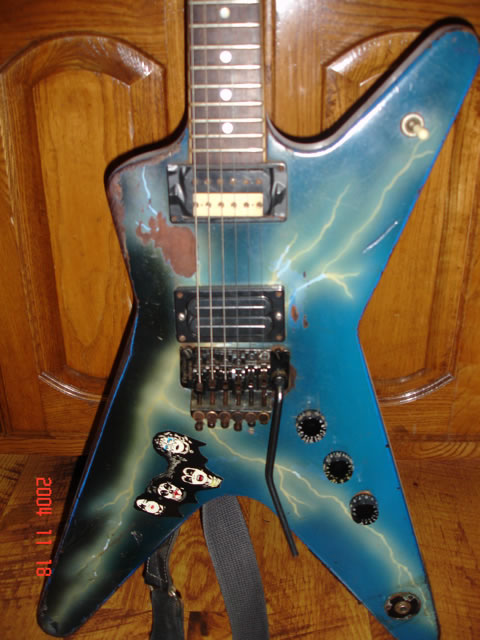
Buddy Webster (pka
Buddy Blaze), a successful guitar maker and technician, in the mid-1980s modified
a Dean guitar and commissioned someone to paint a lightning storm graphic on it;
he gave the guitar to Darrell Abbott, late guitarist of the heavy-metal band
Pantera.
Abbott called the
guitar “The Dean from Hell” (DFH). In 2004, Abbott entered an endorsement-type
contract with Dean, but he died shortly thereafter. Since 2004, Dean has
produced and sold guitar models based on Abbott’s guitar and featuring the
lightning storm graphic, without Webster’s consent and without paying him
royalties for the use of the design. In 2017, Webster sued Dean and others for copyright
infringement, unfair competition, and false endorsement. The court of appeals
affirmed the district court’s grant of summary judgment to Dean et al.
 

Dean from Hell

Dean’s DFH

Copyright
infringement: this was fundamentally a claim over ownership, not general
infringement, and thus it didn’t have general infringement’s rolling accrual.
Webster first learned about the sales of the reissued guitar in December 2004,
and learned of a cheaper, imported version called the Cowboy from Hell in 2006.
In 2006, he emailed then CEO of Dean, Elliot Rubinson, and told him that Dean
could not sell the reissues without his permission, but Dean did not stop
selling the guitars. In 2007, Webster complained again, and Rubinson responded:
I have taken some time and spoken to several “people in the know” and
the consensus concerning [the lightning storm graphic] is that [Abbott’s]
estate is the legal owner of it. With that said, I still would like to work
with you on [an Abbott] project because I am not about making enemies but
keeping friends…. Rita and I have plans to do a relic [DFH] and would like you
involved for a royalty. Is that of interest?
Webster testified
that, in a subsequent phone call, Rubinson suggested that he sue Abbott’s
estate if he was still upset.  Despite
the lack of royalties for the DFH, Webster worked with Dean in 2009 to create
and sell his own signature guitar model—the “Buddy Blaze ML.” He also willingly
appeared in multiple interviews in 2008 and 2009 discussing his role in the
history of the original DFH; Dean posted some of them to its YouTube channel. In
one, he stands in front of the original DFH recounting its history. In another,
he appears in an interview alongside Rubinson “promoting the Buddy Blaze ML,
speaking about the history of the original DFH, and comparing his Buddy Blaze
ML model with the DFH.” The third is similar; there’s no mention of the reissues.
From 2009 to 2015,
Dean released several other versions of the DFH, the “Rust from Hell,” the
“Black Bolt,” and the “Limited USA Dean from Hell.” In 2016, Webster retained
counsel and obtained a copyright registration in the lightning storm graphic.
The court of appeals
agreed with the district court that ownership was the gravamen of the claim
here, and Webster had reason to know that his alleged ownership rights were
being violated as early as 2004, when he first learned that Dean was producing
DFH reissues. Even if that weren’t enough, Rubinson’s email in 2007 stating
that “the consensus concerning [the lightning storm graphic] is that [Abbott’s]
estate is the legal owner of it” “was certainly sufficient.” His claim therefore
accrued in April 2007 at the latest, and the three-year limitation period
expired long before he brought his copyright claim in 2017.
Lanham Act/unfair
competition claims: the district court reasoned that there was no evidence that
Dean used a false or misleading statement to sell the DFH reissues. Dean just posted
Webster’s own statements in the video interviews (which he said he wasn’t
harmed by), and there were no statements that Webster endorsed, sponsored, or
derived income from the DFH reissues. One person stated in a declaration that
he attended a NAMM show and “heard Dean representatives using Buddy’s name when
selling guitars like the one that Buddy Blaze re-built for [Abbott],” but there
was nothing untrue or misleading about that.  [Note: Dastar would be an easy way to get here.]
Webster argued that,
in context, the interviews were likely to cause confusion “because, after
viewing the videos on Dean’s website and reading Dean’s advertising copy for
the DFH reissues, a reasonable person would assume that Webster was working
with Dean on the reissues.” Webster relied on statements by Dean advertising
the DFH reissues as similar to “the one that Buddy Blaze painted” and featuring
the “iconic, [DFH] lightning bolt paint job.”  The court of determined that these statements
were not false or misleading. The videos were Webster discussing his undisputed
involvement in the creation of the DFH, and none stated that Webster was
promoting or selling the DFH reissues. “The statements in these videos do not
become misleading, nor do they imply that he endorses or benefits from the sale
of the DFH reissues, simply because they appear near Dean’s advertisements of
DFH reissues.”
False endorsement: Webster
argued that his presence in Dean’s promotional materials and videos “was
‘inescapably interpreted’ by the audience of guitar-enthusiasts [as] an
endorsement.” The court of appeals applied the multifactor LOC test, but found
that since the claims were based on videos in which Webster “appeared to
willingly promote his legacy as creator of the DFH,” only “(6) the intent of
the alleged infringer to misappropriate the proprietor’s good will; and (7) the
existence and extent of actual confusion in the consuming public” were relevant.
 The court doesn’t explain why it
discounts the other factors, but presumably it means that things like
similarity of marks and similarity of goods point in the wrong direction from
common sense where there is truthful, useful information that the seller should
be able to convey—similar to the justification for nominative fair use. Still
not clear to me why it’s these two factors that should bear the weight, but I
guess that’s what you get if you don’t have nominative fair use.
The court of appeals
rejected Webster’s implicit argument that, “given his notoriety in the
guitar-enthusiast world, the mention of his name near or in relation to the DFH
reissues must have caused consumers to mistakenly believe that he endorsed the
sale of the reissues.”  Instead,
confusion is not simply to be assumed “when a mark is used in the proximity of
advertising for a product, especially when a legitimate use of that mark is
clear from the context.”  There was “little
or no evidence” of intent to misappropriate his goodwill: these were just his
own interviews, “several years after he became aware of the DFH reissues,
willingly discussing the history of the DFH to promote his legacy and sell his
own guitars. He does not mention the DFH reissues in the interviews.” [Would it be intent to misappropriate if someone else truthfully discussed his history? This is a variant of the question of distinguishing use from misappropriation.] And there
was no evidence of consumer confusion. Affirmed.

from Blogger https://ift.tt/2XQvWwd

Posted in Uncategorized | Tagged , , , | Leave a comment

reasonable consumers wouldn’t think Dunkin Donuts Angus Steak was intact piece of meat

Chen v. Dunkin’
Brands, Inc., No. 18-3087-cv, — F.3d —-, 2020 WL 1522826 (2d Cir. Mar. 31,
2020)
Plaintiffs sued Dunkin
for deceptively marketing the Angus Steak & Egg Breakfast Sandwich and the
Angus Steak & Egg Wake-Up Wrap, alleging that Dunkin deceived consumers
into believing that the Products contained an “intact” piece of meat when the products
actually contained a ground beef patty with multiple additives. There wasn’t
jurisdiction over the out of state plaintiffs’ claims, and no reasonable
consumer would have been fooled under GBL §§ 349 and 350.

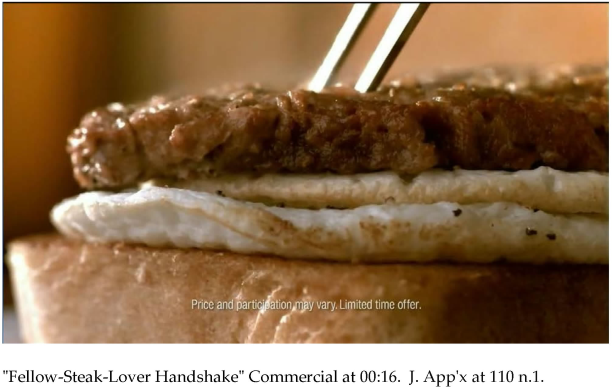
All three challenged
ads “conclude with multiple zoomed-in images that clearly depict the ‘steak’ in
the Products as a beef patty.” And “steak” doesn’t always mean a slice of meat;
 it is also defined as “ground beef
prepared for cooking or for serving in the manner of a steak” by the Merriam-Webster
Online Dictionary, as in chopped steak, hamburger steak, and Salisbury steak.  In the context—the sandwiches cost less than
$4 and less than $2 respectively, and they’re marketed as grab-and-go products
that can be consumed in hand, without the need for a fork and knife—a
reasonable consumer would not be misled into thinking she was purchasing an “unadulterated
piece of meat.”

from Blogger https://ift.tt/2XI4DnW

Posted in Uncategorized | Tagged , | Leave a comment

1201 claim to control device features survives

Philips North
America, LLC v. v. Summit Imaging Inc., 2020 WL 1515624, No. C19-1745JLR (W.D.
Wash. Mar. 30, 2020)
But I was told that
after Lexmark and Chamberlain, manufacturers weren’t using §1201
claims to control devices!
The parties compete
to sell ultrasound imaging devices for hospitals and medical centers; Philips
sells related ultrasound hardwre devices. Philips’ Ultrasound Systems are
driven by one of two software platforms that Philips developed and owns: (1)
Philips Voyager Platform and (2) Philips Common Platform. Each PUS has features/tools
that are only enabled by license, and Philips aleges it uses “multiple layers
of technological controls to protect” their copyrighted works from unauthorized
access, and that the software and access control systems are trade secrets and
that those systems contain other trade secret information.
Summit allegedly hacks
into Philips’ software and alters the Ultrasound Systems in order to enable
features or options for which Philips’ customers have not paid Philips, and
trains Summits customers on how to circumvent Philips’ access controls. Summit
allegedly advertises that its Adepto tool is a “legal solution” or a “legal
alternative” to working with Philips in order to enable additional features and
options.
Defendants moved to
dismiss DMCA §§1201 and 1202 claims, Defend Trade Secrets Act claims, Uniform
Trade Secrets Act claims, false advertising claims, Consumer Protection Act
claims, and contributory copyright infringement claims.
Philips adequately
pled that its Ultrasound Systems are protected by “a technological measure that
effectively controls access to a work” under §§ 1201(a)(1) and (a)(2): (1)
user-specific codes; (2) user-specific hardware keys; (3) machine-specific
codes and hardware keys; (4) software files with licensed features and optional
add-on controls; (5) machine-specific configuration files that control
compatibility between the systems and software and/or the systems and replacement
parts; and (6) software disabling if a user attempts to make use of an
unlicensed feature. And Philips sufficiently alleged circumvention of those
access controls: defendants allegedly remove the hard drive from the Ultrasound
Systems and run their Adepto program on the hard drive, which changes
configuration files and software files in order to enable unlicensed options on
the hard drive, and force compatibility with otherwise incompatible transducer
parts.
§1202, modifying
CMI: Not plausibly alleged. The only CMI identified with any specificity in the
complaint is “the terms and conditions of the use of the software,” which allegedly
resides on “machine readable configuration files.” But Philips didn’t plead
facts explaining how defendants falsify, remove, or alter Philips’ terms and
conditions. Motion to dismiss granted with leave to amend.
DTSA and UTSA causes
of action also survived.
False advertising
(including state Consumer Protection Act): To the extent that the claim was
based on statements about the legality of defendants’ services, these were
inactionable statements of opinion because the statements “purport to interpret
the meaning of a statute or regulation.” And, though there is a “well-established
exception” to the bar against false advertising claims based on opinion
statements for an opinion statement “by a speaker who lacks a good faith belief
in the truth of the statement,” Philips failed to adequately plead that
defendants lacked a good faith belief in the truth of their statements.  Again: leave to amend.
Contributory
copyright infringement: adequately alleged because the Adepto tool allegedly
created copies of Philips’ software and log files [are the log files
copyrightable? Are they copyrightable by Philips? Seems unlikely].

from Blogger https://ift.tt/34HSkJQ

Posted in Uncategorized | Tagged , , , , , | Leave a comment

Humvees in Call of Duty are constitutionally protected realism, not confusing/diluting

AM General LLC v. Activision
Blizzard, Inc., No. 17 Civ. 8644 (GBD) (S.D.N.Y. Mar. 31, 2020)
The district court
allows Humvees to appear in realistic videogames by performing a full confusion
analysis, despite purporting to follow Rogers v. Grimaldi.
The Humvee has become
“an iconic and a ubiquitous symbol of the modern American military.” AMC has
granted licenses to use the Humvee trademark “on or in connection with a wide
variety of products,” including toys and at least four video games. Humvees
have also appeared in “a wide variety of other media, including Hollywood
blockbusters, … television series, … and Academy Award-winning dramas,” as well
as in video games. 
Call of Duty is a
popular, realistic military video game. Humvees are depicted in nine Call of
Duty games, sometimes in the background or mentioned; players sometimes ride in
a Humvee for several minutes during a scene or level and they can occasionally “assum[e]
control of the (Humvee],” including by firing a turret-mounted machine gun. Humvees
are also shown in several trailers for the games and in Call of Duty-brand d strategy
guides. Activision also licensed a toy company to manufacture Call of
Duty-branded construction sets, two of which include toy vehicles that
allegedly bear the distinctive elements of the Humvee’s trade dress.          
An instruction
manual for Call of Duty 4: Modern Warfare included the following language:
All title, ownership rights and intellectual property rights in and to
this Program (including but not limited to any patches and updates) and any and
all copies thereof (including but not limited to any titles, computer code,
themes, objects, characters, character names, stories, dialog, catch phrases,
locations, concepts, artwork, animation, sounds, musical compositions,
audio-visual effects, methods of operation, moral rights, any related
documentation, and “applets” incorporation into this Program) are owned by
Activision, affiliates of Activision or Activision’s licensors.
Similar language
occurs in other manuals for other iterations. Activision also received a letter
in 1998 complaining about the use of Humvees in the video game Sin, which is
unaffiliated with the Call of Duty franchise; Activision supposedly “agreed to
remove [Humvee] vehicles from the video game Sin.”
Infringement: Rogers
is the test for uses in artistic works generally, not just for titles. But then
the court cites a title-v-title case for the proposition that a First
Amendment-sensitive analysis must be done using the Polaroid factors,
which is not the rule in the Second Circuit when the plaintiff doesn’t own
rights in the title of an expressive work. 
Rogers prong two is meaningless if it’s just likely confusion all
over again, but the court cited Twin Peaks Prods., Inc. v. Publ’ns lnt’l, Ltd.,
996 F.2d 1366, 1379 (2d Cir. 1993) (title v. title) and DeClemente v. Columbia
Pictures Indus., Inc., 860 F. Supp. 30, 51 (E.D.N.Y. 1994) (which indeed also
completely misread Rogers as just something to think about when you’re
doing the multifactor confusion analysis, which is kind of amazing if you’ve
read Rogers, which among other things rejects a consumer survey and
evidence of confusion by sophisticated marketers).
By contrasting a
non-title trademark case (the Hangover case with Louis Vuitton) with a
title-v-title case (The Book of Virtues v. The Children’s Audiobook of Virtues), the
court concludes that “an artistically relevant use will outweigh a moderate
risk of confusion where the contested user offers a ‘persuasive explanation’ that
the use was an ‘integral element’ of an artistic expression rather than a
willful attempt to garnish the trademark owner’s goodwill for profit.”  At least the court is clear that the Humvees don’t
need to be “metaphysically” required for the game; an integral element
is one that “communicate[s] ideas—and even social messages,” either “through
many familiar literary devices (such as characters, dialogue, plot, and music)”
or “through features distinctive to the medium (such as the player’s
interaction with the virtual world).”
Of course there was
artistic relevance. “Featuring actual vehicles used by military operations around
the world in video games about simulated modern warfare surely evokes a sense of
realism and lifelikeness to the player who ‘assumes control of a military soldier
and fights against a computer­ controlled or human-controlled opponent across a
variety of computer-generated battlefields.’”
Proceeding to the Polaroid
factors, the court found that the use wasn’t explicitly misleading because
it wasn’t confusing. [sigh] It even quoted Rogers: “no amount of evidence showing
only consumer confusion can satisfy the ‘explicitly misleading’ prong of the
Rogers test because such evidence goes only to the ‘impact of the use’ on a
consumer.” And then it did the multifactor confusion test anyway.
Unsurprisingly, some
distortions appeared in the multifactor test: the court said that the marks
weren’t very similar because the purpose of the uses were different. “Plaintiff
s purpose in using its mark is to sell vehicles to militaries, while Defendants’
purpose is to create realistically simulating modern warfare video games for
purchase by consumers.” AMC’s licensing practices were “sporadic and marginal”
and thus didn’t show market overlap. And anyway, First Amendment considerations
required the court to give minimal weight to bridging the gap.
AMC’s survey
allegedly “found that 16% of consumers shown actual video game play from
Activision’s games were confused as to AM General’s association with Call of
Duty.” That wasn’t enough, given Rogers.
Bad faith: the 1998
letter couldn’t show bad faith, because Activision didn’t respond to it;
silence wasn’t probative of Activision’s agreement about rights in the Humvee.  Nor were a handful of statements by
Activision employees, the use of Humvees decorated with Call of Duty logos at
several in-person promotional events, or the statements in user guides evidence
of an intent to confuse:
For instance, the user guide statements do not affirmatively tell
consumers that Activision either owns or licenses the Humvee IP. All that reasonably
may be said is that a paragraph in miniscule type buried in a user guide—a
paragraph which does not allude to, let alone mention, Humvees at all—does not “tell
consumers” much of anything. Indeed, such back-end boilerplate provides no
basis for “confusion between the two companies’ products.”
Sophistication: The Hangover
court noted that “moviegoers are sophisticated enough to know that the mere presence
of a brand name in a film, especially one that is briefly and intermittently shown,
does not indicate that the brand sponsored the movie.” Here, “[t]here is no
reason to believe that video game players are any less astute.”
Trade dress claims:
Same thing, “[g]iven the improbability of confusion between a vehicle and a
video game—or, in the case of the contested toys, between a plastic figurine
and a full-blown military machine.”
Unfair competition/false
designation of origin. Same thing. “The only thing remotely close to a ‘false
designation’ is the legalese buried inside several games’ user guides,” which
wasn’t enough.
Lanham Act false
advertising: There were no literally or impliedly false statements.  NY false advertising: same. Also, AMC didn’t
show injury.
Federal and NY
dilution: NY dilution is “essentially the same” as federal dilution, and
without evidence of the quality of Activision’s games, AMC failed to show
tarnishing or blurring. If any dilution did occur, it would be “tolerated in
the interest of maintaining broad opportunities for expression.” [Also in the
interest of obeying the federal statute’s requirements and exemptions, but here
I won’t quibble.]

from Blogger https://ift.tt/3aoFYrm

Posted in Uncategorized | Tagged , , , | Leave a comment