Legal Applications of Marketing Theory, part 2

Dominique Hanssens, Natalie Mizik, & Lorenzo Michelozzi,
UCLA Anderson, Univ of Washington, Cornerstone Research, Brand Value, Marketing
Spending and Royalty Rates
Brands can create value, but require ongoing marketing. When
licensed, disputes can arise about royalty rates and marketing
support/maintenance effort. Can we measure the financial value of a brand? Quantify
relative impact of brand and ongoing marketing spending?
Lots of effort goes into valuing brands. Five major brand
value entitities: Interbrand (top 100); Millward Brown, Brand Finance (top
500), Forbes, Eurobrand (top 100 corporate parents). What methods? Only two
major methodologies for economic use value. (1) Earnings split: NPV of
brand-specific earnings of the business. 
(2) Relief from royalty: NPV of notional licensing fee that a company
would have to pay for the use of brand. 
In principle, both should yield approximately the same estimate. Significant
differences between the various list reflect differences in assumptions of
respective models, not differences in methodology.
In the top 30, only 5 brands are common in the top 30 to all
sources in 4 2018 valuations.  Amazon,
Apple, & Google occupy the top spots. 
Only 35 brands are common to all 4 lists. Amazon’s valuation varies from
70-150 billion.  Aggregate value of 100
brands on Millward Brown’s list $4.83 trillion is more than 2.2x Interbrand’s $2.02
trillion.  There’s not even consensus on
direction of change in brand value for the majority—18 of 35—common brands
featured on all 4 lists. 
Why is valuation difficult? Brands have multiple effects on
different groups.  Consumers aren’t the
only audience.  Employees (some evidence
of motivation/effect on firm costs), investors (cost of capital), regulators
(better contracts, concessions on infrastructure), competitors, business
partners.  Demand-shifting effects and
cost-shifting effects.
Pessimistic view of current state of art.  What can be done?
IRS is very interested in brand valuation, especially w/US
companies with overseas affiliates that pay royalties into the US.
Brands require constant marketing investment.  They may have different returns to marketing
investment—A brand that has to keep marketing to generate sales has a weaker “brand
effect” than one that would not lose many sales if it stopped marketing.  Probability of choice w/o marketing stimulus:
brand effect.  Helps us understand which
sales come from marketing versus from brand. 
Q: do you equate brand and product?  Do they have to be same quality?
A: that’s another variable; have to control for that.  Case-specific.  If it’s product level you have to do it for
each product separately. A company may rely more on marketing for one division
than for another, or in South America than in Europe.  Product effects tend to be heterogeneous.  Nivea is bottom tier face cream in France, higher
in other countries. The rest is all accounting; base royalty rates on that part
of the revenue generation that can be attributed to the brand. 
Extensions: brand might not just influence final
consumers.  Can you get a product on the
shelf in various stores? Is it brand strength/promise of marketing dollars for
the brand?  Car dealerships work this way
in the US.  Questions of persistence: how
long will they last?  They do need some
maintenance at least w/the presence of the product/service.  Perrier was off the market for 4 months for
having traces of benzene; 3 years later, they still hadn’t recovered.  Careful about inferring long term impacts of
brand effect.
Q: what’s the best way of dealing w/price?
A: it’s a variable that you control for. Price may be
function of brand strength, but always control for it.
Q: it has to be a thought experiment though (the intercept point
that’s # sales w/o marketing) b/c you can’t set things like distribution to
zero (which was what happened with Perrier when it left the market).
Fit into legal dispute: in principle, many such disputes are
possible. Any situation in which brand is monetized by someone who doesn’t own
it: licensing, franchising, royalty rates/marketing support disputes,
intracompany transfer pricing agreements w/tax consequences. Company argues
that the brand valuation is lower than the tax commissioner thinks b/c of the
marketing investment in local jurisdictions and so low royalty payments back
into the US are justified.  Qs relate to
duration of effects, how the brand itself is perceived/built in various markets.  Judges can be very sophisticated about how
marketing works. Challenge: the model that courts use is grounded in tangible
assets w/certain depreciation rates. You have to recast that in the light of
marketing and branding, which are different.
My Q: how if at all do these standard approaches work for a
small business that doesn’t trade in multiple countries?  A business that targets a subset of
consumers, e.g., doctors?  Easier or
harder to calculate?
A: There is no validated methodology for small business. You
need the data of a publicly traded company. You can do something but can’t get
an ultimate number for the value b/c experts have to make assumptions, which
end up controlling the outcome (e.g., what’s the useful lifetime of a brand?).
Even with the public companies you’re getting ranges like $600 million to $3 billion.
For a small business: You can use something like a multiplier and find
comparables that scale them up. It’s just not feasible with a sufficient degree
of precision.  [It strikes me that this
answer is super helpful to proponents of injunctive relief in cases of
infringement that don’t involve global brands. 
So I might aim this kind of expert at an irreparable harm finding.]
Q: why not ask what would happen if all other brands’
marketing went to zero too?
A: looking for a differential.
Q: sure, but you’d get a different answer. You need an
answer to the Q of what an appropriate benchmark is, which is an issue with operational
definitions of brand value.
A: yes, to do it, you inevitably rely on assumptions. 
Q: sure, and if I’m opposing you I argue that you taking all
competitors down to zero is a better construct.
Anindya Ghose & Avigail Kifer, NYU Stern &
Cornerstone Research, Search Engine Advertising, Trademark Building, and
Consumer Intent
SEO advertising is competitive and lucrative. Search engines
are two-sided markets.  TM bidding: using
keyword ads for TMs you don’t own can in theory increase exposure of lesser
known brands and benefit consumers using the TM as a generic term (e.g., Kleenex)
[or using it as a shorthand because it’s top of mind even though they have no
particular preference for that brand]. But TM bidding might also in theory
prevent/delay consumers from reaching the TM owner’s site or create confusion.
Antitrust Qs: Does TM bidding contribute to consumer
confusion? (It depends on what the resulting ad looks like). Does restricting
TM bidding inhibit consumer price search? Does it prevent the most relevant ads
from appearing in search results?  Would
consumer search costs be affected by restricting TM bidding? If you can’t see
ads from Costco, Wal-Mart, etc. when you search 1800 Contacts, then you may be
getting less relevant ads. But if you have to scroll through a zillion ads,
search costs may go up.
Lots of academic literature on related topics, including
effects of competitor’s ad on your ad and tradeoff effects of your ad on your
organic link. Type of device used can affect search costs and how you react to
them. Mobile search implies something different about intent of search as well.
Presence of ads can increase total clicks and coversions: Example:
Nike w/no ad at all gets 7.9 million clicks on its site; if Nike buys its
keyword, then 5 million clicks go to the ad and 8.1 million clicks go to the
organic result. Presence of ad changes consumer behavior.  Q: does it affect the competitors? A: It
depends.  Where does it come from? Either
from market expansion or from existing competitors.  Touches on differing intent of search
queries.
Navigational searches: what is the search for? Specific product
name: Samsung Galaxy S7 Edge—you may want different retailers but not competing
products (though you might want those too). 
TM—maybe different.  Look at click
distribution, click through rate (conditional on ad rank), conversion rate
(conditional on ad rank), bounce-back rates, dwell times—might give you a sense
of whether consumers realized they didn’t want the result very quickly.
1800 Contracts: 1800 got big companies to agree not to
advertise on 1800’s keywords and vice versa.  Did that violate antitrust law?  [Disclosure: I was FTC’s TM expert.  They were 1800’s search engine data people;
we have not previously interacted.]  We
had 10 years’ data for Google and 5 for Bing. 
We had granular metrics.  Very few
(less than 1%) of the ads had price information.  In response to Q: yes, consumers could click
and compare prices.  People who don’t
search “cheaper than 1800” are not looking for prices. [That is a weird assumption.]  You have to imagine a but-for world in which
these agreements didn’t exist.  What
would have been the results? You have to know Google’s algorithm/ranking.  Also, just b/c ads hypothetically would have
shown up doesn’t mean consumers would’ve engaged with those ads.  Nontrivial, easy to rebut assumptions.  [Which convinced a pretty hostile ALJ and
also the Commission, by the way!  Though
this is definitely not my area, I will point out that there was some data about
what happened when these agreements weren’t in effect with particular
competitors; those competitors did better in search/conversion.]
Regulators are taking on digital ads: EC fined Google $1.7
billion for digital ad restrictions. 
GDPR and its fundamental flaws: SMEs have nontrivial compliance costs
w/display advertising.  Algorithmic/data
divide is the new digital divide.  Is it the
savvy who monitor how and why they’re getting advertised to, or the marginalized?  [I just saw a tweet suggesting that GDPR use
in the US for Microsoft products is much higher than in the EU, since Microsoft
adopted a global rule.] 
Fake news: do consumers perceive FB/Instagram ads as having
been endorsed by the platform?  Must
Instagram influencers disclose relationships when endorsing products? Can consumers
differentiate b/t ads and other content? 2018 class action against Fyre media.
This will be an important issue. 
Distributional effects will be important. 
New tech by blockchain can help data quality.  Until 2017, we knew that the system had
limitations: a lot of fraud.  $30 million
every day for hackers arrested by FBI. Because of lack of transparency in
digital ecosystem, there are disputes b/t authorities, platforms,
intermediaries, ad agencies, consulting agencies like Accenture (which are now
ad agencies), etc. Blockchain introduces much needed transparency in the system.
Fraud and its magnitude would be hard to prove in past.  Now we have the data.
Q: price per click—is it long for this world? Paying for
clicks is uncomfortable for the advertiser. 
A: we’ve gone the other way. Ability online for firms to
identify, quantify path to purchase journeys has dramatically include. 
Q: why not bid for conversions?  [A: Some of it is.]  Why isn’t it all conversion?  [My related suggestion: Because marketing is
still fundamentally probabalistic in a lot of ways?]
A: many products, people don’t buy on the internet. Consumers
still want to go to your website, examine alternatives. Attribution issues are
getting easier but still exist.  If you’re
searching while you’re in the store, for example, we may be able to connect
those. 
Q: is there an argument to be made about keyword ads causing
dilution?  Even if the consumer isn’t
harmed, the brand is.
A: hasn’t looked at it. 
We had a branding expert.  [My
answer: US law specifically allows comparative advertising as an exception to
dilution; there is no legal support for the dilution argument here.]

from Blogger http://bit.ly/2ZUCecT
Posted in Uncategorized | Tagged , , , , , | Leave a comment

Legal Applications of Marketing Theory, part 1

Jacob Gersen & Joel Steckel, Harvard Law & NYU Stern,
Conference Introduction
Steckel gave a talk on dilution years ago and RT tore him
apart (sorry!); since then, he’s done work with Chris Sprigman to answer some
of the Qs I raised and I was right (not sorry!).  Has stayed interested in legal applications
of marketing theory.
Saul Levmore, Chicago Law, Piece Problems: Component
Valuation in Marketing and in Patent and Tort Law
Marketing literature is more interesting than legal literature
here.  We have analogous problems in negligence:
if 3 people jointly cause harm, how do you value the harm of each?  For patent infringement: how important to the
value of the overall product is one ingredient that was found to infringe?  It’s a more interesting problem than it looks
b/c of worries about over- and underdeterrence. Or a case in which someone
patents playing a song on each floor of a parking garage so they can remember
which floor they’re on: if they don’t increase the cost of parking after
implementing this, how do you figure out what the damages are?  [He thinks costs saved in not helping people
find their cars.]
Paper discusses how some solutions in some areas transfer
well, and others don’t.  B/c the
contribution to the joint tort car accident is a one-off, it may not transfer
well. But valuation is a general problem: figuring out how valuable a third baseman
is to a particular team is actually the same problem, b/c a teammate might be
more or less valuable depending on who else is on the team.  The underlying relationship may not be
linear.  Our task: we should look to
other fields to see how they do or could solve the problem.  Though stresses that doesn’t mean the
solutions elsewhere work there, or would work here.
Q: how do you think about heterogeneity of preferences?
A: in some settings we don’t care: we’re trying to evaluate
a market solution. In others, he hopes it’s not a serious problem b/c mostly we
can look to market solutions or ask individual people (surveying).  One possibility: ask people what it was about
the product they like, or ask them to pick among products. People may not be
able to name what they like, but that’s a signal it might not be
important.  But he doesn’t yet know what
to do with what happens if only 4 of 50 mention a feature is important to them;
that might help convince a court that it’s not important. 
Q: conjoint analysis could be meaningless where other
measurements of damage are better. If you have a broken fridge in a house it
could knock $4000 off the value of the house—but if it can be fixed for $50 that’s
what should happen instead.
A: agrees.
Q: reasonable consumer concept. Good marketers think
precisely the opposite: they segment markets, then go after a segment. The whole
point is the heterogeneity.  Groups do
have different valuations for different aspects of products.
A: there’s some doubt, but it’s not as silly as you make it
sound. General approach is to assume that law or the market is aimed at the
reasonable/average consumer; if you know you’re not normal, you should speak
up.  Other areas of law think that law
should pick extreme solutions, forcing information out of people who are “normal”—depends
on the costs and benefits of revelation. 
Sometimes you might pretend to be normal to avoid the costs of valuation
(e.g., you cut I pick). Usually law is unsympathetic to the non-average person,
e.g., a nuisance claim by a person who can’t stand music and lives near a
church.  Law is in part sensitive to the
probability of fraud here.
Q: often sees calculations of actual price compared to
but-for price—but what is the but-for price? 
Is it a price that would’ve kept the same market share?  A price that would reflect a Nash equilibrium
of a new market without the feature b/c competitors would also have reacted to
the absence of the feature? A price equivalent to average consumer’s WTP for
that attribute/its absence?
A: Law & econ answer: paper talks about this and he
thinks there’s no single right answer. 
B2B transactions would be very different from consumers.  General reaction: many ways to do it.  He wants to identify several different
methods and not tell people in advance which will be used; that prevents
strategic behavior. Uncertainty is a valuable part of the system though we make
believe we’re committed to treating like cases alike.
Q: what happens when it’s not 6 elements but 1000, as in a
cellphone? Then when you do the conjoint analysis it’s down to 6, distorting
the results.
A: when it’s 1000, the chance I could build the cellphone
without it is much greater, so the solution should be: if I’d known the problem
upfront, what would have been my cost to avoid it? That would be the best way
to go about measuring those damages—the beginning rather than the end
consumer.  That might also be true when
there are only 3 elements, but it’s more likely w/1000.
Peter Golder, Aaron Yeater, & Mike Schreck, Dartmouth
College, Analysis Group, & Analysis Group, Assessing Trademark Strength
without Surveys
Secondary meaning: in search of a more rigorous way to deal
with the qualitative aspects of an inquiry. Law makes claims about how
consumers perceive product designs that have implications for measurement. Secondary
meaning: “in the minds of the public, the primary significance is to identify
the source of the product rather than the product itself.”  Considers evidence that product features were
intended to indicate source and that the firm succeeded in doing this.  It’s not just that the design needs to be recognizable
but that it signal the specific purpose of identifying source, and that implies
an intentionality that can be assessed.  Wal-Mart: specific assertion about
consumer behavior: predisposition to equate a product design feature with a
source doesn’t exist. The SCt didn’t undertake extensive empirical analysis to
arrive at that conclusion, but it is the rule.
Barriers to secondary meaning: primary meaning of product
design features is to provide functional or aesthetic/ornamental elements.
Extent of advertising for functional benefits of features. Extent of
marketplace crowding and noise with historical or current uses by
competitors/third parties. Duration of existence in market.  Inconsistent use of product design features
in the market.  Documentary/archival
evidence can be important to these elements. 
What else?
RT: I’d add: what else is in use on the product to indicate
source. European concept of the limping mark that is recognized as going with,
e.g., a Kit Kat, but never used to pick candy. Response: in some ways that’s
about materiality.  [I agree!]
Comment: visibility/lack of visibility: consumers have
easier/harder times perceiving certain things as marks.  Identifiers inside a jacket versus inside
(including observability at the time of purchase, so a standard label on a
jacket may be doing source identification work).  How do consumers make categories?  If you’re categorizing “birds,” hollow bones
are perfectly predictive but not observable, so that’s not how ordinary people
implement the category “birds.”  [I really
like use of category theory though I think we’re still, as here, working out its
implications.]
Standard actions to create and maintain secondary meaning: Look
for internal planning documents about intent to make features source identifying;
look for documents w/clear communication objectives for attempting to establish
secondary meaning and measures progress; company carries out planned
communication (e.g., look for ads); advertising “famous,” “iconic,” “exclusive,”
“unique,” “signature”; aggressively policing asserted marks to protect
exclusivity.  Qs? [Also interestingly,
this framework would be consistent with Mark Lemley’s
argument
that having—and thus allowing/not policing against—parodies should
be a requirement for fame, which would turn into media coverage rather than
competition.]
RT: This is a legal question: the doctrine right now
requires none of this, because the theory is always if there is consumer
confusion then there is something protectable. 
So you can have all this and it won’t cover the waterfront unless courts
also say that its absence is dispositive. 
There are cases/proceedings finding protection without any of these
things, e.g., the TTAB saying that the University of Wisconsin can fail to
police/“impliedly license” its marks for 70 years and then (re)claim its TM
rights.
Comment: but perhaps it’s just implausible that this creation
of secondary meaning will really happen without the marketers picking up on it
and talking about it internally so there will be documentation.
Marketplace outcomes related to secondary meaning: Complement
to surveys: media provide evidence of success or failure of calling out features
as source identifying. Traditional/social media.  Company websites (including past versions).
Online search behavior—if they are source identifiers, consumers should be
trying to search by them at least to some degree [which raises the limping mark
issue again]. Online reviews. % of sales w/product design features. Company
monitors and documents progress towards achieving communication objectives related
to creating or maintaining secondary meaning. 
[I like the suggestion, which I’m not sure has shown up in the cases,
that advertising functional features has a separate impact on secondary meaning—it’s
not just that it indicates
functionality; it also tells consumers that they shouldn’t rely on the touted
feature to indicate source.]
The law on what’s required for secondary meaning varies by
circuit.  [They categorized intentional
copying by D as an “outcome” but that doesn’t fit in their framework at all. The
missing concept: functionality—if there are good noninfringing reasons to copy,
then copying tells us nothing about secondary meaning. That factor shouldn’t be
in the legal tests, at least without requiring intentional efforts to confuse
in particular and not just to copy, and their framework helps explain why.]  If you can luck into secondary meaning, why
would courts care about “look for” advertising?
Cass Sunstein, Harvard Law School, Popcorn: Mandatory
Information Disclosure:
How to value the benefits of information? Pervasive unmet
challenge in policy all over.  Principal
focus is on regulatory agencies, but courts and private sector entities are also
trying to value info.  Toy/discussion
framework: people might want information for instrumental value—they can know
whether to buy a product, get health care, change their lives. Our primary
approach in the past. There’s also hedonic value: information might make you
happy or sad, and people might be willing to pay to get information that makes
them happy, or willing to pay to avoid information that makes them sad. Cognitive
value: learning may be something that people value. Maybe it’s just curiosity—how
far from the earth to the moon? Or maybe it will reinforce their model of the
world, or maybe it’s intriguing if it undermines their model of the world.  Sign issue: the valence of instrumental,
hedonic, cognitive value may be positive or negative.  Learning your client is guilty may have
negative value. 
Recent data: knowledge is not always preferred. Mesolimbic
reward circuitry selectively treats the opportunity to gain knowledge about
favorable but not favorable outcomes as a reward to be approached. WTP to
receive or avoid knowledge was tied to participants’ expectations about whether
info would be positive or negative.  Roughly
1/3 in trials chose ignorance.
Asking consumers whether they’d want to know: if they’ll get
Alzheimer’s, whether their partner cheats, year of death, number of calories,
whether there’s heaven (slightly lower percent wants to know whether there’s
hell), predisposition to get cancer.  Alzheimer’s:
47% want to know, $107 WTP (average; median is significantly lower). Cancer:
$115, 58%.  Spouse cheats: 57%, $121;
Death: 27%, $154; calories, 43%, $49 (annually, contingent on wanting to know);
weekly cost of appliance operation: 60%, $44. 
Safety ratings of tires: 67%, GMO, 60% $101, conflict minerals 55, $109,
Online performance of airlines, 57%, $105, GHG emissions from car, 57%, $110. Some
would pay not to receive calorie info, apparently for hedonic reasons.
On yes/no, a lot of heterogeneity out there. Usually around
55-65% even want to know, for typical disclosures. Two categories of not
wanting to know: sometimes it’s bad news, and many people don’t want bad news;
sometimes it is who cares. WTP numbers vary and are usually pretty low.
There are a lot of labels out there: calorie, fuel economy,
energy efficiency, conflict minerals, graphic warnings, country of origin, greenhouse
gass, nutrition, dolphin-safe tuna.
Doing CBA: Four approaches. (1) Benefits not feasibly quantifiable,
so silence is golden (fuel economy labels, conflict minerals).  Common but he hates it.  Q re actual behavior v. expressed WTP: there’s
limited evidence about this, but people who use calorie labels are likely to
have high self-control whereas people who don’t want calorie labels don’t have
high-self control.
Observation: WTP of those who want to know when they’ll die
is higher even though the percentage is low—preference intensity varies.  Payment willingness might be about how likely
it is you’ll get the information some other way.
Comment: hedonic value of information may be one-time
whereas cognitive is persistent. 
A: Hedonic damage of knowing the year you will die might be
long-term.  More generally, the toy model
here uses a rational actor model, but that’s not complete.  People don’t want exposure to info inconsistent
with their political beliefs. But on average people are mistaken in hedonic
forecasting: they aren’t as unhappy with getting inconsistent info as they
thought they’d be, in intensity and duration. Might be present bias or failure
to forecast adaptation. 
Q: why ask such self-directed questions? A lot of policy Qs
will be: do you want to know how many people will die in our next war?  You might not be WTP to know the capital of
New Zealand, but be WTP for everyone in the country to know that.
A: our labeling Qs are asking about whether you benefit from
a label.
Q: but if you asked “do you want your kids to know the
calories in their food,” the answer might be very different.
A: is that the right Q for info disclosure benefits?
Q: better than saying “do you want to know.”
A: you might want to know the benefits your children get
from that.
Q: research on organizations suggests organizations may have
special difficulties processing information they’re not set up to receive.
Some discussion about the “year you’ll die” question: did
they believe it? Did they think they could “fight” it once they knew? Sunstein
thinks the survey had an implicit “work with me here” message and that people
got it.  In Europe, Diet Pepsi is Pepsi
Max—Diet Pepsi was punitive, “good for me.” 
That maps onto a lot of an actual driver of responses.
He thinks the data quality of MTurk varies from excellent to
pretty good—if you compare results to nationally representative surveys, they’re
usually pretty close—he wouldn’t expect a huge variation though some percentage
variation wouldn’t be surprising.
Commenters: one had really bad MTurk experience; another has
had varying experiences. Depends on the kinds of Q you ask; these Qs were
interesting and meaningful and some marketing Qs would be less so.  Some evidence that MTurkers in some parts of
the world sit in the same rooms and consult on answers.
Q about relationship of answers to how optimistic people are
overall: e.g., date of your child’s death (he thinks learning it would always
be painful, though I don’t know—2115 might be a pretty impressive answer,
albeit an unlikely one).  Optimism bias, hedonic
forecasting error, illusion of control—distorting factors. Magnitude of effect
depends on Q.
For policy analysis, we’re trying to look at end states:
e.g., for energy efficiency labels, how much would society gain in reduced
emissions/particulate matter. That doesn’t capture all of the relevant values
if people are made sad by the information. 
Got interested in that when calorie labeling was extended to theaters
and he got the response “you ruined popcorn!” 
Marketers intuitively understand this—but there’s less understanding of
the relationship b/t instrumental and hedonic or of the malleability of the
hedonic.
Q: relationship between avoidability of info/display and
preferences?  E.g., calorie labels that
are impossible to miss [nothing is impossible to miss] versus on the back.  Home energy reports: a lot of people don’t like
them even if they will save money with them. 
Might suggest that you could respond to heterogeneity by differing
presentation/availability.

from Blogger http://bit.ly/2V17djQ

Posted in Uncategorized | Tagged , , , , | Leave a comment

false advertising claim based on alleged misbranding of drug as supplement fails

Amarin Pharma, Inc. v. Int’l Trade Comm’n, Nos. 2018-1247,
2018-114, 2019 WL 1925649, — F.3d – (Fed. Cir. May 1, 2019)
The court of appeals upheld the ITC’s decision not to
institute an investigation into Amarin’s complaint of an unfair method of
competition or unfair act under 19 U.S.C. § 1337(a)(1)(A). Amarin sells
Vascepa, a prescription drug that consists of the omega-3 acid commonly known
as “EPA,” synthetically produced from fish oil. Vascepa is the only purified
ethyl ester E-EPA product sold in the United States as an FDA-approved drug
(for reducing triglyceride levels in adults with severe hypertriglyceridemia).
Amarin filed a complaint alleging violations under § 337 of
the Tariff Act of 1930, as amended. Specifically, certain companies were allegedly
falsely labeling and deceptively advertising their imported synthetically
produced omega-3 products as (or for use in) “dietary supplements,” where the
products are actually unapproved “new drugs” as defined in the FDCA.  This allegedly constituted an unfair act or
unfair method of competition under § 337 because it violated § 43(a) of the
Lanham Act, and also violated the Tariff Act “based upon the standards set
forth in the FDCA.” Amarin sought to exclude synthetically produced omega-3
products from entry into the United States.
The FDA submitted a letter urging the Commission not to
institute an investigation, arguing that the FDCA precludes any claim that
would “require[ ] the Commission to directly apply, enforce, or interpret the
FDCA.” In addition, it argued that the Commission should decline to institute
an investigation based on principles of comity (which I didn’t know was federally
a thing).  The ITC ultimately held that
Amarin’s allegations were precluded by the FDCA.
The Federal Circuit endorsed the Ninth Circuit’s view that,
“[b]ecause the FDCA forbids private rights of action under that statute, a
private action brought under the Lanham Act may not be pursued when, as here,
the claim would require litigation of the alleged underlying FDCA violation in
a circumstance where the FDA has not itself concluded that there was such a
violation.”
Here, the alleged violations of § 337 were “based entirely
on—and could not exist without—the FDCA.” For dietary supplements, affirmative
FDA approval isn’t required.  Whether
there’s been a violation should in the first instance be resolved by FDA
guidance about whether these products are “new drugs.” 
[The way I teach this is that a claim is precluded where it
can only exist—there can only be falsity—because the FDA exists and has
rules.  If, by contrast, there is alleged
falsity that could exist in a counterfactual world without the FDA, then the
claim should not be precluded.  That
doesn’t rule out using FDA standards to help judge falsity in the world we
actually have, though.  For example, FDA
requirements may well shape consumer understanding of what the word “generic”
means—but even without FDA requirements, the word could have a cognizable and
falsifiable meaning.  Here, however, the
drug/supplement distinction is allegedly created only because the FDCA
distinguishes them.  And reformulating
Amarin’s claim to avoid preclusion might be difficult—it’s perhaps plausible
that consumers think differently about the accused products because they’re
labeled supplements and not prescription drugs, but that difference seems
likely to favor the prescription pharmaceutical, though I can imagine situations in which consumers think supplements are “milder” or less likely to have side effects.]
Anyway, “Amarin’s claims are precluded at least until the
FDA has provided guidance as to whether the products at issue are dietary
supplements.”  That’s the ITC’s position;
the US as amicus apparently sought an even broader ruling of preclusion regardless
of whether the FDA has provided guidance, but the court of appeals declined to
reach the issue.
Pom Wonderful
didn’t change the analysis. The case “did not open the door to Lanham Act
claims that are based on proving FDCA violations.”
A dissent would have found lack of appellate jurisdiction
over a decision not to institute an investigation, and would have instead exercised
mandamus jurisdiction and concluded that Amarin didn’t show that the
“extraordinary remedy” of issuing a writ of mandamus was appropriate.

from Blogger http://bit.ly/2VDJQRF

Posted in Uncategorized | Tagged , , | Leave a comment

Recommended podcast on multilevel marketing

The Dream by Stitcher.

Excellent look at how multilevel marketing companies succeed
at avoiding regulation and at convincing enough people to try them—and convincing
them that their subsequent failure is their own fault and not intrinsic to the
model—to make the people at the top a lot of money.  Both gender and the collapse of real economic
opportunity for many people in the U.S. play big roles—the American mythos of
success being a matter of wanting it enough, combined with women’s desire for
flexible work that will allow them to support their families in both economic
and noneconomic ways, makes MLMs seem like a plausible response to rather than a
symptom of toxic inequality.  There are
many striking moments, including the justifications that people in the “upline”
use to explain why it’s ok to take money from losers—I mean, from people who
lack sufficient motivation to succeed.  (Interestingly, the industry mouthpiece who
appears in the last episode does not push that line, contrary to all the
individual MLMs trying to recruit “sellers”—instead, he would prefer to
characterize most “sellers” as people who sign up because they like the product
and want a discount, even though he admits that almost all of them want to be
understood as sellers/businesspeople.) One woman with 150 people in her
“downline” makes (just) $42,000 a year—which raises the question of how much
money is going to the MLM, since that’s a small fraction of the money it takes
to buy enough product to get that kind of commission.  The podcast also spends a fair amount of time
on the FTC’s largely lost battle to regulate MLMs like Amway, and on
MLM-friendly proposed legislation that will define most MLMs as not pyramid
schemes no matter how large a percentage of their “sellers” lose money.

from Blogger http://bit.ly/2Lmfm2O

Posted in Uncategorized | Tagged , | Leave a comment

hijacking another’s webpage for competing service is bad

Spy Dialer, Inc. v. Reya LLC, 2019 WL 1873296, No. ED CV
18-1178 FMO (SHKx) (C.D. Cal Mar. 18, 2019)
The parties compete in the market for reverse phone lookups.  When a user accessed plaintiff’s Spydialer.com,
malicious computer code allegedly inserted through ads placed by Reya would
cause the user’s browser to automatically scroll down to the bottom of the
webpage, where defendant’s ad was located. The user’s cursor would then be
placed in a search box located within the ad, instead of in the search box for
the Spy Dialer website. The ad’s search box was designed to look similar to Spy
Dialer’s search box. The malicious code allegedly prevented users from
scrolling back up the page to Spy Dialer’s search box. Users who typed a phone
number into the advertisement’s search box were redirected to defendant’s
website.
When Spy Dialer reached out to defendant, a manager claimed
that the malicious code was the result of a “coding error.” Spy Dialer
complained to Google, which conducted an investigation, concluded that
defendant’s ads “constituted a fraudulent business practice,” and banned the ads
from further use.  The ads allegedly
caused Spy Dialer’s website to lose “ranking in Google’s search engine results”
and led to lower traffic and resulting lower ad revenue.
CFAA: Defendant had limited authorization to access Spy Dialer’s
computers, because it submitted ads to platforms which would then place the
advertisements on Spy Dialer’s website. But it allegedly  exceeded the scope of this authorization by
causing the ads with malicious code to be placed on plaintiff’s site. However,
the complaint failed to plead that defendant obtained or altered information on
plaintiff’s computers that it wasn’t authorized to obtain or alter. For example,
there was no allegation that defendant continued to place ads on plaintiff’s
website even after permission had been revoked. “[M]erely submitting
advertisements through Google Ad Services[] does not state a CFAA violation.”
ECPA: 18 U.S.C. § 2511 provides a private right of action
against “any person who … intentionally intercepts, endeavors to intercept,
or procures any other person to intercept or endeavor to intercept, any wire,
oral, or electronic communication[.]” Here, when a visitor attempted to use Spy
Dialer’s website, defendant’s malicious ad would force the visitor’s browser to
automatically scroll to the bottom of the webpage. Even if the user realized
what was happening, the malicious code allegedly prevented them from scrolling
back up to the top of the webpage to use plaintiff’s own search box. This
“captured” and “redirected” traffic intended for Spy Dialer’s website (is that
the same as interception?).  And it was
plausibly alleged to be intentional, in that the code was sufficiently “sophisticated”
that it could not have come about through mistake or error.
California Penal Code § 502 creates liability against an
individual who “[k]nowingly accesses and without permission alters, damages,
deletes, destroys, or otherwise uses any data, computer, computer system, or
computer network in order to either (A) devise or execute any scheme or
artifice to defraud, deceive, or extort, or (B) wrongfully control or obtain
money, property, or data.” “Just as plaintiff’s CFAA claim fails … so too must
those aspects of plaintiff’s § 502 claim which depend on defendant having
accessed plaintiff’s computers.” But 502(c)(3) prohibits individuals from
“[k]nowingly and without permission us[ing] or caus[ing] to be used computer
services.” Subsection (c)(5) creates liability against a person who
“[k]nowingly and without permission disrupts or causes the disruption of computer
services or denies or causes the denial of computer services to an authorized
user of a computer, computer system, or computer network.” Subsection (c)(8)
bars “[k]nowingly introduc[ing] any computer contaminant into any computer,
computer system, or computer network.”
None of those provisions required access to Spy Dialer’s
computers, so those claims survived.
Lanham Act claim: based on defendant’s use of spydialer.org
(as opposed to plaintiff’s spydialer.com)—easily survives, as does an ACPA
claim.
However, a false advertising claim under California Business
& Professions Code § 17500 failed. That law makes it unlawful for any
person to “induce the public to enter into any obligation” by making “any
statement … which is untrue or misleading, and which is known, or which by
the exercise of reasonable care should be known, to be untrue or misleading.” The
use of the domain name “Spydialer.org” was not an actionable “statement” in connection
with the ad or the domain name.  This
seems inconsistent with the ordinary meaning of “statement”—when I wear a nametag
labeled “Prof. Tushnet,” I’m stating my name—but there are apparently cases so holding. Sensible Foods, LLC v. World Gourmet, Inc., 2012 WL
566304, *7 (N.D. Cal. 2012) (rejecting false advertising claim after concluding
that a heart symbol “is not a statement”); Parent v. MillerCoors LLC, 2015 WL
6455752, *7 (S.D. Cal. 2015) (“MillerCoors’ use of the BMBC trade name on the
label is not a ‘statement[.]’ ”).
But state law unfair competition claims survived under §
17200, since the “ultimate test for unfair competition is exactly the same as
for trademark infringement.”
However, there was no actionable conversion of web traffic.  In the Ninth Circuit, “First, there must be
an interest capable of precise definition; second, it must be capable of
exclusive possession or control; and third, the putative owner must have
established a legitimate claim to exclusivity.” Though web traffic is “an
interest capable of precise definition,” in that web traffic consists of the
number of Internet users who accessed a particular website within a given time
frame, it is not “capable of exclusive possession or control.” Unlike domain
names, “web traffic is distinctively ephemeral. Indeed, even the parties that
posted non-malicious banner advertisements on Spydialer.com were no doubt
hoping to redirect a portion of plaintiff’s web traffic from plaintiff’s
website to theirs.”
Fraud claims also failed because there was no allegation
that the plaintiff reasonably relied
on the ad, as opposed to third parties. 
A negligence claim survived, though, based on defendant’s denial of
intentional conduct.

from Blogger http://bit.ly/2GO2m0k

Posted in Uncategorized | Tagged , , , | Leave a comment

prisoner’s consumer protection claim against false advertising of music player should proceed

Mendoza v. Inch, 2019 WL 1901811, No. 18cv66-RH/CAS (N.D.
Fla. Feb. 20, 2019) (report & recommendation)
Prisoners are an extremely vulnerable population; here a
consumer protection claim may offer some hope despite the usual barriers to
relief.  Mendoza alleged that the Florida
Department of Corrections and its vendors (Access, Trinity, and Keefe)
advertised an MP3 digital music player with various options and accessories. Buying
the player player supposedly included updates of the latest music releases and
the ability to own an unlimited amount of music. If the music player failed,
purchased music could be transferred to a new device and there was no “mortality”
date listed for the player. Mendoza bought a player and accessories, and as
well as music which, at the time the complaint was filed, totaled over six
hundred dollars.
Four years later, the DOC told inmates that it was ending
its contract with Keefe/Trinity/Access and was entering a new contract with
“JPay” to provide multimedia services. Inmates were told to mail out their
existing music players, and that they would be required to obtain a new tablet
to listen to music. Mendoza then learned that a “mortality timer” had been
installed on his music player and it would become non-operational on January
23, 2019.
The magistrate recommended rejecting most of the defendants’
motions to dismiss, including that “no degree of redressability within this
Court” because this “Court has no power to require a state agency to enter into
any specific contract or remain contractually obligated to a specific entity.” The
magistrate pointed out that it was far from clear that even injunctive relief
would interfere with a DOC contract—requiring Mendoza to surrender his own
property “appears to be a matter of DOC policy, not contract.” 
Eleventh Amendment immunity: Ex Parte Young allows injunctive relief, though not money damages,
against the DOC.  The defendants argued
that Mendoza wasn’t entitled “to any damages as he fails to state a physical
injury.”  But anti-prisoner laws reject claims
for mental or emotional injury; the relevant statute “does not specifically
preclude an inmate from seeking compensatory damages for an actual injury such
as the loss of property.”  A disparate
impact claim failed, though (based on the idea that requiring surrender of the
music player to someone outside the prison deprived inmates with longer/life
sentences of more property).
The Florida Deceptive and Unfair Trade Practices Act claim
was sufficiently pled, according to the magistrate. Defendants argued that
allegations of “bait and switch” alone, without pointing to any unfair or
deceptive practices, was insufficient to state a claim. But Mendoza alleged
that the defendants made false representations in their ads on which he relied,
including a promise that he could “own unlimited music” and Access Corrections
would store all purchased songs, including deleted songs, and “give them back”
to him whenever he desired “for free.” If the player ceased to function, the
music would “be transferable to a new device, and there was absolutely no
mortality (end) date advertised in advance.” This was sufficient.
The magistrate rejected Mendoza’s argument that he had a constitutional
right not to be defrauded by the government—the law establishes that law
enforcement is allowed to deceive people (though why that applies here, without
a law enforcement purpose in sight, is mysterious to me)—but fortunately for him,
he does have a statutory right not to
be defrauded of his money in a sale, even without a constitutional right to buy
a music player in the first place (as defendants argued).
Two of the private defendants argued that they weren’t
“state actors” for purposes of 42 U.S.C. § 1983. Mendoza argued that the State
“significantly encouraged the Defendant(s) to advertise and sell” him and other
prisoners mp3 players and music, and that the State and all defendants profited
from those sales; further, Florida allegedly “was a joint participant” with the
private companies and engaged in collusion to render his device
non-operational.  That was enough for “color
of state law” for now. “Plaintiff’s allegation of a conspiracy and joint action
distinguish this case from the cases cited by Defendants which hold that
private parties operating canteens or selling commissary items are not acting
under color of state law.”  [Again, the
law leaves prisoners very, very exposed here.]
The magistrate also recommended preserving Mendoza’s state-law
breach of contract claim.

from Blogger http://bit.ly/2Vek2MU

Posted in Uncategorized | Tagged , | Leave a comment

allegations of “use on a website” don’t plausibly allege TM confusion

Blue Water Innovations, LLC v. Fettig, No.
18-60671-Civ-Scola, 2019 WL 1904589 (S.D. Fla. Mar. 8, 2019)
Quick reminder that the Eleventh Circuit hasn’t formally
recognized initial interest confusion. 
That said, at least in a complaint with fewer problems, simply alleging “consumer
confusion” might have been enough for some courts.
Blue Water makes a fat reducing device; it has related
patents and a trademark registration for Ultraslim, for use on fat reduction
and skin rejuvenation devices. Blue Water alleged that defendants stole its
patented technology to sell “knockoff” fat reducing devices and that they were
improperly using Ultraslim on their website “in a manner that falsely
associates the Fettig and Vevazz device with those of Blue Water.”
Patent infringement: failed to state a claim because the
complaint didn’t name a single claim in the Blue Water patents or explain how
the defendants’ product infringes on any of the elements of the claims.  Instead, it alleged that defendants’ devices
were “virtually identical” to Blue Waters’. 
That wasn’t enough.  
Initial interest confusion: The use of Ultraslim on
defendants’ website allegedly created a likelihood that when an internet user
searches “Ultraslim” they’ll get a “hit” for the defendants’ product. [That isn’t
even alleging that the user is confused!] 
The Eleventh Circuit has suggested that confusion that is remedied
before purchase isn’t actionable.  The
complaint also alleged that “several clients have complained that the Vevazz
device and system is substantially less expensive, and sells for approximately
10% less of the Blue Water device and system, as the Vevazz product is a cheaply
made ‘knock-off.’ ” Thus, the allegations of the complaint showed that
customers are able to identify the difference between the two products (the cheap one apparently sells for thousands
of dollars!), so there is no evidence of confusion. That was fatal to a likely
confusion claim.

from Blogger http://bit.ly/2GM9wSO

Posted in Uncategorized | Tagged | Leave a comment

alcohol beverage maker has standing b/c D’s non-alcoholic label plausibly attracts alcohol drinkers too

Tortilla Factory, LLC v. Makana Beverages, Inc., No. CV
18-2981-MWF (PLAx), 2018 WL 8130609 (C.D. Cal. Nov. 14, 2018)
Tortilla Factory makes kombucha beverages under the brand
name “Kombucha Dog.” Makana also makes kombucha drinks. Kombucha is “a
fermented beverage produced from a mixture of steeped tea and sugar, combined
with a culture of yeast strains and bacteria.” Many consumers allegedly choose kombucha
because it is natural, has low sugar content, and contains healthy probiotics.  Because of fermentation, kombucha may contain
alcohol in excess of 0.5% by volume. Because Tortilla Factory “does not dilute
the beverage like other manufacturers,” Kombucha Dog beverages allegedly contain
alcohol in excess of 0.5% by volume. Such beverages are deemed alcoholic and
must adhere to relevant federal laws and Alcohol and Tobacco Tax and Trade
Bureau (TTB) regulations, including displaying a health warning statement under
the Alcoholic Beverage Labeling Act of 1988.
Makana doesn’t label or market its beverages as alcoholic,
but Tortilla Factory alleged that they in fact contained “between 0.6% and 1.9%
alcohol,” as confirmed “by utilizing headspace gas chromatography combined with
mass spectrometry from a third party lab to test alcohol levels.”  This allegedly “confused and misled consumers
(and jeopardized their health and safety).” 
In addition, Tortilla Factory alleged that Makana “understate[s] the
sugar content of [its] drinks, to mislead consumers into believing the products
are healthier than other kombucha drinks on the market that properly advertise
their sugar content.” “Given the manufacturing process for a true kombucha
product, as [Makana’s] products purport to be, it is highly unlikely that the
sugar level is accurate.”
It sued for state and federal false advertising.  Makana argued that Tortilla Factory lacked
standing because it wasn’t targeting the nonalcoholic market, and Makana’s
flavors were completely different from Tortilla Factory’s “eccentric” flavors,
making it not plausible that any Makana drinkers would switch to Kombucha Dog.
“Construed in Tortilla Factory’s favor, as it must be, the
Complaint actually suggests that Tortilla Factory and Makana are both targeting
health-conscious kombucha drinkers, and that Tortilla Factory accurately
discloses the amount of alcohol in its beverages while Makana does not.” Different
flavors didn’t necessarily mean different markets.  It was plausible that, properly labeled,
Makana’s consumer base would shrink to exclude under-21s, and if, as the
complaint indicated, “kombucha drinkers are a relatively abstemious and
health-conscious bunch, such a labeling change could presumably reduce the number
of over-21 Makana drinkers…. With Makana and Kombucha Dog on equal (or more
equal) footing, alcohol-labeling-wise, it is entirely plausible that at least
some consumers who had historically purchased Makana based upon its lack of
alcohol content might elect to try Kombucha Dog.” Uncertainty about proving that
number was insufficient at the motion to dismiss stage.
Applying Rule 9(b), the court then found the alcohol
allegations sufficent but not the sugar allegations.  It wasn’t enough to invoke information and
belief is that, “[g]iven the manufacturing process for a true kombucha product,
as [Makana’s] products purport to be, it is highly unlikely that the sugar
level is accurate.” Tortilla Factory could test Makana’s sugar content just as
it tested alcohol content. Even if allegations on information and belief were
allowed because the information was uniquely under Makana’s control, a
plaintiff making a fraud claim upon information and belief “still must ‘state
the facts upon which [its] belief is founded.’ ” Tortilla Factory didn’t
explain the facts underling its belief that it is “highly unlikely that the
sugar level is accurate” “[g]iven the manufacturing process.”
Alcohol content was different; the facts were alleged and
allegedly supported by testing.  Makana
pointed to a TTB webpage about kombucha stating that: [P]roducers may use any
method that has been formally validated (e.g., that underwent a multi-laboratory
performance evaluation) or that is otherwise scientifically valid for purposes
of determining the alcohol content of beverages, including beverages that
contain less than 0.5% alcohol by volume. Makana didn’t argue that Tortilla
Factory’s method was not scientifically valid, nor could it at this stage. “Instead,
Makana argues, in essence, that Tortilla Factory cannot satisfy its pleading
burden unless it alleges that it has tested the alcohol content of Makana’s
kombucha drinks using the more permissive scientifically valid testing methods
(since the TTB does not specify a particular test) and that the alcohol content
registered above 0.5% in this test.”  The
court refused to draw inferences against Tortilla Factory at the pleading stage—specifically,
that there are other scientifically valid methods that would detect less
alcohol in Makana’s beverages.  If Makana
can show that other valid tests come out differently, “Makana should be in a
position to file a relatively quick and streamlined motion for summary
judgment.”
Makana also argued that Tortilla Factory failed to allege which
specific Makana kombucha beverages (of various flavors) were tested. The complaint
listed each of Makana’s flavors, defined them collectively as “Kombucha
Products,” and alleged that, based on third-party lab testing, the “Kombucha
Products contain between 0.6% and 1.9% alcohol.” “In this Court’s opinion, and
absent any authority suggesting otherwise (which Makana has not cited), these
allegations are sufficient to put Makana on notice which products were tested.”

from Blogger http://bit.ly/2ZKOFYC

Posted in Uncategorized | Tagged , | Leave a comment

antitrust/false advertising claims against Keurig’s K-Cup conduct survive

In re Keurig Green Mountain Single-Serve Coffee Antitrust
Litig., 2019 WL 1789789, No. 14-MD-2542 (VSB) (S.D.N.Y. Apr. 22, 2019)
Big antitrust litigation in which many claims survive; I’m only discussing the false advertising-relevant bits, but the basic antitrust claims under federal law and the law of a number of states survive.  Direct purchaser plaintiffs (DPPs) alleged
that Keurig’s anticompetitive practices caused the DPPs to be overcharged for
their purchases of cups or pods used in Keurig’s single-server brewer machines,
while indirect purchaser plaintiffs made similar claims.
Keurig’s K-Cup Brewer was the first commercially successful
Single Serve Brewer. To be usable with a particular Single Serve Brewer, a
Portion Pack must be compatible with that Single Serve Brewer. Keurig makes and
licenses Portion Packs compatible with K-Cup Brewers. Keurig’s competitors also
make their own compatible Competitor Cups. Keurig controls at least 89% of the
market for Single Serve Brewers, 73% of the market for Portion Packs, and 95%
of the market for K-Cup Compatible Cups.
In 2012, patents covering the K-Cup filtering technology
expired. (Shortly before that some competitors introduced nonfiltered cups,
resulting in litigation both by Keurig
and by consumers.)
Threatened by the rise of competition, Keurig responded by allegedly (i) filing
baseless lawsuits against new entrants; (ii) entering into non-competition,
tying, and exclusive dealing agreements and threatening companies who would do
business with Compatible Cup manufacturers,; (iii) redesigning K-Cup Brewers
and introducing the Keurig 2.0 K-Cup Brewer to lock out Competitor Cups and
misinforming customers about the motivation for, and the abilities of, this
lock-out technology, and (iv) maligning Competitor Cups and otherwise
interfering with competitors’ business relationships.
Although competitor Sturm has definitely engaged in bad behavior
(it put instant coffee in Portion Packs, leading consumers to believe they were
buying ground coffee—and it charged ground coffee prices in part to keep
consumers from getting suspicious), Keurig’s patent lawsuits against competitors
Sturm and Rogers were dismissed as (in one court’s words) an attempted
“end-run” around the patent laws with “a tactic that the Supreme Court has
explicitly admonished,” with Keurig attempting “to impermissibly restrict
purchasers of Keurig brewers from using non-Keurig [Competitor Cups] by
invoking patent law.”   
Keurig also entered into over 600 exclusive and restrictive
agreements with various entities involved in the line of manufacture and
distribution of Compatible Cups (suppliers of cups, lids, and filters, as well
as suppliers of the lock-out technology, a special taggant ink that is included
on the lid of the Compatible Cup), as well as with potential competitors. In
addition, Keurig allegedly locked up virtually all of the distributors who
provide Compatible Cups for use outside of the home in long-term exclusive
contracts. Keurig also has exclusive contracts with numerous major coffee
brands and eliminated potential competitors through acquisitions of competitors
and previous licensees.
Alleged false advertising: The packaging of the 2.0 Brewer
states “Works only with Keurig Brand Packs,” and the user manual warns
consumers that their “Keurig 2.0 brewer will not work with packs that don’t
have the Keurig logo,” among other alleged misrepresentations. The 2.0 Brewer
itself displays a misleading message, “[t]his pack wasn’t designed for this
brewer” when a consumer attempts to use a Competitive Cup in it. Plaintiffs
also alleged false and misleading messaging online regarding quality and safety
issues with respect to Competitor Cups; misstatements to consumers about
quality and safety issues with the use of non-Keurig cups in the 2.0 Brewer and
about how use of unlicensed Compatible Cups affects the brewer warranty; and
misrepresentations to both consumers and retailers about compatibility and
quality issues.
The 2.0 Brewer was allegedly solely intended to further lock
out competitors. Keurig developed a “taggant,” a special kind of ink, used to
authenticate that a Portion Pack was a Keurig or Keurig-licensed pack. Keurig
allegedly knowingly made false representations that its lockout technology had
consumer benefits, and disparaged all Competitor Cups. Nonetheless, some
competitors have reverse-engineered 2.0 Brewer-compatible Portion Packs.
Keurig’s anti-competitive conduct allegedly caused consumers
to pay supra-competitive prices for K-Cups. IPPs were not efficient antitrust
enforcers, but the DPPs adequately pled antitrust standing.
Competitor Rogers also pled sufficent anticompetitive
conduct—product design alone likely wouldn’t have been enough, but allegations
of exclusive dealing, tying agreements, sham lawsuits, and product disparagement
together were sufficient.
It’s hard to base an antitrust claim on false advertising.  Because courts don’t like antitrust claims, “a
plaintiff asserting a monopolization claim based on misleading advertising must
‘overcome a presumption that the effect on competition of such a practice was
de minimis.’ ” Factors include whether representations “were (1) clearly false,
(2) clearly material, (3) clearly likely to induce reasonable reliance, (4)
made to buyers without knowledge of the subject matter, (5) continued for
prolonged periods, and (6) not readily susceptible of neutralization or other
offset by rivals.” Here, there was enough to go forward with discovery. Though
Keurig argued that its statements were susceptible to neutralization, that
retailers are not buyers without knowledge of the subject matter, that statements
that non-approved products may void the warranty are true, and that its statements
about how the 2.0 Brewer operates weren’t clearly false, “these challenges are
more appropriately raised on summary judgment.” 
This isn’t the district court’s problem, but I’ve never seen
a coherent explanation of why these factors are important to whether false
advertising harmed competition, not just competitors.  (Time might be the best candidate, but even
that can be context-specific: false advertising just as competition threatens
might be enough to maintain a monopoly.) They are best understood as a
channeling doctrine: competitor false advertising claims should be brought as Lanham
Act claims unless there’s a good reason to think they harmed competition, not
just competitors.  I would think that harm
to the structure of competition would be more closely tied to whether the
defendant was advertising in ways that harmed all competitors—promoting its own
product or disparaging all the competition—than to the other factors listed.  The “clearly” factors might plausibly go to
whether the claims were likely to affect a more-than-substantial number of
consumers—20% deception might be enough for Lanham Act false advertising, but
we might want something more like 75% for antitrust, though that doesn’t really
help distinguish “literally” false from “clearly” false.  Relatedly, jumping off what Mark McKenna
& Mark Lemley have written,
if a false claim was material to some subset of consumers, those consumers
would arguably be a relevant submarket.
Anyway, plaintiffs were entitled to discovery in order to
substantiate their disparagement claims.
Unsurprisingly, Lanham Act claims by the competitor
plaintiffs also survived.  Keurig argued
that they only challenged subjective statements of quality, performance, and
safety. But claims about inferior quality are actionable under the Lanham Act,
which covers “more than blatant falsehoods. It embraces innuendo, indirect
intimations, and ambiguous suggestions evidenced by the consuming public’s
misapprehension of the hard facts underlying an advertisement.” Keurig argued
that its adjectives, such as “perfect,” were “puffery,” but not in context. For
example, alleged misrepresentations about the necessity of using Keurig brand
cups, as opposed to Competitor Cups, “involve more than the mere use of
qualifiers and cross the line into statements of direction or fact.” Anyway, a
determination on this wasn’t appropriate for summary judgment.
Keurig argued that its statements to consumers who called to
complain about the 2.0 Brewers weren’t “advertising,” nor were messages
displayed on the 2.0 Brewer and messages in the 2.0 Brewer warranty because
they were received by consumers who had already purchased the brewer and thus
were not made “for the purpose of influencing consumers to buy defendant’s
goods or services.” Keurig ignored that it also sells/licenses K-Cups; the
statements were “advertising or promotion” as to K-Cups. Also, “Keurig cites no
case law, and I have found none, in which a court has held that warranty
policies fall outside the scope of the Lanham Act as a matter of law.” And some
of the statements were made to consumers by using Facebook and Amazon.com. Even
assuming they were were all made to consumers who had already bought the
brewer, they were viewable by everyone.  “This
type of communication is materially different from a one-on-one communication
between a manufacturer and a consumer inquiring about the product owned by the
consumer. Therefore, such statements are appropriately viewed as being made for
consumption by a wider audience for the purpose of influencing other consumers
to buy defendant’s goods or services.” 
The coordinate state law claims also survived.

from Blogger http://bit.ly/2UONmEC

Posted in Uncategorized | Tagged , , | Leave a comment

Instagram hashtags aren’t nominative fair use because they’re visible to consumers

Align Technol., Inc. v. Strauss Diamond Instruments, Inc., 2019
WL 1586776, No. 18-cv-06663-TSH (N.D. Cal. Apr. 12, 2019)
Nominative fair use purports to be a test, but cases like
this make me want to say that it’s a fairness judgment.  Here, defendant’s use of Instagram hashtags
wasn’t fair use because they’re visible to consumers, unlike keyword ads, and
thus “too much” (and also, the court thinks, used to refer to defendant’s
product, which doesn’t make very much sense to me, since defendant’s product is
for use with plaintiff’s product);
likewise, using a picture of plaintiff’s product (which has the plaintiff’s
mark on it) isn’t fair use, but there the court may think that using a
different drawing would be ok.
Align’s Invisalign straightens teeth. Align’s iTero Element scanner
takes scans of a patient’s mouth, teeth and gums, which helps in implementing the
Invisalign system. The scanner includes a computer system with an attached
“wand,” which uses a protective sleeve that slides over and covers the portion
of the scanning wand that is inserted into the patient’s mouth. Align’s sleeve
is disposable and single-use only, and has a number of other wonderful features
that Align touts and the court repeats; “[a]n inferior quality sleeve may
affect the performance of the iTero Element scanner system as a whole and may
also increase risk to patients in cross-contamination, fluid transfer,
discomfort and inconvenience.”  Align has
registrations for iTero, iTero Element, and Invisalign for dental services,
dental and oral healthcare devices, and computer-aided modeling.
Strauss sells dental instruments and related goods,
including is the MagicSleeve, a silicone sleeve that covers the wand portion of
intraoral scanners. It is reusable, and according to Align, inferior to Align’s
sleeve.
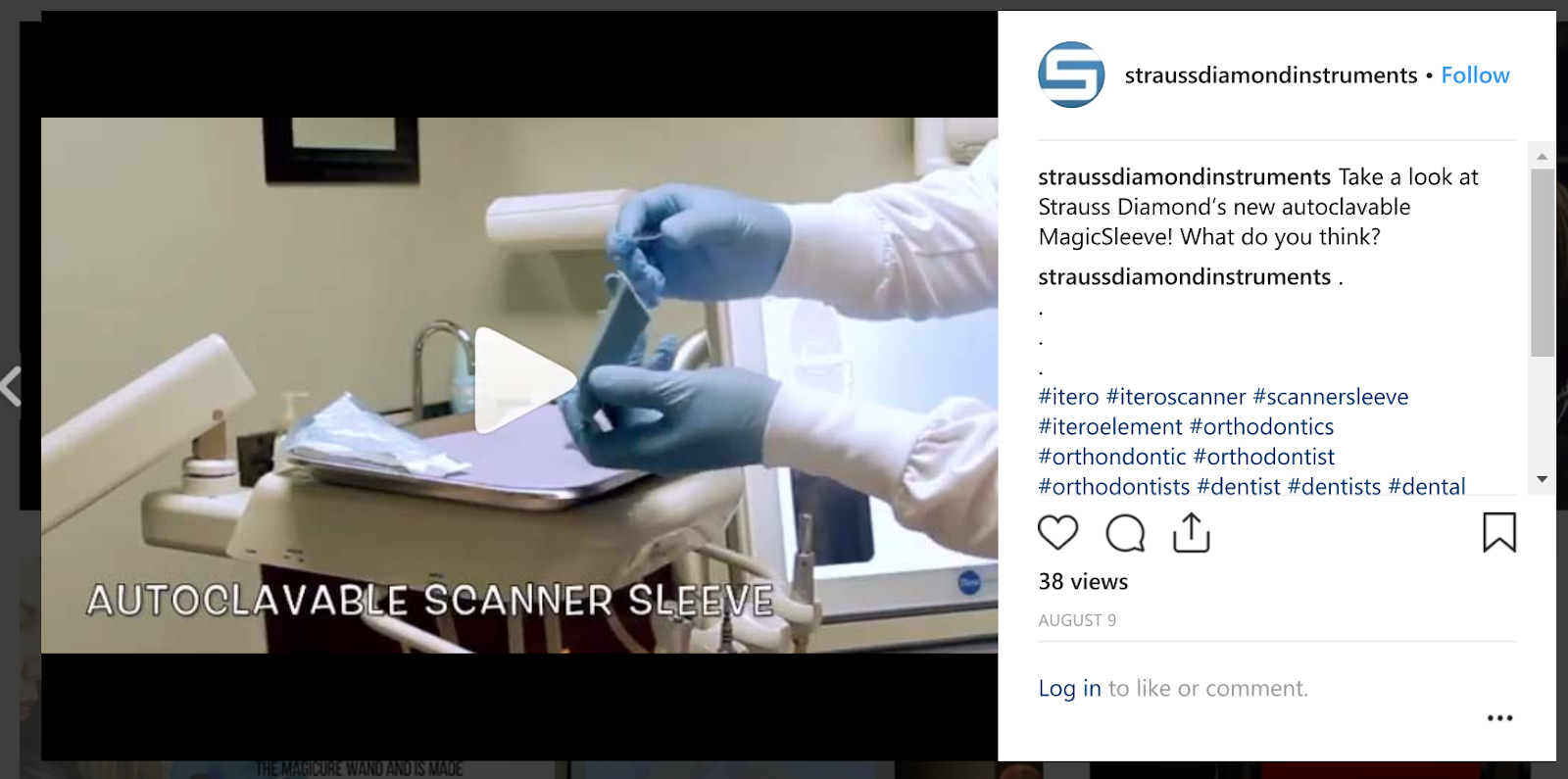
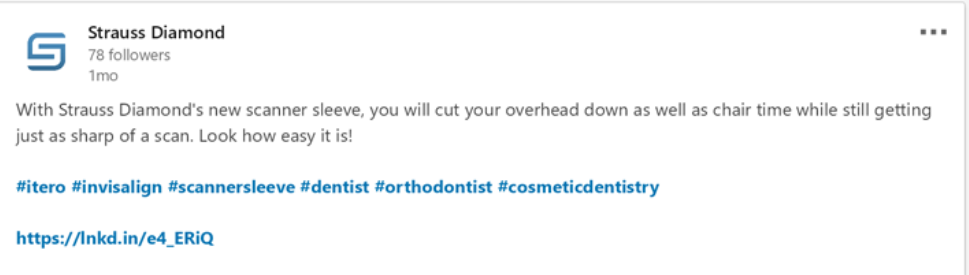
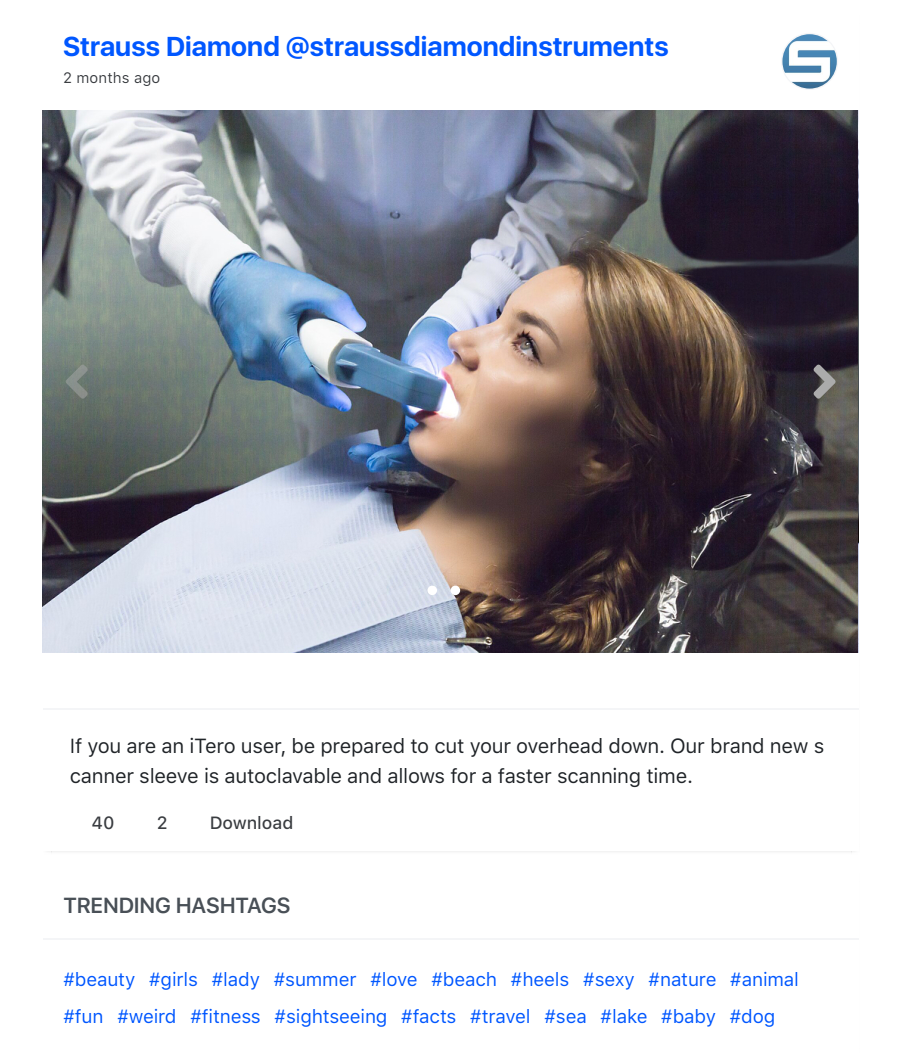
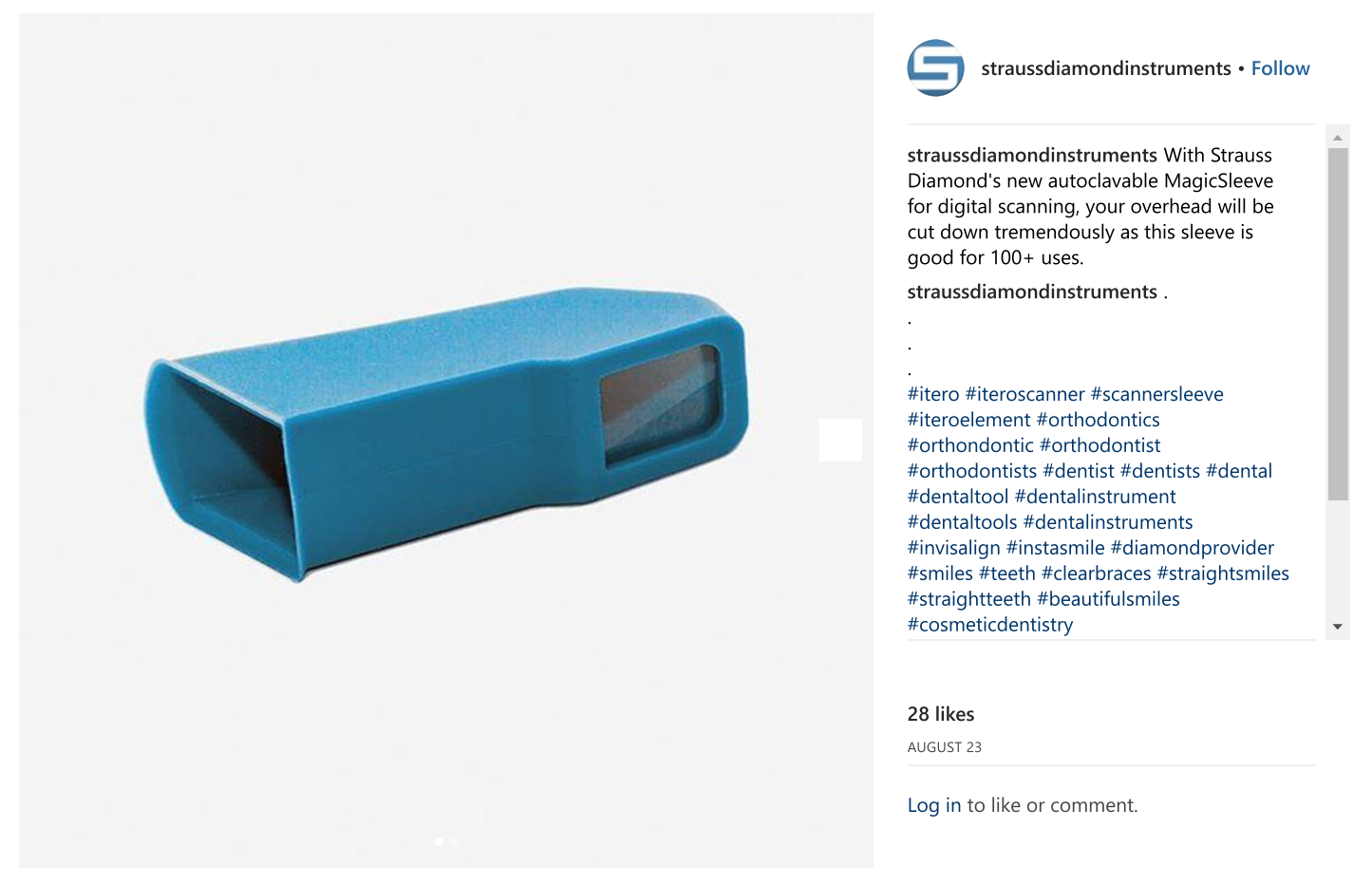
Three problems: (1) Hashtags containing Align’s marks.  For example, two pictures show the
MagicSleeve in use with a patient. The text says, “If you are a digital scanner
user, be prepared to cut your overhead down. Our brand new MagicSleeve is
autoclavable and allows for a faster scanning time. Shop now ->
https://straussdiamond.com/product/scanner-sleeve/.” The third hashtag says
“#invisalign,” and the fifth says “#itero.”

(2) One screenshot from a video says “Order Today.” To the
right is a picture of an Align iTero Element machine with a Strauss MagicSleeve
on the wand. A stylized image of a row of teeth is on the screen, and on the
upper left is an image of both rows of teeth, and on the bottom left is a
picture taken of someone’s mouth showing a couple of teeth. “[T]he machine
itself has the normal ‘iTero element’ logo in tiny letters on the front of it because
that’s how an iTero Element machine looks in real life.” Beneath the picture of
the machine is Strauss’s domain name. 
The problem is that the image of the iTero Element machine with the
stylized pictures on it “was actually created by Align, then copied by Strauss,
which superimposed an image of its MagicSleeve on top of the wand.”
 

screen shot with iTero image
iTero’s image
(3) False claims: Concededly false advertising of “25%
faster scanning time.” Allegedly false advertising that the MagicSleeve
produces scans that are just as sharp as the ones produced by using an iTero
Element sleeve.
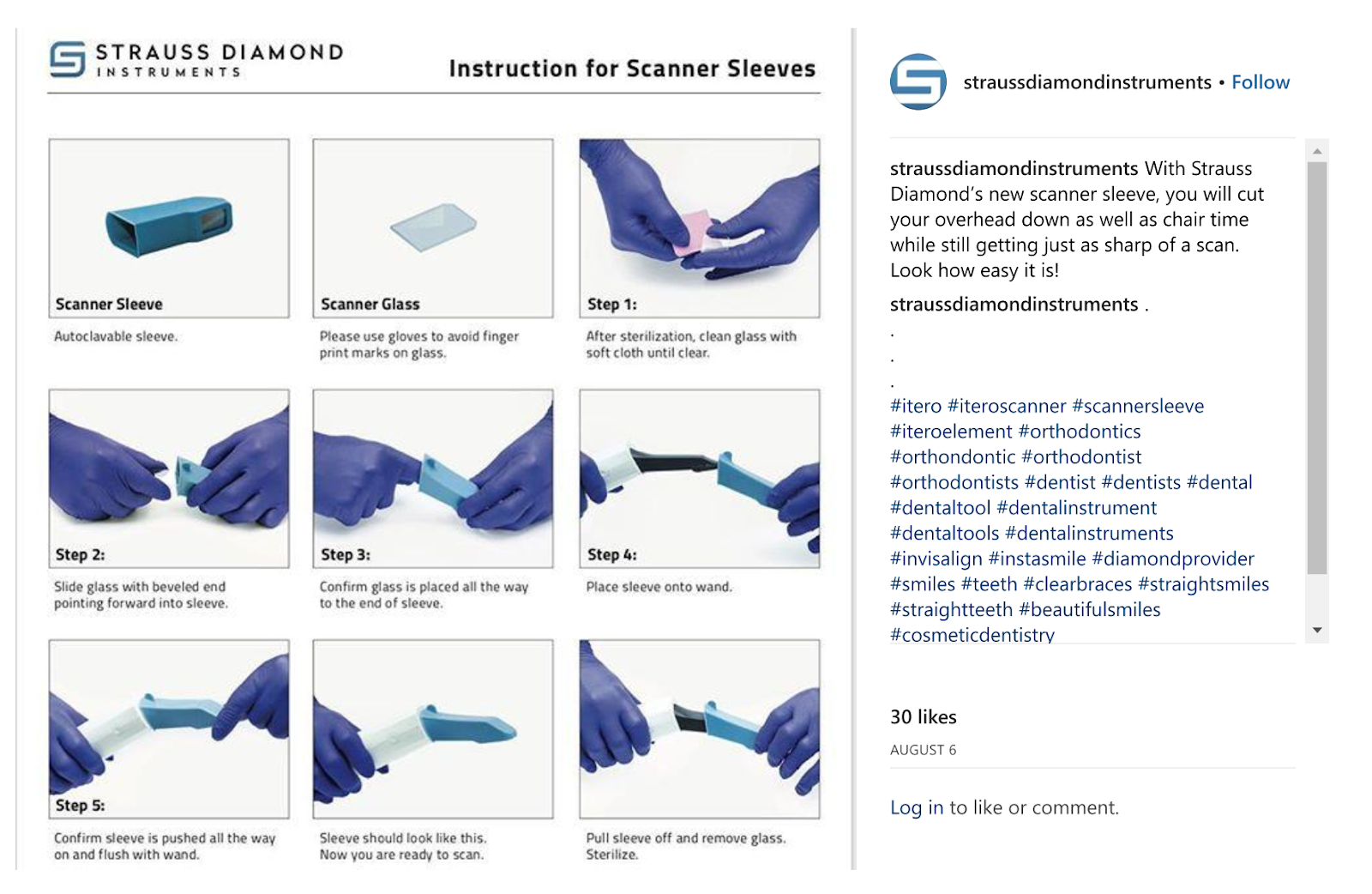
The court found that the hashtags wasn’t nominative fair use
because in some cases “Strauss used the marks to refer to its own product,” and
“in all cases, Strauss used more of the marks than is reasonably necessary to
identify the product.”  The court
understood the hashtags to be references to Strauss’s own product, which doesn’t
make a lot of sense to me as a linguistic matter; hashtags do generally
contribute to one’s understanding of the topic under discussion.  But the court didn’t like the context. For
example, the illustrated nine-step instructions for using the MagicSleeve had several
hashtags listed, including #itero, #iteroscanner, #iteroelement and #invisalign,
along with #scannersleeve and #diamondprovider, and then hashtags about
dentistry (e.g., #dentist, #cosmeticdentistry) and attractive teeth (e.g.,
#straightsmiles, #beautifulsmiles). “These hashtags are all collectively being
used to promote and describe the MagicSleeve. It is not credible to view the
hashtags containing Align’s marks as referring to Align’s products (the
foundational assumption of nominative fair use) and the other hashtags as
referring to the MagicSleeve. They are all together references to the
MagicSleeve.”  Citation: Public Impact,
LLC v. Boston Consulting Group, Inc., 169 F. Supp. 3d 278 (D. Mass 2016) (use
of competitor’s mark in social media hashtag “likely” to confuse “even a
sophisticated consumer”).

What a mess.  Yes,
they’re references to something that can be done with the MagicSleeve—it can be
used with an iTero—but that doesn’t make them uses of the marks as marks for
Strauss, any more than the reference to “dentistry” is a trademark use of the
word dentistry.
Regardless, this was more use than necessary. The pictures
already show that the MagicSleeve is meant to be used on the wand of an iTero
scanner. “The hashtags themselves just indicate a vague association between the
term in the hashtag and the MagicSleeve. None of the hashtags are reasonably
necessary to identify Strauss’s product.” 
[Again, that’s not the test in the 9th Circuit, which is
whether you need to use the mark to identify the trademark owner/product once
you’ve decided to talk about it.]  Then,
bizarrely in context, the court says: “In fact, the hashtags do not perform an
identification function. For example, #straightsmiles and #beautifulsmiles are
not meant to identify the MagicSleeve but to imply that this product is
associated with having a beautiful or straight smile. Likewise, #dentist and
#cosmeticdentistry are too vague to serve as a useful identifier; rather, they
indicate that the MagicSleeve is associated with dentistry.”  Which seems true, but exactly why this isn’t
trademark use and why the court’s first reason was wrong.  But then:
In a similar fashion, the hashtags
with Align’s marks indicate an association with Align’s iTero and Invisalign
products. But they don’t identify the MagicSleeve – you can’t read the hashtags
and figure out that this product is the sleeve that goes on the wand of an
iTero scanner. All the reader can glean from the hashtags is an implied association.
OK.  If you replace “association”
with “subject matter,” this becomes somewhat more coherent, but I don’t
understand why the court ignores the rest of the post, which would explain why
and how the hashtags are being used.  This
reasoning does highlight just how often nominative fair use is really just a
quick and dirty confusion inquiry, with the court substituting its own judgment
for evidence about reasonable consumers.
What the court really wants is an unfair competition argument,
but it doesn’t really have much in the way of principles to get it.  The court described one image: a woman in a
dental chair who is having her mouth scanned by someone using an iTero scanner
with a MagicSleeve on the wand. “The textual sentences that use Align’s mark (‘If
you are an iTero user, be prepared to cut your overhead down. Our brand new
scanner sleeve is autoclavable and allows for faster scanning time.’) are a
classic case of nominative fair use.”  And
the hashtags #itero, #iteroscanner, #scannersleeve, #iteroelement and #orthodontics
were “less of a laundry list,” so that could in theory be a set of references
to Align’s products, references to Strauss’s, and reference to the overall product
category.

But it was still more than reasonably necessary to identify Strauss’s
product, because the hypothetical version of the ad without the hashtags was
just as good at identifying Strauss’s product [still the wrong test].  The identification came from the picture and
the textual sentences; “the use of the marks in the hashtags is never
reasonably necessary to identify the MagicSleeve. You would have to imagine a
pretty terrible ad for the hashtags to do any identifying – maybe just a picture
of the MagicSleeve with no illustration or text explaining what it is for,
leaving the viewer to wonder if he should put it on his finger to do the
dishes, wear it for protection when sewing, or what other use is contemplated.”
This at least clearly indicates the problem the court is
having: “too much” is not, as it more often has been in NFU cases, about using
the text mark and not the font/symbols in a discussion. Instead, as in the
early Playboy v. Welles case, the
problem is that Strauss is just repeating “itero” too often.  But hashtags aren’t wallpaper backgrounds:
they have a purpose both for the reader of the individual post (this is what
the post is about, if you had any doubts) and for searching.
But the court has thought of that!  Apparently NFU does not require that a competitor
is allowed to participate in hashtag searches. 
Although this is indeed a function of the hashtag, the court disagreed
that it was allowed by NFU; previous cases about metatags were not relevant
because metatags just work behind the scenes, whereas hashtags are visible to
consumers.  [So “necessary” here means “necessary
to physically speak the advertising message,” not “necessary to reach consumers.”] Anyway, many of these hashtags “are simply implausible as search
terms. Someone looking for information about how to get straight teeth might
search for ‘adult braces’ or ‘straight teeth,’ but it is unlikely they would
search for #beautifulsmiles or even #straightsmiles.”  Might they look for Invisalign?  If so, uses of those non-trademark terms seem not
particularly relevant.  Also, searches
aren’t the only thing hashtags are used for—trending/locally trending topics can
also be important.  Nonetheless, the
court concluded, the inclusion of #beautifulsmiles and “other implausible
search terms … confirms that the intended audience of the hashtags is, at least
in part, the viewer of the ad, implying association between the MagicSleeve and
the terms in the hashtags.”  [Again, the
court is equivocating about “association,” using the “talking about” meaning
with respect to the non-Align terms and “trademark meaning” for the Align
terms.]
Second, the iTero image was different. This was a reference to Align’s product. “This
is like a Volkswagen repair shop putting a picture of a Volkswagen (including
the VW logo on the car) in an ad to show what it repairs.”  The first and second prongs of nominative
fair use were satisfied—“the MagicSleeve is not readily identifiable without
some reference to an iTero scanner” [still the wrong test] and there’s no more
use than necessary because the only reason why the word “iTero” appears in the
ad is that Align stamped the word on the front of its iTero scanners. However, part
three is “the user must do nothing that would, in conjunction with the mark,
suggest sponsorship or endorsement by the trademark holder.” And a copy-paste
from Align’s website (with the MagicSleeve added on) was “something else”: “Align
created pictures for the screen of the scanner, so the overall image is distinctive.”  The use of the same distinctive image
suggests that the MagicSleeve is endorsed or authorized by Align. 
Note: That does not follow in the slightest.  The copyright analysis could well be
different (though that the actual teeth in the Strauss picture seem to be different, at least based on the quick searches I did), but the fact that Align made the picture doesn’t make the picture
distinctive as trade dress—indeed, as an image of the product design, it is
presumptively unprotected.  Without a
showing that the audience would recognize the picture as the same picture Align
uses, this reasoning is nonsense, but it’s at least nonsense that perhaps is
easier to avoid for future marketers. The court nearly says as much: Strauss
can “likely” put a MagicSleeve on an iTero scanner, take a picture of that, and
use that image in marketing.  
But the court has actually created a Dastar problem in its reasoning: “Align’s marketing people created
that image, and any reasonable observer would understand it was a picture created
for an ad. When it starts showing up in Strauss’s ads for the MagicSleeve, reasonable
people would infer sponsorship or endorsement by Align.”  This is just passing off without secondary
meaning, which doesn’t seem actionable after Dastar (consider Dastar’s
discussion of Wal-Mart).
With NFU out of the way, the court found likely confusion
using the ordinary multifactor test. 
Note how the reasoning on intent contradicts the court’s analysis of the
necessity of using a #trademark hashtag: When asked why Strauss “include[s] the
iTero, iTero Element, and Invisalign hashtags in its Instagram post,” Strauss’s
Vice President Lital Lizotte testified: “Most likely because it has a high
following.” This showed an intent to trade on Align’s goodwill—except that’s
also an intent to reach customers interested in Align products.
There was “some anecdotal evidence” of actual confusion. According
to Align, one dentist told an Align trainer that he “did not know that Align
did not approve of the use of Strauss Diamond’s MagicSleeves with Align’s iTero
system” and, in a second instance, that it was the trainer’s “understanding
that this dentist did not know that the MagicSleeves are not an Align sponsored
product.” [This is pretty weak tea even for association evidence: it’s a double negative rather than a claim that the dentists affirmatively thought there was an affiliation.] Another clinical trainer for Align declared her understanding that a
dentist who called Align to complain about the performance of an iTero Element
being used with a Strauss MagicSleeve believed the MagicSleeves “to be
Align-supported products.” Still, anecdotal evidence is entitled to little
weight; this factor was neutral.
Perhaps surprisingly, the cost of the products here was held
to be low/supporting a finding of confusion. 
The MagicSleeve is $360 for one pack (15 sleeves), or $24 a unit, a low
enough cost that “consumers are not expected to be taking great care in
analyzing the products’ packaging.”  Still, it’s for a dental practice, where the
customers should be sophisticated, making this factor neutral overall.
Result: likely confusion.  Here’s one question going forward: can another competitor use the same hashtags with text that makes clear that it’s an independent product not affiliated with Align?  What if it adds #independent #notaffiliatedwithalign?  Would that change the NFU analysis or the multifactor confusion analysis?
Counterfeiting: Not likely to succeed (though it is notable
that Align thought it worth claiming). First, as far as the court could tell,
none of Align’s registrations covered scanner sleeves. Second, “counterfeiting
is the ‘hard core’ or ‘first degree’ of trademark infringement that seeks to
trick the consumer into believing he or she is getting the genuine article,
rather than a ‘colorable imitation.’ ” There were substantial differences between
the parties’ sleeves in shape, color, and design.
False advertising: Strauss conceded that its 25% faster
claim was literally false.  As to “just
as sharp of a scan,” Align “submitted persuasive evidence that the MagicSleeve
will often produce a lower quality scan. The design of the MagicSleeve means
that the window is more likely to be out of place …. The complicated cleaning
instructions are likely to result in blurry screens. Align has submitted a
large number of customer complaints about the quality of the scans taken with
the MagicSleeve.” The court was persuaded that the MagicSleeve “often” results
in blurrier scans, but it didn’t know exactly how often.  It hadn’t been shown that “just as sharp of a
scan” was “always or even usually false.”
Irreparable harm: since dental professionals and patients
are likely to believe that the MagicSleeve is endorsed or approved by Align, “Strauss’s
continued use of Align’s marks will result in Align losing control over its
reputation and goodwill as a result.” 
This is irreparable harm. And Align showed that the MagicSleeve was
lower quality, which risked Align’s reputation if it was wrongly blamed for
that.
Perplexingly, the court found a higher risk of irreparable
harm because iTero is fanciful, and Invisalign is strong and famous, “so
Strauss’s use of them almost automatically tells a customer they refer to a
brand.” [Citing Qualitex, which is
about distinctiveness, not harm.] 
And 25% faster was a completely unjustified swipe at Align,
which would therefore suffer irreparable harm. 
[The court is standard in using intent to infer irreparability
(but even if we presume that intent to produce damage results in damage, why
would that be irreparable damage in
particular?); the two concepts lack much logical connection but certainly fit
an equitable conception of injunctive relief.]
The court declined Align’s request to enjoin sale of the
MagicSleeve, which was distinguishable from the particular ads at issue.  But a more limited injunction against the particular
conduct at issue wasn’t moot.

from Blogger http://bit.ly/2ZIHXCw

Posted in Uncategorized | Tagged | Leave a comment